SOFT ROT IN DIFFERENT CROPS
CAUSED BY BACTERIAL PATHOGENS
SUBMITTED TO:
DR. KAMAL KHILARI
PROFESSOR
PLANT PATHOLOGY
SUBMITTED BY:
KSHITIJ KUMAR
MSc(Ag) Plant Pathology
PG/A-4866/19
What is bacterial soft rot?
• Bacterial soft rots damage succulent plant parts such as
fruits, tubers, stems and bulbs of plants in nearly every
plant family. Soft rot bacteria degrade pectate molecules
that bind plant cells together, causing plant structure to
eventually fall apart.
• Soft rots commonly affect vegetables such as potato,
carrot, tomato, cucurbits (e.g., cucumbers, melons,
squash, pumpkins), and cruciferous crops (e.g., cabbage,
cauliflower).
What does bacterial soft rot look like?
• Initially, bacterial soft rots cause water-soaked spots.
These spots enlarge over time and become sunken and
soft. Interior tissues beneath the spots become mushy
and discolored, with the discoloration ranging anywhere
from cream to black. Seepage from affected areas is
common.
• Soft rots are known for a strong, disagreeable odor that
accompanies the breakdown of plant tissue.
What does bacterial soft rot look like?
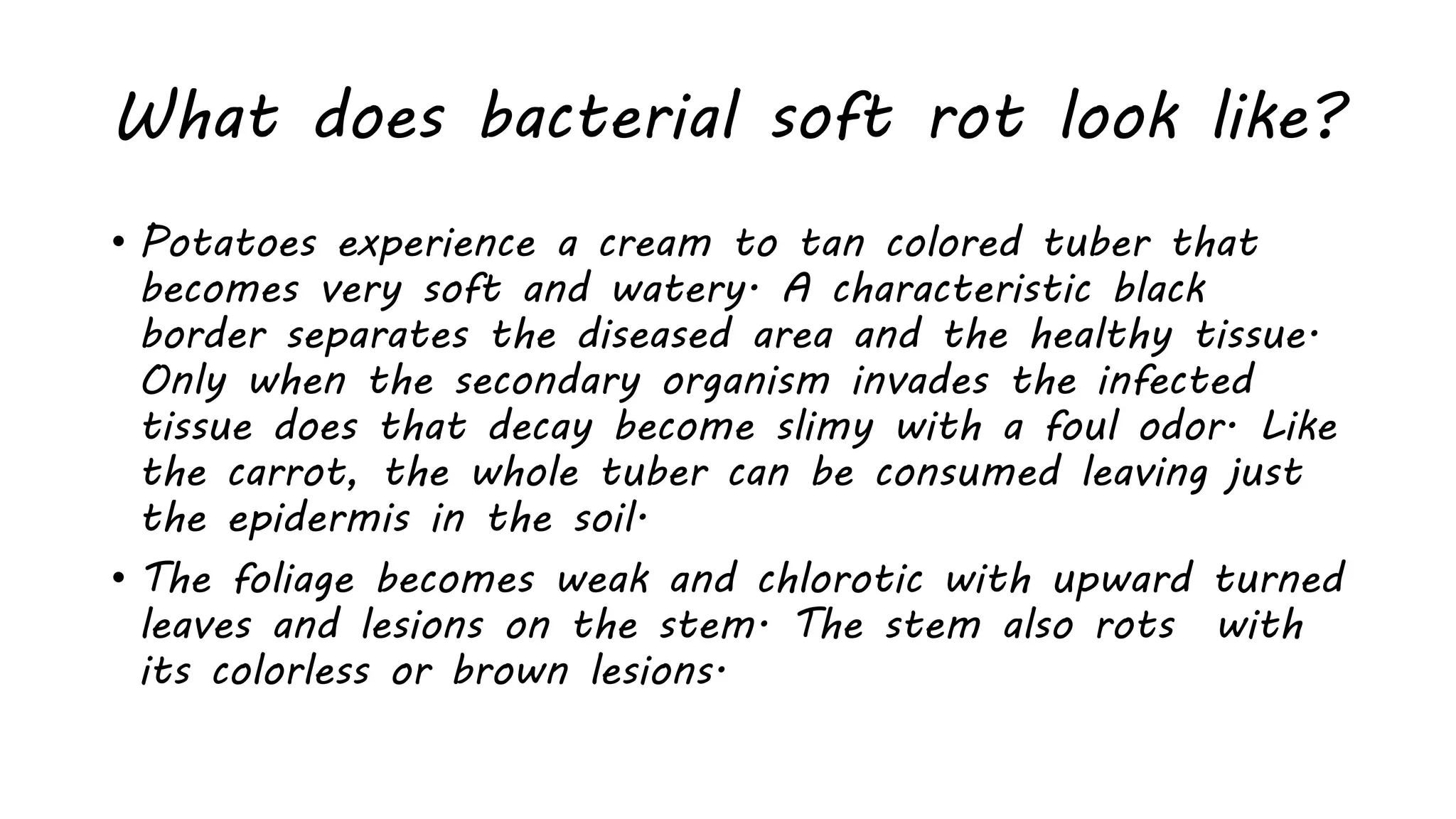
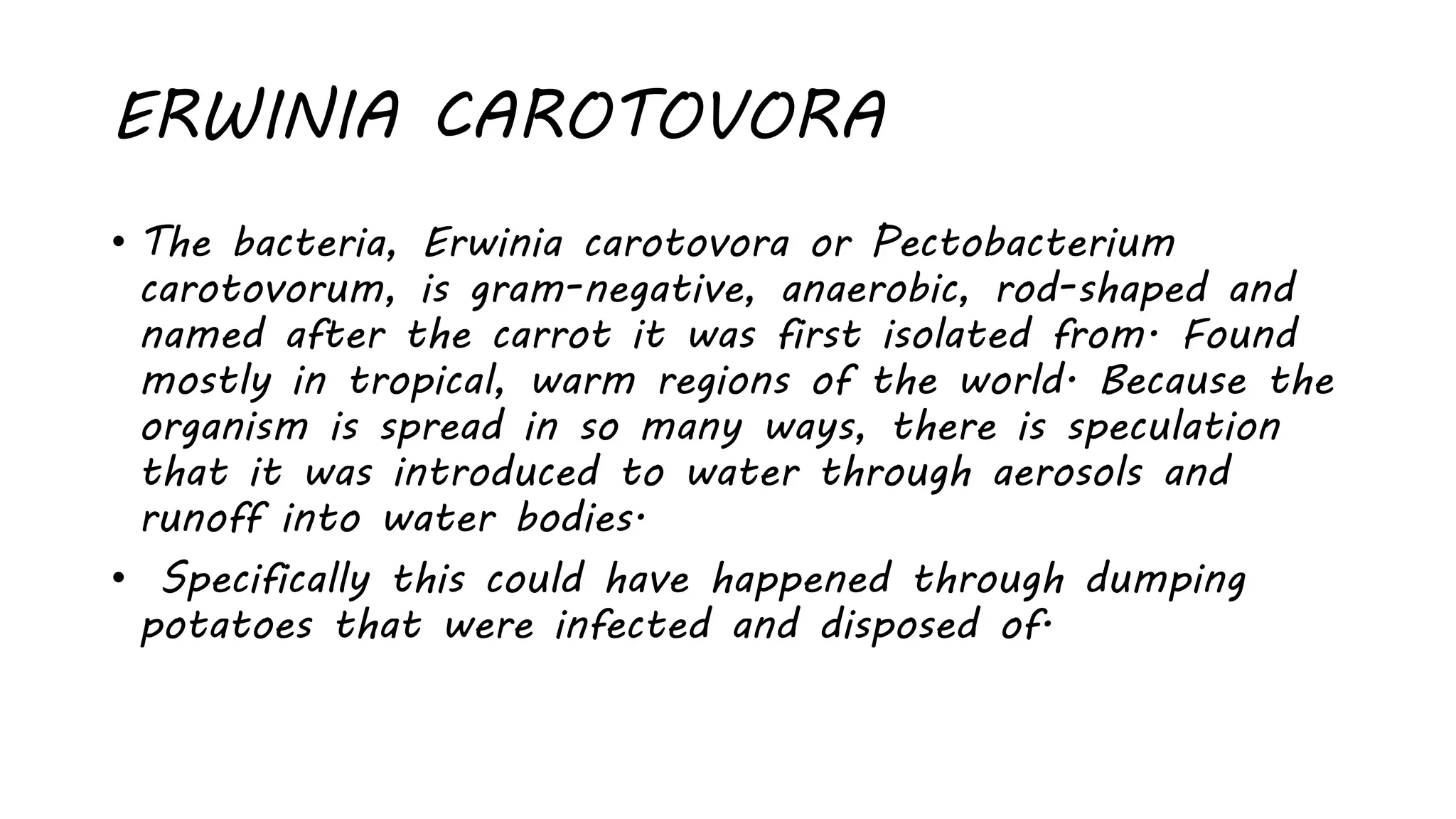
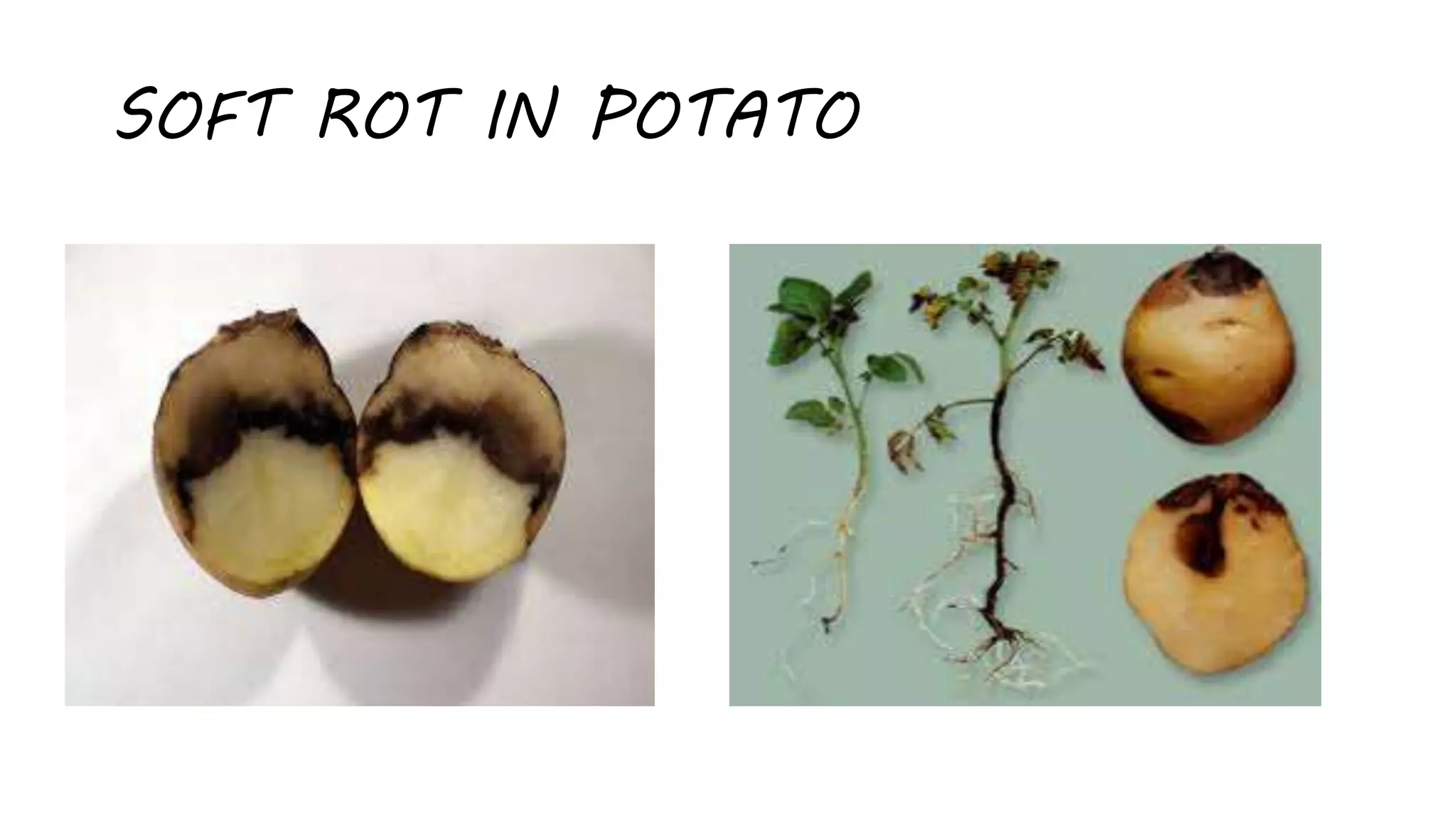
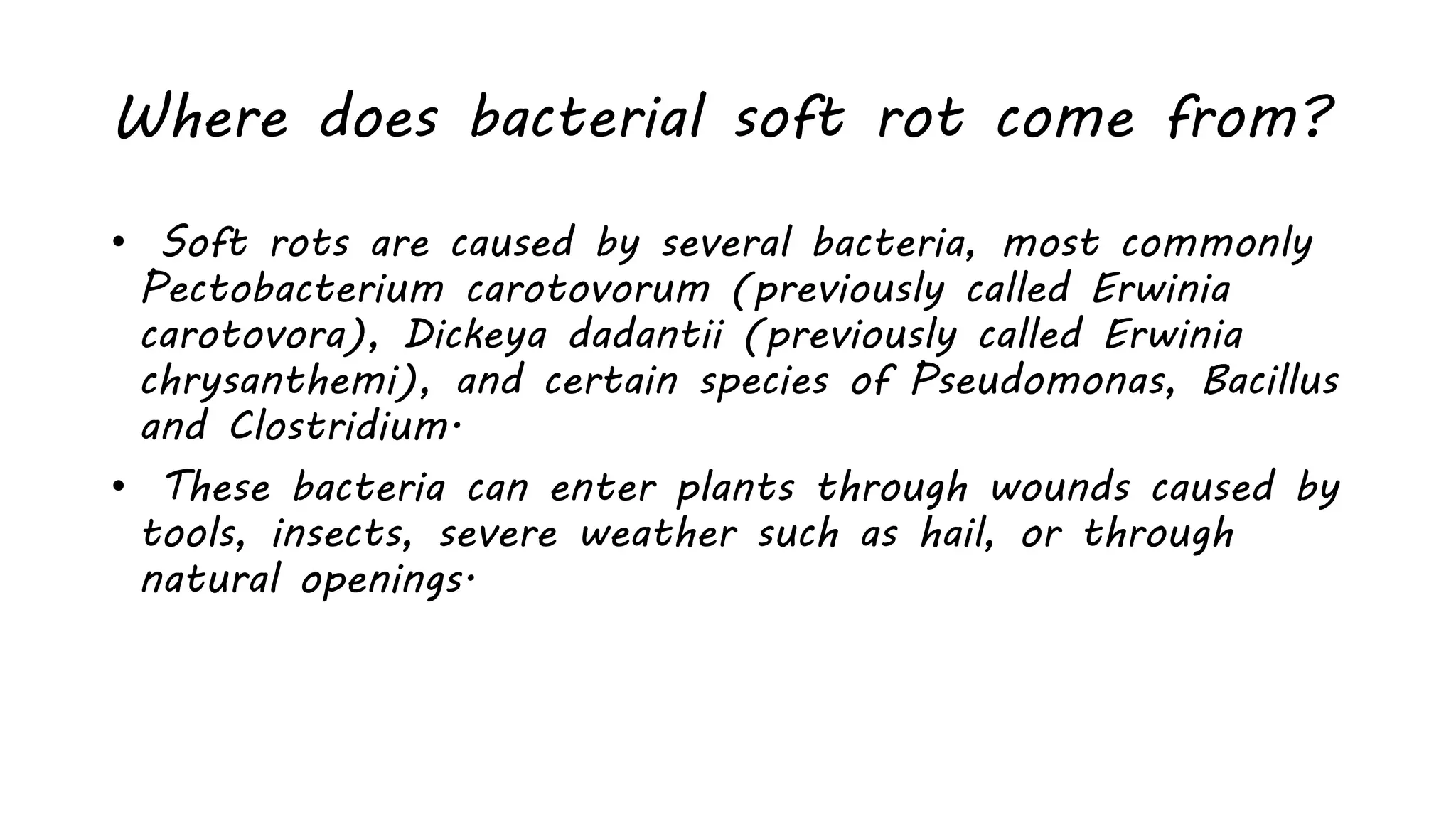
• Potatoes experience a cream to tan colored tuber that
becomes very soft and watery. A characteristic black
border separates the diseased area and the healthy tissue.
Only when the secondary organism invades the infected
tissue does that decay become slimy with a foul odor. Like
the carrot, the whole tuber can be consumed leaving just
the epidermis in the soil.
• The foliage becomes weak and chlorotic with upward turned
leaves and lesions on the stem. The stem also rots with
its colorless or brown lesions.
ERWINIA CAROTOVORA
• The bacteria, Erwinia carotovora or Pectobacterium
carotovorum, is gram-negative, anaerobic, rod-shaped and
named after the carrot it was first isolated from. Found
mostly in tropical, warm regions of the world. Because the
organism is spread in so many ways, there is speculation
that it was introduced to water through aerosols and
runoff into water bodies.
• Specifically this could have happened through dumping
potatoes that were infected and disposed of.
SOFT ROT IN POTATO
Where does bacterial soft rot come from?
• Soft rots are caused by several bacteria, most commonly
Pectobacterium carotovorum (previously called Erwinia
carotovora), Dickeya dadantii (previously called Erwinia
chrysanthemi), and certain species of Pseudomonas, Bacillus
and Clostridium.
• These bacteria can enter plants through wounds caused by
tools, insects, severe weather such as hail, or through
natural openings.
How do I save a plant with bacterial soft
rot?
• Once soft rot bacteria have infected plant tissue, there
are no treatments.
• Immediately remove and discard infected plants or plant
parts.
• DO NOT bury or compost this material.
How do I avoid problems with bacterial
soft rot in the future?
• Avoiding wet conditions is key for managing soft rot.
Plant vegetables in well- drained soils and control watering
times and amounts, making sure plants are watered
adequately (but not excessively) and uniformly. DO NOT
crowd plants; wider spacing will promote more rapid drying
of plants and soil.
• Make sure that soil fertility (particularly soil calcium) is
optimal for the vegetables that you are growing based on
a soil nutrient test. Add calcium (e.g., bone meal) at
planting as needed.
How do I avoid problems with bacterial
soft rot in the future?
• Use soft rot-resistant vegetables in rotation with
susceptible vegetables. Corn, snap beans and beets are
vegetables that are not considered susceptible to soft rot.
• When growing broccoli, avoid varieties with flat/concave
heads that trap moisture and promote soft rot. Instead
select varieties with domed heads where water readily
drains away.
• Decontaminate garden tools before and after use by
treating them for at least 30 seconds with 10% bleach or
preferably (because of its less corrosive properties), 70%
alcohol. Rubbing alcohol and many spray disinfectants
typically contain approximately 70% alcohol.
bacterial soft rot

bacterial soft rot

  • 1.
    SOFT ROT INDIFFERENT CROPS CAUSED BY BACTERIAL PATHOGENS SUBMITTED TO: DR. KAMAL KHILARI PROFESSOR PLANT PATHOLOGY SUBMITTED BY: KSHITIJ KUMAR MSc(Ag) Plant Pathology PG/A-4866/19
  • 2.
    What is bacterialsoft rot? • Bacterial soft rots damage succulent plant parts such as fruits, tubers, stems and bulbs of plants in nearly every plant family. Soft rot bacteria degrade pectate molecules that bind plant cells together, causing plant structure to eventually fall apart. • Soft rots commonly affect vegetables such as potato, carrot, tomato, cucurbits (e.g., cucumbers, melons, squash, pumpkins), and cruciferous crops (e.g., cabbage, cauliflower).
  • 3.
    What does bacterialsoft rot look like? • Initially, bacterial soft rots cause water-soaked spots. These spots enlarge over time and become sunken and soft. Interior tissues beneath the spots become mushy and discolored, with the discoloration ranging anywhere from cream to black. Seepage from affected areas is common. • Soft rots are known for a strong, disagreeable odor that accompanies the breakdown of plant tissue.
  • 4.
    What does bacterialsoft rot look like? • Potatoes experience a cream to tan colored tuber that becomes very soft and watery. A characteristic black border separates the diseased area and the healthy tissue. Only when the secondary organism invades the infected tissue does that decay become slimy with a foul odor. Like the carrot, the whole tuber can be consumed leaving just the epidermis in the soil. • The foliage becomes weak and chlorotic with upward turned leaves and lesions on the stem. The stem also rots with its colorless or brown lesions.
  • 7.
    ERWINIA CAROTOVORA • Thebacteria, Erwinia carotovora or Pectobacterium carotovorum, is gram-negative, anaerobic, rod-shaped and named after the carrot it was first isolated from. Found mostly in tropical, warm regions of the world. Because the organism is spread in so many ways, there is speculation that it was introduced to water through aerosols and runoff into water bodies. • Specifically this could have happened through dumping potatoes that were infected and disposed of.
  • 8.
  • 9.
    Where does bacterialsoft rot come from? • Soft rots are caused by several bacteria, most commonly Pectobacterium carotovorum (previously called Erwinia carotovora), Dickeya dadantii (previously called Erwinia chrysanthemi), and certain species of Pseudomonas, Bacillus and Clostridium. • These bacteria can enter plants through wounds caused by tools, insects, severe weather such as hail, or through natural openings.
  • 10.
    How do Isave a plant with bacterial soft rot? • Once soft rot bacteria have infected plant tissue, there are no treatments. • Immediately remove and discard infected plants or plant parts. • DO NOT bury or compost this material.
  • 11.
    How do Iavoid problems with bacterial soft rot in the future? • Avoiding wet conditions is key for managing soft rot. Plant vegetables in well- drained soils and control watering times and amounts, making sure plants are watered adequately (but not excessively) and uniformly. DO NOT crowd plants; wider spacing will promote more rapid drying of plants and soil. • Make sure that soil fertility (particularly soil calcium) is optimal for the vegetables that you are growing based on a soil nutrient test. Add calcium (e.g., bone meal) at planting as needed.
  • 12.
    How do Iavoid problems with bacterial soft rot in the future? • Use soft rot-resistant vegetables in rotation with susceptible vegetables. Corn, snap beans and beets are vegetables that are not considered susceptible to soft rot. • When growing broccoli, avoid varieties with flat/concave heads that trap moisture and promote soft rot. Instead select varieties with domed heads where water readily drains away. • Decontaminate garden tools before and after use by treating them for at least 30 seconds with 10% bleach or preferably (because of its less corrosive properties), 70% alcohol. Rubbing alcohol and many spray disinfectants typically contain approximately 70% alcohol.