Los verbos regulares
   en el pretérito
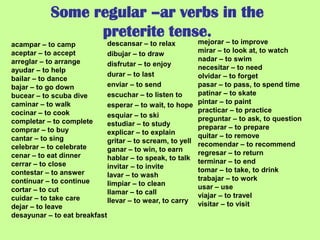
Some regular –ar verbs in the
                  preterite tense. – to improve
                                mejorar
acampar – to camp            descansar – to relax
aceptar – to accept          dibujar – to draw             mirar – to look at, to watch
arreglar – to arrange                                      nadar – to swim
                             disfrutar – to enjoy          necesitar – to need
ayudar – to help
                             durar – to last               olvidar – to forget
bailar – to dance
bajar – to go down           enviar – to send              pasar – to pass, to spend time
bucear – to scuba dive       escuchar – to listen to       patinar – to skate
caminar – to walk            esperar – to wait, to hope    pintar – to paint
cocinar – to cook                                          practicar – to practice
                             esquiar – to ski              preguntar – to ask, to question
completar – to complete      estudiar – to study
comprar – to buy                                           preparar – to prepare
                             explicar – to explain         quitar – to remove
cantar – to sing             gritar – to scream, to yell
celebrar – to celebrate                                    recomendar – to recommend
                             ganar – to win, to earn       regresar – to return
cenar – to eat dinner        hablar – to speak, to talk
cerrar – to close                                          terminar – to end
                             invitar – to invite           tomar – to take, to drink
contestar – to answer        lavar – to wash
continuar – to continue                                    trabajar – to work
                             limpiar – to clean            usar – use
cortar – to cut              llamar – to call
cuidar – to take care                                      viajar – to travel
                             llevar – to wear, to carry    visitar – to visit
dejar – to leave
desayunar – to eat breakfast
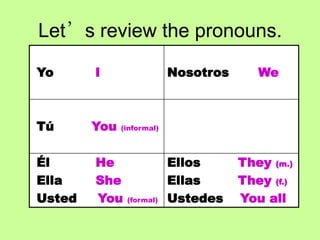
Let’s review the pronouns.

Yo      I                  Nosotros      We


Tú      You   (informal)


Él      He                 Ellos      They (m.)
Ella    She                Ellas      They (f.)
Usted   You    (formal)    Ustedes    You all
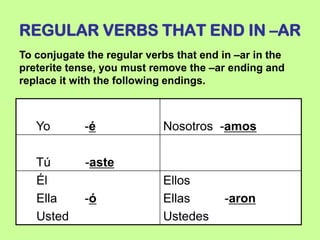
REGULAR VERBS THAT END IN –AR
To conjugate the regular verbs that end in –ar in the
preterite tense, you must remove the –ar ending and
replace it with the following endings.


   Yo        -é             Nosotros -amos

   Tú        -aste
   Él                       Ellos
   Ella      -ó             Ellas        -aron
   Usted                    Ustedes
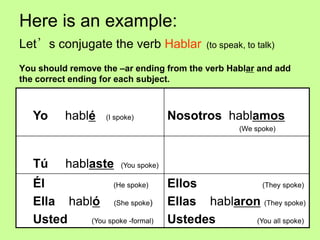
Here is an example:
Let’s conjugate the verb Hablar              (to speak, to talk)

You should remove the –ar ending from the verb Hablar and add
the correct ending for each subject.


   Yo     hablé    (I spoke)         Nosotros hablamos
                                                      (We spoke)


   Tú     hablaste     (You spoke)

   Él             (He spoke)         Ellos           (They spoke)

   Ella habló (She spoke)            Ellas hablaron (They spoke)
   Usted    (You spoke -formal)      Ustedes       (You all spoke)
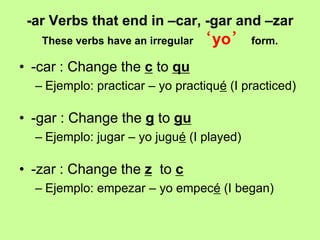
-ar Verbs that end in –car, -gar and –zar
   These verbs have an irregular ‘yo’ form.

• -car : Change the c to qu
  – Ejemplo: practicar – yo practiqué (I practiced)

• -gar : Change the g to gu
  – Ejemplo: jugar – yo jugué (I played)

• -zar : Change the z to c
  – Ejemplo: empezar – yo empecé (I began)
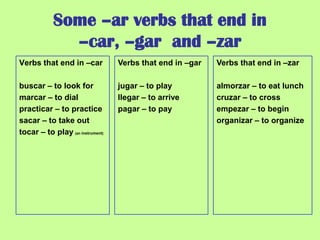
Some –ar verbs that end in
              –car, –gar and –zar
Verbs that end in –car            Verbs that end in –gar   Verbs that end in –zar

buscar – to look for              jugar – to play          almorzar – to eat lunch
marcar – to dial                  llegar – to arrive       cruzar – to cross
practicar – to practice           pagar – to pay           empezar – to begin
sacar – to take out                                        organizar – to organize
tocar – to play (an instrument)
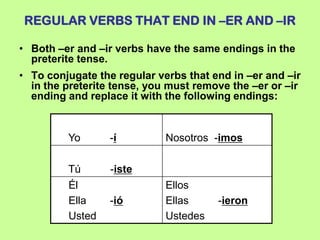
REGULAR VERBS THAT END IN –ER AND –IR

• Both –er and –ir verbs have the same endings in the
  preterite tense.
• To conjugate the regular verbs that end in –er and –ir
  in the preterite tense, you must remove the –er or –ir
  ending and replace it with the following endings:


         Yo       -í         Nosotros -imos

         Tú       -iste
         Él                  Ellos
         Ella     -ió        Ellas     -ieron
         Usted               Ustedes
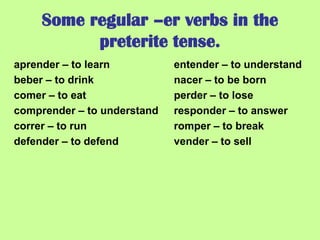
Some regular –er verbs in the
           preterite tense.
aprender – to learn          entender – to understand
beber – to drink             nacer – to be born
comer – to eat               perder – to lose
comprender – to understand   responder – to answer
correr – to run              romper – to break
defender – to defend         vender – to sell
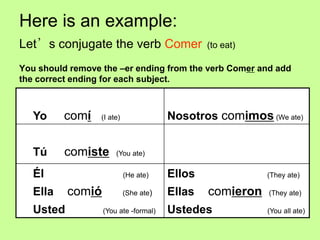
Here is an example:
Let’s conjugate the verb Comer                  (to eat)

You should remove the –er ending from the verb Comer and add
the correct ending for each subject.


   Yo     comí    (I ate)               Nosotros comimos (We ate)


   Tú     comiste      (You ate)


   Él                       (He ate)    Ellos              (They ate)

   Ella    comió            (She ate)   Ellas   comieron   (They ate)

   Usted           (You ate -formal)    Ustedes            (You all ate)
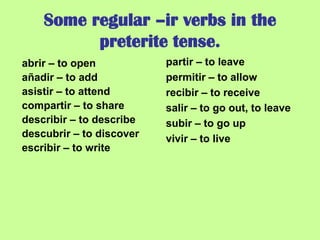
Some regular –ir verbs in the
          preterite tense.
abrir – to open           partir – to leave
añadir – to add           permitir – to allow
asistir – to attend       recibir – to receive
compartir – to share      salir – to go out, to leave
describir – to describe   subir – to go up
descubrir – to discover   vivir – to live
escribir – to write
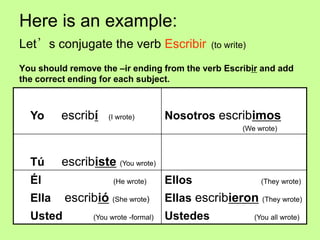
Here is an example:
Let’s conjugate the verb Escribir                (to write)

You should remove the –ir ending from the verb Escribir and add
the correct ending for each subject.


  Yo     escribí     (I wrote)         Nosotros escribimos
                                                          (We wrote)


  Tú     escribiste (You wrote)
  Él                   (He wrote)      Ellos                    (They wrote)

  Ella    escribió (She wrote)         Ellas escribieron (They wrote)
  Usted          (You wrote -formal)   Ustedes                (You all wrote)
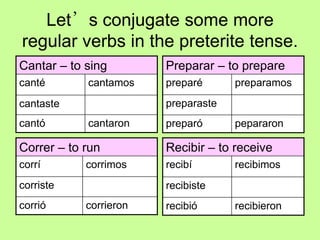
Let’s conjugate some more
regular verbs in the preterite tense.
Cantar – to sing        Preparar – to prepare
canté       cantamos    preparé      preparamos
cantaste                preparaste
cantó       cantaron    preparó      pepararon

Correr – to run         Recibir – to receive
corrí       corrimos    recibí       recibimos
corriste                recibiste
corrió      corrieron   recibió      recibieron
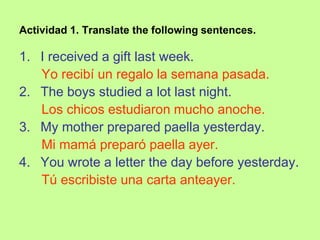
Actividad 1. Translate the following sentences.

1. I received a gift last week.
   Yo recibí un regalo la semana pasada.
2. The boys studied a lot last night.
   Los chicos estudiaron mucho anoche.
3. My mother prepared paella yesterday.
   Mi mamá preparó paella ayer.
4. You wrote a letter the day before yesterday.
   Tú escribiste una carta anteayer.

Preterite verbs

  • 1.
    Los verbos regulares en el pretérito
  • 2.
    Some regular –arverbs in the preterite tense. – to improve mejorar acampar – to camp descansar – to relax aceptar – to accept dibujar – to draw mirar – to look at, to watch arreglar – to arrange nadar – to swim disfrutar – to enjoy necesitar – to need ayudar – to help durar – to last olvidar – to forget bailar – to dance bajar – to go down enviar – to send pasar – to pass, to spend time bucear – to scuba dive escuchar – to listen to patinar – to skate caminar – to walk esperar – to wait, to hope pintar – to paint cocinar – to cook practicar – to practice esquiar – to ski preguntar – to ask, to question completar – to complete estudiar – to study comprar – to buy preparar – to prepare explicar – to explain quitar – to remove cantar – to sing gritar – to scream, to yell celebrar – to celebrate recomendar – to recommend ganar – to win, to earn regresar – to return cenar – to eat dinner hablar – to speak, to talk cerrar – to close terminar – to end invitar – to invite tomar – to take, to drink contestar – to answer lavar – to wash continuar – to continue trabajar – to work limpiar – to clean usar – use cortar – to cut llamar – to call cuidar – to take care viajar – to travel llevar – to wear, to carry visitar – to visit dejar – to leave desayunar – to eat breakfast
  • 3.
    Let’s review thepronouns. Yo I Nosotros We Tú You (informal) Él He Ellos They (m.) Ella She Ellas They (f.) Usted You (formal) Ustedes You all
  • 4.
    REGULAR VERBS THATEND IN –AR To conjugate the regular verbs that end in –ar in the preterite tense, you must remove the –ar ending and replace it with the following endings. Yo -é Nosotros -amos Tú -aste Él Ellos Ella -ó Ellas -aron Usted Ustedes
  • 5.
    Here is anexample: Let’s conjugate the verb Hablar (to speak, to talk) You should remove the –ar ending from the verb Hablar and add the correct ending for each subject. Yo hablé (I spoke) Nosotros hablamos (We spoke) Tú hablaste (You spoke) Él (He spoke) Ellos (They spoke) Ella habló (She spoke) Ellas hablaron (They spoke) Usted (You spoke -formal) Ustedes (You all spoke)
  • 6.
    -ar Verbs thatend in –car, -gar and –zar These verbs have an irregular ‘yo’ form. • -car : Change the c to qu – Ejemplo: practicar – yo practiqué (I practiced) • -gar : Change the g to gu – Ejemplo: jugar – yo jugué (I played) • -zar : Change the z to c – Ejemplo: empezar – yo empecé (I began)
  • 7.
    Some –ar verbsthat end in –car, –gar and –zar Verbs that end in –car Verbs that end in –gar Verbs that end in –zar buscar – to look for jugar – to play almorzar – to eat lunch marcar – to dial llegar – to arrive cruzar – to cross practicar – to practice pagar – to pay empezar – to begin sacar – to take out organizar – to organize tocar – to play (an instrument)
  • 8.
    REGULAR VERBS THATEND IN –ER AND –IR • Both –er and –ir verbs have the same endings in the preterite tense. • To conjugate the regular verbs that end in –er and –ir in the preterite tense, you must remove the –er or –ir ending and replace it with the following endings: Yo -í Nosotros -imos Tú -iste Él Ellos Ella -ió Ellas -ieron Usted Ustedes
  • 9.
    Some regular –erverbs in the preterite tense. aprender – to learn entender – to understand beber – to drink nacer – to be born comer – to eat perder – to lose comprender – to understand responder – to answer correr – to run romper – to break defender – to defend vender – to sell
  • 10.
    Here is anexample: Let’s conjugate the verb Comer (to eat) You should remove the –er ending from the verb Comer and add the correct ending for each subject. Yo comí (I ate) Nosotros comimos (We ate) Tú comiste (You ate) Él (He ate) Ellos (They ate) Ella comió (She ate) Ellas comieron (They ate) Usted (You ate -formal) Ustedes (You all ate)
  • 11.
    Some regular –irverbs in the preterite tense. abrir – to open partir – to leave añadir – to add permitir – to allow asistir – to attend recibir – to receive compartir – to share salir – to go out, to leave describir – to describe subir – to go up descubrir – to discover vivir – to live escribir – to write
  • 12.
    Here is anexample: Let’s conjugate the verb Escribir (to write) You should remove the –ir ending from the verb Escribir and add the correct ending for each subject. Yo escribí (I wrote) Nosotros escribimos (We wrote) Tú escribiste (You wrote) Él (He wrote) Ellos (They wrote) Ella escribió (She wrote) Ellas escribieron (They wrote) Usted (You wrote -formal) Ustedes (You all wrote)
  • 13.
    Let’s conjugate somemore regular verbs in the preterite tense. Cantar – to sing Preparar – to prepare canté cantamos preparé preparamos cantaste preparaste cantó cantaron preparó pepararon Correr – to run Recibir – to receive corrí corrimos recibí recibimos corriste recibiste corrió corrieron recibió recibieron
  • 14.
    Actividad 1. Translatethe following sentences. 1. I received a gift last week. Yo recibí un regalo la semana pasada. 2. The boys studied a lot last night. Los chicos estudiaron mucho anoche. 3. My mother prepared paella yesterday. Mi mamá preparó paella ayer. 4. You wrote a letter the day before yesterday. Tú escribiste una carta anteayer.