Pulse Code Modulation (PCM)
   Pulse code modulation (PCM) is produced by analog-to-digital conversion
    process. Quantized PAM
   As in the case of other pulse modulation techniques, the rate at which
    samples are taken and encoded must conform to the Nyquist sampling rate.

   The sampling rate must be greater than, twice the highest frequency in the
    analog signal,

            fs > 2fA(max)
   Telegraph time-division multiplex (TDM) was conveyed as early as 1853, by
    the American inventor M.B. Farmer. The electrical engineer W.M. Miner, in
    1903.
   PCM was invented by the British engineer Alec Reeves in 1937 in France.

   It was not until about the middle of 1943 that the Bell Labs people became
    aware of the use of PCM binary coding as already proposed by Alec Reeves.

           EE 541/451 Fall 2006
Pulse Code Modulation


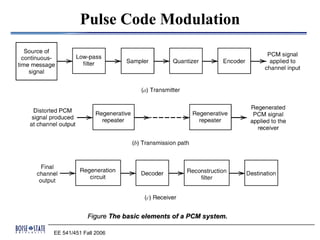
             Figure The basic elements of a PCM system.

EE 541/451 Fall 2006
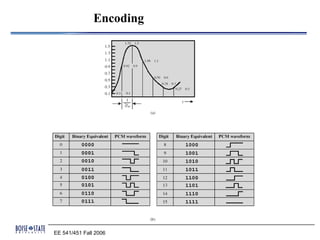
Encoding


EE 541/451 Fall 2006
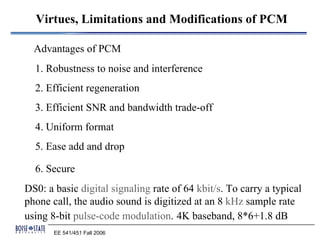
Virtues, Limitations and Modifications of PCM

  Advantages of PCM
  1. Robustness to noise and interference
  2. Efficient regeneration
  3. Efficient SNR and bandwidth trade-off
  4. Uniform format
  5. Ease add and drop

  6. Secure
DS0: a basic digital signaling rate of 64 kbit/s. To carry a typical
phone call, the audio sound is digitized at an 8 kHz sample rate
using 8-bit pulse-code modulation. 4K baseband, 8*6+1.8 dB
       EE 541/451 Fall 2006
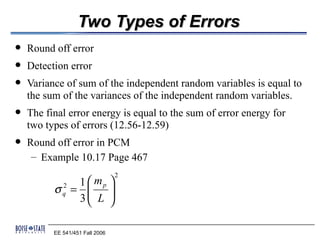
Two Types of Errors
   Round off error
   Detection error
   Variance of sum of the independent random variables is equal to
    the sum of the variances of the independent random variables.
   The final error energy is equal to the sum of error energy for
    two types of errors (12.56-12.59)
   Round off error in PCM
     – Example 10.17 Page 467
                                 2
             1  mp 
          σ = 
             2
             q  L 
             3     

          EE 541/451 Fall 2006
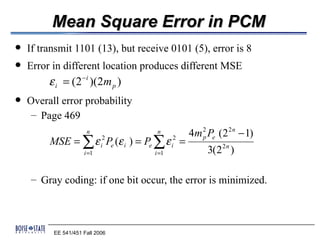
Mean Square Error in PCM
   If transmit 1101 (13), but receive 0101 (5), error is 8
   Error in different location produces different MSE
         ε i = (2 − i )(2m p )
   Overall error probability
     – Page 469
                      n              n          4m 2 Pe (2 2 n − 1)
         MSE = ∑ ε i2 Pe (ε i ) = Pe ∑ ε i2 =
                                                   p

                     i =1           i =1             3(2 2 n )

    – Gray coding: if one bit occur, the error is minimized.


          EE 541/451 Fall 2006
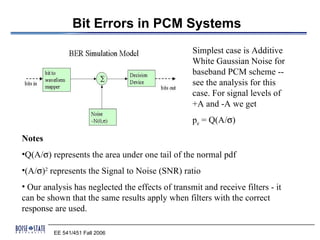
Bit Errors in PCM Systems
                                                  Simplest case is Additive
                                                  White Gaussian Noise for
                                                  baseband PCM scheme --
                                                  see the analysis for this
                                                  case. For signal levels of
                                                  +A and -A we get
                                                  pe = Q(A/σ)

Notes
•Q(A/σ) represents the area under one tail of the normal pdf
•(A/σ)2 represents the Signal to Noise (SNR) ratio
• Our analysis has neglected the effects of transmit and receive filters - it
can be shown that the same results apply when filters with the correct
response are used.

         EE 541/451 Fall 2006
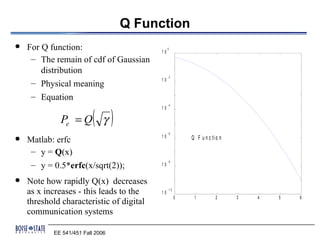
Q Function
   For Q function:                       10
                                               0


     – The remain of cdf of Gaussian
        distribution
                                               -2
                                          10
     – Physical meaning
     – Equation

                          ( )
                                               -4
                                          10

             Pe = Q γ
                                               -6
                                          10
   Matlab: erfc                                          Q F u n c tio n

     – y = Q(x)
     – y = 0.5*erfc(x/sqrt(2));
                                               -8
                                          10


   Note how rapidly Q(x) decreases
    as x increases - this leads to the    10
                                               -1 0

                                                      0    1          2     3   4   5   6
    threshold characteristic of digital
    communication systems

           EE 541/451 Fall 2006
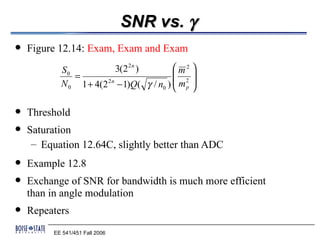
SNR vs. γ
   Figure 12.14: Exam, Exam and Exam
            S0                           m2 
                                 3(2 2 n )
               =                             
            N 0 1 + 4(2 − 1)Q( γ / n0 )  m p 
                       2n
                                        
                                            2 


   Threshold
   Saturation
     – Equation 12.64C, slightly better than ADC
   Example 12.8
   Exchange of SNR for bandwidth is much more efficient
    than in angle modulation
   Repeaters
          EE 541/451 Fall 2006
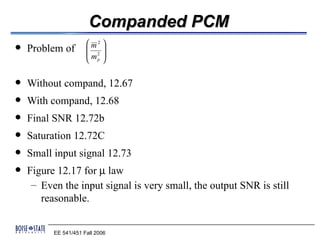
Companded PCM
                       m2 
   Problem of            
                       m2 
                       p

   Without compand, 12.67
   With compand, 12.68
   Final SNR 12.72b
   Saturation 12.72C
   Small input signal 12.73
   Figure 12.17 for µ law
     – Even the input signal is very small, the output SNR is still
       reasonable.


          EE 541/451 Fall 2006
Optimal Pre-emphasis and De-emphasis
   System model: Figure 12.18
   Distortion-less condition
    – 12.76a for amplitude and 12.76b for phase
   SNR expression 12.78
   Maximize SNR s.t. distortionless
   Lagrange multiplier
   Optimal Hp and Hd, 12.83a and 12.83b
   SNR improvement, 12.83c
   Example 12.11


          EE 541/451 Fall 2006
Pre-emphasis and De-emphasis in AM and FM
   AM
    – No that effective
   FM
    – Noise is larger when frequency is high
    – Optimal pre-emphasis and de-emphasis, 12.88d
    – Only simple suboptimum is used in commercial FM for historical
      and practical reasons


         EE 541/451 Fall 2006
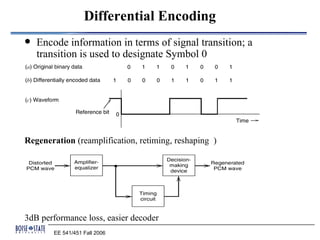
Differential Encoding
   Encode information in terms of signal transition; a
    transition is used to designate Symbol 0


Regeneration (reamplification, retiming, reshaping )


3dB performance loss, easier decoder
        EE 541/451 Fall 2006
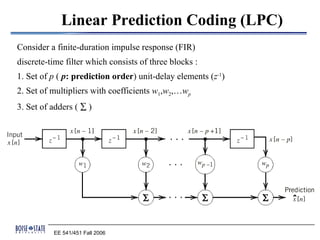
Linear Prediction Coding (LPC)
Consider a finite-duration impulse response (FIR)
discrete-time filter which consists of three blocks :
1. Set of p ( p: prediction order) unit-delay elements (z-1)
2. Set of multipliers with coefficients w1,w2,…wp
3. Set of adders ( ∑ )


          EE 541/451 Fall 2006
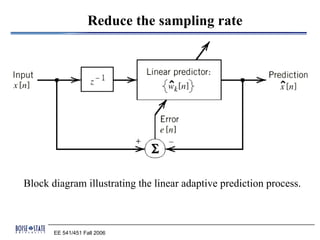
Reduce the sampling rate


Block diagram illustrating the linear adaptive prediction process.


       EE 541/451 Fall 2006
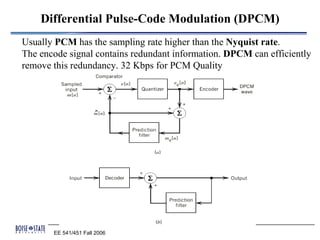
Differential Pulse-Code Modulation (DPCM)
Usually PCM has the sampling rate higher than the Nyquist rate.
The encode signal contains redundant information. DPCM can efficiently
remove this redundancy. 32 Kbps for PCM Quality


       EE 541/451 Fall 2006
Processing Gain

The (SNR) o of the DPCM system is
              σM
               2
     (SNR) o = 2
              σQ
where σ M and σ Q are variances of m[ n] ( E[m[n]] = 0) and q[ n]
        2       2


               σM σE
                 2   2
    (SNR) o = ( 2 )( 2 )
               σ E σQ
              = G p (SNR )Q
where σ E is the variance of the predictions error
        2


and the signal - to - quantization noise ratio is
               σE
                2
     (SNR ) Q = 2
               σQ
                      σM
                       2
Processing Gain, G p = 2
                      σE
Design a prediction filter to maximize G p (minimize σ E )
                                                       2


 EE 541/451 Fall 2006
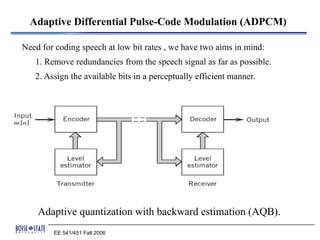
Adaptive Differential Pulse-Code Modulation (ADPCM)

Need for coding speech at low bit rates , we have two aims in mind:
   1. Remove redundancies from the speech signal as far as possible.
   2. Assign the available bits in a perceptually efficient manner.


    Adaptive quantization with backward estimation (AQB).
        EE 541/451 Fall 2006
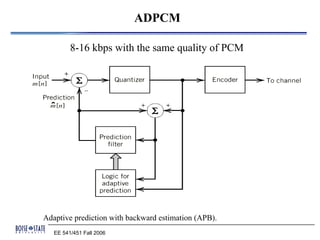
ADPCM

         8-16 kbps with the same quality of PCM


Adaptive prediction with backward estimation (APB).
   EE 541/451 Fall 2006
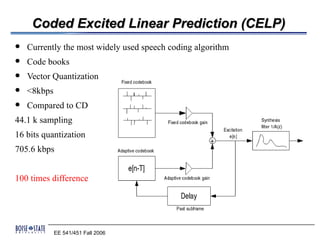
Coded Excited Linear Prediction (CELP)
   Currently the most widely used speech coding algorithm
   Code books
   Vector Quantization
   <8kbps
   Compared to CD
44.1 k sampling
16 bits quantization
705.6 kbps


100 times difference


             EE 541/451 Fall 2006
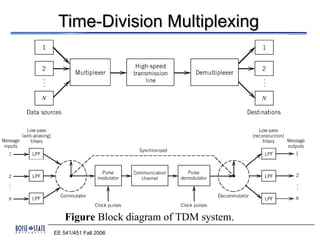
Time-Division Multiplexing


    Figure Block diagram of TDM system.
EE 541/451 Fall 2006
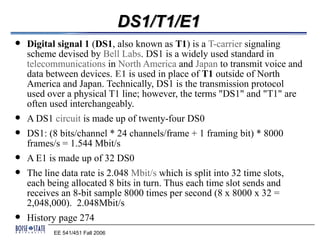
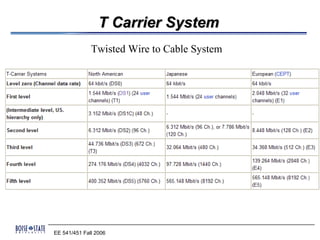
DS1/T1/E1
   Digital signal 1 (DS1, also known as T1) is a T-carrier signaling
    scheme devised by Bell Labs. DS1 is a widely used standard in
    telecommunications in North America and Japan to transmit voice and
    data between devices. E1 is used in place of T1 outside of North
    America and Japan. Technically, DS1 is the transmission protocol
    used over a physical T1 line; however, the terms "DS1" and "T1" are
    often used interchangeably.
   A DS1 circuit is made up of twenty-four DS0
   DS1: (8 bits/channel * 24 channels/frame + 1 framing bit) * 8000
    frames/s = 1.544 Mbit/s
   A E1 is made up of 32 DS0
   The line data rate is 2.048 Mbit/s which is split into 32 time slots,
    each being allocated 8 bits in turn. Thus each time slot sends and
    receives an 8-bit sample 8000 times per second (8 x 8000 x 32 =
    2,048,000). 2.048Mbit/s
   History page 274
           EE 541/451 Fall 2006
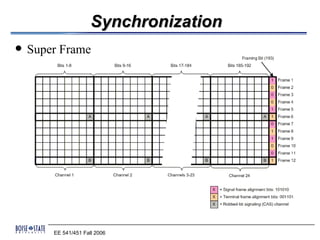
Synchronization
   Super Frame


        EE 541/451 Fall 2006
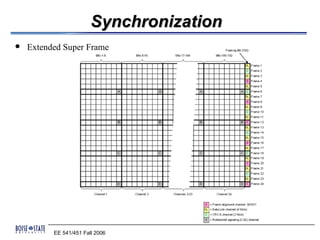
Synchronization
   Extended Super Frame


          EE 541/451 Fall 2006
T Carrier System
              Twisted Wire to Cable System


EE 541/451 Fall 2006
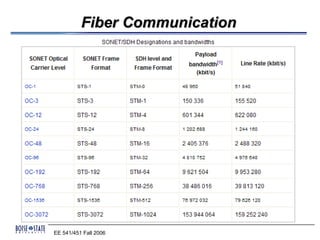
Fiber Communication


EE 541/451 Fall 2006
Delta Modulation (DM)


Let m[ n] = m(nTs ) , n = 0,±1,±2, 
where Ts is the sampling period and m(nTs ) is a sample of m(t ).
The error signal is
e[ n] = m[ n] − mq [ n − 1]
eq [ n] = ∆ sgn(e[ n] )
mq [ n] = mq [ n − 1] + eq [ n]
where mq [ n] is the quantizer output , eq [ n] is
the quantized version of e[ n] , and ∆ is the step size

EE 541/451 Fall 2006
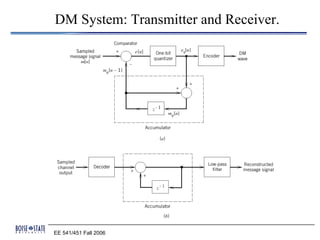
DM System: Transmitter and Receiver.


EE 541/451 Fall 2006
Slope overload distortion and granular noise
The modulator consists of a comparator, a quantizer, and an
accumulator. The output of the accumulator is
                                     n
                     mq [ n] = ∆ ∑ sgn(e[ i ])
                                  i =1
                                 n
                             = ∑ eq [ i ]
                                i =1


      EE 541/451 Fall 2006
Slope Overload Distortion and Granular Noise
Denote the quantization error by q[ n] ,
        mq [ n] = m[ n] − q[ n]
We have
  e[ n] = m[ n] − m[ n − 1] − q[ n − 1]
Except for q[ n − 1], the quantizer input is a first
backward difference of the input signal ( differentiator )
To avoid slope - overload distortion , we require
             ∆          dm(t )
(slope)         ≥ max
             Ts           dt
On the other hand, granular noise occurs when step size
∆ is too large relative to the local slope of m(t ).
     EE 541/451 Fall 2006
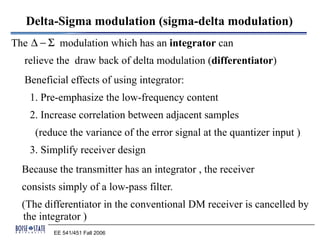
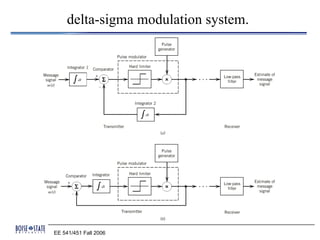
Delta-Sigma modulation (sigma-delta modulation)
The ∆ − Σ modulation which has an integrator can
  relieve the draw back of delta modulation (differentiator)
  Beneficial effects of using integrator:
    1. Pre-emphasize the low-frequency content
    2. Increase correlation between adjacent samples
     (reduce the variance of the error signal at the quantizer input )
    3. Simplify receiver design
  Because the transmitter has an integrator , the receiver
  consists simply of a low-pass filter.
  (The differentiator in the conventional DM receiver is cancelled by
  the integrator )
         EE 541/451 Fall 2006
delta-sigma modulation system.


EE 541/451 Fall 2006
Adaptive Delta Modulation
   Adaptive adjust the step size according to frequency, figure 6.21
   Out SNR
    – Page 286-287
    – For single integration case, (BT/B)^3
    – For double integration case, (BT/B)^5
   Comparison with PCM, figure 6.22
    – Low quality has the advantages.
    – Used in walky-talky


          EE 541/451 Fall 2006

Pcm

  • 1.
    Pulse Code Modulation(PCM)  Pulse code modulation (PCM) is produced by analog-to-digital conversion process. Quantized PAM  As in the case of other pulse modulation techniques, the rate at which samples are taken and encoded must conform to the Nyquist sampling rate.  The sampling rate must be greater than, twice the highest frequency in the analog signal, fs > 2fA(max)  Telegraph time-division multiplex (TDM) was conveyed as early as 1853, by the American inventor M.B. Farmer. The electrical engineer W.M. Miner, in 1903.  PCM was invented by the British engineer Alec Reeves in 1937 in France.  It was not until about the middle of 1943 that the Bell Labs people became aware of the use of PCM binary coding as already proposed by Alec Reeves. EE 541/451 Fall 2006
  • 2.
    Pulse Code Modulation Figure The basic elements of a PCM system. EE 541/451 Fall 2006
  • 3.
  • 4.
    Virtues, Limitations andModifications of PCM Advantages of PCM 1. Robustness to noise and interference 2. Efficient regeneration 3. Efficient SNR and bandwidth trade-off 4. Uniform format 5. Ease add and drop 6. Secure DS0: a basic digital signaling rate of 64 kbit/s. To carry a typical phone call, the audio sound is digitized at an 8 kHz sample rate using 8-bit pulse-code modulation. 4K baseband, 8*6+1.8 dB EE 541/451 Fall 2006
  • 5.
    Two Types ofErrors  Round off error  Detection error  Variance of sum of the independent random variables is equal to the sum of the variances of the independent random variables.  The final error energy is equal to the sum of error energy for two types of errors (12.56-12.59)  Round off error in PCM – Example 10.17 Page 467 2 1  mp  σ =  2 q  L  3  EE 541/451 Fall 2006
  • 6.
    Mean Square Errorin PCM  If transmit 1101 (13), but receive 0101 (5), error is 8  Error in different location produces different MSE ε i = (2 − i )(2m p )  Overall error probability – Page 469 n n 4m 2 Pe (2 2 n − 1) MSE = ∑ ε i2 Pe (ε i ) = Pe ∑ ε i2 = p i =1 i =1 3(2 2 n ) – Gray coding: if one bit occur, the error is minimized. EE 541/451 Fall 2006
  • 7.
    Bit Errors inPCM Systems Simplest case is Additive White Gaussian Noise for baseband PCM scheme -- see the analysis for this case. For signal levels of +A and -A we get pe = Q(A/σ) Notes •Q(A/σ) represents the area under one tail of the normal pdf •(A/σ)2 represents the Signal to Noise (SNR) ratio • Our analysis has neglected the effects of transmit and receive filters - it can be shown that the same results apply when filters with the correct response are used. EE 541/451 Fall 2006
  • 8.
    Q Function  For Q function: 10 0 – The remain of cdf of Gaussian distribution -2 10 – Physical meaning – Equation ( ) -4 10 Pe = Q γ -6 10  Matlab: erfc Q F u n c tio n – y = Q(x) – y = 0.5*erfc(x/sqrt(2)); -8 10  Note how rapidly Q(x) decreases as x increases - this leads to the 10 -1 0 0 1 2 3 4 5 6 threshold characteristic of digital communication systems EE 541/451 Fall 2006
  • 9.
    SNR vs. γ  Figure 12.14: Exam, Exam and Exam S0  m2  3(2 2 n ) =   N 0 1 + 4(2 − 1)Q( γ / n0 )  m p  2n  2   Threshold  Saturation – Equation 12.64C, slightly better than ADC  Example 12.8  Exchange of SNR for bandwidth is much more efficient than in angle modulation  Repeaters EE 541/451 Fall 2006
  • 10.
    Companded PCM  m2   Problem of    m2   p  Without compand, 12.67  With compand, 12.68  Final SNR 12.72b  Saturation 12.72C  Small input signal 12.73  Figure 12.17 for µ law – Even the input signal is very small, the output SNR is still reasonable. EE 541/451 Fall 2006
  • 11.
    Optimal Pre-emphasis andDe-emphasis  System model: Figure 12.18  Distortion-less condition – 12.76a for amplitude and 12.76b for phase  SNR expression 12.78  Maximize SNR s.t. distortionless  Lagrange multiplier  Optimal Hp and Hd, 12.83a and 12.83b  SNR improvement, 12.83c  Example 12.11 EE 541/451 Fall 2006
  • 12.
    Pre-emphasis and De-emphasisin AM and FM  AM – No that effective  FM – Noise is larger when frequency is high – Optimal pre-emphasis and de-emphasis, 12.88d – Only simple suboptimum is used in commercial FM for historical and practical reasons EE 541/451 Fall 2006
  • 13.
    Differential Encoding  Encode information in terms of signal transition; a transition is used to designate Symbol 0 Regeneration (reamplification, retiming, reshaping ) 3dB performance loss, easier decoder EE 541/451 Fall 2006
  • 14.
    Linear Prediction Coding(LPC) Consider a finite-duration impulse response (FIR) discrete-time filter which consists of three blocks : 1. Set of p ( p: prediction order) unit-delay elements (z-1) 2. Set of multipliers with coefficients w1,w2,…wp 3. Set of adders ( ∑ ) EE 541/451 Fall 2006
  • 15.
    Reduce the samplingrate Block diagram illustrating the linear adaptive prediction process. EE 541/451 Fall 2006
  • 16.
    Differential Pulse-Code Modulation(DPCM) Usually PCM has the sampling rate higher than the Nyquist rate. The encode signal contains redundant information. DPCM can efficiently remove this redundancy. 32 Kbps for PCM Quality EE 541/451 Fall 2006
  • 17.
    Processing Gain The (SNR)o of the DPCM system is σM 2 (SNR) o = 2 σQ where σ M and σ Q are variances of m[ n] ( E[m[n]] = 0) and q[ n] 2 2 σM σE 2 2 (SNR) o = ( 2 )( 2 ) σ E σQ = G p (SNR )Q where σ E is the variance of the predictions error 2 and the signal - to - quantization noise ratio is σE 2 (SNR ) Q = 2 σQ σM 2 Processing Gain, G p = 2 σE Design a prediction filter to maximize G p (minimize σ E ) 2 EE 541/451 Fall 2006
  • 18.
    Adaptive Differential Pulse-CodeModulation (ADPCM) Need for coding speech at low bit rates , we have two aims in mind: 1. Remove redundancies from the speech signal as far as possible. 2. Assign the available bits in a perceptually efficient manner. Adaptive quantization with backward estimation (AQB). EE 541/451 Fall 2006
  • 19.
    ADPCM 8-16 kbps with the same quality of PCM Adaptive prediction with backward estimation (APB). EE 541/451 Fall 2006
  • 20.
    Coded Excited LinearPrediction (CELP)  Currently the most widely used speech coding algorithm  Code books  Vector Quantization  <8kbps  Compared to CD 44.1 k sampling 16 bits quantization 705.6 kbps 100 times difference EE 541/451 Fall 2006
  • 21.
    Time-Division Multiplexing Figure Block diagram of TDM system. EE 541/451 Fall 2006
  • 22.
    DS1/T1/E1  Digital signal 1 (DS1, also known as T1) is a T-carrier signaling scheme devised by Bell Labs. DS1 is a widely used standard in telecommunications in North America and Japan to transmit voice and data between devices. E1 is used in place of T1 outside of North America and Japan. Technically, DS1 is the transmission protocol used over a physical T1 line; however, the terms "DS1" and "T1" are often used interchangeably.  A DS1 circuit is made up of twenty-four DS0  DS1: (8 bits/channel * 24 channels/frame + 1 framing bit) * 8000 frames/s = 1.544 Mbit/s  A E1 is made up of 32 DS0  The line data rate is 2.048 Mbit/s which is split into 32 time slots, each being allocated 8 bits in turn. Thus each time slot sends and receives an 8-bit sample 8000 times per second (8 x 8000 x 32 = 2,048,000). 2.048Mbit/s  History page 274 EE 541/451 Fall 2006
  • 23.
    Synchronization  Super Frame EE 541/451 Fall 2006
  • 24.
    Synchronization  Extended Super Frame EE 541/451 Fall 2006
  • 25.
    T Carrier System Twisted Wire to Cable System EE 541/451 Fall 2006
  • 26.
  • 27.
    Delta Modulation (DM) Letm[ n] = m(nTs ) , n = 0,±1,±2,  where Ts is the sampling period and m(nTs ) is a sample of m(t ). The error signal is e[ n] = m[ n] − mq [ n − 1] eq [ n] = ∆ sgn(e[ n] ) mq [ n] = mq [ n − 1] + eq [ n] where mq [ n] is the quantizer output , eq [ n] is the quantized version of e[ n] , and ∆ is the step size EE 541/451 Fall 2006
  • 28.
    DM System: Transmitterand Receiver. EE 541/451 Fall 2006
  • 29.
    Slope overload distortionand granular noise The modulator consists of a comparator, a quantizer, and an accumulator. The output of the accumulator is n mq [ n] = ∆ ∑ sgn(e[ i ]) i =1 n = ∑ eq [ i ] i =1 EE 541/451 Fall 2006
  • 30.
    Slope Overload Distortionand Granular Noise Denote the quantization error by q[ n] , mq [ n] = m[ n] − q[ n] We have e[ n] = m[ n] − m[ n − 1] − q[ n − 1] Except for q[ n − 1], the quantizer input is a first backward difference of the input signal ( differentiator ) To avoid slope - overload distortion , we require ∆ dm(t ) (slope) ≥ max Ts dt On the other hand, granular noise occurs when step size ∆ is too large relative to the local slope of m(t ). EE 541/451 Fall 2006
  • 31.
    Delta-Sigma modulation (sigma-deltamodulation) The ∆ − Σ modulation which has an integrator can relieve the draw back of delta modulation (differentiator) Beneficial effects of using integrator: 1. Pre-emphasize the low-frequency content 2. Increase correlation between adjacent samples (reduce the variance of the error signal at the quantizer input ) 3. Simplify receiver design Because the transmitter has an integrator , the receiver consists simply of a low-pass filter. (The differentiator in the conventional DM receiver is cancelled by the integrator ) EE 541/451 Fall 2006
  • 32.
  • 33.
    Adaptive Delta Modulation  Adaptive adjust the step size according to frequency, figure 6.21  Out SNR – Page 286-287 – For single integration case, (BT/B)^3 – For double integration case, (BT/B)^5  Comparison with PCM, figure 6.22 – Low quality has the advantages. – Used in walky-talky EE 541/451 Fall 2006