

{
Genetic Engineering
Presented by:
Soz Najat
Firdaws Yasin
Chawan Jamal
Darya Ali
Nusaiba Abdullah
 Also called Recombinant DNA technology, Genetic modification and Biotechnology
 It is a set of techniques that are used to achieve one or more of three goals:
What is Genetic Engineering?
to reveal the processes of how genes are inherited
and expressed.
to generate economic benefits which include improved plants
and animals for agriculture, and efficient production of valuable
biopharmaceuticals.
to provide effective treatment for various diseases
(particularly genetic disorders).
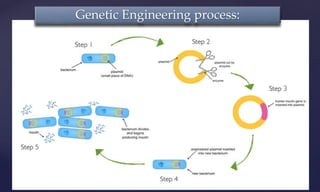
Genetic Engineering process:
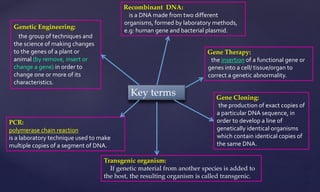
Genetic Engineering:
the group of techniques and
the science of making changes
to the genes of a plant or
animal (by remove, insert or
change a gene) in order to
change one or more of its
characteristics.
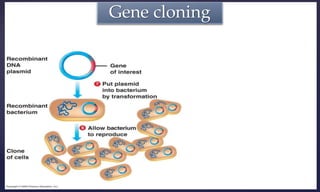
Key terms Gene Cloning:
the production of exact copies of
a particular DNA sequence, in
order to develop a line of
genetically identical organisms
which contain identical copies of
the same DNA.
Gene Therapy:
the insertion of a functional gene or
genes into a cell/ tissue/organ to
correct a genetic abnormality.
PCR:
polymerase chain reaction
is a laboratory technique used to make
multiple copies of a segment of DNA.
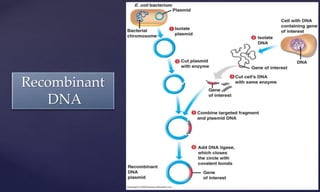
Recombinant DNA:
is a DNA made from two different
organisms, formed by laboratory methods,
e.g: human gene and bacterial plasmid.
Transgenic organism:
If genetic material from another species is added to
the host, the resulting organism is called transgenic.
Recombinant
DNA
Gene cloning
PCR working
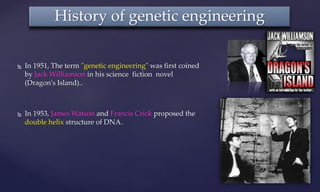
 In 1951, The term "genetic engineering" was first coined
by Jack Williamson in his science fiction novel
(Dragon's Island)..
 In 1953, James Watson and Francis Crick proposed the
double helix structure of DNA.
History of genetic engineering
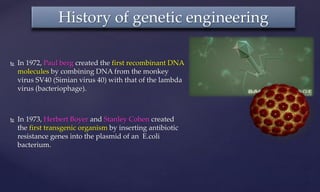
 In 1972, Paul berg created the first recombinant DNA
molecules by combining DNA from the monkey
virus SV40 (Simian virus 40) with that of the lambda
virus (bacteriophage).
 In 1973, Herbert Boyer and Stanley Cohen created
the first transgenic organism by inserting antibiotic
resistance genes into the plasmid of an E.coli
bacterium.
History of genetic engineering
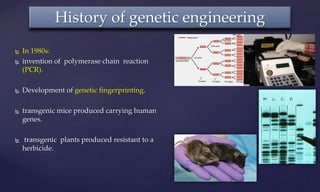
 In 1980s:
 invention of polymerase chain reaction
(PCR).
 Development of genetic fingerprinting.
 transgenic mice produced carrying human
genes.
 transgenic plants produced resistant to a
herbicide.
History of genetic engineering
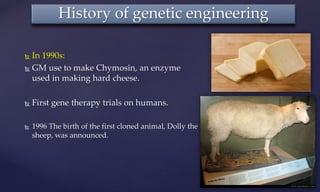
 In 1990s:
 GM use to make Chymosin, an enzyme
used in making hard cheese.
 First gene therapy trials on humans.
 1996 The birth of the first cloned animal, Dolly the
sheep, was announced.
History of genetic engineering
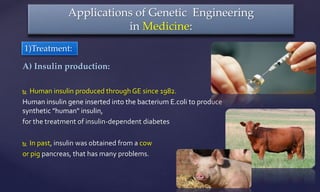
A) Insulin production:
 Human insulin produced through GE since 1982.
Human insulin gene inserted into the bacterium E.coli to produce
synthetic "human" insulin,
for the treatment of insulin-dependent diabetes
 In past, insulin was obtained from a cow
or pig pancreas, that has many problems.
Applications of Genetic Engineering
in Medicine:
1)Treatment:
B) Producing human growth hormones:
to treat growth retardation (dwarfism).
C) Producing Follistim injection:
(contains the FSH hormone) for treating infertility.
D) Making human albumin, anti-hemophilic factors and many
other drugs.
E) Other biopharmaceuticals under development through genetic
engineering, include:
anti-cancer drug and a possible vaccine forAIDS, malaria, etc.
Applications of Genetic Engineering
in Medicine:
1)Treatment:
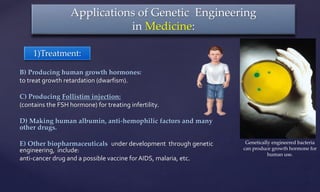
Genetically engineered bacteria
can produce growth hormone for
human use.
 Today, the microorganism (such as: yeast) is used to
produce virus antigen used as a vaccine, that stimulate
human immune system against this virus.
 This procedure has been done successfully for
development of a vaccine against hepatitis B virus
(HBV) that is now widely used.
 Genetically engineered vaccines hold great promise for
the future!
 GE vaccines may be useful to prevent diseases that
have resistant to traditional vaccination , including HIV,
tuberculosis…etc.
Applications of Genetic Engineering
in Medicine:
2) Vaccination:
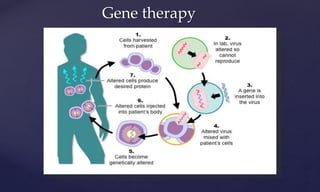
 1. Somatic gene therapy is designed to introduce
functional gene(s) to body cells, which enable the
body to perform normal functions thus providing
correction for genetic abnormalities.
 This will cause treating individuals by targeting the
therapy to body cells such as bone marrow or blood
cells.
 Gene therapy has been successfully used to treat
Chronic lymphocytic leukemia (CLL) and
Parkinson's disease.
Applications of Genetic Engineering
in Medicine:
3) Gene therapy:
 Gene therapy is also being tested as a treatment for
cystic fibrosis, skin cancer, breast cancer, brain cancer,
and AIDS.
 However, most of these treatments are only partially
successful,The major reasons for these failures is
inefficient vectors
 In the future, as more efficient vectors are
engineered, gene therapy is expected to be a
common method for treating a large number of
genetic disorders.
Applications of Genetic Engineering
in Medicine:
3) Gene therapy:
Gene therapy
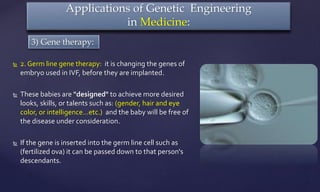
 2. Germ line gene therapy: it is changing the genes of
embryo used in IVF, before they are implanted.
 These babies are "designed" to achieve more desired
looks, skills, or talents such as: (gender, hair and eye
color, or intelligence…etc.) and the baby will be free of
the disease under consideration.
 If the gene is inserted into the germ line cell such as
(fertilized ova) it can be passed down to that person's
descendants.
Applications of Genetic Engineering
in Medicine:
3) Gene therapy:
Applications of Genetic Engineering
in Medicine:
4) Tissue engineering:
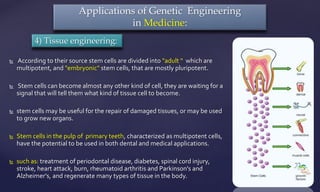
 According to their source stem cells are divided into "adult “ which are
multipotent, and "embryonic" stem cells, that are mostly pluripotent.
 Stem cells can become almost any other kind of cell, they are waiting for a
signal that will tell them what kind of tissue cell to become.
 stem cells may be useful for the repair of damaged tissues, or may be used
to grow new organs.
 Stem cells in the pulp of primary teeth, characterized as multipotent cells,
have the potential to be used in both dental and medical applications.
 such as: treatment of periodontal disease, diabetes, spinal cord injury,
stroke, heart attack, burn, rheumatoid arthritis and Parkinson's and
Alzheimer's, and regenerate many types of tissue in the body.
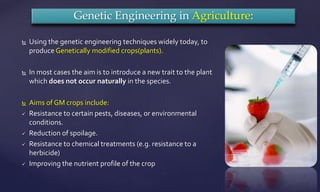
 Using the genetic engineering techniques widely today, to
produce Genetically modified crops(plants).
 In most cases the aim is to introduce a new trait to the plant
which does not occur naturally in the species.
 Aims of GM crops include:
 Resistance to certain pests, diseases, or environmental
conditions.
 Reduction of spoilage.
 Resistance to chemical treatments (e.g. resistance to a
herbicide)
 Improving the nutrient profile of the crop
Genetic Engineering in Agriculture:
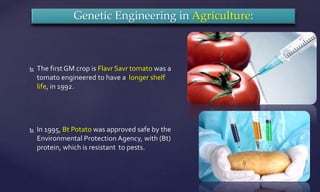
 The first GM crop is Flavr Savr tomato was a
tomato engineered to have a longer shelf
life, in 1992.
 In 1995, Bt Potato was approved safe by the
Environmental Protection Agency, with (Bt)
protein, which is resistant to pests.
Genetic Engineering in Agriculture:
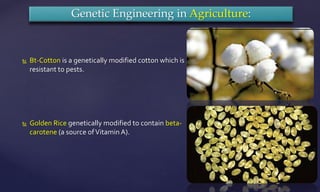
 Bt-Cotton is a genetically modified cotton which is
resistant to pests.
 Golden Rice genetically modified to contain beta-
carotene (a source ofVitamin A).
Genetic Engineering in Agriculture:
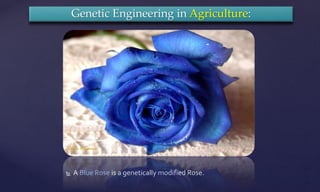
 A Blue Rose is a genetically modified Rose.
Genetic Engineering in Agriculture:
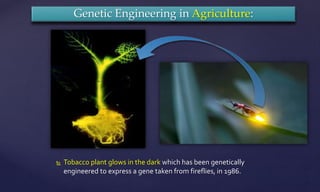
 Tobacco plant glows in the dark which has been genetically
engineered to express a gene taken from fireflies, in 1986.
Genetic Engineering in Agriculture:
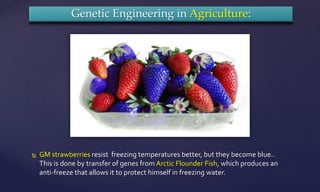
 GM strawberries resist freezing temperatures better, but they become blue..
This is done by transfer of genes from Arctic Flounder Fish, which produces an
anti-freeze that allows it to protect himself in freezing water.
Genetic Engineering in Agriculture:
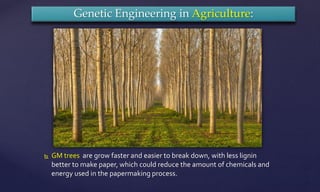
 GM trees are grow faster and easier to break down, with less lignin
better to make paper, which could reduce the amount of chemicals and
energy used in the papermaking process.
Genetic Engineering in Agriculture:
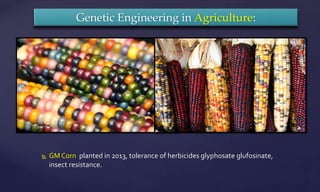
 GM Corn planted in 2013, tolerance of herbicides glyphosate glufosinate,
insect resistance.
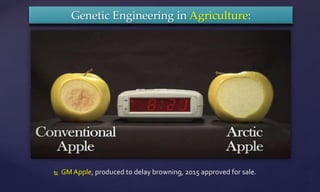
 GM Apple, produced to delay browning, 2015 approved for sale.
Genetic Engineering in Agriculture:
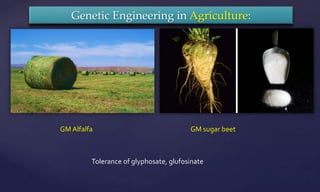
GM Alfalfa GM sugar beet
Tolerance of glyphosate, glufosinate
Genetic Engineering in Agriculture:
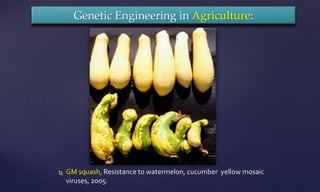
 GM squash, Resistance to watermelon, cucumber yellow mosaic
viruses, 2005.
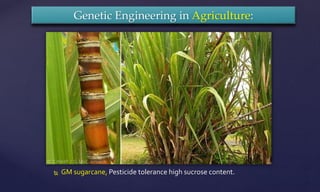
 GM sugarcane, Pesticide tolerance high sucrose content.
Genetic Engineering in Agriculture:
Other examples of
Genetically Modified Organisms:
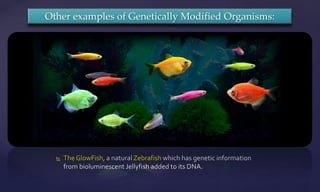
 The GlowFish, a natural Zebrafish which has genetic information
from bioluminescent Jellyfish added to its DNA.
Other examples of Genetically Modified Organisms:
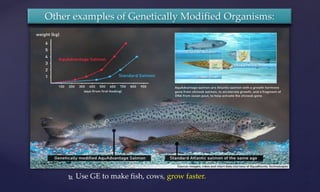
 Use GE to make fish, cows, grow faster.
Other examples of Genetically Modified Organisms:
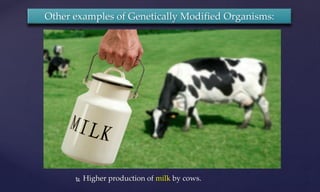
 Higher production of milk by cows.
Other examples of Genetically Modified Organisms:
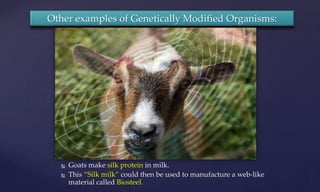
 Goats make silk protein in milk.
 This “Silk milk” could then be used to manufacture a web-like
material called Biosteel.
Other examples of Genetically Modified Organisms:
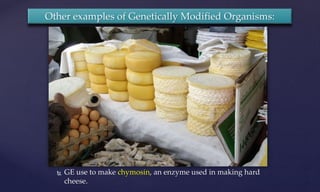
 GE use to make chymosin, an enzyme used in making hard
cheese.
Other examples of Genetically Modified Organisms:
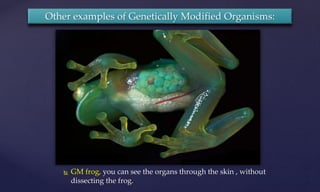
 GM frog, you can see the organs through the skin , without
dissecting the frog.
Other examples of Genetically Modified Organisms:
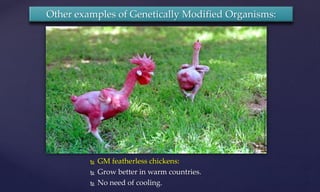
 GM featherless chickens:
 Grow better in warm countries.
 No need of cooling.
Other examples of Genetically Modified Organisms:
 There are scientists who believe that
genetically modified genes can have an
irreversible effects and associated
consequences.
 Genetic engineering can hinder the moral
issues particularly in religion.They also
wonder if man has the right to influence law
of nature, and interfere with God’s made.
Disadvantages of Genetically Modified Organisms:
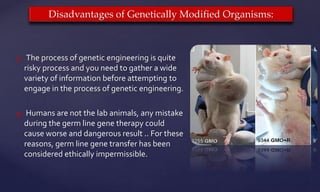
 The process of genetic engineering is quite
risky process and you need to gather a wide
variety of information before attempting to
engage in the process of genetic engineering.
 Humans are not the lab animals, any mistake
during the germ line gene therapy could
cause worse and dangerous result .. For these
reasons, germ line gene transfer has been
considered ethically impermissible.
Disadvantages of Genetically Modified Organisms:
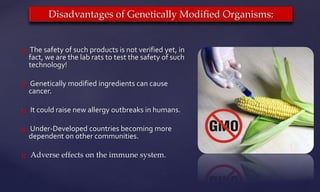
 The safety of such products is not verified yet, in
fact, we are the lab rats to test the safety of such
technology!
 Genetically modified ingredients can cause
cancer.
 It could raise new allergy outbreaks in humans.
 Under-Developed countries becoming more
dependent on other communities.
 Adverse effects on the immune system.
Disadvantages of Genetically Modified Organisms:
 You are ‘not’ what you eat any more!
 It is un-natural way of producing food.
 Pesticide resistant food can create
super-creatures!
 The effects of genetic food engineering
could be irreversible.
Disadvantages of Genetically Modified Organisms:
Thank You

Genetic engineering

  • 1.
    { Genetic Engineering Presented by: SozNajat Firdaws Yasin Chawan Jamal Darya Ali Nusaiba Abdullah
  • 2.
     Also calledRecombinant DNA technology, Genetic modification and Biotechnology  It is a set of techniques that are used to achieve one or more of three goals: What is Genetic Engineering? to reveal the processes of how genes are inherited and expressed. to generate economic benefits which include improved plants and animals for agriculture, and efficient production of valuable biopharmaceuticals. to provide effective treatment for various diseases (particularly genetic disorders).
  • 3.
  • 4.
    Genetic Engineering: the groupof techniques and the science of making changes to the genes of a plant or animal (by remove, insert or change a gene) in order to change one or more of its characteristics. Key terms Gene Cloning: the production of exact copies of a particular DNA sequence, in order to develop a line of genetically identical organisms which contain identical copies of the same DNA. Gene Therapy: the insertion of a functional gene or genes into a cell/ tissue/organ to correct a genetic abnormality. PCR: polymerase chain reaction is a laboratory technique used to make multiple copies of a segment of DNA. Recombinant DNA: is a DNA made from two different organisms, formed by laboratory methods, e.g: human gene and bacterial plasmid. Transgenic organism: If genetic material from another species is added to the host, the resulting organism is called transgenic.
  • 5.
  • 6.
  • 7.
  • 8.
     In 1951,The term "genetic engineering" was first coined by Jack Williamson in his science fiction novel (Dragon's Island)..  In 1953, James Watson and Francis Crick proposed the double helix structure of DNA. History of genetic engineering
  • 9.
     In 1972,Paul berg created the first recombinant DNA molecules by combining DNA from the monkey virus SV40 (Simian virus 40) with that of the lambda virus (bacteriophage).  In 1973, Herbert Boyer and Stanley Cohen created the first transgenic organism by inserting antibiotic resistance genes into the plasmid of an E.coli bacterium. History of genetic engineering
  • 10.
     In 1980s: invention of polymerase chain reaction (PCR).  Development of genetic fingerprinting.  transgenic mice produced carrying human genes.  transgenic plants produced resistant to a herbicide. History of genetic engineering
  • 11.
     In 1990s: GM use to make Chymosin, an enzyme used in making hard cheese.  First gene therapy trials on humans.  1996 The birth of the first cloned animal, Dolly the sheep, was announced. History of genetic engineering
  • 12.
    A) Insulin production: Human insulin produced through GE since 1982. Human insulin gene inserted into the bacterium E.coli to produce synthetic "human" insulin, for the treatment of insulin-dependent diabetes  In past, insulin was obtained from a cow or pig pancreas, that has many problems. Applications of Genetic Engineering in Medicine: 1)Treatment:
  • 13.
    B) Producing humangrowth hormones: to treat growth retardation (dwarfism). C) Producing Follistim injection: (contains the FSH hormone) for treating infertility. D) Making human albumin, anti-hemophilic factors and many other drugs. E) Other biopharmaceuticals under development through genetic engineering, include: anti-cancer drug and a possible vaccine forAIDS, malaria, etc. Applications of Genetic Engineering in Medicine: 1)Treatment: Genetically engineered bacteria can produce growth hormone for human use.
  • 14.
     Today, themicroorganism (such as: yeast) is used to produce virus antigen used as a vaccine, that stimulate human immune system against this virus.  This procedure has been done successfully for development of a vaccine against hepatitis B virus (HBV) that is now widely used.  Genetically engineered vaccines hold great promise for the future!  GE vaccines may be useful to prevent diseases that have resistant to traditional vaccination , including HIV, tuberculosis…etc. Applications of Genetic Engineering in Medicine: 2) Vaccination:
  • 15.
     1. Somaticgene therapy is designed to introduce functional gene(s) to body cells, which enable the body to perform normal functions thus providing correction for genetic abnormalities.  This will cause treating individuals by targeting the therapy to body cells such as bone marrow or blood cells.  Gene therapy has been successfully used to treat Chronic lymphocytic leukemia (CLL) and Parkinson's disease. Applications of Genetic Engineering in Medicine: 3) Gene therapy:
  • 16.
     Gene therapyis also being tested as a treatment for cystic fibrosis, skin cancer, breast cancer, brain cancer, and AIDS.  However, most of these treatments are only partially successful,The major reasons for these failures is inefficient vectors  In the future, as more efficient vectors are engineered, gene therapy is expected to be a common method for treating a large number of genetic disorders. Applications of Genetic Engineering in Medicine: 3) Gene therapy:
  • 17.
  • 18.
     2. Germline gene therapy: it is changing the genes of embryo used in IVF, before they are implanted.  These babies are "designed" to achieve more desired looks, skills, or talents such as: (gender, hair and eye color, or intelligence…etc.) and the baby will be free of the disease under consideration.  If the gene is inserted into the germ line cell such as (fertilized ova) it can be passed down to that person's descendants. Applications of Genetic Engineering in Medicine: 3) Gene therapy:
  • 19.
    Applications of GeneticEngineering in Medicine: 4) Tissue engineering:  According to their source stem cells are divided into "adult “ which are multipotent, and "embryonic" stem cells, that are mostly pluripotent.  Stem cells can become almost any other kind of cell, they are waiting for a signal that will tell them what kind of tissue cell to become.  stem cells may be useful for the repair of damaged tissues, or may be used to grow new organs.  Stem cells in the pulp of primary teeth, characterized as multipotent cells, have the potential to be used in both dental and medical applications.  such as: treatment of periodontal disease, diabetes, spinal cord injury, stroke, heart attack, burn, rheumatoid arthritis and Parkinson's and Alzheimer's, and regenerate many types of tissue in the body.
  • 21.
     Using thegenetic engineering techniques widely today, to produce Genetically modified crops(plants).  In most cases the aim is to introduce a new trait to the plant which does not occur naturally in the species.  Aims of GM crops include:  Resistance to certain pests, diseases, or environmental conditions.  Reduction of spoilage.  Resistance to chemical treatments (e.g. resistance to a herbicide)  Improving the nutrient profile of the crop Genetic Engineering in Agriculture:
  • 22.
     The firstGM crop is Flavr Savr tomato was a tomato engineered to have a longer shelf life, in 1992.  In 1995, Bt Potato was approved safe by the Environmental Protection Agency, with (Bt) protein, which is resistant to pests. Genetic Engineering in Agriculture:
  • 23.
     Bt-Cotton isa genetically modified cotton which is resistant to pests.  Golden Rice genetically modified to contain beta- carotene (a source ofVitamin A). Genetic Engineering in Agriculture:
  • 24.
     A BlueRose is a genetically modified Rose. Genetic Engineering in Agriculture:
  • 25.
     Tobacco plantglows in the dark which has been genetically engineered to express a gene taken from fireflies, in 1986. Genetic Engineering in Agriculture:
  • 26.
     GM strawberriesresist freezing temperatures better, but they become blue.. This is done by transfer of genes from Arctic Flounder Fish, which produces an anti-freeze that allows it to protect himself in freezing water. Genetic Engineering in Agriculture:
  • 27.
     GM treesare grow faster and easier to break down, with less lignin better to make paper, which could reduce the amount of chemicals and energy used in the papermaking process. Genetic Engineering in Agriculture:
  • 28.
    Genetic Engineering inAgriculture:  GM Corn planted in 2013, tolerance of herbicides glyphosate glufosinate, insect resistance.
  • 29.
     GM Apple,produced to delay browning, 2015 approved for sale. Genetic Engineering in Agriculture:
  • 30.
    Genetic Engineering inAgriculture: GM Alfalfa GM sugar beet Tolerance of glyphosate, glufosinate
  • 31.
    Genetic Engineering inAgriculture:  GM squash, Resistance to watermelon, cucumber yellow mosaic viruses, 2005.
  • 32.
     GM sugarcane,Pesticide tolerance high sucrose content. Genetic Engineering in Agriculture:
  • 33.
    Other examples of GeneticallyModified Organisms:
  • 34.
     The GlowFish,a natural Zebrafish which has genetic information from bioluminescent Jellyfish added to its DNA. Other examples of Genetically Modified Organisms:
  • 35.
     Use GEto make fish, cows, grow faster. Other examples of Genetically Modified Organisms:
  • 36.
     Higher productionof milk by cows. Other examples of Genetically Modified Organisms:
  • 37.
     Goats makesilk protein in milk.  This “Silk milk” could then be used to manufacture a web-like material called Biosteel. Other examples of Genetically Modified Organisms:
  • 38.
     GE useto make chymosin, an enzyme used in making hard cheese. Other examples of Genetically Modified Organisms:
  • 39.
     GM frog,you can see the organs through the skin , without dissecting the frog. Other examples of Genetically Modified Organisms:
  • 40.
     GM featherlesschickens:  Grow better in warm countries.  No need of cooling. Other examples of Genetically Modified Organisms:
  • 41.
     There arescientists who believe that genetically modified genes can have an irreversible effects and associated consequences.  Genetic engineering can hinder the moral issues particularly in religion.They also wonder if man has the right to influence law of nature, and interfere with God’s made. Disadvantages of Genetically Modified Organisms:
  • 42.
     The processof genetic engineering is quite risky process and you need to gather a wide variety of information before attempting to engage in the process of genetic engineering.  Humans are not the lab animals, any mistake during the germ line gene therapy could cause worse and dangerous result .. For these reasons, germ line gene transfer has been considered ethically impermissible. Disadvantages of Genetically Modified Organisms:
  • 43.
     The safetyof such products is not verified yet, in fact, we are the lab rats to test the safety of such technology!  Genetically modified ingredients can cause cancer.  It could raise new allergy outbreaks in humans.  Under-Developed countries becoming more dependent on other communities.  Adverse effects on the immune system. Disadvantages of Genetically Modified Organisms:
  • 44.
     You are‘not’ what you eat any more!  It is un-natural way of producing food.  Pesticide resistant food can create super-creatures!  The effects of genetic food engineering could be irreversible. Disadvantages of Genetically Modified Organisms:
  • 45.