LIPOPROTEINS
SOBIA RAFIQ
M.Phil. biochemistry
INTRODUCTION:
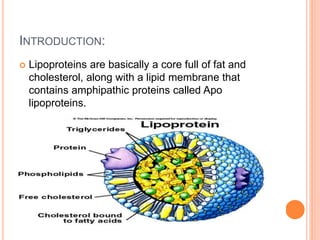
 Lipoproteins are basically a core full of fat and
cholesterol, along with a lipid membrane that
contains amphipathic proteins called Apo
lipoproteins.
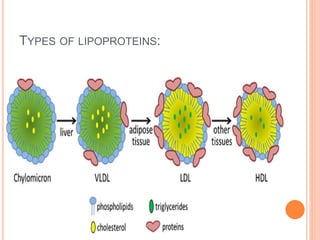
TYPES OF LIPOPROTEINS:
LIPID AND PROTEIN CONTENT OF LIP-
PROTEINS:
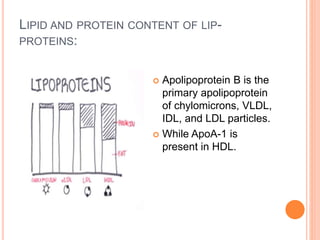
 Apolipoprotein B is the
primary apolipoprotein
of chylomicrons, VLDL,
IDL, and LDL particles.
 While ApoA-1 is
present in HDL.
FUNCTION OF CHYLOMICRONS AND
VLDL:
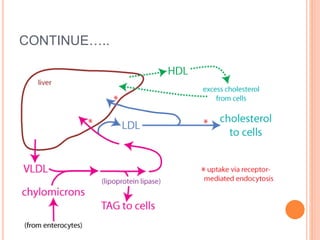
 Chylomicrons and VLDL deliver TAG to cells in the
body. triglyceride-rich.
 Chylomicrons are synthesized by enterocytes VLDL
is synthesized in the liver.
 The function of these lipoproteins is to deliver
energy-rich triacylglycerol (TAG) to cells in the body
.
 TAG is stripped from both through the action of
lipoprotein lipase,
 an enzyme that is found on the surface of
endothelial cells.
 convert TAG to fatty acids and monoglycerides.
 Used by the body or stored.
LOW DENSITY LIPOPROTEINS:
 As VLDL particles are stripped of triacylglycerol,
These particles are remodeled at the liver and
transformed into LDL.
 Cells take up cholesterol by receptor-mediated
endocytosis. LDL binds to a specific LDL receptor
and is internalized in an endocytic vesicle.
 Receptors are recycled to the cell surface, while
cholesterol is further processed in the body.
FUNCTION OF LDL:
 The function of LDL is to deliver cholesterol to cells,
where it is used in membranes, or for the synthesis
of steroid hormones .
HIGH DENSITY LIPO-PROTEINS:
 Additionally, excess cholesterol from cells is
brought back to the liver by HDL in a process
known as reverse cholesterol transport .
 HDL is synthesized and secreted by the liver and
small intestine.
 It travels in the circulation where it gathers
cholesterol to form mature HDL, which then returns
the cholesterol to the liver via various pathways.
CONTINUE…..
Lipoproteins

Lipoproteins

  • 1.
  • 2.
    INTRODUCTION:  Lipoproteins arebasically a core full of fat and cholesterol, along with a lipid membrane that contains amphipathic proteins called Apo lipoproteins.
  • 3.
  • 4.
    LIPID AND PROTEINCONTENT OF LIP- PROTEINS:  Apolipoprotein B is the primary apolipoprotein of chylomicrons, VLDL, IDL, and LDL particles.  While ApoA-1 is present in HDL.
  • 5.
    FUNCTION OF CHYLOMICRONSAND VLDL:  Chylomicrons and VLDL deliver TAG to cells in the body. triglyceride-rich.  Chylomicrons are synthesized by enterocytes VLDL is synthesized in the liver.  The function of these lipoproteins is to deliver energy-rich triacylglycerol (TAG) to cells in the body .  TAG is stripped from both through the action of lipoprotein lipase,  an enzyme that is found on the surface of endothelial cells.  convert TAG to fatty acids and monoglycerides.  Used by the body or stored.
  • 6.
    LOW DENSITY LIPOPROTEINS: As VLDL particles are stripped of triacylglycerol, These particles are remodeled at the liver and transformed into LDL.  Cells take up cholesterol by receptor-mediated endocytosis. LDL binds to a specific LDL receptor and is internalized in an endocytic vesicle.  Receptors are recycled to the cell surface, while cholesterol is further processed in the body.
  • 7.
    FUNCTION OF LDL: The function of LDL is to deliver cholesterol to cells, where it is used in membranes, or for the synthesis of steroid hormones .
  • 8.
    HIGH DENSITY LIPO-PROTEINS: Additionally, excess cholesterol from cells is brought back to the liver by HDL in a process known as reverse cholesterol transport .  HDL is synthesized and secreted by the liver and small intestine.  It travels in the circulation where it gathers cholesterol to form mature HDL, which then returns the cholesterol to the liver via various pathways.
  • 9.

Editor's Notes

  • #9 Excess cholesterol is eliminated from the body via the liver, which secretes cholesterol in bile or converts it to bile salts. The liver removes LDL and other lipoproteins from the circulation by receptor-mediated endocytosis.
  • #10 Reverse cholesterol transport is the net movement of cholesterol from peripheral tissues back to the liver first via entering the lymphatic system, then the bloodstream.