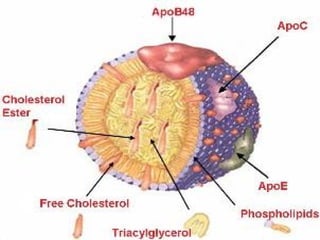
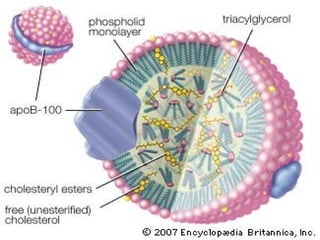
Structure of Lipoproteins
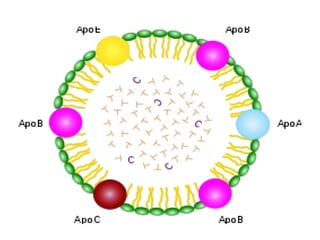
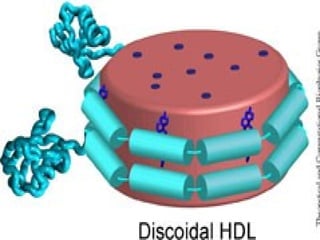
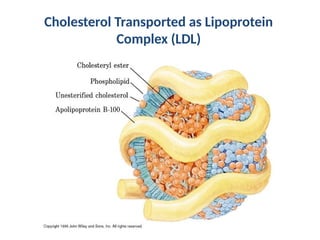
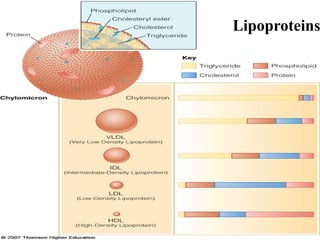
•The non polar /hydrophobic Lipids TAG and
Cholesterol Ester are gathered centrally to
form the core of LipoProtein particle.
• At the periphery of Lipoprotein are
Apoprotein and Amphipathic Lipids viz
Phospholipids and Cholesterol.
11.
• The Apoproteinand polar groups of
Amphipathic Lipids impart
hydrophilic property to Lipoprotein
molecules
• This helps in transportation of Lipids
• From site of origin to site of
utilization through blood.
Functions Of Lipoproteins
•Lipoproteins serve as a vehicle in
transportation of non polar Lipids
• From the site of its biosynthesis to
the site of utilization through
aqueous media of blood or lymph.
• Depending uponthe composition and other
properties following are the types of
Lipoproteins:
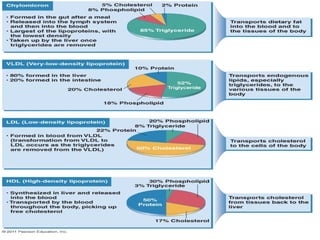
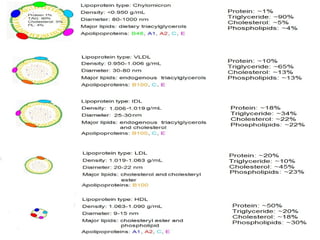
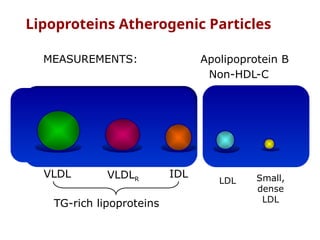
–Chylomicrons (CM)
–Very Low Density Lipoprotein (VLDL)
–Low Density Lipoproteins (LDL)
–High Density Lipoproteins (HDL)
–Free Fatty acid -Albumin
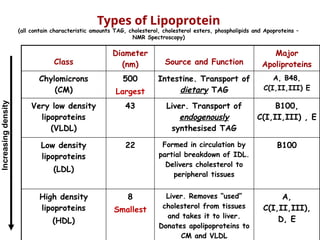
Types of Lipoprotein
(allcontain characteristic amounts TAG, cholesterol, cholesterol esters, phospholipids and Apoproteins –
NMR Spectroscopy)
Class
Diameter
(nm) Source and Function
Major
Apoliproteins
Chylomicrons
(CM)
500
Largest
Intestine. Transport of
dietary TAG
A, B48,
C(I,II,III) E
Very low density
lipoproteins
(VLDL)
43 Liver. Transport of
endogenously
synthesised TAG
B100,
C(I,II,III) , E
Low density
lipoproteins
(LDL)
22 Formed in circulation by
partial breakdown of IDL.
Delivers cholesterol to
peripheral tissues
B100
High density
lipoproteins
(HDL)
8
Smallest
Liver. Removes “used”
cholesterol from tissues
and takes it to liver.
Donates apolipoproteins to
CM and VLDL
A,
C(I,II,III),
D, E
Increasing
density
21.
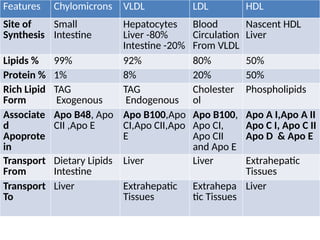
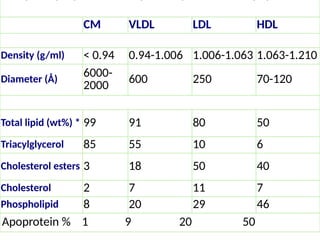
Features Chylomicrons VLDLLDL HDL
Site of
Synthesis
Small
Intestine
Hepatocytes
Liver -80%
Intestine -20%
Blood
Circulation
From VLDL
Nascent HDL
Liver
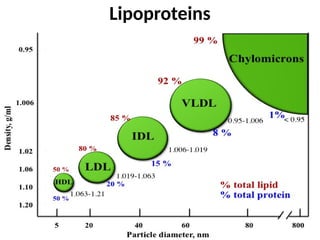
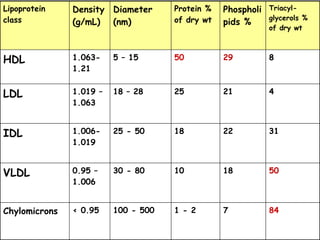
Lipids % 99% 92% 80% 50%
Protein % 1% 8% 20% 50%
Rich Lipid
Form
TAG
Exogenous
TAG
Endogenous
Cholester
ol
Phospholipids
Associate
d
Apoprote
in
Apo B48, Apo
CII ,Apo E
Apo B100,Apo
CI,Apo CII,Apo
E
Apo B100,
Apo CI,
Apo CII
and Apo E
Apo A I,Apo A II
Apo C I, Apo C II
Apo D & Apo E
Transport
From
Dietary Lipids
Intestine
Liver Liver Extrahepatic
Tissues
Transport
To
Liver Extrahepatic
Tissues
Extrahepa
tic Tissues
Liver
HDL Is Associated
WithEnzyme LCAT
Responsible For
Cholesterol
Esterification And Its
Excretion
25.
• HDL hasscavenging role with
protective mechanism.
• HDL Transports Cholesterol from
Extrahepatic tissues back to Liver for
its excretion.
26.
• HDL reducesrisk of
Atherosclerosis.
• HDL clears the body Lipids and do
not allow accumulation of Lipids
in blood.
27.
•Thus when thelevels of
HDL are within normal
range
•Cholesterol associated
with HDL is termed as
Good Cholesterol
28.
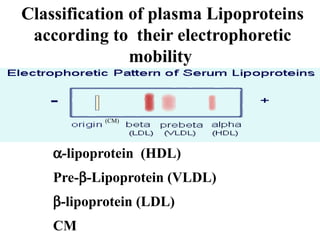
• Based onElectrophoretic pattern
the Lipoproteins are termed as:
–LDL: Beta Lipoproteins
–VLDL: Pre Beta Lipoproteins
–HDL: Alpha Lipoproteins
29.
Classification of plasmaLipoproteins
according to their electrophoretic
mobility
(CM)
a-lipoprotein (HDL)
Pre-b-Lipoprotein (VLDL)
b-lipoprotein (LDL)
CM
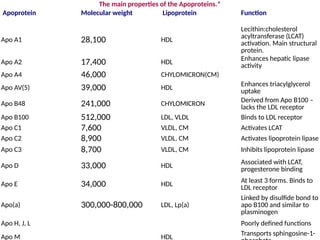
The main propertiesof the Apoproteins.*
Apoprotein Molecular weight Lipoprotein Function
Apo A1 28,100 HDL
Lecithin:cholesterol
acyltransferase (LCAT)
activation. Main structural
protein.
Apo A2 17,400 HDL Enhances hepatic lipase
activity
Apo A4 46,000 CHYLOMICRON(CM)
Apo AV(5) 39,000 HDL
Enhances triacylglycerol
uptake
Apo B48 241,000 CHYLOMICRON
Derived from Apo B100 –
lacks the LDL receptor
Apo B100 512,000 LDL, VLDL Binds to LDL receptor
Apo C1 7,600 VLDL, CM Activates LCAT
Apo C2 8,900 VLDL, CM Activates lipoprotein lipase
Apo C3 8,700 VLDL, CM Inhibits lipoprotein lipase
Apo D 33,000 HDL
Associated with LCAT,
progesterone binding
Apo E 34,000 HDL At least 3 forms. Binds to
LDL receptor
Apo(a) 300,000-800,000 LDL, Lp(a)
Linked by disulfide bond to
apo B100 and similar to
plasminogen
Apo H, J, L Poorly defined functions
Apo M HDL
Transports sphingosine-1-
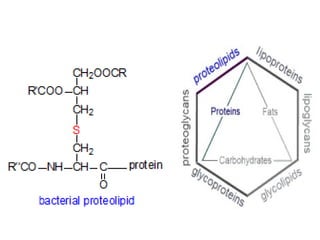
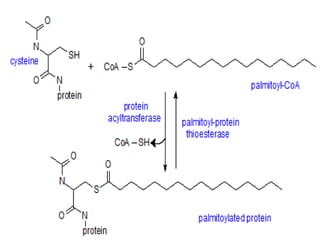
Proteolipids/ Lipophilin
• Proteolipidsare compound lipids
which have more content of
Proteins than Lipids.
• Proteolipid is a transmembrane
domain protein bound with
Lipids.
49.
Occurrence Of Proteolipids
•Proteolipids are structural Lipids
• Present on the extracellular
side of the membrane.
• Proteolipids are also present in
Myelin Sheath.
Editor's Notes
#30 Most proteins have densities of about 1.3 – 1.4 g/mL and lipid aggregates usually
have densities of about 0.8 g/mL Circulation. 2004 Jun 15;109(23 Suppl 1):III2-7