FORCEP
DELIVERY
Prepared by: Rashmi Goswami
Forceps
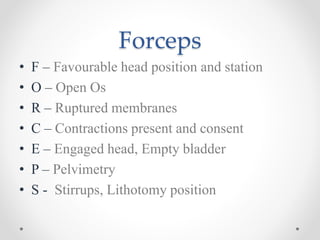
• F – Favourable head position and station
• O – Open Os
• R – Ruptured membranes
• C – Contractions present and consent
• E – Engaged head, Empty bladder
• P – Pelvimetry
• S - Stirrups, Lithotomy position
Introduction
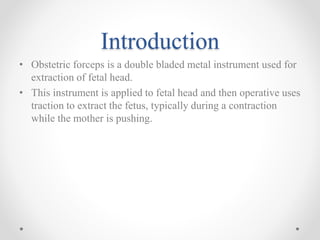
• Obstetric forceps is a double bladed metal instrument used for
extraction of fetal head.
• This instrument is applied to fetal head and then operative uses
traction to extract the fetus, typically during a contraction
while the mother is pushing.
Definition
• Obstetric Forceps is a pair of instruments
specially designed to assist the extraction of
the fetal head and thereby accomplishing
delivery of the fetus.
• Forceps delivery is a means of extracting the
fetus with the aid of obstetric forceps when it
is advisable or impossible for the mother
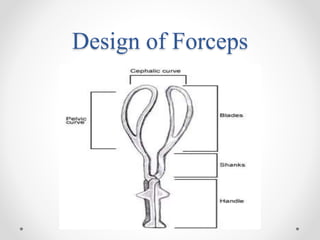
Design of Forceps
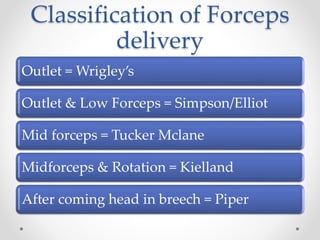
Classification of Forceps
delivery
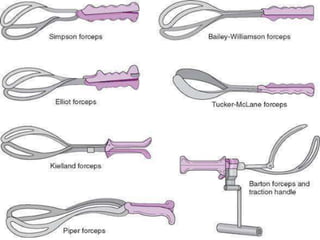
Outlet = Wrigley’s
Outlet & Low Forceps = Simpson/Elliot
Mid forceps = Tucker Mclane
Midforceps & Rotation = Kielland
After coming head in breech = Piper
Classification of Forceps
delivery
• Outlet forceps – Scalp visible at the vulva without separating
the labia.
• Low forceps – Vertex at +2 Station
• Midforceps – Head is engaged but leading part above +2
station.
- Sagittal suture not in the AP plane of the mother.
Types of forceps application
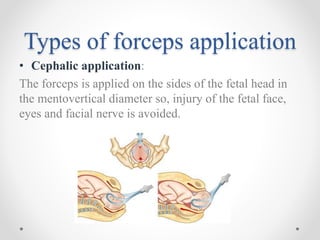
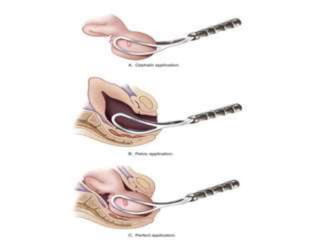
• Cephalic application:
The forceps is applied on the sides of the fetal head in
the mentovertical diameter so, injury of the fetal face,
eyes and facial nerve is avoided.
• Pelvic application:
The forceps is applied along the maternal pelvic
wall irrespective to the position of the head, it is
easier for application but carries a great risk of
fetal injuries.
• Cephalo-pelvic application:
It is the ideal and possible application when the
occiput is directly anterior or in mento-anterior
diameter position.
Action of traction
• Traction: is the main action
• Rotation: in deep transverse arrest, persistent
occipito-posterior and mento-posterior.
Indications
1. Prolonged 2nd stage
2. It is the prolongation for more than 1 hour in Primigravida or
30 minutes in Multipara. This may be due to:
- Poor voluntary bearing down
- Large fetus
- Rigid perineum
- Malposition: persistent occipito-posterior and deep transverse
arrest.
Indication
Maternal Fetal
Maternal distress are manifested
by:
• Exhaustion
• Pulse greater than 100 beats
per min
• Temperature greater than 38 C
• Sign of dehydration
• Maternal diseases as - Heart
disease, Pulmonary TB, Pre
Eclampsia and Eclampsia.
• Fetal distress
• Prolapsed pulsating cord
• Preterm delivery
• After coming head in breech
delivery
Pre-requisites for forceps
application
• Anesthesia: general, epidural, spinal, pudental block.
• Adequate pelvic outlet
• Aseptic measures
• Bladder and bowel evacuation
• Contractions of the uterus should be present
• Dilatation of the cervix should be fully
• Engaged head
• Forewater rupture
• Favourable position and presentation
Management
• Re-assessment : the forceps is removed and the
patient is re-examined to detect the cause and correct
it if possible.
• Caesarean section: it is indicated in uncorrectable
causes as CPD and contracted outlet.
• Exploration of the birth canal: for any injuries.
Contraindications
• Fetal prematurity
• Known fetal dimineralizing diseases (e.g osteoporosis
imperfecta)
• Unengaged head
• Unknown fetal position
• Malpresentation
Complications
Maternal Fetal
• Extension of the episiotomy
• Perineal tear
• Vaginal tear
• Cervical lacerations
• Bladder injury
• Rupture uterus
• Pelvic nerve injuries
• Puerperal infections
• Fracture of the skull
• Intracranial hemorrhage
• Facial nerve palsy
• Trauma to the eyes, face,
scalp

............FORCEPS DELIVERY............

  • 1.
  • 2.
    Forceps • F –Favourable head position and station • O – Open Os • R – Ruptured membranes • C – Contractions present and consent • E – Engaged head, Empty bladder • P – Pelvimetry • S - Stirrups, Lithotomy position
  • 3.
    Introduction • Obstetric forcepsis a double bladed metal instrument used for extraction of fetal head. • This instrument is applied to fetal head and then operative uses traction to extract the fetus, typically during a contraction while the mother is pushing.
  • 4.
    Definition • Obstetric Forcepsis a pair of instruments specially designed to assist the extraction of the fetal head and thereby accomplishing delivery of the fetus. • Forceps delivery is a means of extracting the fetus with the aid of obstetric forceps when it is advisable or impossible for the mother
  • 5.
  • 6.
    Classification of Forceps delivery Outlet= Wrigley’s Outlet & Low Forceps = Simpson/Elliot Mid forceps = Tucker Mclane Midforceps & Rotation = Kielland After coming head in breech = Piper
  • 8.
    Classification of Forceps delivery •Outlet forceps – Scalp visible at the vulva without separating the labia. • Low forceps – Vertex at +2 Station • Midforceps – Head is engaged but leading part above +2 station. - Sagittal suture not in the AP plane of the mother.
  • 9.
    Types of forcepsapplication • Cephalic application: The forceps is applied on the sides of the fetal head in the mentovertical diameter so, injury of the fetal face, eyes and facial nerve is avoided.
  • 10.
    • Pelvic application: Theforceps is applied along the maternal pelvic wall irrespective to the position of the head, it is easier for application but carries a great risk of fetal injuries. • Cephalo-pelvic application: It is the ideal and possible application when the occiput is directly anterior or in mento-anterior diameter position.
  • 12.
    Action of traction •Traction: is the main action • Rotation: in deep transverse arrest, persistent occipito-posterior and mento-posterior.
  • 13.
    Indications 1. Prolonged 2ndstage 2. It is the prolongation for more than 1 hour in Primigravida or 30 minutes in Multipara. This may be due to: - Poor voluntary bearing down - Large fetus - Rigid perineum - Malposition: persistent occipito-posterior and deep transverse arrest.
  • 14.
    Indication Maternal Fetal Maternal distressare manifested by: • Exhaustion • Pulse greater than 100 beats per min • Temperature greater than 38 C • Sign of dehydration • Maternal diseases as - Heart disease, Pulmonary TB, Pre Eclampsia and Eclampsia. • Fetal distress • Prolapsed pulsating cord • Preterm delivery • After coming head in breech delivery
  • 15.
    Pre-requisites for forceps application •Anesthesia: general, epidural, spinal, pudental block. • Adequate pelvic outlet • Aseptic measures • Bladder and bowel evacuation • Contractions of the uterus should be present • Dilatation of the cervix should be fully • Engaged head • Forewater rupture • Favourable position and presentation
  • 16.
    Management • Re-assessment :the forceps is removed and the patient is re-examined to detect the cause and correct it if possible. • Caesarean section: it is indicated in uncorrectable causes as CPD and contracted outlet. • Exploration of the birth canal: for any injuries.
  • 17.
    Contraindications • Fetal prematurity •Known fetal dimineralizing diseases (e.g osteoporosis imperfecta) • Unengaged head • Unknown fetal position • Malpresentation
  • 18.
    Complications Maternal Fetal • Extensionof the episiotomy • Perineal tear • Vaginal tear • Cervical lacerations • Bladder injury • Rupture uterus • Pelvic nerve injuries • Puerperal infections • Fracture of the skull • Intracranial hemorrhage • Facial nerve palsy • Trauma to the eyes, face, scalp