ZZZZZ WORKSHOP
MUS WELLNESS
ZZZZZZ OBJECTIVES
• As in, Zzzzzzzzzzz. Hopefully, you might sleep through this
workshop, and it won’t be due to boredom. We’ll talk about
healthy sleeping patterns and habits, strategies for better
sleep, and hopefully get to practice a little.
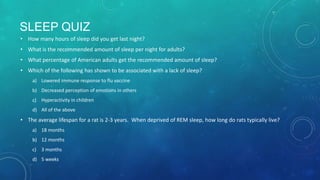
SLEEP QUIZ
• How many hours of sleep did you get last night?
• What is the recommended amount of sleep per night for adults?
• What percentage of American adults get the recommended amount of sleep?
• Which of the following has shown to be associated with a lack of sleep?
a) Lowered immune response to flu vaccine
b) Decreased perception of emotions in others
c) Hyperactivity in children
d) All of the above
• The average lifespan for a rat is 2-3 years. When deprived of REM sleep, how long do rats typically live?
a) 18 months
b) 12 months
c) 3 months
d) 5 weeks
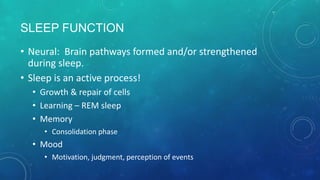
SLEEP FUNCTION
• Neural: Brain pathways formed and/or strengthened
during sleep.
• Sleep is an active process!
• Growth & repair of cells
• Learning – REM sleep
• Memory
• Consolidation phase
• Mood
• Motivation, judgment, perception of events
SLEEP CYCLE
• Non-REM sleep
• Stage 1- light sleep, muscles relax, awakened easily
• Stage 2 – 50% of total sleep time, HR slows, BP lowers
• Stage 3 & 4 – 20% total sleep time – very deep sleep, restorative stages
crucial for feeling well rested
• Delta waves
SLEEP CYCLE
• REM – 20% total sleep time
• Dreaming occurs
• Arms & legs temporarily paralyzed
• Breathing/BP/HR irregular
• Stimulates brain regions associated with learning and making memories
• Sleep stages repeat continuously throughout the night w/REM becoming
longer
• Typical sleep cycle is 90 minutes
• REM & Non-REM both vital to proper body functioning
CIRCADIAN RHYTHM
• Circadian Rhythm – physiological changes that follow a 24 hour
cycle
• Driven by internal clock
• SCN (suprachiasmatic nucleus)
• Responsive to light & dark
• Triggers hormone production & body temperature regulation to produce
natural fluctuations in sleepiness & alertness
• Adults: feel most tired between midnight – 7AM (2-4AM in particular) and 1-4PM
• Melatonin & Cortisol
• Exposure to bright light in the late evening may disrupt melatonin peak
• Rhythm changes with age/life stages
ADDITIONAL BIOLOGICAL INFLUENCES
• Sleep promoters
• Adenosine – builds up during awake time, broken down during sleep
• Sleep/wake homeostasis
• Sleep debt
• Caffeine blocks adenosine cell receptors
• Estrogen & progesterone
• Cytokines – immune system cells
• Increase need for sleep (may help body fight infection by conserving resources)
SLEEP DEPRIVATION
• Link to chronic diseases
• Diabetes
• Sleep associated with improved blood sugar control
• Study: Healthy young men allowed to sleep only 4 hours/night for 6 nights had
insulin & glucose levels that matched diagnosis for pre-diabetes
• Cardiovascular Disease
• Cardiovascular system needs rest too! System given a little break (our bodies need
that dip in BP and slow down of HR)
• Sleep apnea = significant risk factor for hypertension, stroke, coronary heart
disease, and arrhythmias
SLEEP DEPRIVATION
• Link to chronic diseases
• Obesity
• Sleep is a powerful regulator of appetite
• During sleep
• Grehlin (appetite stimulant) decreases
• Leptin (appetite suppressant) increases
• Studies show sleep deprivation increased intake of calories and carbohydrates
• Depression
• Sleep disturbance both a symptom and perhaps a cause
FOUR MOST COMMON SLEEP DISORDERS
• Four most common disorders
• Insomnia – trouble falling or staying asleep
• Temporary vs chronic (3 nights/week for > 1 month)
• Chronic insomnia usually a secondary condition, caused by factors such as medications,
depression/anxiety or other neuro/pysch disorders, hormones
• Sleep apnea – pauses in breathing while sleeping due to airway getting blocked by soft
tissue
• Loud, frequent snoring most common symptom
• 50% of people undiagnosed
• Restless Leg Syndrome
• Narcolepsy
FOUR MOST COMMON SLEEP DISORDERS
When should I talk to my doctor?
• It takes more than 30 minutes to fall asleep at night
• You awaken frequently at night and then have trouble
falling back to sleep again
• You awaken too early in the AM
• You often don’t feel well rested despite spending 7–8
hours or more asleep at night.
• You feel sleepy during the day and fall asleep within
5 minutes if you have an opportunity to nap, or you fall
asleep unexpectedly or at inappropriate times during
the day.
• Your bed partner claims you snore loudly, snort, gasp, or
make choking sounds while you sleep, or your partner
notices that your breathing stops for short periods
• You have creeping, tingling, or crawling feelings in your
legs that are relieved by moving or massaging them,
especially in the evening or when you are trying to fall
asleep
• You have sudden muscle weakness when you are angry
or fearful, or when you laugh
• You feel as though you cannot move when you first wake
up
• Your bed partner notices your arms or legs jerk often
during sleep
• You regularly need stimulants to stay awake during the
day
SLEEP RECOMMENDATIONS
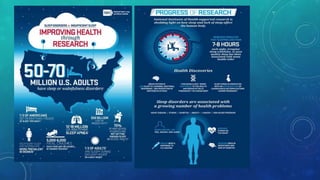
• 7-8 hours per day for adults
• Depends somewhat on the individual (5-9 hrs)
• Quality & timing as important
Naps!
• 20-30 minutes. Not after 5PM
• Long naps can trigger sleep inertia
THE TRAP OF THE 21ST CENTURY WEST
• We are busier than ever. We live in a non-stop, on-the-go, information age.
Many people struggle with work/life balance and the cumulative stress of
multi-tasking and a myriad of responsibilities.
• What is sacrificed when we cannot complete all of the tasks?
• Exercise
• Recreation
• Good Nutrition
• SLEEP!
TIPS TO IMPROVE SLEEP!
• Avoid caffeine 4-6 hours before bed, avoid nicotine too
• (actually, go ahead and avoid nicotine all the time)
• Limit or avoid alcohol before bed
• Inhibits REM and stage 3 non-REM sleep
TIPS TO IMPROVE SLEEP!
• Sleep-inducing environment – quiet, dark, cool
• Temperature – 60-75 degrees
• Well-ventilated
• Eliminate distractions – computer, TV, bright lights, phone
• Comfortable bed
• Clock face – don’t be a clock watcher
• Limit bedroom activities to the two S’s
TIPS TO IMPROVE SLEEP!
• Stick to a consistent sleep schedule as much as possible
• Even on weekends
• Soothing pre-sleep routine
• Hot bath
• Non-stressful or stimulating activities
• Light reading or listening to music
• Avoid large meals and/or lots of fluids before bed
• Get enough physical activity
• Try to end 3 hours before going to sleep
• Get up if not asleep in 20 minutes
• Relaxation exercises – mental & physical
LET’S RELAX, SHALL WE?
• montanamovesandmeals.com
• wellness.mus.edu
• Twitter:
• @montanameals
• @montanamoves

Zzzzz workshop

  • 1.
  • 2.
    ZZZZZZ OBJECTIVES • Asin, Zzzzzzzzzzz. Hopefully, you might sleep through this workshop, and it won’t be due to boredom. We’ll talk about healthy sleeping patterns and habits, strategies for better sleep, and hopefully get to practice a little.
  • 3.
    SLEEP QUIZ • Howmany hours of sleep did you get last night? • What is the recommended amount of sleep per night for adults? • What percentage of American adults get the recommended amount of sleep? • Which of the following has shown to be associated with a lack of sleep? a) Lowered immune response to flu vaccine b) Decreased perception of emotions in others c) Hyperactivity in children d) All of the above • The average lifespan for a rat is 2-3 years. When deprived of REM sleep, how long do rats typically live? a) 18 months b) 12 months c) 3 months d) 5 weeks
  • 4.
    SLEEP FUNCTION • Neural:Brain pathways formed and/or strengthened during sleep. • Sleep is an active process! • Growth & repair of cells • Learning – REM sleep • Memory • Consolidation phase • Mood • Motivation, judgment, perception of events
  • 5.
    SLEEP CYCLE • Non-REMsleep • Stage 1- light sleep, muscles relax, awakened easily • Stage 2 – 50% of total sleep time, HR slows, BP lowers • Stage 3 & 4 – 20% total sleep time – very deep sleep, restorative stages crucial for feeling well rested • Delta waves
  • 6.
    SLEEP CYCLE • REM– 20% total sleep time • Dreaming occurs • Arms & legs temporarily paralyzed • Breathing/BP/HR irregular • Stimulates brain regions associated with learning and making memories • Sleep stages repeat continuously throughout the night w/REM becoming longer • Typical sleep cycle is 90 minutes • REM & Non-REM both vital to proper body functioning
  • 7.
    CIRCADIAN RHYTHM • CircadianRhythm – physiological changes that follow a 24 hour cycle • Driven by internal clock • SCN (suprachiasmatic nucleus) • Responsive to light & dark • Triggers hormone production & body temperature regulation to produce natural fluctuations in sleepiness & alertness • Adults: feel most tired between midnight – 7AM (2-4AM in particular) and 1-4PM • Melatonin & Cortisol • Exposure to bright light in the late evening may disrupt melatonin peak • Rhythm changes with age/life stages
  • 8.
    ADDITIONAL BIOLOGICAL INFLUENCES •Sleep promoters • Adenosine – builds up during awake time, broken down during sleep • Sleep/wake homeostasis • Sleep debt • Caffeine blocks adenosine cell receptors • Estrogen & progesterone • Cytokines – immune system cells • Increase need for sleep (may help body fight infection by conserving resources)
  • 9.
    SLEEP DEPRIVATION • Linkto chronic diseases • Diabetes • Sleep associated with improved blood sugar control • Study: Healthy young men allowed to sleep only 4 hours/night for 6 nights had insulin & glucose levels that matched diagnosis for pre-diabetes • Cardiovascular Disease • Cardiovascular system needs rest too! System given a little break (our bodies need that dip in BP and slow down of HR) • Sleep apnea = significant risk factor for hypertension, stroke, coronary heart disease, and arrhythmias
  • 10.
    SLEEP DEPRIVATION • Linkto chronic diseases • Obesity • Sleep is a powerful regulator of appetite • During sleep • Grehlin (appetite stimulant) decreases • Leptin (appetite suppressant) increases • Studies show sleep deprivation increased intake of calories and carbohydrates • Depression • Sleep disturbance both a symptom and perhaps a cause
  • 11.
    FOUR MOST COMMONSLEEP DISORDERS • Four most common disorders • Insomnia – trouble falling or staying asleep • Temporary vs chronic (3 nights/week for > 1 month) • Chronic insomnia usually a secondary condition, caused by factors such as medications, depression/anxiety or other neuro/pysch disorders, hormones • Sleep apnea – pauses in breathing while sleeping due to airway getting blocked by soft tissue • Loud, frequent snoring most common symptom • 50% of people undiagnosed • Restless Leg Syndrome • Narcolepsy
  • 12.
    FOUR MOST COMMONSLEEP DISORDERS When should I talk to my doctor? • It takes more than 30 minutes to fall asleep at night • You awaken frequently at night and then have trouble falling back to sleep again • You awaken too early in the AM • You often don’t feel well rested despite spending 7–8 hours or more asleep at night. • You feel sleepy during the day and fall asleep within 5 minutes if you have an opportunity to nap, or you fall asleep unexpectedly or at inappropriate times during the day. • Your bed partner claims you snore loudly, snort, gasp, or make choking sounds while you sleep, or your partner notices that your breathing stops for short periods • You have creeping, tingling, or crawling feelings in your legs that are relieved by moving or massaging them, especially in the evening or when you are trying to fall asleep • You have sudden muscle weakness when you are angry or fearful, or when you laugh • You feel as though you cannot move when you first wake up • Your bed partner notices your arms or legs jerk often during sleep • You regularly need stimulants to stay awake during the day
  • 13.
    SLEEP RECOMMENDATIONS • 7-8hours per day for adults • Depends somewhat on the individual (5-9 hrs) • Quality & timing as important Naps! • 20-30 minutes. Not after 5PM • Long naps can trigger sleep inertia
  • 14.
    THE TRAP OFTHE 21ST CENTURY WEST • We are busier than ever. We live in a non-stop, on-the-go, information age. Many people struggle with work/life balance and the cumulative stress of multi-tasking and a myriad of responsibilities. • What is sacrificed when we cannot complete all of the tasks? • Exercise • Recreation • Good Nutrition • SLEEP!
  • 16.
    TIPS TO IMPROVESLEEP! • Avoid caffeine 4-6 hours before bed, avoid nicotine too • (actually, go ahead and avoid nicotine all the time) • Limit or avoid alcohol before bed • Inhibits REM and stage 3 non-REM sleep
  • 17.
    TIPS TO IMPROVESLEEP! • Sleep-inducing environment – quiet, dark, cool • Temperature – 60-75 degrees • Well-ventilated • Eliminate distractions – computer, TV, bright lights, phone • Comfortable bed • Clock face – don’t be a clock watcher • Limit bedroom activities to the two S’s
  • 18.
    TIPS TO IMPROVESLEEP! • Stick to a consistent sleep schedule as much as possible • Even on weekends • Soothing pre-sleep routine • Hot bath • Non-stressful or stimulating activities • Light reading or listening to music • Avoid large meals and/or lots of fluids before bed • Get enough physical activity • Try to end 3 hours before going to sleep • Get up if not asleep in 20 minutes • Relaxation exercises – mental & physical
  • 19.
  • 20.
    • montanamovesandmeals.com • wellness.mus.edu •Twitter: • @montanameals • @montanamoves