
By Ralf Marcoux Skovgaard
What is sleep ?
Sleep is a state of rest, where body
and brain is regenerating energy and
power.
Sleep is an active process involving
specific cues for its regulation.
Why is sleep necessary?
Sleep is necessary to rebuild and regenerate
the physical as the mental state.
Lack of sleep/bad sleep can cause:
 Fatigue, daytime sleepiness and clumsiness
 Changed emotional and social behaviour
 Reduced working capability
 Health risks
See list at the end of this presentation of some effects of lack of
sleep/bad sleep.
Sleeping pattern and its
stages
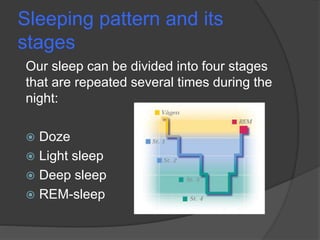
Our sleep can be divided into four stages
that are repeated several times during the
night:
 Doze
 Light sleep
 Deep sleep
 REM-sleep
What is REM sleep
Rapid eye movement (REM) sleep is a stage of
sleep characterized by the rapid and random
movement of the eyes.
Usually, REM sleep happens 90 minutes after
you fall asleep. The first period of REM typically
lasts 10 minutes. Each of your later REM stages
gets longer, and the final one may last up to an
hour. Your heart rate and breathing quickens.
You can have intense dreams during REM sleep,
since your brain is more active.
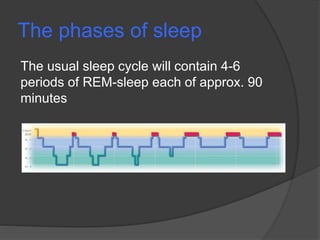
The phases of sleep
The usual sleep cycle will contain 4-6
periods of REM-sleep each of approx. 90
minutes
Interruptions of sleep
Studies show that just one single night with
interruption of your sleep can cause:
 Sadness / depression
 Fatigue
 Confusion
There has not been found big differences
between interrupted sleep and lack of sleep.
Resumption of sleep after
interruption
American studies show that any
interruption of the sleep means that the
body has to start all over, which could
imply that you do not reach the most
regenerating deeper phases of the
sleep.
Sleepiness Causes
Accidents
Studies show that sleep loss and poor-
quality sleep lead to accidents and injuries
on the job.
In one study, workers who complained
about excessive daytime sleepiness had
significantly more work accidents,
particularly repeated work accidents. They
also had more sick days per accident.
Sleep Loss Dumbs You
Down
Sleep plays a critical role in thinking and learning.
Lack of sleep hurts these cognitive processes in
many ways.
First, it impairs attention, alertness, concentration,
reasoning, and problem solving. This makes it more
difficult to learn efficiently.
Second, during the night, various sleep cycles play a
role in “consolidating” memories in the mind. If you
don’t get enough sleep, you won’t be able to
remember what you learned and experienced during
the day.
Sleep Deprivation Can Lead to
Serious Health Problems
Sleep disorders and chronic sleep loss can
put you at risk for:
 Heart disease
 Heart attack
 Heart failure
 Irregular heartbeat
 High blood pressure
 Stroke
 Diabetes
Lack of Sleep Kills Sex
Drive
Sleep specialists say that sleep-deprived
men and women report lower libidos and
less interest in sex. Depleted energy,
sleepiness, and increased tension may be
largely to blame.
Sleepiness Is Depressing
Over time, lack of sleep and sleep disorders
can contribute to the symptoms of
depression. In a 2005 Sleep in America poll,
people who were diagnosed with depression
or anxiety were more likely to sleep less than
six hours at night.
Insomnia and depression feed on each other.
Sleep loss often aggravates the symptoms of
depression, and depression can make it more
difficult to fall asleep.
Lack of Sleep Ages Your
Skin
Most people have experienced sallow skin
and puffy eyes after a few nights of missed
sleep. But it turns out that chronic sleep loss
can lead to lacklustre skin, fine lines, and
dark circles under the eyes.
When you don’t get enough sleep, your body
releases more of the stress hormone cortisol.
In excess amounts, cortisol can break down
skin collagen, the protein that keeps skin
smooth and elastic.
Sleepiness Makes You
Forgetful
Trying to keep your memory sharp? Try
getting plenty of sleep.
In 2009, American and French researchers
determined that brain events called “sharp
wave ripples” are responsible for
consolidating memory. The ripples also
transfer learned information from the
hippocampus to the neocortex of the brain,
where long-term memories are stored. Sharp
wave ripples occur mostly during the deepest
levels of sleep.
Losing Sleep Can Make You Gain
Weight
When it comes to body weight, it may be that
if you snooze, you lose. Lack of sleep seems
to be related to an increase in hunger and
appetite, and possibly to obesity.
Recent research has focused on the link
between sleep and the peptides that regulate
appetite.
Not only does sleep loss appear to stimulate
appetite. It also stimulates cravings for high-
fat, high-carbohydrate foods.
Lack of Sleep May Increase Risk of
Death
In the “Whitehall II Study,” British researchers
looked at how sleep patterns affected the
mortality of more than 10,000 British civil
servants over two decades.
The results, published in 2007, showed that
those who had cut their sleep from seven to
five hours or fewer a night nearly doubled
their risk of death from all causes. In
particular, lack of sleep doubled the risk of
death from cardiovascular disease.
Sleep Loss Impairs Judgment,
Especially About Sleep
Lack of sleep can affect our interpretation of
events. This hurts our ability to make sound
judgments because we may not assess
situations accurately and act on them wisely.
Sleep-deprived people seem to be especially
prone to poor judgment when it comes to
assessing what lack of sleep is doing to them.
In our increasingly fast-paced world,
functioning on less sleep has become a kind
of badge of honour.

Sleep

  • 1.
    By Ralf MarcouxSkovgaard
  • 2.
    What is sleep? Sleep is a state of rest, where body and brain is regenerating energy and power. Sleep is an active process involving specific cues for its regulation.
  • 3.
    Why is sleepnecessary? Sleep is necessary to rebuild and regenerate the physical as the mental state. Lack of sleep/bad sleep can cause:  Fatigue, daytime sleepiness and clumsiness  Changed emotional and social behaviour  Reduced working capability  Health risks See list at the end of this presentation of some effects of lack of sleep/bad sleep.
  • 4.
    Sleeping pattern andits stages Our sleep can be divided into four stages that are repeated several times during the night:  Doze  Light sleep  Deep sleep  REM-sleep
  • 5.
    What is REMsleep Rapid eye movement (REM) sleep is a stage of sleep characterized by the rapid and random movement of the eyes. Usually, REM sleep happens 90 minutes after you fall asleep. The first period of REM typically lasts 10 minutes. Each of your later REM stages gets longer, and the final one may last up to an hour. Your heart rate and breathing quickens. You can have intense dreams during REM sleep, since your brain is more active.
  • 6.
    The phases ofsleep The usual sleep cycle will contain 4-6 periods of REM-sleep each of approx. 90 minutes
  • 7.
    Interruptions of sleep Studiesshow that just one single night with interruption of your sleep can cause:  Sadness / depression  Fatigue  Confusion There has not been found big differences between interrupted sleep and lack of sleep.
  • 8.
    Resumption of sleepafter interruption American studies show that any interruption of the sleep means that the body has to start all over, which could imply that you do not reach the most regenerating deeper phases of the sleep.
  • 9.
    Sleepiness Causes Accidents Studies showthat sleep loss and poor- quality sleep lead to accidents and injuries on the job. In one study, workers who complained about excessive daytime sleepiness had significantly more work accidents, particularly repeated work accidents. They also had more sick days per accident.
  • 10.
    Sleep Loss DumbsYou Down Sleep plays a critical role in thinking and learning. Lack of sleep hurts these cognitive processes in many ways. First, it impairs attention, alertness, concentration, reasoning, and problem solving. This makes it more difficult to learn efficiently. Second, during the night, various sleep cycles play a role in “consolidating” memories in the mind. If you don’t get enough sleep, you won’t be able to remember what you learned and experienced during the day.
  • 11.
    Sleep Deprivation CanLead to Serious Health Problems Sleep disorders and chronic sleep loss can put you at risk for:  Heart disease  Heart attack  Heart failure  Irregular heartbeat  High blood pressure  Stroke  Diabetes
  • 12.
    Lack of SleepKills Sex Drive Sleep specialists say that sleep-deprived men and women report lower libidos and less interest in sex. Depleted energy, sleepiness, and increased tension may be largely to blame.
  • 13.
    Sleepiness Is Depressing Overtime, lack of sleep and sleep disorders can contribute to the symptoms of depression. In a 2005 Sleep in America poll, people who were diagnosed with depression or anxiety were more likely to sleep less than six hours at night. Insomnia and depression feed on each other. Sleep loss often aggravates the symptoms of depression, and depression can make it more difficult to fall asleep.
  • 14.
    Lack of SleepAges Your Skin Most people have experienced sallow skin and puffy eyes after a few nights of missed sleep. But it turns out that chronic sleep loss can lead to lacklustre skin, fine lines, and dark circles under the eyes. When you don’t get enough sleep, your body releases more of the stress hormone cortisol. In excess amounts, cortisol can break down skin collagen, the protein that keeps skin smooth and elastic.
  • 15.
    Sleepiness Makes You Forgetful Tryingto keep your memory sharp? Try getting plenty of sleep. In 2009, American and French researchers determined that brain events called “sharp wave ripples” are responsible for consolidating memory. The ripples also transfer learned information from the hippocampus to the neocortex of the brain, where long-term memories are stored. Sharp wave ripples occur mostly during the deepest levels of sleep.
  • 16.
    Losing Sleep CanMake You Gain Weight When it comes to body weight, it may be that if you snooze, you lose. Lack of sleep seems to be related to an increase in hunger and appetite, and possibly to obesity. Recent research has focused on the link between sleep and the peptides that regulate appetite. Not only does sleep loss appear to stimulate appetite. It also stimulates cravings for high- fat, high-carbohydrate foods.
  • 17.
    Lack of SleepMay Increase Risk of Death In the “Whitehall II Study,” British researchers looked at how sleep patterns affected the mortality of more than 10,000 British civil servants over two decades. The results, published in 2007, showed that those who had cut their sleep from seven to five hours or fewer a night nearly doubled their risk of death from all causes. In particular, lack of sleep doubled the risk of death from cardiovascular disease.
  • 18.
    Sleep Loss ImpairsJudgment, Especially About Sleep Lack of sleep can affect our interpretation of events. This hurts our ability to make sound judgments because we may not assess situations accurately and act on them wisely. Sleep-deprived people seem to be especially prone to poor judgment when it comes to assessing what lack of sleep is doing to them. In our increasingly fast-paced world, functioning on less sleep has become a kind of badge of honour.

Editor's Notes

  • #7 Læg mærke til at REM-søvnen bliver længere og længere for hver fase jo længere vi sover. Derfor er det vigtigt, at vi får så lang en søvn som muligt. Indikationer fra PsychCenter, USA, viser at den samlede mængde af REM-søvn er overordentlig vigtig.
  • #8 Studier fra udlandet viser, at indlagte patienter, specielt kritisk syge, tilbringer 40-50 % af ”sovetiden” i vågen tilstand. Patientens søvn er karakteriseret ved afbrydelser og et unormalt søvnmønster, hvilket kan medføre forlænget indlæggelse, øget sygelighed og øget dødelighed.
  • #9 udviklingsprojekter fra flere afsnit i Hjertecentret, både almene sengeafsnit og intensive afsnit, har søgt at inddrage patienternes oplevelser. Disse studier viser, at 40-65 % af patienterne har svært ved at sove under indlæggelsen. Årsagerne til den manglende søvn er både indre og ydre problemstillinger. De indre problemer kan være bekymring, angst eller uro, fysisk ubehag eller ”kendt med dårlig sovehjerte”. De ydre problemer kan være støj, lys, forkert rumtemperatur, generende apparatur eller afbrydelse af søvnen pga. sygeplejeprocedurer og behandling enten til patienten selv eller til medpatienten.   Disse årsager til manglende søvn understøttes af den internationale litteratur, som anbefaler at reducere årsagerne til patienternes manglende søvn under indlæggelse.