Power Plant
Proteins
Cristin Stokes, RD, LN
MUS Wellness
April 2015
Workshop Description
 Protein doesn't just mean steak! Nuts,
legumes, soy, and other plant based
proteins can adequately meet a person's
protein needs while reducing one's
carbon footprint and improving health. In
this workshop, discover how to
incorporate more plant proteins into your
diet with recipes using ingredients like
lentils, chickpeas, almonds, and seitan.
Cristin’s 6 Nutritional Tenets
 1. Consider the 80/20 rule of moderation.
 2. Eat more plants.
 3. Choose whole foods over processed.
 4. There’s no hidden secret to weight loss.
 5. Take advantage of all the wonderful
foods grown in Montana.
 6. Enjoy your food!
Definition of proteins
 Large, complex molecules, made up of
chains of amino acids, that play many critical
roles in the body.
 Structural component of all cells in the body
 Bones, muscles, skin
 Immune system antibodies
 Hormones
 Enzymes
 10,000 different proteins in the body!
Benefits of dietary protein
Builds & repairs body tissues
Takes longer to digest than
carbohydrates
Does not raise blood sugar
May boost metabolism
 But protein calories are still calories!
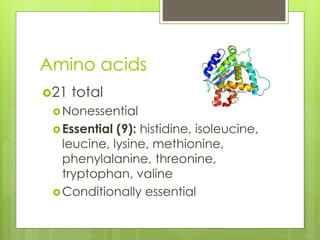
Amino acids
21 total
Nonessential
Essential (9): histidine, isoleucine,
leucine, lysine, methionine,
phenylalanine, threonine,
tryptophan, valine
Conditionally essential
Protein requirements
No storage form – protein needed
every day
Deficiency (kwashiorkor) very rare in
the U.S.
Recommended Daily Allowance
(RDA)
 Women: 46g
 Men: 56g
Protein Requirements
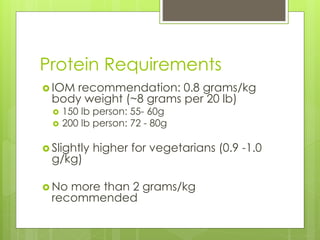
 IOM recommendation: 0.8 grams/kg
body weight (~8 grams per 20 lb)
 150 lb person: 55- 60g
 200 lb person: 72 - 80g
 Slightly higher for vegetarians (0.9 -1.0
g/kg)
 No more than 2 grams/kg
recommended
Protein Requirements
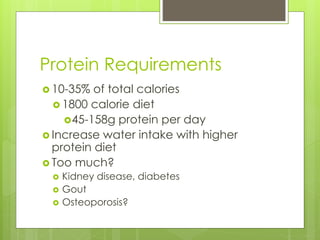
 10-35% of total calories
 1800 calorie diet
45-158g protein per day
 Increase water intake with higher
protein diet
 Too much?
 Kidney disease, diabetes
 Gout
 Osteoporosis?
Protein requirements
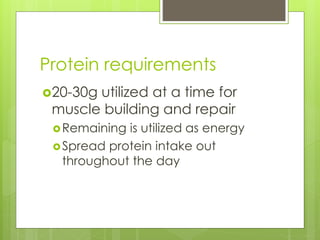
20-30g utilized at a time for
muscle building and repair
Remaining is utilized as energy
Spread protein intake out
throughout the day
Complete vs incomplete
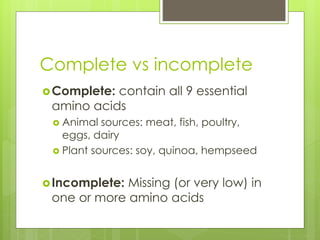
Complete: contain all 9 essential
amino acids
 Animal sources: meat, fish, poultry,
eggs, dairy
 Plant sources: soy, quinoa, hempseed
Incomplete: Missing (or very low) in
one or more amino acids
True or False?
 Vegetarians & vegans must combine
sources of proteins at each meal in order
to get the protein they need.
 False! Vegetarians & vegans should eat a
variety of foods & protein sources
throughout the week to ensure adequate
protein intake.
Flexitarian/Vegetarian Benefits
Health
 Red meat
Increased risk of CVD, Diabetes,
Cancer, Obesity (Nurses Health Study)
Processed red meat even higher risk
 The protein package
What comes with your protein?
Flexitarian/Vegetarian Benefits
 Longevity
 Blue Zones: Okinawa, Sardinia, Nicoya,
Icaria, Loma Linda (Seventh-Day
Adventists)
 High concentrations of male centenarians
 9 common characteristics
 Semi-vegetarianism
 Legumes
 Meat 5x or less/month (3-4 oz portion)
Flexitarian/Vegetarian Benefits
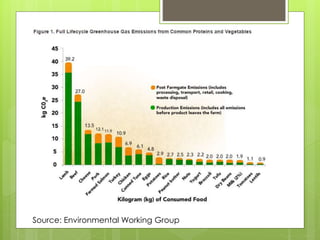
 Environmental impact
 Conventional meat production =
pesticides, chemical fertilizers, fuel, feed,
water, land
 1 lb beef = 1,847 gallons of water
 1 lb tofu = 302 gallons of water
 Production of greenhouse gases
 Livestock contributes 18% (more than cars,
planes, and all transportation!)
 Going meatless one day per week has a
greater impact than buying local for a year
Source: Environmental Working Group
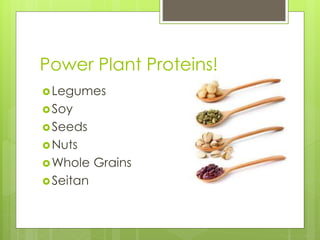
Power Plant Proteins!
Legumes
Soy
Seeds
Nuts
Whole Grains
Seitan
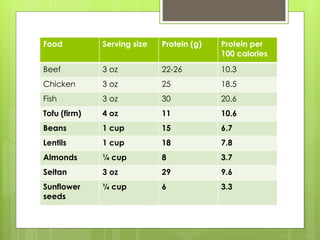
Food Serving size Protein (g) Protein per
100 calories
Beef 3 oz 22-26 10.3
Chicken 3 oz 25 18.5
Fish 3 oz 30 20.6
Tofu (firm) 4 oz 11 10.6
Beans 1 cup 15 6.7
Lentils 1 cup 18 7.8
Almonds ¼ cup 8 3.7
Seitan 3 oz 29 9.6
Sunflower
seeds
¼ cup 6 3.3
Legumes
 Examples: Lentils, pinto beans, black beans,
black-eyed peas, kidney beans, chickpeas
 ~15 grams protein per 1 cup serving
 Also high in fiber, B vitamins
 Ways to incorporate
 Roasted chickpeas!
 Soups
 Hummus
 With grains
 Tacos
 Dried vs canned
Soy
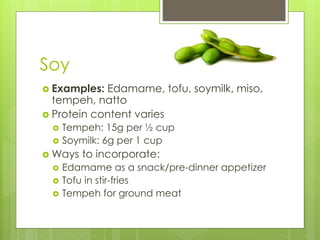
 Examples: Edamame, tofu, soymilk, miso,
tempeh, natto
 Protein content varies
 Tempeh: 15g per ½ cup
 Soymilk: 6g per 1 cup
 Ways to incorporate:
 Edamame as a snack/pre-dinner appetizer
 Tofu in stir-fries
 Tempeh for ground meat
Soy controversy
Isoflavones (phytoestrogens)
Benefits:
 25g/day may reduce risk of heart
disease (health claim)
 Ease of menopausal symptoms
 Potentially lower risk of breast,
endometrial, and prostate cancers
Soy controversy
Yet…
 Could raise cancer risk
 Harmful to hormone balance/fertility?
 Men
Potentially lower sperm count
No significant impact on hormone
levels with moderate soy intake (does
not have a feminizing effect)
Soy controversy
 Rumors of “anti-nutrients”
 Fermentation deactivates these: miso,
tempeh, natto, soy sauce
 Most soy is genetically modified
 Bottom line: Research is mixed. Enjoy
whole soy foods in moderation
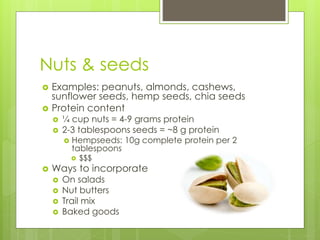
Nuts & seeds
 Examples: peanuts, almonds, cashews,
sunflower seeds, hemp seeds, chia seeds
 Protein content
 ¼ cup nuts = 4-9 grams protein
 2-3 tablespoons seeds = ~8 g protein
 Hempseeds: 10g complete protein per 2
tablespoons
 $$$
 Ways to incorporate
 On salads
 Nut butters
 Trail mix
 Baked goods
Whole grains
 Examples: amaranth, barley, kamut,
wheat berries
 Quinoa= complete protein
 8 grams per cup
 Other whole grains
 5-6 grams per cup
 Complement to legumes or dairy
Seitan
 “Wheat meat”
 High in protein
 29g per 3 oz
 Also very high in gluten
 Digestibility
 Meat-like texture & mild taste
Other plant-based protein
sources
 Vegetables
 ½ cup = 2-3g protein
 Veggies higher in protein: spinach, potatoes,
peas, broccoli, brussel sprouts
 Faux meat
 Examples: TVP, Quorn, Tofurkey, Boca Burger,
etc.
 High in protein, but highly processed & often
high in sodium
 Supplements
Resources
 Incentive Program
 www.muswell.limeade.com
 Blog
 www.montanamovesandmeals.com
 Email
 wellness@montana.edu
 Twitter
 @montanameals

Power Plant Proteins

  • 1.
    Power Plant Proteins Cristin Stokes,RD, LN MUS Wellness April 2015
  • 2.
    Workshop Description  Proteindoesn't just mean steak! Nuts, legumes, soy, and other plant based proteins can adequately meet a person's protein needs while reducing one's carbon footprint and improving health. In this workshop, discover how to incorporate more plant proteins into your diet with recipes using ingredients like lentils, chickpeas, almonds, and seitan.
  • 3.
    Cristin’s 6 NutritionalTenets  1. Consider the 80/20 rule of moderation.  2. Eat more plants.  3. Choose whole foods over processed.  4. There’s no hidden secret to weight loss.  5. Take advantage of all the wonderful foods grown in Montana.  6. Enjoy your food!
  • 4.
    Definition of proteins Large, complex molecules, made up of chains of amino acids, that play many critical roles in the body.  Structural component of all cells in the body  Bones, muscles, skin  Immune system antibodies  Hormones  Enzymes  10,000 different proteins in the body!
  • 5.
    Benefits of dietaryprotein Builds & repairs body tissues Takes longer to digest than carbohydrates Does not raise blood sugar May boost metabolism  But protein calories are still calories!
  • 6.
    Amino acids 21 total Nonessential Essential(9): histidine, isoleucine, leucine, lysine, methionine, phenylalanine, threonine, tryptophan, valine Conditionally essential
  • 7.
    Protein requirements No storageform – protein needed every day Deficiency (kwashiorkor) very rare in the U.S. Recommended Daily Allowance (RDA)  Women: 46g  Men: 56g
  • 8.
    Protein Requirements  IOMrecommendation: 0.8 grams/kg body weight (~8 grams per 20 lb)  150 lb person: 55- 60g  200 lb person: 72 - 80g  Slightly higher for vegetarians (0.9 -1.0 g/kg)  No more than 2 grams/kg recommended
  • 9.
    Protein Requirements  10-35%of total calories  1800 calorie diet 45-158g protein per day  Increase water intake with higher protein diet  Too much?  Kidney disease, diabetes  Gout  Osteoporosis?
  • 10.
    Protein requirements 20-30g utilizedat a time for muscle building and repair Remaining is utilized as energy Spread protein intake out throughout the day
  • 11.
    Complete vs incomplete Complete:contain all 9 essential amino acids  Animal sources: meat, fish, poultry, eggs, dairy  Plant sources: soy, quinoa, hempseed Incomplete: Missing (or very low) in one or more amino acids
  • 12.
    True or False? Vegetarians & vegans must combine sources of proteins at each meal in order to get the protein they need.  False! Vegetarians & vegans should eat a variety of foods & protein sources throughout the week to ensure adequate protein intake.
  • 13.
    Flexitarian/Vegetarian Benefits Health  Redmeat Increased risk of CVD, Diabetes, Cancer, Obesity (Nurses Health Study) Processed red meat even higher risk  The protein package What comes with your protein?
  • 14.
    Flexitarian/Vegetarian Benefits  Longevity Blue Zones: Okinawa, Sardinia, Nicoya, Icaria, Loma Linda (Seventh-Day Adventists)  High concentrations of male centenarians  9 common characteristics  Semi-vegetarianism  Legumes  Meat 5x or less/month (3-4 oz portion)
  • 15.
    Flexitarian/Vegetarian Benefits  Environmentalimpact  Conventional meat production = pesticides, chemical fertilizers, fuel, feed, water, land  1 lb beef = 1,847 gallons of water  1 lb tofu = 302 gallons of water  Production of greenhouse gases  Livestock contributes 18% (more than cars, planes, and all transportation!)  Going meatless one day per week has a greater impact than buying local for a year
  • 16.
  • 17.
  • 18.
    Food Serving sizeProtein (g) Protein per 100 calories Beef 3 oz 22-26 10.3 Chicken 3 oz 25 18.5 Fish 3 oz 30 20.6 Tofu (firm) 4 oz 11 10.6 Beans 1 cup 15 6.7 Lentils 1 cup 18 7.8 Almonds ¼ cup 8 3.7 Seitan 3 oz 29 9.6 Sunflower seeds ¼ cup 6 3.3
  • 19.
    Legumes  Examples: Lentils,pinto beans, black beans, black-eyed peas, kidney beans, chickpeas  ~15 grams protein per 1 cup serving  Also high in fiber, B vitamins  Ways to incorporate  Roasted chickpeas!  Soups  Hummus  With grains  Tacos  Dried vs canned
  • 20.
    Soy  Examples: Edamame,tofu, soymilk, miso, tempeh, natto  Protein content varies  Tempeh: 15g per ½ cup  Soymilk: 6g per 1 cup  Ways to incorporate:  Edamame as a snack/pre-dinner appetizer  Tofu in stir-fries  Tempeh for ground meat
  • 21.
    Soy controversy Isoflavones (phytoestrogens) Benefits: 25g/day may reduce risk of heart disease (health claim)  Ease of menopausal symptoms  Potentially lower risk of breast, endometrial, and prostate cancers
  • 22.
    Soy controversy Yet…  Couldraise cancer risk  Harmful to hormone balance/fertility?  Men Potentially lower sperm count No significant impact on hormone levels with moderate soy intake (does not have a feminizing effect)
  • 23.
    Soy controversy  Rumorsof “anti-nutrients”  Fermentation deactivates these: miso, tempeh, natto, soy sauce  Most soy is genetically modified  Bottom line: Research is mixed. Enjoy whole soy foods in moderation
  • 24.
    Nuts & seeds Examples: peanuts, almonds, cashews, sunflower seeds, hemp seeds, chia seeds  Protein content  ¼ cup nuts = 4-9 grams protein  2-3 tablespoons seeds = ~8 g protein  Hempseeds: 10g complete protein per 2 tablespoons  $$$  Ways to incorporate  On salads  Nut butters  Trail mix  Baked goods
  • 25.
    Whole grains  Examples:amaranth, barley, kamut, wheat berries  Quinoa= complete protein  8 grams per cup  Other whole grains  5-6 grams per cup  Complement to legumes or dairy
  • 26.
    Seitan  “Wheat meat” High in protein  29g per 3 oz  Also very high in gluten  Digestibility  Meat-like texture & mild taste
  • 27.
    Other plant-based protein sources Vegetables  ½ cup = 2-3g protein  Veggies higher in protein: spinach, potatoes, peas, broccoli, brussel sprouts  Faux meat  Examples: TVP, Quorn, Tofurkey, Boca Burger, etc.  High in protein, but highly processed & often high in sodium  Supplements
  • 28.
    Resources  Incentive Program www.muswell.limeade.com  Blog  www.montanamovesandmeals.com  Email  wellness@montana.edu  Twitter  @montanameals