Sleep
• What is sleep ?
• Hormone That Are Responsible Of Sleep
• Sleep Cycle
• Types Of Sleep
• Normal Sleep
• Naps And Its Type
• Brain And Body During Sleep
• How To Sleep Better At Night ?
• Waking Up Early And Its Advantage
• How To Wake Up Early ?
• Disadvantages Of Lacking Sleep
• Sleep Disorders
Content
What Is Sleep?
A condition of body and mind which typically
occur for several hours every night.
Getting enough of sleep at the right times, it is
as essential to survival as food and water.
Without sleep you can’t maintain the pathways
in your brain that let you learn and create new
memories, and it’s harder to concentrate and
respond quickly.
in which the nervous system is inactive, the
eyes closed, the postural muscles relaxed
Hormone That Are Responsible
Of Sleep
Melatonin is a hormone produced in the pineal gland of the brain
that is responsible for regulating sleep cycles.
Melatonin is often considered to be the body’s natural pacemaker.
It plays an instrumental role in signaling time of day and time of
year, helping to regulate your body’s internal clock.
?What IsSleepCycle
A sleep cycle is the progression through the various stages of NREM sleep
to REM sleep before beginning the progression again with NREM sleep.
Typically, a person would begin a sleep cycle every 90-120 minutes
resulting in four to five cycles per sleep time, or hours spent asleep.
Usually sleepers pass through four stages: 1, 2, 3, and REM (rapid eye
movement) sleep. These stages progress cyclically from 1 through REM
then begin again with stage 1. A complete sleep cycle takes an average of
90 to 110 minutes, with each stage lasting between 5 to 15 minutes. The
first sleep cycles each night have relatively short REM sleeps and long
periods of deep sleep but later in the night, REM periods lengthen and
deep sleep time decreases.
Normal sleep
On average, adults should optimally receive between seven and nine
hours of sleep each night, but those needs vary individually. For example,
some people feel best with eight consecutive hours of sleep, while others
do well with six to seven hours at night and daytime napping. Some
people feel okay when their sleep schedule changes, while others feel
very affected by a new schedule or even one night of insufficient sleep.
Good sleep is necessary for optimal health and can affect hormone levels,
mood and weight. Sleep problems, including snoring, sleep apnea,
insomnia, sleep deprivation, and restless legs syndrome, are common.
• You fall asleep within 15-20 minutes of lying down
to sleep.
• You regularly sleep a total of seven to nine hours
in a 24-hour period.
• While in your bed, your sleep is continuous—you
don’t have long periods of lying awake when you
wish to be sleeping.
• You wake up feeling refreshed, as if you’ve “filled
the tank.”
• You feel alert and are able to be fully productive
throughout the waking hours (note, it’s natural
for people to feel a dip in alertness during waking
hours, but with healthy sleep, alertness returns).
• Your partner or family members do not notice any
disturbing or out of the ordinary behavior from
you while you sleep, such as snoring, pauses in
breathing, restlessness, or otherwise nighttime
behaviors.
Nap
A nap is a short period of sleep, typically taken during daytime hours. Napping is
physiologically and psychologically beneficial. Studies demonstrate that naps are as
good as a night of sleep for some types of memory tasks, But naps can leave people
with sleep inertia. Sleep inertia is defined as the feeling of grogginess and
disorientation that can come with awakening from a deep sleep.
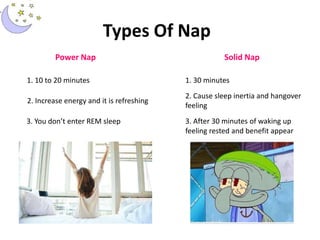
Types Of Nap
Power Nap
3. You don’t enter REM sleep
Solid Nap
3. After 30 minutes of waking up
feeling rested and benefit appear
1. 10 to 20 minutes 1. 30 minutes
2. Increase energy and it is refreshing
2. Cause sleep inertia and hangover
feeling
Types Of Nap
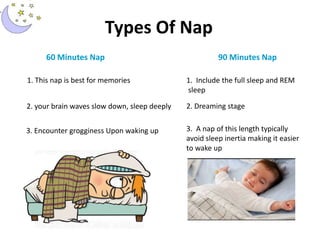
60 Minutes Nap
3. Encounter grogginess Upon waking up
90 Minutes Nap
3. A nap of this length typically
avoid sleep inertia making it easier
to wake up
1. This nap is best for memories 1. Include the full sleep and REM
sleep
2. your brain waves slow down, sleep deeply 2. Dreaming stage
Brain And Body During Sleep
• Brain activities
It’s basically naptime for the nerve cells in
your brain as you dip into non-REM sleep.
They do send out a few messages, but
nothing much. But like so many other bodily
functions, brain activity goes up during REM
sleep, sometimes even more than during the
day. Blood flow to the brain and the
metabolism in your brain also go up during
REM sleep.
• Heart rate and blood pressure
go down and are steadier during non-REM
sleep. During REM sleep, they rise and are
more varied, similar to daytime patterns.
Brain Wave During Sleep
How To Sleep Better At Night ?
• Avoid any screen at least 1 hour before
sleep
• Turn off white light at your room
• Use yellow light
• Close your room curtain
• Drink 8-10 cup of water everyday
• You can read book, take a bath
before sleeping
• Listen to relaxing music before or
during sleep
• Room temperature at 20-22C
• Avoid nap during day time
• Stick to a sleep schedule of the
same bedtime and wake up time,
even on the weekends.
• Sleep on a
comfortable mattress and pillows.
• Choose best sleep position
Best Sleep Position
1. Physical
• Helps you to Sustain a Healthier Diet
• Helps your Skin Look Healthy
• Gives you More Time to Exercise
2. Mental
• Better Concentration
• Enhances your Productivity
3. Emotional
• Improves your Quality of Sleep
• Helps you Enjoy Quiet Time
How To Wake Up Early ?
• You should know how much hours
of sleep you need
• Put your phone to sleep mode
• Drink water everyday you wake up
instead of coffee
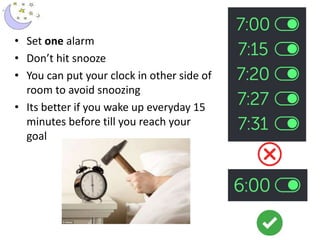
• Set one alarm
• Don’t hit snooze
• You can put your clock in other side of
room to avoid snoozing
• Its better if you wake up everyday 15
minutes before till you reach your
goal
• Avoid any screen before sleeping
• Know why are you waking up
• Have schedule and know what you
are going to do for rest of the day
• Repeat
Disadvantages Of Lacking Sleep
Commonsleepdisorders
• Excessive sleepiness is not a disorder in itself—it is a serious
symptom that can have many different causes.
• Sleep apnea is a potentially serious sleep disorder in which
breathing repeatedly stops and starts. If you snore loudly and feel
tired even after a full night's sleep, you might have sleep apnea.
• insomnia is difficulty falling asleep or staying asleep. People with
insomnia can feel dissatisfied with their sleep and usually
experience one or more of the following symptoms: fatigue, low
energy, difficulty concentrating, mood disturbances, and
decreased performance in work or at school.
• Narcolepsy, a condition characterized by extreme sleepiness
during the day and falling asleep suddenly during the day.
Thank You For Not Sleeping
During Our Boring Presentation

Sleep

  • 1.
  • 2.
    • What issleep ? • Hormone That Are Responsible Of Sleep • Sleep Cycle • Types Of Sleep • Normal Sleep • Naps And Its Type • Brain And Body During Sleep • How To Sleep Better At Night ? • Waking Up Early And Its Advantage • How To Wake Up Early ? • Disadvantages Of Lacking Sleep • Sleep Disorders Content
  • 3.
    What Is Sleep? Acondition of body and mind which typically occur for several hours every night. Getting enough of sleep at the right times, it is as essential to survival as food and water. Without sleep you can’t maintain the pathways in your brain that let you learn and create new memories, and it’s harder to concentrate and respond quickly. in which the nervous system is inactive, the eyes closed, the postural muscles relaxed
  • 4.
    Hormone That AreResponsible Of Sleep Melatonin is a hormone produced in the pineal gland of the brain that is responsible for regulating sleep cycles. Melatonin is often considered to be the body’s natural pacemaker. It plays an instrumental role in signaling time of day and time of year, helping to regulate your body’s internal clock.
  • 5.
    ?What IsSleepCycle A sleepcycle is the progression through the various stages of NREM sleep to REM sleep before beginning the progression again with NREM sleep. Typically, a person would begin a sleep cycle every 90-120 minutes resulting in four to five cycles per sleep time, or hours spent asleep. Usually sleepers pass through four stages: 1, 2, 3, and REM (rapid eye movement) sleep. These stages progress cyclically from 1 through REM then begin again with stage 1. A complete sleep cycle takes an average of 90 to 110 minutes, with each stage lasting between 5 to 15 minutes. The first sleep cycles each night have relatively short REM sleeps and long periods of deep sleep but later in the night, REM periods lengthen and deep sleep time decreases.
  • 7.
    Normal sleep On average,adults should optimally receive between seven and nine hours of sleep each night, but those needs vary individually. For example, some people feel best with eight consecutive hours of sleep, while others do well with six to seven hours at night and daytime napping. Some people feel okay when their sleep schedule changes, while others feel very affected by a new schedule or even one night of insufficient sleep. Good sleep is necessary for optimal health and can affect hormone levels, mood and weight. Sleep problems, including snoring, sleep apnea, insomnia, sleep deprivation, and restless legs syndrome, are common.
  • 8.
    • You fallasleep within 15-20 minutes of lying down to sleep. • You regularly sleep a total of seven to nine hours in a 24-hour period. • While in your bed, your sleep is continuous—you don’t have long periods of lying awake when you wish to be sleeping. • You wake up feeling refreshed, as if you’ve “filled the tank.” • You feel alert and are able to be fully productive throughout the waking hours (note, it’s natural for people to feel a dip in alertness during waking hours, but with healthy sleep, alertness returns). • Your partner or family members do not notice any disturbing or out of the ordinary behavior from you while you sleep, such as snoring, pauses in breathing, restlessness, or otherwise nighttime behaviors.
  • 9.
    Nap A nap isa short period of sleep, typically taken during daytime hours. Napping is physiologically and psychologically beneficial. Studies demonstrate that naps are as good as a night of sleep for some types of memory tasks, But naps can leave people with sleep inertia. Sleep inertia is defined as the feeling of grogginess and disorientation that can come with awakening from a deep sleep.
  • 10.
    Types Of Nap PowerNap 3. You don’t enter REM sleep Solid Nap 3. After 30 minutes of waking up feeling rested and benefit appear 1. 10 to 20 minutes 1. 30 minutes 2. Increase energy and it is refreshing 2. Cause sleep inertia and hangover feeling
  • 11.
    Types Of Nap 60Minutes Nap 3. Encounter grogginess Upon waking up 90 Minutes Nap 3. A nap of this length typically avoid sleep inertia making it easier to wake up 1. This nap is best for memories 1. Include the full sleep and REM sleep 2. your brain waves slow down, sleep deeply 2. Dreaming stage
  • 12.
    Brain And BodyDuring Sleep • Brain activities It’s basically naptime for the nerve cells in your brain as you dip into non-REM sleep. They do send out a few messages, but nothing much. But like so many other bodily functions, brain activity goes up during REM sleep, sometimes even more than during the day. Blood flow to the brain and the metabolism in your brain also go up during REM sleep. • Heart rate and blood pressure go down and are steadier during non-REM sleep. During REM sleep, they rise and are more varied, similar to daytime patterns.
  • 13.
  • 14.
    How To SleepBetter At Night ? • Avoid any screen at least 1 hour before sleep • Turn off white light at your room • Use yellow light • Close your room curtain
  • 15.
    • Drink 8-10cup of water everyday • You can read book, take a bath before sleeping • Listen to relaxing music before or during sleep • Room temperature at 20-22C • Avoid nap during day time
  • 16.
    • Stick toa sleep schedule of the same bedtime and wake up time, even on the weekends. • Sleep on a comfortable mattress and pillows. • Choose best sleep position
  • 17.
  • 19.
    1. Physical • Helpsyou to Sustain a Healthier Diet • Helps your Skin Look Healthy • Gives you More Time to Exercise
  • 20.
    2. Mental • BetterConcentration • Enhances your Productivity
  • 21.
    3. Emotional • Improvesyour Quality of Sleep • Helps you Enjoy Quiet Time
  • 22.
    How To WakeUp Early ? • You should know how much hours of sleep you need • Put your phone to sleep mode • Drink water everyday you wake up instead of coffee
  • 23.
    • Set onealarm • Don’t hit snooze • You can put your clock in other side of room to avoid snoozing • Its better if you wake up everyday 15 minutes before till you reach your goal
  • 24.
    • Avoid anyscreen before sleeping • Know why are you waking up • Have schedule and know what you are going to do for rest of the day • Repeat
  • 25.
  • 26.
    Commonsleepdisorders • Excessive sleepinessis not a disorder in itself—it is a serious symptom that can have many different causes. • Sleep apnea is a potentially serious sleep disorder in which breathing repeatedly stops and starts. If you snore loudly and feel tired even after a full night's sleep, you might have sleep apnea.
  • 27.
    • insomnia isdifficulty falling asleep or staying asleep. People with insomnia can feel dissatisfied with their sleep and usually experience one or more of the following symptoms: fatigue, low energy, difficulty concentrating, mood disturbances, and decreased performance in work or at school. • Narcolepsy, a condition characterized by extreme sleepiness during the day and falling asleep suddenly during the day.
  • 28.
    Thank You ForNot Sleeping During Our Boring Presentation