Jim “Mattress Mack” McIngvale
Gallery Furniture
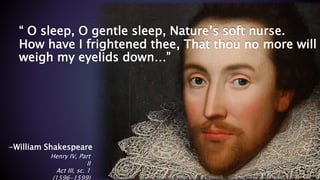
-William Shakespeare
“ O sleep, O gentle sleep, Nature’s soft nurse.
How have I frightened thee, That thou no more will
weigh my eyelids down…”
Henry IV, Part
II
Act III, sc. 1
(1596-1599)
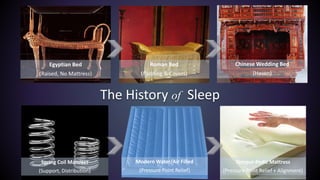
Egyptian Bed
(Raised, No Mattress)
Roman Bed
(Padding & Covers)
Chinese Wedding Bed
(Haven)
The History of Sleep
Spring Coil Mattress
(Support, Distribution)
Tempur-Pedic Mattress
(Pressure Point Relief + Alignment)
Modern Water/Air Filled
(Pressure Point Relief)
The Importance of Sleep
“If you are an average person, 36% of your life will be spent…entirely asleep... what that
[time] is telling us, is that sleep–at some level–is important.”
-Russel G. Foster, FRS,
University of Oxford
or 32 years of your 90 year lifeThat’s 4.32
months per year
“…the single most important behavioral experience that we have...”
-Russell G. Foster, FRS
University of Oxford
The Importance of Sleep
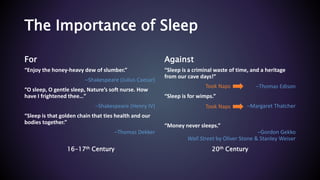
For
“Enjoy the honey-heavy dew of slumber.”
–Shakespeare (Julius Caesar)
“O sleep, O gentle sleep, Nature’s soft nurse. How
have I frightened thee…”
–Shakespeare (Henry IV)
“Sleep is that golden chain that ties health and our
bodies together.”
–Thomas Dekker
Against
“Sleep is a criminal waste of time, and a heritage
from our cave days!”
–Thomas Edison
“Sleep is for wimps.”
–Margaret Thatcher
“Money never sleeps.”
–Gordon Gekko
Wall Street by Oliver Stone & Stanley Weiser
16-17th Century 20th Century
Took Naps
Took Naps
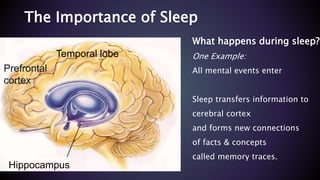
What happens during sleep?
One Example:
All mental events enter
Sleep transfers information to
cerebral cortex
and forms new connections
of facts & concepts
called memory traces.
Hippocampus
Temporal lobe
Prefrontal
cortex
The Importance of Sleep
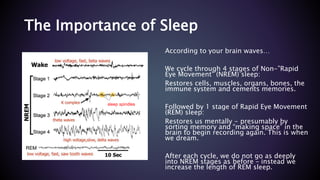
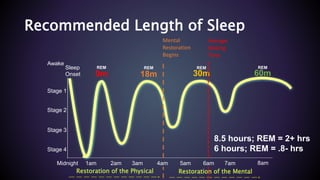
According to your brain waves…
We cycle through 4 stages of Non-”Rapid
Eye Movement” (NREM) sleep:
Restores cells, muscles, organs, bones, the
immune system and cements memories.
Followed by 1 stage of Rapid Eye Movement
(REM) sleep:
Restores us mentally - presumably by
sorting memory and “making space” in the
brain to begin recording again. This is when
we dream.
After each cycle, we do not go as deeply
into NREM stages as before – instead we
increase the length of REM sleep.
sleep spindles
Stage 4
Stage 1
Stage 2
Stage 3
Awake
Midnight 2am1am 3am 4am 5am 8am6am 7am
8.5 hours; REM = 2+ hrs
6 hours; REM = .8- hrs
18m
REM
30m
REM
60m
REM
9m
REMSleep
Onset
Recommended Length of Sleep
Restoration of the Physical Restoration of the Mental
Mental
Restoration
Begins
Average
Waking
Time
Recommended Length of Sleep
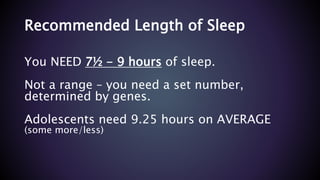
You NEED 7½ - 9 hours of sleep.
Not a range – you need a set number,
determined by genes.
Adolescents need 9.25 hours on AVERAGE
(some more/less)
The
Sleep Deprivation Crisis
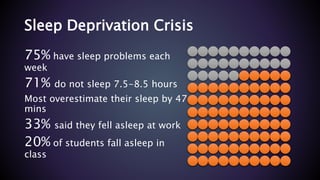
75% have sleep problems each
week
71% do not sleep 7.5-8.5 hours
Most overestimate their sleep by 47
mins
33% said they fell asleep at work
20% of students fall asleep in
class
Consequences of Sleep Deprivation
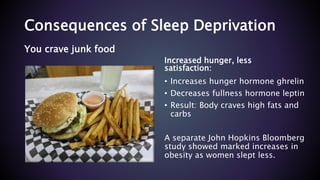
You crave junk food
Increased hunger, less
satisfaction:
• Increases hunger hormone ghrelin
• Decreases fullness hormone leptin
• Result: Body craves high fats and
carbs
A separate John Hopkins Bloomberg
study showed marked increases in
obesity as women slept less.
Consequences of Sleep Deprivation
-Dr. Jan Born, University of Luebeck, Germany
You get sick
Consequences of Sleep Deprivation
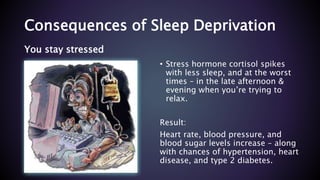
You stay stressed
• Stress hormone cortisol spikes
with less sleep, and at the worst
times – in the late afternoon &
evening when you’re trying to
relax.
Result:
Heart rate, blood pressure, and
blood sugar levels increase – along
with chances of hypertension, heart
disease, and type 2 diabetes.
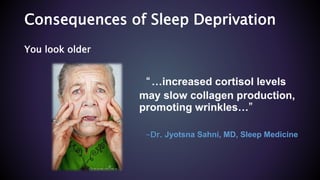
-Dr. Jyotsna Sahni, MD, Sleep Medicine
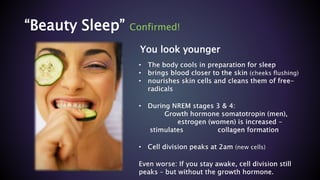
You look older
Consequences of Sleep Deprivation
“Beauty Sleep” Confirmed!
You look younger
Consequences of Sleep Deprivation
-Gallery Furniture Sleep Center, YAHOO!Health
(study by University of Chicago)
You can’t process sugar
correctly
Consequences of Sleep Deprivation
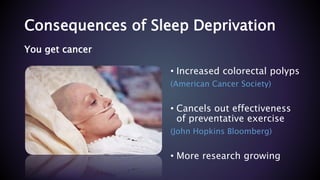
• Increased colorectal polyps
(American Cancer Society)
• Cancels out effectiveness
of preventative exercise
(John Hopkins Bloomberg)
• More research growing
You get cancer
Consequences of Sleep Deprivation
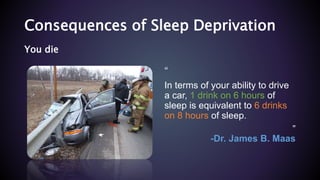
“
In terms of your ability to drive
a car, 1 drink on 6 hours of
sleep is equivalent to 6 drinks
on 8 hours of sleep.
”
-Dr. James B. Maas
You die
Consequences of Sleep Deprivation
• Obesity
• increased ghrelin (hunger hormone) craves fats and carbs
• Hypertension (Heart Attacks & Strokes)
• Diabetes Type II (Glucose Intolerance)
• increased insulin resistance
• Periodontal Disease
• Depression
• Loss of Memory & Ability to Retain New Information
• Cancer
• Increased colorectal polyps (& more research growing)
Signs of Sleep Deprivation
1. Does a heavy meal, low dose of alcohol, warm
room, boring meeting or lecture make you drowsy?
2. Do you fall asleep instantly at night?
3. Do you need an alarm clock to wake up?
4. Do you repeatedly hit the snooze button?
5. Do you sleep extra hours on weekends?
6. People tell you – “You look tired.”
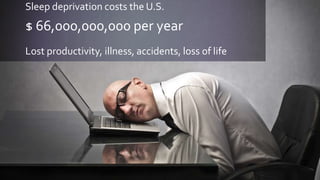
Sleep deprivation costs the U.S.
$ 66,000,000,000 per year
Lost productivity, illness, accidents, loss of life
How to Sleep Better
“ [Sleep] doesn’t arise from a single
structure within the brain, but is – to some
extent – a
network property. ”
-Russell G. Foster, FRS
(University of Oxford)
I. A Bedtime Bedroom
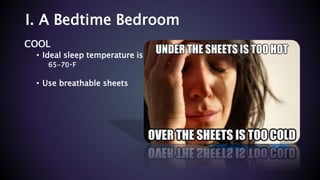
COOL
• Ideal sleep temperature is
65-70 F
• Use breathable sheets
I. A Bedtime Bedroom
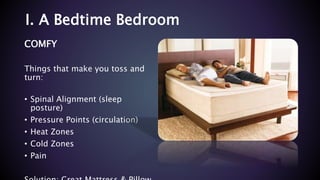
COMFY
Things that make you toss and
turn:
• Spinal Alignment (sleep
posture)
• Pressure Points (circulation)
• Heat Zones
• Cold Zones
• Pain
I. A Bedtime Bedroom
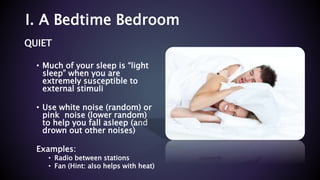
QUIET
• Much of your sleep is “light
sleep” when you are
extremely susceptible to
external stimuli
• Use white noise (random) or
pink noise (lower random)
to help you fall asleep (and
drown out other noises)
Examples:
• Radio between stations
• Fan (Hint: also helps with heat)
I. A Bedtime Bedroom
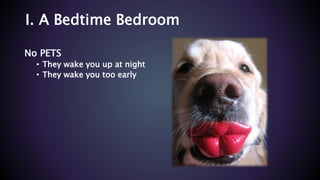
No PETS
• They wake you up at night
• They wake you too early
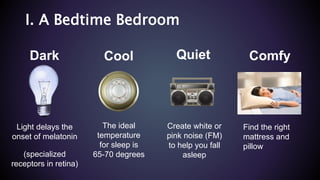
Cool
The ideal
temperature
for sleep is
65-70 degrees
Quiet
Create white or
pink noise (FM)
to help you fall
asleep
Dark
Light delays the
onset of melatonin
(specialized
receptors in retina)
Comfy
Find the right
mattress and
pillow
I. A Bedtime Bedroom
II. Digestion
Disturbances
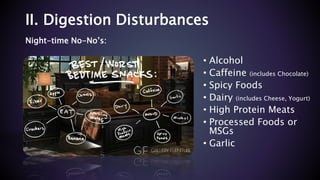
Night-time No-No’s:
• Alcohol
• Caffeine (includes Chocolate)
• Spicy Foods
• Dairy (includes Cheese, Yogurt)
• High Protein Meats
• Processed Foods or
MSGs
• Garlic
II. Digestion Disturbances
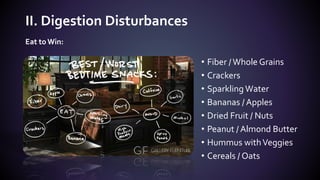
• Fiber /Whole Grains
• Crackers
• Sparkling Water
• Bananas / Apples
• Dried Fruit / Nuts
• Peanut / Almond Butter
• Hummus withVeggies
• Cereals / Oats
II. Digestion Disturbances
Eat to Win:
III. Restful Rituals
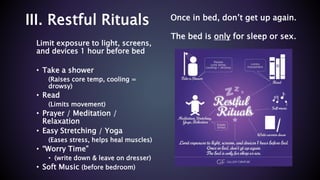
Limit exposure to light, screens,
and devices 1 hour before bed
• Take a shower
(Raises core temp, cooling =
drowsy)
• Read
(Limits movement)
• Prayer / Meditation /
Relaxation
• Easy Stretching / Yoga
(Eases stress, helps heal muscles)
• “Worry Time”
• (write down & leave on dresser)
• Soft Music (before bedroom)
Once in bed, don’t get up again.
The bed is only for sleep or sex.
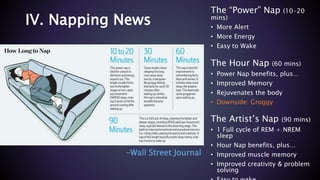
IV. Napping News
The “Power” Nap (10-20
mins)
• More Alert
• More Energy
• Easy to Wake
The Hour Nap (60 mins)
• Power Nap benefits, plus…
• Improved Memory
• Rejuvenates the body
• Downside: Groggy
The Artist’s Nap (90 mins)
• 1 Full cycle of REM + NREM
sleep
• Hour Nap benefits, plus…
• Improved muscle memory
• Improved creativity & problem
solving
-Wall Street Journal
The
Benefits of Proper Sleep
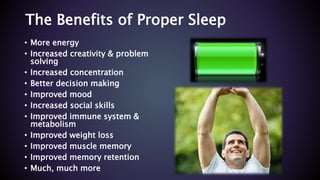
The Benefits of Proper Sleep
• More energy
• Increased creativity & problem
solving
• Increased concentration
• Better decision making
• Improved mood
• Increased social skills
• Improved immune system &
metabolism
• Improved weight loss
• Improved muscle memory
• Improved memory retention
• Much, much more
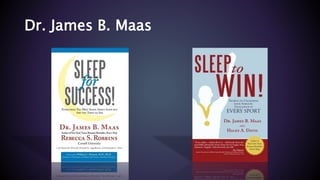
Dr. James B. Maas
•What’s your daily routine?
•How much sleep do you get?
•Do you have a regular sleep/wake schedule?
•How do you stay awake in school?
•Follow strategies in my sleep book
•No early morning exercise
•Get 9.25 hours sleep nightly
•Establish a regular sleep/wake schedule
•Cut out caffeine
Dr. Maas & theTeenage Ice Skater
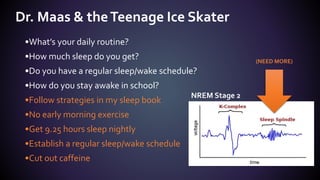
NREM Stage 2
(NEED MORE)
K-Complex
• Happen spontaneously, or in response to stimuli
• Seems to protect sleep by telling the brain “ignore that”
• Seems to aid memory consolidation
Dr. Maas & theTeenage Ice Skater
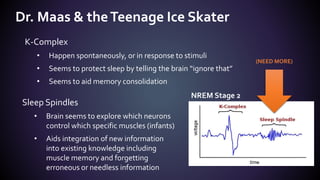
NREM Stage 2
(NEED MORE)
Sleep Spindles
• Brain seems to explore which neurons
control which specific muscles (infants)
• Aids integration of new information
into existing knowledge including
muscle memory and forgetting
erroneous or needless information
Sarah Hughes
Written off by the figure skating community
for not attending early morning practices…
…took home the Women’s Olympic Gold
Medal
Sleep better
and get the performance
you just DREAM about
TODAY!

Jim McIngvale on the Importance of Sleep

  • 1.
    Jim “Mattress Mack”McIngvale Gallery Furniture
  • 2.
    -William Shakespeare “ Osleep, O gentle sleep, Nature’s soft nurse. How have I frightened thee, That thou no more will weigh my eyelids down…” Henry IV, Part II Act III, sc. 1 (1596-1599)
  • 3.
    Egyptian Bed (Raised, NoMattress) Roman Bed (Padding & Covers) Chinese Wedding Bed (Haven) The History of Sleep Spring Coil Mattress (Support, Distribution) Tempur-Pedic Mattress (Pressure Point Relief + Alignment) Modern Water/Air Filled (Pressure Point Relief)
  • 5.
    The Importance ofSleep “If you are an average person, 36% of your life will be spent…entirely asleep... what that [time] is telling us, is that sleep–at some level–is important.” -Russel G. Foster, FRS, University of Oxford or 32 years of your 90 year lifeThat’s 4.32 months per year
  • 6.
    “…the single mostimportant behavioral experience that we have...” -Russell G. Foster, FRS University of Oxford
  • 7.
    The Importance ofSleep For “Enjoy the honey-heavy dew of slumber.” –Shakespeare (Julius Caesar) “O sleep, O gentle sleep, Nature’s soft nurse. How have I frightened thee…” –Shakespeare (Henry IV) “Sleep is that golden chain that ties health and our bodies together.” –Thomas Dekker Against “Sleep is a criminal waste of time, and a heritage from our cave days!” –Thomas Edison “Sleep is for wimps.” –Margaret Thatcher “Money never sleeps.” –Gordon Gekko Wall Street by Oliver Stone & Stanley Weiser 16-17th Century 20th Century Took Naps Took Naps
  • 8.
    What happens duringsleep? One Example: All mental events enter Sleep transfers information to cerebral cortex and forms new connections of facts & concepts called memory traces. Hippocampus Temporal lobe Prefrontal cortex The Importance of Sleep
  • 9.
    The Importance ofSleep According to your brain waves… We cycle through 4 stages of Non-”Rapid Eye Movement” (NREM) sleep: Restores cells, muscles, organs, bones, the immune system and cements memories. Followed by 1 stage of Rapid Eye Movement (REM) sleep: Restores us mentally - presumably by sorting memory and “making space” in the brain to begin recording again. This is when we dream. After each cycle, we do not go as deeply into NREM stages as before – instead we increase the length of REM sleep. sleep spindles
  • 10.
    Stage 4 Stage 1 Stage2 Stage 3 Awake Midnight 2am1am 3am 4am 5am 8am6am 7am 8.5 hours; REM = 2+ hrs 6 hours; REM = .8- hrs 18m REM 30m REM 60m REM 9m REMSleep Onset Recommended Length of Sleep Restoration of the Physical Restoration of the Mental Mental Restoration Begins Average Waking Time
  • 11.
    Recommended Length ofSleep You NEED 7½ - 9 hours of sleep. Not a range – you need a set number, determined by genes. Adolescents need 9.25 hours on AVERAGE (some more/less)
  • 12.
  • 13.
    Sleep Deprivation Crisis 75%have sleep problems each week 71% do not sleep 7.5-8.5 hours Most overestimate their sleep by 47 mins 33% said they fell asleep at work 20% of students fall asleep in class
  • 14.
    Consequences of SleepDeprivation You crave junk food Increased hunger, less satisfaction: • Increases hunger hormone ghrelin • Decreases fullness hormone leptin • Result: Body craves high fats and carbs A separate John Hopkins Bloomberg study showed marked increases in obesity as women slept less.
  • 15.
    Consequences of SleepDeprivation -Dr. Jan Born, University of Luebeck, Germany You get sick
  • 16.
    Consequences of SleepDeprivation You stay stressed • Stress hormone cortisol spikes with less sleep, and at the worst times – in the late afternoon & evening when you’re trying to relax. Result: Heart rate, blood pressure, and blood sugar levels increase – along with chances of hypertension, heart disease, and type 2 diabetes.
  • 17.
    -Dr. Jyotsna Sahni,MD, Sleep Medicine You look older Consequences of Sleep Deprivation
  • 18.
  • 19.
    Consequences of SleepDeprivation -Gallery Furniture Sleep Center, YAHOO!Health (study by University of Chicago) You can’t process sugar correctly
  • 20.
    Consequences of SleepDeprivation • Increased colorectal polyps (American Cancer Society) • Cancels out effectiveness of preventative exercise (John Hopkins Bloomberg) • More research growing You get cancer
  • 21.
    Consequences of SleepDeprivation “ In terms of your ability to drive a car, 1 drink on 6 hours of sleep is equivalent to 6 drinks on 8 hours of sleep. ” -Dr. James B. Maas You die
  • 22.
    Consequences of SleepDeprivation • Obesity • increased ghrelin (hunger hormone) craves fats and carbs • Hypertension (Heart Attacks & Strokes) • Diabetes Type II (Glucose Intolerance) • increased insulin resistance • Periodontal Disease • Depression • Loss of Memory & Ability to Retain New Information • Cancer • Increased colorectal polyps (& more research growing)
  • 23.
    Signs of SleepDeprivation 1. Does a heavy meal, low dose of alcohol, warm room, boring meeting or lecture make you drowsy? 2. Do you fall asleep instantly at night? 3. Do you need an alarm clock to wake up? 4. Do you repeatedly hit the snooze button? 5. Do you sleep extra hours on weekends? 6. People tell you – “You look tired.”
  • 24.
    Sleep deprivation coststhe U.S. $ 66,000,000,000 per year Lost productivity, illness, accidents, loss of life
  • 25.
  • 26.
    “ [Sleep] doesn’tarise from a single structure within the brain, but is – to some extent – a network property. ” -Russell G. Foster, FRS (University of Oxford)
  • 27.
    I. A BedtimeBedroom
  • 29.
    I. A BedtimeBedroom COOL • Ideal sleep temperature is 65-70 F • Use breathable sheets
  • 30.
    I. A BedtimeBedroom COMFY Things that make you toss and turn: • Spinal Alignment (sleep posture) • Pressure Points (circulation) • Heat Zones • Cold Zones • Pain
  • 31.
    I. A BedtimeBedroom QUIET • Much of your sleep is “light sleep” when you are extremely susceptible to external stimuli • Use white noise (random) or pink noise (lower random) to help you fall asleep (and drown out other noises) Examples: • Radio between stations • Fan (Hint: also helps with heat)
  • 32.
    I. A BedtimeBedroom No PETS • They wake you up at night • They wake you too early
  • 33.
    Cool The ideal temperature for sleepis 65-70 degrees Quiet Create white or pink noise (FM) to help you fall asleep Dark Light delays the onset of melatonin (specialized receptors in retina) Comfy Find the right mattress and pillow I. A Bedtime Bedroom
  • 34.
  • 35.
    Night-time No-No’s: • Alcohol •Caffeine (includes Chocolate) • Spicy Foods • Dairy (includes Cheese, Yogurt) • High Protein Meats • Processed Foods or MSGs • Garlic II. Digestion Disturbances
  • 36.
    • Fiber /WholeGrains • Crackers • Sparkling Water • Bananas / Apples • Dried Fruit / Nuts • Peanut / Almond Butter • Hummus withVeggies • Cereals / Oats II. Digestion Disturbances Eat to Win:
  • 37.
  • 38.
    III. Restful Rituals Limitexposure to light, screens, and devices 1 hour before bed • Take a shower (Raises core temp, cooling = drowsy) • Read (Limits movement) • Prayer / Meditation / Relaxation • Easy Stretching / Yoga (Eases stress, helps heal muscles) • “Worry Time” • (write down & leave on dresser) • Soft Music (before bedroom) Once in bed, don’t get up again. The bed is only for sleep or sex.
  • 41.
    IV. Napping News The“Power” Nap (10-20 mins) • More Alert • More Energy • Easy to Wake The Hour Nap (60 mins) • Power Nap benefits, plus… • Improved Memory • Rejuvenates the body • Downside: Groggy The Artist’s Nap (90 mins) • 1 Full cycle of REM + NREM sleep • Hour Nap benefits, plus… • Improved muscle memory • Improved creativity & problem solving -Wall Street Journal
  • 42.
  • 43.
    The Benefits ofProper Sleep • More energy • Increased creativity & problem solving • Increased concentration • Better decision making • Improved mood • Increased social skills • Improved immune system & metabolism • Improved weight loss • Improved muscle memory • Improved memory retention • Much, much more
  • 44.
  • 45.
    •What’s your dailyroutine? •How much sleep do you get? •Do you have a regular sleep/wake schedule? •How do you stay awake in school? •Follow strategies in my sleep book •No early morning exercise •Get 9.25 hours sleep nightly •Establish a regular sleep/wake schedule •Cut out caffeine Dr. Maas & theTeenage Ice Skater NREM Stage 2 (NEED MORE)
  • 46.
    K-Complex • Happen spontaneously,or in response to stimuli • Seems to protect sleep by telling the brain “ignore that” • Seems to aid memory consolidation Dr. Maas & theTeenage Ice Skater NREM Stage 2 (NEED MORE) Sleep Spindles • Brain seems to explore which neurons control which specific muscles (infants) • Aids integration of new information into existing knowledge including muscle memory and forgetting erroneous or needless information
  • 47.
    Sarah Hughes Written offby the figure skating community for not attending early morning practices… …took home the Women’s Olympic Gold Medal
  • 48.
    Sleep better and getthe performance you just DREAM about
  • 49.