ZIEHL - NEELSEN(ZN)
STAINING
 E

Presented by :- DR MOHD SAQIB HASAN
CONTENTS
 INTRODUCTION
 PRINCIPLE
 SPECIMEN
 REAGENTS
 PROCEDURE
 INTERPRETATION OF ZN STAIN
 QUALITY CONTROL
 MODIFICATION OF ZN STAINING
INTRODUCTION
 ZN is a modification of Ehrlich’s (1882) original method for
the differential staining of tubercle bacilli and other acid fast
bacilli with aniline gentian violet followed by strong nitric
acid.
 It incorporates improvements suggested , successively , by
Ziehl – Neelsen
 The ordinary aniline dye solutions do not readily penetrate
the substance of the tubercle bacillus and therefore
unsuitable for staining.
PRINCIPLE
 ACID FAST
mycobacteria contain
mycolic acid in their
outer membrane ,
making the cell waxy
and resistant to
staining with aqueous
based stains such as
the Gram stains.
 The primary stain (carbol fuchin) binds to mycolic acids in the
cell wall of mycobacteria.
 Intense decolourization ( strong acid or acid / alcohol ) does
not release the primary stain from the cell wall and the
mycobacteria retain the red colour of fuchsin –hence acid
fastness.
 Counterstaining ( with methylene blue ) provides a contrasting
background.
SPECIMEN
A. PULMONARY
 Sputum
 BAL or washing
 Brocho alveolar biopsies
B. EXTRAPULMONARY
 Tissues
 Body fluids
C. CULRURE ISOLATES
REAGENTS
1) 1% CARBOL FUCHSIN :-
Basic fuchsin 1.0 g
Phenol 5 g
Alcohol ( 95% or 100% ethanol) 10 ml
Distilled water 90ml
 Take phenol crystals in a clean round bottom flask and melt
by using heating water bath
 Add the ethanol to molten phenol.
 Add basic fuchsin to the phenol – ethanol mixture and swirl
until all the crystals have completely dissolved
 Add distilled water to the final mixture and then filter using
whattman filter paper No 1
NOTE :- Freshly filtered carbol fuchsin should be used for
staining.
Small quantities of staining reagent according to the work
load, may be filtered every day before use.
2) Decolouring agent ( 25% SULPHURIC ACID –
100ml )
Concentrated sulphuric acid 25ml
Sterile Distilled water 75ml
o Carefully add concentrated sulphuric acid to water containing
round bottom flask.
oNOTE :-
 Since it is an exothermic reaction , producing large quantity of
heat , the flask should be placed in a trough containing cold water.
 Always add acid to water , and not vice versa as it is explosive.
3) Counterstain ( 0.1% METHYLENE BLUE – 100ml )
Methylene blue chloride 0.1 g
Distilled water 100 ml
 Dissolve the dye methylene blue chloride in distilled water and filter
it using whattman filter paper No 1.
 NOTE :- The reagent bottles should be labelled of appropriately with
the batch number , date of preparation and date of expiry , reagents
should be used with in 3 months.
PROCEDURE
1. Label a clean glass slide at one end with the laboratory number.
2. Wear gloves and mask and open the specimen container in close
proximity of spirit lamp or use Biosafety cabinet.
3. Transfer an appropriate portion of the specimen to the central part of
slide by with an applicator stick.
4. Smear the specimen over an area of approx 2x3cm by making small
circles.
5. Allow smears to air dry.
6. Fix the smear by passing through a flame 4-5 times. Allow it to cool
before staining.
7. Place the slide on the staining rack.
8. Flood the slide with 1% Carbol fuchsin and heat until steaming.
Avoid the boiling and drying of solution.
9. Rinse the slides with clean tap water.
10. Pour the decolorizing agent over smears. Drain off the decolorizing
agent and then rinse slides with tap water. The red color of smears
should disappear.
11. Flood smears with 0.1% methylene blue solution for
1minute.
12. Rinse the slides with clean tap water.
13. Let the slides air dry.
INTERPRETATION OF ZN STAIN
 Acid fast bacilli will
appear stained pink ,
straight curved rods
with blue background
due to methylene
blue.
 Focus the slide under
oil immersion and scan
the smear from left to
right and observe a
minimum of 100 fields
before giving a
negative report.
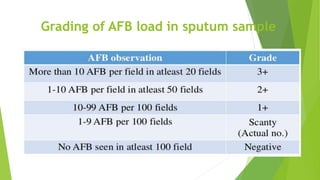
Grading of AFB load in sputum sample
Quality control
Internal QC of freshly made staining solutions :-
 Take 1 slide of 3+ grade and 1 negative slide ( prepared by
using known positive and negative sputum sample ) as
unstained control smear.
 Check every newly prepared staining solution with unstained
control smears , using atleast one positive.
Unacceptable control result :-
o PC , AFB are not stained strongly red or are clearly too few in
numbers.
o NC shows AFB .( possibly from contaminated water )
o Stain deposit is present on QC slide.
Internal QCof staining solutions in use and of
staining procedure :-
 Include positive and negative controls with each day’s
reading . Read control slides before patients smears.
 If results are unacceptable , re-stain smears of that day
together with new controls
 If these controls are also unacceptable, prepare new staining
solutions and repeat the staining.
Modifications in the percentage of sulfuric acid
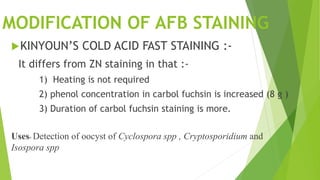
MODIFICATION OF AFB STAINING
KINYOUN’S COLD ACID FAST STAINING :-
It differs from ZN staining in that :-
1) Heating is not required
2) phenol concentration in carbol fuchsin is increased (8 g )
3) Duration of carbol fuchsin staining is more.
Uses- Detection of oocyst of Cyclospora spp , Cryptosporidium and
Isospora spp
MCQ
 1) All of the following are acid – fast , except :
a) Mycobacterium
b) Nocardia
c) Cystoisospora belli
d) Staphylococcus
Ans :- D
2) Which of the following is a defining characteristic of
acid fast bacteria?
a) A thin cell membrane made up of phospholipid
b) A thick layer of mycolic acid
c) A thin layer of peptidoglycan
d) A polypeptide layer surrounding the cell
membrane
Ans - B
3) Concentration 0f sulfuric acid used for acid fast
staining for Mycobacterium leprae ?
a) 20 %
b) 5%
c) 25%
d) 0.5-1%
Ans :- B
 4) All are true about kinyoun’s method, except:
a) This method was developed by Joseph J. kinyoun
b) High concentration of phenol is used
C) Heat acts as physical mordant
d) this method is safer because phenol fumes are not
generated during staining procedure.
 Answer : c
 5)Concentration of sulfuric acid used for acid fast
staining for Mycobacterium tuberculosis according to
RNTCP?
a) 25%
b) 20%
c) 5%
d) 0.5-1%
Ans - A
THANK
YOU

Ziehl Neelsen staining

  • 1.
    ZIEHL - NEELSEN(ZN) STAINING E  Presented by :- DR MOHD SAQIB HASAN
  • 2.
    CONTENTS  INTRODUCTION  PRINCIPLE SPECIMEN  REAGENTS  PROCEDURE  INTERPRETATION OF ZN STAIN  QUALITY CONTROL  MODIFICATION OF ZN STAINING
  • 3.
    INTRODUCTION  ZN isa modification of Ehrlich’s (1882) original method for the differential staining of tubercle bacilli and other acid fast bacilli with aniline gentian violet followed by strong nitric acid.  It incorporates improvements suggested , successively , by Ziehl – Neelsen  The ordinary aniline dye solutions do not readily penetrate the substance of the tubercle bacillus and therefore unsuitable for staining.
  • 4.
    PRINCIPLE  ACID FAST mycobacteriacontain mycolic acid in their outer membrane , making the cell waxy and resistant to staining with aqueous based stains such as the Gram stains.
  • 5.
     The primarystain (carbol fuchin) binds to mycolic acids in the cell wall of mycobacteria.  Intense decolourization ( strong acid or acid / alcohol ) does not release the primary stain from the cell wall and the mycobacteria retain the red colour of fuchsin –hence acid fastness.  Counterstaining ( with methylene blue ) provides a contrasting background.
  • 6.
    SPECIMEN A. PULMONARY  Sputum BAL or washing  Brocho alveolar biopsies B. EXTRAPULMONARY  Tissues  Body fluids C. CULRURE ISOLATES
  • 7.
    REAGENTS 1) 1% CARBOLFUCHSIN :- Basic fuchsin 1.0 g Phenol 5 g Alcohol ( 95% or 100% ethanol) 10 ml Distilled water 90ml  Take phenol crystals in a clean round bottom flask and melt by using heating water bath  Add the ethanol to molten phenol.
  • 8.
     Add basicfuchsin to the phenol – ethanol mixture and swirl until all the crystals have completely dissolved  Add distilled water to the final mixture and then filter using whattman filter paper No 1 NOTE :- Freshly filtered carbol fuchsin should be used for staining. Small quantities of staining reagent according to the work load, may be filtered every day before use.
  • 9.
    2) Decolouring agent( 25% SULPHURIC ACID – 100ml ) Concentrated sulphuric acid 25ml Sterile Distilled water 75ml o Carefully add concentrated sulphuric acid to water containing round bottom flask. oNOTE :-  Since it is an exothermic reaction , producing large quantity of heat , the flask should be placed in a trough containing cold water.  Always add acid to water , and not vice versa as it is explosive.
  • 10.
    3) Counterstain (0.1% METHYLENE BLUE – 100ml ) Methylene blue chloride 0.1 g Distilled water 100 ml  Dissolve the dye methylene blue chloride in distilled water and filter it using whattman filter paper No 1.  NOTE :- The reagent bottles should be labelled of appropriately with the batch number , date of preparation and date of expiry , reagents should be used with in 3 months.
  • 11.
    PROCEDURE 1. Label aclean glass slide at one end with the laboratory number. 2. Wear gloves and mask and open the specimen container in close proximity of spirit lamp or use Biosafety cabinet. 3. Transfer an appropriate portion of the specimen to the central part of slide by with an applicator stick. 4. Smear the specimen over an area of approx 2x3cm by making small circles. 5. Allow smears to air dry.
  • 12.
    6. Fix thesmear by passing through a flame 4-5 times. Allow it to cool before staining. 7. Place the slide on the staining rack. 8. Flood the slide with 1% Carbol fuchsin and heat until steaming. Avoid the boiling and drying of solution. 9. Rinse the slides with clean tap water. 10. Pour the decolorizing agent over smears. Drain off the decolorizing agent and then rinse slides with tap water. The red color of smears should disappear.
  • 13.
    11. Flood smearswith 0.1% methylene blue solution for 1minute. 12. Rinse the slides with clean tap water. 13. Let the slides air dry.
  • 14.
    INTERPRETATION OF ZNSTAIN  Acid fast bacilli will appear stained pink , straight curved rods with blue background due to methylene blue.
  • 15.
     Focus theslide under oil immersion and scan the smear from left to right and observe a minimum of 100 fields before giving a negative report.
  • 16.
    Grading of AFBload in sputum sample
  • 17.
    Quality control Internal QCof freshly made staining solutions :-  Take 1 slide of 3+ grade and 1 negative slide ( prepared by using known positive and negative sputum sample ) as unstained control smear.  Check every newly prepared staining solution with unstained control smears , using atleast one positive.
  • 18.
    Unacceptable control result:- o PC , AFB are not stained strongly red or are clearly too few in numbers. o NC shows AFB .( possibly from contaminated water ) o Stain deposit is present on QC slide.
  • 19.
    Internal QCof stainingsolutions in use and of staining procedure :-  Include positive and negative controls with each day’s reading . Read control slides before patients smears.  If results are unacceptable , re-stain smears of that day together with new controls  If these controls are also unacceptable, prepare new staining solutions and repeat the staining.
  • 20.
    Modifications in thepercentage of sulfuric acid
  • 21.
    MODIFICATION OF AFBSTAINING KINYOUN’S COLD ACID FAST STAINING :- It differs from ZN staining in that :- 1) Heating is not required 2) phenol concentration in carbol fuchsin is increased (8 g ) 3) Duration of carbol fuchsin staining is more. Uses- Detection of oocyst of Cyclospora spp , Cryptosporidium and Isospora spp
  • 22.
  • 23.
     1) Allof the following are acid – fast , except : a) Mycobacterium b) Nocardia c) Cystoisospora belli d) Staphylococcus Ans :- D
  • 24.
    2) Which ofthe following is a defining characteristic of acid fast bacteria? a) A thin cell membrane made up of phospholipid b) A thick layer of mycolic acid c) A thin layer of peptidoglycan d) A polypeptide layer surrounding the cell membrane Ans - B
  • 25.
    3) Concentration 0fsulfuric acid used for acid fast staining for Mycobacterium leprae ? a) 20 % b) 5% c) 25% d) 0.5-1% Ans :- B
  • 26.
     4) Allare true about kinyoun’s method, except: a) This method was developed by Joseph J. kinyoun b) High concentration of phenol is used C) Heat acts as physical mordant d) this method is safer because phenol fumes are not generated during staining procedure.  Answer : c
  • 27.
     5)Concentration ofsulfuric acid used for acid fast staining for Mycobacterium tuberculosis according to RNTCP? a) 25% b) 20% c) 5% d) 0.5-1% Ans - A
  • 28.