ZIGBEE BASED PARAMETER MONITORING AND CONTROLLING SYSTEM FOR INDUCTION MACHINE 
Mohit Kumar1, Mohnish Sharma1, Rishabh Narayan1, Sumit Joshi1, Sanjay Kumar2 
1B.Tech IVth year students, Electrical Engineering Department, COER, Roorkee, 
2Asst. Prof. Dept. of Electrical Engg, COER, Roorkee. 
Abstract - Nowadays the automation has become a basic need for the industries. Induction Motors are the nerves of many industries. Hence Industrial automation is required for precise and accurate operation. This paper proposes a wireless control and monitoring system for an induction motor based on Zigbee communication protocol for safe and economic data communication in industrial fields where the wired communication is more expensive or impossible due to physical conditions. A module of transducers and sensors monitors the parameters of induction machine and transmit the data through Zigbee Protocol. A microcontroller based system is used for collecting and storing data and accordingly generating control signal to stop or start the induction machine wireless through computer interface developed with Zigbee. 
Keywords- Induction Machine, Zigbee Protocol, Wireless control and Monitoring System 
1. INTRODUCTION 
Single Phase and Three Phase Induction machines are very popular in industries because of their vast applications. Hence it becomes necessary to protect them against faults so as to ensure uninterrupted operation and functioning1 . Various parameter controlling and monitoring systems are there for other types of machine, but in case of induction machine the controlling and monitoring systems are not extensively used due to high cost of installation and physical constraints. So as to overcome the limitations in monitoring and controlling, Zigbee Based System is used which makes it cost- effective and simple on the other hand2. To start with, first we should know what Zigbee Protocol is. Zigbee is a wireless communication device like Bluetooth and Wireless Local Area Network (WLAN)3. Basic difference between Zigbee and other communication protocol is that all Zigbee devices relay each other’s traffic, bypassing the wired network entirely. While Bluetooth devices connect to another wireless that acts as a hub and WLAN devices connect directly to an access point, which is wired to the enterprise network using Ethernet. The Institute of Electrical and Electronics Engineers (IEEE) developed 802.15.4 standards and helped the production of Zigbee protocol and devices that support this protocol. The disadvantage of using traditional systems is that it increases the cost whereas digital systems reduce the cost of system. The basic structure of Zigbee based parameter monitoring and controlling system consists of microcontroller board and zigbee device, one set of microcontroller board and zigbee device are near induction machine and acts as transmitter for the other microcontroller and zigbee device which is near the computer where the parameters are displayed on computer using software application. In addition to Zigbee Device various other sensors are used for 
Conference on Advances in Communication and Control Systems 2013 (CAC2S 2013) 
© 2013. The authors - Published by Atlantis Press 598
measuring different parameters. Wireless sensor network (WSN) system are autonomous and operate unattended also adaptive to the environment4. 
2. ABOUT ZIGBEE TECHNOLOGY 
2.1 WIRELESS SENSOR NETWORK 
Wireless sensor network system are autonomous and operate unattended also adaptive to the environment. The wireless system for monitoring purpose will not only reduce the overall monitoring system cost in term of facilities setup and labor cost, but always provide flexibility in system in term of distance or location. So these systems are widely used in military, hospitals, home and other commercial areas. According to these aspects the ZigBee becomes the new standard intended for low cost devices in automation, computer peripherals and home controls. ZigBee standard performs well at industrial environments the fundamental design and implementation of WSN featuring a high power transmission Zigbee based technology4. The developed platform is cost-effective and allows easily in WSN systems and as well as the effect on reducing energy consumption 
2.2 ZIGBEE NETWORK STRUCTURES 
There are three network topologies which are used. They are Star Network, Cluster- Tree Network and Mesh Network5. Different network topologies built up by Zigbee devices like star topology, cluster tree topology and mesh network. For all network topologies, there can be only one coordinator in each network. In star topology there is a coordinator which is responsible for all over the network. All other devices are back-end devices and directly communicate with the coordinator. This topology is suitable for networks with a centralized device and for time critical applications. Next is a cluster tree network where coordinators are still responsible for the Network initiating and maintenance. However, routers can be used to extend the network. Routers control data flow by using hierarchical routing strategies in the network. They also may imply beacon enabled network that is defined in IEEE 802.15.4 for periodical data transmission. In mesh network coordinator is seen as responsible for the network initiating and maintenance. Routers can be used to extend the network. A mesh network allows full peer to- peer communication. A mesh relies on this way self-healing technology so that if a node fails another route is used for the data delivery. 
3. MONITORING AND CONTROLLING SCHEME 
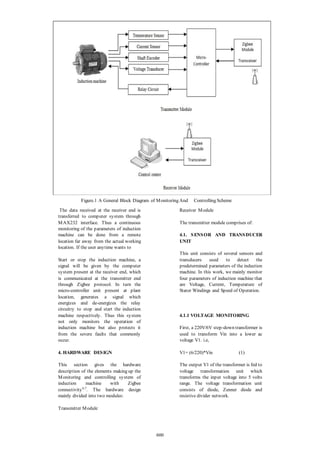
This section gives the overview of the monitoring and controlling scheme of induction machine. A general block diagram of the proposed scheme is given in Figure. 1. Figure.1 A General Block Diagram of Monitoring And Controlling Scheme 
The whole system is divided into two parts- transmitter and receiver. In the transmitter part a network of sensor and transducers are used to monitor the risky parameters such as voltage, current, temperature of stator winding and speed of the induction machine present at the plant location .The monitoring data is simultaneously fed to the micro- controller. This data is transmitted efficiently and smoothly to receiver end through wireless Zigbee Communication Protocol (IEEE802.15.4 Standards). The micro-controller at the transmitter end is so programmed that if the monitoring parameters of induction machine come out of the desired or safety limit, a signal will be generated by the micro-controller which will energize the relay circuit and the contractor cuts the mains supply to the induction machine. 599
The data received at the receiver end is transferred to computer system through MAX232 interface. Thus a continuous monitoring of the parameters of induction machine can be done from a remote location far away from the actual working location. If the user anytime wants to 
Start or stop the induction machine, a signal will be given by the computer system present at the receiver end, which is communicated at the transmitter end through Zigbee protocol. In turn the micro-controller unit present at plant location, generates a signal which energizes and de-energizes the relay circuitry to stop and start the induction machine respectively. Thus this system not only monitors the operation of induction machine but also protects it from the severe faults that commonly occur. 
4. HARDWARE DESIGN 
This section gives the hardware description of the elements making up the Monitoring and controlling system of induction machine with Zigbee connectivity6,7. The hardware design mainly divided into two modules: 
Transmitter Module 
Receiver Module 
The transmitter module comprises of: 
4.1. SENSOR AND TRANSDUCER UNIT 
This unit consists of several sensors and transducers used to detect the predetermined parameters of the induction machine. In this work, we mainly monitor four parameters of induction machine that are Voltage, Current, Temperature of Stator Windings and Speed of Operation. 
4.1.1 VOLTAGE MONITORING 
First, a 220V/6V step-down transformer is used to transform Vin into a lower ac voltage V1. i.e, 
V1= (6/220)*Vin (1) 
The output V1 of the transformer is fed to voltage transformation unit which transforms the input voltage into 5 volts range. The voltage transformation unit consists of diode, Zenner diode and resistive divider network. 
Figure.1 A General Block Diagram of Monitoring And Controlling Scheme 600
4.1.2. CURRENT MONITORING Current flowing through induction machine can be measured through the Hall Effect current sensor (A1120). A current sensor is a device that detects electrical current (AC or DC) in a wire, and generates a signal proportional to it. Hall-Effect current sensors can sense both AC and DC magnetic fields and can generally be specified to operate over a frequency range of DC to several thousand Hertz. 
4.1.3 TEMPERATURE MONITORING 
Temperature of stator winding can be measured through Dallas DS1820 Direct to digital temperature sensor. The Dallas Direct–to–Digital Temperature Sensors measure temperature through the use of an onboard proprietary temperature measurement technique. 
4.1.4 SPEED MONITORING 
Speed of revolution of induction machine can be measured using shaft encoder wheel and sensor.An encoder is a rotational transducer that converts angular movement into digital impulses. 
4.2 MICROCONTROLLER UNIT: This unit consist of a microcontroller from Atmel which is powered by the AVR core. ATMEGA 32 is one of the new mega ranges of Atmel AVR microcontrollers, offering much larger program space. The ATMEGA 32 includes a large 32kb of program flash memory, which will be more than adequate formost applications. The board consists of a crystal oscillator of 16MHz frequency.It consists of a reset switch and connectors for LCD and Zigbee Module interfacing. 
4.3 ZIGBEE TRANSMITTER MODULE 
The XBee RF Modules are designed to operate within the ZigBee protocol and support the unique needs of low-cost, low-power wireless sensor networks. The modules require minimal power and provide reliable delivery of data between remote devices. The modules operate within the ISM 2.4 GHz frequency band. It operates over a range of 100-200 meters. 
The receiver module consists of a Xbee RF module which is connected to computer system through MAX232.Thus the monitoring data received by Zigbee module is directly transffered to computer system. 
5. SOFTWARE 
X-CTU is a Windows-based application provided by Digi. This program was designed to interact with the firmware files found on Digi’s RF products and to 
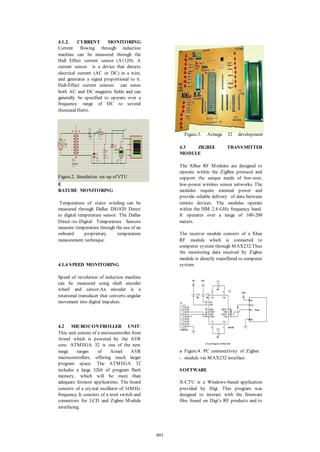
Figure.2. Simulation set-up of VTU 
Figure.3. Atmega 32 development board 
Figure.4. PC connnectivity of Zigbee module via MAX232 interface 601
provide a simple-to-use graphical user interface to them. 
The module’s baud rate, channel number,and network ID etc. can be configure by sending the set of AT commands to the XBee Module using the X-CTU software. The Test / Query button is used to test the selected COM port and PC settings. The Host Setup tab allows the user to configure how the X-CTU program is to interface with a radio’s firmware. This includes determining whether API or AT command mode will be used to access the module’s firmware as well as the proper command mode character and sequence. 
6. CONCLUSION 
With the help of this study, a parameter monitoring system for induction machines based on Zigbee protocol is achieved and tested successfully. The system developed is capable to perform such operations as running the motor though RF, stopping it, measuring, monitoring and controlling the most parameters of the motor like phase currents, phase voltages, wiring temperature, speed. All of these values can be transferred to the host computer, displayed on the interface, represented graphically; Monitoring and controlling the basic parameters of the induction motors were examined and achieved in various ways. A new ZigBee technology is a new wireless protocol is used for the communication. This protocol is widely used various areas for its better reliability, low power consuming profile, excellent Capability, high flexibility and low cost. So it’s significant to embed the ZigBee protocol into the WSN system that widely applied now in every area. The system achieved can be used for industrial applications. The whole system may be very useful to colleges and research institutes that have vocational, technical, and industrial education 
REFERENCES 
[1] Tanmoy Maity , Partha sarathi Das , and Mithu Mukherjee, “Rescue and protection system for underground mine workers based on Zigbee ” Int. Jr. Of Advanced Computer Engineering & Architecture Vol. 2 No. 2 (June - December,12) 
[2]Jui-Yu Cheng and Min-Hsiung Hung, Jen-Wei Chang, “A ZigBee-Based Power Monitoring System with Direct Load Control Capabilities” Proceedings of the 2007 IEEE International Conference on 
Figure.5. X-CTU setup 
Figure.6. Remote Configuration view on X-CTU software 602
TuesE04 Networking, Sensing and Control, London, UK, 15-17 April 2007 
[3] A Comparative Study of Wireless Protocols: Bluetooth, UWB, ZigBee, and Wi-Fi by Jin-Shyan Lee, Yu-Wei Su, and Chung-Chou Shen, Information & Communications Research Labs, Industrial Technology Research Institute (ITRI) 
[4] F.L.Lewis, Wireless Sensor Networks- Chapter 4, Smart environments: Technologies, Protocols, and Applications Journal 
[5] Ramazan BAYINDIR, Mehmet ŞEN, “A Parameter Monitoring System for Induction Motors based on zigbee protocol”, Gazi University Journal of Science. GU J Sci 24(4):763-771 (2011) 
[6] Zulhani Rasin, Mohd Rizal Abdullah , “Water Quality Monitoring System Using Zigbee Based Wireless Sensor Network”, International Journal of Engineering & Technology IJET Vol: 9 No: 10 
[7] Shizhuang Lin1, Jingyu Liu2 and Yanjun Fang,” ZigBee Based Wireless Sensor Networks and Its Applications in Industrial”, International Conference on Automation and Logistics August 18 - 21, 2007, Jinan, China 603

Zigbee based parameter monitoring and controlling system for induction machine

  • 1.
    ZIGBEE BASED PARAMETERMONITORING AND CONTROLLING SYSTEM FOR INDUCTION MACHINE Mohit Kumar1, Mohnish Sharma1, Rishabh Narayan1, Sumit Joshi1, Sanjay Kumar2 1B.Tech IVth year students, Electrical Engineering Department, COER, Roorkee, 2Asst. Prof. Dept. of Electrical Engg, COER, Roorkee. Abstract - Nowadays the automation has become a basic need for the industries. Induction Motors are the nerves of many industries. Hence Industrial automation is required for precise and accurate operation. This paper proposes a wireless control and monitoring system for an induction motor based on Zigbee communication protocol for safe and economic data communication in industrial fields where the wired communication is more expensive or impossible due to physical conditions. A module of transducers and sensors monitors the parameters of induction machine and transmit the data through Zigbee Protocol. A microcontroller based system is used for collecting and storing data and accordingly generating control signal to stop or start the induction machine wireless through computer interface developed with Zigbee. Keywords- Induction Machine, Zigbee Protocol, Wireless control and Monitoring System 1. INTRODUCTION Single Phase and Three Phase Induction machines are very popular in industries because of their vast applications. Hence it becomes necessary to protect them against faults so as to ensure uninterrupted operation and functioning1 . Various parameter controlling and monitoring systems are there for other types of machine, but in case of induction machine the controlling and monitoring systems are not extensively used due to high cost of installation and physical constraints. So as to overcome the limitations in monitoring and controlling, Zigbee Based System is used which makes it cost- effective and simple on the other hand2. To start with, first we should know what Zigbee Protocol is. Zigbee is a wireless communication device like Bluetooth and Wireless Local Area Network (WLAN)3. Basic difference between Zigbee and other communication protocol is that all Zigbee devices relay each other’s traffic, bypassing the wired network entirely. While Bluetooth devices connect to another wireless that acts as a hub and WLAN devices connect directly to an access point, which is wired to the enterprise network using Ethernet. The Institute of Electrical and Electronics Engineers (IEEE) developed 802.15.4 standards and helped the production of Zigbee protocol and devices that support this protocol. The disadvantage of using traditional systems is that it increases the cost whereas digital systems reduce the cost of system. The basic structure of Zigbee based parameter monitoring and controlling system consists of microcontroller board and zigbee device, one set of microcontroller board and zigbee device are near induction machine and acts as transmitter for the other microcontroller and zigbee device which is near the computer where the parameters are displayed on computer using software application. In addition to Zigbee Device various other sensors are used for Conference on Advances in Communication and Control Systems 2013 (CAC2S 2013) © 2013. The authors - Published by Atlantis Press 598
  • 2.
    measuring different parameters.Wireless sensor network (WSN) system are autonomous and operate unattended also adaptive to the environment4. 2. ABOUT ZIGBEE TECHNOLOGY 2.1 WIRELESS SENSOR NETWORK Wireless sensor network system are autonomous and operate unattended also adaptive to the environment. The wireless system for monitoring purpose will not only reduce the overall monitoring system cost in term of facilities setup and labor cost, but always provide flexibility in system in term of distance or location. So these systems are widely used in military, hospitals, home and other commercial areas. According to these aspects the ZigBee becomes the new standard intended for low cost devices in automation, computer peripherals and home controls. ZigBee standard performs well at industrial environments the fundamental design and implementation of WSN featuring a high power transmission Zigbee based technology4. The developed platform is cost-effective and allows easily in WSN systems and as well as the effect on reducing energy consumption 2.2 ZIGBEE NETWORK STRUCTURES There are three network topologies which are used. They are Star Network, Cluster- Tree Network and Mesh Network5. Different network topologies built up by Zigbee devices like star topology, cluster tree topology and mesh network. For all network topologies, there can be only one coordinator in each network. In star topology there is a coordinator which is responsible for all over the network. All other devices are back-end devices and directly communicate with the coordinator. This topology is suitable for networks with a centralized device and for time critical applications. Next is a cluster tree network where coordinators are still responsible for the Network initiating and maintenance. However, routers can be used to extend the network. Routers control data flow by using hierarchical routing strategies in the network. They also may imply beacon enabled network that is defined in IEEE 802.15.4 for periodical data transmission. In mesh network coordinator is seen as responsible for the network initiating and maintenance. Routers can be used to extend the network. A mesh network allows full peer to- peer communication. A mesh relies on this way self-healing technology so that if a node fails another route is used for the data delivery. 3. MONITORING AND CONTROLLING SCHEME This section gives the overview of the monitoring and controlling scheme of induction machine. A general block diagram of the proposed scheme is given in Figure. 1. Figure.1 A General Block Diagram of Monitoring And Controlling Scheme The whole system is divided into two parts- transmitter and receiver. In the transmitter part a network of sensor and transducers are used to monitor the risky parameters such as voltage, current, temperature of stator winding and speed of the induction machine present at the plant location .The monitoring data is simultaneously fed to the micro- controller. This data is transmitted efficiently and smoothly to receiver end through wireless Zigbee Communication Protocol (IEEE802.15.4 Standards). The micro-controller at the transmitter end is so programmed that if the monitoring parameters of induction machine come out of the desired or safety limit, a signal will be generated by the micro-controller which will energize the relay circuit and the contractor cuts the mains supply to the induction machine. 599
  • 3.
    The data receivedat the receiver end is transferred to computer system through MAX232 interface. Thus a continuous monitoring of the parameters of induction machine can be done from a remote location far away from the actual working location. If the user anytime wants to Start or stop the induction machine, a signal will be given by the computer system present at the receiver end, which is communicated at the transmitter end through Zigbee protocol. In turn the micro-controller unit present at plant location, generates a signal which energizes and de-energizes the relay circuitry to stop and start the induction machine respectively. Thus this system not only monitors the operation of induction machine but also protects it from the severe faults that commonly occur. 4. HARDWARE DESIGN This section gives the hardware description of the elements making up the Monitoring and controlling system of induction machine with Zigbee connectivity6,7. The hardware design mainly divided into two modules: Transmitter Module Receiver Module The transmitter module comprises of: 4.1. SENSOR AND TRANSDUCER UNIT This unit consists of several sensors and transducers used to detect the predetermined parameters of the induction machine. In this work, we mainly monitor four parameters of induction machine that are Voltage, Current, Temperature of Stator Windings and Speed of Operation. 4.1.1 VOLTAGE MONITORING First, a 220V/6V step-down transformer is used to transform Vin into a lower ac voltage V1. i.e, V1= (6/220)*Vin (1) The output V1 of the transformer is fed to voltage transformation unit which transforms the input voltage into 5 volts range. The voltage transformation unit consists of diode, Zenner diode and resistive divider network. Figure.1 A General Block Diagram of Monitoring And Controlling Scheme 600
  • 4.
    4.1.2. CURRENT MONITORINGCurrent flowing through induction machine can be measured through the Hall Effect current sensor (A1120). A current sensor is a device that detects electrical current (AC or DC) in a wire, and generates a signal proportional to it. Hall-Effect current sensors can sense both AC and DC magnetic fields and can generally be specified to operate over a frequency range of DC to several thousand Hertz. 4.1.3 TEMPERATURE MONITORING Temperature of stator winding can be measured through Dallas DS1820 Direct to digital temperature sensor. The Dallas Direct–to–Digital Temperature Sensors measure temperature through the use of an onboard proprietary temperature measurement technique. 4.1.4 SPEED MONITORING Speed of revolution of induction machine can be measured using shaft encoder wheel and sensor.An encoder is a rotational transducer that converts angular movement into digital impulses. 4.2 MICROCONTROLLER UNIT: This unit consist of a microcontroller from Atmel which is powered by the AVR core. ATMEGA 32 is one of the new mega ranges of Atmel AVR microcontrollers, offering much larger program space. The ATMEGA 32 includes a large 32kb of program flash memory, which will be more than adequate formost applications. The board consists of a crystal oscillator of 16MHz frequency.It consists of a reset switch and connectors for LCD and Zigbee Module interfacing. 4.3 ZIGBEE TRANSMITTER MODULE The XBee RF Modules are designed to operate within the ZigBee protocol and support the unique needs of low-cost, low-power wireless sensor networks. The modules require minimal power and provide reliable delivery of data between remote devices. The modules operate within the ISM 2.4 GHz frequency band. It operates over a range of 100-200 meters. The receiver module consists of a Xbee RF module which is connected to computer system through MAX232.Thus the monitoring data received by Zigbee module is directly transffered to computer system. 5. SOFTWARE X-CTU is a Windows-based application provided by Digi. This program was designed to interact with the firmware files found on Digi’s RF products and to Figure.2. Simulation set-up of VTU Figure.3. Atmega 32 development board Figure.4. PC connnectivity of Zigbee module via MAX232 interface 601
  • 5.
    provide a simple-to-usegraphical user interface to them. The module’s baud rate, channel number,and network ID etc. can be configure by sending the set of AT commands to the XBee Module using the X-CTU software. The Test / Query button is used to test the selected COM port and PC settings. The Host Setup tab allows the user to configure how the X-CTU program is to interface with a radio’s firmware. This includes determining whether API or AT command mode will be used to access the module’s firmware as well as the proper command mode character and sequence. 6. CONCLUSION With the help of this study, a parameter monitoring system for induction machines based on Zigbee protocol is achieved and tested successfully. The system developed is capable to perform such operations as running the motor though RF, stopping it, measuring, monitoring and controlling the most parameters of the motor like phase currents, phase voltages, wiring temperature, speed. All of these values can be transferred to the host computer, displayed on the interface, represented graphically; Monitoring and controlling the basic parameters of the induction motors were examined and achieved in various ways. A new ZigBee technology is a new wireless protocol is used for the communication. This protocol is widely used various areas for its better reliability, low power consuming profile, excellent Capability, high flexibility and low cost. So it’s significant to embed the ZigBee protocol into the WSN system that widely applied now in every area. The system achieved can be used for industrial applications. The whole system may be very useful to colleges and research institutes that have vocational, technical, and industrial education REFERENCES [1] Tanmoy Maity , Partha sarathi Das , and Mithu Mukherjee, “Rescue and protection system for underground mine workers based on Zigbee ” Int. Jr. Of Advanced Computer Engineering & Architecture Vol. 2 No. 2 (June - December,12) [2]Jui-Yu Cheng and Min-Hsiung Hung, Jen-Wei Chang, “A ZigBee-Based Power Monitoring System with Direct Load Control Capabilities” Proceedings of the 2007 IEEE International Conference on Figure.5. X-CTU setup Figure.6. Remote Configuration view on X-CTU software 602
  • 6.
    TuesE04 Networking, Sensingand Control, London, UK, 15-17 April 2007 [3] A Comparative Study of Wireless Protocols: Bluetooth, UWB, ZigBee, and Wi-Fi by Jin-Shyan Lee, Yu-Wei Su, and Chung-Chou Shen, Information & Communications Research Labs, Industrial Technology Research Institute (ITRI) [4] F.L.Lewis, Wireless Sensor Networks- Chapter 4, Smart environments: Technologies, Protocols, and Applications Journal [5] Ramazan BAYINDIR, Mehmet ŞEN, “A Parameter Monitoring System for Induction Motors based on zigbee protocol”, Gazi University Journal of Science. GU J Sci 24(4):763-771 (2011) [6] Zulhani Rasin, Mohd Rizal Abdullah , “Water Quality Monitoring System Using Zigbee Based Wireless Sensor Network”, International Journal of Engineering & Technology IJET Vol: 9 No: 10 [7] Shizhuang Lin1, Jingyu Liu2 and Yanjun Fang,” ZigBee Based Wireless Sensor Networks and Its Applications in Industrial”, International Conference on Automation and Logistics August 18 - 21, 2007, Jinan, China 603