Priorities for the Management
of Soils in Zambia
Stalin Sichinga
Ministry of Agriculture and Livestock
Zambia
Country Profile
• Zambia is a land-locked country in Southern Africa
• covers a surface area of 752,972 km2
• The population of Zambia is about 14.54 million as of 2013
Climate
• Zambia has a sub-tropical climate.
• The rainfall pattern is unimodal and it’s from November to March.
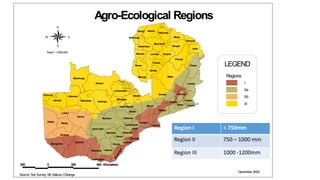
• Rainfall varies from 750 mm in the south to 1200 mm in the north
Economy
• The Zambian economy has historically been based on the Copper Mining
industry.
• However Agriculture plays a very important part in Zambia's economy
providing many more jobs than the mining industry
Mpika
Solwezi
Sesheke
Kaoma
Serenje
Kalabo
Chama
Mkushi
Mumbwa
Kasempa
Lukulu
Chinsali
Mwinilunga
Kalomo
Senanga
MufumbweZambezi
Lundazi
Kaputa
Kazungula
Isoka
Kabompo
Mansa
Mongu
Mbala
Nyimba
Itezhi-Tezhi
Shangombo
Samfya
Kasama
Chibombo
Chongwe
Mungwi
Kapiri Mposhi
Luwingu
Mporokoso
Petauke
Kafue
Choma
Lufwanyama
Mpongwe
Mpulungu
Chipata
Mwense
Kawambwa
Milenge
Monze
Mazabuka
Mambwe
Chilubi
Namwala
Katete
Chavuma Masaiti
Chiengi
Nakonde
Gwembe
Luangwa
Siavonga
Sinazongwe
Nchelenge
Chadiza
Kabwe
Livingstone
LusakaUrban
Chililabombwe
MufuliraChingola
Kalulushi Kitwe
Luanshya
Ndola
200 0 200 400 Kilometers
N
EW
S
Agro-Ecological Regions
District boundary
KEY
Source: Soil Survey, Mt. Makulu Chilanga
December 2002
Scale 1: 2,500,000
Regions
I
IIa
IIb
III
LEGEND
Region I < 750mm
Region II 750 – 1000 mm
Region III 1000 -1200mm
Agriculture
•Farming in Zambia is predominantly rain-fed, only
about 2 percent to 3 percent of the land area
cultivated annually is irrigated.
•Agriculture provides employment for 67 percent of the
labor force and remains by far the major opportunity
for employment of rural women.
•It contributes about 23% to the country’s GDP
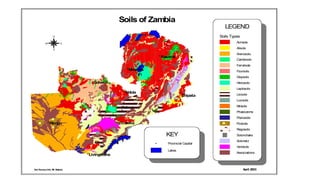
Soils Types
Acrisols
Alisols
Arenosols
Cambisols
Ferralsols
Fluvisols
Gleysols
Histosols
Leptosols
Lixisols
Luvisols
Nitisols
Phaeozems
Planosols
Podzols
Regosols
Solonchaks
Solonetz
Vertisols
Associations
LEGEND
%
%
%
%
%
%
%
%
%
Mwansa
Ndola
Lusaka
Kasama
Solwezi
Livingstone
Mongu
Kabwe
Chipata
N
EW
S
Soils of Zambia
Provincial Capital%
Lakes
KEY
Soil SurveyUnit, Mt. Makulu April 2003
Main Constraint to sustainable soil management is
Soil erosion and soil degradation
•Soil erosion and soil degradation are also closely linked
to deforestation which is a major cause of soil erosion
and soil degradation, and clearing new land for
agriculture when old fields lose their fertility is a major
source of deforestation.
Other causes of soil degradation and soil erosion
are bush fires and overgrazing by livestock
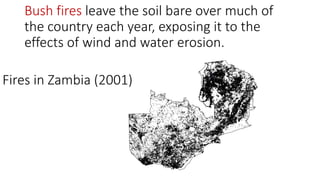
Bush fires leave the soil bare over much of
the country each year, exposing it to the
effects of wind and water erosion.
Fires in Zambia (2001)
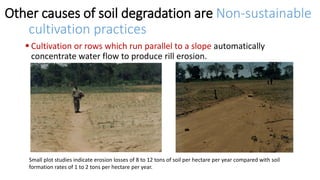
Other causes of soil degradation are Non-sustainable
cultivation practices
 Cultivation or rows which run parallel to a slope automatically
concentrate water flow to produce rill erosion.
Small plot studies indicate erosion losses of 8 to 12 tons of soil per hectare per year compared with soil
formation rates of 1 to 2 tons per hectare per year.
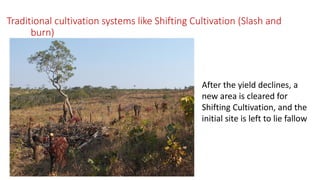
Traditional cultivation systems like Shifting Cultivation (Slash and
burn)
After the yield declines, a
new area is cleared for
Shifting Cultivation, and the
initial site is left to lie fallow
Soil acidity is also an important problem, particularly
in the heavily leached soils of the higher rainfall
zones of northern Zambia.
Phosphate becomes insoluble and unavailable to
the plants even when present in the soil under
conditions of high acidity.
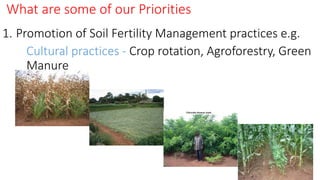
What are some of our Priorities
1. Promotion of Soil Fertility Management practices e.g.
Cultural practices - Crop rotation, Agroforestry, Green
Manure
Gliricidia biomass bank
2. Development of site specific fertilizer
recommendations as opposed to blanket
application- working with AGRA
3. Capacity building of Agricultural stuff at all levels,
there is also need to encourage farmer to farmer
extension by way of Training Farmer Trainers. This
will enhances farmer participation.
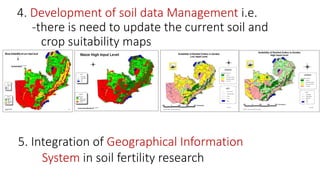
4. Development of soil data Management i.e.
-there is need to update the current soil and
crop suitability maps
5. Integration of Geographical Information
System in soil fertility research
6. Support for the development of crushed
lime production for agricultural
application to overcome the problem of
soil acidity in the Northern part of Zambia
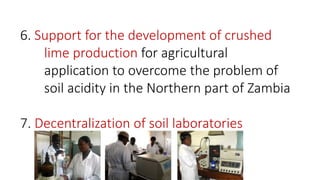
7. Decentralization of soil laboratories
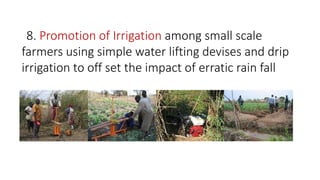
8. Promotion of Irrigation among small scale
farmers using simple water lifting devises and drip
irrigation to off set the impact of erratic rain fall
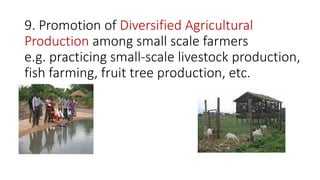
9. Promotion of Diversified Agricultural
Production among small scale farmers
e.g. practicing small-scale livestock production,
fish farming, fruit tree production, etc.
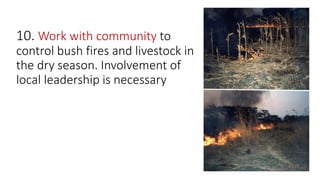
10. Work with community to
control bush fires and livestock in
the dry season. Involvement of
local leadership is necessary
Thank You
Thank You

Zambia