Network of Youth Leaders for Health Congress 
25 – 27 May 2011 
Clark Field, Pampanga 
Youth and HIV 
Jose Gerard Belimac, MD, MPH 
Medical Specialist II 
Manager, National AIDS and STI Prevention and Control Program 
(NASPCP) 
National Center for Disease Prevention and Control (NCDPC) 
Pampanga
• Young People? 
• Youth? 
• Children? 
• Adolescent? 
National AIDS/STI Prevention and Control Program 
Infectious Disease Office
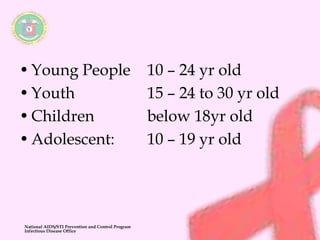
• Young People 10 – 24 yr old 
• Youth 15 – 24 to 30 yr old 
• Children below 18yr old 
• Adolescent: 10 – 19 yr old 
National AIDS/STI Prevention and Control Program 
Infectious Disease Office
Purpose 
- To inform Youth leaders on HIV risks 
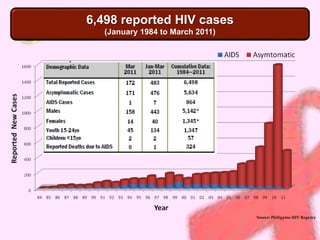
and vulnerabilities so that leaders can 
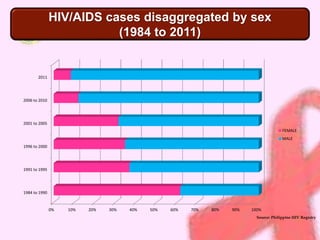
fully maximise their potential as 
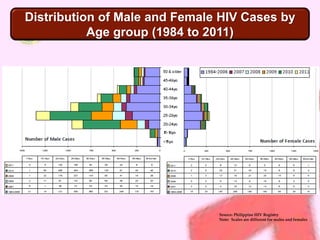
agents of change in their communities 
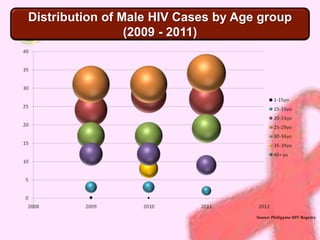
National AIDS/STI Prevention and Control Program 
Infectious Disease Office
Outline of Presentation 
• Facts on HIV and AIDS 
– Basic information on HIV 
– Risks and Vulnerabilities 
– Impact of HIV to individuals, families and 
communities 
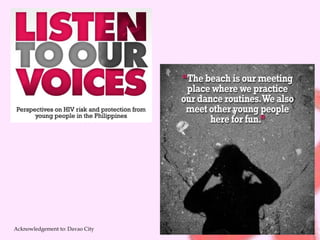
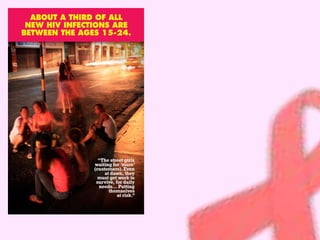
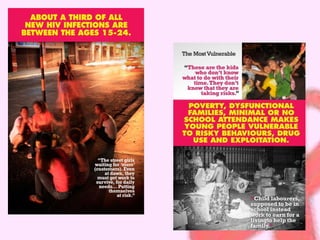
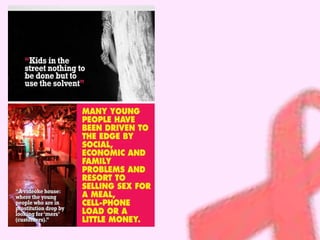
• Epidemiology 
• Examples of Interventions 
National AIDS/STI Prevention and Control Program 
Infectious Disease Office
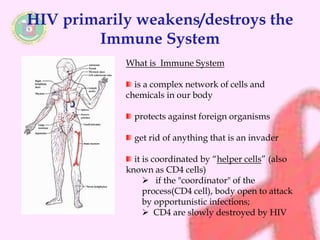
HIV primarily weakens/destroys the 
Immune System 
What is Immune System 
is a complex network of cells and 
chemicals in our body 
protects against foreign organisms 
get rid of anything that is an invader 
it is coordinated by “helper cells” (also 
known as CD4 cells) 
 if the "coordinator" of the 
process(CD4 cell), body open to attack 
by opportunistic infections; 
 CD4 are slowly destroyed by HIV
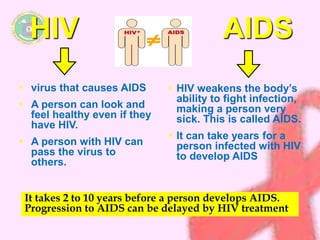
HIV AIDS 
• virus that causes AIDS 
• A person can look and 
feel healthy even if they 
have HIV. 
• A person with HIV can 
pass the virus to 
others. 
• HIV weakens the body’s 
ability to fight infection, 
making a person very 
sick. This is called AIDS. 
• It can take years for a 
person infected with HIV 
to develop AIDS 
It takes 2 to 10 years before a person develops AIDS. 
Progression to AIDS can be delayed by HIV treatment
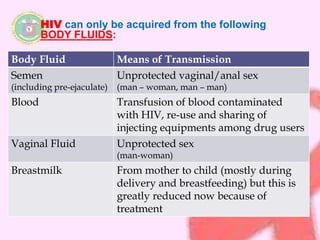
HIV can only be acquired from the following 
BODY FLUIDS: 
Body Fluid Means of Transmission 
Semen 
(including pre-ejaculate) 
Unprotected vaginal/anal sex 
(man – woman, man – man) 
Blood Transfusion of blood contaminated 
with HIV, re-use and sharing of 
injecting equipments among drug users 
Vaginal Fluid Unprotected sex 
(man-woman) 
Breastmilk From mother to child (mostly during 
delivery and breastfeeding) but this is 
greatly reduced now because of 
treatment
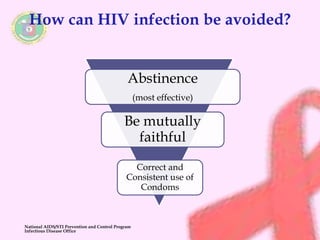
How can HIV infection be avoided? 
Abstinence 
(most effective) 
Be mutually 
faithful 
Correct and 
Consistent use of 
Condoms 
National AIDS/STI Prevention and Control Program 
Infectious Disease Office
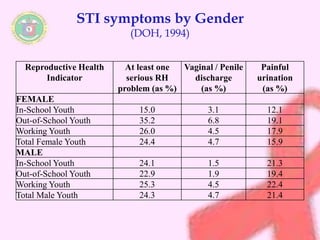
STI symptoms by Gender 
(DOH, 1994) 
Reproductive Health 
Indicator 
At least one 
serious RH 
problem (as %) 
Vaginal / Penile 
discharge 
(as %) 
Painful 
urination 
(as %) 
FEMALE 
In-School Youth 15.0 3.1 12.1 
Out-of-School Youth 35.2 6.8 19.1 
Working Youth 26.0 4.5 17.9 
Total Female Youth 24.4 4.7 15.9 
MALE 
In-School Youth 24.1 1.5 21.3 
Out-of-School Youth 22.9 1.9 19.4 
Working Youth 25.3 4.5 22.4 
Total Male Youth 24.3 4.7 21.4
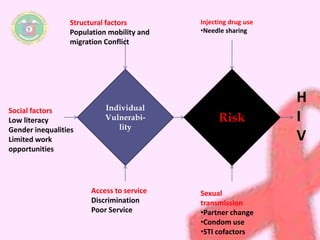
Individual 
Vulnerabi-lity 
Risk 
Structural factors 
Population mobility and 
migration Conflict 
Injecting drug use 
•Needle sharing 
Social factors 
Low literacy 
Gender inequalities 
Limited work 
opportunities 
H 
I 
V 
Access to service 
Discrimination 
Poor Service 
Sexual 
transmission 
•Partner change 
•Condom use 
•STI cofactors
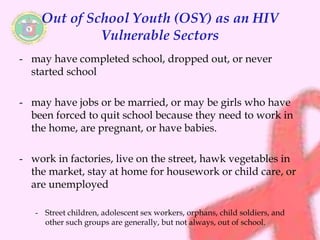
Out of School Youth (OSY) as an HIV 
Vulnerable Sectors 
- may have completed school, dropped out, or never 
started school 
- may have jobs or be married, or may be girls who have 
been forced to quit school because they need to work in 
the home, are pregnant, or have babies. 
- work in factories, live on the street, hawk vegetables in 
the market, stay at home for housework or child care, or 
are unemployed 
- Street children, adolescent sex workers, orphans, child soldiers, and 
other such groups are generally, but not always, out of school.
What are the needs of OSY? 
• Same needs as other youth: 
– food and shelter 
– sense of connection or belonging 
– skills in problem-solving and life planning, job or vocational 
training 
– access to appropriate services 
– empowerment to take responsibility for their own lives 
– and information on sexual health issues, including contraception 
and HIV prevention. 
– However, different populations of out-of-school youth have 
specific needs defined by their circumstances. 
Adapted
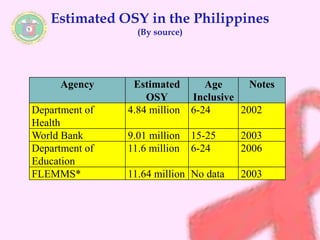
Estimated OSY in the Philippines 
(By source) 
Agency Estimated 
OSY 
Age 
Inclusive 
Notes 
Department of 
Health 
4.84 million 6-24 2002 
World Bank 9.01 million 15-25 2003 
Department of 
11.6 million 6-24 2006 
Education 
FLEMMS* 11.64 million No data 2003
Vulnerability of Young People to HIV and AIDS 
(UNICEF, 2006) 
• Knowledge of HIV, AIDS and condom increases with age, 
and is high among those with high education and in school 
adolescents 
• Almost 2 out of 10 youths surveyed are sexually active 
• More young people from the major urban cities have 
engaged in sex 
– Condom use still low among sexually active youth 
– Younger youth are likely to use condom the first time, and this 
improved slightly with higher number of older youth using 
condom in their last sexual episode
Vulnerability of Young People to HIV and AIDS 
(UNICEF, 2006) 
• Attitude 
– About 4 of 10 youths and healthworkers 
believe that discussing condoms among 
youth only promotes promiscuity 
– Even among healthworkers, a substantial 
17 percent agreed to the statement that 
using condom is sign of not trusting one’s 
partner.
Other vulnerabilities (15 – 24 yr old) 
(HAIN OR, 2008) 
• OSY rely more on friends especially on issues such as sexuality 
• When asked how to prevent STI, ways cited are withdrawal, 
choosing the right partner, and taking of medicines/antibiotics 
• More males than females mentioned the use of condom as a way 
to prevent STI 
• 94% are aware of condom but only 45% know that use of 
condom during sex can reduce the risk of HIV infection 
• Majority are currently in a relationship and had engaged in 
sexual intercourse. 
National AIDS/STI Prevention and Control Program 
Infectious Disease Office
Some HIV Risks (15 – 24 yr old) 
(HAIN OR, 2008) 
• OSYs exhibit a more liberal attitude towards sex, with higher 
percentage engaged in almost all types of sexual practices: 
multiples sex, unprotected sex, commercial sex, sex with same sex 
• A third of sexually active OSY reported they had ever experienced 
being forced against their will to have sex, with males having a 
slightly higher rate than female (35%,32%) 
• Males reported to have had an average of six sexual partners while 
women had an average of two. 
National AIDS/STI Prevention and Control Program 
Infectious Disease Office
Biological Risk 
• Cervix of adolescents is more 
vulnerable to STI
What Happens when one is Infected 
with HIV? – The Impact of AIDS
Impact of HIV/AIDS Effects of HIV/AIDS on 
Individuals, Families and Households 
• Need for care and support 
• Sickness and death 
• Psychological losses and burdens related to sickness, 
death, decline in well being and increased insecurity 
• Loss of the family’s adult members at their most 
productive ages 
• Reduction in nutrition 
• Loss of productivity 
• Loss of income, increase in poverty, diversion of 
resources 
• Increase in dependants 
• Orphaning
Impact of HIV/AIDS Effects of HIV/AIDS on 
Individuals, Families and Households 
• Breakup of families 
• Increased dependency ratios and pressure on surviving 
adults caring for additional family members 
• Population shifts due to both mortality and migration 
• Increased violence associated with crime and stigma, 
increase in discrimination
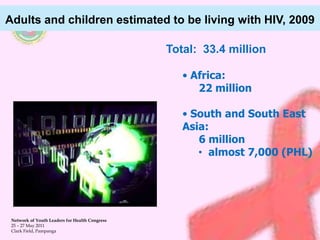
Adults and children estimated to be living with HIV, 2009 
Network of Youth Leaders for Health Congress 
25 – 27 May 2011 
Clark Field, Pampanga 
Total: 33.4 million 
• Africa: 
22 million 
• South and South East 
Asia: 
6 million 
• almost 7,000 (PHL)
6,498 reported HIV cases 
(January 1984 to March 2011) 
Source: Philippine HIV Registry
0% 10% 20% 30% 40% 50% 60% 70% 80% 90% 100% 
2011 
2006 to 2010 
2001 to 2005 
1996 to 2000 
1991 to 1995 
1984 to 1990 
FEMALE 
MALE 
HIV/AIDS cases disaggregated by sex 
(1984 to 2011) 
Source: Philippine HIV Registry
Distribution of Male and Female HIV Cases by 
Age group (1984 to 2011) 
Source: Philippine HIV Registry 
Note: Scales are different for males and females
Distribution of Male HIV Cases by Age group 
(2009 - 2011) 
Source: Philippine HIV Registry
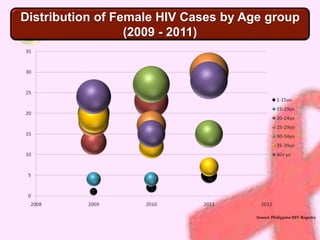
Distribution of Female HIV Cases by Age group 
(2009 - 2011) 
Source: Philippine HIV Registry
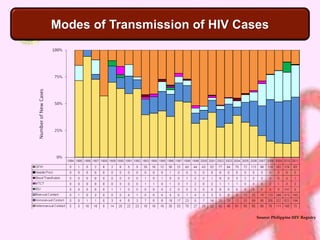
Modes of Transmission of HIV Cases 
Source: Philippine HIV Registry
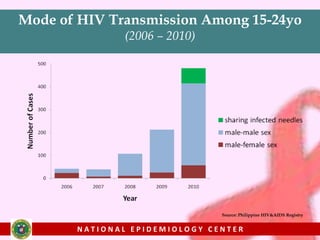
Mode of HIV Transmission Among 15-24yo 
(2006 – 2010) 
Source: Philippine HIV&AIDS Registry 
N A T I O N A L E P I D E M I O L O G Y C E N T E R
The General Gameplan 
(5th AIDS Medium Term Plan 2011 – 2015) 
Vision 
The spread of HIV infection is halted in the 
Philippines 
Goal 
By 2016, the country will have prevented the 
further spread of HIV infection and reduced the 
impact of the disease on individuals, families, 
sectors, and communities. 
National AIDS/STI Prevention and Control Program 
Infectious Disease Office
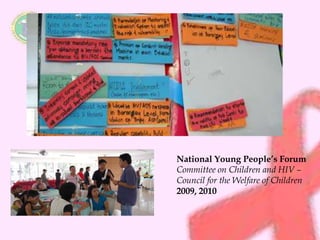
National Young People’s Forum 
Committee on Children and HIV – 
Council for the Welfare of Children 
2009, 2010
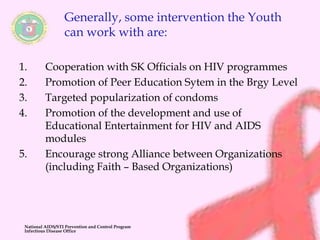
Generally, some intervention the Youth 
can work with are: 
1. Cooperation with SK Officials on HIV programmes 
2. Promotion of Peer Education Sytem in the Brgy Level 
3. Targeted popularization of condoms 
4. Promotion of the development and use of 
Educational Entertainment for HIV and AIDS 
modules 
5. Encourage strong Alliance between Organizations 
(including Faith – Based Organizations) 
National AIDS/STI Prevention and Control Program 
Infectious Disease Office
Generally, some intervention the Youth 
can work with are: 
7. Intensify, correct & update Advocacy campaigns 
among all in school personnel and students 
8. Inclusion of children and young peoples in the 
monitoring and evaluation of programmes 
9. Ensure that VCT is provided for free in all health 
centers; ensure the availability of HIV IEC materials 
in every health center 
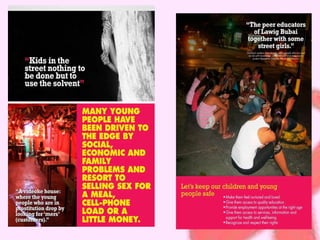
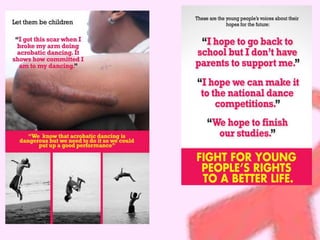
National AIDS/STI Prevention and Control Program 
Infectious Disease Office
HIV Vulnerabilities thru the Eyes of 
Young People 
National AIDS/STI Prevention and Control Program 
Infectious Disease Office
Acknowledgement to: Davao City
Summer Internship Programme for Young 
People on HIV and AIDS 
(2010) 
Background: 
• Very low knowledge of Youth on HIV and AIDS 
• Limited manpower of health offices to educate the youth 
• Recognised the Power of peers as good source of 
information 
Project: 
• 240 YP trained and hired by DOH to conduct peer 
education in their own communities (NCR, Cebu and 
Davao) 
• Daily visit to communities, supervised by doctors and 
counselors from LGU and NGO 
National AIDS/STI Prevention and Control Program 
Infectious Disease Office
Summer Internship Programme for Young 
People on HIV and AIDS 
(2010) 
Outcome: 
1. Delivered education to almost 5,000 peers (one – on – 
one) 
2. Summer interns able to maintain group of peers for 
self-help sessions weekly 
3. Summer Interns eventually became school – based 
advocates and educators and tapped by schools and 
communities for HIV advocay and programmes 
4. Sense of belongingness, heightened social 
consciousness (poverty, independence, responsibility, 
accountability) 
National AIDS/STI Prevention and Control Program 
Infectious Disease Office
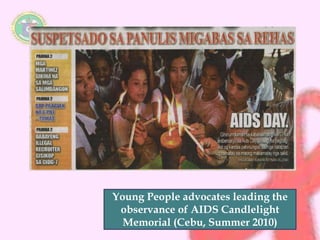
Young People advocates leading the 
observance of AIDS Candlelight 
Memorial (Cebu, Summer 2010)
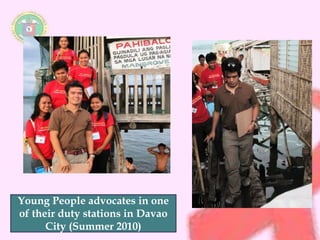
Young People advocates in one 
of their duty stations in Davao 
City (Summer 2010)
Summary 
• The youth is at risk to HIV: Very low condom use, Biologically 
more susceptible , engaged in partnerships often of limited 
duration, face multiple obstacles to utilization of health care 
• Behavioral risks of youth to HIV include early sexual initiation, and 
failure to take appropriate prevention precaution 
• HIV is a highly preventable infection 
• Structures and systems are continuesly built to engage and 
empower youth to be partners of HIV advocacies 
• There is life after HIV infection, treatment is available, although 
there is no cure yet 
• Due to stigma and discrimination, HIV impact to person, family and 
community is much broader
Challenges 
• Socio-cultural resistance to behaviour change; 
• Lack of knowledge about one’s HIV status (personal 
denial, stigma, and poor geographical accessibility of 
counseling and testing services) 
• Geographic obstacles to accessing comprehensive care 
• Lack of access to basic services due to poverty 
• Stigma and discrimination 
• Weak structures that enables delivery of HIV services
Believe in the Power of You. 
Be responsible. 
Stop HIV transmission. 
National AIDS/STI Prevention and Control Program 
Infectious Disease Office
www.pnac.org.ph 
www2.doh.gov.ph/naspcp

Youth and hiv

  • 1.
    Network of YouthLeaders for Health Congress 25 – 27 May 2011 Clark Field, Pampanga Youth and HIV Jose Gerard Belimac, MD, MPH Medical Specialist II Manager, National AIDS and STI Prevention and Control Program (NASPCP) National Center for Disease Prevention and Control (NCDPC) Pampanga
  • 2.
    • Young People? • Youth? • Children? • Adolescent? National AIDS/STI Prevention and Control Program Infectious Disease Office
  • 3.
    • Young People10 – 24 yr old • Youth 15 – 24 to 30 yr old • Children below 18yr old • Adolescent: 10 – 19 yr old National AIDS/STI Prevention and Control Program Infectious Disease Office
  • 4.
    Purpose - Toinform Youth leaders on HIV risks and vulnerabilities so that leaders can fully maximise their potential as agents of change in their communities National AIDS/STI Prevention and Control Program Infectious Disease Office
  • 5.
    Outline of Presentation • Facts on HIV and AIDS – Basic information on HIV – Risks and Vulnerabilities – Impact of HIV to individuals, families and communities • Epidemiology • Examples of Interventions National AIDS/STI Prevention and Control Program Infectious Disease Office
  • 6.
    HIV primarily weakens/destroysthe Immune System What is Immune System is a complex network of cells and chemicals in our body protects against foreign organisms get rid of anything that is an invader it is coordinated by “helper cells” (also known as CD4 cells)  if the "coordinator" of the process(CD4 cell), body open to attack by opportunistic infections;  CD4 are slowly destroyed by HIV
  • 7.
    HIV AIDS •virus that causes AIDS • A person can look and feel healthy even if they have HIV. • A person with HIV can pass the virus to others. • HIV weakens the body’s ability to fight infection, making a person very sick. This is called AIDS. • It can take years for a person infected with HIV to develop AIDS It takes 2 to 10 years before a person develops AIDS. Progression to AIDS can be delayed by HIV treatment
  • 8.
    HIV can onlybe acquired from the following BODY FLUIDS: Body Fluid Means of Transmission Semen (including pre-ejaculate) Unprotected vaginal/anal sex (man – woman, man – man) Blood Transfusion of blood contaminated with HIV, re-use and sharing of injecting equipments among drug users Vaginal Fluid Unprotected sex (man-woman) Breastmilk From mother to child (mostly during delivery and breastfeeding) but this is greatly reduced now because of treatment
  • 9.
    How can HIVinfection be avoided? Abstinence (most effective) Be mutually faithful Correct and Consistent use of Condoms National AIDS/STI Prevention and Control Program Infectious Disease Office
  • 10.
    STI symptoms byGender (DOH, 1994) Reproductive Health Indicator At least one serious RH problem (as %) Vaginal / Penile discharge (as %) Painful urination (as %) FEMALE In-School Youth 15.0 3.1 12.1 Out-of-School Youth 35.2 6.8 19.1 Working Youth 26.0 4.5 17.9 Total Female Youth 24.4 4.7 15.9 MALE In-School Youth 24.1 1.5 21.3 Out-of-School Youth 22.9 1.9 19.4 Working Youth 25.3 4.5 22.4 Total Male Youth 24.3 4.7 21.4
  • 11.
    Individual Vulnerabi-lity Risk Structural factors Population mobility and migration Conflict Injecting drug use •Needle sharing Social factors Low literacy Gender inequalities Limited work opportunities H I V Access to service Discrimination Poor Service Sexual transmission •Partner change •Condom use •STI cofactors
  • 12.
    Out of SchoolYouth (OSY) as an HIV Vulnerable Sectors - may have completed school, dropped out, or never started school - may have jobs or be married, or may be girls who have been forced to quit school because they need to work in the home, are pregnant, or have babies. - work in factories, live on the street, hawk vegetables in the market, stay at home for housework or child care, or are unemployed - Street children, adolescent sex workers, orphans, child soldiers, and other such groups are generally, but not always, out of school.
  • 13.
    What are theneeds of OSY? • Same needs as other youth: – food and shelter – sense of connection or belonging – skills in problem-solving and life planning, job or vocational training – access to appropriate services – empowerment to take responsibility for their own lives – and information on sexual health issues, including contraception and HIV prevention. – However, different populations of out-of-school youth have specific needs defined by their circumstances. Adapted
  • 14.
    Estimated OSY inthe Philippines (By source) Agency Estimated OSY Age Inclusive Notes Department of Health 4.84 million 6-24 2002 World Bank 9.01 million 15-25 2003 Department of 11.6 million 6-24 2006 Education FLEMMS* 11.64 million No data 2003
  • 15.
    Vulnerability of YoungPeople to HIV and AIDS (UNICEF, 2006) • Knowledge of HIV, AIDS and condom increases with age, and is high among those with high education and in school adolescents • Almost 2 out of 10 youths surveyed are sexually active • More young people from the major urban cities have engaged in sex – Condom use still low among sexually active youth – Younger youth are likely to use condom the first time, and this improved slightly with higher number of older youth using condom in their last sexual episode
  • 16.
    Vulnerability of YoungPeople to HIV and AIDS (UNICEF, 2006) • Attitude – About 4 of 10 youths and healthworkers believe that discussing condoms among youth only promotes promiscuity – Even among healthworkers, a substantial 17 percent agreed to the statement that using condom is sign of not trusting one’s partner.
  • 17.
    Other vulnerabilities (15– 24 yr old) (HAIN OR, 2008) • OSY rely more on friends especially on issues such as sexuality • When asked how to prevent STI, ways cited are withdrawal, choosing the right partner, and taking of medicines/antibiotics • More males than females mentioned the use of condom as a way to prevent STI • 94% are aware of condom but only 45% know that use of condom during sex can reduce the risk of HIV infection • Majority are currently in a relationship and had engaged in sexual intercourse. National AIDS/STI Prevention and Control Program Infectious Disease Office
  • 18.
    Some HIV Risks(15 – 24 yr old) (HAIN OR, 2008) • OSYs exhibit a more liberal attitude towards sex, with higher percentage engaged in almost all types of sexual practices: multiples sex, unprotected sex, commercial sex, sex with same sex • A third of sexually active OSY reported they had ever experienced being forced against their will to have sex, with males having a slightly higher rate than female (35%,32%) • Males reported to have had an average of six sexual partners while women had an average of two. National AIDS/STI Prevention and Control Program Infectious Disease Office
  • 19.
    Biological Risk •Cervix of adolescents is more vulnerable to STI
  • 20.
    What Happens whenone is Infected with HIV? – The Impact of AIDS
  • 21.
    Impact of HIV/AIDSEffects of HIV/AIDS on Individuals, Families and Households • Need for care and support • Sickness and death • Psychological losses and burdens related to sickness, death, decline in well being and increased insecurity • Loss of the family’s adult members at their most productive ages • Reduction in nutrition • Loss of productivity • Loss of income, increase in poverty, diversion of resources • Increase in dependants • Orphaning
  • 22.
    Impact of HIV/AIDSEffects of HIV/AIDS on Individuals, Families and Households • Breakup of families • Increased dependency ratios and pressure on surviving adults caring for additional family members • Population shifts due to both mortality and migration • Increased violence associated with crime and stigma, increase in discrimination
  • 23.
    Adults and childrenestimated to be living with HIV, 2009 Network of Youth Leaders for Health Congress 25 – 27 May 2011 Clark Field, Pampanga Total: 33.4 million • Africa: 22 million • South and South East Asia: 6 million • almost 7,000 (PHL)
  • 24.
    6,498 reported HIVcases (January 1984 to March 2011) Source: Philippine HIV Registry
  • 25.
    0% 10% 20%30% 40% 50% 60% 70% 80% 90% 100% 2011 2006 to 2010 2001 to 2005 1996 to 2000 1991 to 1995 1984 to 1990 FEMALE MALE HIV/AIDS cases disaggregated by sex (1984 to 2011) Source: Philippine HIV Registry
  • 26.
    Distribution of Maleand Female HIV Cases by Age group (1984 to 2011) Source: Philippine HIV Registry Note: Scales are different for males and females
  • 27.
    Distribution of MaleHIV Cases by Age group (2009 - 2011) Source: Philippine HIV Registry
  • 28.
    Distribution of FemaleHIV Cases by Age group (2009 - 2011) Source: Philippine HIV Registry
  • 29.
    Modes of Transmissionof HIV Cases Source: Philippine HIV Registry
  • 30.
    Mode of HIVTransmission Among 15-24yo (2006 – 2010) Source: Philippine HIV&AIDS Registry N A T I O N A L E P I D E M I O L O G Y C E N T E R
  • 31.
    The General Gameplan (5th AIDS Medium Term Plan 2011 – 2015) Vision The spread of HIV infection is halted in the Philippines Goal By 2016, the country will have prevented the further spread of HIV infection and reduced the impact of the disease on individuals, families, sectors, and communities. National AIDS/STI Prevention and Control Program Infectious Disease Office
  • 32.
    National Young People’sForum Committee on Children and HIV – Council for the Welfare of Children 2009, 2010
  • 33.
    Generally, some interventionthe Youth can work with are: 1. Cooperation with SK Officials on HIV programmes 2. Promotion of Peer Education Sytem in the Brgy Level 3. Targeted popularization of condoms 4. Promotion of the development and use of Educational Entertainment for HIV and AIDS modules 5. Encourage strong Alliance between Organizations (including Faith – Based Organizations) National AIDS/STI Prevention and Control Program Infectious Disease Office
  • 34.
    Generally, some interventionthe Youth can work with are: 7. Intensify, correct & update Advocacy campaigns among all in school personnel and students 8. Inclusion of children and young peoples in the monitoring and evaluation of programmes 9. Ensure that VCT is provided for free in all health centers; ensure the availability of HIV IEC materials in every health center National AIDS/STI Prevention and Control Program Infectious Disease Office
  • 35.
    HIV Vulnerabilities thruthe Eyes of Young People National AIDS/STI Prevention and Control Program Infectious Disease Office
  • 36.
  • 42.
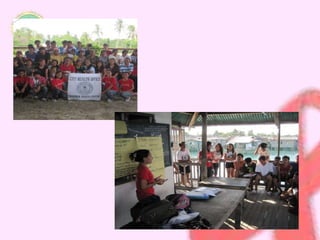
    Summer Internship Programmefor Young People on HIV and AIDS (2010) Background: • Very low knowledge of Youth on HIV and AIDS • Limited manpower of health offices to educate the youth • Recognised the Power of peers as good source of information Project: • 240 YP trained and hired by DOH to conduct peer education in their own communities (NCR, Cebu and Davao) • Daily visit to communities, supervised by doctors and counselors from LGU and NGO National AIDS/STI Prevention and Control Program Infectious Disease Office
  • 43.
    Summer Internship Programmefor Young People on HIV and AIDS (2010) Outcome: 1. Delivered education to almost 5,000 peers (one – on – one) 2. Summer interns able to maintain group of peers for self-help sessions weekly 3. Summer Interns eventually became school – based advocates and educators and tapped by schools and communities for HIV advocay and programmes 4. Sense of belongingness, heightened social consciousness (poverty, independence, responsibility, accountability) National AIDS/STI Prevention and Control Program Infectious Disease Office
  • 44.
    Young People advocatesleading the observance of AIDS Candlelight Memorial (Cebu, Summer 2010)
  • 46.
    Young People advocatesin one of their duty stations in Davao City (Summer 2010)
  • 47.
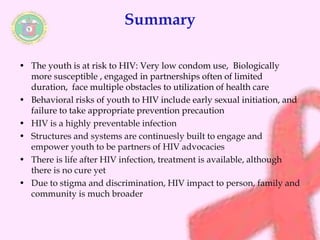
    Summary • Theyouth is at risk to HIV: Very low condom use, Biologically more susceptible , engaged in partnerships often of limited duration, face multiple obstacles to utilization of health care • Behavioral risks of youth to HIV include early sexual initiation, and failure to take appropriate prevention precaution • HIV is a highly preventable infection • Structures and systems are continuesly built to engage and empower youth to be partners of HIV advocacies • There is life after HIV infection, treatment is available, although there is no cure yet • Due to stigma and discrimination, HIV impact to person, family and community is much broader
  • 48.
    Challenges • Socio-culturalresistance to behaviour change; • Lack of knowledge about one’s HIV status (personal denial, stigma, and poor geographical accessibility of counseling and testing services) • Geographic obstacles to accessing comprehensive care • Lack of access to basic services due to poverty • Stigma and discrimination • Weak structures that enables delivery of HIV services
  • 49.
    Believe in thePower of You. Be responsible. Stop HIV transmission. National AIDS/STI Prevention and Control Program Infectious Disease Office
  • 50.

Editor's Notes

  • #23 Disease, weakness and inability to work, Unemployment and loss of income, High cost of treatment and care, Financial stress in the family leading to poor nutrition, discontinued schooling for children, Death, Orphans, child labour, Social stigma, discrimination, violence
  • #28 11 have not answered the question regarding their gender. The first 2 reported cases in 1984 were both males. From 1985 til 1990s, HIV cases were predominantly women. However, there has been a shift from female new cases to Male new HIV cases.