AIDS
 Acquired Immune
Deficiency Syndrome
HIV came from a similar virus found in chimpanzees - SIV.
HIV probably entered the United States around 1970
CDC in 1981 noticed unusual clusters of Kaposi’s sarcoma
in gay men in NY and San Francisco, which led to the
disease to be called GRID (Gay Related Immune
Deficiency).
By 1982 the disease was apparent in heterosexuals and
was renamed AIDS (Acquired Immune Deficiency).
1984- Scientists(Dr. Luc Montagnier, Dr. Robert Gallo)
identify HIV (initially called LAV or HTLV-III) as the cause of
AIDS
1987- AZT is the first drug approved for treating AIDS


           http://www.avert.org/aids-timeline.htm
• Types : HIV1 & HIV2
• HIV1: HIV-1A & HIV-1B
• HIV-1A & HIV-2 are spread heterosexually, but HIV-1A
  is more virulent than HIV-2
• HIV-1B dominates in Europe & the United States
• SIV: Simian Immunodeficiency virus from monkeys
• SIV-CPZ (Chimpanzee/ Pan troglodytes) is similar to
  HIV-1
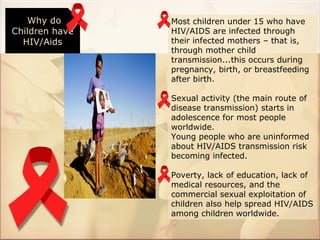
Why do       Most children under 15 who have
Children have   HIV/AIDS are infected through
  HIV/Aids      their infected mothers – that is,
                through mother child
                transmission...this occurs during
                pregnancy, birth, or breastfeeding
                after birth.

                Sexual activity (the main route of
                disease transmission) starts in
                adolescence for most people
                worldwide.
                Young people who are uninformed
                about HIV/AIDS transmission risk
                becoming infected.

                Poverty, lack of education, lack of
                medical resources, and the
                commercial sexual exploitation of
                children also help spread HIV/AIDS
                among children worldwide.
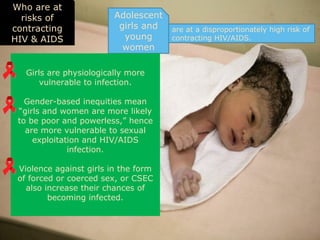
Who are at
  risks of               Adolescent
contracting               girls and   are at a disproportionately high risk of
HIV & AIDS                 young      contracting HIV/AIDS.
                           women

   Girls are physiologically more
       vulnerable to infection.

   Gender-based inequities mean
 “girls and women are more likely
 to be poor and powerless,” hence
   are more vulnerable to sexual
     exploitation and HIV/AIDS
              infection.

 Violence against girls in the form
 of forced or coerced sex, or CSEC
   also increase their chances of
         becoming infected.
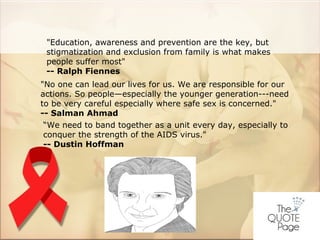
"Education, awareness and prevention are the key, but
 stigmatization and exclusion from family is what makes
 people suffer most"
 -- Ralph Fiennes
"No one can lead our lives for us. We are responsible for our
actions. So people—especially the younger generation---need
to be very careful especially where safe sex is concerned."
-- Salman Ahmad
 “We need to band together as a unit every day, especially to
 conquer the strength of the AIDS virus."
 -- Dustin Hoffman
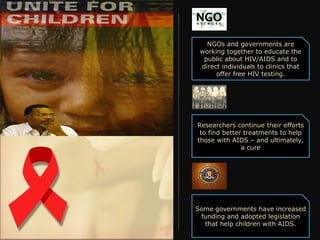
NGOs and governments are
 working together to educate the
  public about HIV/AIDS and to
 direct individuals to clinics that
      offer free HIV testing.


Researchers continue their efforts
 to find better treatments to help
those with AIDS – and ultimately,
               a cure


Some governments have increased
 funding and adopted legislation
  that help children with AIDS.
Anyone of any age, race, sex or sexual orientation can be
infected with HIV, but you're at greatest risk of HIV/AIDS
if you:
Have unprotected sex with multiple partners. You're at risk
whether you're heterosexual, homosexual or bisexual.
Unprotected sex means having sex without using a new
latex or polyurethane condom every time.
Have unprotected sex with someone who is HIV-positive.
Have another sexually transmitted disease, such as
syphilis, herpes, Chlamydia, gonorrhea or bacterial
vaginosis.
Share needles during intravenous drug use.
Received a blood transfusion or blood products before
There's no vaccine to prevent HIV infection and no cure for
   AIDS. Prevention includes educating yourself about HIV and avoiding
   any behavior that allows HIV-infected fluids — blood, semen, vaginal
   secretions and breast milk — into your body.
HIV-negative Individual prevention:
   Educate yourself and others.
   Know the HIV status of any sexual partner.
   Use a new latex or polyurethane condom every time you have sex.
   Consider male circumcision.
   Use a clean needle.
   Be cautious about blood products in certain countries.
   Get regular screening tests.
   Don't become complacent.


  http://www.mayoclinic.com/health/hiv-aids/DS00005/DSECTION=prevention
HIV positive individual prevention:
  Follow safe-sex practices.
  Tell your sexual partners you have HIV.
  If your partner is pregnant, tell her you have HIV.
  Tell others who need to know.
  Don't share needles or syringes.
  Don't donate blood or organs.
  Don't share razor blades or toothbrushes.
  If you're pregnant, get medical care right away.


http://www.mayoclinic.com/health/hiv-aids/DS00005/DSECTION=prevention
...continues.
There is no known cure.
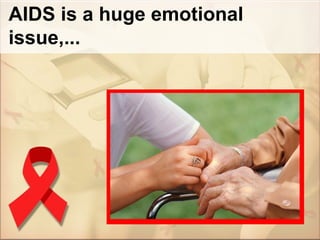
AIDS is a huge emotional
issue,...
"Helping kids understand about
AIDS is the most important thing
 I do. Some kids like to pretend
  that it's not happening in the
   world. By letting them know
 what's really going on, I might
      save someone's life.“

     Hydeia L. Broadbent
   AIDS patient and activist.
educate


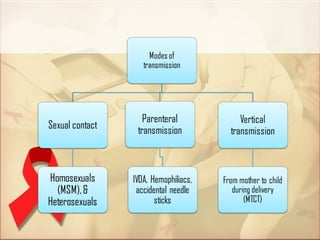
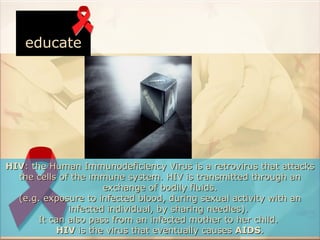
HIV: the Human Immunodeficiency Virus is a retrovirus that attacks
  the cells of the immune system. HIV is transmitted through an
                      exchange of bodily fluids.
  (e.g. exposure to infected blood, during sexual activity with an
              infected individual, by sharing needles).
       It can also pass from an infected mother to her child.
           HIV is the virus that eventually causes AIDS.
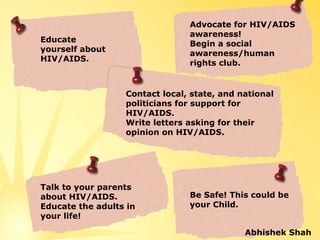
Advocate for HIV/AIDS 
                                 awareness! 
Educate 
                                 Begin a social 
yourself about 
                                 awareness/human 
HIV/AIDS.
                                 rights club.


                   Contact local, state, and national 
                   politicians for support for 
                   HIV/AIDS.
                   Write letters asking for their 
                   opinion on HIV/AIDS.


Talk to your parents 
about HIV/AIDS.                  Be Safe! This could be 
Educate the adults in            your Child.
your life!

                                              Abhishek Shah
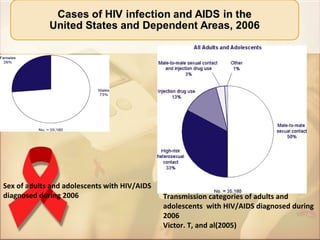
Sex of adults and adolescents with HIV/AIDS
diagnosed during 2006                         Transmission categories of adults and
                                              adolescents with HIV/AIDS diagnosed during
                                              2006
                                              Victor. T, and al(2005)
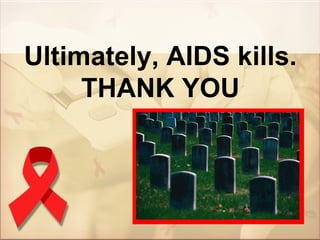
Ultimately, AIDS kills.
     THANK YOU
REFERANCES
  •   Copyright Indezine.com
  •   http://www.indezine.com
  •   More presentations at:
  •   http://www.indezine.com/bank/
  •   abhishekshan@rediffmail.com
  •   National Institutes of Health. (2008). AIDS. Retrieved October 14, 2008,
      from http://www.nlm.nih.gov/medlineplus/aids.html
  •   Chan-Tack, K. M. (2007). Early symptomatic HIV infection. Retrieved
      October 14, 2008 , from        http://www.emedicine.com/med/topic86.htm
      Mayo Clinic. (2008). HIV/AIDS. Retrieved October 14, 2008, from
      C:Documents and SettingsMSUDesktopDSECTION=symptoms.htm
  •   Vistacion, T. , Reyes, R. , Salvacion, N. (2005). Principles of microbiology
      [Power point slides].Retrieved from
      http://www.raritanval.edu/servicelearning/HS/student_work/HIV_Visitacion_Salvacion_%2

hiv and aids

  • 1.
  • 2.
    HIV came froma similar virus found in chimpanzees - SIV. HIV probably entered the United States around 1970 CDC in 1981 noticed unusual clusters of Kaposi’s sarcoma in gay men in NY and San Francisco, which led to the disease to be called GRID (Gay Related Immune Deficiency). By 1982 the disease was apparent in heterosexuals and was renamed AIDS (Acquired Immune Deficiency). 1984- Scientists(Dr. Luc Montagnier, Dr. Robert Gallo) identify HIV (initially called LAV or HTLV-III) as the cause of AIDS 1987- AZT is the first drug approved for treating AIDS http://www.avert.org/aids-timeline.htm
  • 3.
    • Types :HIV1 & HIV2 • HIV1: HIV-1A & HIV-1B • HIV-1A & HIV-2 are spread heterosexually, but HIV-1A is more virulent than HIV-2 • HIV-1B dominates in Europe & the United States • SIV: Simian Immunodeficiency virus from monkeys • SIV-CPZ (Chimpanzee/ Pan troglodytes) is similar to HIV-1
  • 4.
    Why do Most children under 15 who have Children have HIV/AIDS are infected through HIV/Aids their infected mothers – that is, through mother child transmission...this occurs during pregnancy, birth, or breastfeeding after birth. Sexual activity (the main route of disease transmission) starts in adolescence for most people worldwide. Young people who are uninformed about HIV/AIDS transmission risk becoming infected. Poverty, lack of education, lack of medical resources, and the commercial sexual exploitation of children also help spread HIV/AIDS among children worldwide.
  • 5.
    Who are at risks of Adolescent contracting girls and are at a disproportionately high risk of HIV & AIDS young contracting HIV/AIDS. women Girls are physiologically more vulnerable to infection. Gender-based inequities mean “girls and women are more likely to be poor and powerless,” hence are more vulnerable to sexual exploitation and HIV/AIDS infection. Violence against girls in the form of forced or coerced sex, or CSEC also increase their chances of becoming infected.
  • 7.
    "Education, awareness andprevention are the key, but stigmatization and exclusion from family is what makes people suffer most" -- Ralph Fiennes "No one can lead our lives for us. We are responsible for our actions. So people—especially the younger generation---need to be very careful especially where safe sex is concerned." -- Salman Ahmad “We need to band together as a unit every day, especially to conquer the strength of the AIDS virus." -- Dustin Hoffman
  • 8.
    NGOs and governmentsare working together to educate the public about HIV/AIDS and to direct individuals to clinics that offer free HIV testing. Researchers continue their efforts to find better treatments to help those with AIDS – and ultimately, a cure Some governments have increased funding and adopted legislation that help children with AIDS.
  • 9.
    Anyone of anyage, race, sex or sexual orientation can be infected with HIV, but you're at greatest risk of HIV/AIDS if you: Have unprotected sex with multiple partners. You're at risk whether you're heterosexual, homosexual or bisexual. Unprotected sex means having sex without using a new latex or polyurethane condom every time. Have unprotected sex with someone who is HIV-positive. Have another sexually transmitted disease, such as syphilis, herpes, Chlamydia, gonorrhea or bacterial vaginosis. Share needles during intravenous drug use. Received a blood transfusion or blood products before
  • 10.
    There's no vaccineto prevent HIV infection and no cure for AIDS. Prevention includes educating yourself about HIV and avoiding any behavior that allows HIV-infected fluids — blood, semen, vaginal secretions and breast milk — into your body. HIV-negative Individual prevention: Educate yourself and others. Know the HIV status of any sexual partner. Use a new latex or polyurethane condom every time you have sex. Consider male circumcision. Use a clean needle. Be cautious about blood products in certain countries. Get regular screening tests. Don't become complacent. http://www.mayoclinic.com/health/hiv-aids/DS00005/DSECTION=prevention
  • 11.
    HIV positive individualprevention: Follow safe-sex practices. Tell your sexual partners you have HIV. If your partner is pregnant, tell her you have HIV. Tell others who need to know. Don't share needles or syringes. Don't donate blood or organs. Don't share razor blades or toothbrushes. If you're pregnant, get medical care right away. http://www.mayoclinic.com/health/hiv-aids/DS00005/DSECTION=prevention
  • 12.
  • 13.
    There is noknown cure.
  • 14.
    AIDS is ahuge emotional issue,...
  • 15.
    "Helping kids understandabout AIDS is the most important thing I do. Some kids like to pretend that it's not happening in the world. By letting them know what's really going on, I might save someone's life.“ Hydeia L. Broadbent AIDS patient and activist.
  • 16.
    educate HIV: the HumanImmunodeficiency Virus is a retrovirus that attacks the cells of the immune system. HIV is transmitted through an exchange of bodily fluids. (e.g. exposure to infected blood, during sexual activity with an infected individual, by sharing needles). It can also pass from an infected mother to her child. HIV is the virus that eventually causes AIDS.
  • 17.
    Advocate for HIV/AIDS  awareness!  Educate  Begin a social  yourself about  awareness/human  HIV/AIDS. rights club. Contact local, state, and national  politicians for support for  HIV/AIDS. Write letters asking for their  opinion on HIV/AIDS. Talk to your parents  about HIV/AIDS. Be Safe! This could be  Educate the adults in  your Child. your life! Abhishek Shah
  • 18.
    Sex of adultsand adolescents with HIV/AIDS diagnosed during 2006 Transmission categories of adults and adolescents with HIV/AIDS diagnosed during 2006 Victor. T, and al(2005)
  • 19.
  • 20.
    REFERANCES • Copyright Indezine.com • http://www.indezine.com • More presentations at: • http://www.indezine.com/bank/ • abhishekshan@rediffmail.com • National Institutes of Health. (2008). AIDS. Retrieved October 14, 2008, from http://www.nlm.nih.gov/medlineplus/aids.html • Chan-Tack, K. M. (2007). Early symptomatic HIV infection. Retrieved October 14, 2008 , from http://www.emedicine.com/med/topic86.htm Mayo Clinic. (2008). HIV/AIDS. Retrieved October 14, 2008, from C:Documents and SettingsMSUDesktopDSECTION=symptoms.htm • Vistacion, T. , Reyes, R. , Salvacion, N. (2005). Principles of microbiology [Power point slides].Retrieved from http://www.raritanval.edu/servicelearning/HS/student_work/HIV_Visitacion_Salvacion_%2

Editor's Notes

  • #3 Dr. Robert Gallo of the National Cancer Institute had isolated the virus which caused AIDS. Dr. Luc Montagnier Pasteur Institute in Paris The scientific protagonists finally agreed to share credit for the discovery of HIV, and in 1986, both the French and the US names (LAV and HTLV-III) were dropped in favor of the new term human immunodeficiency virus
  • #19 HIV/AIDS : This refers to cases of HIV infection, regardless of whether they have progressed to AIDS from the 38 areas (33 states and 5 U.S. dependent areas) that have had confidential name-based HIV infection reporting long enough to monitor trends. According to the number of AIDS cases, these 33 states represent approximately 63% of the epidemic in the 50 states and the District of Columbia.