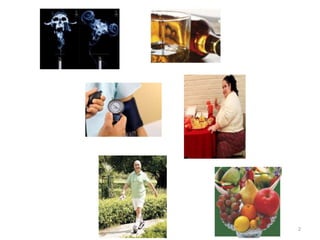
NCD Risk factor Assessment/ Surveillance
Dr Ramya S
1
2
Outline
1. Burden of NCDs and their Risk factors
2. Global Action Plan 2014
3. WHO STEPs for surveillance of NCD Risk factors
4. IDSP Report based on STEPs approach
5. SuRF (Surveillance of chronic disease risk factors) Report 2
3
Global NCD burden
4
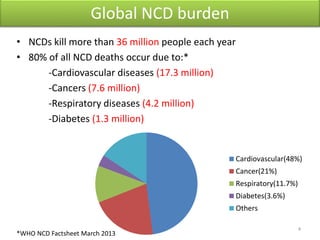
• NCDs kill more than 36 million people each year
• 80% of all NCD deaths occur due to:*
-Cardiovascular diseases (17.3 million)
-Cancers (7.6 million)
-Respiratory diseases (4.2 million)
-Diabetes (1.3 million)
*WHO NCD Factsheet March 2013
Cardiovascular(48%)
Cancer(21%)
Respiratory(11.7%)
Diabetes(3.6%)
Others
NCD Burden in India
NCDs accounts for 53% of deaths in India
-Cardiovascular diseases (24%)
-Chronic respiratory diseases (11%)
-Cancer (6%)
-Diabetes (2%)
1. Diabetes – 65 million affected$
2. Cancer – 28 lakh cases
11 lakh new cases and 5 lakh deaths#
3. IHD : Overall prevalence – 159.46/1000*
4. Stroke: @ Incidence rate – 119-145/100,000
Prevalence in Rural – 84-262/100,000
Urban – 334-424/ 100,000
$IDF Atlas, 6th edition, 2013 #NCRP, ICMR 2006;
*ICMR, 2006; @Taylor FC, Kumar SK. Stroke in India Factsheet (Updated 2012) 5
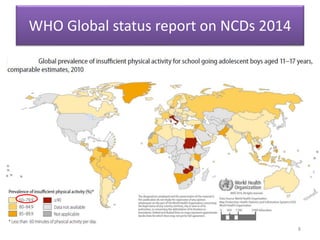
WHO Global status report on NCDs 2014
6
7
WHO Global status report on NCDs 2014
8
WHO Global status report on NCDs 2014
9
WHO Global status report on NCDs 2014
10
WHO Global status report on NCDs 2014
11
WHO Global status report on NCDs 2014
12
WHO Global status report on NCDs 2014
13
WHO Global status report on NCDs 2014
14
WHO Global status report on NCDs 2014
15
WHO Global status report on NCDs 2014
Global Action Plan 2014
9 Targets for 2025
6 Global objectives
16
Six Global Objectives
1. Make prevention and control of NCDs a priority
2. Strengthen national capacities and leadership
3. Reduce modifiable risk factors
4. Strengthen health system
5. Promote high-quality research
6. Monitor disease trends
17
9 Global targets for 2025
18
What is surveillance?
Surveillance is the ongoing systematic
collection, collation, analysis, and
interpretation of health data and timely
dissemination for the planning,
implementation, and assessment of
disease control
"information for action”
19
Objectives of NCD surveillance
1. Collect consistent data across and within countries
2. Prevent chronic disease epidemics before they occur
3. Help health services plan and determine public health
priorities
4. Predict future caseloads of chronic diseases
5. Monitor and evaluate population-wide interventions
20
Choice of risk factor for inclusion in surveillance
1. Significance of the risk factor for public health
2. Potential global impact
3. Potential to be modified
4. High likelihood of causality
5. Cost of collecting valid data
6. Availability and strength of evidence
7. Ability to measure the risk factor burden uniformly
21
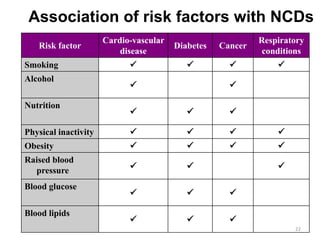
Risk factor
Cardio-vascular
disease
Diabetes Cancer
Respiratory
conditions
Smoking    
Alcohol
 
Nutrition
  
Physical inactivity    
Obesity    
Raised blood
pressure   
Blood glucose
  
Blood lipids
  
Association of risk factors with NCDs
22
Disease Outcomes
 Heart disease
 Stroke
 Diabetes
 Cancer
 Respiratory
Physiological RF
 BMI
 Blood pressure
 Blood glucose
 Cholesterol
Behavioral RF
Tobacco
Alcohol
Physical
inactivity
Nutrition
The causal chain
23
WHO NCD Global Surveillance strategy
• Identification of key risk factors
• Co-ordinated approach for conducting surveillance
• Training
• Effective communication strategies
• Affordable and accessible technology
24
NCD RF Surveillance Initiatives
• STEPs Approach of WHO
– Risk Factor
– Stroke
• Global Youth Tobacco Surveys
• Global School Based Health Surveys
• Behavior Risk Factor Surveillance System
25
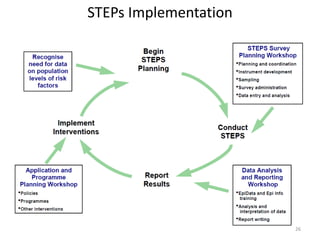
STEPs Implementation
26
Key stages, tasks and timeframes
27
KISH Selection table
28
WHO STEPS Approach- STEPs concept
• The conceptual framework is the distinction between the different
levels of risk factor assessment:
– Information by questionnaire
– Physical measurements
– Blood samples
• The 3 modules describes each risk factor
– Core
– Expanded core
– Optional
29
WHO STEP-wise approach to NCD Surveillance
30
31
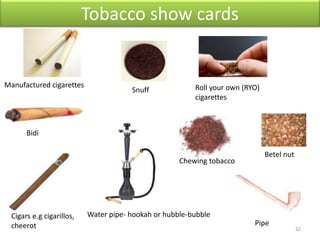
Tobacco show cards
Manufactured cigarettes Roll your own (RYO)
cigarettes
Snuff
Cigars e.g cigarillos,
cheerot Pipe
Bidi
Water pipe- hookah or hubble-bubble
Betel nut
Chewing tobacco
32
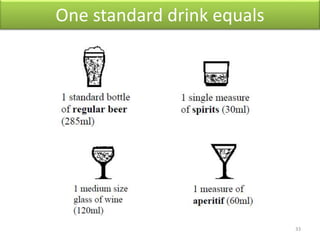
One standard drink equals
33
One serving of fruits and vegetables
• Vegetables
-1 cup of green leafy vegetables
-1/2 cup of chopped raw vegetables or vegetable juice
• Fruits
- 1 medium size banana, orange, apple
- ½ cup of chopped fruits or fruit juice
• 1 standard serving= 80g
34
Physical activity
35
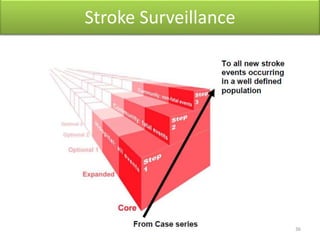
Stroke Surveillance
36
STEPS approach to STROKE assessment
STEP CORE EXPANDED Provides data on
1- Hospitalized
events (fatal and
non-fatal)
Demographic
information, Time of
onset, Vital status
day 10
Treatment
Disability
Type of stroke
Stroke admissions
and hospital case
fatality
2- Fatal events in
the community
Demographic
information, Death
certificates or
Verbal autopsy
Autopsy/ necropsy
reports
Type of stroke
Stroke mortality
3- Non-fatal events
in the community
Demographic
information, Time of
onset, Vital status
day 10
Treatment
Disability
Type of stroke
Stroke incidence
and case fatality
37
Development and maintenance of a surveillance
Infrastructure
• Depends upon the capacity, need and available resources
• Formation of an expert committee or a national nodal
organization with stakeholders from all relevant sectors
• Monitoring by nodal officers in Ministries of Health
• A central or lead agency for co-ordination of the surveillance
activities and ensure quality control
• Stakeholders to share ownership of the system and
surveillance information produced
• Dissemination and utilization of data 38
GSHS
• The Global school-based student health survey (GSHS) is a
collaborative surveillance project designed to help countries
measure and assess the behavioural risk factors in 10 key
areas among young people aged 13 -17 years
• Relatively low cost school-based survey which uses a self-
administered questionnaire to obtain data on young people's
health behaviour and protective factors related to the leading
causes of morbidity and mortality among children and adults
worldwide 39
GSHS
The key topics addressed by the survey are:
• Alcohol use
• Dietary behaviours
• Drug use
• Hygiene
• Mental health
• Physical activity
• Protective factors
• Sexual behaviours
• Tobacco use
• Violence and unintentional injury
40
NPCDCS-Objectives
1. Health promotion
2. Opportunistic screening – all levels of health care
3. Prevention & control of NCD’s
4. Capacity building at various levels of health care
5. Support – diagnosis & cost effective treatment
6. Development of database – NCDs
41
IDSP Results
42
43
44
45
SuRF (Surveillance of chronic disease risk factors) 2
• The SuRF Series is an on-going surveillance activity aimed to:
– provide regularly updated Country Profiles on chronic disease risk factors
– use the data to produce comparable estimates for all eight risk factors
– report on the burden of disease attributed to these major risk factors
SuRF2 – What’s new?
The Country Profiles are a major feature of SuRF2 displaying the following
information for each Member State:
– all available recent risk factor data
– age-specific prevalence rates
– risk factor definitions
– complete source information 46
WHO Global Infobase
• It is a data warehouse that collects, stores and displays information on chronic
diseases and their risk factors for all WHO member states
• The Infobase assembles, for the first time in one place, NCD risk factor data
crucial for identifying potential interventions to reduce the future burden.
• It is a dynamic and an on-going project and promotes "transparency,
accessibility and traceability" of health information.
• A unique feature is that each record can be linked back to its source. The current
version contains over 150,000 data points from more than 5,000 sources and
9,500 surveys
47
Noncommunicable Diseases Risk Factor Surveillance:
Experience and Challenge from India
Indian J Community Med. 2011 Dec; 36(Suppl1): S50–S56.
• NCD Risk factor surveillance in India
– The WHO-ICMR NCD risk factor surveillance
– Integrated Disease Surveillance Project
• Challenges in obtaining data
– Anthropometric measurements
– Measuring waist circumference
– Measuring blood pressure
– Assessing tobacco consumption
– Assessing diet and physical activity
48
• General challenges in obtaining accurate data
– Low awareness level
– 22 official languages
• Challenges in field operations
– Contacting subjects
– Convincing subjects
– Creating rapport
– Climatic conditions
– Conducive surroundings
– Tracking subjects
– Recall ability
– Interviewer ability
49
Summary
Because behaviours can be modified, promoting
positive health behaviour choices, through
education and through community policies and
practices, is essential to reducing the overall
NCD burden!
50
References
Thank you 51

NCD Risk factor Surveillance

  • 1.
    NCD Risk factorAssessment/ Surveillance Dr Ramya S 1
  • 2.
  • 3.
    Outline 1. Burden ofNCDs and their Risk factors 2. Global Action Plan 2014 3. WHO STEPs for surveillance of NCD Risk factors 4. IDSP Report based on STEPs approach 5. SuRF (Surveillance of chronic disease risk factors) Report 2 3
  • 4.
    Global NCD burden 4 •NCDs kill more than 36 million people each year • 80% of all NCD deaths occur due to:* -Cardiovascular diseases (17.3 million) -Cancers (7.6 million) -Respiratory diseases (4.2 million) -Diabetes (1.3 million) *WHO NCD Factsheet March 2013 Cardiovascular(48%) Cancer(21%) Respiratory(11.7%) Diabetes(3.6%) Others
  • 5.
    NCD Burden inIndia NCDs accounts for 53% of deaths in India -Cardiovascular diseases (24%) -Chronic respiratory diseases (11%) -Cancer (6%) -Diabetes (2%) 1. Diabetes – 65 million affected$ 2. Cancer – 28 lakh cases 11 lakh new cases and 5 lakh deaths# 3. IHD : Overall prevalence – 159.46/1000* 4. Stroke: @ Incidence rate – 119-145/100,000 Prevalence in Rural – 84-262/100,000 Urban – 334-424/ 100,000 $IDF Atlas, 6th edition, 2013 #NCRP, ICMR 2006; *ICMR, 2006; @Taylor FC, Kumar SK. Stroke in India Factsheet (Updated 2012) 5
  • 6.
    WHO Global statusreport on NCDs 2014 6
  • 7.
    7 WHO Global statusreport on NCDs 2014
  • 8.
    8 WHO Global statusreport on NCDs 2014
  • 9.
    9 WHO Global statusreport on NCDs 2014
  • 10.
    10 WHO Global statusreport on NCDs 2014
  • 11.
    11 WHO Global statusreport on NCDs 2014
  • 12.
    12 WHO Global statusreport on NCDs 2014
  • 13.
    13 WHO Global statusreport on NCDs 2014
  • 14.
    14 WHO Global statusreport on NCDs 2014
  • 15.
    15 WHO Global statusreport on NCDs 2014
  • 16.
    Global Action Plan2014 9 Targets for 2025 6 Global objectives 16
  • 17.
    Six Global Objectives 1.Make prevention and control of NCDs a priority 2. Strengthen national capacities and leadership 3. Reduce modifiable risk factors 4. Strengthen health system 5. Promote high-quality research 6. Monitor disease trends 17
  • 18.
    9 Global targetsfor 2025 18
  • 19.
    What is surveillance? Surveillanceis the ongoing systematic collection, collation, analysis, and interpretation of health data and timely dissemination for the planning, implementation, and assessment of disease control "information for action” 19
  • 20.
    Objectives of NCDsurveillance 1. Collect consistent data across and within countries 2. Prevent chronic disease epidemics before they occur 3. Help health services plan and determine public health priorities 4. Predict future caseloads of chronic diseases 5. Monitor and evaluate population-wide interventions 20
  • 21.
    Choice of riskfactor for inclusion in surveillance 1. Significance of the risk factor for public health 2. Potential global impact 3. Potential to be modified 4. High likelihood of causality 5. Cost of collecting valid data 6. Availability and strength of evidence 7. Ability to measure the risk factor burden uniformly 21
  • 22.
    Risk factor Cardio-vascular disease Diabetes Cancer Respiratory conditions Smoking    Alcohol   Nutrition    Physical inactivity     Obesity     Raised blood pressure    Blood glucose    Blood lipids    Association of risk factors with NCDs 22
  • 23.
    Disease Outcomes  Heartdisease  Stroke  Diabetes  Cancer  Respiratory Physiological RF  BMI  Blood pressure  Blood glucose  Cholesterol Behavioral RF Tobacco Alcohol Physical inactivity Nutrition The causal chain 23
  • 24.
    WHO NCD GlobalSurveillance strategy • Identification of key risk factors • Co-ordinated approach for conducting surveillance • Training • Effective communication strategies • Affordable and accessible technology 24
  • 25.
    NCD RF SurveillanceInitiatives • STEPs Approach of WHO – Risk Factor – Stroke • Global Youth Tobacco Surveys • Global School Based Health Surveys • Behavior Risk Factor Surveillance System 25
  • 26.
  • 27.
    Key stages, tasksand timeframes 27
  • 28.
  • 29.
    WHO STEPS Approach-STEPs concept • The conceptual framework is the distinction between the different levels of risk factor assessment: – Information by questionnaire – Physical measurements – Blood samples • The 3 modules describes each risk factor – Core – Expanded core – Optional 29
  • 30.
    WHO STEP-wise approachto NCD Surveillance 30
  • 31.
  • 32.
    Tobacco show cards Manufacturedcigarettes Roll your own (RYO) cigarettes Snuff Cigars e.g cigarillos, cheerot Pipe Bidi Water pipe- hookah or hubble-bubble Betel nut Chewing tobacco 32
  • 33.
  • 34.
    One serving offruits and vegetables • Vegetables -1 cup of green leafy vegetables -1/2 cup of chopped raw vegetables or vegetable juice • Fruits - 1 medium size banana, orange, apple - ½ cup of chopped fruits or fruit juice • 1 standard serving= 80g 34
  • 35.
  • 36.
  • 37.
    STEPS approach toSTROKE assessment STEP CORE EXPANDED Provides data on 1- Hospitalized events (fatal and non-fatal) Demographic information, Time of onset, Vital status day 10 Treatment Disability Type of stroke Stroke admissions and hospital case fatality 2- Fatal events in the community Demographic information, Death certificates or Verbal autopsy Autopsy/ necropsy reports Type of stroke Stroke mortality 3- Non-fatal events in the community Demographic information, Time of onset, Vital status day 10 Treatment Disability Type of stroke Stroke incidence and case fatality 37
  • 38.
    Development and maintenanceof a surveillance Infrastructure • Depends upon the capacity, need and available resources • Formation of an expert committee or a national nodal organization with stakeholders from all relevant sectors • Monitoring by nodal officers in Ministries of Health • A central or lead agency for co-ordination of the surveillance activities and ensure quality control • Stakeholders to share ownership of the system and surveillance information produced • Dissemination and utilization of data 38
  • 39.
    GSHS • The Globalschool-based student health survey (GSHS) is a collaborative surveillance project designed to help countries measure and assess the behavioural risk factors in 10 key areas among young people aged 13 -17 years • Relatively low cost school-based survey which uses a self- administered questionnaire to obtain data on young people's health behaviour and protective factors related to the leading causes of morbidity and mortality among children and adults worldwide 39
  • 40.
    GSHS The key topicsaddressed by the survey are: • Alcohol use • Dietary behaviours • Drug use • Hygiene • Mental health • Physical activity • Protective factors • Sexual behaviours • Tobacco use • Violence and unintentional injury 40
  • 41.
    NPCDCS-Objectives 1. Health promotion 2.Opportunistic screening – all levels of health care 3. Prevention & control of NCD’s 4. Capacity building at various levels of health care 5. Support – diagnosis & cost effective treatment 6. Development of database – NCDs 41
  • 42.
  • 43.
  • 44.
  • 45.
  • 46.
    SuRF (Surveillance ofchronic disease risk factors) 2 • The SuRF Series is an on-going surveillance activity aimed to: – provide regularly updated Country Profiles on chronic disease risk factors – use the data to produce comparable estimates for all eight risk factors – report on the burden of disease attributed to these major risk factors SuRF2 – What’s new? The Country Profiles are a major feature of SuRF2 displaying the following information for each Member State: – all available recent risk factor data – age-specific prevalence rates – risk factor definitions – complete source information 46
  • 47.
    WHO Global Infobase •It is a data warehouse that collects, stores and displays information on chronic diseases and their risk factors for all WHO member states • The Infobase assembles, for the first time in one place, NCD risk factor data crucial for identifying potential interventions to reduce the future burden. • It is a dynamic and an on-going project and promotes "transparency, accessibility and traceability" of health information. • A unique feature is that each record can be linked back to its source. The current version contains over 150,000 data points from more than 5,000 sources and 9,500 surveys 47
  • 48.
    Noncommunicable Diseases RiskFactor Surveillance: Experience and Challenge from India Indian J Community Med. 2011 Dec; 36(Suppl1): S50–S56. • NCD Risk factor surveillance in India – The WHO-ICMR NCD risk factor surveillance – Integrated Disease Surveillance Project • Challenges in obtaining data – Anthropometric measurements – Measuring waist circumference – Measuring blood pressure – Assessing tobacco consumption – Assessing diet and physical activity 48
  • 49.
    • General challengesin obtaining accurate data – Low awareness level – 22 official languages • Challenges in field operations – Contacting subjects – Convincing subjects – Creating rapport – Climatic conditions – Conducive surroundings – Tracking subjects – Recall ability – Interviewer ability 49
  • 50.
    Summary Because behaviours canbe modified, promoting positive health behaviour choices, through education and through community policies and practices, is essential to reducing the overall NCD burden! 50
  • 51.