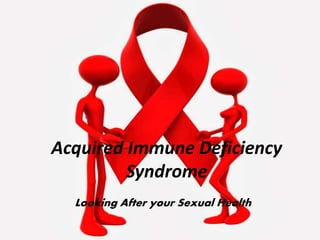
Acquired Immune Deficiency
Syndrome
Looking After your Sexual Health
HIV
•HIV stands for Human Immunodeficiency Virus. It is a retrovirus that
causes AIDS . Its entrance into the body lowers the immunity (body
defense system) or the ability to fight off disease.
•HIV Infection is the successful entry of HIV in the human host,
weakening the immune system and leading to a spectrum of diseases.
•Invades the helper T cells (CD4 cells) in the body of the host (defense
mechanism of a person)
AIDS
•AIDS stands for Acquired Immune Deficiency Syndrome. It is a
condition characterized by a combination of signs and symptoms,
caused by HIV contracted from another which attacks and weakens
the body’s immune system, making the afflicted individual
susceptible to other life threatening.
•Disease limits the body’s ability to fight infection due to markedly
reduced helper T cells.
•Patients have a very weak immune system (defense mechanism)
Patients predisposed to multiple opportunistic infections leading to
death.
How does HIV attack the
immune system?
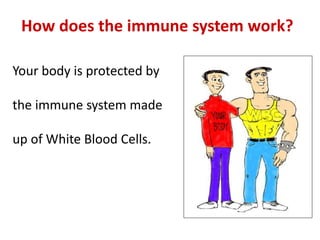
How does the immune system work?
Your body is protected by
the immune system made
up of White Blood Cells.
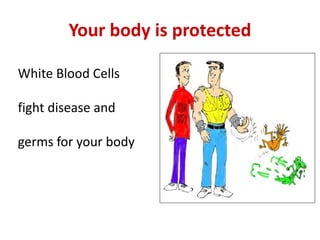
Your body is protected
White Blood Cells
fight disease and
germs for your body
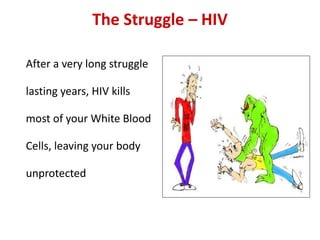
The Struggle – HIV
After a very long struggle
lasting years, HIV kills
most of your White Blood
Cells, leaving your body
unprotected
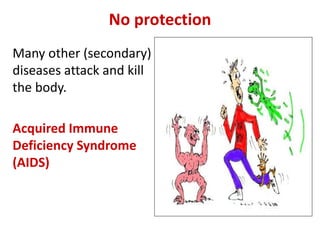
No protection
Many other (secondary)
diseases attack and kill
the body.
Acquired Immune
Deficiency Syndrome
(AIDS)
Signs and Symptoms
•Once infected with HIV, there are very mild symptoms or none at
all
•The patient starts experiencing “ flu-like” symptoms.
•More severe symptoms may not appear for 10 years or more
( asymptomatic illness)
•As the immune system worsens, variety of complications start to
occur.
•Persistent fever
•Extreme fatigue not related to stress or lack of sleep
•Persistent diarrhoea
•Severe malnutrition, losing weight
•Swollen glands in the neck, groin, etc.
•Difficulty in swallowing
•Oral thrush,Headache, confusion and forgetfulness
Most symptoms of HIV disease are similar in men and women.
Women who have HIV can have additional symptoms that happen
more often. These include:
•vaginal yeast infections
•other vaginal infections such as bacterial vaginosis; common
sexually transmitted diseases (STDs) like gonorrhea,
Chlamydia and trichomoniasis; human papillomavirus (HPV)
infections that cause genital warts and can lead to cervical
cancer; pelvic inflammatory disease (PID)
•infection of a women's reproductive organs and menstrual
cycle changes, such as not having periods
Once HIV turns into AIDS, advance diseases may occur. The
patient experiences opportunistic infections from
bacterial, mycobacterial, fungal, protozoal, viral and
malignant sources that can cause any of the following:
•Swollen glands
•Mouth infections
•Brain infections
•Skin diseases
•Lung diseases
•Loss of weight
•DEATH
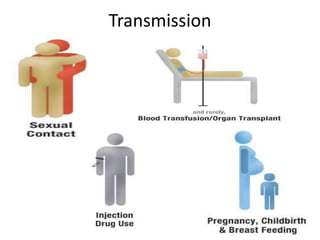
Transmission
Cases and Epidemiology
Behaviors that makes us at RISK for
infection
• Unprotected anal sex between males
• Unprotected sex with paid partners
• Unprotected sex with multiple sex partners
• Injecting with used needles
Behaviors that put Filipinos at risk for
HIV
• Younger age of first sex
• Younger Filipinos try injecting drugs
• More males engage in anal sex
• Unprotected sex with >1 sexual partner
• Most injecting drug users share needles
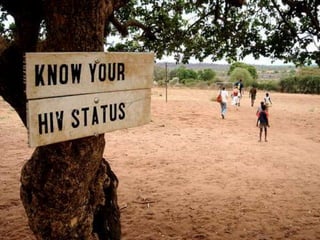
• Few voluntarily get tested for HIV and know
their HIV status – so many may be spreading
HIV and not know it
And as of January 2014………
The Philippine HIV and AIDS Registry of the
Department of Health- National Epidemiology
Center (DOH-NEC) just released its January
2014 Report.
Newly Diagnosed HIV cases in the
Philippines
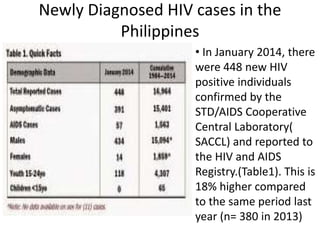
• In January 2014, there
were 448 new HIV
positive individuals
confirmed by the
STD/AIDS Cooperative
Central Laboratory(
SACCL) and reported to
the HIV and AIDS
Registry.(Table1). This is
18% higher compared
to the same period last
year (n= 380 in 2013)
Most of the cases were male(97%). The median age
was 28 years.
• Age range: 17-73 years
20- 29 years(56%) age group had the most
number of cases.
Reported modes of transmission were sexual
contact (444) and needle sharing among
injecting drug users.
Males having sex with other males (85%) were
the predominant type of sexual transmission.
87% are still asymptomatic at the time of
reporting
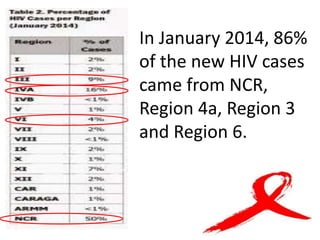
In January 2014, 86%
of the new HIV cases
came from NCR,
Region 4a, Region 3
and Region 6.
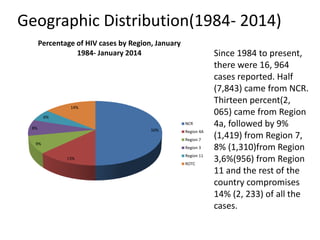
Geographic Distribution(1984- 2014)
50%
13%
9%
8%
6%
14%
Percentage of HIV cases by Region, January
1984- January 2014
NCR
Region 4A
Region 7
Region 3
Region 11
ROTC
Since 1984 to present,
there were 16, 964
cases reported. Half
(7,843) came from NCR.
Thirteen percent(2,
065) came from Region
4a, followed by 9%
(1,419) from Region 7,
8% (1,310)from Region
3,6%(956) from Region
11 and the rest of the
country compromises
14% (2, 233) of all the
cases.
AIDS Cases
• Of the 448 HIV positive cases in January 2014,
57 were reported as AIDS cases. All were
male.
• Sexual contact was the most common mode
of the HIV transmission.
Deaths among people with HIV
• In January 1984 to January 2014, there were 938 reported deaths
among people with HIV. 80% were male. In total, there have been 107
deaths among youth( 15-24 years old) and 15 deaths among children(
<15 years old).
•In January 2014, there were a total of 7 deaths. All were male. The
highest number of deaths occurred in the 25-29 age group, followed by
the 20-24, 30-34 and 50 and older age group.
•Among the reported deaths in 2014, 100% sexual contact was the
main mode of HIV transmission. There were no cases of infections
through injecting drug use, maternal to child transmission and blood
transfusion.
Treatment
• There is NO vaccine and NO cure for HIV.
• Anti-retroviral medication (ARVs) may only
slow down the replication of the virus and
Strengthening the immune system
Prevention Strategies
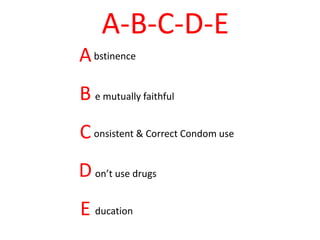
A-B-C-D-E
A
B
C
D
E
bstinence
e mutually faithful
onsistent & Correct Condom use
on’t use drugs
ducation
Abstinence
• It is the most effective method of not
acquiring HIV/AIDS.
• Refraining from unprotected sex: oral, anal,
or vaginal.
• Refraining from intravenous drug use
Be Mutually FAITHFUL!!!!
• A mutually monogamous (only one sex partner)
relationship with a person who is not infected
with HIV
• HIV testing before intercourse is necessary to
prove your partner is not infected
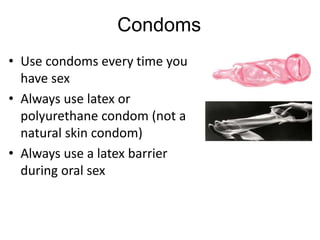
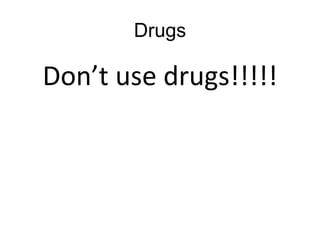
Condoms
• Use condoms every time you
have sex
• Always use latex or
polyurethane condom (not a
natural skin condom)
• Always use a latex barrier
during oral sex
Drugs
Don’t use drugs!!!!!
Education
Correct Knowledge on HIV
what is HIV and what it is not, how to
prevent it, what to do if you or a
loved one gets infected
Student forum( hiv)
Student forum( hiv)

Student forum( hiv)

  • 1.
  • 2.
    HIV •HIV stands forHuman Immunodeficiency Virus. It is a retrovirus that causes AIDS . Its entrance into the body lowers the immunity (body defense system) or the ability to fight off disease. •HIV Infection is the successful entry of HIV in the human host, weakening the immune system and leading to a spectrum of diseases. •Invades the helper T cells (CD4 cells) in the body of the host (defense mechanism of a person)
  • 3.
    AIDS •AIDS stands forAcquired Immune Deficiency Syndrome. It is a condition characterized by a combination of signs and symptoms, caused by HIV contracted from another which attacks and weakens the body’s immune system, making the afflicted individual susceptible to other life threatening. •Disease limits the body’s ability to fight infection due to markedly reduced helper T cells. •Patients have a very weak immune system (defense mechanism) Patients predisposed to multiple opportunistic infections leading to death.
  • 4.
    How does HIVattack the immune system?
  • 5.
    How does theimmune system work? Your body is protected by the immune system made up of White Blood Cells.
  • 6.
    Your body isprotected White Blood Cells fight disease and germs for your body
  • 7.
    The Struggle –HIV After a very long struggle lasting years, HIV kills most of your White Blood Cells, leaving your body unprotected
  • 8.
    No protection Many other(secondary) diseases attack and kill the body. Acquired Immune Deficiency Syndrome (AIDS)
  • 9.
    Signs and Symptoms •Onceinfected with HIV, there are very mild symptoms or none at all •The patient starts experiencing “ flu-like” symptoms. •More severe symptoms may not appear for 10 years or more ( asymptomatic illness) •As the immune system worsens, variety of complications start to occur. •Persistent fever •Extreme fatigue not related to stress or lack of sleep •Persistent diarrhoea •Severe malnutrition, losing weight •Swollen glands in the neck, groin, etc. •Difficulty in swallowing •Oral thrush,Headache, confusion and forgetfulness
  • 10.
    Most symptoms ofHIV disease are similar in men and women. Women who have HIV can have additional symptoms that happen more often. These include: •vaginal yeast infections •other vaginal infections such as bacterial vaginosis; common sexually transmitted diseases (STDs) like gonorrhea, Chlamydia and trichomoniasis; human papillomavirus (HPV) infections that cause genital warts and can lead to cervical cancer; pelvic inflammatory disease (PID) •infection of a women's reproductive organs and menstrual cycle changes, such as not having periods
  • 11.
    Once HIV turnsinto AIDS, advance diseases may occur. The patient experiences opportunistic infections from bacterial, mycobacterial, fungal, protozoal, viral and malignant sources that can cause any of the following: •Swollen glands •Mouth infections •Brain infections •Skin diseases •Lung diseases •Loss of weight •DEATH
  • 12.
  • 13.
  • 14.
    Behaviors that makesus at RISK for infection • Unprotected anal sex between males • Unprotected sex with paid partners • Unprotected sex with multiple sex partners • Injecting with used needles
  • 15.
    Behaviors that putFilipinos at risk for HIV • Younger age of first sex • Younger Filipinos try injecting drugs • More males engage in anal sex • Unprotected sex with >1 sexual partner • Most injecting drug users share needles • Few voluntarily get tested for HIV and know their HIV status – so many may be spreading HIV and not know it
  • 17.
    And as ofJanuary 2014……… The Philippine HIV and AIDS Registry of the Department of Health- National Epidemiology Center (DOH-NEC) just released its January 2014 Report.
  • 18.
    Newly Diagnosed HIVcases in the Philippines • In January 2014, there were 448 new HIV positive individuals confirmed by the STD/AIDS Cooperative Central Laboratory( SACCL) and reported to the HIV and AIDS Registry.(Table1). This is 18% higher compared to the same period last year (n= 380 in 2013)
  • 19.
    Most of thecases were male(97%). The median age was 28 years. • Age range: 17-73 years 20- 29 years(56%) age group had the most number of cases. Reported modes of transmission were sexual contact (444) and needle sharing among injecting drug users. Males having sex with other males (85%) were the predominant type of sexual transmission. 87% are still asymptomatic at the time of reporting
  • 20.
    In January 2014,86% of the new HIV cases came from NCR, Region 4a, Region 3 and Region 6.
  • 21.
    Geographic Distribution(1984- 2014) 50% 13% 9% 8% 6% 14% Percentageof HIV cases by Region, January 1984- January 2014 NCR Region 4A Region 7 Region 3 Region 11 ROTC Since 1984 to present, there were 16, 964 cases reported. Half (7,843) came from NCR. Thirteen percent(2, 065) came from Region 4a, followed by 9% (1,419) from Region 7, 8% (1,310)from Region 3,6%(956) from Region 11 and the rest of the country compromises 14% (2, 233) of all the cases.
  • 22.
    AIDS Cases • Ofthe 448 HIV positive cases in January 2014, 57 were reported as AIDS cases. All were male. • Sexual contact was the most common mode of the HIV transmission.
  • 23.
    Deaths among peoplewith HIV • In January 1984 to January 2014, there were 938 reported deaths among people with HIV. 80% were male. In total, there have been 107 deaths among youth( 15-24 years old) and 15 deaths among children( <15 years old). •In January 2014, there were a total of 7 deaths. All were male. The highest number of deaths occurred in the 25-29 age group, followed by the 20-24, 30-34 and 50 and older age group. •Among the reported deaths in 2014, 100% sexual contact was the main mode of HIV transmission. There were no cases of infections through injecting drug use, maternal to child transmission and blood transfusion.
  • 24.
    Treatment • There isNO vaccine and NO cure for HIV. • Anti-retroviral medication (ARVs) may only slow down the replication of the virus and Strengthening the immune system
  • 25.
  • 26.
    A-B-C-D-E A B C D E bstinence e mutually faithful onsistent& Correct Condom use on’t use drugs ducation
  • 27.
    Abstinence • It isthe most effective method of not acquiring HIV/AIDS. • Refraining from unprotected sex: oral, anal, or vaginal. • Refraining from intravenous drug use
  • 28.
    Be Mutually FAITHFUL!!!! •A mutually monogamous (only one sex partner) relationship with a person who is not infected with HIV • HIV testing before intercourse is necessary to prove your partner is not infected
  • 29.
    Condoms • Use condomsevery time you have sex • Always use latex or polyurethane condom (not a natural skin condom) • Always use a latex barrier during oral sex
  • 30.
  • 31.
    Education Correct Knowledge onHIV what is HIV and what it is not, how to prevent it, what to do if you or a loved one gets infected