1
HIV/AIDS Teen Outreach
Madison County AIDS Program
2016 Madison Ave. Granite City, IL 62040
United Way of Greater St. Louis
August 1 2015 – May 31, 2016
$61,387.40
2
Agency Description
The Madison County AIDS Program also known as MadCAP was established in 1986. MadCAP
aims to not only prevent the spread of HIV but to also assist and provide resources for
individuals and their families who have been infected or affected by HIV. MadCAP staff are
equipped with over eighteen years in servicing the community. This agency serves as a branch of
Coordinated Youth & Human Services, which offers a number of educational programs.
Mission:
The mission of MadCAP is to "prevent the spread of HIV and to respond to the needs of people
infected or affected by HIV/AIDS while recognizing and respecting the dignity and privacy of all
individuals in a non-judgmental way." (Coordinated Youth & Human Services [CYHS], n.d.)
Goals:
-Raise awareness about HIV and AIDS in the community
-Target more African American men to get screened due to a high risk
-Provide more health screenings not only to those at risk but others wanting to know their status
-Provide more preventive care for positives people
Current Programs:
MadCAP currently offers a Peer Counseling Program, which is available to those who have
recently been diagnosed with HIV, are currently taking new medications and those that are
struggling with adherence. The program is led by a peer educator who has been diagnosed with
HIV and also has been specially trained to assist others that are coping with living with HIV.
Another program this agency provides is giving health screenings for those at risk. These
screenings include HIV, AIDS, Hepatitis C, Gonorrhea, and Chlamydia. Additionally, MadCAP
provides two kinds of case management programs known as Ryan White Case Management and
the Home Service Program. The case managers meet with HIV positive individuals and assess
whether they are eligible for the resources that MadCAP provides for HIV/AIDS individuals.
Lastly, MadCAP provides HIV/AIDS prevention in the form of presentations, outreach, risk
reduction and walk-in testing services.
3
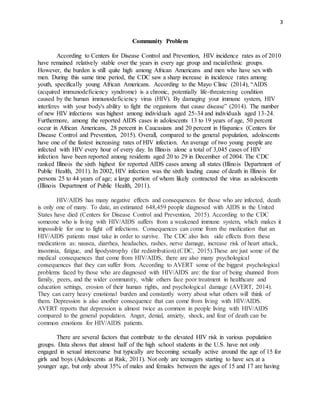
Community Problem
According to Centers for Disease Control and Prevention, HIV incidence rates as of 2010
have remained relatively stable over the years in every age group and racial/ethnic groups.
However, the burden is still quite high among African Americans and men who have sex with
men. During this same time period, the CDC saw a sharp increase in incidence rates among
youth, specifically young African Americans. According to the Mayo Clinic (2014), “AIDS
(acquired immunodeficiency syndrome) is a chronic, potentially life-threatening condition
caused by the human immunodeficiency virus (HIV). By damaging your immune system, HIV
interferes with your body's ability to fight the organisms that cause disease” (2014). The number
of new HIV infections was highest among individuals aged 25-34 and individuals aged 13-24.
Furthermore, among the reported AIDS cases in adolescents 13 to 19 years of age, 50 percent
occur in African Americans, 28 percent in Caucasians and 20 percent in Hispanics (Centers for
Disease Control and Prevention, 2015). Overall, compared to the general population, adolescents
have one of the fastest increasing rates of HIV infection. An average of two young people are
infected with HIV every hour of every day. In Illinois alone a total of 3,045 cases of HIV
infection have been reported among residents aged 20 to 29 in December of 2004. The CDC
ranked Illinois the sixth highest for reported AIDS cases among all states (Illinois Department of
Public Health, 2011). In 2002, HIV infection was the sixth leading cause of death in Illinois for
persons 25 to 44 years of age; a large portion of whom likely contracted the virus as adolescents
(Illinois Department of Public Health, 2011).
HIV/AIDS has many negative effects and consequences for those who are infected, death
is only one of many. To date, an estimated 648,459 people diagnosed with AIDS in the United
States have died (Centers for Disease Control and Prevention, 2015). According to the CDC
someone who is living with HIV/AIDS suffers from a weakened immune system, which makes it
impossible for one to fight off infections. Consequences can come from the medication that an
HIV/AIDS patients must take in order to survive. The CDC also lists side effects from these
medications as: nausea, diarrhea, headaches, rashes, nerve damage, increase risk of heart attack,
insomnia, fatigue, and lipodystrophy (fat redistribution).(CDC, 2015).These are just some of the
medical consequences that come from HIV/AIDS, there are also many psychological
consequences that they can suffer from. According to AVERT some of the biggest psychological
problems faced by those who are diagnosed with HIV/AIDS are: the fear of being shunned from
family, peers, and the wider community, while others face poor treatment in healthcare and
education settings, erosion of their human rights, and psychological damage (AVERT, 2014).
They can carry heavy emotional burden and constantly worry about what others will think of
them. Depression is also another consequence that can come from living with HIV/AIDS.
AVERT reports that depression is almost twice as common in people living with HIV/AIDS
compared to the general population. Anger, denial, anxiety, shock, and fear of death can be
common emotions for HIV/AIDS patients.
There are several factors that contribute to the elevated HIV risk in various population
groups. Data shows that almost half of the high school students in the U.S. have not only
engaged in sexual intercourse but typically are becoming sexually active around the age of 15 for
girls and boys (Adolescents at Risk, 2011). Not only are teenagers starting to have sex at a
younger age, but only about 35% of males and females between the ages of 15 and 17 are having
4
sex with a condom (Adolescents: Health Risk and Solutions, 2011). According to a report on
AIDS.gov site gay and bisexual men are also engaging in risky sexual behavior (Syphilis and
HIV: A Dangerous Duo Affecting Gay and Bisexual Men, 2012). The report also states that they
account for almost 70% of all infections and also have a higher risk of contracting HIV. Of these
infections, secondary syphilis rates are increasing within this population. Studies have shown
that sores on the genitals, triggered by syphilis, increase the likelihood of transmitting and
possibly acquiring HIV (Syphilis and HIV: A Dangerous Duo Affecting Gay and Bisexual Men,
2012). According to a report published by the CDC: Morbidity and Mortality Weekly Report
both Black women and Hispanic/Latino women made up 68% of those that were diagnosed with
HIV, in comparison to White women (HIV Transmission among Black Women-North Carolina,
2004) . The MMWR reports a study was conducted in North Carolina, where black women made
up majority of the population of newly reported HIV infections. Of the women that had been
infected and agreed to be interviewed most of them reported that the reasons they engaged in
risky sexual behaviors included low self-esteem, alcohol/drug use and a sense of financial
freedom (HIV Transmission among Black Women-North Carolina, 2004). Behavioral factors
play a major role in acquiring HIV, but it has also been shown that socioeconomic status and
environmental factors play a role as well. According to the CDC there are several socioeconomic
factors that are impacting elevated HIV risks. One of the factors is poverty, which may limit
one’s access to healthcare and medical testing (Socioeconomic Factors Affecting HIV Risk,
2013). Other factors listed by the CDC include high rates of male incarceration which decreases
the number of men available to women which may also increase the spread of HIV.
Discrimination is also another factor. Individuals might be intimidated into not getting tested or
seeking help. Finally the prevalence of HIV/ STD’s is a significant factor that is impacting
elevated HIV risk. The more individuals that live within a community and are infected with
either HIV or other STD’s increases the likelihood of spreading or acquiring HIV, especially if
individuals within the community are engaging in sexual exchanges with people of the same
ethnicity (Socioeconomic Factors Affecting HIV Risk, 2013).
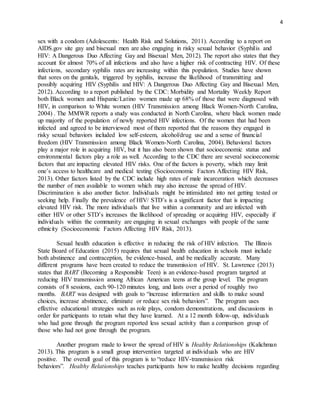
Sexual health education is effective in reducing the risk of HIV infection. The Illinois
State Board of Education (2015) requires that sexual health education in schools must include
both abstinence and contraception, be evidence-based, and be medically accurate. Many
different programs have been created to reduce the transmission of HIV. St. Lawrence (2013)
states that BART (Becoming a Responsible Teen) is an evidence-based program targeted at
reducing HIV transmission among African American teens at the group level. The program
consists of 8 sessions, each 90-120 minutes long, and lasts over a period of roughly two
months. BART was designed with goals to “increase information and skills to make sound
choices, increase abstinence, eliminate or reduce sex risk behaviors”. The program uses
effective educational strategies such as role plays, condom demonstrations, and discussions in
order for participants to retain what they have learned. At a 12 month follow-up, individuals
who had gone through the program reported less sexual activity than a comparison group of
those who had not gone through the program.
Another program made to lower the spread of HIV is Healthy Relationships (Kalichman
2013). This program is a small group intervention targeted at individuals who are HIV
positive. The overall goal of this program is to “reduce HIV-transmission risk
behaviors”. Healthy Relationships teaches participants how to make healthy decisions regarding
5
sexual activity such as strategies to practice safe sex with a partner. The sessions are delivered
twice a week for about three weeks, each session lasting about two hours. Overall, the program
increased safe sex behaviors among participants, including increased condom use and refusal of
unprotected sex.
6
Program Summary
Our proposal seeks to obtain funding to implement a HIV/AIDS risk reduction program with
adolescents attending public schools in Madison County, Illinois. Our HIV awareness seminar
will be held at various high schools in the Madison County area. We will model the program
BART (Becoming a Responsible Teen), which is a CDC recognized evidence-based HIV risk
reduction program. It will be implemented over the course of the Fall 2016-Spring 2017 school
year. Our program will reach the target population because we have met with the superintendent
of Madison County Schools, who has agreed to allow the program to be held during the school
day. As such, we can ensure that our intended population will be reached. Students of the
freshman class will be taken in groups of 12-15 according to their last name. This will be
repeated four times each school day, allowing each student within the freshmen class to
participate in all discussion topics and activities. Each session will last one hour, providing
enough time for students to complete pre and post test and ask any additional questions they may
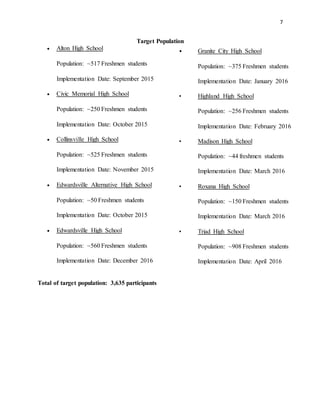
have. The health educator, intern and volunteer will be scheduled to attend each of the schools
below for a total period of one month, covering a different topic each week. At the conclusion of
the program we will use the pre and post test results from each activity as indicators on whether
the program achieved the outcomes.
7
Target Population
 Alton High School
Population: ~517 Freshmen students
Implementation Date: September 2015
 Civic Memorial High School
Population: ~250 Freshmen students
Implementation Date: October 2015
 Collinsville High School
Population: ~525 Freshmen students
Implementation Date: November 2015
 Edwardsville Alternative High School
Population: ~50 Freshmen students
Implementation Date: October 2015
 Edwardsville High School
Population: ~560 Freshmen students
Implementation Date: December 2016
Total of target population: 3,635 participants
• Granite City High School
Population: ~375 Freshmen students
Implementation Date: January 2016
• Highland High School
Population: ~256 Freshmen students
Implementation Date: February 2016
• Madison High School
Population: ~44 freshmen students
Implementation Date: March 2016
• Roxana High School
Population: ~150 Freshmen students
Implementation Date: March 2016
• Triad High School
Population: ~908 Freshmen students
Implementation Date: April 2016
8
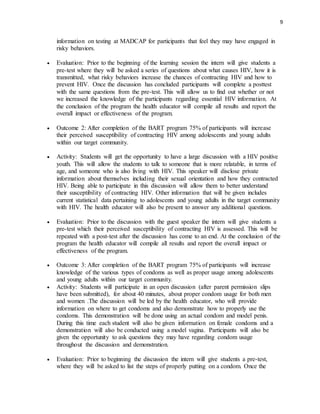
Program Timeline
Program Goal, Objectives, Activities, and Evaluation
Goal: Reduce the rate of HIV among adolescents and young adults within Madison County.
 Outcome 1: After completion of the BART program, 75% of participants of the B.A.R.T.
program will increase knowledge of essential HIV/AIDS information by 50%.
 Activity: Students will participate in an interactive learning session, which includes the
use of video clips, online polls and small group discussions. The health educator will also
utilize a PowerPoint presentation that contains information on causes, transmission, risk
behaviors and effective prevention methods. The health educator will also provide
Activity Time
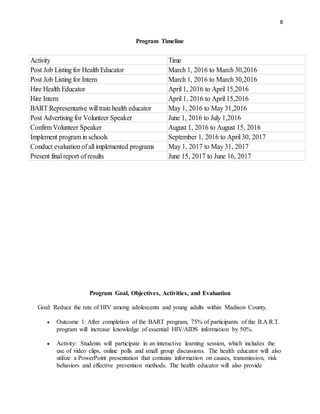
Post Job Listing for Health Educator March 1, 2016 to March 30,2016
Post Job Listing for Intern March 1, 2016 to March 30,2016
Hire Health Educator April1, 2016 to April15,2016
Hire Intern April1, 2016 to April15,2016
BART Representative willtrain health educator May 1, 2016 to May 31,2016
Post Advertising for Volunteer Speaker June 1, 2016 to July 1,2016
ConfirmVolunteer Speaker August 1, 2016 to August 15, 2016
Implement programin schools September 1, 2016 to April30, 2017
Conduct evaluation of allimplemented programs May 1, 2017 to May 31, 2017
Present finalreport of results June 15, 2017 to June 16, 2017
9
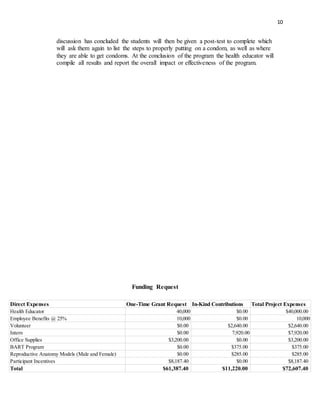
information on testing at MADCAP for participants that feel they may have engaged in
risky behaviors.
 Evaluation: Prior to the beginning of the learning session the intern will give students a
pre-test where they will be asked a series of questions about what causes HIV, how it is
transmitted, what risky behaviors increase the chances of contracting HIV and how to
prevent HIV. Once the discussion has concluded participants will complete a posttest
with the same questions from the pre-test. This will allow us to find out whether or not
we increased the knowledge of the participants regarding essential HIV information. At
the conclusion of the program the health educator will compile all results and report the
overall impact or effectiveness of the program.
 Outcome 2: After completion of the BART program 75% of participants will increase
their perceived susceptibility of contracting HIV among adolescents and young adults
within our target community.
 Activity: Students will get the opportunity to have a large discussion with a HIV positive
youth. This will allow the students to talk to someone that is more relatable, in terms of
age, and someone who is also living with HIV. This speaker will disclose private
information about themselves including their sexual orientation and how they contracted
HIV. Being able to participate in this discussion will allow them to better understand
their susceptibility of contracting HIV. Other information that will be given includes
current statistical data pertaining to adolescents and young adults in the target community
with HIV. The health educator will also be present to answer any additional questions.
 Evaluation: Prior to the discussion with the guest speaker the intern will give students a
pre-test which their perceived susceptibility of contracting HIV is assessed. This will be
repeated with a post-test after the discussion has come to an end. At the conclusion of the
program the health educator will compile all results and report the overall impact or
effectiveness of the program.
 Outcome 3: After completion of the BART program 75% of participants will increase
knowledge of the various types of condoms as well as proper usage among adolescents
and young adults within our target community.
 Activity: Students will participate in an open discussion (after parent permission slips
have been submitted), for about 40 minutes, about proper condom usage for both men
and women .The discussion will be led by the health educator, who will provide
information on where to get condoms and also demonstrate how to properly use the
condoms. This demonstration will be done using an actual condom and model penis.
During this time each student will also be given information on female condoms and a
demonstration will also be conducted using a model vagina. Participants will also be
given the opportunity to ask questions they may have regarding condom usage
throughout the discussion and demonstration.
 Evaluation: Prior to beginning the discussion the intern will give students a pre-test,
where they will be asked to list the steps of properly putting on a condom. Once the
10
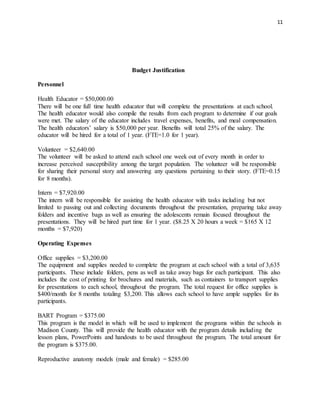
Direct Expenses One-Time Grant Request In-Kind Contributions Total Project Expenses
Health Educator 40,000 $0.00 $40,000.00
Employee Benefits @ 25% 10,000 $0.00 10,000
Volunteer $0.00 $2,640.00 $2,640.00
Intern $0.00 7,920.00 $7,920.00
Office Supplies $3,200.00 $0.00 $3,200.00
BART Program $0.00 $375.00 $375.00
Reproductive Anatomy Models (Male and Female) $0.00 $285.00 $285.00
Participant Incentives $8,187.40 $0.00 $8,187.40
Total $61,387.40 $11,220.00 $72,607.40
discussion has concluded the students will then be given a post-test to complete which
will ask them again to list the steps to properly putting on a condom, as well as where
they are able to get condoms. At the conclusion of the program the health educator will
compile all results and report the overall impact or effectiveness of the program.
Funding Request
11
Budget Justification
Personnel
Health Educator = $50,000.00
There will be one full time health educator that will complete the presentations at each school.
The health educator would also compile the results from each program to determine if our goals
were met. The salary of the educator includes travel expenses, benefits, and meal compensation.
The health educators’ salary is $50,000 per year. Benefits will total 25% of the salary. The
educator will be hired for a total of 1 year. (FTE=1.0 for 1 year).
Volunteer = $2,640.00
The volunteer will be asked to attend each school one week out of every month in order to
increase perceived susceptibility among the target population. The volunteer will be responsible
for sharing their personal story and answering any questions pertaining to their story. (FTE=0.15
for 8 months).
Intern = $7,920.00
The intern will be responsible for assisting the health educator with tasks including but not
limited to passing out and collecting documents throughout the presentation, preparing take away
folders and incentive bags as well as ensuring the adolescents remain focused throughout the
presentations. They will be hired part time for 1 year. ($8.25 X 20 hours a week = $165 X 12
months = $7,920)
Operating Expenses
Office supplies = $3,200.00
The equipment and supplies needed to complete the program at each school with a total of 3,635
participants. These include folders, pens as well as take away bags for each participant. This also
includes the cost of printing for brochures and materials, such as containers to transport supplies
for presentations to each school, throughout the program. The total request for office supplies is
$400/month for 8 months totaling $3,200. This allows each school to have ample supplies for its
participants.
BART Program = $375.00
This program is the model in which will be used to implement the programs within the schools in
Madison County. This will provide the health educator with the program details including the
lesson plans, PowerPoints and handouts to be used throughout the program. The total amount for
the program is $375.00.
Reproductive anatomy models (male and female) = $285.00
12
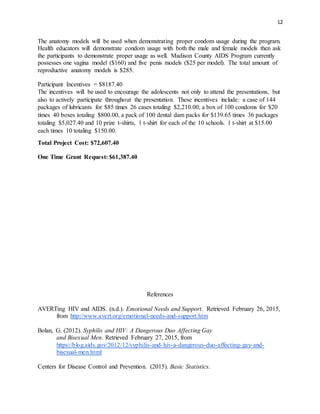
The anatomy models will be used when demonstrating proper condom usage during the program.
Health educators will demonstrate condom usage with both the male and female models then ask
the participants to demonstrate proper usage as well. Madison County AIDS Program currently
possesses one vagina model ($160) and five penis models ($25 per model). The total amount of
reproductive anatomy models is $285.
Participant Incentives = $8187.40
The incentives will be used to encourage the adolescents not only to attend the presentations, but
also to actively participate throughout the presentation. These incentives include: a case of 144
packages of lubricants for $85 times 26 cases totaling $2,210.00, a box of 100 condoms for $20
times 40 boxes totaling $800.00, a pack of 100 dental dam packs for $139.65 times 36 packages
totaling $5,027.40 and 10 prize t-shirts, 1 t-shirt for each of the 10 schools. 1 t-shirt at $15.00
each times 10 totaling $150.00.
Total Project Cost: $72,607.40
One Time Grant Request: $61,387.40
References
AVERTing HIV and AIDS. (n.d.). Emotional Needs and Support. Retrieved February 26, 2015,
from http://www.avert.org/emotional-needs-and-support.htm
Bolan, G. (2012). Syphilis and HIV: A Dangerous Duo Affecting Gay
and Bisexual Men. Retrieved February 27, 2015, from
https://blog.aids.gov/2012/12/syphilis-and-hiv-a-dangerous-duo-affecting-gay-and-
bisexual-men.html
Centers for Disease Control and Prevention. (2015). Basic Statistics.
13
Retrieved February 27, 2015, from http://www.cdc.gov/hiv/basics/statistics.html
Centers for Disease Control and Prevention. (2004). HIV Transmission Among Black Women ,
North Carolina. Retrieved on February 27,2015 from
http://www.cdc.gov/mmwr/preview/mmwrhtml/mm5404a2.htm
Centers for Disease Control and Prevention. (2013). Socioeconomic Factors Affecting HIV Risk.
Retrieved on February 27, 2015 from
http://www.cdc.gov/nchhstp/newsroom/HIVFactSheets/Epidemic/Factors.htm
Coordinated Youth & Human Services. (n.d.). Welcome to MadCAP. Retrieved February 5,
2015, from http://www.cyhs.com/index.php/madcap
Illinois Department of Public Health. (2011). HIV/AIDS. Retrieved March 3,
2015, from http://www.idph.state.il.us/aids/materials/adol_hiv_fs.htm
Illinois State Board of Education. (2015) School Health Issues. Retrieved on
April 9, 2015 from http://www.isbe.net/school_health.htm
Kalichman, S. (2013). Compendium of Evidence-Based Interventions and Best Practices for
HIV Prevention: Healthy Relationships. Centers for Disease Control and Prevention.
Retrieved from:
http://www.cdc.gov/hiv/prevention/research/compendium/rr/healthyrelationships.html
Mayo Clinic. (2014). HIV/AIDS. Retrieved April 9, 2015, from
http://www.mayoclinic.org/diseases-conditions/hiv-aids/basics/definition/con-20013732
St. Lawrence, J. (2013). Compendium of Evidence-Based Interventions and Best Practices
for HIV Prevention: Becoming a Responsible Teen (BART). Centers for Disease Control
and Prevention. Retrieved from:
http://www.cdc.gov/hiv/prevention/research/compendium/rr/bart.html
World Health Organization. (2014). Adolescents: Health Risk and Solutions. Retrieved
on February 27,2015 from http://www.who.int/mediacentre/factsheets/fs345/en/

Final Grant-3

  • 1.
    1 HIV/AIDS Teen Outreach MadisonCounty AIDS Program 2016 Madison Ave. Granite City, IL 62040 United Way of Greater St. Louis August 1 2015 – May 31, 2016 $61,387.40
  • 2.
    2 Agency Description The MadisonCounty AIDS Program also known as MadCAP was established in 1986. MadCAP aims to not only prevent the spread of HIV but to also assist and provide resources for individuals and their families who have been infected or affected by HIV. MadCAP staff are equipped with over eighteen years in servicing the community. This agency serves as a branch of Coordinated Youth & Human Services, which offers a number of educational programs. Mission: The mission of MadCAP is to "prevent the spread of HIV and to respond to the needs of people infected or affected by HIV/AIDS while recognizing and respecting the dignity and privacy of all individuals in a non-judgmental way." (Coordinated Youth & Human Services [CYHS], n.d.) Goals: -Raise awareness about HIV and AIDS in the community -Target more African American men to get screened due to a high risk -Provide more health screenings not only to those at risk but others wanting to know their status -Provide more preventive care for positives people Current Programs: MadCAP currently offers a Peer Counseling Program, which is available to those who have recently been diagnosed with HIV, are currently taking new medications and those that are struggling with adherence. The program is led by a peer educator who has been diagnosed with HIV and also has been specially trained to assist others that are coping with living with HIV. Another program this agency provides is giving health screenings for those at risk. These screenings include HIV, AIDS, Hepatitis C, Gonorrhea, and Chlamydia. Additionally, MadCAP provides two kinds of case management programs known as Ryan White Case Management and the Home Service Program. The case managers meet with HIV positive individuals and assess whether they are eligible for the resources that MadCAP provides for HIV/AIDS individuals. Lastly, MadCAP provides HIV/AIDS prevention in the form of presentations, outreach, risk reduction and walk-in testing services.
  • 3.
    3 Community Problem According toCenters for Disease Control and Prevention, HIV incidence rates as of 2010 have remained relatively stable over the years in every age group and racial/ethnic groups. However, the burden is still quite high among African Americans and men who have sex with men. During this same time period, the CDC saw a sharp increase in incidence rates among youth, specifically young African Americans. According to the Mayo Clinic (2014), “AIDS (acquired immunodeficiency syndrome) is a chronic, potentially life-threatening condition caused by the human immunodeficiency virus (HIV). By damaging your immune system, HIV interferes with your body's ability to fight the organisms that cause disease” (2014). The number of new HIV infections was highest among individuals aged 25-34 and individuals aged 13-24. Furthermore, among the reported AIDS cases in adolescents 13 to 19 years of age, 50 percent occur in African Americans, 28 percent in Caucasians and 20 percent in Hispanics (Centers for Disease Control and Prevention, 2015). Overall, compared to the general population, adolescents have one of the fastest increasing rates of HIV infection. An average of two young people are infected with HIV every hour of every day. In Illinois alone a total of 3,045 cases of HIV infection have been reported among residents aged 20 to 29 in December of 2004. The CDC ranked Illinois the sixth highest for reported AIDS cases among all states (Illinois Department of Public Health, 2011). In 2002, HIV infection was the sixth leading cause of death in Illinois for persons 25 to 44 years of age; a large portion of whom likely contracted the virus as adolescents (Illinois Department of Public Health, 2011). HIV/AIDS has many negative effects and consequences for those who are infected, death is only one of many. To date, an estimated 648,459 people diagnosed with AIDS in the United States have died (Centers for Disease Control and Prevention, 2015). According to the CDC someone who is living with HIV/AIDS suffers from a weakened immune system, which makes it impossible for one to fight off infections. Consequences can come from the medication that an HIV/AIDS patients must take in order to survive. The CDC also lists side effects from these medications as: nausea, diarrhea, headaches, rashes, nerve damage, increase risk of heart attack, insomnia, fatigue, and lipodystrophy (fat redistribution).(CDC, 2015).These are just some of the medical consequences that come from HIV/AIDS, there are also many psychological consequences that they can suffer from. According to AVERT some of the biggest psychological problems faced by those who are diagnosed with HIV/AIDS are: the fear of being shunned from family, peers, and the wider community, while others face poor treatment in healthcare and education settings, erosion of their human rights, and psychological damage (AVERT, 2014). They can carry heavy emotional burden and constantly worry about what others will think of them. Depression is also another consequence that can come from living with HIV/AIDS. AVERT reports that depression is almost twice as common in people living with HIV/AIDS compared to the general population. Anger, denial, anxiety, shock, and fear of death can be common emotions for HIV/AIDS patients. There are several factors that contribute to the elevated HIV risk in various population groups. Data shows that almost half of the high school students in the U.S. have not only engaged in sexual intercourse but typically are becoming sexually active around the age of 15 for girls and boys (Adolescents at Risk, 2011). Not only are teenagers starting to have sex at a younger age, but only about 35% of males and females between the ages of 15 and 17 are having
  • 4.
    4 sex with acondom (Adolescents: Health Risk and Solutions, 2011). According to a report on AIDS.gov site gay and bisexual men are also engaging in risky sexual behavior (Syphilis and HIV: A Dangerous Duo Affecting Gay and Bisexual Men, 2012). The report also states that they account for almost 70% of all infections and also have a higher risk of contracting HIV. Of these infections, secondary syphilis rates are increasing within this population. Studies have shown that sores on the genitals, triggered by syphilis, increase the likelihood of transmitting and possibly acquiring HIV (Syphilis and HIV: A Dangerous Duo Affecting Gay and Bisexual Men, 2012). According to a report published by the CDC: Morbidity and Mortality Weekly Report both Black women and Hispanic/Latino women made up 68% of those that were diagnosed with HIV, in comparison to White women (HIV Transmission among Black Women-North Carolina, 2004) . The MMWR reports a study was conducted in North Carolina, where black women made up majority of the population of newly reported HIV infections. Of the women that had been infected and agreed to be interviewed most of them reported that the reasons they engaged in risky sexual behaviors included low self-esteem, alcohol/drug use and a sense of financial freedom (HIV Transmission among Black Women-North Carolina, 2004). Behavioral factors play a major role in acquiring HIV, but it has also been shown that socioeconomic status and environmental factors play a role as well. According to the CDC there are several socioeconomic factors that are impacting elevated HIV risks. One of the factors is poverty, which may limit one’s access to healthcare and medical testing (Socioeconomic Factors Affecting HIV Risk, 2013). Other factors listed by the CDC include high rates of male incarceration which decreases the number of men available to women which may also increase the spread of HIV. Discrimination is also another factor. Individuals might be intimidated into not getting tested or seeking help. Finally the prevalence of HIV/ STD’s is a significant factor that is impacting elevated HIV risk. The more individuals that live within a community and are infected with either HIV or other STD’s increases the likelihood of spreading or acquiring HIV, especially if individuals within the community are engaging in sexual exchanges with people of the same ethnicity (Socioeconomic Factors Affecting HIV Risk, 2013). Sexual health education is effective in reducing the risk of HIV infection. The Illinois State Board of Education (2015) requires that sexual health education in schools must include both abstinence and contraception, be evidence-based, and be medically accurate. Many different programs have been created to reduce the transmission of HIV. St. Lawrence (2013) states that BART (Becoming a Responsible Teen) is an evidence-based program targeted at reducing HIV transmission among African American teens at the group level. The program consists of 8 sessions, each 90-120 minutes long, and lasts over a period of roughly two months. BART was designed with goals to “increase information and skills to make sound choices, increase abstinence, eliminate or reduce sex risk behaviors”. The program uses effective educational strategies such as role plays, condom demonstrations, and discussions in order for participants to retain what they have learned. At a 12 month follow-up, individuals who had gone through the program reported less sexual activity than a comparison group of those who had not gone through the program. Another program made to lower the spread of HIV is Healthy Relationships (Kalichman 2013). This program is a small group intervention targeted at individuals who are HIV positive. The overall goal of this program is to “reduce HIV-transmission risk behaviors”. Healthy Relationships teaches participants how to make healthy decisions regarding
  • 5.
    5 sexual activity suchas strategies to practice safe sex with a partner. The sessions are delivered twice a week for about three weeks, each session lasting about two hours. Overall, the program increased safe sex behaviors among participants, including increased condom use and refusal of unprotected sex.
  • 6.
    6 Program Summary Our proposalseeks to obtain funding to implement a HIV/AIDS risk reduction program with adolescents attending public schools in Madison County, Illinois. Our HIV awareness seminar will be held at various high schools in the Madison County area. We will model the program BART (Becoming a Responsible Teen), which is a CDC recognized evidence-based HIV risk reduction program. It will be implemented over the course of the Fall 2016-Spring 2017 school year. Our program will reach the target population because we have met with the superintendent of Madison County Schools, who has agreed to allow the program to be held during the school day. As such, we can ensure that our intended population will be reached. Students of the freshman class will be taken in groups of 12-15 according to their last name. This will be repeated four times each school day, allowing each student within the freshmen class to participate in all discussion topics and activities. Each session will last one hour, providing enough time for students to complete pre and post test and ask any additional questions they may have. The health educator, intern and volunteer will be scheduled to attend each of the schools below for a total period of one month, covering a different topic each week. At the conclusion of the program we will use the pre and post test results from each activity as indicators on whether the program achieved the outcomes.
  • 7.
    7 Target Population  AltonHigh School Population: ~517 Freshmen students Implementation Date: September 2015  Civic Memorial High School Population: ~250 Freshmen students Implementation Date: October 2015  Collinsville High School Population: ~525 Freshmen students Implementation Date: November 2015  Edwardsville Alternative High School Population: ~50 Freshmen students Implementation Date: October 2015  Edwardsville High School Population: ~560 Freshmen students Implementation Date: December 2016 Total of target population: 3,635 participants • Granite City High School Population: ~375 Freshmen students Implementation Date: January 2016 • Highland High School Population: ~256 Freshmen students Implementation Date: February 2016 • Madison High School Population: ~44 freshmen students Implementation Date: March 2016 • Roxana High School Population: ~150 Freshmen students Implementation Date: March 2016 • Triad High School Population: ~908 Freshmen students Implementation Date: April 2016
  • 8.
    8 Program Timeline Program Goal,Objectives, Activities, and Evaluation Goal: Reduce the rate of HIV among adolescents and young adults within Madison County.  Outcome 1: After completion of the BART program, 75% of participants of the B.A.R.T. program will increase knowledge of essential HIV/AIDS information by 50%.  Activity: Students will participate in an interactive learning session, which includes the use of video clips, online polls and small group discussions. The health educator will also utilize a PowerPoint presentation that contains information on causes, transmission, risk behaviors and effective prevention methods. The health educator will also provide Activity Time Post Job Listing for Health Educator March 1, 2016 to March 30,2016 Post Job Listing for Intern March 1, 2016 to March 30,2016 Hire Health Educator April1, 2016 to April15,2016 Hire Intern April1, 2016 to April15,2016 BART Representative willtrain health educator May 1, 2016 to May 31,2016 Post Advertising for Volunteer Speaker June 1, 2016 to July 1,2016 ConfirmVolunteer Speaker August 1, 2016 to August 15, 2016 Implement programin schools September 1, 2016 to April30, 2017 Conduct evaluation of allimplemented programs May 1, 2017 to May 31, 2017 Present finalreport of results June 15, 2017 to June 16, 2017
  • 9.
    9 information on testingat MADCAP for participants that feel they may have engaged in risky behaviors.  Evaluation: Prior to the beginning of the learning session the intern will give students a pre-test where they will be asked a series of questions about what causes HIV, how it is transmitted, what risky behaviors increase the chances of contracting HIV and how to prevent HIV. Once the discussion has concluded participants will complete a posttest with the same questions from the pre-test. This will allow us to find out whether or not we increased the knowledge of the participants regarding essential HIV information. At the conclusion of the program the health educator will compile all results and report the overall impact or effectiveness of the program.  Outcome 2: After completion of the BART program 75% of participants will increase their perceived susceptibility of contracting HIV among adolescents and young adults within our target community.  Activity: Students will get the opportunity to have a large discussion with a HIV positive youth. This will allow the students to talk to someone that is more relatable, in terms of age, and someone who is also living with HIV. This speaker will disclose private information about themselves including their sexual orientation and how they contracted HIV. Being able to participate in this discussion will allow them to better understand their susceptibility of contracting HIV. Other information that will be given includes current statistical data pertaining to adolescents and young adults in the target community with HIV. The health educator will also be present to answer any additional questions.  Evaluation: Prior to the discussion with the guest speaker the intern will give students a pre-test which their perceived susceptibility of contracting HIV is assessed. This will be repeated with a post-test after the discussion has come to an end. At the conclusion of the program the health educator will compile all results and report the overall impact or effectiveness of the program.  Outcome 3: After completion of the BART program 75% of participants will increase knowledge of the various types of condoms as well as proper usage among adolescents and young adults within our target community.  Activity: Students will participate in an open discussion (after parent permission slips have been submitted), for about 40 minutes, about proper condom usage for both men and women .The discussion will be led by the health educator, who will provide information on where to get condoms and also demonstrate how to properly use the condoms. This demonstration will be done using an actual condom and model penis. During this time each student will also be given information on female condoms and a demonstration will also be conducted using a model vagina. Participants will also be given the opportunity to ask questions they may have regarding condom usage throughout the discussion and demonstration.  Evaluation: Prior to beginning the discussion the intern will give students a pre-test, where they will be asked to list the steps of properly putting on a condom. Once the
  • 10.
    10 Direct Expenses One-TimeGrant Request In-Kind Contributions Total Project Expenses Health Educator 40,000 $0.00 $40,000.00 Employee Benefits @ 25% 10,000 $0.00 10,000 Volunteer $0.00 $2,640.00 $2,640.00 Intern $0.00 7,920.00 $7,920.00 Office Supplies $3,200.00 $0.00 $3,200.00 BART Program $0.00 $375.00 $375.00 Reproductive Anatomy Models (Male and Female) $0.00 $285.00 $285.00 Participant Incentives $8,187.40 $0.00 $8,187.40 Total $61,387.40 $11,220.00 $72,607.40 discussion has concluded the students will then be given a post-test to complete which will ask them again to list the steps to properly putting on a condom, as well as where they are able to get condoms. At the conclusion of the program the health educator will compile all results and report the overall impact or effectiveness of the program. Funding Request
  • 11.
    11 Budget Justification Personnel Health Educator= $50,000.00 There will be one full time health educator that will complete the presentations at each school. The health educator would also compile the results from each program to determine if our goals were met. The salary of the educator includes travel expenses, benefits, and meal compensation. The health educators’ salary is $50,000 per year. Benefits will total 25% of the salary. The educator will be hired for a total of 1 year. (FTE=1.0 for 1 year). Volunteer = $2,640.00 The volunteer will be asked to attend each school one week out of every month in order to increase perceived susceptibility among the target population. The volunteer will be responsible for sharing their personal story and answering any questions pertaining to their story. (FTE=0.15 for 8 months). Intern = $7,920.00 The intern will be responsible for assisting the health educator with tasks including but not limited to passing out and collecting documents throughout the presentation, preparing take away folders and incentive bags as well as ensuring the adolescents remain focused throughout the presentations. They will be hired part time for 1 year. ($8.25 X 20 hours a week = $165 X 12 months = $7,920) Operating Expenses Office supplies = $3,200.00 The equipment and supplies needed to complete the program at each school with a total of 3,635 participants. These include folders, pens as well as take away bags for each participant. This also includes the cost of printing for brochures and materials, such as containers to transport supplies for presentations to each school, throughout the program. The total request for office supplies is $400/month for 8 months totaling $3,200. This allows each school to have ample supplies for its participants. BART Program = $375.00 This program is the model in which will be used to implement the programs within the schools in Madison County. This will provide the health educator with the program details including the lesson plans, PowerPoints and handouts to be used throughout the program. The total amount for the program is $375.00. Reproductive anatomy models (male and female) = $285.00
  • 12.
    12 The anatomy modelswill be used when demonstrating proper condom usage during the program. Health educators will demonstrate condom usage with both the male and female models then ask the participants to demonstrate proper usage as well. Madison County AIDS Program currently possesses one vagina model ($160) and five penis models ($25 per model). The total amount of reproductive anatomy models is $285. Participant Incentives = $8187.40 The incentives will be used to encourage the adolescents not only to attend the presentations, but also to actively participate throughout the presentation. These incentives include: a case of 144 packages of lubricants for $85 times 26 cases totaling $2,210.00, a box of 100 condoms for $20 times 40 boxes totaling $800.00, a pack of 100 dental dam packs for $139.65 times 36 packages totaling $5,027.40 and 10 prize t-shirts, 1 t-shirt for each of the 10 schools. 1 t-shirt at $15.00 each times 10 totaling $150.00. Total Project Cost: $72,607.40 One Time Grant Request: $61,387.40 References AVERTing HIV and AIDS. (n.d.). Emotional Needs and Support. Retrieved February 26, 2015, from http://www.avert.org/emotional-needs-and-support.htm Bolan, G. (2012). Syphilis and HIV: A Dangerous Duo Affecting Gay and Bisexual Men. Retrieved February 27, 2015, from https://blog.aids.gov/2012/12/syphilis-and-hiv-a-dangerous-duo-affecting-gay-and- bisexual-men.html Centers for Disease Control and Prevention. (2015). Basic Statistics.
  • 13.
    13 Retrieved February 27,2015, from http://www.cdc.gov/hiv/basics/statistics.html Centers for Disease Control and Prevention. (2004). HIV Transmission Among Black Women , North Carolina. Retrieved on February 27,2015 from http://www.cdc.gov/mmwr/preview/mmwrhtml/mm5404a2.htm Centers for Disease Control and Prevention. (2013). Socioeconomic Factors Affecting HIV Risk. Retrieved on February 27, 2015 from http://www.cdc.gov/nchhstp/newsroom/HIVFactSheets/Epidemic/Factors.htm Coordinated Youth & Human Services. (n.d.). Welcome to MadCAP. Retrieved February 5, 2015, from http://www.cyhs.com/index.php/madcap Illinois Department of Public Health. (2011). HIV/AIDS. Retrieved March 3, 2015, from http://www.idph.state.il.us/aids/materials/adol_hiv_fs.htm Illinois State Board of Education. (2015) School Health Issues. Retrieved on April 9, 2015 from http://www.isbe.net/school_health.htm Kalichman, S. (2013). Compendium of Evidence-Based Interventions and Best Practices for HIV Prevention: Healthy Relationships. Centers for Disease Control and Prevention. Retrieved from: http://www.cdc.gov/hiv/prevention/research/compendium/rr/healthyrelationships.html Mayo Clinic. (2014). HIV/AIDS. Retrieved April 9, 2015, from http://www.mayoclinic.org/diseases-conditions/hiv-aids/basics/definition/con-20013732 St. Lawrence, J. (2013). Compendium of Evidence-Based Interventions and Best Practices for HIV Prevention: Becoming a Responsible Teen (BART). Centers for Disease Control and Prevention. Retrieved from: http://www.cdc.gov/hiv/prevention/research/compendium/rr/bart.html World Health Organization. (2014). Adolescents: Health Risk and Solutions. Retrieved on February 27,2015 from http://www.who.int/mediacentre/factsheets/fs345/en/