Your True Colors Communicating using four styles Kirsten Adachi
Objective To be able to  Identify communication styles Improve communication with people around you Enable your trainees to be more effective communicators Kirsten Adachi
Outline Warm-up Background  Color Communication styles Stakeholder analysis  Application and Feedback How to use in sessions Kirsten Adachi
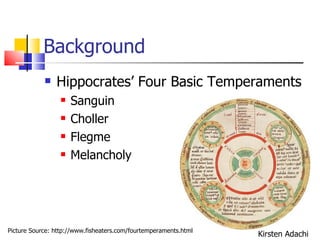
Background Hippocrates’ Four Basic Temperaments Sanguin  Choller  Flegme  Melancholy  Picture Source: http://www.fisheaters.com/fourtemperaments.html Kirsten Adachi
Communication Styles Modern classifications Red, yellow, blue, green Direct, Spirited, Considerate, or Systematic Expresser, Driver, Relater, Analytical Relater, Socializer, Thinker, Director  What do they all have in common? Kirsten Adachi
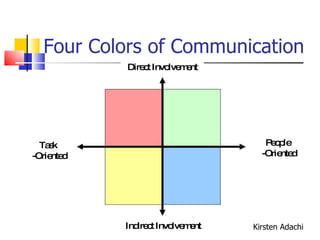
Four Colors of Communication Kirsten Adachi Task  -Oriented People  -Oriented Direct Involvement Indirect Involvement
Focus on objectives direct decisive to the point direct eye contact short conversations interruptions Image source: http://www.worth1000.com/entries/178000/178379GLNK_w.jpg Kirsten Adachi
Focus on process Deliberate, reserved, organized, logical  Indirect eye contact Detailed questions Systematic approach Kirsten Adachi
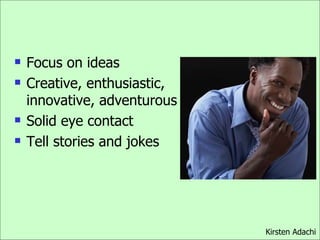
Focus on ideas Creative, enthusiastic, innovative, adventurous  Solid eye contact Tell stories and jokes Kirsten Adachi
Focus on feelings Empathetic, loyal, trustworthy, persuasive  Make variable eye contact Speak thoughtfully and casually Kirsten Adachi
Stakeholder Analysis Brainstorm a list of different people you regularly communicate with Write their names in the appropriate section of the spectrum Kirsten Adachi Task  -Oriented People  -Oriented Direct Involvement Indirect Involvement
Getting the message across Choose one person and think of a message you want to give him/her Find a partner who is the same color as the person you want to communicate with Practice telling your partner  your message Get feedback from your partner Kirsten Adachi
Communicating with Reds Results first – conclusion Best recommendation – few alternatives Direct and Concise  Emphasize practicality Visual aids Kirsten Adachi
Communicating with Yellows Outline Precise – state facts Background    Present situation   Outcome Break down Options with pros and cons Don’t rush Kirsten Adachi
Communicating with Greens Discussion time Relate topic to broad concept/idea Stress uniqueness Future value/impact Big picture    details Show enthusiasm  Kirsten Adachi
Communicating with Blues Start with small talk Stress relationship proposal and people concerned Past success of idea Support of respected people Acknowledge and show appreciation Kirsten Adachi
Communication Styles in Sessions Get in to three groups How can you use that tool in a session? Demonstrate how to use that tool Kirsten Adachi
Review Kirsten Adachi
Thank You おつかれさまでした! Kirsten Adachi
References Team Chrysalis Newsletter – Approaching Change  http://www.teamchrysalis.com/AC/V4/AC46_Communication_Styles.htm MedHunters.com http://www.medhunters.com/articles/communicationStyles.html Texas Center for Legal Ethics and Professionalism http://www.txethics.org/TCLEPCOURSE2005/omlp/sec2.5.pdf Kirsten Adachi

Your True Colors

  • 1.
    Your True ColorsCommunicating using four styles Kirsten Adachi
  • 2.
    Objective To beable to Identify communication styles Improve communication with people around you Enable your trainees to be more effective communicators Kirsten Adachi
  • 3.
    Outline Warm-up Background Color Communication styles Stakeholder analysis Application and Feedback How to use in sessions Kirsten Adachi
  • 4.
    Background Hippocrates’ FourBasic Temperaments Sanguin Choller Flegme Melancholy Picture Source: http://www.fisheaters.com/fourtemperaments.html Kirsten Adachi
  • 5.
    Communication Styles Modernclassifications Red, yellow, blue, green Direct, Spirited, Considerate, or Systematic Expresser, Driver, Relater, Analytical Relater, Socializer, Thinker, Director What do they all have in common? Kirsten Adachi
  • 6.
    Four Colors ofCommunication Kirsten Adachi Task -Oriented People -Oriented Direct Involvement Indirect Involvement
  • 7.
    Focus on objectivesdirect decisive to the point direct eye contact short conversations interruptions Image source: http://www.worth1000.com/entries/178000/178379GLNK_w.jpg Kirsten Adachi
  • 8.
    Focus on processDeliberate, reserved, organized, logical Indirect eye contact Detailed questions Systematic approach Kirsten Adachi
  • 9.
    Focus on ideasCreative, enthusiastic, innovative, adventurous Solid eye contact Tell stories and jokes Kirsten Adachi
  • 10.
    Focus on feelingsEmpathetic, loyal, trustworthy, persuasive Make variable eye contact Speak thoughtfully and casually Kirsten Adachi
  • 11.
    Stakeholder Analysis Brainstorma list of different people you regularly communicate with Write their names in the appropriate section of the spectrum Kirsten Adachi Task -Oriented People -Oriented Direct Involvement Indirect Involvement
  • 12.
    Getting the messageacross Choose one person and think of a message you want to give him/her Find a partner who is the same color as the person you want to communicate with Practice telling your partner your message Get feedback from your partner Kirsten Adachi
  • 13.
    Communicating with RedsResults first – conclusion Best recommendation – few alternatives Direct and Concise Emphasize practicality Visual aids Kirsten Adachi
  • 14.
    Communicating with YellowsOutline Precise – state facts Background  Present situation  Outcome Break down Options with pros and cons Don’t rush Kirsten Adachi
  • 15.
    Communicating with GreensDiscussion time Relate topic to broad concept/idea Stress uniqueness Future value/impact Big picture  details Show enthusiasm Kirsten Adachi
  • 16.
    Communicating with BluesStart with small talk Stress relationship proposal and people concerned Past success of idea Support of respected people Acknowledge and show appreciation Kirsten Adachi
  • 17.
    Communication Styles inSessions Get in to three groups How can you use that tool in a session? Demonstrate how to use that tool Kirsten Adachi
  • 18.
  • 19.
  • 20.
    References Team ChrysalisNewsletter – Approaching Change http://www.teamchrysalis.com/AC/V4/AC46_Communication_Styles.htm MedHunters.com http://www.medhunters.com/articles/communicationStyles.html Texas Center for Legal Ethics and Professionalism http://www.txethics.org/TCLEPCOURSE2005/omlp/sec2.5.pdf Kirsten Adachi

Editor's Notes

  • #5 The humor of Blood, associated with the liver and with Air, which is the hot and moist element. A person in whom blood predominates is said to be "sanguine," from the Latin "sanguis" (blood).   The humor of Yellow Bile, associated with the spleen and with Fire, which is the hot and dry element. A person in whom yellow bile predominates is said to be "choleric," from the Greek "khole" (bile).   The humor of Black Bile, associated with the gall bladder and with Earth, which is the cold and dry element. A person in whom black bile predominates is said to be "melancholic," from the Greek "melas" (black) and "khole" (bile).   The humor of Phlegm, associated with the lungs and brain and with Water, which is the cold and moist element. A person in whom phlegm predominates is said to be "phlegmatic," from the Greek "phlegmatikos" (abounding in phlegm) .
  • #12 You don’t need to leave the English on the slide – just the Japanese Brainstorm a list of different people you regularly communicate with Write their names in the appropriate section of the spectrum
  • #13 You don’t need to leave the English on the slide – just the Japanese Choose one person and think of a message you want to give him/her Find a partner who is the same color as the person you want to communicate with Practice telling your partner what you want to say Get feedback from your partner