Adaptation is development: Linking policy to practice Youba Sokona African Climate Policy Centre (ACPC) part of the  ClimDev-Africa Programme United Nations Economic Commission for Africa Climate Change  Meets Policy
Outline Outline: Reasons for concern Africa’s response and the development challenge A new approach to climate change in Africa The climate change opportunity The ClimDev-Africa and the ACPC
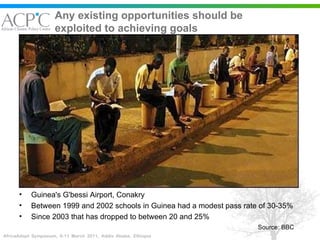
Guinea's G'bessi Airport, Conakry Between 1999 and 2002 schools in Guinea had a modest pass rate of 30-35%  Since 2003 that has dropped to between 20 and 25% Source: BBC Any existing opportunities should be exploited to achieving goals
Observations Warming of the climate system is unequivocal, as is evident from:  scientific findings  various observations Mitigation measures are slow and sparse Adaptation has started however Further adaptation is now unavoidable  but without mitigation of greenhouse gas emissions, it may be impossible to achieve meaningful adaptation where it is direly needed
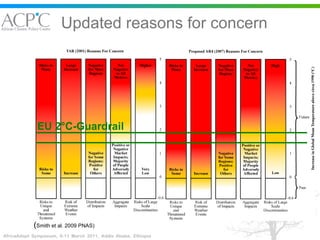
( Smith et al. 2009 PNAS) Updated reasons for concern EU 2°C-Guardrail
Facts Despite economic growth during past 15 years: Africa as a whole is lagging behind on each of the eight MDGs  Achieving the MDGs requires enduring efforts and adequate resources The challenge is further compounded by adverse impacts and the grave long-term risk that climate change poses.
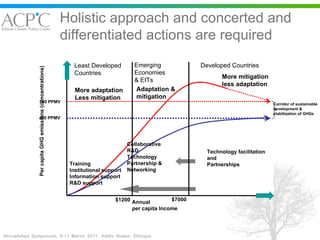
Holistic approach and concerted and differentiated actions are required Least Developed  Countries Emerging  Economies & EITs Developed Countries More adaptation Less mitigation Adaptation & mitigation More mitigation less adaptation Training Institutional support Information support R&D support Collaborative  R&D Technology Partnership & Networking Technology facilitation and Partnerships Annual  per capita Income $1200 $7000 550 PPMV 450 PPMV Corridor of sustainable development & stabilization of GHGs Per capita GHG emissions (concentrations)
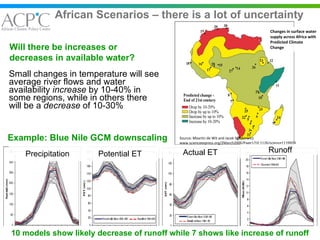
African Scenarios – there is a lot of uncertainty Small changes in temperature will see average river flows and water availability  increase  by 10-40% in some regions, while in others there will be a  decrease  of 10-30% Changes in surface water supply across Africa with Predicted Climate Change Will there be increases or decreases in available water? Potential ET Actual ET Runoff 10 models show likely decrease of runoff while 7 shows like increase of runoff Example: Blue Nile GCM downscaling Precipitation Source: Maartin de Wit and Jacek Stankiewicz www.scienceexpress.org/2March2006/Page1/10.1126/science1119929
Africa is responding to climate change There have been many initiatives/action plans of what Africa needs to do: African Ministerial Conference on the Environment (AMCEN) Conference of African Heads of State and Government on Climate Change (CAHOSCC) and climate change negotiators United Nations Framework Convention on Climate Change and related instruments (UNFCCC)   NEPAD Environmental Action Plan The Cancun Agreements African Development Forum VII Global Climate Observation System (GCOS) AMCEN Comprehensive Framework for Climate Change Africa-EU Climate Change Partnership Africa is acting on climate change: Examples include: CCAA, AfricaAdapt African Adaptation Programme The ClimDev-Africa Programme Many other initiatives, institutions and responses Much more is required for Africa to address climate change and development: That is why we are here at this symposium
The development challenge It is widely recognized and accepted that in Africa, climate change will hamper the ability of Africa to adequately address: rapid onset-disaster events widening energy access water availability food security public health migration  Adaptation to climate change is a matter of survival for most Africans
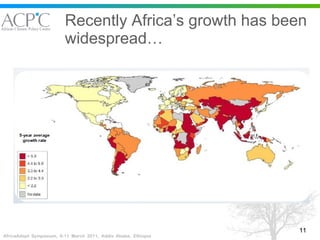
Recently Africa’s growth has been widespread…
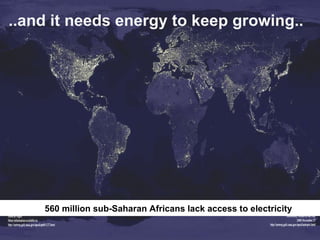
560 million sub-Saharan Africans lack access to electricity ..and it needs energy to keep growing..
But The quality of growth matters Moving towards climate resilient and low carbon pathway is paramount for increasing demand for services and meeting unmet demand avoid lock-into carbon intensive options  for policies for making development more sustainable In some ways, we are in an advantageous position Africa is starting from a low base and has the resources For mainstreaming
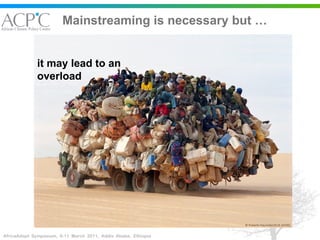
Mainstreaming is necessary but  … it may lead to an overload
A new approach is required… that starts with development priorities, following this approach, we can: aim to meet development and poverty eradication objectives  use strategies that aim for climate safe and climate friendly development that can explore wide range of already existing development initiatives that are climate resilient and friendly: there exist a diversity of local actions, national policies that have delivered positive development and climate outcomes  we can explore such options at various levels we can scale them up coupling with international initiatives to enhance their impacts this approach is “ development first ” that will stimulate concrete actions, mainstreaming, strong and inclusive climate actions and cooperation at global, regional and local levels
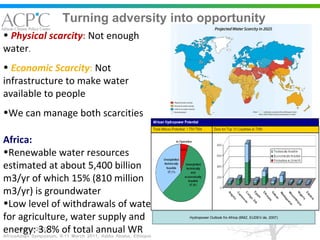
Turning adversity into opportunity 6-9/11/2007 Africa: Renewable water resources estimated at about 5,400 billion m3/yr of which 15% (810 million m3/yr) is groundwater Low level of withdrawals of water for agriculture, water supply and energy: 3.8% of total annual WR Physical scarcity :  Not enough water .  Economic Scarcity :  Not infrastructure to make water available to people We can manage both scarcities Hydropower Outlook fro Africa (BMZ, EUDEV.de, 2007)
Better exploring opportunity We need to: revisit our development objectives and strategies from a new perspective renew its focus and urgency on sustainability  We need to address at the same time: climate resilient and low carbon future local, national, regional and global concerns immediate needs while investing in long term obligations by: the imperative of building bridges between development and environment more systematically  widening decision making process at various levels
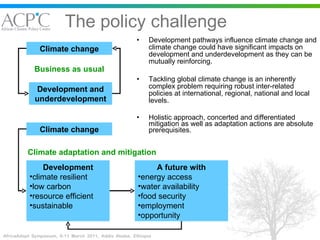
The policy challenge Development pathways influence climate change and climate change could have significant impacts on development and underdevelopment as they can be mutually reinforcing.  Tackling global climate change is an inherently complex problem requiring robust inter-related policies at international, regional, national and local levels.  Holistic approach, concerted and differentiated mitigation as well as adaptation actions are absolute prerequisites. Development and underdevelopment Climate change Development climate resilient low carbon resource efficient sustainable Climate change A future with energy access water availability food security employment opportunity Business as usual Climate   adaptation and mitigation
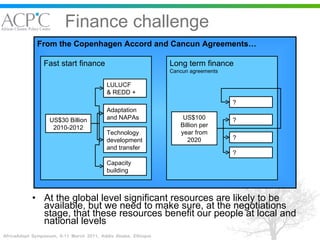
Finance challenge At the global level significant resources are likely to be available, but we need to make sure, at the negotiations stage, that these resources benefit our people at local and national levels From the Copenhagen Accord and Cancun Agreements… Fast start finance Long term finance  Cancun agreements US$30 Billion 2010-2012 LULUCF & REDD +  Adaptation and NAPAs Technology development and transfer Capacity building US$100 Billion per year from 2020 ? ? ? ?
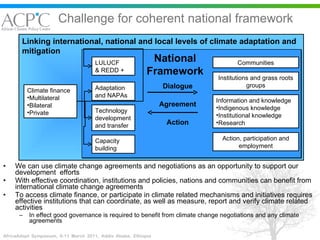
Challenge for coherent national framework We can use climate change agreements and negotiations as an opportunity to support our development  efforts With effective coordination, institutions and policies, nations and communities can benefit from international climate change agreements To access climate finance, or participate in climate related mechanisms and initiatives requires effective institutions that can coordinate, as well as measure, report and verify climate related activities In effect good governance is required to benefit from climate change negotiations and any climate agreements Linking international, national and local levels of climate adaptation and mitigation Climate finance Multilateral Bilateral Private LULUCF & REDD +  Adaptation and NAPAs Technology development and transfer Capacity building Communities Information and knowledge Indigenous knowledge Institutional knowledge Research Institutions and grass roots groups Action, participation and employment National Framework Dialogue Agreement Action
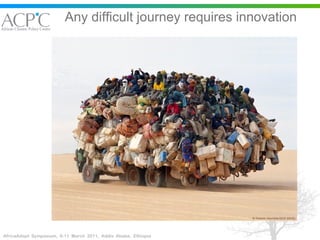
Any difficult journey requires innovation
Introducing ACPC The African Climate Policy Centre (ACPC) is: A hub for demand driven climate change and development  knowledge, advocacy and capacity mobilisation & building Based at UNECA in Addis Ababa Part of the Climate for Development of Africa programme (ClimDev-Africa) ClimDev-Africa is a joint programme of the: African Union Commission (AUC) Climate Change and Desertification Programmes Coordination Unit (CCDU) United Nations Economic Commission for Africa (UNECA) the ACPC African Development Bank (AfDB) the ClimDev-Special Fund
Team The ACPC core team is composed of: multidisciplinary and multicultural professionals and experts, covering: energy, water, agriculture, economics, climate science, political science, statistics, adaptation and risk management, communications Most staff will be based in Addis Ababa, Ethiopia   Some staff will be deployed in the five sub-regions to be closer to: Sub-Regional Offices (SROs)  Regional Economic Communities (RECs) Other regional and sub-regional institutions and countries The centre will be supported by expertise from: various UNECA divisions strategic partners consultants and experts in specific disciplines
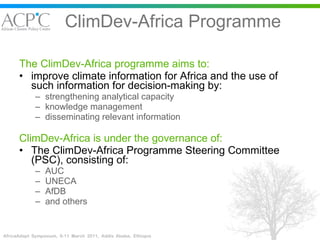
ClimDev-Africa Programme The ClimDev-Africa programme aims to: improve climate information for Africa and the use of such information for decision-making by: strengthening analytical capacity knowledge management disseminating relevant information ClimDev-Africa is under the governance of: The ClimDev-Africa Programme Steering Committee (PSC), consisting of: AUC  UNECA AfDB  and others
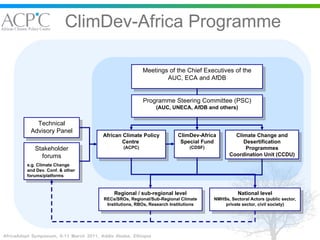
ClimDev-Africa Programme Meetings of the Chief Executives of the AUC, ECA and AfDB Programme Steering Committee (PSC) (AUC, UNECA, AfDB and others) African Climate Policy Centre  (ACPC) ClimDev-Africa Special Fund (CDSF) Regional / sub-regional level RECs/SROs, Regional/Sub-Regional Climate Institutions, RBOs, Research Institutions Technical Advisory Panel National level NMHSs, Sectoral Actors (public sector, private sector, civil society) Climate Change and Desertification Programmes Coordination Unit (CCDU) Stakeholder forums e.g. Climate Change and Dev. Conf. & other forums/platforms
Work programme 2011 + The ACPC has three broad areas of activity:  Knowledge generation, sharing and networking Advocacy and consensus building Advisory services and technical cooperation
Knowledge generation… The ACPC is addressing: African challenges and opportunities for climate finance, including:  Fast Start Finance The Green Climate Fund Long Term Financing Mitigation in the context of Africa, including: the development of national or sub-regional strategies on low carbon economy  Adaptation, including:  the implementation of AMCEN sub-regional and national adaptation strategies the creation of an adaptation and vulnerability knowledge base,  an assessment of the economics of climate adaptation in Africa (AdaptCost) Technology transfer, including: a technology transfer needs assessment that maps out models of technology transfer for Africa  Awareness, including: the development of a knowledge management platform to: support climate policy discussions  act as a hub for climate change and policy communities
Advocacy… The ACPC will: Hold a Climate Change and Development Conference to: enhance awareness on climate change in Africa Prepare for, and participate in, the Conference of Parties to the Convention on Climate Change 17 (COP17) with the aim of ensuring: Africa's key  concerns in climate change are brought to the fore  Develop a communications strategy to ensure: Climate and development information is targeted and makes it to all relevant audiences
Capacity mobilisation… The ACPC will: Evaluate and enhance climate information systems across Africa, such as: hydrological and meteorological data and information systems Strengthen Measurement, Reporting and Verification (MRV) systems across Africa Establish a fellowship programme
Next steps Elaborating on the ACPC work programme: Through consultations with: Countries Regional Economic Communities (RECs)  Sub-regional organisations African climate change negotiators International organisations Discussing needs and priorities Identifying gaps and activities to address these Implementing the work programme: Initiating activities Forming partnerships Delivering outputs
Thank you Youba Sokona [email_address] Climate Change  Meets Policy United Nations Economic Commission for Africa

Youba Sokona: Adaptation is development: Linking policy to practice

  • 1.
    Adaptation is development:Linking policy to practice Youba Sokona African Climate Policy Centre (ACPC) part of the ClimDev-Africa Programme United Nations Economic Commission for Africa Climate Change Meets Policy
  • 2.
    Outline Outline: Reasonsfor concern Africa’s response and the development challenge A new approach to climate change in Africa The climate change opportunity The ClimDev-Africa and the ACPC
  • 3.
    Guinea's G'bessi Airport,Conakry Between 1999 and 2002 schools in Guinea had a modest pass rate of 30-35% Since 2003 that has dropped to between 20 and 25% Source: BBC Any existing opportunities should be exploited to achieving goals
  • 4.
    Observations Warming ofthe climate system is unequivocal, as is evident from: scientific findings various observations Mitigation measures are slow and sparse Adaptation has started however Further adaptation is now unavoidable but without mitigation of greenhouse gas emissions, it may be impossible to achieve meaningful adaptation where it is direly needed
  • 5.
    ( Smith etal. 2009 PNAS) Updated reasons for concern EU 2°C-Guardrail
  • 6.
    Facts Despite economicgrowth during past 15 years: Africa as a whole is lagging behind on each of the eight MDGs Achieving the MDGs requires enduring efforts and adequate resources The challenge is further compounded by adverse impacts and the grave long-term risk that climate change poses.
  • 7.
    Holistic approach andconcerted and differentiated actions are required Least Developed Countries Emerging Economies & EITs Developed Countries More adaptation Less mitigation Adaptation & mitigation More mitigation less adaptation Training Institutional support Information support R&D support Collaborative R&D Technology Partnership & Networking Technology facilitation and Partnerships Annual per capita Income $1200 $7000 550 PPMV 450 PPMV Corridor of sustainable development & stabilization of GHGs Per capita GHG emissions (concentrations)
  • 8.
    African Scenarios –there is a lot of uncertainty Small changes in temperature will see average river flows and water availability increase by 10-40% in some regions, while in others there will be a decrease of 10-30% Changes in surface water supply across Africa with Predicted Climate Change Will there be increases or decreases in available water? Potential ET Actual ET Runoff 10 models show likely decrease of runoff while 7 shows like increase of runoff Example: Blue Nile GCM downscaling Precipitation Source: Maartin de Wit and Jacek Stankiewicz www.scienceexpress.org/2March2006/Page1/10.1126/science1119929
  • 9.
    Africa is respondingto climate change There have been many initiatives/action plans of what Africa needs to do: African Ministerial Conference on the Environment (AMCEN) Conference of African Heads of State and Government on Climate Change (CAHOSCC) and climate change negotiators United Nations Framework Convention on Climate Change and related instruments (UNFCCC) NEPAD Environmental Action Plan The Cancun Agreements African Development Forum VII Global Climate Observation System (GCOS) AMCEN Comprehensive Framework for Climate Change Africa-EU Climate Change Partnership Africa is acting on climate change: Examples include: CCAA, AfricaAdapt African Adaptation Programme The ClimDev-Africa Programme Many other initiatives, institutions and responses Much more is required for Africa to address climate change and development: That is why we are here at this symposium
  • 10.
    The development challengeIt is widely recognized and accepted that in Africa, climate change will hamper the ability of Africa to adequately address: rapid onset-disaster events widening energy access water availability food security public health migration Adaptation to climate change is a matter of survival for most Africans
  • 11.
    Recently Africa’s growthhas been widespread…
  • 12.
    560 million sub-SaharanAfricans lack access to electricity ..and it needs energy to keep growing..
  • 13.
    But The qualityof growth matters Moving towards climate resilient and low carbon pathway is paramount for increasing demand for services and meeting unmet demand avoid lock-into carbon intensive options for policies for making development more sustainable In some ways, we are in an advantageous position Africa is starting from a low base and has the resources For mainstreaming
  • 14.
    Mainstreaming is necessarybut … it may lead to an overload
  • 15.
    A new approachis required… that starts with development priorities, following this approach, we can: aim to meet development and poverty eradication objectives use strategies that aim for climate safe and climate friendly development that can explore wide range of already existing development initiatives that are climate resilient and friendly: there exist a diversity of local actions, national policies that have delivered positive development and climate outcomes we can explore such options at various levels we can scale them up coupling with international initiatives to enhance their impacts this approach is “ development first ” that will stimulate concrete actions, mainstreaming, strong and inclusive climate actions and cooperation at global, regional and local levels
  • 16.
    Turning adversity intoopportunity 6-9/11/2007 Africa: Renewable water resources estimated at about 5,400 billion m3/yr of which 15% (810 million m3/yr) is groundwater Low level of withdrawals of water for agriculture, water supply and energy: 3.8% of total annual WR Physical scarcity : Not enough water . Economic Scarcity : Not infrastructure to make water available to people We can manage both scarcities Hydropower Outlook fro Africa (BMZ, EUDEV.de, 2007)
  • 17.
    Better exploring opportunityWe need to: revisit our development objectives and strategies from a new perspective renew its focus and urgency on sustainability We need to address at the same time: climate resilient and low carbon future local, national, regional and global concerns immediate needs while investing in long term obligations by: the imperative of building bridges between development and environment more systematically widening decision making process at various levels
  • 18.
    The policy challengeDevelopment pathways influence climate change and climate change could have significant impacts on development and underdevelopment as they can be mutually reinforcing. Tackling global climate change is an inherently complex problem requiring robust inter-related policies at international, regional, national and local levels. Holistic approach, concerted and differentiated mitigation as well as adaptation actions are absolute prerequisites. Development and underdevelopment Climate change Development climate resilient low carbon resource efficient sustainable Climate change A future with energy access water availability food security employment opportunity Business as usual Climate adaptation and mitigation
  • 19.
    Finance challenge Atthe global level significant resources are likely to be available, but we need to make sure, at the negotiations stage, that these resources benefit our people at local and national levels From the Copenhagen Accord and Cancun Agreements… Fast start finance Long term finance Cancun agreements US$30 Billion 2010-2012 LULUCF & REDD + Adaptation and NAPAs Technology development and transfer Capacity building US$100 Billion per year from 2020 ? ? ? ?
  • 20.
    Challenge for coherentnational framework We can use climate change agreements and negotiations as an opportunity to support our development efforts With effective coordination, institutions and policies, nations and communities can benefit from international climate change agreements To access climate finance, or participate in climate related mechanisms and initiatives requires effective institutions that can coordinate, as well as measure, report and verify climate related activities In effect good governance is required to benefit from climate change negotiations and any climate agreements Linking international, national and local levels of climate adaptation and mitigation Climate finance Multilateral Bilateral Private LULUCF & REDD + Adaptation and NAPAs Technology development and transfer Capacity building Communities Information and knowledge Indigenous knowledge Institutional knowledge Research Institutions and grass roots groups Action, participation and employment National Framework Dialogue Agreement Action
  • 21.
    Any difficult journeyrequires innovation
  • 22.
    Introducing ACPC TheAfrican Climate Policy Centre (ACPC) is: A hub for demand driven climate change and development knowledge, advocacy and capacity mobilisation & building Based at UNECA in Addis Ababa Part of the Climate for Development of Africa programme (ClimDev-Africa) ClimDev-Africa is a joint programme of the: African Union Commission (AUC) Climate Change and Desertification Programmes Coordination Unit (CCDU) United Nations Economic Commission for Africa (UNECA) the ACPC African Development Bank (AfDB) the ClimDev-Special Fund
  • 23.
    Team The ACPCcore team is composed of: multidisciplinary and multicultural professionals and experts, covering: energy, water, agriculture, economics, climate science, political science, statistics, adaptation and risk management, communications Most staff will be based in Addis Ababa, Ethiopia Some staff will be deployed in the five sub-regions to be closer to: Sub-Regional Offices (SROs) Regional Economic Communities (RECs) Other regional and sub-regional institutions and countries The centre will be supported by expertise from: various UNECA divisions strategic partners consultants and experts in specific disciplines
  • 24.
    ClimDev-Africa Programme TheClimDev-Africa programme aims to: improve climate information for Africa and the use of such information for decision-making by: strengthening analytical capacity knowledge management disseminating relevant information ClimDev-Africa is under the governance of: The ClimDev-Africa Programme Steering Committee (PSC), consisting of: AUC UNECA AfDB and others
  • 25.
    ClimDev-Africa Programme Meetingsof the Chief Executives of the AUC, ECA and AfDB Programme Steering Committee (PSC) (AUC, UNECA, AfDB and others) African Climate Policy Centre (ACPC) ClimDev-Africa Special Fund (CDSF) Regional / sub-regional level RECs/SROs, Regional/Sub-Regional Climate Institutions, RBOs, Research Institutions Technical Advisory Panel National level NMHSs, Sectoral Actors (public sector, private sector, civil society) Climate Change and Desertification Programmes Coordination Unit (CCDU) Stakeholder forums e.g. Climate Change and Dev. Conf. & other forums/platforms
  • 26.
    Work programme 2011+ The ACPC has three broad areas of activity: Knowledge generation, sharing and networking Advocacy and consensus building Advisory services and technical cooperation
  • 27.
    Knowledge generation… TheACPC is addressing: African challenges and opportunities for climate finance, including: Fast Start Finance The Green Climate Fund Long Term Financing Mitigation in the context of Africa, including: the development of national or sub-regional strategies on low carbon economy Adaptation, including: the implementation of AMCEN sub-regional and national adaptation strategies the creation of an adaptation and vulnerability knowledge base, an assessment of the economics of climate adaptation in Africa (AdaptCost) Technology transfer, including: a technology transfer needs assessment that maps out models of technology transfer for Africa Awareness, including: the development of a knowledge management platform to: support climate policy discussions act as a hub for climate change and policy communities
  • 28.
    Advocacy… The ACPCwill: Hold a Climate Change and Development Conference to: enhance awareness on climate change in Africa Prepare for, and participate in, the Conference of Parties to the Convention on Climate Change 17 (COP17) with the aim of ensuring: Africa's key concerns in climate change are brought to the fore Develop a communications strategy to ensure: Climate and development information is targeted and makes it to all relevant audiences
  • 29.
    Capacity mobilisation… TheACPC will: Evaluate and enhance climate information systems across Africa, such as: hydrological and meteorological data and information systems Strengthen Measurement, Reporting and Verification (MRV) systems across Africa Establish a fellowship programme
  • 30.
    Next steps Elaboratingon the ACPC work programme: Through consultations with: Countries Regional Economic Communities (RECs) Sub-regional organisations African climate change negotiators International organisations Discussing needs and priorities Identifying gaps and activities to address these Implementing the work programme: Initiating activities Forming partnerships Delivering outputs
  • 31.
    Thank you YoubaSokona [email_address] Climate Change Meets Policy United Nations Economic Commission for Africa

Editor's Notes

  • #6 The IPCC never advised on a figure regarding temperature rise. In fact scientists who recently at a climate conference in Denmark (March 2009) argued that the IPCC was actually optimistic but the current situation is even dire. Clearly indicating that under the current situation, a 2 degree rise will impossible for Africa to manage. There we need to ADAPT right away!!!
  • #13 A view of the World at Night – once again making the point that most of the developing world remains “dark”