DNA Replication
By Kyle Yoho
DNA Replication
5
T
A

C
A
G

T

G

A

T
C

G

C

T

A
G

A

G

3

C

T

C

T

3
C

A

G

A

T
C

G

5

Adenine

Thymine

cytosine

Guanine

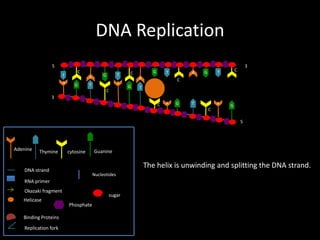
The helix is unwinding and splitting the DNA strand.

DNA strand

Nucleotides

RNA primer
Okazaki fragment

Helicase
Binding Proteins
Replication fork

sugar
Phosphate
DNA Replication
5
T
A

C
A
G

T

G

A

T
C

G

C

T

A
G

A

G

3

C

T

C

T

3
C

A

G

A

T
C

G

5

Adenine

Thymine

DNA strand
RNA primer
Okazaki fragment

Binding Proteins
Replication fork

cytosine

Guanine

Nucleotides

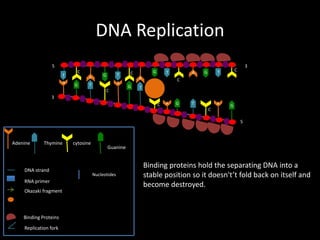
Binding proteins hold the separating DNA into a
stable position so it doesn't’t fold back on itself and
become destroyed.
DNA Replication

Leading strand

5
T
A

C
A
G

T

G

A

T
C

G

C

T

A
G

A

G

3

C

T

C

T

3
C

A

G

A

T
C

G

5

Adenine

Thymine

DNA strand
RNA primer
Okazaki fragment

Binding Proteins
Replication fork

cytosine

Guanine

Nucleotides

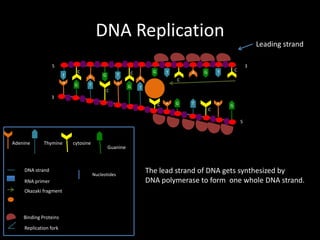
The lead strand of DNA gets synthesized by
DNA polymerase to form one whole DNA strand.
DNA Replication
5
T
A

C
A
G

T

G

A

T
C

G

C

T

A
G

A

G

3

C

T

C

T

3
C

A

G

A

T
C

G

5

Adenine

Thymine

DNA strand
RNA primer
Okazaki fragment

Binding Proteins
Replication fork

cytosine

Guanine

Nucleotides

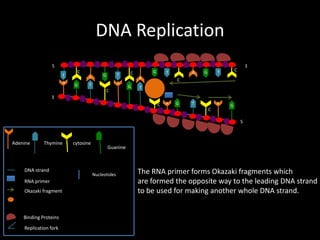
The RNA primer forms Okazaki fragments which
are formed the opposite way to the leading DNA strand
to be used for making another whole DNA strand.
DNA Replication
5
T
A

C
A
G

T

G

A

T
C

G

C

T

A
G

A

G

3

C

T

C

T

3
C

A

G

A

T
C

G

5

Adenine

Thymine

DNA strand
RNA primer
Okazaki fragment

Binding Proteins
Replication fork

cytosine

Guanine

Nucleotides

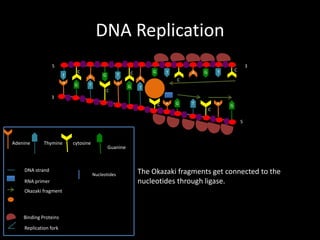
The Okazaki fragments get connected to the
nucleotides through ligase.
DNA Replication
5
T
A

C
A
G

T

G

A

T
C

G

C

T

A
G

A

T

C
G

A
T

C

G

C

T
A

G

C

5

3
5
T
A

C
A
G

G

T
A

T
C

Thymine

DNA strand
RNA primer
Okazaki fragment

Binding Proteins
Replication fork

G

C
A
G

T

C

T
A
C

G

A
T

G

C

T
A

3

G

C

5

3

Adenine

3

cytosine

Guanine

Nucleotides

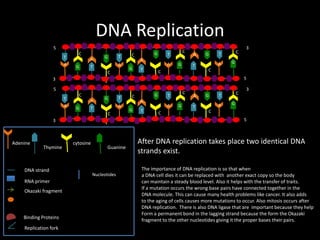
After DNA replication takes place two identical DNA
strands exist.
The importance of DNA replication is so that when
a DNA cell dies it can be replaced with another exact copy so the body
can maintain a steady blood level. Also it helps with the transfer of traits.
If a mutation occurs the wrong base pairs have connected together in the
DNA molecule. This can cause many health problems like cancer. It also adds
to the aging of cells causes more mutations to occur. Also mitosis occurs after
DNA replication. There is also DNA ligase that are important because they help
Form a permanent bond in the lagging strand because the form the Okazaki
fragment to the other nucleotides giving it the proper bases their pairs.

Yoho dna replication