
YOGA CHIKITSAYOGA CHIKITSA
Application of Yoga as therapy
Chairman: ICYER at Ananda Ashram,
Puducherry, South India.
www.icyer.com
YogacharyaYogacharya
Dr ANANDA BALAYOGI BHAVANANIDr ANANDA BALAYOGI BHAVANANI
MBBS, MD (AM), ADY, DSM, DPC, PGDFH, PGDY, FIAYMBBS, MD (AM), ADY, DSM, DPC, PGDFH, PGDY, FIAY
YOGA AND YOGA THERAPYYOGA AND YOGA THERAPY
 YOGAYOGA
-process and state of integration-process and state of integration
(mind-body --- spirit-universe)(mind-body --- spirit-universe)
 YOGA THERAPYYOGA THERAPY
- tools to attain integration at all- tools to attain integration at all
levelslevels
DEFINITIONS OF YOGADEFINITIONS OF YOGA
 Kathopanishad:Kathopanishad: State of mastery over senses & mindState of mastery over senses & mind
 Bhagavad GitaBhagavad Gita
 Equanimity of mindEquanimity of mind
 Disassociation from the union with sufferingDisassociation from the union with suffering
 Yoga Vashistha:Yoga Vashistha: A skillful & subtle process to calmA skillful & subtle process to calm
down the minddown the mind
 Maitri Upanishad:Maitri Upanishad: Oneness of breath, mind & senses,Oneness of breath, mind & senses,
and the abandonment of all states of existenceand the abandonment of all states of existence
 Swami Gitananda Giri:Swami Gitananda Giri:
 Science & art of mastering the mindScience & art of mastering the mind
 The path of moderationThe path of moderation
 Four (five) fold awarenessFour (five) fold awareness
CAUSE OF DISEASECAUSE OF DISEASE
ACCORDING TO YOGAACCORDING TO YOGA
 Primary causePrimary cause
– Dwaitam – duality - dichotomy
 Disease =Disease = dis + easedis + ease
(Asana-(Asana-stira sukamstira sukam andand tado dwandwa anabigatatado dwandwa anabigata))
 Tri DoshasTri Doshas and their imbalanceand their imbalance
 PranasPranas and their imbalanceand their imbalance
 Yoga VashisthaYoga Vashistha
- psychosomatic and non psychosomatic disorders- psychosomatic and non psychosomatic disorders
 Somato-psychic disordersSomato-psychic disorders
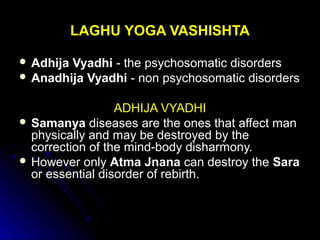
LAGHU YOGA VASHISHTALAGHU YOGA VASHISHTA
 Adhija VyadhiAdhija Vyadhi - the psychosomatic disorders- the psychosomatic disorders
 Anadhija VyadhiAnadhija Vyadhi - non psychosomatic disorders- non psychosomatic disorders
ADHIJA VYADHIADHIJA VYADHI
 SamanyaSamanya diseases are the ones that affect mandiseases are the ones that affect man
physically and may be destroyed by thephysically and may be destroyed by the
correction of the mind-body disharmony.correction of the mind-body disharmony.
 However onlyHowever only Atma JnanaAtma Jnana can destroy thecan destroy the SaraSara
or essential disorder of rebirth.or essential disorder of rebirth.
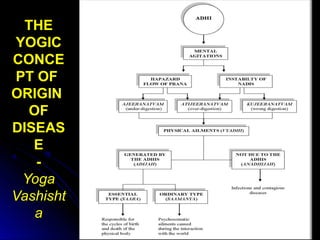
THETHE
YOGICYOGIC
CONCECONCE
PT OFPT OF
ORIGINORIGIN
OFOF
DISEASDISEAS
EE
--
YogaYoga
VashishtVashisht
aa
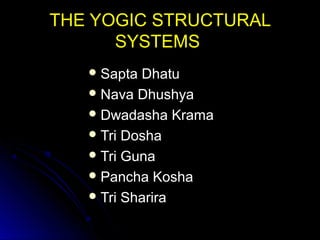
THE YOGIC STRUCTURALTHE YOGIC STRUCTURAL
SYSTEMSSYSTEMS
 Sapta DhatuSapta Dhatu
 Nava DhushyaNava Dhushya
 Dwadasha KramaDwadasha Krama
 Tri DoshaTri Dosha
 Tri GunaTri Guna
 Pancha KoshaPancha Kosha
 Tri ShariraTri Sharira
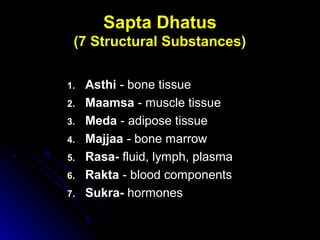
Sapta Dhatus
(7 Structural Substances)
1.1. AsthiAsthi - bone tissue- bone tissue
2.2. MaamsaMaamsa - muscle tissue- muscle tissue
3.3. MedaMeda - adipose tissue- adipose tissue
4.4. MajjaaMajjaa - bone marrow- bone marrow
5.5. Rasa-Rasa- fluid, lymph, plasmafluid, lymph, plasma
6.6. RaktaRakta - blood components- blood components
7.7. Sukra-Sukra- hormoneshormones
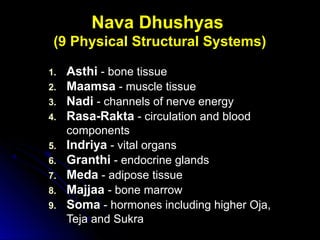
Nava Dhushyas
(9 Physical Structural Systems)
1.1. AsthiAsthi - bone tissue- bone tissue
2.2. MaamsaMaamsa - muscle tissue- muscle tissue
3.3. NadiNadi - channels of nerve energy- channels of nerve energy
4.4. Rasa-RaktaRasa-Rakta - circulation and blood- circulation and blood
componentscomponents
5.5. IndriyaIndriya - vital organs- vital organs
6.6. GranthiGranthi - endocrine glands- endocrine glands
7.7. MedaMeda - adipose tissue- adipose tissue
8.8. MajjaaMajjaa - bone marrow- bone marrow
9.9. SomaSoma - hormones including higher Oja,- hormones including higher Oja,
Teja and SukraTeja and Sukra
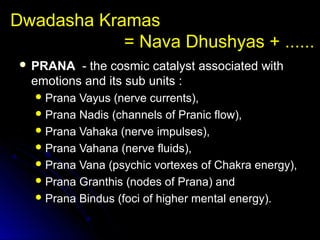
Dwadasha Kramas
= Nava Dhushyas + ......
 PRANAPRANA - the cosmic catalyst associated with- the cosmic catalyst associated with
emotions and its sub units :emotions and its sub units :
 Prana Vayus (nerve currents),Prana Vayus (nerve currents),
 Prana Nadis (channels of Pranic flow),Prana Nadis (channels of Pranic flow),
 Prana Vahaka (nerve impulses),Prana Vahaka (nerve impulses),
 Prana Vahana (nerve fluids),Prana Vahana (nerve fluids),
 Prana Vana (psychic vortexes of Chakra energy),Prana Vana (psychic vortexes of Chakra energy),
 Prana Granthis (nodes of Prana) andPrana Granthis (nodes of Prana) and
 Prana Bindus (foci of higher mental energy).Prana Bindus (foci of higher mental energy).
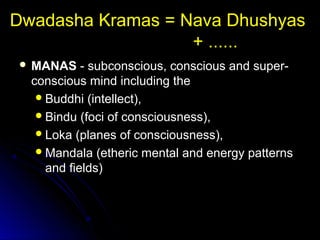
Dwadasha Kramas = Nava Dhushyas
+ ......
 MANASMANAS - subconscious, conscious and super-- subconscious, conscious and super-
conscious mind including theconscious mind including the
Buddhi (intellect),Buddhi (intellect),
Bindu (foci of consciousness),Bindu (foci of consciousness),
Loka (planes of consciousness),Loka (planes of consciousness),
Mandala (etheric mental and energy patternsMandala (etheric mental and energy patterns
and fields)and fields)
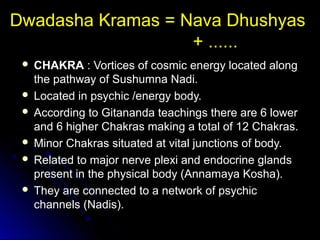
Dwadasha Kramas = Nava Dhushyas
+ ......
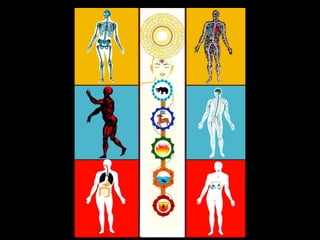
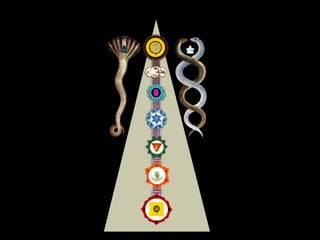
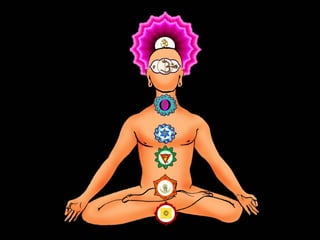
 CHAKRA : Vortices of cosmic energy located along
the pathway of Sushumna Nadi.
 Located in psychic /energy body.
 According to Gitananda teachings there are 6 lower
and 6 higher Chakras making a total of 12 Chakras.
 Minor Chakras situated at vital junctions of body.
 Related to major nerve plexi and endocrine glands
present in the physical body (Annamaya Kosha).
 They are connected to a network of psychic
channels (Nadis).
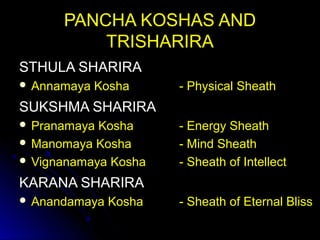
PANCHA KOSHAS ANDPANCHA KOSHAS AND
TRISHARIRATRISHARIRA
STHULA SHARIRASTHULA SHARIRA
 Annamaya KoshaAnnamaya Kosha - Physical Sheath- Physical Sheath
SUKSHMA SHARIRASUKSHMA SHARIRA
 Pranamaya KoshaPranamaya Kosha - Energy Sheath- Energy Sheath
 Manomaya KoshaManomaya Kosha - Mind Sheath- Mind Sheath
 Vignanamaya KoshaVignanamaya Kosha - Sheath of Intellect- Sheath of Intellect
KARANA SHARIRAKARANA SHARIRA
 Anandamaya KoshaAnandamaya Kosha - Sheath of Eternal Bliss- Sheath of Eternal Bliss
PRINCIPLES OF YOGA THERAPYPRINCIPLES OF YOGA THERAPY
 Become aware of your body, emotions and mindBecome aware of your body, emotions and mind
 Improve your dietary habitsImprove your dietary habits
 Relax yourself completelyRelax yourself completely
 Slow down your breath -quiet and deepSlow down your breath -quiet and deep
 Calm down your mind and focus it inwardlyCalm down your mind and focus it inwardly
 Improve the flow of Healing Pranic Life Energy toImprove the flow of Healing Pranic Life Energy to
all parts of your body, especially to thoseall parts of your body, especially to those
diseased parts, thus relaxing, regenerating anddiseased parts, thus relaxing, regenerating and
reinvigorating yourselfreinvigorating yourself
 Decrease your stress level by fortifying yourselfDecrease your stress level by fortifying yourself
against various omnipresent stressorsagainst various omnipresent stressors
PRINCIPLES OF YOGA THERAPY-2PRINCIPLES OF YOGA THERAPY-2
 Increase your self reliance and self confidenceIncrease your self reliance and self confidence
 Facilitate the natural emanation of waste fromFacilitate the natural emanation of waste from
your body by the practice of Yoga Shuddiyour body by the practice of Yoga Shuddi
Kriyas such as Dhauti, Basti and Neti.Kriyas such as Dhauti, Basti and Neti.
 Remember that ultimately it is “YOU” who areRemember that ultimately it is “YOU” who are
responsible for your health and well being andresponsible for your health and well being and
must take the initiative to develop positivemust take the initiative to develop positive
health to tide you over challenging times of illhealth to tide you over challenging times of ill
health.health.
 Health and happiness are your birthright, claimHealth and happiness are your birthright, claim
them and develop them to your maximumthem and develop them to your maximum
potential.potential.
YOGA THERAPY MODELSYOGA THERAPY MODELS
 PANCHA KOSHA MODELPANCHA KOSHA MODEL
 KAIVALYADHAMA MODELKAIVALYADHAMA MODEL
 Cultivation of correct psychological attitudes
 Reconditioning of the neuro-muscular and
neuro-glandular system
 Appropriate diet and encouraging the natural
processes of elimination
 KLESHAS- PSYCHOTHERAPY MODELKLESHAS- PSYCHOTHERAPY MODEL
 Kriya Yoga
THERAPEUTIC INTERVENTIONSTHERAPEUTIC INTERVENTIONS
 ANNAMAYA KOSHA INTERVENTIONS:ANNAMAYA KOSHA INTERVENTIONS:
Jattis (Shitileekarana Vyayama), KriyasJattis (Shitileekarana Vyayama), Kriyas
(structured movements), Asanas and dietary(structured movements), Asanas and dietary
modifications and control.modifications and control.
 PRANAMAYA KOSHA INTERVENTIONS:PRANAMAYA KOSHA INTERVENTIONS:
Shat Karmas, Pranayamas, Prananusandhana,Shat Karmas, Pranayamas, Prananusandhana,
breath awareness, breath-movementbreath awareness, breath-movement
coordination and the energizing and balancing ofcoordination and the energizing and balancing of
the Pranic energy.the Pranic energy.
 MANOMAYA KOSHA INTERVENTIONS:MANOMAYA KOSHA INTERVENTIONS:
Trataka, Concentration (Dharana), meditationTrataka, Concentration (Dharana), meditation
(Dhyana) and Japa(Dhyana) and Japa
THERAPEUTIC INTERVENTIONS (Contd..)THERAPEUTIC INTERVENTIONS (Contd..)
 VIGNANAMAYA KOSHA INTERVENTIONS:VIGNANAMAYA KOSHA INTERVENTIONS:
Analysis (Swadhyaya), lectures, spirituallyAnalysis (Swadhyaya), lectures, spiritually
uplifting exchange (Satsangha) & experienceuplifting exchange (Satsangha) & experience
(Anubhava)(Anubhava)
 ANANDAMAYA KOSHA INTERVENTIONS:ANANDAMAYA KOSHA INTERVENTIONS:
Learning to implement principles of Karma YogaLearning to implement principles of Karma Yoga
(Yoga is skilled action without expectation).(Yoga is skilled action without expectation).
Following the principle of action in relaxationFollowing the principle of action in relaxation
brings about joy in all activities. A realization thatbrings about joy in all activities. A realization that
we live in a blissful universe & that all life is joy iswe live in a blissful universe & that all life is joy is
to be brought about through use of Bhakti Yoga,to be brought about through use of Bhakti Yoga,
Karma Yoga and elements such as Bhajans,Karma Yoga and elements such as Bhajans,
counseling and Satsanghas.counseling and Satsanghas.
YOGA THERAPY MODALITIESYOGA THERAPY MODALITIES
 PHYSICAL THERAPIESPHYSICAL THERAPIES
 Asanas, Kriyas, Mudras and BandhasAsanas, Kriyas, Mudras and Bandhas
 EMOTIONAL THERAPIESEMOTIONAL THERAPIES
 Swadyaya, Pranayama, Pratyahara, Dharana,Swadyaya, Pranayama, Pratyahara, Dharana,
Dhyana and BhajansDhyana and Bhajans
 Development of +ve psychological attitudesDevelopment of +ve psychological attitudes
 VairagyaVairagya
 Chitta PrasadanChitta Prasadan
 Maitri Karuna Mudita and Upekshanam etcMaitri Karuna Mudita and Upekshanam etc
 MENTAL THERAPIESMENTAL THERAPIES
 Relaxation and visualization practices, Trataka,Relaxation and visualization practices, Trataka,
Pranayama, Pratyahara, Dharana as well asPranayama, Pratyahara, Dharana as well as
DhyanaDhyana
YOGA THERAPY MODALITIES (Contd…)YOGA THERAPY MODALITIES (Contd…)
 SPIRITUAL THERAPIESSPIRITUAL THERAPIES
 Swadyaya, Satsangha, Bhajans and YogicSwadyaya, Satsangha, Bhajans and Yogic
counselingcounseling
 PREVENTIVE THERAPIESPREVENTIVE THERAPIES
 Start early in childhoodStart early in childhood
 Prevention of accidentsPrevention of accidents
 Improved immunityImproved immunity
 Knows the technique so that can do it if neededKnows the technique so that can do it if needed
 REHABILITATIVE THERAPIESREHABILITATIVE THERAPIES
 Prevention of disability and improving quality ofPrevention of disability and improving quality of
lifelife
 PAIN RELIEF THERAPIESPAIN RELIEF THERAPIES
 Increases pain tolerance - improved quality of lifeIncreases pain tolerance - improved quality of life
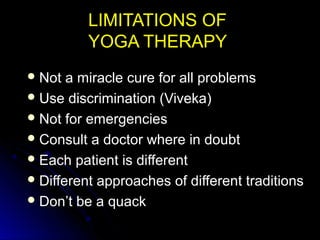
LIMITATIONS OFLIMITATIONS OF
YOGA THERAPYYOGA THERAPY
 Not a miracle cure for all problemsNot a miracle cure for all problems
 Use discrimination (Viveka)Use discrimination (Viveka)
 Not for emergenciesNot for emergencies
 Consult a doctor where in doubtConsult a doctor where in doubt
 Each patient is differentEach patient is different
 Different approaches of different traditionsDifferent approaches of different traditions
 Don’t be a quackDon’t be a quack
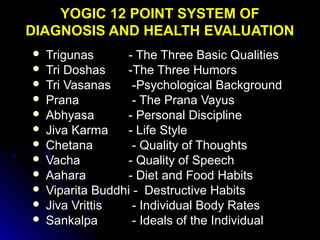
YOGIC 12 POINT SYSTEM OFYOGIC 12 POINT SYSTEM OF
DIAGNOSIS AND HEALTH EVALUATIONDIAGNOSIS AND HEALTH EVALUATION
 TrigunasTrigunas - The Three Basic Qualities- The Three Basic Qualities
 Tri DoshasTri Doshas -The Three Humors-The Three Humors
 Tri VasanasTri Vasanas -Psychological Background-Psychological Background
 PranaPrana - The Prana Vayus- The Prana Vayus
 AbhyasaAbhyasa - Personal Discipline- Personal Discipline
 Jiva KarmaJiva Karma - Life Style- Life Style
 ChetanaChetana - Quality of Thoughts- Quality of Thoughts
 VachaVacha - Quality of Speech- Quality of Speech
 AaharaAahara - Diet and Food Habits- Diet and Food Habits
 Viparita Buddhi - Destructive HabitsViparita Buddhi - Destructive Habits
 Jiva VrittisJiva Vrittis - Individual Body Rates- Individual Body Rates
 SankalpaSankalpa - Ideals of the Individual- Ideals of the Individual
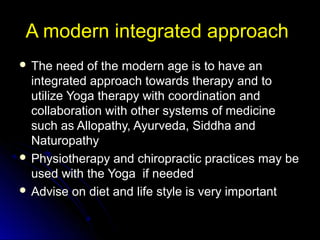
A modern integrated approachA modern integrated approach
 The need of the modern age is to have anThe need of the modern age is to have an
integrated approach towards therapy and tointegrated approach towards therapy and to
utilize Yoga therapy with coordination andutilize Yoga therapy with coordination and
collaboration with other systems of medicinecollaboration with other systems of medicine
such as Allopathy, Ayurveda, Siddha andsuch as Allopathy, Ayurveda, Siddha and
NaturopathyNaturopathy
 Physiotherapy and chiropractic practices may bePhysiotherapy and chiropractic practices may be
used with the Yoga if neededused with the Yoga if needed
 Advise on diet and life style is very importantAdvise on diet and life style is very important
IN CONCLUSIONIN CONCLUSION
Yoga is an integrated way of life
Awareness and consciousness play a
great part in guiding our spiritual evolution
through life in the social system itself and
not in some remote cave in the mountains
or hut in the forest.
"Yoga is the science and art of right-
useness of body, emotions and mind”
- Yogamaharishi Dr Swami Gitananda
Giri
Thank YouThank You