Vicarious movements
Dr. Arunima Biswas
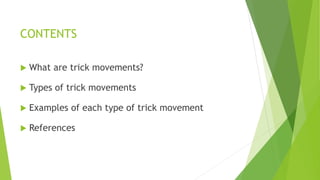
CONTENTS
 What are trick movements?
 Types of trick movements
 Examples of each type of trick movement
 References
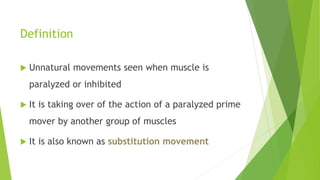
Definition
 Unnatural movements seen when muscle is
paralyzed or inhibited
 It is taking over of the action of a paralyzed prime
mover by another group of muscles
 It is also known as substitution movement
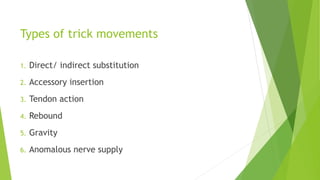
Types of trick movements
1. Direct/ indirect substitution
2. Accessory insertion
3. Tendon action
4. Rebound
5. Gravity
6. Anomalous nerve supply
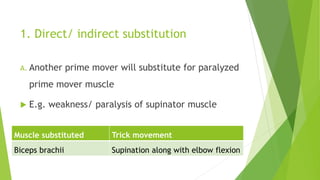
1. Direct/ indirect substitution
A. Another prime mover will substitute for paralyzed
prime mover muscle
 E.g. weakness/ paralysis of supinator muscle
Muscle substituted Trick movement
Biceps brachii Supination along with elbow flexion
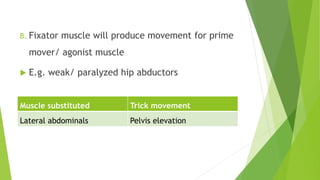
B. Fixator muscle will produce movement for prime
mover/ agonist muscle
 E.g. weak/ paralyzed hip abductors
Muscle substituted Trick movement
Lateral abdominals Pelvis elevation
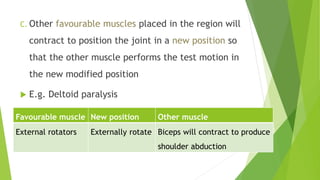
C. Other favourable muscles placed in the region will
contract to position the joint in a new position so
that the other muscle performs the test motion in
the new modified position
 E.g. Deltoid paralysis
Favourable muscle New position Other muscle
External rotators Externally rotate Biceps will contract to produce
shoulder abduction
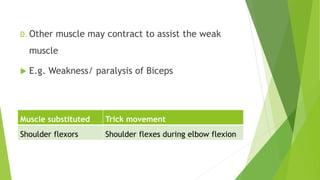
D. Other muscle may contract to assist the weak
muscle
 E.g. Weakness/ paralysis of Biceps
Muscle substituted Trick movement
Shoulder flexors Shoulder flexes during elbow flexion
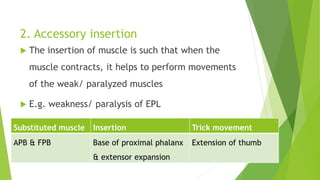
2. Accessory insertion
 The insertion of muscle is such that when the
muscle contracts, it helps to perform movements
of the weak/ paralyzed muscles
 E.g. weakness/ paralysis of EPL
Substituted muscle Insertion Trick movement
APB & FPB Base of proximal phalanx
& extensor expansion
Extension of thumb
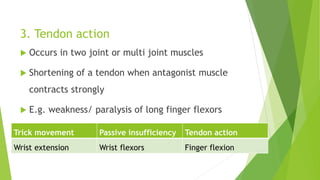
3. Tendon action
 Occurs in two joint or multi joint muscles
 Shortening of a tendon when antagonist muscle
contracts strongly
 E.g. weakness/ paralysis of long finger flexors
Trick movement Passive insufficiency Tendon action
Wrist extension Wrist flexors Finger flexion
4. Rebound
 Phenomenon of seeming contraction in the
agonist when the antagonist contracts strongly &
the relaxes quickly
 E.g. weakness/ paralysis of long finger flexors
Antagonist contraction Trick movement
EPL & ED Finger flexion
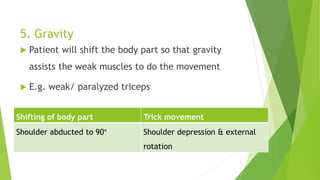
5. Gravity
 Patient will shift the body part so that gravity
assists the weak muscles to do the movement
 E.g. weak/ paralyzed triceps
Shifting of body part Trick movement
Shoulder abducted to 90° Shoulder depression & external
rotation
6. Anomalous nerve supply
 20% of all normal people have anomalous nerve supply in
the hand
 These motor anomalies may/not be associated with an
anomaly of sensory supply and may not be bilateral or
symmetrical
 E.g. Median nerve palsy
Muscle action Anomalous innervation
Opponens pollicis, 2nd & 3rd
lumbricals, & FPB
Ulnar nerve
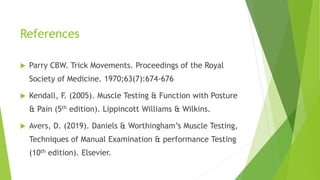
References
 Parry CBW. Trick Movements. Proceedings of the Royal
Society of Medicine. 1970;63(7):674-676
 Kendall, F. (2005). Muscle Testing & Function with Posture
& Pain (5th edition). Lippincott Williams & Wilkins.
 Avers, D. (2019). Daniels & Worthingham’s Muscle Testing,
Techniques of Manual Examination & performance Testing
(10th edition). Elsevier.
THANK YOU

Vicarious movements or trick movements_AB.pdf

  • 1.
  • 2.
    CONTENTS  What aretrick movements?  Types of trick movements  Examples of each type of trick movement  References
  • 3.
    Definition  Unnatural movementsseen when muscle is paralyzed or inhibited  It is taking over of the action of a paralyzed prime mover by another group of muscles  It is also known as substitution movement
  • 4.
    Types of trickmovements 1. Direct/ indirect substitution 2. Accessory insertion 3. Tendon action 4. Rebound 5. Gravity 6. Anomalous nerve supply
  • 5.
    1. Direct/ indirectsubstitution A. Another prime mover will substitute for paralyzed prime mover muscle  E.g. weakness/ paralysis of supinator muscle Muscle substituted Trick movement Biceps brachii Supination along with elbow flexion
  • 6.
    B. Fixator musclewill produce movement for prime mover/ agonist muscle  E.g. weak/ paralyzed hip abductors Muscle substituted Trick movement Lateral abdominals Pelvis elevation
  • 7.
    C. Other favourablemuscles placed in the region will contract to position the joint in a new position so that the other muscle performs the test motion in the new modified position  E.g. Deltoid paralysis Favourable muscle New position Other muscle External rotators Externally rotate Biceps will contract to produce shoulder abduction
  • 8.
    D. Other musclemay contract to assist the weak muscle  E.g. Weakness/ paralysis of Biceps Muscle substituted Trick movement Shoulder flexors Shoulder flexes during elbow flexion
  • 9.
    2. Accessory insertion The insertion of muscle is such that when the muscle contracts, it helps to perform movements of the weak/ paralyzed muscles  E.g. weakness/ paralysis of EPL Substituted muscle Insertion Trick movement APB & FPB Base of proximal phalanx & extensor expansion Extension of thumb
  • 10.
    3. Tendon action Occurs in two joint or multi joint muscles  Shortening of a tendon when antagonist muscle contracts strongly  E.g. weakness/ paralysis of long finger flexors Trick movement Passive insufficiency Tendon action Wrist extension Wrist flexors Finger flexion
  • 11.
    4. Rebound  Phenomenonof seeming contraction in the agonist when the antagonist contracts strongly & the relaxes quickly  E.g. weakness/ paralysis of long finger flexors Antagonist contraction Trick movement EPL & ED Finger flexion
  • 12.
    5. Gravity  Patientwill shift the body part so that gravity assists the weak muscles to do the movement  E.g. weak/ paralyzed triceps Shifting of body part Trick movement Shoulder abducted to 90° Shoulder depression & external rotation
  • 13.
    6. Anomalous nervesupply  20% of all normal people have anomalous nerve supply in the hand  These motor anomalies may/not be associated with an anomaly of sensory supply and may not be bilateral or symmetrical  E.g. Median nerve palsy Muscle action Anomalous innervation Opponens pollicis, 2nd & 3rd lumbricals, & FPB Ulnar nerve
  • 14.
    References  Parry CBW.Trick Movements. Proceedings of the Royal Society of Medicine. 1970;63(7):674-676  Kendall, F. (2005). Muscle Testing & Function with Posture & Pain (5th edition). Lippincott Williams & Wilkins.  Avers, D. (2019). Daniels & Worthingham’s Muscle Testing, Techniques of Manual Examination & performance Testing (10th edition). Elsevier.
  • 15.