
HARI OM
Deepak Bagadia
Introduction to
YOGA THERAPY
(2021-22)
1
It is most important to realize that no
system in body works in isolation. All the
systems in body work in harmony
and coordination to produce desired result.
Nervous & Endocrine are main controlling
other systems and HPO Axis
A single root cause like STRESS can be
responsible for manifestation of disease in
different systems.
We have inbuilt Stress management system
HUMAN SYSTEMS
2
The International Association of Yoga
Therapists defines yoga therapy as:
“The process of empowering
individuals to progress toward
improved health and well-being
through the application of the
philosophy and practice of yoga.”
Thus, Yoga therapy consists of the
application of yogic principles, methods,
and techniques to specific human ailments.
3
Yoga practices treat the root cause.
Integrated or holistic approach of Yoga
therapy thus allows us to treat person
rather than symptoms
There is never a single causative factor,
BUT a combination of psychological,
social, environmental factors, familial and
cultural influences which cause illness.
Illness is of two types -
A) Disease - organic disorder (YT @min)
B) Functional disorder. (adhija vyadhi)
YOGA THERAPY
4
Any therapy aims at healing and reducing the
symptoms of pain and suffering in life. The root
cause of most of the diseases is unsteadiness or
instability of mind. Yoga targets the root cause
by putting mind in steady and well balanced
state. Basically, yoga is a way of life and not the
therapy.
“It is absolutely true that every thought we think
has its corresponding effect on the whole or
some part of the human anatomy. Therefore, the
mind can both create and cure disease”
Dr. Charles Davis
YOGA THERAPY (Meaning/Aim)
5
A true yoga aspirant tries to create balance
between the physical, mental, emotional and
spiritual aspects. As he gets focused on the
ultimate goal of life, self realization or Samadhi,
freedom from diseases comes as a by-product of
his enriched way of living.
Yoga Therapy is the use of the techniques of Yoga
to create, stimulate, and maintain an optimum
state of physical, emotional, mental, and spiritual
health.
-Judith Hanson Lasater, Ph.D
YOGA THERAPY (Technique)
6
“In its ideal application, Yoga therapy is
preventive in nature, as is Yoga itself, but
it is also restorative in many instances,
palliative in others, and curative in many
others.”
Art Brownstein, M.D.
Actually, Yoga therapy is not organ
specific but it is a science that works
holistically to strengthen the inner being.
YOGA THERAPY:
7
1AIM22222A
AIM OF YOGA THERAPY
1.To recognise the root cause, area of stress
and treat with Yoga practices
2. To reduce internal resistance and relax the
whole body with proper Yoga, Diet and rest
3. To correct and develop right (+ve) attitude
towards others/day to day happenings
(Notional corrections, thinking pattern, percepn)
4. To tune the psycho-physiological apparatus
5. To change lifestyle to prevent further damage
and it assures promotion of health.1towards
8
9
MODERN CONCEPT OF DISEASE:
Disease, in modern medical perspective is
considered as dysfunction of organs and
systems, which may be due to congenital,
defects, external atmosphere agents like
allergens, toxins, pollutants or infectious
germs. The other major cause for diseases
could be the factor of internal imbalances
like mental restlessness, emotional
upsurges or intellectual conflicts that lead
to stress reactions.
Main Characteristics:
1. The oldest therapy
2. Not a passive therapy like many other
modules. One is active participant in
management.
3. Yoga techniques with purpose of healing a
person as a whole unit.
4. Integrated approach: all aspects of
individual (treats person/disease).
5. Holistic Science: takes care of Diet,
Exercise, routine, habits, beliefs
providing congenial atmosphere,
counseling etc. Concept of Koshas:
YOGA THERAPY
10
YOGA THERAPY (characteristics)
Koshas: Physical body (annamaya), subtle
body (pranamaya, Manomaya, Vijnanamaya),
& causal body (anandmaya) gives us a
holistic and concrete perspective of human
existence as the foundation for Yoga therapy
6. Almost costless therapy
7. Self indicative as done with full
awareness of active participant
8. NO TALL CLAIMS
9. Powerful & Guaranteed Healing, if done
properly, consistently & with awareness
10. It treats the root cause
11. NO SIDE EFFECTS 11
Cultivation of positive health through
following integral steps:
a) Cleansing/purifying: Kriyas
b) Reconditioning of neuromuscular and
neuroglandular systems
c) Correct psychological attitude (Positivity)
d) Relaxing effects on physical level
followed by
Slowing & Relaxing effects at mental
level, and
e) Silencing and easing on emotions and
sublimation at spiritual level
Scientific Plan for Treatment
12
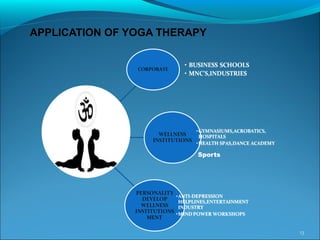
APPLICATION OF YOGA THERAPY
Sports
13
“ जातस्य हि ध्रुवो मृत्युवं जन्म मृतस्य च /
तस्मात ् अपरििाये अर्थे न त्वम् शोचचतुम अि्सी//”
Reference of YT in various scriptures
1. Bhagvat Gita is full of psychotherapy and
counseling of a weak and sick person.
Chapter-2: psychological knowledge and helps us to come out
of depression.
Verses 22-31:The nature of immortal atman, transitory nature
of body and its ailments.
Verse 71: makes us aware of our desires and ego makes us
realized of true peace.
V.39-53: How to manage our stress, work without getting
attached to the fruits of it to minimize self exploitation.
V.54 to 72: characteristics of a stable man with mental
equilibrium. Such people can avoid problems in life.
14
15
P.Yogasutra: Klesas & Avidya-cause of suffering,
Remedies given to unite body, mind & soul:
vairagya, nirodha, viram-pratyaya, Ishwar
pranidhana, ekatatvabhyasa, japa,Yamaniyama,
pratipakshabhava, cittaprasadana, kriyayoga……
Heyam dukham anagatam. (II.16)(Prevention)
Hathayoga is not just a physical practice but a
process of cellular transmutation from gross to
subtle to divine:
by Purification, Postural corrections, Pranic
energization, Awakening of vital energies and
Nadanusandhana leads to eternal happiness
YT in Yogic scriptures
16
Disease in scriptures
• Upanisad: disintegration of Panchakosas
• Ayurveda: Asatmendriyartha sayoga due
to prajnaparadha (crime against
intellect)
• Y.Vasistha: Adhija vyadhi is cause of
miseries,
if removed, you get happiness. But, if
you remove avidya, you get Moksha,
total bliss
17
Aurobindo’s definition:
“Yoga is a methodized effort towards self – perfection”
• Preventive and Social medicine
• Personality development
• Value added lifestyle
•Human Relations development
•Information Technology
YOGA AS PREVENTIVE & PROMOTIVE
18
•Tirumalai Krishnamacharya is considered (1888)
to be the father of modern Yoga and
contemporary Yoga Therapy. He was the teacher
of BKS Iyengar, A. G. Mohan, and TKV Desikachar,
three of the most well known Gurus of
contemporary Yoga Therapy
• Swami Kuvalyananda-The pioneer & researcher
•In U.S., Dean Ornish during 1990: his program of
reversing heart diseases, approved by Health
Insurance coverage
• 200 to 800hrs of certification required (YCB)
• SVYASA, NIMHANS, MDIYA, Kaivalyadham, BSY
HISTORY OF YOGA THERAPY
19
It is the strength of mind and not the dose of
medicine which helps illness.
1.Yoga Practices are Safe and non-invasive.
2. Regular practices reduce level of anxiety,
improve pain threshold and also immunity.
3.Improves the ability of practitioner to face
stressful situations, keeps him active
Thus, yoga has potential to heal, cure the
illness beyond just a complementary therapy
and can serve purpose of antacids,
analgesics, antidiarrheal, anxiolytics and
psychopharmacologic drugs.
YOGA THERAPY: Benefits
20
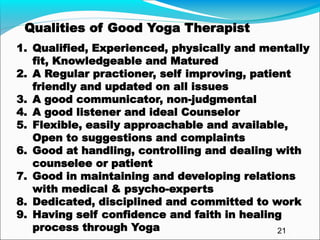
Qualities of Good Yoga Therapist
1. Qualified, Experienced, physically and mentally
fit, Knowledgeable and Matured
2. A Regular practioner, self improving, patient
friendly and updated on all issues
3. A good communicator, non-judgmental
4. A good listener and ideal Counselor
5. Flexible, easily approachable and available,
Open to suggestions and complaints
6. Good at handling, controlling and dealing with
counselee or patient
7. Good in maintaining and developing relations
with medical & psycho-experts
8. Dedicated, disciplined and committed to work
9. Having self confidence and faith in healing
process through Yoga 21
LIMITATIONS OF YOGA THERAPY
1. It can work only together with the nature
and not against it.
2. As it has Natural way of healing – slow
and Tailor made. (not all-cure)
3. No standardization of practices & results
4. Practices can’t be prescribed
5. Not possible in acute, painful, serious &
surgery cases, Poison, Infections,
Accidents. Less effective in ADHD,
Epilepsy
6. Active Cooperation of patient is must
7. Patience & determination 22
23
Certain conditions where YT has limitations
1. Acute chest pain, heart attack, stroke
2. Acute pain due to Kidney stone, kidney
failure, Appendicitis
3. Bleeding from rectum, Ear, Nose, Throat
4. Acute breathing problem
5. Non-stop loose motions or/& Vomiting
6. High grade fever
7. Food or snake poisoning
8. Viral, fungal, T.B. infections, Cancer
9. Accidents: fracture, excess bleeding
10. Certain neurological conditions
YOGA THERAPY FOR LIFESTYLE DISORDERS
Most common diseases are:
1. Diabetes & other metabolic disorders
2. Hypertension & Cardiac ailments
3. Respiratory disorders-COPD: Asthma
4. Joint problems: Backache, Neckache, Knees
5. Hormonal Problems: PCOS, Thyroid & Sex
related
Acute: sudden onset of symptoms creating distractions in
routine. Chronic is prolonged unresolved symptoms
Main causes are:
Wrong, irregular and uncontrolled lifestyle
Stress (mainly mental, distress)
Heredity – Genetic
Auto-immunity
Obesity and side effects of other drugs
24
Common Yoga therapy (देहसाधना)
General practices:
Various kriya-s like Kapalbhati, Dhauti,
Basti, Nauli help in reducing acidity,
improve digestion, respiration
Yogic kriyas teach us in getting mastery
over basic reflexes as per following:
Basti : Mastery over emptying reflex.
Neti : Mastery over sneezing reflex.
Trataka : Mastery over blinking reflex.
Vamana : Mastery over vomiting reflex.
Shankhaprakshalana : Voluntary control
over involuntary reflexes 25
26
Patanjali has prescribed Ashtanga Yoga for
the purpose of systematic elimination
of impurities, i.e., Asuddhi – Kshaya.
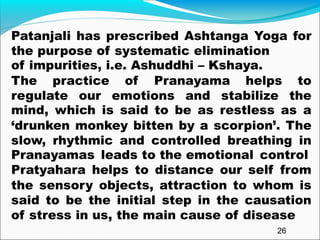
Patanjali has prescribed Ashtanga Yoga for
the purpose of systematic elimination
of impurities, i.e. Ashuddhi – Kshaya.
The practice of Pranayama helps to
regulate our emotions and stabilize the
mind, which is said to be as restless as a
‘drunken monkey bitten by a scorpion’. The
slow, rhythmic and controlled breathing in
Pranayamas leads to the emotional control
Pratyahara helps to distance our self from
the sensory objects, attraction to whom is
said to be the initial step in the causation
of stress in us, the main cause of disease
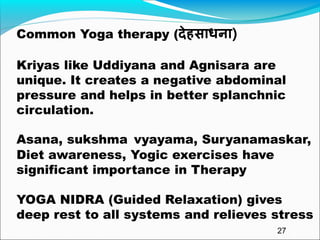
Common Yoga therapy (देहसाधना)
Kriyas like Uddiyana and Agnisara are
unique. It creates a negative abdominal
pressure and helps in better splanchnic
circulation.
Asana, sukshma vyayama, Suryanamaskar,
Diet awareness, Yogic exercises have
significant importance in Therapy
YOGA NIDRA (Guided Relaxation) gives
deep rest to all systems and relieves stress
27
28
अन्तरङ्ग योग (DHARANA AND DHYANA)
Internal journey helps to focus our mind on the
right direction and pursue our goals in a spirit
of selfless action (“ननष्कामकमम“) and skillful
actions (“कममसु कौशलम ्”). Development of clarity
of thought appears when we have mental
balance (समत्त्वं) i.e. equal reaction to the
opposites. Proper sleep patterns and a
subjective feeling of wellness are produced by
Yoga and this in turn leads to better human
relationships, proper attitudes, increased
production at work and the greater good for
the individual, family, nation and ultimately for
the whole of humanity.
ABDOMINAL BREATHING (प्राणसाधना):
Normally, when we breathe in, diaphragm
is pushed down. This helps in smooth
gentle massage of abdominal organs. This
helps in proper circulation and proper
digestion of ingested food.
If abdominal breathing (i. e. pushing
abdominal wall in as close to spine as
possible while expiration) is done with an
awareness, effect is much more enhanced.
Abdominal breathing is one of the most
effective method of reducing stress.
29
30
BHAKTI, NADA & LAYA YOGA
• Perform all our activities with the intention as
an offering to the divine and gratefully receive
HIS blessings with surrendering & egoless
attitude
• Music and the chanting of Mantras with
devotion helps to elevate the mind into a
higher plane where the individual transcends
their problems and can look at things in the
right perspective. A detached view of our life
can help us to see our self in the true reality.
The faith in Reality brings us out of all
symptoms, suffering and problems,
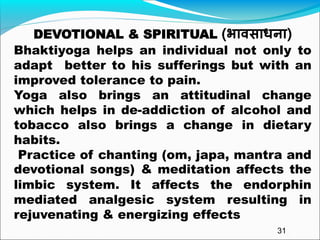
DEVOTIONAL & SPIRITUAL (भावसाधना)
Bhaktiyoga helps an individual not only to
adapt better to his sufferings but with an
improved tolerance to pain.
Yoga also brings an attitudinal change
which helps in de-addiction of alcohol and
tobacco also brings a change in dietary
habits.
Practice of chanting (om, japa, mantra and
devotional songs) & meditation affects the
limbic system. It affects the endorphin
mediated analgesic system resulting in
rejuvenating & energizing effects
31
LIFESTYLE CORRECTIONS (ददव्यसाधना)
Takes the practitioner to a
transcendental level beyond that of
physical illness along with mental
tranquility.
It helps in regularizing diurnal
rhythm indirectly (active during
daytime) because one gets
habituated to getting up early in the
morning for the practice and going
to bed early, improving quality of life
32
33
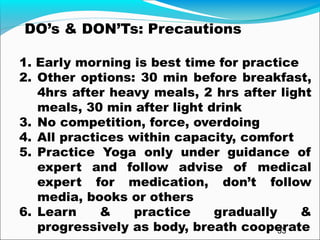
DO’s & DON’Ts: Precautions
1. Early morning is best time for practice
2. Other options: 30 min before breakfast,
4hrs after heavy meals, 2 hrs after light
meals, 30 min after light drink
3. No competition, force, overdoing
4. All practices within capacity, comfort
5. Practice Yoga only under guidance of
expert and follow advise of medical
expert for medication, don’t follow
media, books or others
6. Learn & practice gradually &
progressively as body, breath cooperate
WISH YOU ALL
A
HAPPY, HEALTHY
&
YOGIC LIFESTYLE
34

Yoga Therapy overview

  • 1.
    HARI OM Deepak Bagadia Introductionto YOGA THERAPY (2021-22) 1
  • 2.
    It is mostimportant to realize that no system in body works in isolation. All the systems in body work in harmony and coordination to produce desired result. Nervous & Endocrine are main controlling other systems and HPO Axis A single root cause like STRESS can be responsible for manifestation of disease in different systems. We have inbuilt Stress management system HUMAN SYSTEMS 2
  • 3.
    The International Associationof Yoga Therapists defines yoga therapy as: “The process of empowering individuals to progress toward improved health and well-being through the application of the philosophy and practice of yoga.” Thus, Yoga therapy consists of the application of yogic principles, methods, and techniques to specific human ailments. 3
  • 4.
    Yoga practices treatthe root cause. Integrated or holistic approach of Yoga therapy thus allows us to treat person rather than symptoms There is never a single causative factor, BUT a combination of psychological, social, environmental factors, familial and cultural influences which cause illness. Illness is of two types - A) Disease - organic disorder (YT @min) B) Functional disorder. (adhija vyadhi) YOGA THERAPY 4
  • 5.
    Any therapy aimsat healing and reducing the symptoms of pain and suffering in life. The root cause of most of the diseases is unsteadiness or instability of mind. Yoga targets the root cause by putting mind in steady and well balanced state. Basically, yoga is a way of life and not the therapy. “It is absolutely true that every thought we think has its corresponding effect on the whole or some part of the human anatomy. Therefore, the mind can both create and cure disease” Dr. Charles Davis YOGA THERAPY (Meaning/Aim) 5
  • 6.
    A true yogaaspirant tries to create balance between the physical, mental, emotional and spiritual aspects. As he gets focused on the ultimate goal of life, self realization or Samadhi, freedom from diseases comes as a by-product of his enriched way of living. Yoga Therapy is the use of the techniques of Yoga to create, stimulate, and maintain an optimum state of physical, emotional, mental, and spiritual health. -Judith Hanson Lasater, Ph.D YOGA THERAPY (Technique) 6
  • 7.
    “In its idealapplication, Yoga therapy is preventive in nature, as is Yoga itself, but it is also restorative in many instances, palliative in others, and curative in many others.” Art Brownstein, M.D. Actually, Yoga therapy is not organ specific but it is a science that works holistically to strengthen the inner being. YOGA THERAPY: 7
  • 8.
    1AIM22222A AIM OF YOGATHERAPY 1.To recognise the root cause, area of stress and treat with Yoga practices 2. To reduce internal resistance and relax the whole body with proper Yoga, Diet and rest 3. To correct and develop right (+ve) attitude towards others/day to day happenings (Notional corrections, thinking pattern, percepn) 4. To tune the psycho-physiological apparatus 5. To change lifestyle to prevent further damage and it assures promotion of health.1towards 8
  • 9.
    9 MODERN CONCEPT OFDISEASE: Disease, in modern medical perspective is considered as dysfunction of organs and systems, which may be due to congenital, defects, external atmosphere agents like allergens, toxins, pollutants or infectious germs. The other major cause for diseases could be the factor of internal imbalances like mental restlessness, emotional upsurges or intellectual conflicts that lead to stress reactions.
  • 10.
    Main Characteristics: 1. Theoldest therapy 2. Not a passive therapy like many other modules. One is active participant in management. 3. Yoga techniques with purpose of healing a person as a whole unit. 4. Integrated approach: all aspects of individual (treats person/disease). 5. Holistic Science: takes care of Diet, Exercise, routine, habits, beliefs providing congenial atmosphere, counseling etc. Concept of Koshas: YOGA THERAPY 10
  • 11.
    YOGA THERAPY (characteristics) Koshas:Physical body (annamaya), subtle body (pranamaya, Manomaya, Vijnanamaya), & causal body (anandmaya) gives us a holistic and concrete perspective of human existence as the foundation for Yoga therapy 6. Almost costless therapy 7. Self indicative as done with full awareness of active participant 8. NO TALL CLAIMS 9. Powerful & Guaranteed Healing, if done properly, consistently & with awareness 10. It treats the root cause 11. NO SIDE EFFECTS 11
  • 12.
    Cultivation of positivehealth through following integral steps: a) Cleansing/purifying: Kriyas b) Reconditioning of neuromuscular and neuroglandular systems c) Correct psychological attitude (Positivity) d) Relaxing effects on physical level followed by Slowing & Relaxing effects at mental level, and e) Silencing and easing on emotions and sublimation at spiritual level Scientific Plan for Treatment 12
  • 13.
    APPLICATION OF YOGATHERAPY Sports 13
  • 14.
    “ जातस्य हिध्रुवो मृत्युवं जन्म मृतस्य च / तस्मात ् अपरििाये अर्थे न त्वम् शोचचतुम अि्सी//” Reference of YT in various scriptures 1. Bhagvat Gita is full of psychotherapy and counseling of a weak and sick person. Chapter-2: psychological knowledge and helps us to come out of depression. Verses 22-31:The nature of immortal atman, transitory nature of body and its ailments. Verse 71: makes us aware of our desires and ego makes us realized of true peace. V.39-53: How to manage our stress, work without getting attached to the fruits of it to minimize self exploitation. V.54 to 72: characteristics of a stable man with mental equilibrium. Such people can avoid problems in life. 14
  • 15.
  • 16.
    P.Yogasutra: Klesas &Avidya-cause of suffering, Remedies given to unite body, mind & soul: vairagya, nirodha, viram-pratyaya, Ishwar pranidhana, ekatatvabhyasa, japa,Yamaniyama, pratipakshabhava, cittaprasadana, kriyayoga…… Heyam dukham anagatam. (II.16)(Prevention) Hathayoga is not just a physical practice but a process of cellular transmutation from gross to subtle to divine: by Purification, Postural corrections, Pranic energization, Awakening of vital energies and Nadanusandhana leads to eternal happiness YT in Yogic scriptures 16
  • 17.
    Disease in scriptures •Upanisad: disintegration of Panchakosas • Ayurveda: Asatmendriyartha sayoga due to prajnaparadha (crime against intellect) • Y.Vasistha: Adhija vyadhi is cause of miseries, if removed, you get happiness. But, if you remove avidya, you get Moksha, total bliss 17
  • 18.
    Aurobindo’s definition: “Yoga isa methodized effort towards self – perfection” • Preventive and Social medicine • Personality development • Value added lifestyle •Human Relations development •Information Technology YOGA AS PREVENTIVE & PROMOTIVE 18
  • 19.
    •Tirumalai Krishnamacharya isconsidered (1888) to be the father of modern Yoga and contemporary Yoga Therapy. He was the teacher of BKS Iyengar, A. G. Mohan, and TKV Desikachar, three of the most well known Gurus of contemporary Yoga Therapy • Swami Kuvalyananda-The pioneer & researcher •In U.S., Dean Ornish during 1990: his program of reversing heart diseases, approved by Health Insurance coverage • 200 to 800hrs of certification required (YCB) • SVYASA, NIMHANS, MDIYA, Kaivalyadham, BSY HISTORY OF YOGA THERAPY 19
  • 20.
    It is thestrength of mind and not the dose of medicine which helps illness. 1.Yoga Practices are Safe and non-invasive. 2. Regular practices reduce level of anxiety, improve pain threshold and also immunity. 3.Improves the ability of practitioner to face stressful situations, keeps him active Thus, yoga has potential to heal, cure the illness beyond just a complementary therapy and can serve purpose of antacids, analgesics, antidiarrheal, anxiolytics and psychopharmacologic drugs. YOGA THERAPY: Benefits 20
  • 21.
    Qualities of GoodYoga Therapist 1. Qualified, Experienced, physically and mentally fit, Knowledgeable and Matured 2. A Regular practioner, self improving, patient friendly and updated on all issues 3. A good communicator, non-judgmental 4. A good listener and ideal Counselor 5. Flexible, easily approachable and available, Open to suggestions and complaints 6. Good at handling, controlling and dealing with counselee or patient 7. Good in maintaining and developing relations with medical & psycho-experts 8. Dedicated, disciplined and committed to work 9. Having self confidence and faith in healing process through Yoga 21
  • 22.
    LIMITATIONS OF YOGATHERAPY 1. It can work only together with the nature and not against it. 2. As it has Natural way of healing – slow and Tailor made. (not all-cure) 3. No standardization of practices & results 4. Practices can’t be prescribed 5. Not possible in acute, painful, serious & surgery cases, Poison, Infections, Accidents. Less effective in ADHD, Epilepsy 6. Active Cooperation of patient is must 7. Patience & determination 22
  • 23.
    23 Certain conditions whereYT has limitations 1. Acute chest pain, heart attack, stroke 2. Acute pain due to Kidney stone, kidney failure, Appendicitis 3. Bleeding from rectum, Ear, Nose, Throat 4. Acute breathing problem 5. Non-stop loose motions or/& Vomiting 6. High grade fever 7. Food or snake poisoning 8. Viral, fungal, T.B. infections, Cancer 9. Accidents: fracture, excess bleeding 10. Certain neurological conditions
  • 24.
    YOGA THERAPY FORLIFESTYLE DISORDERS Most common diseases are: 1. Diabetes & other metabolic disorders 2. Hypertension & Cardiac ailments 3. Respiratory disorders-COPD: Asthma 4. Joint problems: Backache, Neckache, Knees 5. Hormonal Problems: PCOS, Thyroid & Sex related Acute: sudden onset of symptoms creating distractions in routine. Chronic is prolonged unresolved symptoms Main causes are: Wrong, irregular and uncontrolled lifestyle Stress (mainly mental, distress) Heredity – Genetic Auto-immunity Obesity and side effects of other drugs 24
  • 25.
    Common Yoga therapy(देहसाधना) General practices: Various kriya-s like Kapalbhati, Dhauti, Basti, Nauli help in reducing acidity, improve digestion, respiration Yogic kriyas teach us in getting mastery over basic reflexes as per following: Basti : Mastery over emptying reflex. Neti : Mastery over sneezing reflex. Trataka : Mastery over blinking reflex. Vamana : Mastery over vomiting reflex. Shankhaprakshalana : Voluntary control over involuntary reflexes 25
  • 26.
    26 Patanjali has prescribedAshtanga Yoga for the purpose of systematic elimination of impurities, i.e., Asuddhi – Kshaya. Patanjali has prescribed Ashtanga Yoga for the purpose of systematic elimination of impurities, i.e. Ashuddhi – Kshaya. The practice of Pranayama helps to regulate our emotions and stabilize the mind, which is said to be as restless as a ‘drunken monkey bitten by a scorpion’. The slow, rhythmic and controlled breathing in Pranayamas leads to the emotional control Pratyahara helps to distance our self from the sensory objects, attraction to whom is said to be the initial step in the causation of stress in us, the main cause of disease
  • 27.
    Common Yoga therapy(देहसाधना) Kriyas like Uddiyana and Agnisara are unique. It creates a negative abdominal pressure and helps in better splanchnic circulation. Asana, sukshma vyayama, Suryanamaskar, Diet awareness, Yogic exercises have significant importance in Therapy YOGA NIDRA (Guided Relaxation) gives deep rest to all systems and relieves stress 27
  • 28.
    28 अन्तरङ्ग योग (DHARANAAND DHYANA) Internal journey helps to focus our mind on the right direction and pursue our goals in a spirit of selfless action (“ननष्कामकमम“) and skillful actions (“कममसु कौशलम ्”). Development of clarity of thought appears when we have mental balance (समत्त्वं) i.e. equal reaction to the opposites. Proper sleep patterns and a subjective feeling of wellness are produced by Yoga and this in turn leads to better human relationships, proper attitudes, increased production at work and the greater good for the individual, family, nation and ultimately for the whole of humanity.
  • 29.
    ABDOMINAL BREATHING (प्राणसाधना): Normally,when we breathe in, diaphragm is pushed down. This helps in smooth gentle massage of abdominal organs. This helps in proper circulation and proper digestion of ingested food. If abdominal breathing (i. e. pushing abdominal wall in as close to spine as possible while expiration) is done with an awareness, effect is much more enhanced. Abdominal breathing is one of the most effective method of reducing stress. 29
  • 30.
    30 BHAKTI, NADA &LAYA YOGA • Perform all our activities with the intention as an offering to the divine and gratefully receive HIS blessings with surrendering & egoless attitude • Music and the chanting of Mantras with devotion helps to elevate the mind into a higher plane where the individual transcends their problems and can look at things in the right perspective. A detached view of our life can help us to see our self in the true reality. The faith in Reality brings us out of all symptoms, suffering and problems,
  • 31.
    DEVOTIONAL & SPIRITUAL(भावसाधना) Bhaktiyoga helps an individual not only to adapt better to his sufferings but with an improved tolerance to pain. Yoga also brings an attitudinal change which helps in de-addiction of alcohol and tobacco also brings a change in dietary habits. Practice of chanting (om, japa, mantra and devotional songs) & meditation affects the limbic system. It affects the endorphin mediated analgesic system resulting in rejuvenating & energizing effects 31
  • 32.
    LIFESTYLE CORRECTIONS (ददव्यसाधना) Takesthe practitioner to a transcendental level beyond that of physical illness along with mental tranquility. It helps in regularizing diurnal rhythm indirectly (active during daytime) because one gets habituated to getting up early in the morning for the practice and going to bed early, improving quality of life 32
  • 33.
    33 DO’s & DON’Ts:Precautions 1. Early morning is best time for practice 2. Other options: 30 min before breakfast, 4hrs after heavy meals, 2 hrs after light meals, 30 min after light drink 3. No competition, force, overdoing 4. All practices within capacity, comfort 5. Practice Yoga only under guidance of expert and follow advise of medical expert for medication, don’t follow media, books or others 6. Learn & practice gradually & progressively as body, breath cooperate
  • 34.
    WISH YOU ALL A HAPPY,HEALTHY & YOGIC LIFESTYLE 34