Cultural Diversity and Crime
Ashfaq Sadiq
Oslo, October 26, 2007
E-mail: ashfaq.sadiq@hotmail.com
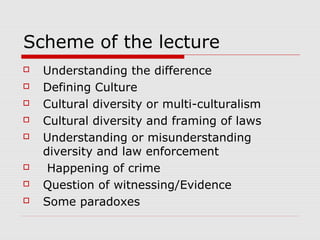
Scheme of the lecture
 Understanding the difference
 Defining Culture
 Cultural diversity or multi-culturalism
 Cultural diversity and framing of laws
 Understanding or misunderstanding
diversity and law enforcement
 Happening of crime
 Question of witnessing/Evidence
 Some paradoxes
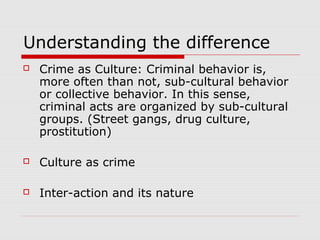
Understanding the difference
 Crime as Culture: Criminal behavior is,
more often than not, sub-cultural behavior
or collective behavior. In this sense,
criminal acts are organized by sub-cultural
groups. (Street gangs, drug culture,
prostitution)
 Culture as crime
 Inter-action and its nature
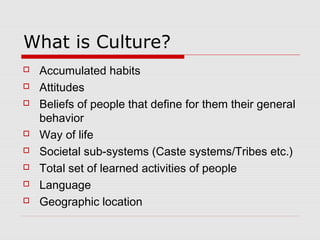
What is Culture?
 Accumulated habits
 Attitudes
 Beliefs of people that define for them their general
behavior
 Way of life
 Societal sub-systems (Caste systems/Tribes etc.)
 Total set of learned activities of people
 Language
 Geographic location
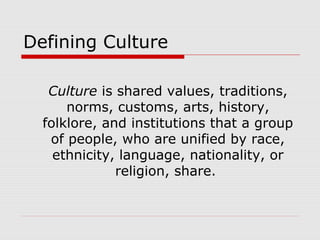
Defining Culture
Culture is shared values, traditions,
norms, customs, arts, history,
folklore, and institutions that a group
of people, who are unified by race,
ethnicity, language, nationality, or
religion, share.
Understanding Diversity
 Defining diversity/multiculturalism:
‘The recognition of cultural and ethnic diversity
within the demographics of a particular social
space.’
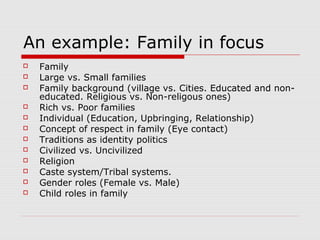
An example: Family in focus
 Family
 Large vs. Small families
 Family background (village vs. Cities. Educated and non-
educated. Religious vs. Non-religous ones)
 Rich vs. Poor families
 Individual (Education, Upbringing, Relationship)
 Concept of respect in family (Eye contact)
 Traditions as identity politics
 Civilized vs. Uncivilized
 Religion
 Caste system/Tribal systems.
 Gender roles (Female vs. Male)
 Child roles in family
Diversity and Law-making
 Why?
 How?
 Whom?
Culture and happening of crime
 Cultural norms and justification of
crime. (Vietnamese values, Zij Paj
Niam customs)
 Rage and law (Rodney King and
Reginald Denny cases)
 Inter-family competition (Positive and
Negative)
Diversity and Enforcement of Law
 ‘Rule of Law’
 ‘Not knowing the law does not mean
law is not applicable’
 Enforcement of law and cultural
sensitivity
Culture and Evidence
 Individual and Evidence
1. Fabrication
2. Personal/group/religious interest
3. Fears (Social Isolation, Community interest)
4. Proud factor (Men vs. women)
 Cultural evidence is admissible
Does system support?
 Law enforcing agencies and their
capacity.
 Women being perceived weak.
 System being perceived as an enemy.
Paradoxes
 Absurd but nevertheless true.
 If all the prisoners are turned completely loose we might
not notice much increase in crime. The reason being that
vast majority of criminals are already at large.
 Most crimes are not reported, and of those reported only
a very small percentage are solved.
 The vast majority has never witnessed a violent crime,
let alone been the victim of one.
 Fear of crime increases while crime itself decreases.
Thank You

Culture and Crime

  • 1.
    Cultural Diversity andCrime Ashfaq Sadiq Oslo, October 26, 2007 E-mail: ashfaq.sadiq@hotmail.com
  • 2.
    Scheme of thelecture  Understanding the difference  Defining Culture  Cultural diversity or multi-culturalism  Cultural diversity and framing of laws  Understanding or misunderstanding diversity and law enforcement  Happening of crime  Question of witnessing/Evidence  Some paradoxes
  • 3.
    Understanding the difference Crime as Culture: Criminal behavior is, more often than not, sub-cultural behavior or collective behavior. In this sense, criminal acts are organized by sub-cultural groups. (Street gangs, drug culture, prostitution)  Culture as crime  Inter-action and its nature
  • 4.
    What is Culture? Accumulated habits  Attitudes  Beliefs of people that define for them their general behavior  Way of life  Societal sub-systems (Caste systems/Tribes etc.)  Total set of learned activities of people  Language  Geographic location
  • 5.
    Defining Culture Culture isshared values, traditions, norms, customs, arts, history, folklore, and institutions that a group of people, who are unified by race, ethnicity, language, nationality, or religion, share.
  • 6.
    Understanding Diversity  Definingdiversity/multiculturalism: ‘The recognition of cultural and ethnic diversity within the demographics of a particular social space.’
  • 7.
    An example: Familyin focus  Family  Large vs. Small families  Family background (village vs. Cities. Educated and non- educated. Religious vs. Non-religous ones)  Rich vs. Poor families  Individual (Education, Upbringing, Relationship)  Concept of respect in family (Eye contact)  Traditions as identity politics  Civilized vs. Uncivilized  Religion  Caste system/Tribal systems.  Gender roles (Female vs. Male)  Child roles in family
  • 8.
    Diversity and Law-making Why?  How?  Whom?
  • 9.
    Culture and happeningof crime  Cultural norms and justification of crime. (Vietnamese values, Zij Paj Niam customs)  Rage and law (Rodney King and Reginald Denny cases)  Inter-family competition (Positive and Negative)
  • 10.
    Diversity and Enforcementof Law  ‘Rule of Law’  ‘Not knowing the law does not mean law is not applicable’  Enforcement of law and cultural sensitivity
  • 11.
    Culture and Evidence Individual and Evidence 1. Fabrication 2. Personal/group/religious interest 3. Fears (Social Isolation, Community interest) 4. Proud factor (Men vs. women)  Cultural evidence is admissible
  • 12.
    Does system support? Law enforcing agencies and their capacity.  Women being perceived weak.  System being perceived as an enemy.
  • 13.
    Paradoxes  Absurd butnevertheless true.  If all the prisoners are turned completely loose we might not notice much increase in crime. The reason being that vast majority of criminals are already at large.  Most crimes are not reported, and of those reported only a very small percentage are solved.  The vast majority has never witnessed a violent crime, let alone been the victim of one.  Fear of crime increases while crime itself decreases.
  • 14.