Yes, You Can Use Copyrighted Materials! Renee HobbsMedia Education LabTemple University
Strengthening Public Understanding of Copyright and Fair UseSupported by a grant from the John D. and Catherine T. MacArthur Foundation
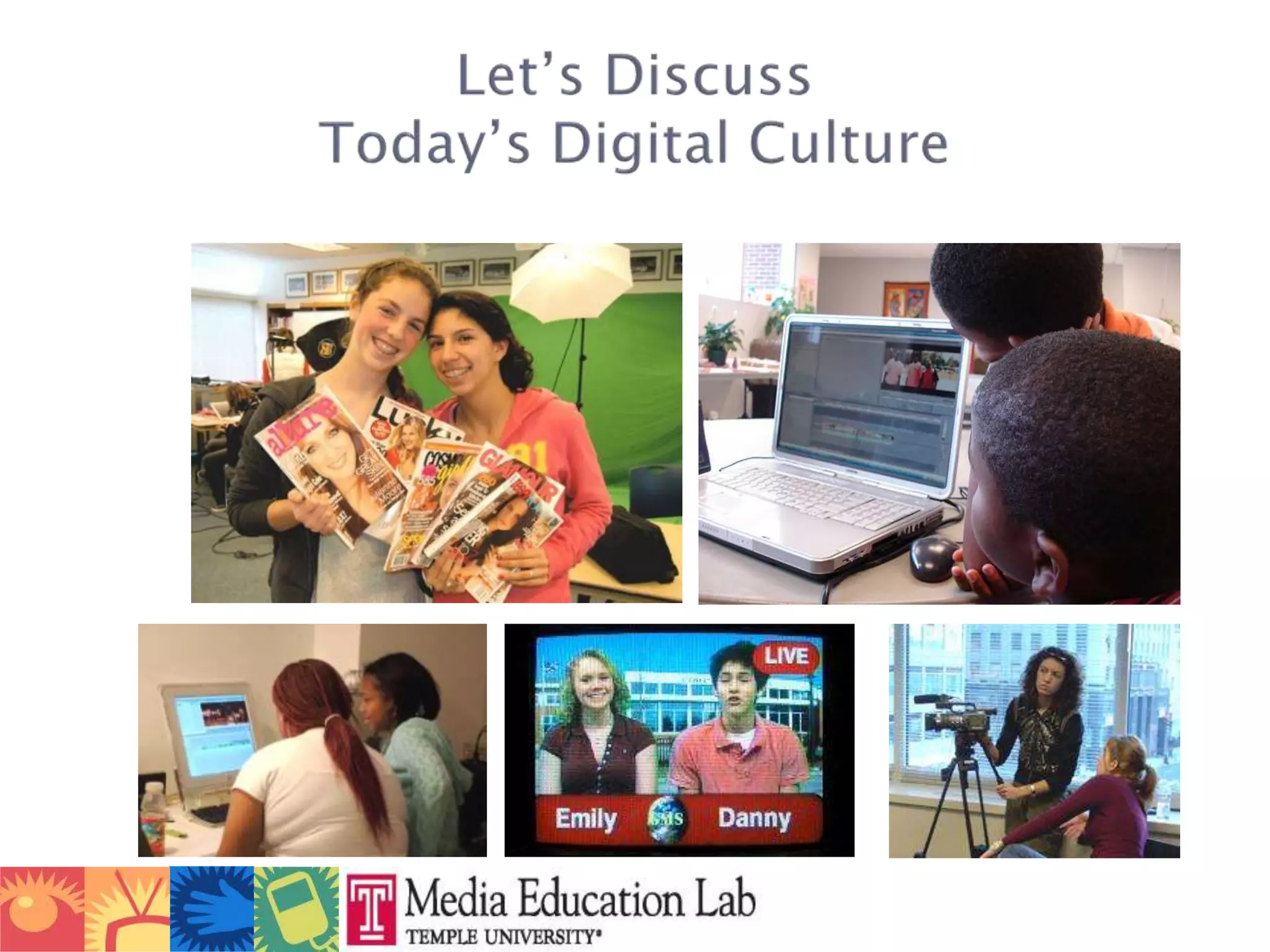
Let’s DiscussToday’s Digital Culture
What is the purpose of
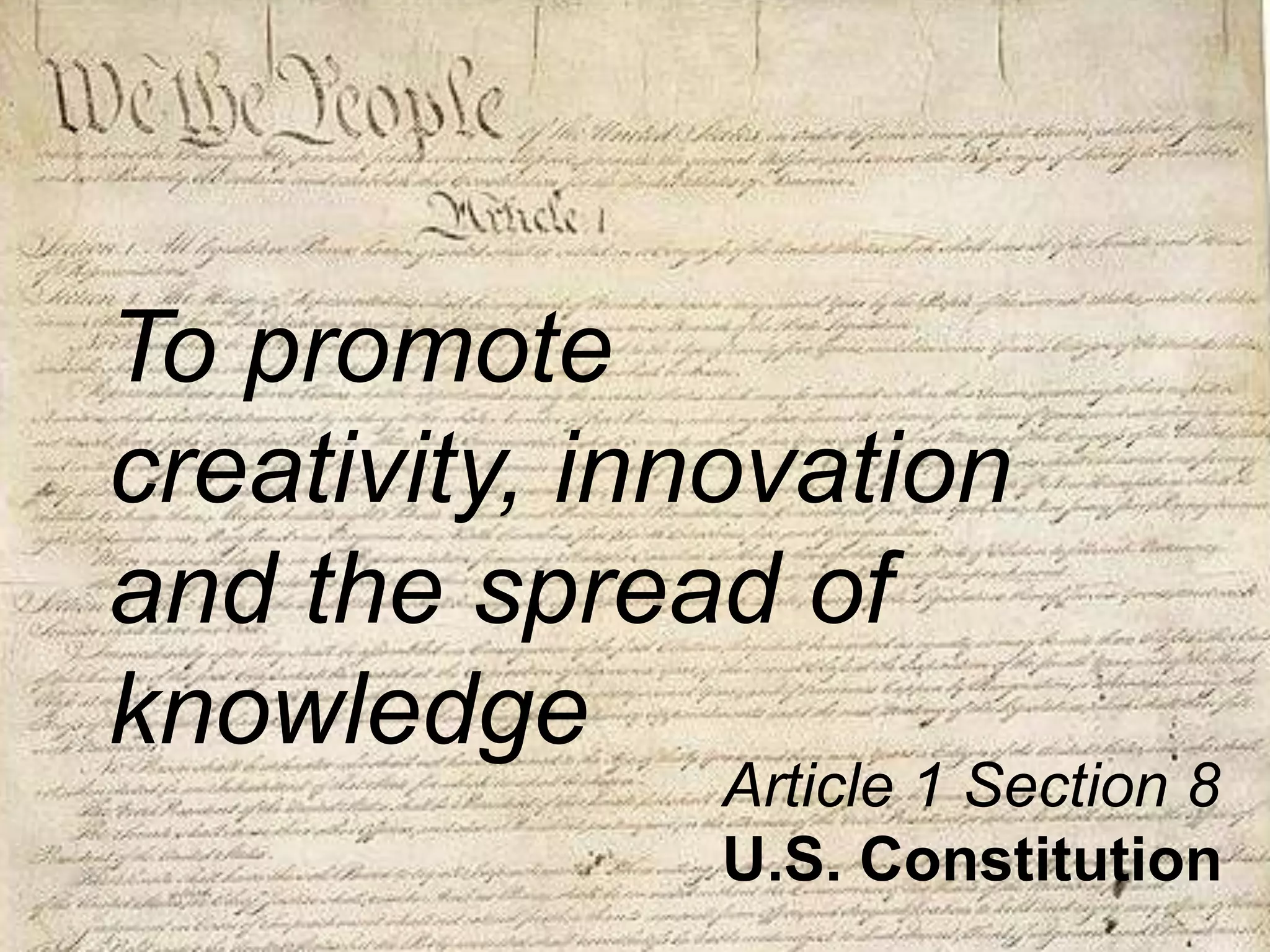
To promote creativity, innovation and the spread of knowledgeArticle 1 Section 8U.S. Constitution
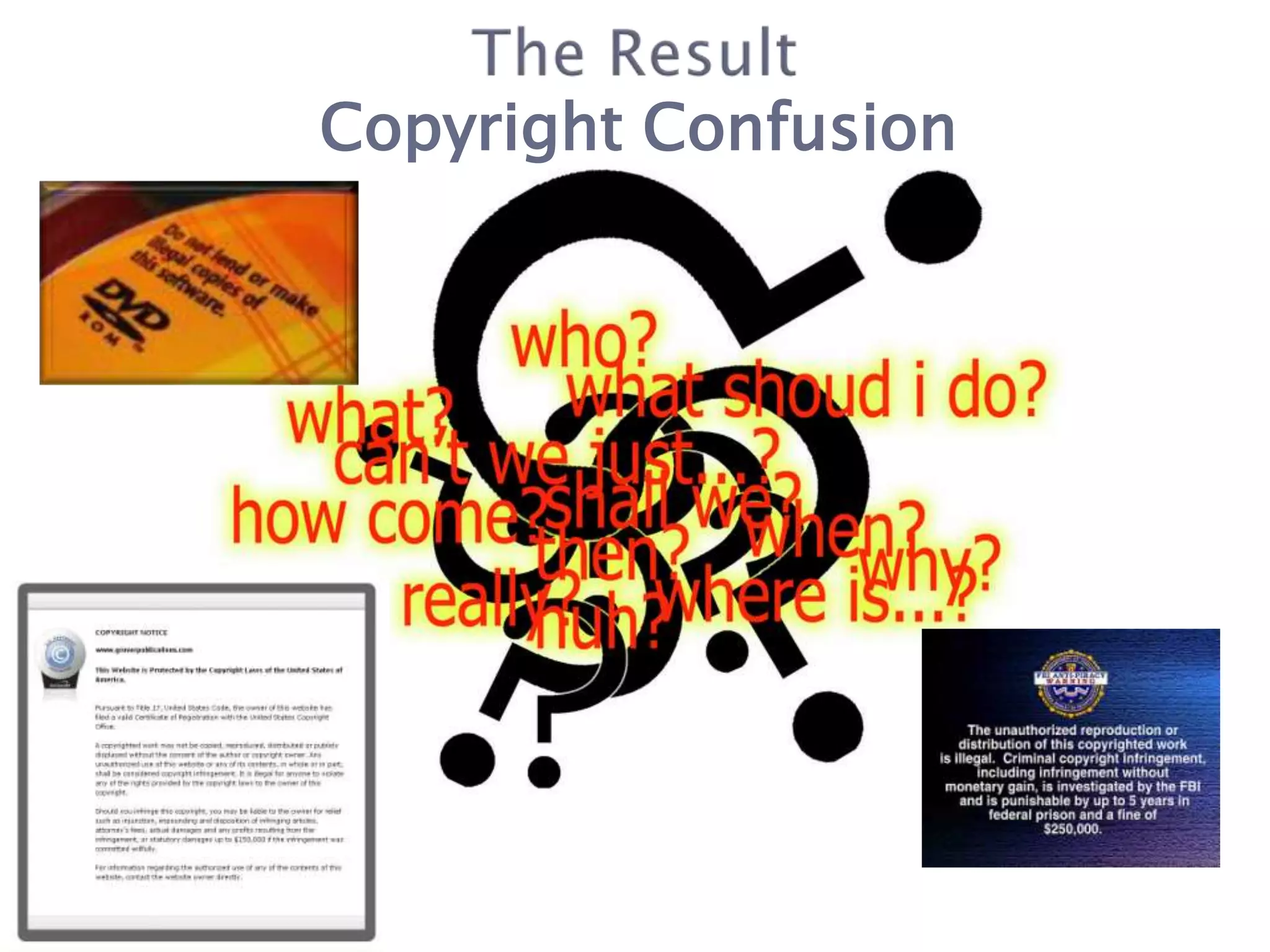
The ResultCopyright Confusion
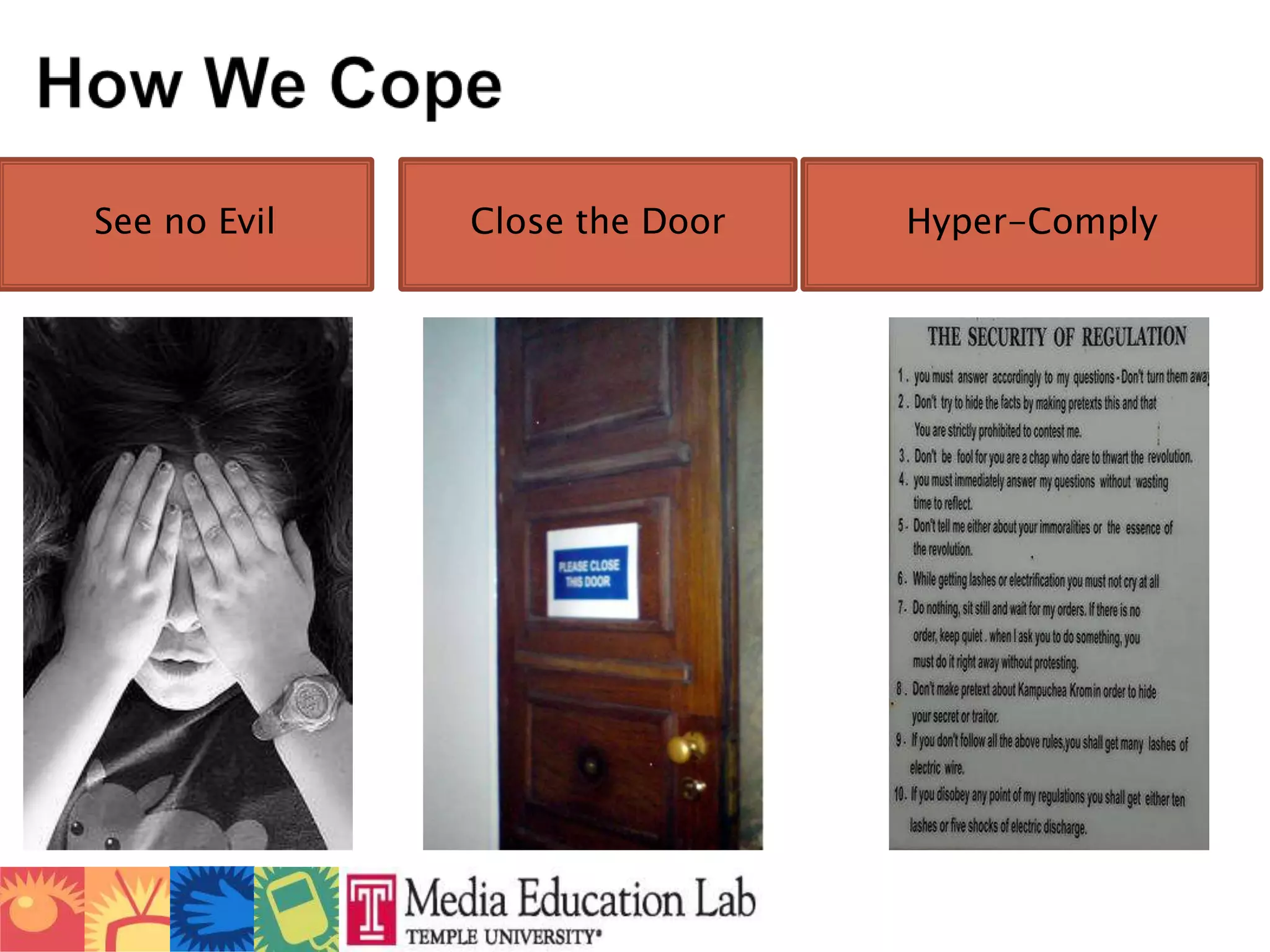
How We CopeSee no EvilClose the DoorHyper-Comply
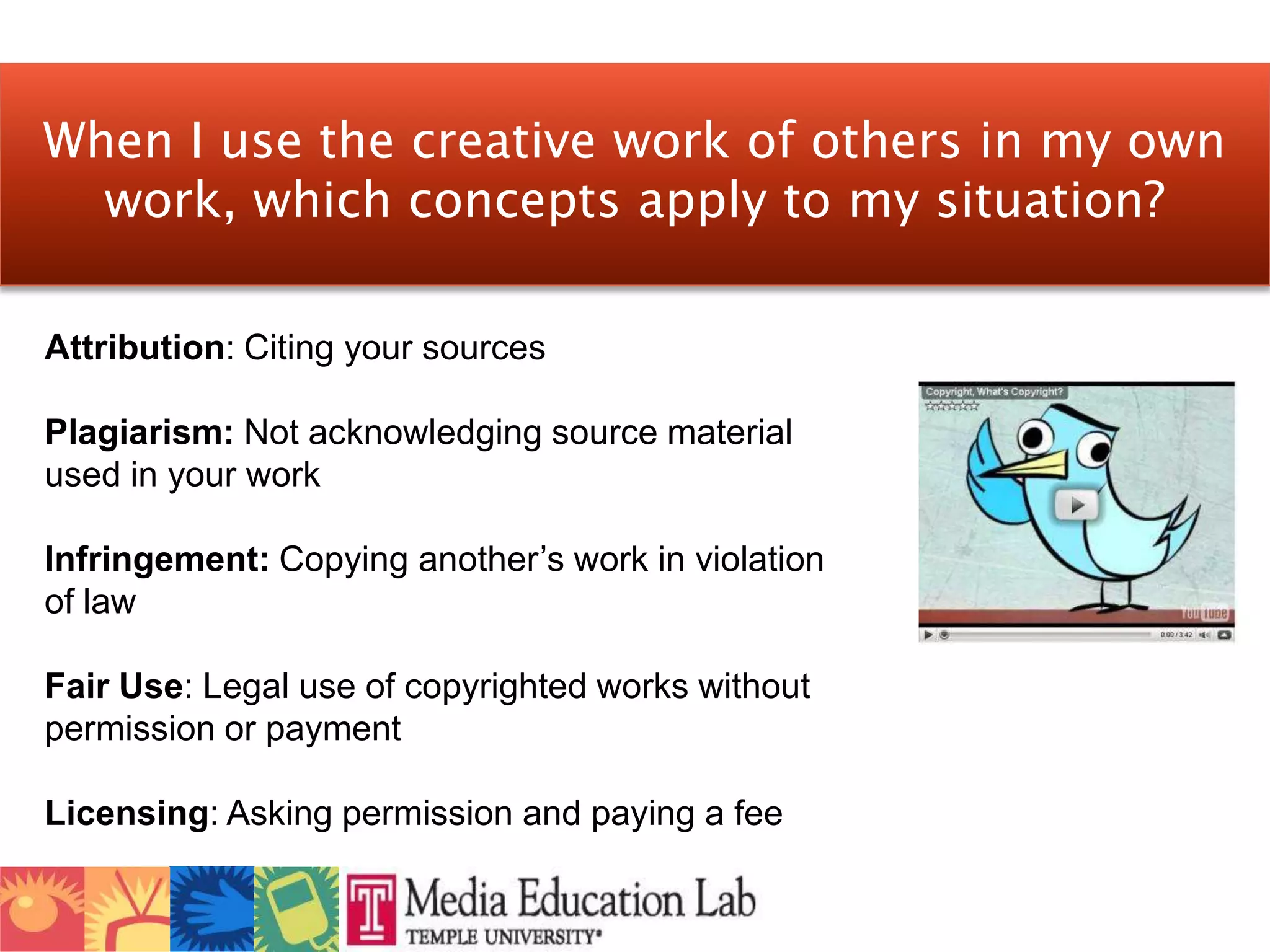
When I use the creative work of others in my own work, which concepts apply to my situation?Attribution: Citing your sourcesPlagiarism: Not acknowledging source material used in your workInfringement: Copying another’s work in violation of lawFair Use: Legal use of copyrighted works without permission or paymentLicensing: Asking permission and paying a fee
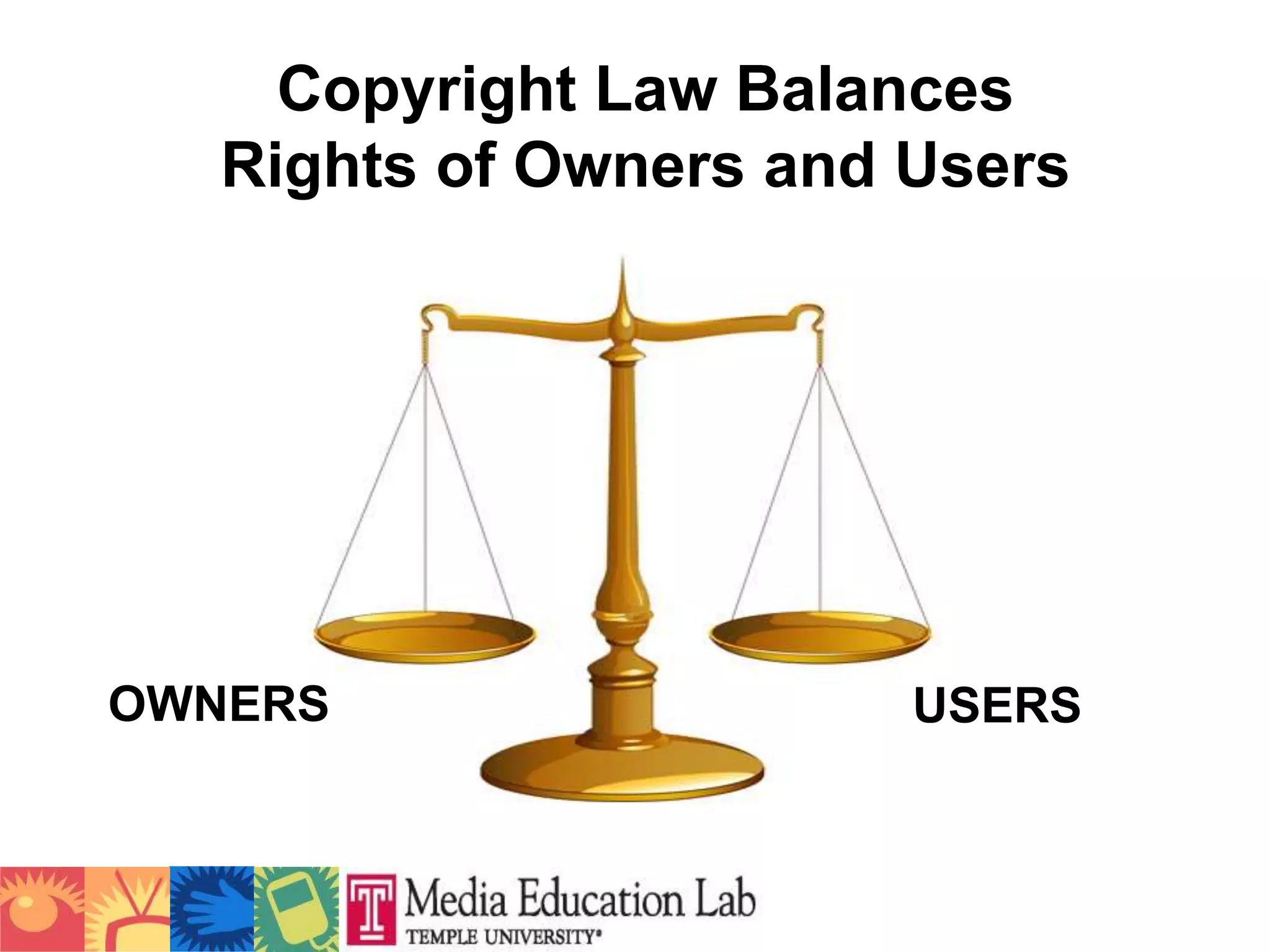
Copyright Law Balances Rights of Owners and UsersOWNERSUSERS
Strengthening Public Understanding of Copyright and Fair UseSupported by a grant from the John D. and Catherine T. MacArthur Foundation
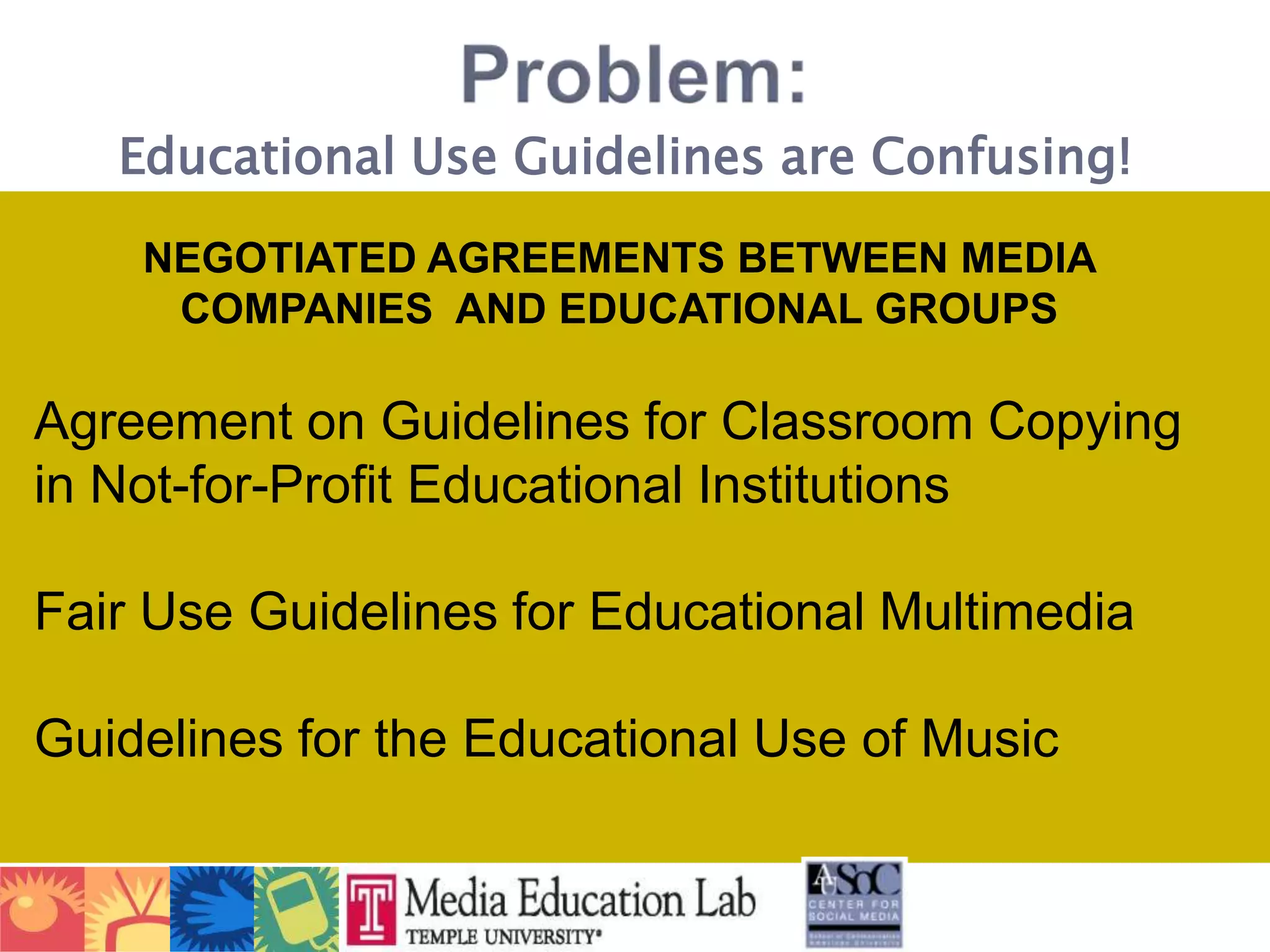
Problem:Educational Use Guidelines are Confusing!NEGOTIATED AGREEMENTS BETWEEN MEDIA COMPANIES  AND EDUCATIONAL GROUPSAgreement on Guidelines for Classroom Copying in Not-for-Profit Educational InstitutionsFair Use Guidelines for Educational MultimediaGuidelines for the Educational Use of Music
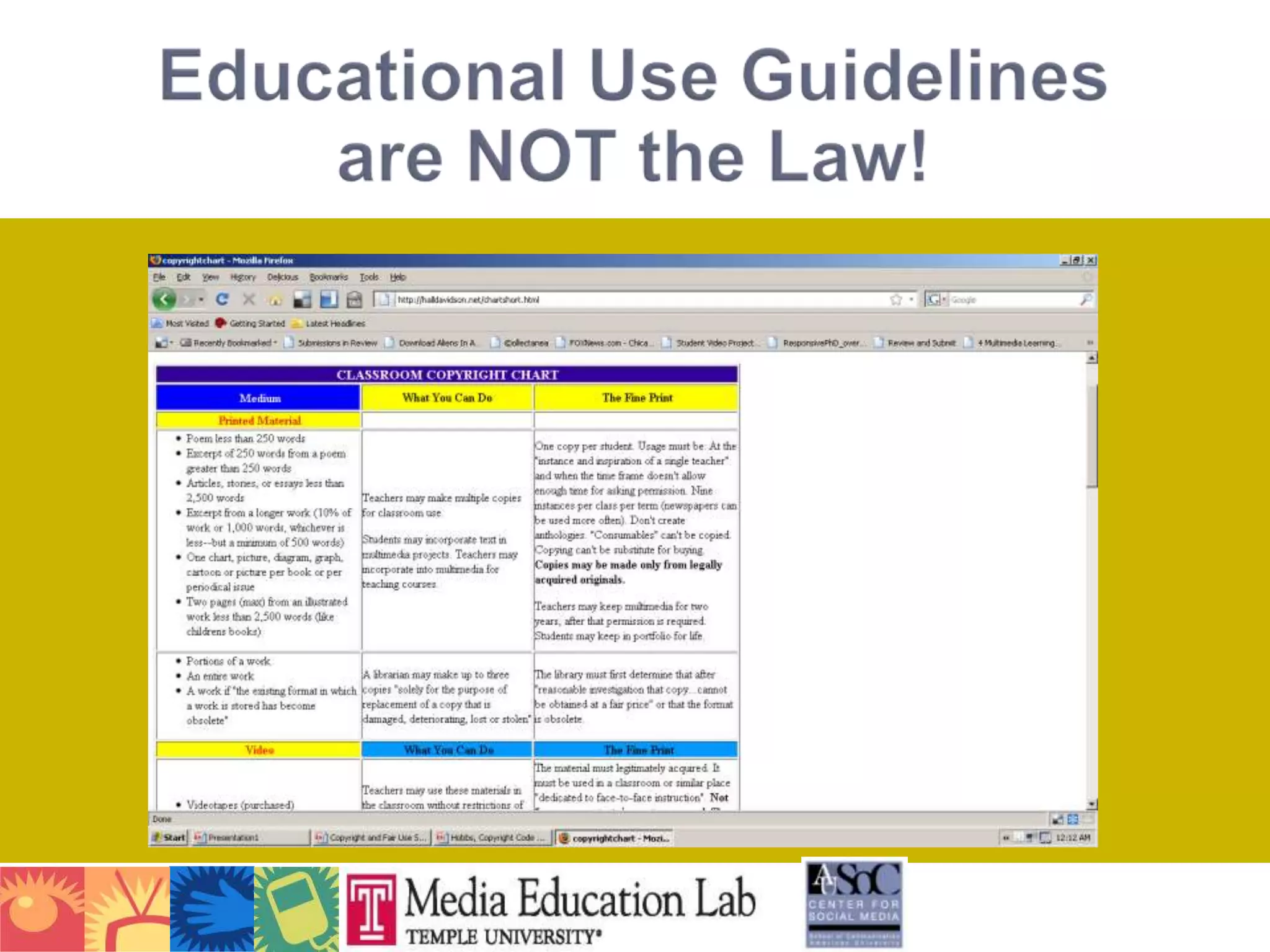
Educational Use Guidelinesare NOT the Law!
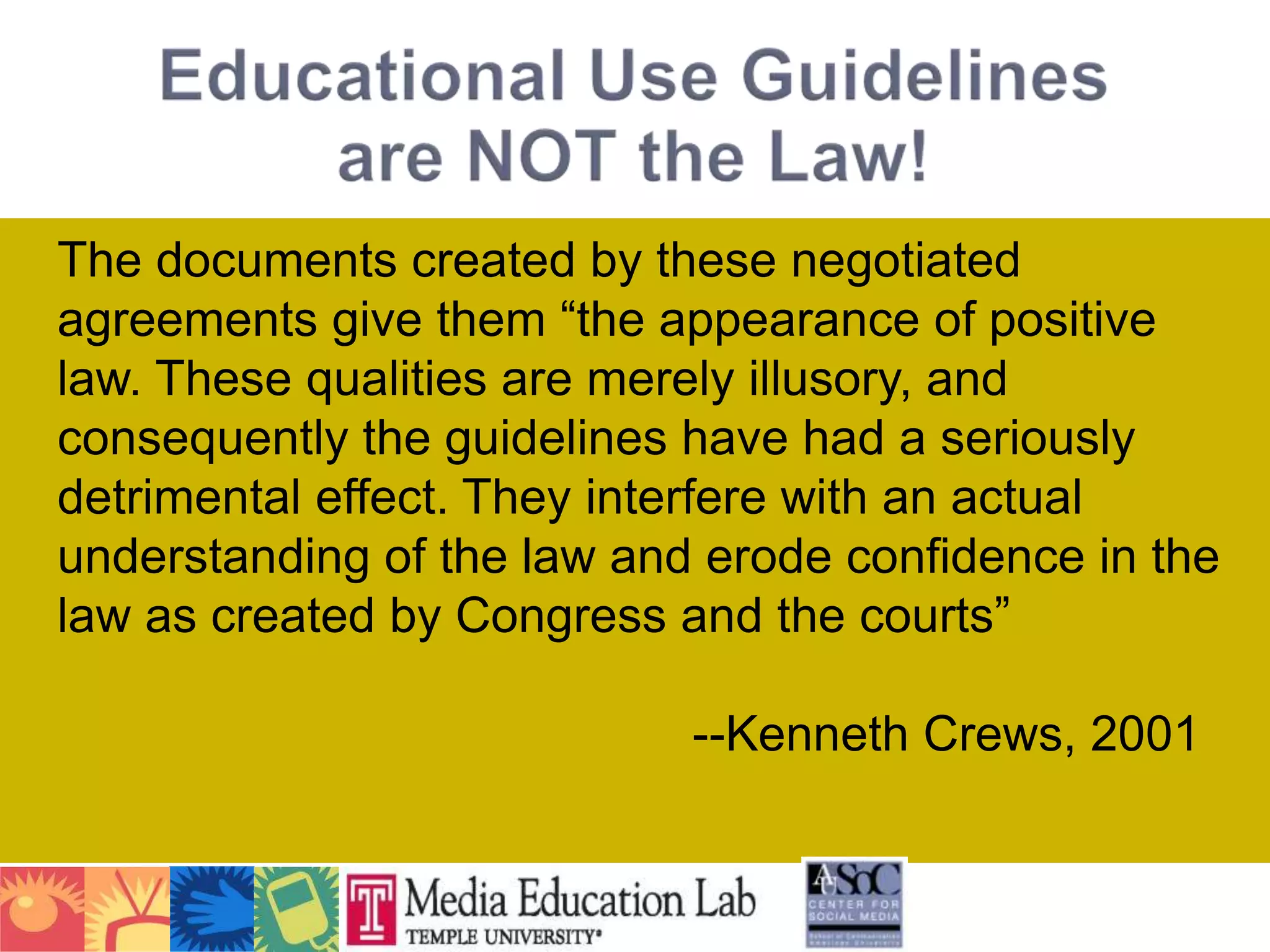
The documents created by these negotiated agreements give them “the appearance of positive law. These qualities are merely illusory, and consequently the guidelines have had a seriously detrimental effect. They interfere with an actual understanding of the law and erode confidence in the law as created by Congress and the courts” 										--Kenneth Crews, 2001Educational Use Guidelinesare NOT the Law!
It’s time to replace old knowledgewithaccurate knowledge
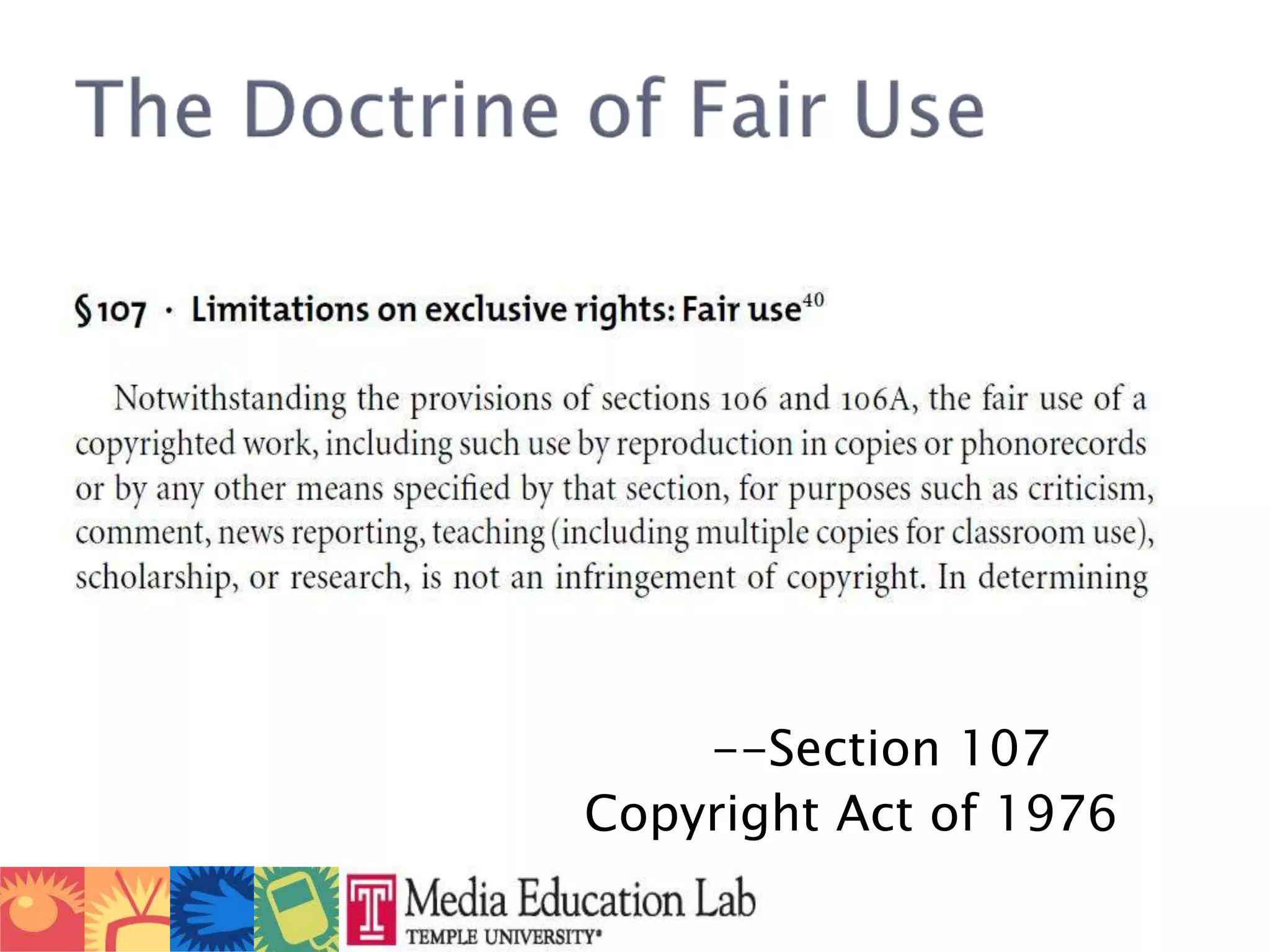
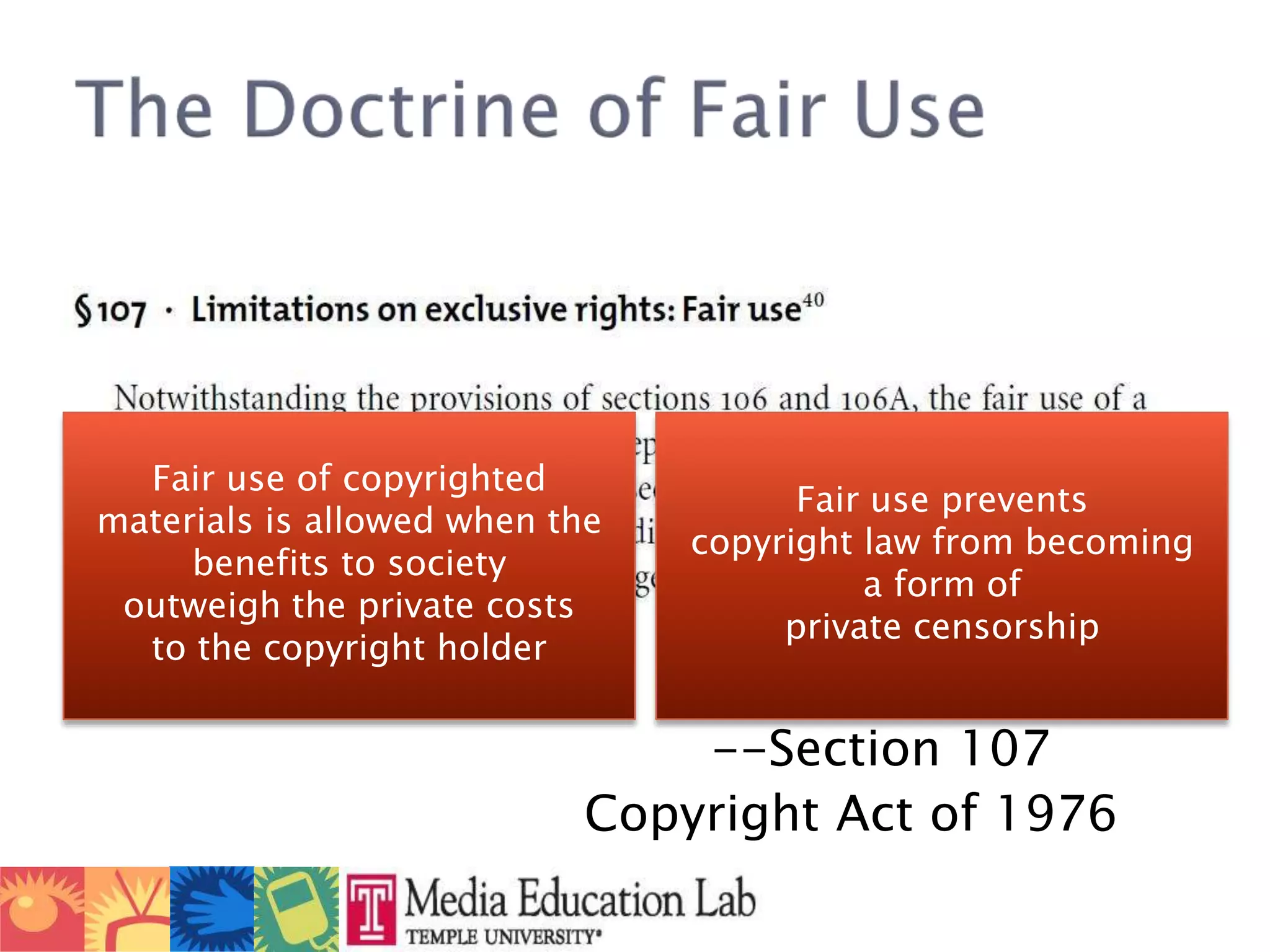
						--Section 107					Copyright Act of 1976The Doctrine of Fair Use
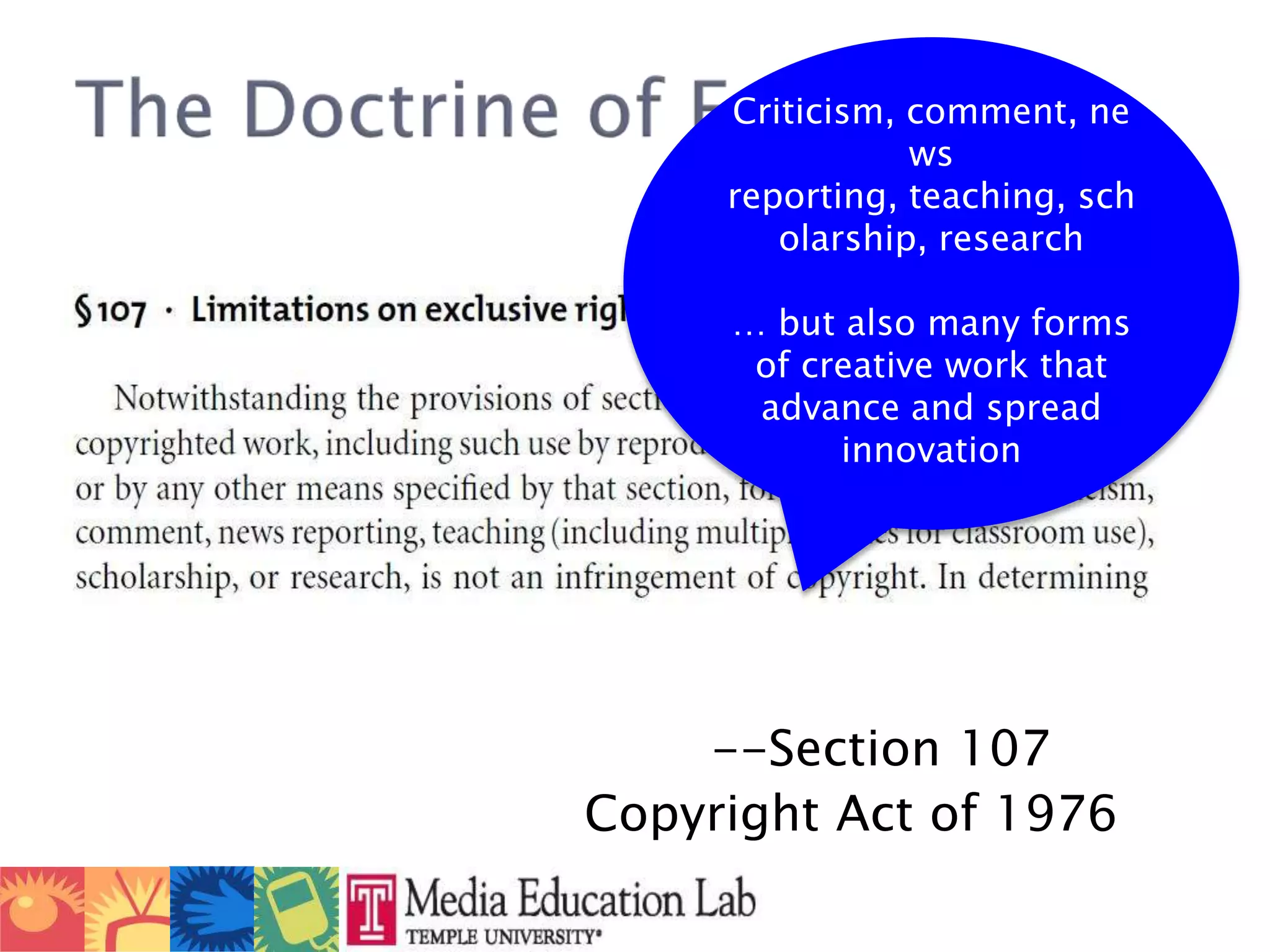
						--Section 107					Copyright Act of 1976The Doctrine of Fair UseCriticism, comment, news reporting, teaching, scholarship, research … but also many forms of creative work that advance and spread innovation
						--Section 107					Copyright Act of 1976The Doctrine of Fair UseFair use of copyrighted materials is allowed when the benefits to society outweigh the private costs to the copyright holderFair use prevents copyright law from becoming a form of private censorship
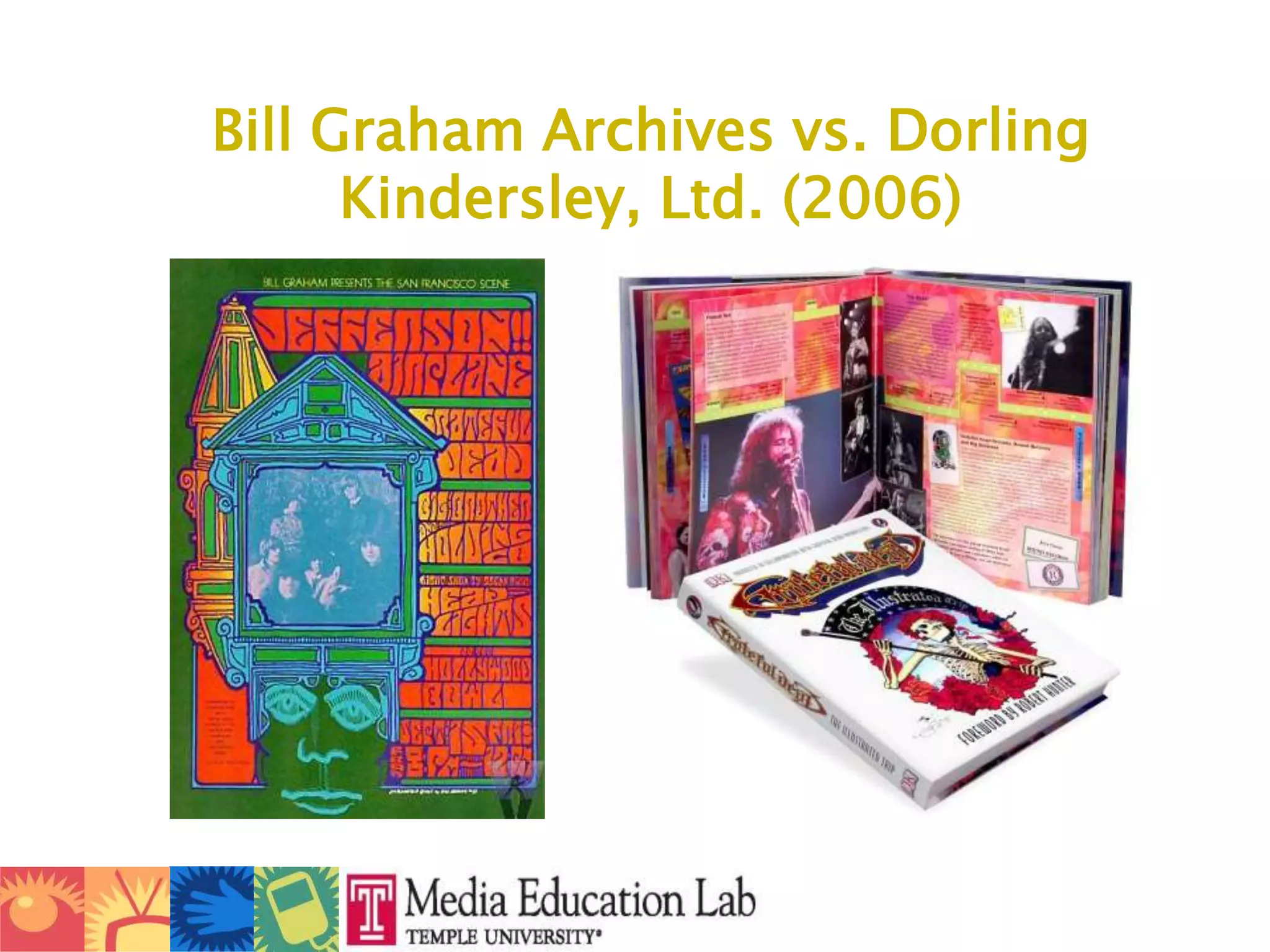
Bill Graham Archives vs. Dorling Kindersley, Ltd. (2006)
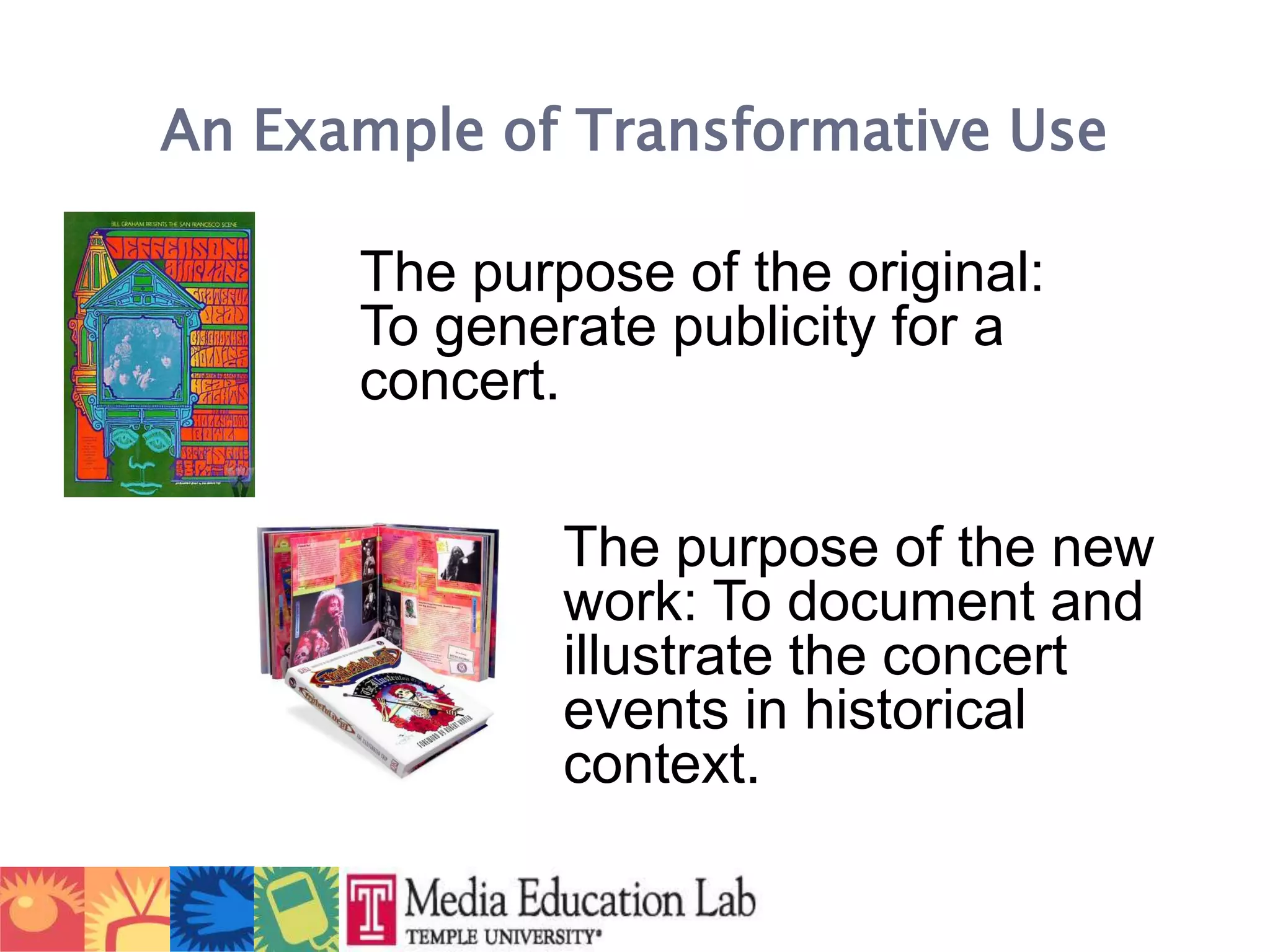
An Example of Transformative Use	The purpose of the original: To generate publicity for a concert.The purpose of the new work: To document and illustrate the concert events in historical context.
Transformative Use is Fair Use    When a user of copyrighted materials adds value to, or repurposes materials for a use different from that for which it was originally intended, it will likely be considered transformative use; it will also likely be considered fair use. Fair use embraces the modifying of existing media content, placing it in new context.  --Joyce Valenza, School Library Journal
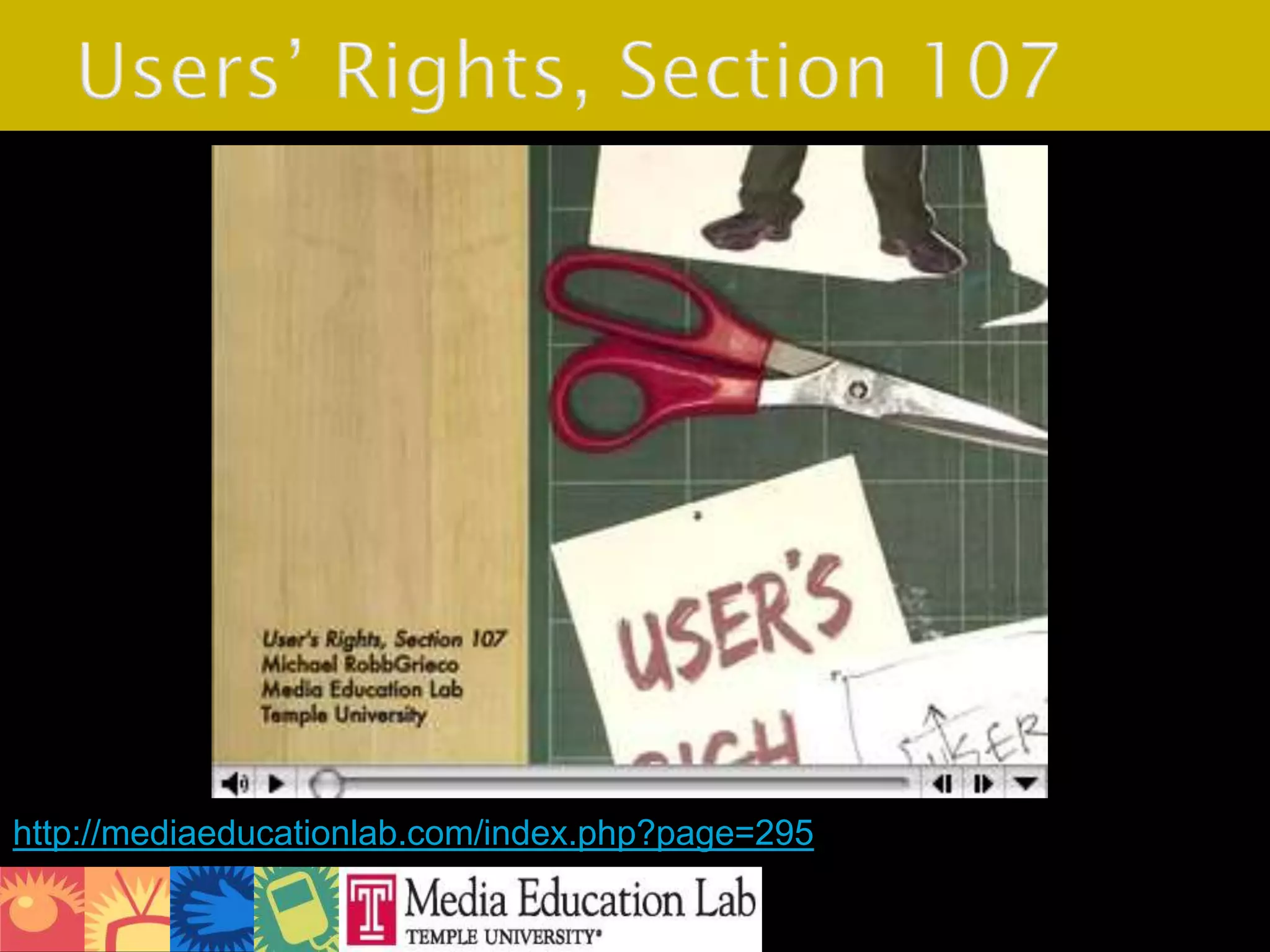
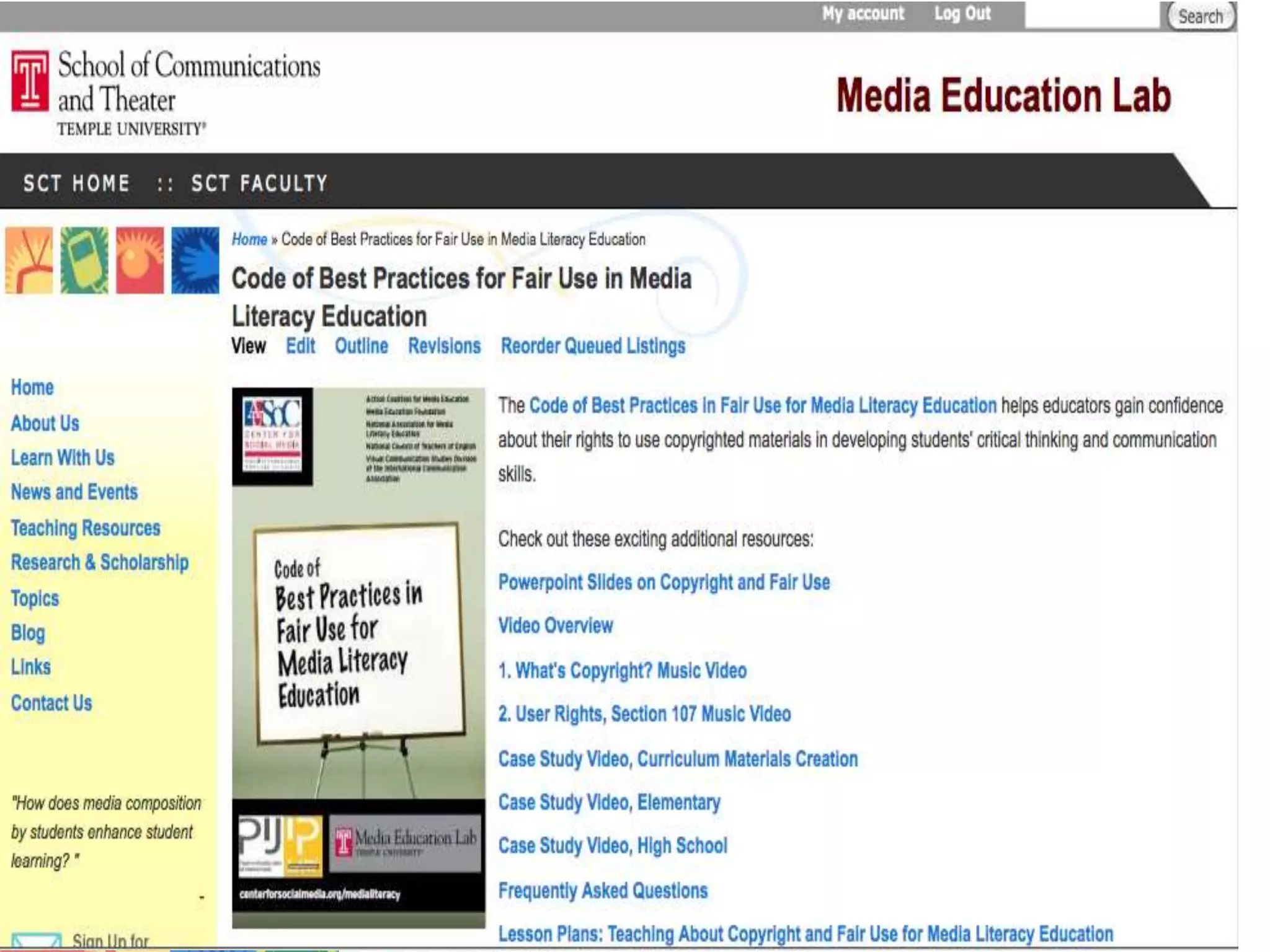
Users’ Rights, Section 107 http://mediaeducationlab.com/index.php?page=295
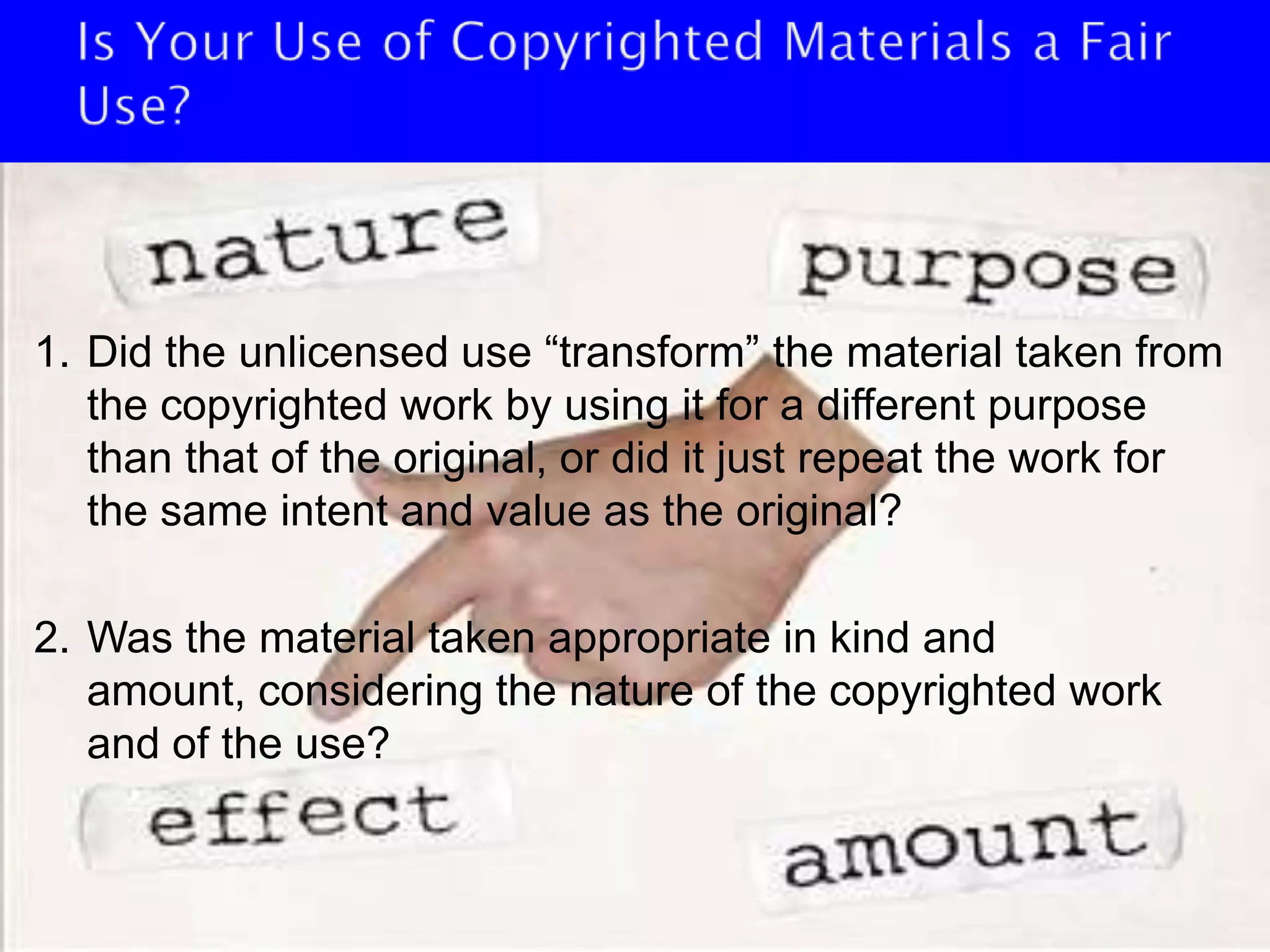
Is Your Use of Copyrighted Materials a Fair Use?Did the unlicensed use “transform” the material taken from the copyrighted work by using it for a different purpose than that of the original, or did it just repeat the work for the same intent and value as the original?Was the material taken appropriate in kind and amount, considering the nature of the copyrighted work and of the use?
Fair Use Is Empowering 	MYTH: 	FAIR USE IS TOO UNCLEAR AND COMPLICATED FOR ME; IT’S BETTER LEFT TO LAWYERS AND ADMINISTRATORS.TRUTH:The fair use provision of the Copyright Act is written broadly because it is designed to apply to a wide range of creative works and the people who use them. Fair use is a part of the law that belongs to everyone.
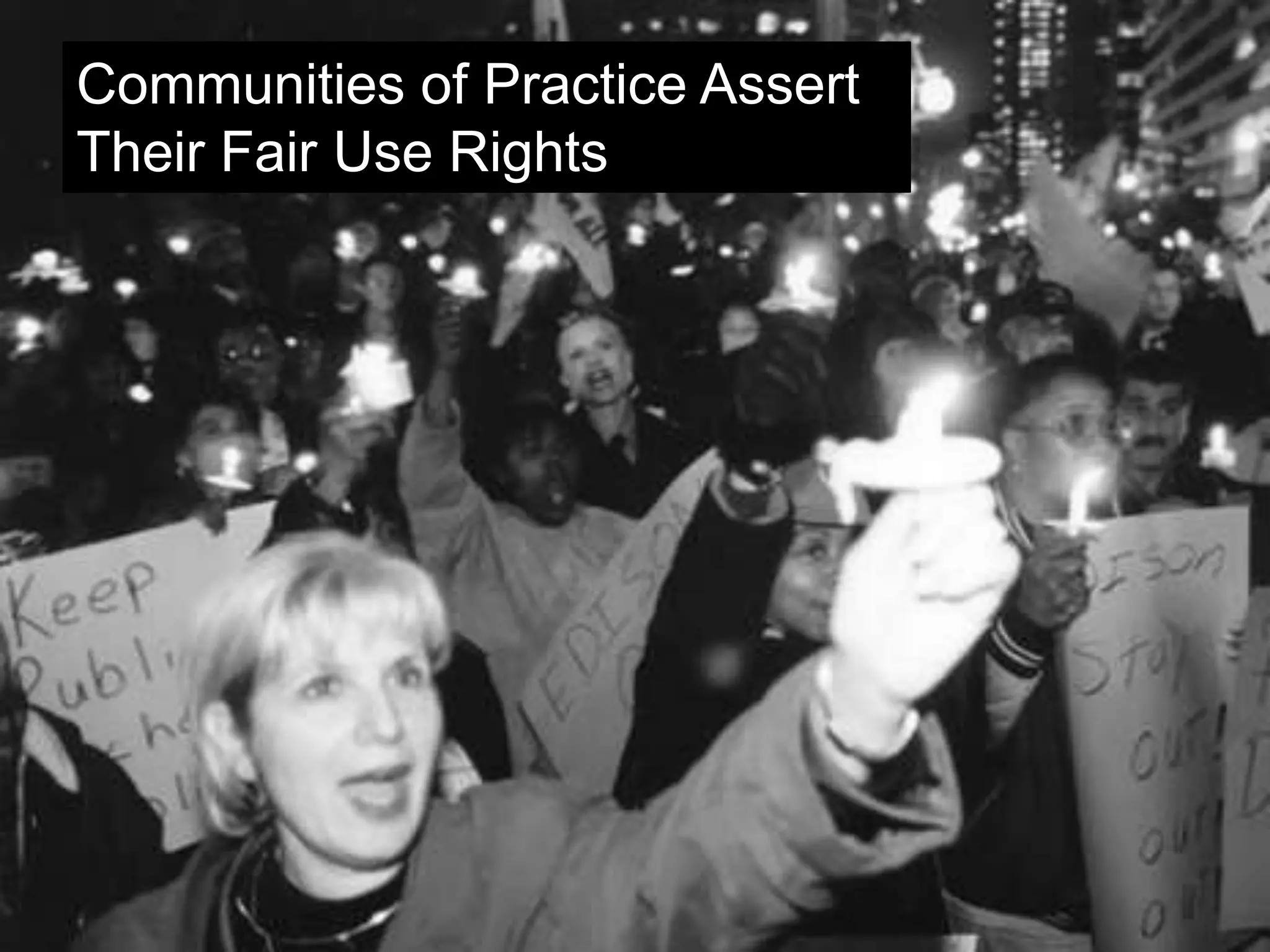
Communities of Practice Assert Their Fair Use Rights
Five Principles Code of Best Practices in Fair Use Educators can:make copies of newspaper articles, TV shows, and other copyrighted works and use them and keep them for educational usecreate curriculum materials and scholarship with copyrighted materials embeddedshare, sell and distribute curriculum materials with copyrighted materials embedded  Learners can:use copyrighted works in creating new materialdistribute their works digitally if they meet the transformativeness standard
The Code of Best Practices Helps To educate educators themselves about how fair use applies to their work
 To persuade gatekeepers, including school      leaders, librarians, and publishers, to accept well-founded assertions of fair use To promote revisions to school policies regarding the use of copyrighted materials that are used in education
 To discourage copyright owners from threatening or bringing lawsuits
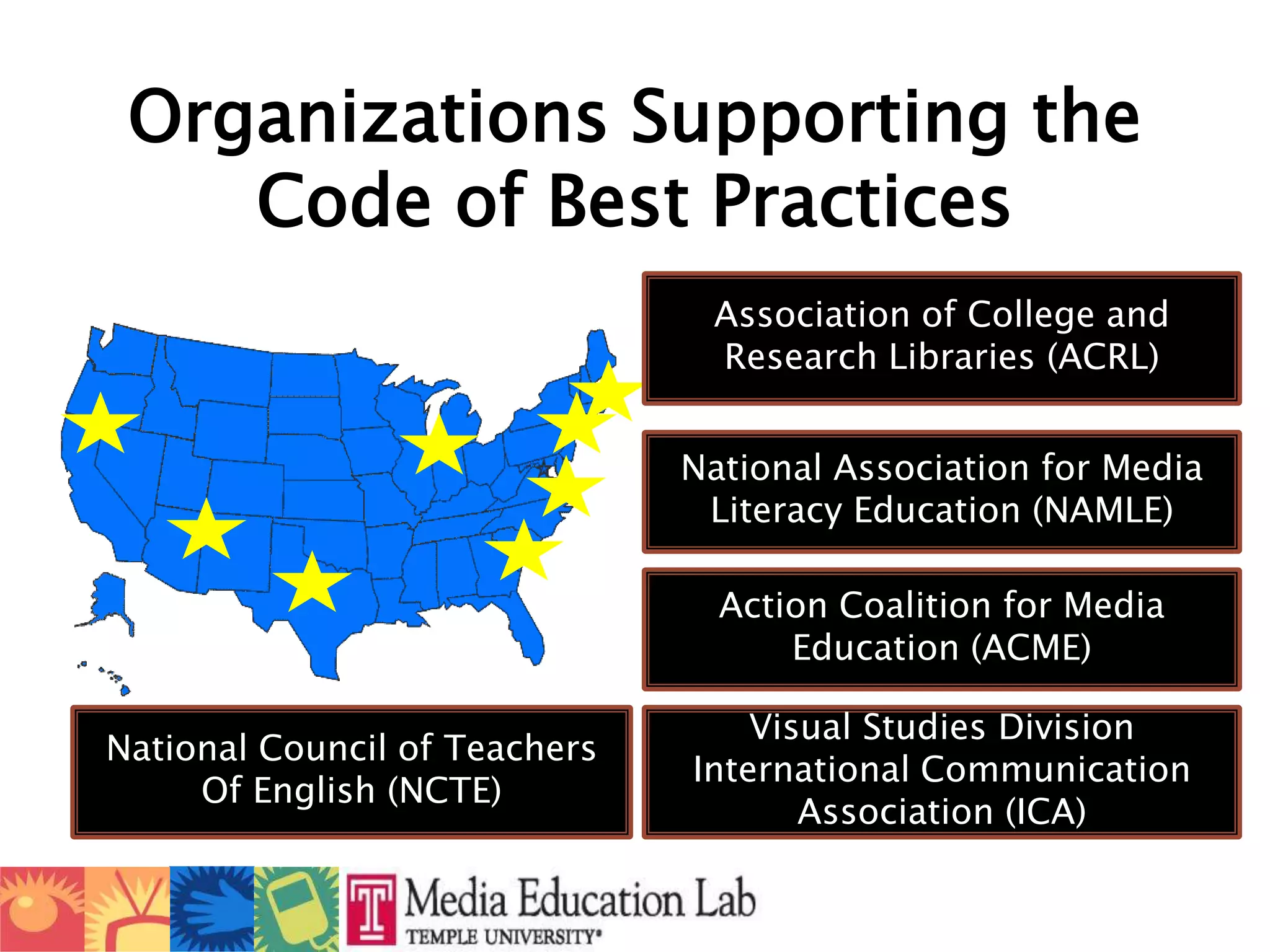
 In the unlikely event that such suits were brought, to provide the defendant with a basis on which to show that her or his uses were both objectively reasonable and undertaken in good faith.Organizations Supporting the Code of Best PracticesAssociation of College and Research Libraries (ACRL)National Association for Media Literacy Education (NAMLE)Action Coalition for Media Education (ACME)National Council of Teachers Of English (NCTE)Visual Studies DivisionInternational Communication Association (ICA)
1201ANTI-CIRCUMVENTION RULEMAKING PROCESSWhen encryption interferes with fair use Digital Millennium Copyright ActDMCA 1201A petition requesting an exemption for media literacy educators and their students
ANTI-CIRCUMVENTION RULEMAKING Digital Millennium Copyright Act
How do copyright and fair use apply to your work?What are the implications of fair use for your students’ composition?FOR REFLECTION
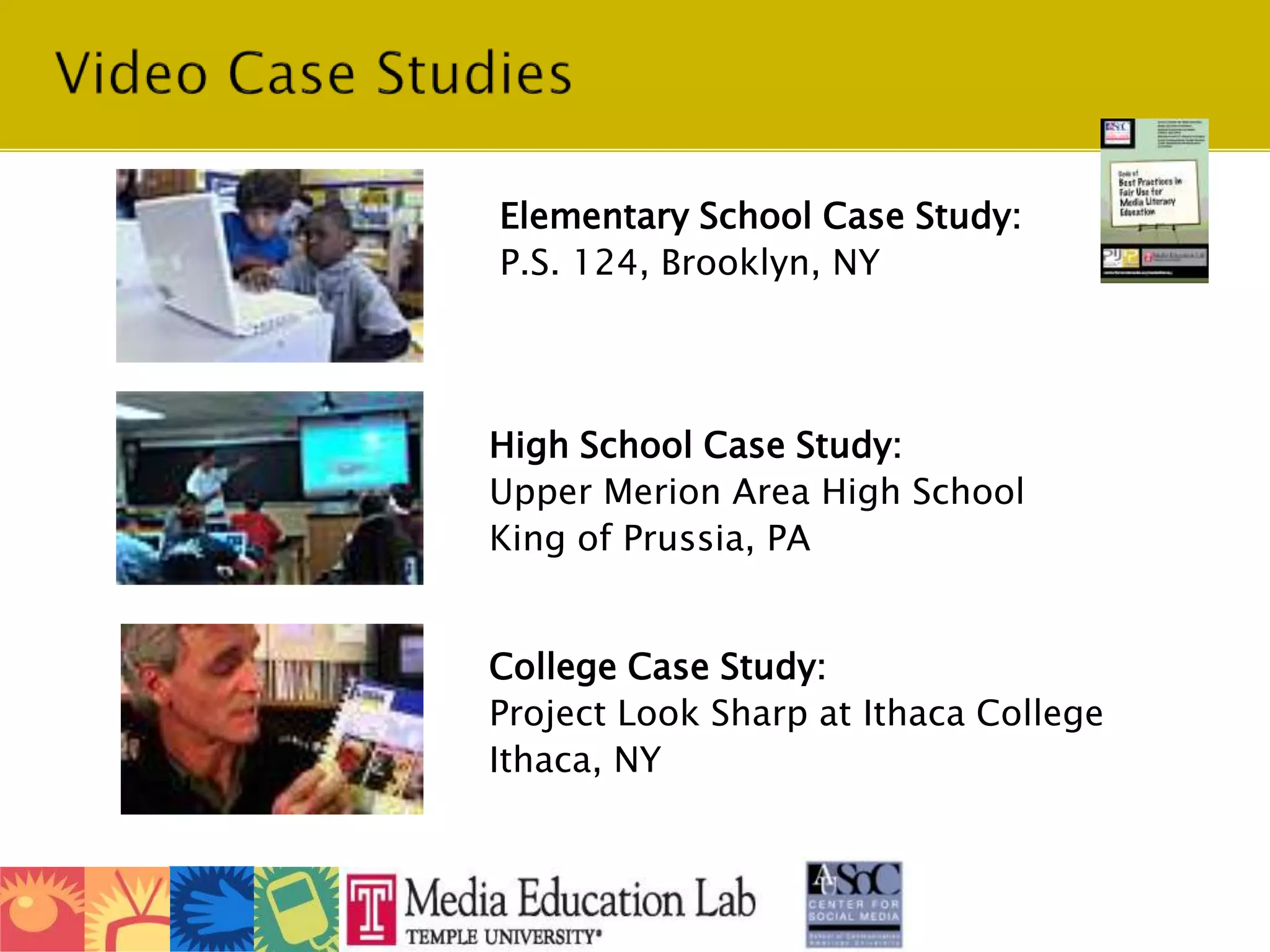
Video Case Studies Elementary School Case Study:P.S. 124, Brooklyn, NYHigh School Case Study:Upper Merion Area High School King of Prussia, PACollege Case Study: Project Look Sharp at Ithaca CollegeIthaca, NY
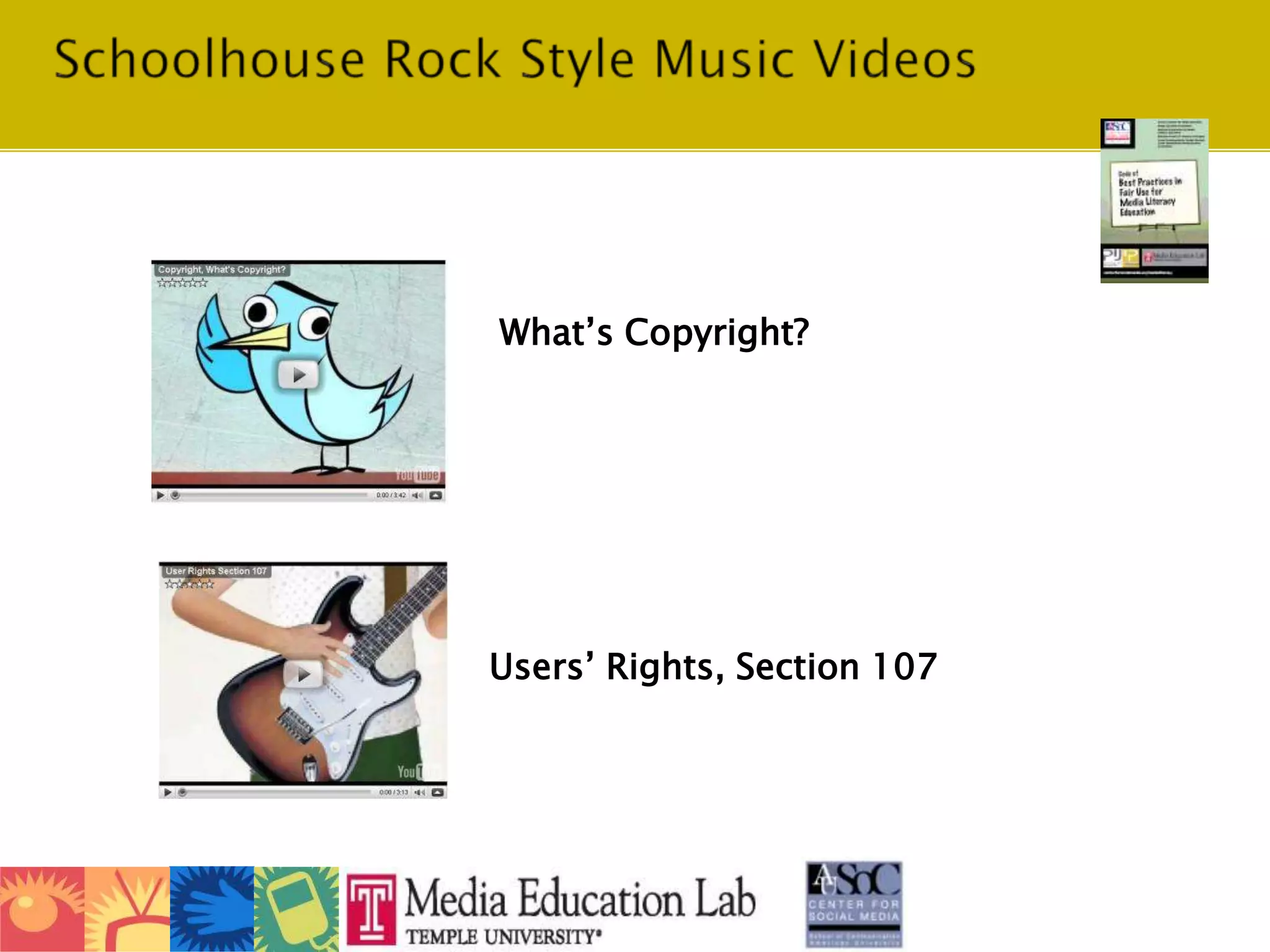
Schoolhouse Rock Style Music VideosWhat’s Copyright?Users’ Rights, Section 107
Practicing the Fair Use Reasoning Processhttp://copyrightconfusion.wikispaces.com

Yes You Can Use Copyrighted Materials

  • 1.
    Yes, You CanUse Copyrighted Materials! Renee HobbsMedia Education LabTemple University
  • 2.
    Strengthening Public Understandingof Copyright and Fair UseSupported by a grant from the John D. and Catherine T. MacArthur Foundation
  • 3.
  • 4.
    What is thepurpose of
  • 5.
    To promote creativity,innovation and the spread of knowledgeArticle 1 Section 8U.S. Constitution
  • 6.
  • 7.
    How We CopeSeeno EvilClose the DoorHyper-Comply
  • 8.
    When I usethe creative work of others in my own work, which concepts apply to my situation?Attribution: Citing your sourcesPlagiarism: Not acknowledging source material used in your workInfringement: Copying another’s work in violation of lawFair Use: Legal use of copyrighted works without permission or paymentLicensing: Asking permission and paying a fee
  • 9.
    Copyright Law BalancesRights of Owners and UsersOWNERSUSERS
  • 10.
    Strengthening Public Understandingof Copyright and Fair UseSupported by a grant from the John D. and Catherine T. MacArthur Foundation
  • 11.
    Problem:Educational Use Guidelinesare Confusing!NEGOTIATED AGREEMENTS BETWEEN MEDIA COMPANIES AND EDUCATIONAL GROUPSAgreement on Guidelines for Classroom Copying in Not-for-Profit Educational InstitutionsFair Use Guidelines for Educational MultimediaGuidelines for the Educational Use of Music
  • 12.
  • 13.
    The documents createdby these negotiated agreements give them “the appearance of positive law. These qualities are merely illusory, and consequently the guidelines have had a seriously detrimental effect. They interfere with an actual understanding of the law and erode confidence in the law as created by Congress and the courts” --Kenneth Crews, 2001Educational Use Guidelinesare NOT the Law!
  • 14.
    It’s time toreplace old knowledgewithaccurate knowledge
  • 15.
    --Section 107 Copyright Actof 1976The Doctrine of Fair Use
  • 16.
    --Section 107 Copyright Actof 1976The Doctrine of Fair UseCriticism, comment, news reporting, teaching, scholarship, research … but also many forms of creative work that advance and spread innovation
  • 17.
    --Section 107 Copyright Actof 1976The Doctrine of Fair UseFair use of copyrighted materials is allowed when the benefits to society outweigh the private costs to the copyright holderFair use prevents copyright law from becoming a form of private censorship
  • 18.
    Bill Graham Archivesvs. Dorling Kindersley, Ltd. (2006)
  • 19.
    An Example ofTransformative Use The purpose of the original: To generate publicity for a concert.The purpose of the new work: To document and illustrate the concert events in historical context.
  • 20.
    Transformative Use isFair Use When a user of copyrighted materials adds value to, or repurposes materials for a use different from that for which it was originally intended, it will likely be considered transformative use; it will also likely be considered fair use. Fair use embraces the modifying of existing media content, placing it in new context.  --Joyce Valenza, School Library Journal
  • 21.
    Users’ Rights, Section107 http://mediaeducationlab.com/index.php?page=295
  • 22.
    Is Your Useof Copyrighted Materials a Fair Use?Did the unlicensed use “transform” the material taken from the copyrighted work by using it for a different purpose than that of the original, or did it just repeat the work for the same intent and value as the original?Was the material taken appropriate in kind and amount, considering the nature of the copyrighted work and of the use?
  • 23.
    Fair Use IsEmpowering MYTH: FAIR USE IS TOO UNCLEAR AND COMPLICATED FOR ME; IT’S BETTER LEFT TO LAWYERS AND ADMINISTRATORS.TRUTH:The fair use provision of the Copyright Act is written broadly because it is designed to apply to a wide range of creative works and the people who use them. Fair use is a part of the law that belongs to everyone.
  • 24.
    Communities of PracticeAssert Their Fair Use Rights
  • 25.
    Five Principles Codeof Best Practices in Fair Use Educators can:make copies of newspaper articles, TV shows, and other copyrighted works and use them and keep them for educational usecreate curriculum materials and scholarship with copyrighted materials embeddedshare, sell and distribute curriculum materials with copyrighted materials embedded Learners can:use copyrighted works in creating new materialdistribute their works digitally if they meet the transformativeness standard
  • 26.
    The Code ofBest Practices Helps To educate educators themselves about how fair use applies to their work
  • 27.
    To persuadegatekeepers, including school leaders, librarians, and publishers, to accept well-founded assertions of fair use To promote revisions to school policies regarding the use of copyrighted materials that are used in education
  • 28.
    To discouragecopyright owners from threatening or bringing lawsuits
  • 29.
    In theunlikely event that such suits were brought, to provide the defendant with a basis on which to show that her or his uses were both objectively reasonable and undertaken in good faith.Organizations Supporting the Code of Best PracticesAssociation of College and Research Libraries (ACRL)National Association for Media Literacy Education (NAMLE)Action Coalition for Media Education (ACME)National Council of Teachers Of English (NCTE)Visual Studies DivisionInternational Communication Association (ICA)
  • 30.
    1201ANTI-CIRCUMVENTION RULEMAKING PROCESSWhenencryption interferes with fair use Digital Millennium Copyright ActDMCA 1201A petition requesting an exemption for media literacy educators and their students
  • 31.
  • 32.
    How do copyrightand fair use apply to your work?What are the implications of fair use for your students’ composition?FOR REFLECTION
  • 34.
    Video Case StudiesElementary School Case Study:P.S. 124, Brooklyn, NYHigh School Case Study:Upper Merion Area High School King of Prussia, PACollege Case Study: Project Look Sharp at Ithaca CollegeIthaca, NY
  • 35.
    Schoolhouse Rock StyleMusic VideosWhat’s Copyright?Users’ Rights, Section 107
  • 36.
    Practicing the FairUse Reasoning Processhttp://copyrightconfusion.wikispaces.com
  • 37.
  • 38.
    Media Education Labhttp://mediaeducationlab.comContact:Professor Renee HobbsTemple UniversitySchool of Communication and TheaterMedia Education LabPhiladelphia, PAEmail: renee.hobbs@temple.eduPhone: 215 204-4291

Editor's Notes

  • #3 Pass out code during video
  • #11 Pass out code during video