RHS Level 2
Certificate
Year 2 Week 9 – Hydroponics.
Review of soil water and of nutrients
and pH.
Learning Outcomes –
Hydroponics
 State what is meant by the term hydroponics.
 Explain the role of aeration, nutrient supply, nutrient levels
and pH control, water supply and quality, pest and disease
control and automation in hydroponic culture.
 Describe TWO methods of growing plants in water culture,
to include: NFT (nutrient film technique), substrate culture
(rockwool).
 State the situations in which water culture can be used, to
include: green walls, vegetable production (tomatoes –
detail week 11), interior landscaping (house plants - in week
14) .
 Identify the environmental implications of growing plants in
water culture.
Learning objectives –
Review
 To identify the three main macro nutrients and their
deficiency symptoms
 To identify two micro nutrients and their deficiency
symptoms.
 To identify the importance of soil and leaf testing for
nutrient deficiency.
 To state the mechanism of CEC
 To define pH correctly
 To identify the effect of pH on nutrient availability for
specific nutrients
 To state that excess of certain nutrients may make others
unavailable
 To apply this knowledge to the diagnosis of plant
problems
Hydroponics
 Growing plants in a pH adjusted solution of
water and nutrients.
 Any rooting media – and this is not always
present – provides only anchorage/ oxygen.
 Usually used in protected environments.
 Provides precise control of nutrient availability
and pH for the selected plant species.
 Water availability is never a problem.
Provision of oxygen for roots must be
addressed.
Nutrient Film Technique
(NFT)
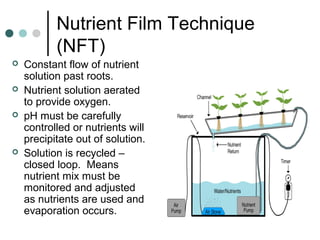
 Constant flow of nutrient
solution past roots.
 Nutrient solution aerated
to provide oxygen.
 pH must be carefully
controlled or nutrients will
precipitate out of solution.
 Solution is recycled –
closed loop. Means
nutrient mix must be
monitored and adjusted
as nutrients are used and
evaporation occurs.
Substrate technique
(rockwool)
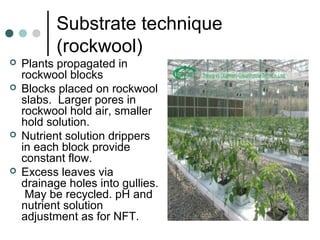
 Plants propagated in
rockwool blocks
 Blocks placed on rockwool
slabs. Larger pores in
rockwool hold air, smaller
hold solution.
 Nutrient solution drippers
in each block provide
constant flow.
 Excess leaves via
drainage holes into gullies.
May be recycled. pH and
nutrient solution
adjustment as for NFT.
Green walls
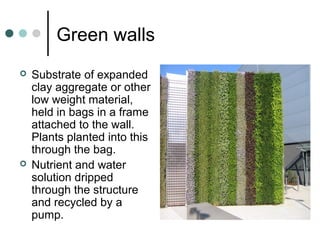
 Substrate of expanded
clay aggregate or other
low weight material,
held in bags in a frame
attached to the wall.
Plants planted into this
through the bag.
 Nutrient and water
solution dripped
through the structure
and recycled by a
pump.
Environmental issues
 Water use – if not recycled hydroponics is
wasteful of water.
 Pollution – if not recycled nutrient solution is
potentially harmful for soils and ground
water/watercourses (if drained to waste).
 Pollution – used substrate materials may not
readily biodegrade and contain high levels of
nutrient salts. Risk of soil contamination if
dumped.
 Benefits – increases production for a given area
of land (potentially freeing land for natural
ecosystems), green walls useful for cooling and
cleaning air in cities.
Plant nutrient review -
macronutrients
 Nitrogen – used by plants in two forms.
Ammonium (cation) and nitrogen (anion). Vital
for green, leafy growth – deficiency symptom
yellowing of older leaves first.
 Phosphorous – vital for root development and
germination. Deficiency symptoms – stunted
growth and bluish/purple tinged leaves.
 Potassium – vital for fruiting and flowering and
hardiness. Deficiency symptom – brown, often
curling edges to leaves, poor flowering and
fruiting.
Plant nutrient review – key
micronutrients
 Iron – vital component of chlorophyll.
Deficiency symptoms – interveinal chlorosis,
younger leaves.
 Calcium – vital component of cell walls.
Deficiency symptom – ‘bitter pit’ in apples,
‘blossom end rot’ in tomatoes, black spots on
leaves.
Review Question answers
1. Removal by humans (harvest, cleaning up) –
composting, feeding with nitrogen fertilizer. pH – too
acidic or too alkaline. Adjust with lime or sulphur.
Used by plant growth – feed the soil, adjust planting
density.
2. Because nutrient presence in the soil may not mean it
is available to the plant or that the plant can take it
up. A leaf test may also be required.
3. Nitrogen – older leaves first because the plant can
move nitrogen from plant tissues in the event of
deficiency.
4. To the amounts needed by the plant not to the
importance of the nutrients.
Cation Exchange Capacity
 Clay and humus particles have a negative
surface charge.
 Certain nutrient (and other) ions found in soil
water have a positive charge (cations).
 Negative charges attract positive charges, so
holding these ions in the soil.
 Which cations are held depends on their
relative concentrations in the soil water. The
higher the concentration of an ion the more
likely it is to be held by a given soil particle.
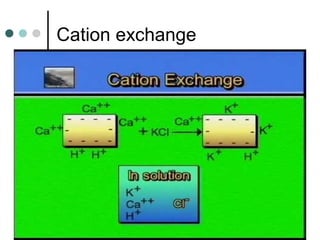
What is cation exchange?
 The ability of one cation to displace
another from the negative charge site
on the clay or humus particle.
 This means that the nutrient cations
can become available to the plant as
they are displaced.
Cation exchange
Soil pH
 A measure of how acid or alkaline a soil is.
Technically a measure of concentration of
hydrogen ions.
 Scale runs 1 – 14 where 1 is very acid, 14
very alkaline
 Plants grow best (with some exceptions) in
the range 6.5 -7.5
Soil pH scale
 Logarithmic scale – each point is 10
times greater than the one before. So
pH 7 is 0 (balanced), pH 6 is ten times
more acidic, pH 5 is 100 times more
acidic (10 x 10), pH 4 is 1000 times
more acidic (10 x 100) etc. Alkaline
soils are less acidic so pH 8 is 10
times less acidic than pH7 etc.
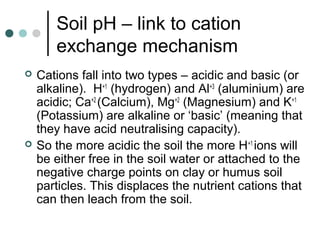
Soil pH – link to cation
exchange mechanism
 Cations fall into two types – acidic and basic (or
alkaline). H+1
(hydrogen) and Al+3
(aluminium) are
acidic; Ca+2
(Calcium), Mg+2
(Magnesium) and K+1
(Potassium) are alkaline or ‘basic’ (meaning that
they have acid neutralising capacity).
 So the more acidic the soil the more H+1
ions will
be either free in the soil water or attached to the
negative charge points on clay or humus soil
particles. This displaces the nutrient cations that
can then leach from the soil.
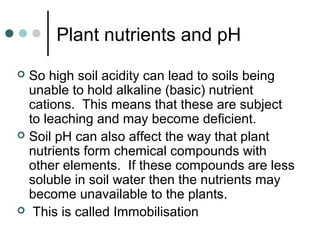
Plant nutrients and pH
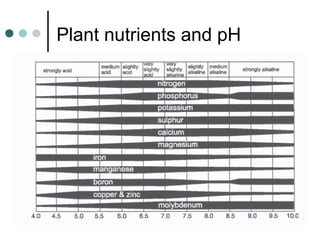
 So high soil acidity can lead to soils being
unable to hold alkaline (basic) nutrient
cations. This means that these are subject
to leaching and may become deficient.
 Soil pH can also affect the way that plant
nutrients form chemical compounds with
other elements. If these compounds are less
soluble in soil water then the nutrients may
become unavailable to the plants.
 This is called Immobilisation
Plant nutrients and pH
pH Worksheet answers
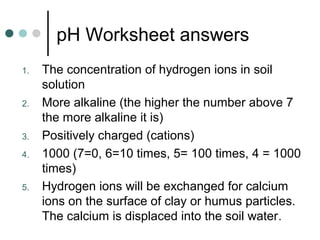
1. The concentration of hydrogen ions in soil
solution
2. More alkaline (the higher the number above 7
the more alkaline it is)
3. Positively charged (cations)
4. 1000 (7=0, 6=10 times, 5= 100 times, 4 = 1000
times)
5. Hydrogen ions will be exchanged for calcium
ions on the surface of clay or humus particles.
The calcium is displaced into the soil water.
pH worksheet answers
6. Iron
7. If the level of iron in the soil is within normal
limits and the soil is acidic then the likely cause
is an over application of phosphates at some
point which have formed an insoluble
compound.
8. Nitrogen deficiency. Either the soil lacks
nitrogen because no N fertilizer or organic
matter has been applied for some time or the
soil pH is below about 5 or above 8.5. To tell
which it is carry out a soil nutrient test for N and
a pH test.
Learning Outcomes –
Hydroponics
 State what is meant by the term hydroponics.
 Explain the role of aeration, nutrient supply, nutrient levels
and pH control, water supply and quality, pest and disease
control and automation in hydroponic culture.
 Describe TWO methods of growing plants in water culture,
to include: NFT (nutrient film technique), substrate culture
(rockwool).
 State the situations in which water culture can be used, to
include: green walls, vegetable production (tomatoes –
detail week 11), interior landscaping (house plants - in week
14) .
 Identify the environmental implications of growing plants in
water culture.
Learning Outcomes
 To identify the three main macro nutrients and their
deficiency symptoms
 To identify two micro nutrients and their deficiency
symptoms.
 To identify the importance of soil and leaf testing for
nutrient deficiency.
 To state the mechanism of CEC
 To define pH correctly
 To identify the effect of pH on nutrient availability for
specific nutrients
 To state that excess of certain nutrients may make others
unavailable
 To apply this knowledge to the diagnosis of plant
problems

Year 2 week 9 presentation 2016

  • 1.
    RHS Level 2 Certificate Year2 Week 9 – Hydroponics. Review of soil water and of nutrients and pH.
  • 2.
    Learning Outcomes – Hydroponics State what is meant by the term hydroponics.  Explain the role of aeration, nutrient supply, nutrient levels and pH control, water supply and quality, pest and disease control and automation in hydroponic culture.  Describe TWO methods of growing plants in water culture, to include: NFT (nutrient film technique), substrate culture (rockwool).  State the situations in which water culture can be used, to include: green walls, vegetable production (tomatoes – detail week 11), interior landscaping (house plants - in week 14) .  Identify the environmental implications of growing plants in water culture.
  • 3.
    Learning objectives – Review To identify the three main macro nutrients and their deficiency symptoms  To identify two micro nutrients and their deficiency symptoms.  To identify the importance of soil and leaf testing for nutrient deficiency.  To state the mechanism of CEC  To define pH correctly  To identify the effect of pH on nutrient availability for specific nutrients  To state that excess of certain nutrients may make others unavailable  To apply this knowledge to the diagnosis of plant problems
  • 4.
    Hydroponics  Growing plantsin a pH adjusted solution of water and nutrients.  Any rooting media – and this is not always present – provides only anchorage/ oxygen.  Usually used in protected environments.  Provides precise control of nutrient availability and pH for the selected plant species.  Water availability is never a problem. Provision of oxygen for roots must be addressed.
  • 5.
    Nutrient Film Technique (NFT) Constant flow of nutrient solution past roots.  Nutrient solution aerated to provide oxygen.  pH must be carefully controlled or nutrients will precipitate out of solution.  Solution is recycled – closed loop. Means nutrient mix must be monitored and adjusted as nutrients are used and evaporation occurs.
  • 6.
    Substrate technique (rockwool)  Plantspropagated in rockwool blocks  Blocks placed on rockwool slabs. Larger pores in rockwool hold air, smaller hold solution.  Nutrient solution drippers in each block provide constant flow.  Excess leaves via drainage holes into gullies. May be recycled. pH and nutrient solution adjustment as for NFT.
  • 7.
    Green walls  Substrateof expanded clay aggregate or other low weight material, held in bags in a frame attached to the wall. Plants planted into this through the bag.  Nutrient and water solution dripped through the structure and recycled by a pump.
  • 8.
    Environmental issues  Wateruse – if not recycled hydroponics is wasteful of water.  Pollution – if not recycled nutrient solution is potentially harmful for soils and ground water/watercourses (if drained to waste).  Pollution – used substrate materials may not readily biodegrade and contain high levels of nutrient salts. Risk of soil contamination if dumped.  Benefits – increases production for a given area of land (potentially freeing land for natural ecosystems), green walls useful for cooling and cleaning air in cities.
  • 9.
    Plant nutrient review- macronutrients  Nitrogen – used by plants in two forms. Ammonium (cation) and nitrogen (anion). Vital for green, leafy growth – deficiency symptom yellowing of older leaves first.  Phosphorous – vital for root development and germination. Deficiency symptoms – stunted growth and bluish/purple tinged leaves.  Potassium – vital for fruiting and flowering and hardiness. Deficiency symptom – brown, often curling edges to leaves, poor flowering and fruiting.
  • 10.
    Plant nutrient review– key micronutrients  Iron – vital component of chlorophyll. Deficiency symptoms – interveinal chlorosis, younger leaves.  Calcium – vital component of cell walls. Deficiency symptom – ‘bitter pit’ in apples, ‘blossom end rot’ in tomatoes, black spots on leaves.
  • 11.
    Review Question answers 1.Removal by humans (harvest, cleaning up) – composting, feeding with nitrogen fertilizer. pH – too acidic or too alkaline. Adjust with lime or sulphur. Used by plant growth – feed the soil, adjust planting density. 2. Because nutrient presence in the soil may not mean it is available to the plant or that the plant can take it up. A leaf test may also be required. 3. Nitrogen – older leaves first because the plant can move nitrogen from plant tissues in the event of deficiency. 4. To the amounts needed by the plant not to the importance of the nutrients.
  • 12.
    Cation Exchange Capacity Clay and humus particles have a negative surface charge.  Certain nutrient (and other) ions found in soil water have a positive charge (cations).  Negative charges attract positive charges, so holding these ions in the soil.  Which cations are held depends on their relative concentrations in the soil water. The higher the concentration of an ion the more likely it is to be held by a given soil particle.
  • 13.
    What is cationexchange?  The ability of one cation to displace another from the negative charge site on the clay or humus particle.  This means that the nutrient cations can become available to the plant as they are displaced.
  • 14.
  • 15.
    Soil pH  Ameasure of how acid or alkaline a soil is. Technically a measure of concentration of hydrogen ions.  Scale runs 1 – 14 where 1 is very acid, 14 very alkaline  Plants grow best (with some exceptions) in the range 6.5 -7.5
  • 16.
    Soil pH scale Logarithmic scale – each point is 10 times greater than the one before. So pH 7 is 0 (balanced), pH 6 is ten times more acidic, pH 5 is 100 times more acidic (10 x 10), pH 4 is 1000 times more acidic (10 x 100) etc. Alkaline soils are less acidic so pH 8 is 10 times less acidic than pH7 etc.
  • 17.
    Soil pH –link to cation exchange mechanism  Cations fall into two types – acidic and basic (or alkaline). H+1 (hydrogen) and Al+3 (aluminium) are acidic; Ca+2 (Calcium), Mg+2 (Magnesium) and K+1 (Potassium) are alkaline or ‘basic’ (meaning that they have acid neutralising capacity).  So the more acidic the soil the more H+1 ions will be either free in the soil water or attached to the negative charge points on clay or humus soil particles. This displaces the nutrient cations that can then leach from the soil.
  • 18.
    Plant nutrients andpH  So high soil acidity can lead to soils being unable to hold alkaline (basic) nutrient cations. This means that these are subject to leaching and may become deficient.  Soil pH can also affect the way that plant nutrients form chemical compounds with other elements. If these compounds are less soluble in soil water then the nutrients may become unavailable to the plants.  This is called Immobilisation
  • 19.
  • 20.
    pH Worksheet answers 1.The concentration of hydrogen ions in soil solution 2. More alkaline (the higher the number above 7 the more alkaline it is) 3. Positively charged (cations) 4. 1000 (7=0, 6=10 times, 5= 100 times, 4 = 1000 times) 5. Hydrogen ions will be exchanged for calcium ions on the surface of clay or humus particles. The calcium is displaced into the soil water.
  • 21.
    pH worksheet answers 6.Iron 7. If the level of iron in the soil is within normal limits and the soil is acidic then the likely cause is an over application of phosphates at some point which have formed an insoluble compound. 8. Nitrogen deficiency. Either the soil lacks nitrogen because no N fertilizer or organic matter has been applied for some time or the soil pH is below about 5 or above 8.5. To tell which it is carry out a soil nutrient test for N and a pH test.
  • 22.
    Learning Outcomes – Hydroponics State what is meant by the term hydroponics.  Explain the role of aeration, nutrient supply, nutrient levels and pH control, water supply and quality, pest and disease control and automation in hydroponic culture.  Describe TWO methods of growing plants in water culture, to include: NFT (nutrient film technique), substrate culture (rockwool).  State the situations in which water culture can be used, to include: green walls, vegetable production (tomatoes – detail week 11), interior landscaping (house plants - in week 14) .  Identify the environmental implications of growing plants in water culture.
  • 23.
    Learning Outcomes  Toidentify the three main macro nutrients and their deficiency symptoms  To identify two micro nutrients and their deficiency symptoms.  To identify the importance of soil and leaf testing for nutrient deficiency.  To state the mechanism of CEC  To define pH correctly  To identify the effect of pH on nutrient availability for specific nutrients  To state that excess of certain nutrients may make others unavailable  To apply this knowledge to the diagnosis of plant problems