It's Alive !!
● Soil is our greatest resource
● It's alive, as opposed to “dirt”
● It's part of the food web as part of the three-way
relationship with soil organisms and plants
● It's considered the most complex of all habitats
Soil
Soil is a mantle of weathered rock, which, when
combined with organic matter, contains minerals
and nutrients capable of supporting plant growth.
Soil forms as the rock minerals and organic matter
interact with climate, living organisms and
topography over time.
Soil Composition
Minerals
Organic
Matter
Air
Water
Minerals
● Gravel, pebbles, rocks
● Sand
● Silt
● Clay
Soil Texture
● Relative amounts of clay,silt, sand determine
your soil texture.
● Ideally – 40% sand, 40% silt, 20% clay make up
the 45% mineral portion of soil
● This is the gardener's holy grail called LOAM.
Size Matters
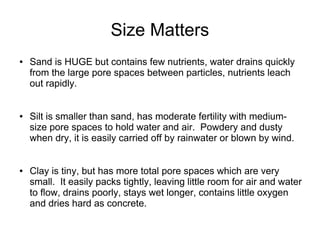
● Sand is HUGE but contains few nutrients, water drains quickly
from the large pore spaces between particles, nutrients leach
out rapidly.
● Silt is smaller than sand, has moderate fertility with medium-
size pore spaces to hold water and air. Powdery and dusty
when dry, it is easily carried off by rainwater or blown by wind.
● Clay is tiny, but has more total pore spaces which are very
small. It easily packs tightly, leaving little room for air and water
to flow, drains poorly, stays wet longer, contains little oxygen
and dries hard as concrete.
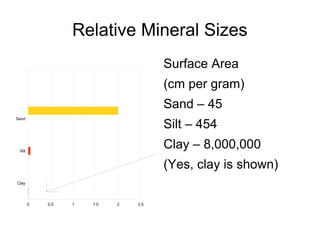
Relative Mineral Sizes
Clay
Silt
Sand
0 0.5 1 1.5 2 2.5
Surface Area
(cm per gram)
Sand – 45
Silt – 454
Clay – 8,000,000
(Yes, clay is shown)
How does this affect the availability
of Nutrients?
● The absorbtion of water, nutrients and gases are
all surface phenomena
● The greater the surface area of the soil particles,
the greater the absorbtion
● Clay has many, many times the surface area per
unit of volume to absorb and hold water,
nutrients and gases than silt or sand! Yea, clay!
That 5% Organic Matter
● Decayed plants and animals, animal matter
● Provides a major food source for all the
microorganisms living in the soil
Marvelous Organisms
● Soil is THE most abundant ecosystem on Earth
● Estimate between 500,000 to over a billion
organisms per teaspoon of good soil!
● Macrofauna from badgers down to ants,
including rabbits, gophers, slugs, moles,
earthworms and millipedes affect soil structure
by burrowing
● Mesofauna – arthropods, collembolla and
enchytraeids – tiny organisms scavenge dead
organic matter, eat bacteria, fungi and algae
● Microfauna and microflora – really, really tiny
creatures that play the final role of converting
plant debris back into plant nutrients and in
making the nutrients and water available to
plants.
● Microfauna include nematodes and protozoa
● Microflora include bacteria, fungi and viruses,
all of which take part in weathering of rocks and
minerals, breakdown of organic matter and
many aspects of the nutrient cycle.
● All this activity effects the rate of chemical
exchanges which draw nutrients and water from
the soil into the plant roots
● Worms and 97% of insects are gardeners'
friends.
– Feed on organic matter and then disperse it though
the soil
– Speed up composting process
Bringing it Home to our Garden Soil
● Garden soil is ever evolving and never perfect!
● As crops and flowers are harvested, the soil
gradually becomes depleted of essential
nutrients.
● Soils can be improved in a number of ways,
depending on the soil type in the garden.
Soil Testing
● To determine the soil's nutrient content
Too much of this nutrient or too little of that, and
we have problems!
● To determine the soil's pH level
The right pH enables plants to use nutrients from
the soil most efficiently.
Nutrients Essential to Plants
● Essential for growth and development
● Each element is essential because no other
element can substitute for it in all it's functions
● Plants cannot complete their life cycle without
these nutrients.
● Non-soil nutrients come from the atmosphere:
Hydrogen, Carbon and Oxygen
Essential Soil Nutrients
● Major
– Nitrogen (for growth of stems and leaves)
– Phosphorus (germination, flowering and fruiting)
– Potassium (roots, disease-resistance growth)
● Secondary
– Magnesium (chlorophyll, sugars and starches)
– Sulfur (chlorophyll production, oil content)
– Calcium (development of terminal buds and roots)
Minor and Trace Soil Nutrients
● Chlorine (roots, water
retention)
● Iron (chlorophyll)
● Manganese
(chlorophyll)
● Boron (solid, well-
formed fruit)
● Zinc (more fruit)
● Copper (leaf
unfolding)
● Molybdenum (roots)
● Sodium
● Cobalt
● Silicon
● Selenium
● Nickel
Soil tests will measure all the nutrients present in
the sample and make recommendations for
fertilizing to cure deficiencies.
Soil tests will also tell us the pH value of the
sample.
The pH Scale
● Symbolizes the hydrogen ion concentration in a
solution
● Ranges from 1 to 14
● 7 is “neutral”, like water
● Less than 7 = acidic
● Greater than 7 = base
● Each pH unit represents a 10x increase in
hydrogen ion concentration! This affects how
much of a nutrients must be added to raise or
lower pH.
pH levels
● “low pH”
0 Hydrocloric Acid
1 Stomach Acid
2 Lemon juice
3 Cola, beer, vinegar
4 Tomatoes
4.5 Fish die in water this
acidic
5 Coffee
6 Urine
6.5 Saliva
● “higher pH”
7 (neutral) water
7.5 Human blood
8 Seawater
9 Baking soda, antacids
10 Great Salt Lake
11 Ammonia
12 Bicarbonate of soda
13 Oven cleaner
14 Sodium hydroxide
(lye)
Why is pH Important?
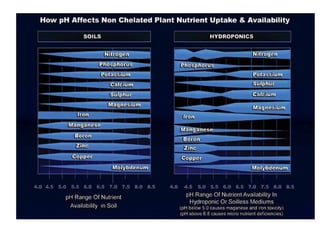
● It greatly affects the availability of each nutrient
to the plants' roots.
● Too low pH suppresses: nitrogen,phosphorus,
potassium,sulfur,calcium,magnesium and
molybdenum
● Too high pH suppresses: nitrogen,
phosphorus, magnesium, iron, manganese,
copper, zinc and boron
● Maximum nutrient availability between 6.0 -7.5
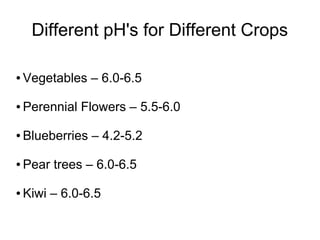
Different pH's for Different Crops
● Vegetables – 6.0-6.5
● Perennial Flowers – 5.5-6.0
● Blueberries – 4.2-5.2
● Pear trees – 6.0-6.5
● Kiwi – 6.0-6.5
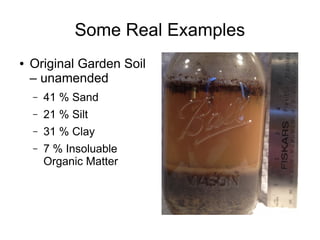
Some Real Examples
● Original Garden Soil
– unamended
– 41 % Sand
– 21 % Silt
– 31 % Clay
– 7 % Insoluable
Organic Matter
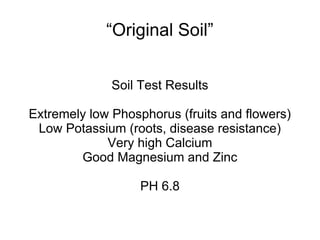
“Original Soil”
Soil Test Results
Extremely low Phosphorus (fruits and flowers)
Low Potassium (roots, disease resistance)
Very high Calcium
Good Magnesium and Zinc
PH 6.8
More.......
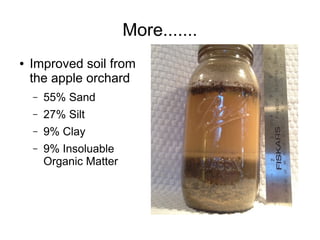
● Improved soil from
the apple orchard
– 55% Sand
– 27% Silt
– 9% Clay
– 9% Insoluable
Organic Matter
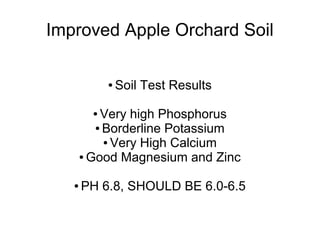
Improved Apple Orchard Soil
● Soil Test Results
● Very high Phosphorus
● Borderline Potassium
● Very High Calcium
● Good Magnesium and Zinc
● PH 6.8, SHOULD BE 6.0-6.5
More.....
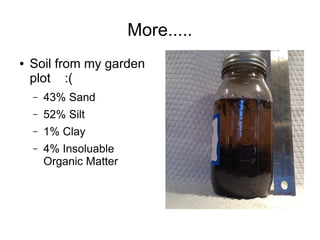
● Soil from my garden
plot :(
– 43% Sand
– 52% Silt
– 1% Clay
– 4% Insoluable
Organic Matter
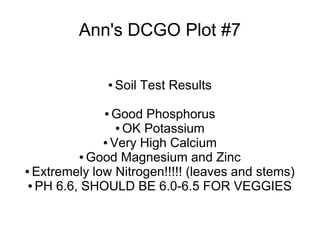
Ann's DCGO Plot #7
● Soil Test Results
● Good Phosphorus
● OK Potassium
● Very High Calcium
● Good Magnesium and Zinc
● Extremely low Nitrogen!!!!! (leaves and stems)
● PH 6.6, SHOULD BE 6.0-6.5 FOR VEGGIES
And more.....
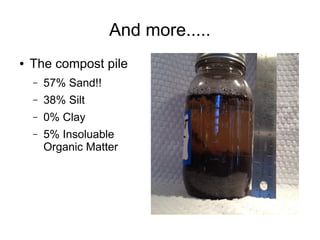
● The compost pile
– 57% Sand!!
– 38% Silt
– 0% Clay
– 5% Insoluable
Organic Matter
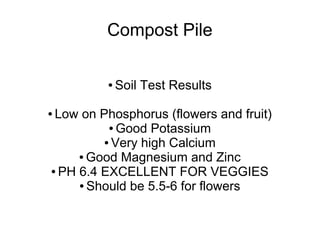
Compost Pile
● Soil Test Results
● Low on Phosphorus (flowers and fruit)
● Good Potassium
● Very high Calcium
● Good Magnesium and Zinc
● PH 6.4 EXCELLENT FOR VEGGIES
● Should be 5.5-6 for flowers
And finally......
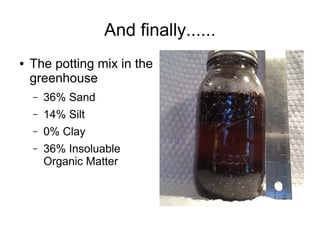
● The potting mix in the
greenhouse
– 36% Sand
– 14% Silt
– 0% Clay
– 36% Insoluable
Organic Matter
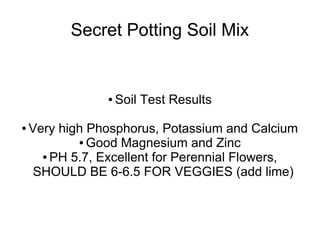
Secret Potting Soil Mix
● Soil Test Results
● Very high Phosphorus, Potassium and Calcium
● Good Magnesium and Zinc
● PH 5.7, Excellent for Perennial Flowers,
SHOULD BE 6-6.5 FOR VEGGIES (add lime)
Top Priority for Gardeners
● Boosting topsoil with good quality organic
matter
– Compost – completely decomposed, please!
– Well-rotted farmyard manure
● Spread on the surface and worked into top 12”
of soil while still including some clay
● Allows easier root growth, better drainage,
more nutrient production by microorganisms
● Facilitates root contact with nutrients
Be Aware of Nitrogen Thieves
● Flowers and veggies use Nitrogen for the growth
of stems and leaves. Constant harvesting
depletes soil of Nitrogen.
● Incompletely decomposed materials added to
the soil – the decomposition process continues
and utilizes Nitrogen.
● Planting in a newly amended, nitrogen depleted
soils will yield yellow and declining plants!
Compost vs Mulch
● Compost is a mixture of decaying organic matter
which improves soil structure and provides LOW
levels of nutrients. It is not a substitute for the
recommended rates of fertilizer required for
good plant growth.
● Mulch is a protective covering left on the surface
to reduce evaporation, maintain even soil temps,
limit erosion and control weeds. Mulch
decomposes to enrich soil (but uses Nitrogen to
decompose).
Next Month....
Fertilizers !!!

Compost and Soil Prep

  • 1.
    It's Alive !! ●Soil is our greatest resource ● It's alive, as opposed to “dirt” ● It's part of the food web as part of the three-way relationship with soil organisms and plants ● It's considered the most complex of all habitats
  • 2.
    Soil Soil is amantle of weathered rock, which, when combined with organic matter, contains minerals and nutrients capable of supporting plant growth. Soil forms as the rock minerals and organic matter interact with climate, living organisms and topography over time.
  • 3.
  • 4.
    Minerals ● Gravel, pebbles,rocks ● Sand ● Silt ● Clay
  • 5.
    Soil Texture ● Relativeamounts of clay,silt, sand determine your soil texture. ● Ideally – 40% sand, 40% silt, 20% clay make up the 45% mineral portion of soil ● This is the gardener's holy grail called LOAM.
  • 6.
    Size Matters ● Sandis HUGE but contains few nutrients, water drains quickly from the large pore spaces between particles, nutrients leach out rapidly. ● Silt is smaller than sand, has moderate fertility with medium- size pore spaces to hold water and air. Powdery and dusty when dry, it is easily carried off by rainwater or blown by wind. ● Clay is tiny, but has more total pore spaces which are very small. It easily packs tightly, leaving little room for air and water to flow, drains poorly, stays wet longer, contains little oxygen and dries hard as concrete.
  • 7.
    Relative Mineral Sizes Clay Silt Sand 00.5 1 1.5 2 2.5 Surface Area (cm per gram) Sand – 45 Silt – 454 Clay – 8,000,000 (Yes, clay is shown)
  • 8.
    How does thisaffect the availability of Nutrients? ● The absorbtion of water, nutrients and gases are all surface phenomena ● The greater the surface area of the soil particles, the greater the absorbtion ● Clay has many, many times the surface area per unit of volume to absorb and hold water, nutrients and gases than silt or sand! Yea, clay!
  • 9.
    That 5% OrganicMatter ● Decayed plants and animals, animal matter ● Provides a major food source for all the microorganisms living in the soil
  • 10.
    Marvelous Organisms ● Soilis THE most abundant ecosystem on Earth ● Estimate between 500,000 to over a billion organisms per teaspoon of good soil! ● Macrofauna from badgers down to ants, including rabbits, gophers, slugs, moles, earthworms and millipedes affect soil structure by burrowing ● Mesofauna – arthropods, collembolla and enchytraeids – tiny organisms scavenge dead organic matter, eat bacteria, fungi and algae
  • 11.
    ● Microfauna andmicroflora – really, really tiny creatures that play the final role of converting plant debris back into plant nutrients and in making the nutrients and water available to plants. ● Microfauna include nematodes and protozoa ● Microflora include bacteria, fungi and viruses, all of which take part in weathering of rocks and minerals, breakdown of organic matter and many aspects of the nutrient cycle.
  • 12.
    ● All thisactivity effects the rate of chemical exchanges which draw nutrients and water from the soil into the plant roots ● Worms and 97% of insects are gardeners' friends. – Feed on organic matter and then disperse it though the soil – Speed up composting process
  • 13.
    Bringing it Hometo our Garden Soil ● Garden soil is ever evolving and never perfect! ● As crops and flowers are harvested, the soil gradually becomes depleted of essential nutrients. ● Soils can be improved in a number of ways, depending on the soil type in the garden.
  • 14.
    Soil Testing ● Todetermine the soil's nutrient content Too much of this nutrient or too little of that, and we have problems! ● To determine the soil's pH level The right pH enables plants to use nutrients from the soil most efficiently.
  • 15.
    Nutrients Essential toPlants ● Essential for growth and development ● Each element is essential because no other element can substitute for it in all it's functions ● Plants cannot complete their life cycle without these nutrients. ● Non-soil nutrients come from the atmosphere: Hydrogen, Carbon and Oxygen
  • 16.
    Essential Soil Nutrients ●Major – Nitrogen (for growth of stems and leaves) – Phosphorus (germination, flowering and fruiting) – Potassium (roots, disease-resistance growth) ● Secondary – Magnesium (chlorophyll, sugars and starches) – Sulfur (chlorophyll production, oil content) – Calcium (development of terminal buds and roots)
  • 17.
    Minor and TraceSoil Nutrients ● Chlorine (roots, water retention) ● Iron (chlorophyll) ● Manganese (chlorophyll) ● Boron (solid, well- formed fruit) ● Zinc (more fruit) ● Copper (leaf unfolding) ● Molybdenum (roots) ● Sodium ● Cobalt ● Silicon ● Selenium ● Nickel
  • 18.
    Soil tests willmeasure all the nutrients present in the sample and make recommendations for fertilizing to cure deficiencies. Soil tests will also tell us the pH value of the sample.
  • 19.
    The pH Scale ●Symbolizes the hydrogen ion concentration in a solution ● Ranges from 1 to 14 ● 7 is “neutral”, like water ● Less than 7 = acidic ● Greater than 7 = base ● Each pH unit represents a 10x increase in hydrogen ion concentration! This affects how much of a nutrients must be added to raise or lower pH.
  • 20.
    pH levels ● “lowpH” 0 Hydrocloric Acid 1 Stomach Acid 2 Lemon juice 3 Cola, beer, vinegar 4 Tomatoes 4.5 Fish die in water this acidic 5 Coffee 6 Urine 6.5 Saliva ● “higher pH” 7 (neutral) water 7.5 Human blood 8 Seawater 9 Baking soda, antacids 10 Great Salt Lake 11 Ammonia 12 Bicarbonate of soda 13 Oven cleaner 14 Sodium hydroxide (lye)
  • 21.
    Why is pHImportant? ● It greatly affects the availability of each nutrient to the plants' roots. ● Too low pH suppresses: nitrogen,phosphorus, potassium,sulfur,calcium,magnesium and molybdenum ● Too high pH suppresses: nitrogen, phosphorus, magnesium, iron, manganese, copper, zinc and boron ● Maximum nutrient availability between 6.0 -7.5
  • 23.
    Different pH's forDifferent Crops ● Vegetables – 6.0-6.5 ● Perennial Flowers – 5.5-6.0 ● Blueberries – 4.2-5.2 ● Pear trees – 6.0-6.5 ● Kiwi – 6.0-6.5
  • 24.
    Some Real Examples ●Original Garden Soil – unamended – 41 % Sand – 21 % Silt – 31 % Clay – 7 % Insoluable Organic Matter
  • 25.
    “Original Soil” Soil TestResults Extremely low Phosphorus (fruits and flowers) Low Potassium (roots, disease resistance) Very high Calcium Good Magnesium and Zinc PH 6.8
  • 26.
    More....... ● Improved soilfrom the apple orchard – 55% Sand – 27% Silt – 9% Clay – 9% Insoluable Organic Matter
  • 27.
    Improved Apple OrchardSoil ● Soil Test Results ● Very high Phosphorus ● Borderline Potassium ● Very High Calcium ● Good Magnesium and Zinc ● PH 6.8, SHOULD BE 6.0-6.5
  • 28.
    More..... ● Soil frommy garden plot :( – 43% Sand – 52% Silt – 1% Clay – 4% Insoluable Organic Matter
  • 29.
    Ann's DCGO Plot#7 ● Soil Test Results ● Good Phosphorus ● OK Potassium ● Very High Calcium ● Good Magnesium and Zinc ● Extremely low Nitrogen!!!!! (leaves and stems) ● PH 6.6, SHOULD BE 6.0-6.5 FOR VEGGIES
  • 30.
    And more..... ● Thecompost pile – 57% Sand!! – 38% Silt – 0% Clay – 5% Insoluable Organic Matter
  • 31.
    Compost Pile ● SoilTest Results ● Low on Phosphorus (flowers and fruit) ● Good Potassium ● Very high Calcium ● Good Magnesium and Zinc ● PH 6.4 EXCELLENT FOR VEGGIES ● Should be 5.5-6 for flowers
  • 32.
    And finally...... ● Thepotting mix in the greenhouse – 36% Sand – 14% Silt – 0% Clay – 36% Insoluable Organic Matter
  • 33.
    Secret Potting SoilMix ● Soil Test Results ● Very high Phosphorus, Potassium and Calcium ● Good Magnesium and Zinc ● PH 5.7, Excellent for Perennial Flowers, SHOULD BE 6-6.5 FOR VEGGIES (add lime)
  • 34.
    Top Priority forGardeners ● Boosting topsoil with good quality organic matter – Compost – completely decomposed, please! – Well-rotted farmyard manure ● Spread on the surface and worked into top 12” of soil while still including some clay ● Allows easier root growth, better drainage, more nutrient production by microorganisms ● Facilitates root contact with nutrients
  • 35.
    Be Aware ofNitrogen Thieves ● Flowers and veggies use Nitrogen for the growth of stems and leaves. Constant harvesting depletes soil of Nitrogen. ● Incompletely decomposed materials added to the soil – the decomposition process continues and utilizes Nitrogen. ● Planting in a newly amended, nitrogen depleted soils will yield yellow and declining plants!
  • 36.
    Compost vs Mulch ●Compost is a mixture of decaying organic matter which improves soil structure and provides LOW levels of nutrients. It is not a substitute for the recommended rates of fertilizer required for good plant growth. ● Mulch is a protective covering left on the surface to reduce evaporation, maintain even soil temps, limit erosion and control weeds. Mulch decomposes to enrich soil (but uses Nitrogen to decompose).
  • 37.