©2016 MarylandOnline, Inc.
Designing quality distance learning
research studies
Distance Teaching & Learning Conference ♦ August 9 – 11, 2016
©2016 MarylandOnline, Inc.
Bethany Simunich
Director of Online Pedagogy and
Research
Kent State University
Presenters
Kay Shattuck
Director of Research
Quality Matters
©2016 MarylandOnline, Inc.
• The Foundations of Distance Learning Research
• The Unique Considerations of Distance Learning
Research
• Break!
• Research Framework: Steps and Templates
• Reporting Out and Final Thoughts
AGENDA
©2016 MarylandOnline, Inc.
Workshop Learning Outcomes
By the end of this workshop, you will be able to:
• Discuss why and how to investigate current research base.
• Describe unique DL research challenges and ways to
overcome through a targeted research plan.
• Develop a specific DL research question; identify relevant
stakeholders and inputs; plus needed resources.
• Outline a quality DL research project, including overall
methodology, that meets stakeholder needs and
contributes to our body of knowledge.
©2016 MarylandOnline, Inc.
“[R]esearch will fail unless it is based on
a good foundation of knowledge of
previous research.”
Michael G. Moore
The Foundations of Distance
Learning Research
©2016 MarylandOnline, Inc.
“Distance education is teaching and planned learning
that normally occurs in a different place from
teaching, requiring special techniques for course
design, special instructional techniques, special
methods of communication by electronic and other
technology, as well as special organizational and
administrative arrangements”
(Moore & Kearsley, 2012, p. 2)
Distance Education
©2016 MarylandOnline, Inc.
“The future research agenda will force us to devise an
effective way to combine the old and the new research
methodologies…will involve a continuing conversation
among many constituencies, where each one of them can
make contributions to the research agenda”
(Dziuban & Picciano, 2016, pp. 187, 189)
 It’s about learning, not the technology
 It’s about replication and research, including but also
broader than teaching and learning
 Systems perspective provides foundation for nuance
and complexity
The Changing Focus of Online Research
©2016 MarylandOnline, Inc.
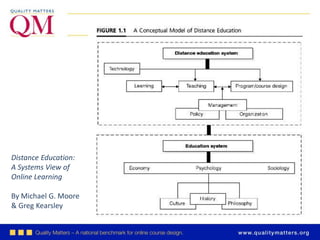
Distance Education:
A Systems View of
Online Learning
By Michael G. Moore
& Greg Kearsley
©2016 MarylandOnline, Inc.
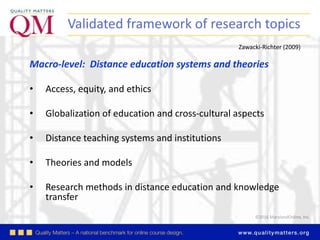
Validated framework of research topics
Zawacki-Richter (2009)
Macro-level: Distance education systems and theories
• Access, equity, and ethics
• Globalization of education and cross-cultural aspects
• Distance teaching systems and institutions
• Theories and models
• Research methods in distance education and knowledge
transfer
©2016 MarylandOnline, Inc.
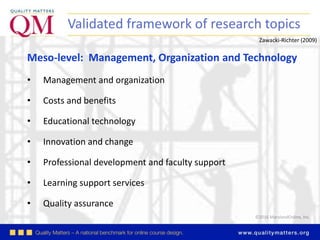
Validated framework of research topics
Zawacki-Richter (2009)
Meso-level: Management, Organization and Technology
• Management and organization
• Costs and benefits
• Educational technology
• Innovation and change
• Professional development and faculty support
• Learning support services
• Quality assurance
©2016 MarylandOnline, Inc.
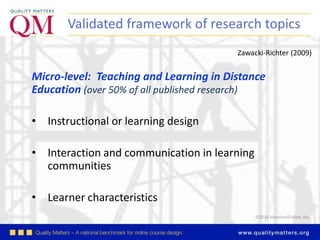
Validated framework of research topics
Zawacki-Richter (2009)
Micro-level: Teaching and Learning in Distance
Education (over 50% of all published research)
• Instructional or learning design
• Interaction and communication in learning
communities
• Learner characteristics
©2016 MarylandOnline, Inc.
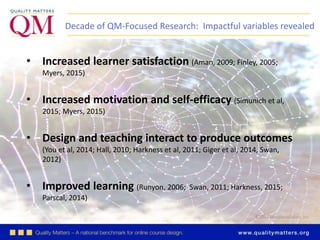
Decade of QM-Focused Research: Impactful variables revealed
• Increased learner satisfaction (Aman, 2009; Finley, 2005;
Myers, 2015)
• Increased motivation and self-efficacy (Simunich et al,
2015; Myers, 2015)
• Design and teaching interact to produce outcomes
(You et al, 2014; Hall, 2010; Harkness et al, 2011; Giger et al, 2014, Swan,
2012)
• Improved learning (Runyon, 2006; Swan, 2011; Harkness, 2015;
Parscal, 2014)
©2016 MarylandOnline, Inc.
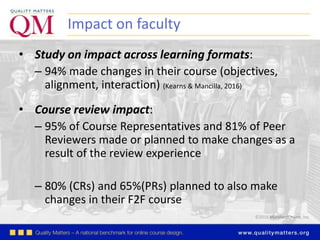
• Study on impact across learning formats:
– 94% made changes in their course (objectives,
alignment, interaction) (Kearns & Mancilla, 2016)
• Course review impact:
– 95% of Course Representatives and 81% of Peer
Reviewers made or planned to make changes as a
result of the review experience
– 80% (CRs) and 65%(PRs) planned to also make
changes in their F2F course
Impact on faculty
©2016 MarylandOnline, Inc.
Lessons Learned
• Isolation of input factors and implementation
influence is crucial
• Get the full picture of the “before”
• Understand the field, review the literature
• Ask the right questions of the right people
©2016 MarylandOnline, Inc.
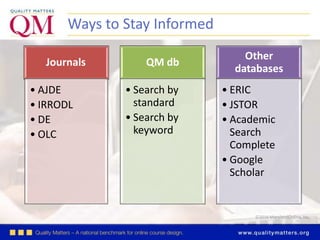
Ways to Stay Informed
Journals
• AJDE
• IRRODL
• DE
• OLC
QM db
• Search by
standard
• Search by
keyword
Other
databases
• ERIC
• JSTOR
• Academic
Search
Complete
• Google
Scholar
©2016 MarylandOnline, Inc.
The Unique Considerations
of DL Research
“[D]istance education can no longer be
considered a one-dimensional
phenomenon…online distance education is a
comprehensive, many-sided process and a
multifunctional system”
Otto Peters
©2016 MarylandOnline, Inc.
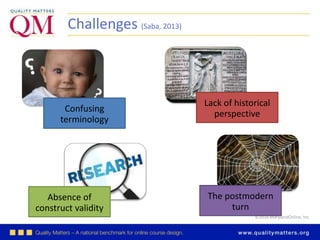
Challenges (Saba, 2013)
Confusing
terminology
Lack of historical
perspective
The postmodern
turn
Absence of
construct validity
©2016 MarylandOnline, Inc.
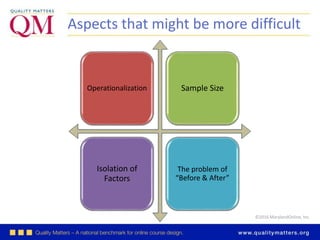
Aspects that might be more difficult
Operationalization Sample Size
Isolation of
Factors
The problem of
“Before & After”
©2016 MarylandOnline, Inc.
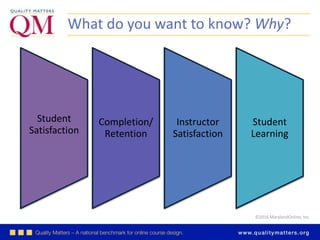
What do you want to know? Why?
Student
Satisfaction
Completion/
Retention
Instructor
Satisfaction
Student
Learning
©2016 MarylandOnline, Inc.
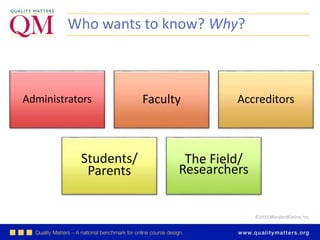
Who wants to know? Why?
Administrators Faculty Accreditors
Students/
Parents
The Field/
Researchers
©2016 MarylandOnline, Inc.
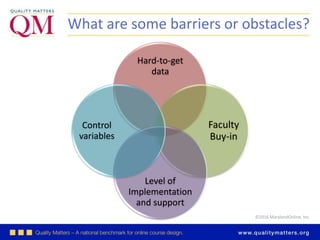
What are some barriers or obstacles?
Hard-to-get
data
Faculty
Buy-in
Level of
Implementation
and support
Control
variables
©2016 MarylandOnline, Inc.
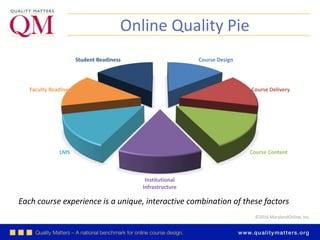
Online Quality Pie
Course Design
Course Delivery
Course Content
Institutional
Infrastructure
LMS
Faculty Readiness
Student Readiness
Each course experience is a unique, interactive combination of these factors
©2016 MarylandOnline, Inc.
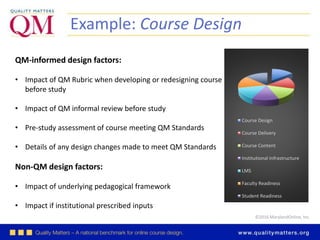
Example: Course Design
QM-informed design factors:
• Impact of QM Rubric when developing or redesigning course
before study
• Impact of QM informal review before study
• Pre-study assessment of course meeting QM Standards
• Details of any design changes made to meet QM Standards
Non-QM design factors:
• Impact of underlying pedagogical framework
• Impact if institutional prescribed inputs
Course Design
Course Delivery
Course Content
Institutional Infrastructure
LMS
Faculty Readiness
Student Readiness
©2016 MarylandOnline, Inc.
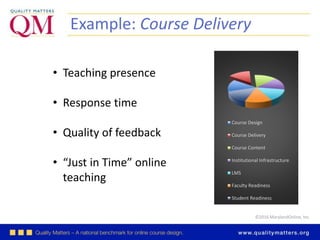
Example: Course Delivery
• Teaching presence
• Response time
• Quality of feedback
• “Just in Time” online
teaching
Course Design
Course Delivery
Course Content
Institutional Infrastructure
LMS
Faculty Readiness
Student Readiness
©2016 MarylandOnline, Inc.
Example: Student Readiness
Course Design
Course Delivery
Course Content
Institutional Infrastructure
LMS
Faculty Readiness
Student Readiness
• Meeting course prerequisites
• Prior online learning experience
• Technology experience
• Proactive/self-directed
• GPA
• Readiness measures
©2016 MarylandOnline, Inc.
Research Framework:
Steps and Templates
©2016 MarylandOnline, Inc.
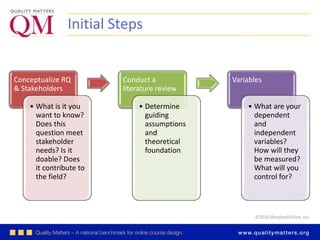
Initial Steps
Conceptualize RQ
& Stakeholders
• What is it you
want to know?
Does this
question meet
stakeholder
needs? Is it
doable? Does
it contribute to
the field?
Conduct a
literature review
• Determine
guiding
assumptions
and
theoretical
foundation
Variables
• What are your
dependent
and
independent
variables?
How will they
be measured?
What will you
control for?
©2016 MarylandOnline, Inc.
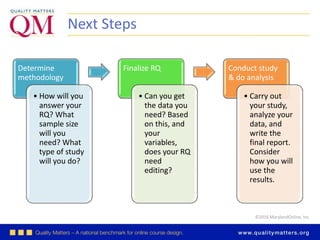
Next Steps
Determine
methodology
• How will you
answer your
RQ? What
sample size
will you
need? What
type of study
will you do?
Finalize RQ
• Can you get
the data you
need? Based
on this, and
your
variables,
does your RQ
need
editing?
Conduct study
& do analysis
• Carry out
your study,
analyze your
data, and
write the
final report.
Consider
how you will
use the
results.
©2016 MarylandOnline, Inc.
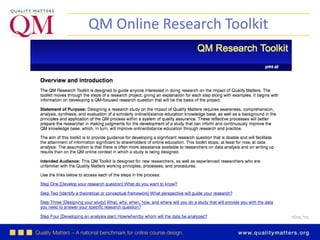
QM Online Research Toolkit
©2016 MarylandOnline, Inc.
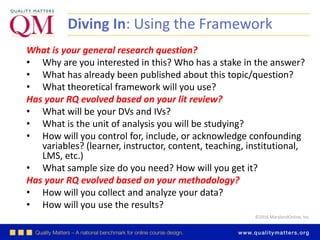
Diving In: Using the Framework
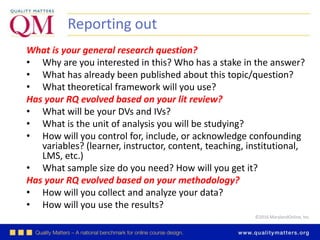
What is your general research question?
• Why are you interested in this? Who has a stake in the answer?
• What has already been published about this topic/question?
• What theoretical framework will you use?
Has your RQ evolved based on your lit review?
• What will be your DVs and IVs?
• What is the unit of analysis you will be studying?
• How will you control for, include, or acknowledge confounding
variables? (learner, instructor, content, teaching, institutional,
LMS, etc.)
• What sample size do you need? How will you get it?
Has your RQ evolved based on your methodology?
• How will you collect and analyze your data?
• How will you use the results?
©2016 MarylandOnline, Inc.
EXAMPLE: shortened online courses
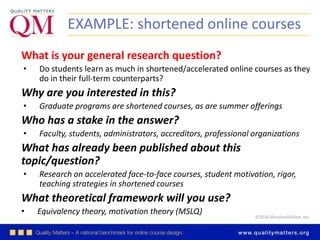
What is your general research question?
• Do students learn as much in shortened/accelerated online courses as they
do in their full-term counterparts?
Why are you interested in this?
• Graduate programs are shortened courses, as are summer offerings
Who has a stake in the answer?
• Faculty, students, administrators, accreditors, professional organizations
What has already been published about this
topic/question?
• Research on accelerated face-to-face courses, student motivation, rigor,
teaching strategies in shortened courses
What theoretical framework will you use?
• Equivalency theory, motivation theory (MSLQ)
©2016 MarylandOnline, Inc.
EXAMPLE: shortened online courses
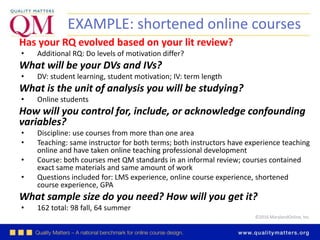
Has your RQ evolved based on your lit review?
• Additional RQ: Do levels of motivation differ?
What will be your DVs and IVs?
• DV: student learning, student motivation; IV: term length
What is the unit of analysis you will be studying?
• Online students
How will you control for, include, or acknowledge confounding
variables?
• Discipline: use courses from more than one area
• Teaching: same instructor for both terms; both instructors have experience teaching
online and have taken online teaching professional development
• Course: both courses met QM standards in an informal review; courses contained
exact same materials and same amount of work
• Questions included for: LMS experience, online course experience, shortened
course experience, GPA
What sample size do you need? How will you get it?
• 162 total: 98 fall, 64 summer
©2016 MarylandOnline, Inc.
EXAMPLE: shortened online courses
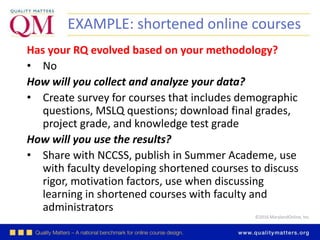
Has your RQ evolved based on your methodology?
• No
How will you collect and analyze your data?
• Create survey for courses that includes demographic
questions, MSLQ questions; download final grades,
project grade, and knowledge test grade
How will you use the results?
• Share with NCCSS, publish in Summer Academe, use
with faculty developing shortened courses to discuss
rigor, motivation factors, use when discussing
learning in shortened courses with faculty and
administrators
©2016 MarylandOnline, Inc.
Reporting Out and
Final Thoughts
©2016 MarylandOnline, Inc.
Reporting out
What is your general research question?
• Why are you interested in this? Who has a stake in the answer?
• What has already been published about this topic/question?
• What theoretical framework will you use?
Has your RQ evolved based on your lit review?
• What will be your DVs and IVs?
• What is the unit of analysis you will be studying?
• How will you control for, include, or acknowledge confounding
variables? (learner, instructor, content, teaching, institutional,
LMS, etc.)
• What sample size do you need? How will you get it?
Has your RQ evolved based on your methodology?
• How will you collect and analyze your data?
• How will you use the results?
©2016 MarylandOnline, Inc.
• What do you want to know and why?
• Who else cares about this?
• What has been done before on this
topic/question?
• It it doable? Who needs to be included? Who can
help?
• How will you use the results?
Big Takeaways
©2016 MarylandOnline, Inc.
Find your motivation
©2016 MarylandOnline, Inc.

ABCs of Research

  • 1.
    ©2016 MarylandOnline, Inc. Designingquality distance learning research studies Distance Teaching & Learning Conference ♦ August 9 – 11, 2016
  • 2.
    ©2016 MarylandOnline, Inc. BethanySimunich Director of Online Pedagogy and Research Kent State University Presenters Kay Shattuck Director of Research Quality Matters
  • 3.
    ©2016 MarylandOnline, Inc. •The Foundations of Distance Learning Research • The Unique Considerations of Distance Learning Research • Break! • Research Framework: Steps and Templates • Reporting Out and Final Thoughts AGENDA
  • 4.
    ©2016 MarylandOnline, Inc. WorkshopLearning Outcomes By the end of this workshop, you will be able to: • Discuss why and how to investigate current research base. • Describe unique DL research challenges and ways to overcome through a targeted research plan. • Develop a specific DL research question; identify relevant stakeholders and inputs; plus needed resources. • Outline a quality DL research project, including overall methodology, that meets stakeholder needs and contributes to our body of knowledge.
  • 5.
    ©2016 MarylandOnline, Inc. “[R]esearchwill fail unless it is based on a good foundation of knowledge of previous research.” Michael G. Moore The Foundations of Distance Learning Research
  • 6.
    ©2016 MarylandOnline, Inc. “Distanceeducation is teaching and planned learning that normally occurs in a different place from teaching, requiring special techniques for course design, special instructional techniques, special methods of communication by electronic and other technology, as well as special organizational and administrative arrangements” (Moore & Kearsley, 2012, p. 2) Distance Education
  • 7.
    ©2016 MarylandOnline, Inc. “Thefuture research agenda will force us to devise an effective way to combine the old and the new research methodologies…will involve a continuing conversation among many constituencies, where each one of them can make contributions to the research agenda” (Dziuban & Picciano, 2016, pp. 187, 189)  It’s about learning, not the technology  It’s about replication and research, including but also broader than teaching and learning  Systems perspective provides foundation for nuance and complexity The Changing Focus of Online Research
  • 8.
    ©2016 MarylandOnline, Inc. DistanceEducation: A Systems View of Online Learning By Michael G. Moore & Greg Kearsley
  • 9.
    ©2016 MarylandOnline, Inc. Validatedframework of research topics Zawacki-Richter (2009) Macro-level: Distance education systems and theories • Access, equity, and ethics • Globalization of education and cross-cultural aspects • Distance teaching systems and institutions • Theories and models • Research methods in distance education and knowledge transfer
  • 10.
    ©2016 MarylandOnline, Inc. Validatedframework of research topics Zawacki-Richter (2009) Meso-level: Management, Organization and Technology • Management and organization • Costs and benefits • Educational technology • Innovation and change • Professional development and faculty support • Learning support services • Quality assurance
  • 11.
    ©2016 MarylandOnline, Inc. Validatedframework of research topics Zawacki-Richter (2009) Micro-level: Teaching and Learning in Distance Education (over 50% of all published research) • Instructional or learning design • Interaction and communication in learning communities • Learner characteristics
  • 12.
    ©2016 MarylandOnline, Inc. Decadeof QM-Focused Research: Impactful variables revealed • Increased learner satisfaction (Aman, 2009; Finley, 2005; Myers, 2015) • Increased motivation and self-efficacy (Simunich et al, 2015; Myers, 2015) • Design and teaching interact to produce outcomes (You et al, 2014; Hall, 2010; Harkness et al, 2011; Giger et al, 2014, Swan, 2012) • Improved learning (Runyon, 2006; Swan, 2011; Harkness, 2015; Parscal, 2014)
  • 13.
    ©2016 MarylandOnline, Inc. •Study on impact across learning formats: – 94% made changes in their course (objectives, alignment, interaction) (Kearns & Mancilla, 2016) • Course review impact: – 95% of Course Representatives and 81% of Peer Reviewers made or planned to make changes as a result of the review experience – 80% (CRs) and 65%(PRs) planned to also make changes in their F2F course Impact on faculty
  • 14.
    ©2016 MarylandOnline, Inc. LessonsLearned • Isolation of input factors and implementation influence is crucial • Get the full picture of the “before” • Understand the field, review the literature • Ask the right questions of the right people
  • 15.
    ©2016 MarylandOnline, Inc. Waysto Stay Informed Journals • AJDE • IRRODL • DE • OLC QM db • Search by standard • Search by keyword Other databases • ERIC • JSTOR • Academic Search Complete • Google Scholar
  • 16.
    ©2016 MarylandOnline, Inc. TheUnique Considerations of DL Research “[D]istance education can no longer be considered a one-dimensional phenomenon…online distance education is a comprehensive, many-sided process and a multifunctional system” Otto Peters
  • 17.
    ©2016 MarylandOnline, Inc. Challenges(Saba, 2013) Confusing terminology Lack of historical perspective The postmodern turn Absence of construct validity
  • 18.
    ©2016 MarylandOnline, Inc. Aspectsthat might be more difficult Operationalization Sample Size Isolation of Factors The problem of “Before & After”
  • 19.
    ©2016 MarylandOnline, Inc. Whatdo you want to know? Why? Student Satisfaction Completion/ Retention Instructor Satisfaction Student Learning
  • 20.
    ©2016 MarylandOnline, Inc. Whowants to know? Why? Administrators Faculty Accreditors Students/ Parents The Field/ Researchers
  • 21.
    ©2016 MarylandOnline, Inc. Whatare some barriers or obstacles? Hard-to-get data Faculty Buy-in Level of Implementation and support Control variables
  • 22.
  • 23.
    ©2016 MarylandOnline, Inc. OnlineQuality Pie Course Design Course Delivery Course Content Institutional Infrastructure LMS Faculty Readiness Student Readiness Each course experience is a unique, interactive combination of these factors
  • 24.
    ©2016 MarylandOnline, Inc. Example:Course Design QM-informed design factors: • Impact of QM Rubric when developing or redesigning course before study • Impact of QM informal review before study • Pre-study assessment of course meeting QM Standards • Details of any design changes made to meet QM Standards Non-QM design factors: • Impact of underlying pedagogical framework • Impact if institutional prescribed inputs Course Design Course Delivery Course Content Institutional Infrastructure LMS Faculty Readiness Student Readiness
  • 25.
    ©2016 MarylandOnline, Inc. Example:Course Delivery • Teaching presence • Response time • Quality of feedback • “Just in Time” online teaching Course Design Course Delivery Course Content Institutional Infrastructure LMS Faculty Readiness Student Readiness
  • 26.
    ©2016 MarylandOnline, Inc. Example:Student Readiness Course Design Course Delivery Course Content Institutional Infrastructure LMS Faculty Readiness Student Readiness • Meeting course prerequisites • Prior online learning experience • Technology experience • Proactive/self-directed • GPA • Readiness measures
  • 27.
    ©2016 MarylandOnline, Inc. ResearchFramework: Steps and Templates
  • 28.
    ©2016 MarylandOnline, Inc. InitialSteps Conceptualize RQ & Stakeholders • What is it you want to know? Does this question meet stakeholder needs? Is it doable? Does it contribute to the field? Conduct a literature review • Determine guiding assumptions and theoretical foundation Variables • What are your dependent and independent variables? How will they be measured? What will you control for?
  • 29.
    ©2016 MarylandOnline, Inc. NextSteps Determine methodology • How will you answer your RQ? What sample size will you need? What type of study will you do? Finalize RQ • Can you get the data you need? Based on this, and your variables, does your RQ need editing? Conduct study & do analysis • Carry out your study, analyze your data, and write the final report. Consider how you will use the results.
  • 30.
    ©2016 MarylandOnline, Inc. QMOnline Research Toolkit
  • 31.
    ©2016 MarylandOnline, Inc. DivingIn: Using the Framework What is your general research question? • Why are you interested in this? Who has a stake in the answer? • What has already been published about this topic/question? • What theoretical framework will you use? Has your RQ evolved based on your lit review? • What will be your DVs and IVs? • What is the unit of analysis you will be studying? • How will you control for, include, or acknowledge confounding variables? (learner, instructor, content, teaching, institutional, LMS, etc.) • What sample size do you need? How will you get it? Has your RQ evolved based on your methodology? • How will you collect and analyze your data? • How will you use the results?
  • 32.
    ©2016 MarylandOnline, Inc. EXAMPLE:shortened online courses What is your general research question? • Do students learn as much in shortened/accelerated online courses as they do in their full-term counterparts? Why are you interested in this? • Graduate programs are shortened courses, as are summer offerings Who has a stake in the answer? • Faculty, students, administrators, accreditors, professional organizations What has already been published about this topic/question? • Research on accelerated face-to-face courses, student motivation, rigor, teaching strategies in shortened courses What theoretical framework will you use? • Equivalency theory, motivation theory (MSLQ)
  • 33.
    ©2016 MarylandOnline, Inc. EXAMPLE:shortened online courses Has your RQ evolved based on your lit review? • Additional RQ: Do levels of motivation differ? What will be your DVs and IVs? • DV: student learning, student motivation; IV: term length What is the unit of analysis you will be studying? • Online students How will you control for, include, or acknowledge confounding variables? • Discipline: use courses from more than one area • Teaching: same instructor for both terms; both instructors have experience teaching online and have taken online teaching professional development • Course: both courses met QM standards in an informal review; courses contained exact same materials and same amount of work • Questions included for: LMS experience, online course experience, shortened course experience, GPA What sample size do you need? How will you get it? • 162 total: 98 fall, 64 summer
  • 34.
    ©2016 MarylandOnline, Inc. EXAMPLE:shortened online courses Has your RQ evolved based on your methodology? • No How will you collect and analyze your data? • Create survey for courses that includes demographic questions, MSLQ questions; download final grades, project grade, and knowledge test grade How will you use the results? • Share with NCCSS, publish in Summer Academe, use with faculty developing shortened courses to discuss rigor, motivation factors, use when discussing learning in shortened courses with faculty and administrators
  • 35.
  • 36.
    ©2016 MarylandOnline, Inc. Reportingout What is your general research question? • Why are you interested in this? Who has a stake in the answer? • What has already been published about this topic/question? • What theoretical framework will you use? Has your RQ evolved based on your lit review? • What will be your DVs and IVs? • What is the unit of analysis you will be studying? • How will you control for, include, or acknowledge confounding variables? (learner, instructor, content, teaching, institutional, LMS, etc.) • What sample size do you need? How will you get it? Has your RQ evolved based on your methodology? • How will you collect and analyze your data? • How will you use the results?
  • 37.
    ©2016 MarylandOnline, Inc. •What do you want to know and why? • Who else cares about this? • What has been done before on this topic/question? • It it doable? Who needs to be included? Who can help? • How will you use the results? Big Takeaways
  • 38.
  • 39.

Editor's Notes

  • #4 BETHANY
  • #5 BETHANY
  • #6 We have too much to do to keep “spinning our wheels” by trying to answer research questions about online and distance learning that already have a large body of research. We need to build on that research to continue delving deeper into the important topics of online learning. BETHANY INTRODUCES SECTION AND TURNS IT OVER TO KAY
  • #7 KAY
  • #8 Here is an appropriate time to remind everyone of the definition of distance education: “planned learning that normally occurs in a different place from teaching, requiring special techniques for course design, special instructional techniques, special methods of communication by electronic and other technology, as well as special organizational and administrative arrangements” (Moore & Kearsley, 2012, p. 2) KAY
  • #9 Saba has been expanding model to broader system. KAY
  • #10 “the early research from systems perspective related to distance education (notably that of Otto Peters [and Michael Moore] need not be abandoned, but rather needs to evolve to theorize and generate solutions for vastly more complex systems and networks that define current and next-generation education institutions” (Zawacki-Richter & Anderson, 2014, p. 21) BETHANY
  • #11 BETHANY
  • #12 On one hand, this makes sense. Faculty/instructors are interested in improving their own teaching/learning so action research by reflective practitioners makes sense. However, Don’t know what’s done before, so we do the same old study over again Still foundational – do it well, then move to next tier BETHANY
  • #13 Spider web picture makes this more a discussion about how everything is connected (design, teaching, student readiness, etc.) and all these factors interplay. Why it’s difficult to say “X improves student learning” BETHANY
  • #14 Kearns & Mancilla (2016) https://www.qualitymatters.org/node/3176/download/Final%20Report%20Pittsburgh%20QM%20Grant-1.pdf BETHANY
  • #15 The third and even fourth ones here can be discussed from my own experience, including Greg Blundell’s dissertation (but no names), since it’s included in the What we’re Learning report KAY
  • #16 [added OLC=Online Learning] IRRODL and OLC are open access Look up academic KAY
  • #17 While the practice of distance education is rapidly growing, its theoretical base is not… [t]he task is daunting.” Farhad Saba KAY INTRODUCES
  • #18 KAY
  • #19 BETHANY
  • #20 BETHANY
  • #21 Contribution to the field How can we use this information to continue to help improvement BETHANY
  • #22 BETHANY
  • #24 KAY
  • #25 QM-informed design factors Impact of QM Rubric when developing or redesigning course before study Impact of QM informal review before study Pre-study assessment of course meeting QM Standards Details of any design changes made to meet QM Standards Non-QM design factors Impact of underlying pedagogical framework, for example: Designed to promote community of inquiry presence (CoI), to deliberately build social presence, teaching/facilitation presence, and/or content presence Designed to present access and to promote mastery of specific content-related competencies, such as adaptive learning mastery, before moving to next content unit Impact if institutional prescribed inputs   BETHANY
  • #26 Link to https://softchalkcloud.com/lesson/serve/dV2TbKrlX96sAt/html Page 5 BETHANY
  • #27 BETHANY
  • #28 KAY INTRODUCES
  • #29 BETHANY
  • #30 BETHANY
  • #31 “Under construction” Content loaded Done by November BETHANY WILL GIVE WEB TOUR HERE QUESTION: CAN QM PUT A DIRECT LINK TO THE RT IN THE LEFT-HAND NAV OF THE RESEARCH PAGE?
  • #32 KAY
  • #33 BETHANY
  • #34 BETHANY
  • #35 BETHANY
  • #36 I’ll add some slides here to guide their reporting out, note the big takeaways, and leave off with the motivation piece
  • #37 BETHANY
  • #38 BETHANY ADDRESSES BULLET POINTS; KAY ADDS FINAL THOUGHTS/TAKEAWAYS
  • #39 BETHANY TRIES TO MOTIVATE AND INSPIRE PEOPLE RIGHT BEFORE LUNCH. GOOD LUCK WITH THAT, BETHANY! ;)