An educational scenario based on the Pyramid pedagogical pattern Yannis Dimitriadis GSIC/EMIC research group University of Valladolid November 30, 2011 The theory and practice of  Design for Learning OEB 2011 pre-conference workshop
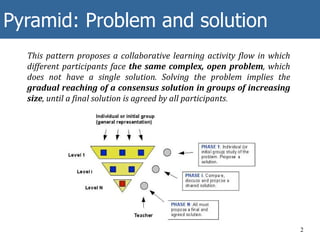
Pyramid: Problem and solution This pattern proposes a collaborative learning activity flow in which different participants face  the same complex, open problem , which does not have a single solution. Solving the problem implies the  gradual reaching of a consensus solution in groups of increasing size , until a final solution is agreed by all participants .
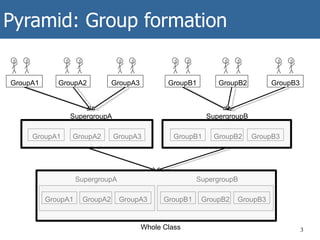
Pyramid: Group formation GroupA1 GroupA2 GroupA3 GroupB1 GroupB2 GroupB3 GroupA1 GroupA2 GroupA3 GroupB1 GroupB2 GroupB3 SupergroupA SupergroupB SupergroupA SupergroupB Whole Class GroupB1 GroupB2 GroupB3 GroupA1 GroupA2 GroupA3
Scenario: Some principles Use collaborative learning Positive interdependence:  Team members need each other for a global success Knowledge construction:  Students discuss and reach consensus Through  Pyramid  pedagogical pattern Multiple iterations: groups join larger groups… …  reaching agreements on common proposals
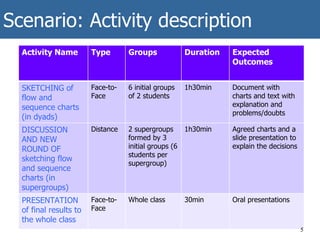
Scenario: Activity description Activity Name Type Groups Duration Expected Outcomes SKETCHING of flow and sequence charts (in dyads) Face-to-Face 6 initial groups of 2 students 1h30min Document with charts and text with explanation and problems/doubts DISCUSSION AND NEW ROUND OF sketching flow and sequence charts (in supergroups) Distance 2 supergroups formed by 3 initial groups (6 students per supergroup) 1h30min Agreed charts and a slide presentation to explain the decisions PRESENTATION of final results to the whole class Face-to-Face Whole class 30min Oral presentations
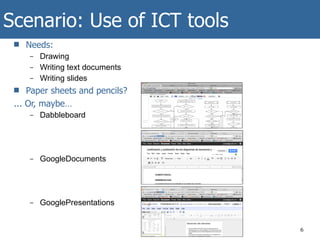
Scenario: Use of ICT tools Needs: Drawing Writing text documents Writing slides Paper sheets and pencils? ... Or, maybe… Dabbleboard GoogleDocuments GooglePresentations

The pyramid pedagogical pattern and a sample associated educational scenario

  • 1.
    An educational scenariobased on the Pyramid pedagogical pattern Yannis Dimitriadis GSIC/EMIC research group University of Valladolid November 30, 2011 The theory and practice of Design for Learning OEB 2011 pre-conference workshop
  • 2.
    Pyramid: Problem andsolution This pattern proposes a collaborative learning activity flow in which different participants face the same complex, open problem , which does not have a single solution. Solving the problem implies the gradual reaching of a consensus solution in groups of increasing size , until a final solution is agreed by all participants .
  • 3.
    Pyramid: Group formationGroupA1 GroupA2 GroupA3 GroupB1 GroupB2 GroupB3 GroupA1 GroupA2 GroupA3 GroupB1 GroupB2 GroupB3 SupergroupA SupergroupB SupergroupA SupergroupB Whole Class GroupB1 GroupB2 GroupB3 GroupA1 GroupA2 GroupA3
  • 4.
    Scenario: Some principlesUse collaborative learning Positive interdependence: Team members need each other for a global success Knowledge construction: Students discuss and reach consensus Through Pyramid pedagogical pattern Multiple iterations: groups join larger groups… … reaching agreements on common proposals
  • 5.
    Scenario: Activity descriptionActivity Name Type Groups Duration Expected Outcomes SKETCHING of flow and sequence charts (in dyads) Face-to-Face 6 initial groups of 2 students 1h30min Document with charts and text with explanation and problems/doubts DISCUSSION AND NEW ROUND OF sketching flow and sequence charts (in supergroups) Distance 2 supergroups formed by 3 initial groups (6 students per supergroup) 1h30min Agreed charts and a slide presentation to explain the decisions PRESENTATION of final results to the whole class Face-to-Face Whole class 30min Oral presentations
  • 6.
    Scenario: Use ofICT tools Needs: Drawing Writing text documents Writing slides Paper sheets and pencils? ... Or, maybe… Dabbleboard GoogleDocuments GooglePresentations