XSLT presentation
By Alejandro herreño y Miguel Teheran
XSLT
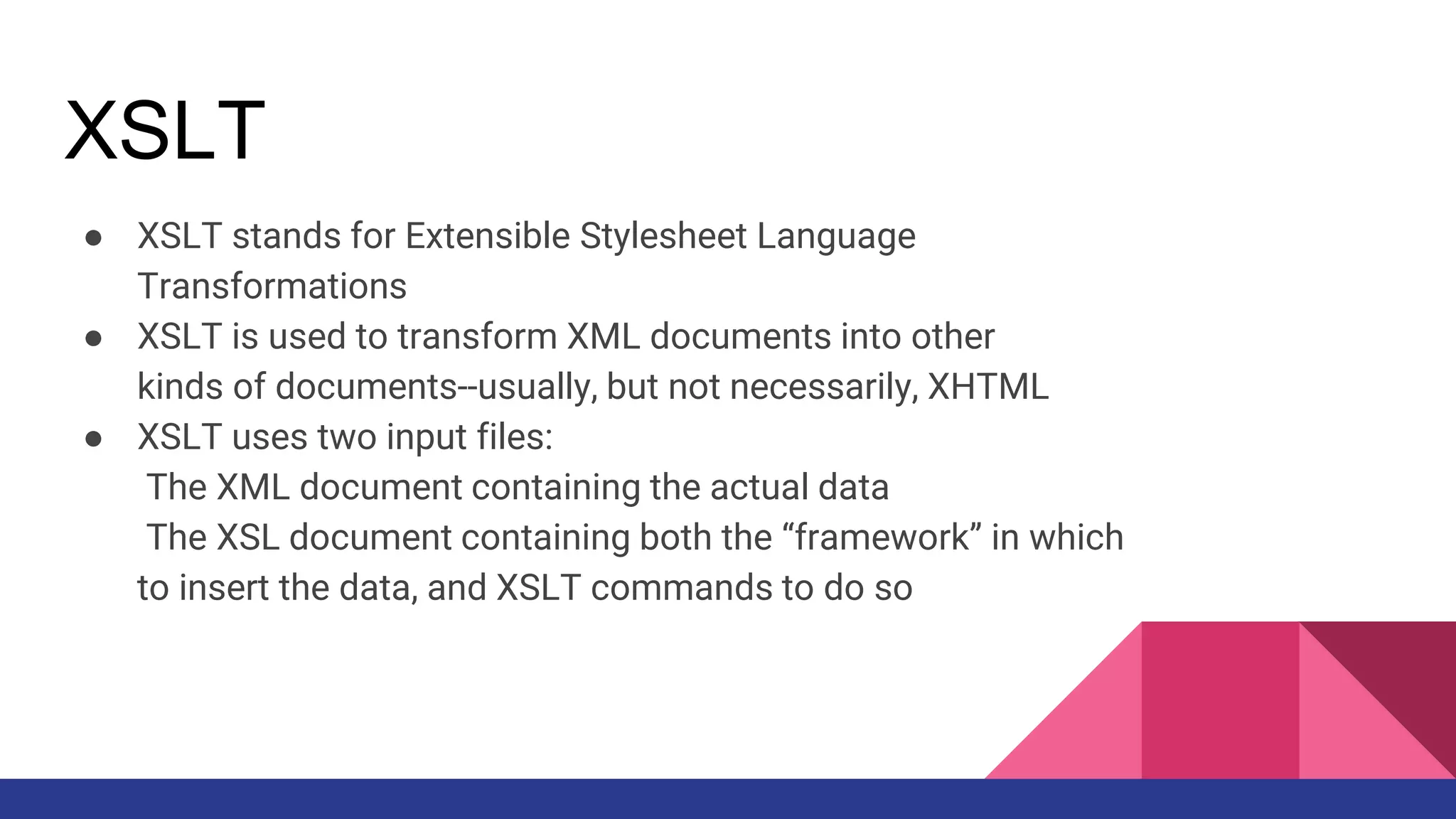
● XSLT stands for Extensible Stylesheet Language
Transformations
● XSLT is used to transform XML documents into other
kinds of documents--usually, but not necessarily, XHTML
● XSLT uses two input files:
The XML document containing the actual data
The XSL document containing both the “framework” in which
to insert the data, and XSLT commands to do so
Simple example
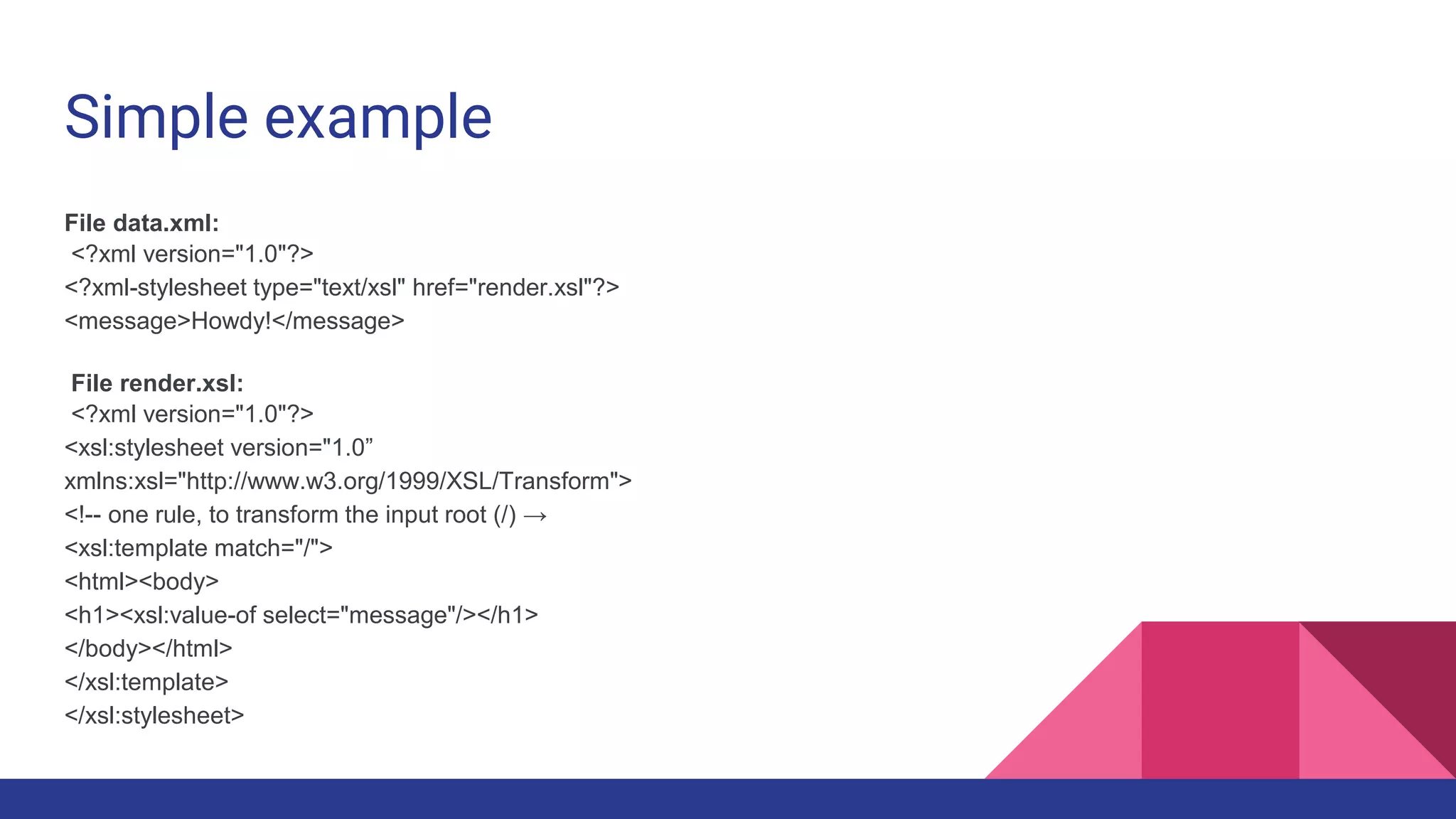
File data.xml:
<?xml version="1.0"?>
<?xml-stylesheet type="text/xsl" href="render.xsl"?>
<message>Howdy!</message>
File render.xsl:
<?xml version="1.0"?>
<xsl:stylesheet version="1.0”
xmlns:xsl="http://www.w3.org/1999/XSL/Transform">
<!-- one rule, to transform the input root (/) →
<xsl:template match="/">
<html><body>
<h1><xsl:value-of select="message"/></h1>
</body></html>
</xsl:template>
</xsl:stylesheet>
The .xsl file
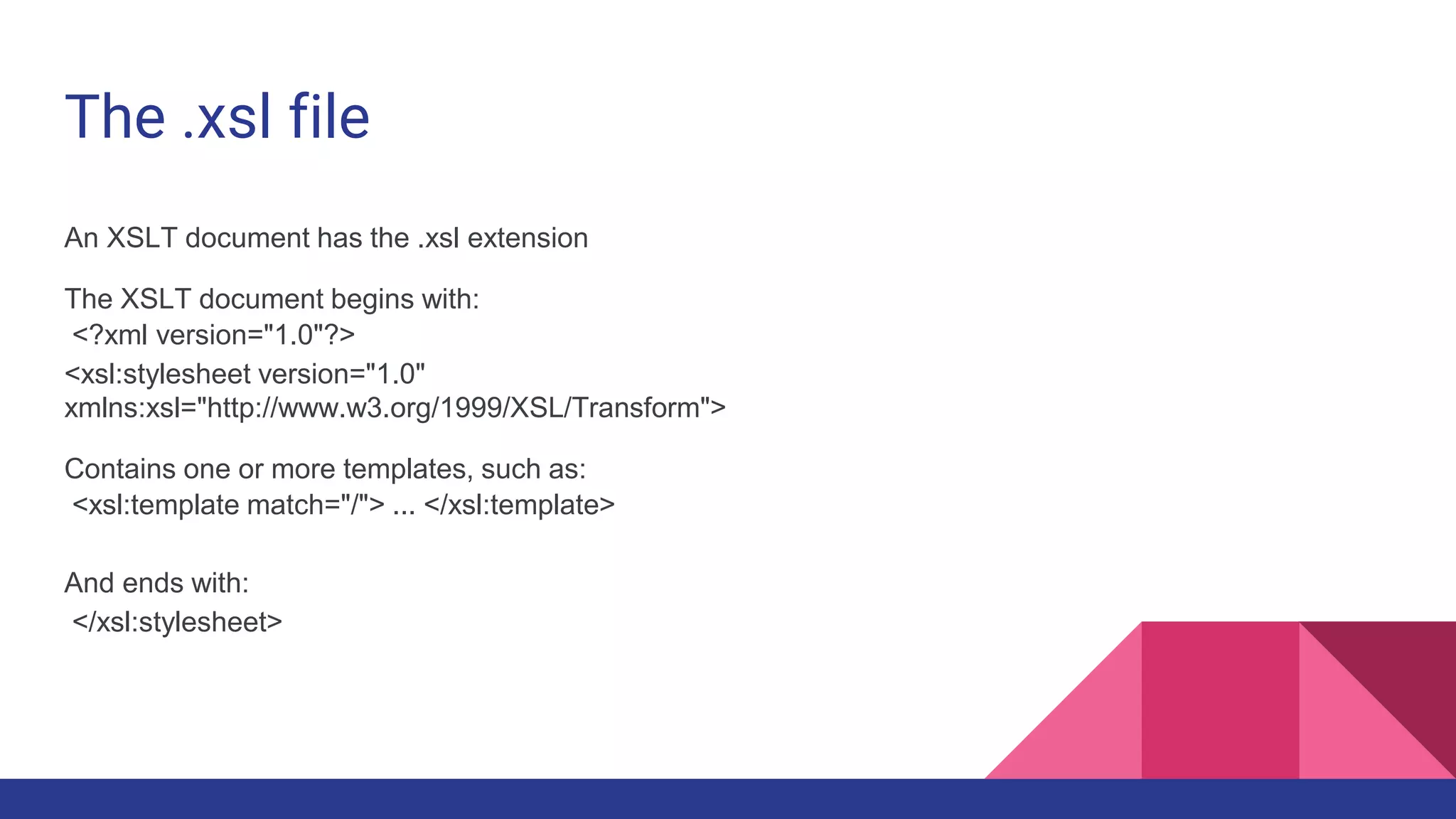
An XSLT document has the .xsl extension
The XSLT document begins with:
<?xml version="1.0"?>
<xsl:stylesheet version="1.0"
xmlns:xsl="http://www.w3.org/1999/XSL/Transform">
Contains one or more templates, such as:
<xsl:template match="/"> ... </xsl:template>
And ends with:
</xsl:stylesheet>
xsl:value-of
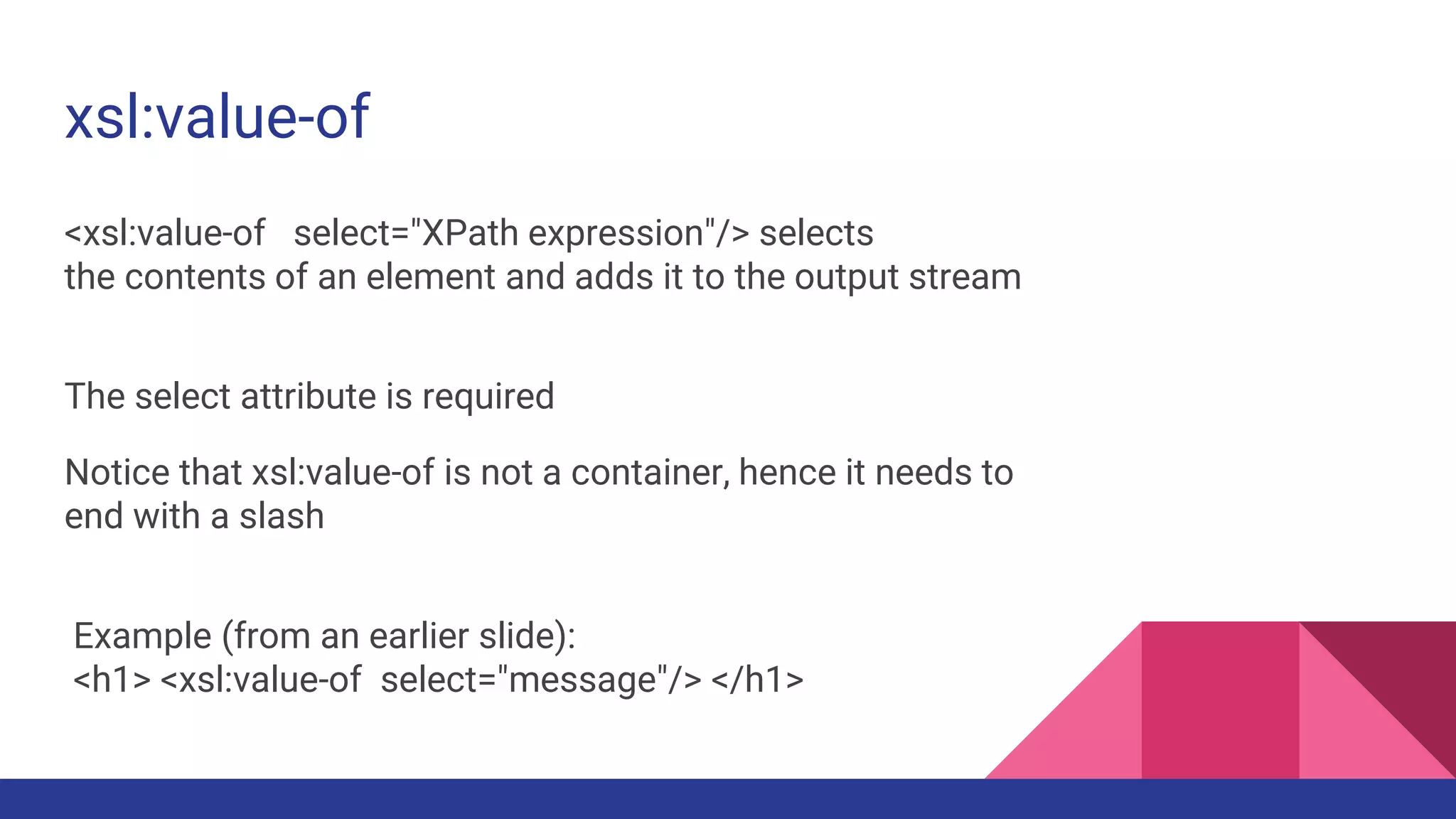
<xsl:value-of select="XPath expression"/> selects
the contents of an element and adds it to the output stream
The select attribute is required
Notice that xsl:value-of is not a container, hence it needs to
end with a slash
Example (from an earlier slide):
<h1> <xsl:value-of select="message"/> </h1>
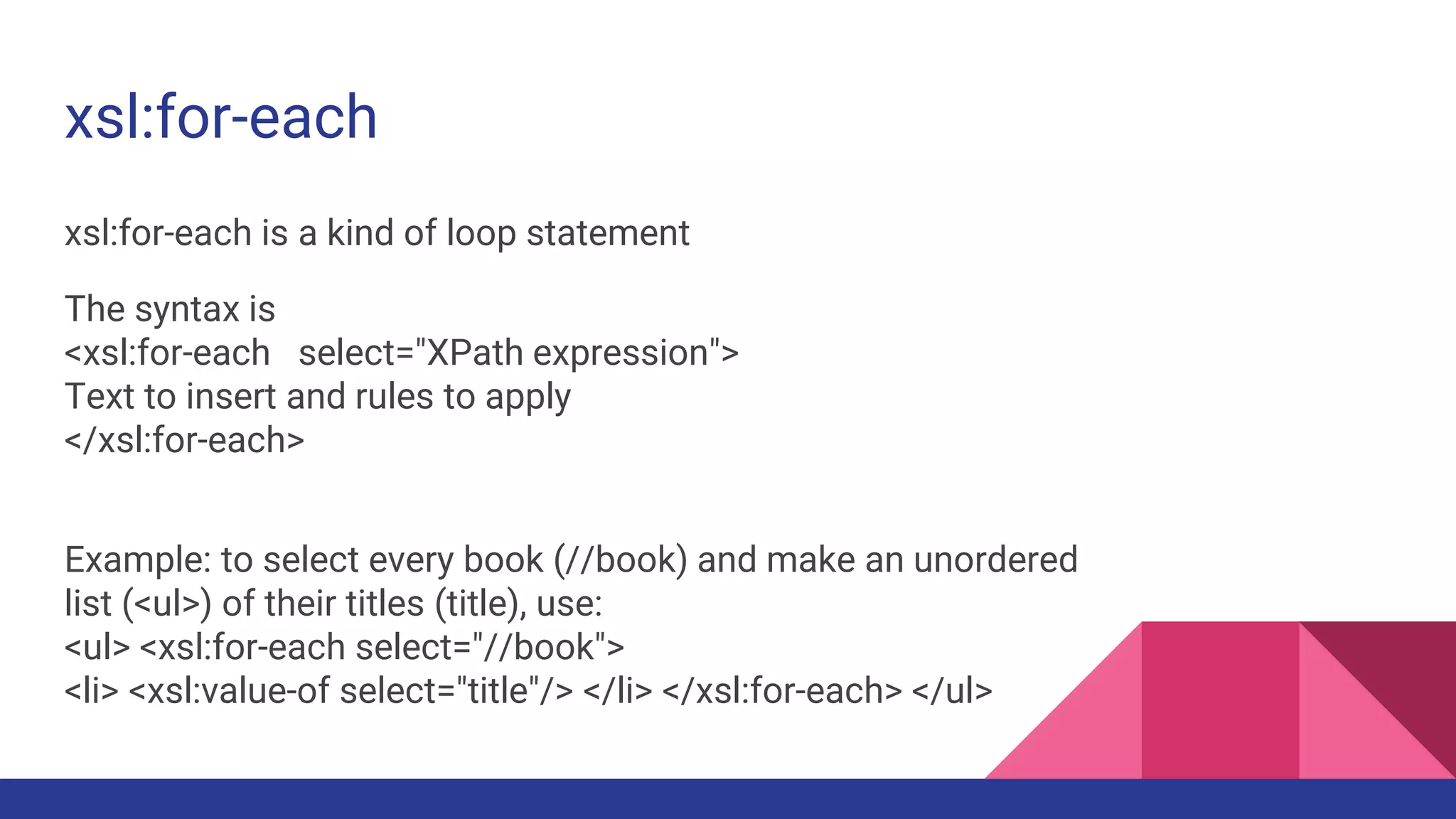
xsl:for-each
xsl:for-each is a kind of loop statement
The syntax is
<xsl:for-each select="XPath expression">
Text to insert and rules to apply
</xsl:for-each>
Example: to select every book (//book) and make an unordered
list (<ul>) of their titles (title), use:
<ul> <xsl:for-each select="//book">
<li> <xsl:value-of select="title"/> </li> </xsl:for-each> </ul>
Filtering output
You can filter (restrict) output by adding a criterion
to the select attribute’s value:
<ul> <xsl:for-each select="//book">
<li>
<xsl:value-of select="title[../author='Terry Pratchett']"/>
</li> </xsl:for-each>
</ul>
This will select book titles by Terry Pratchett
Filter details
Here is the filter we just used:
<xsl:value-of select="title[../author='Terry Pratchett']"/>
author is a sibling of title, so from title we have to
go up to its parent, book, then back down to author
This filter requires a quote within a quote, so we need
both single quotes and double quotes
Legal filter operators are:
= != &lt; &gt;
Numbers should be quoted, but apparently don’t have to be
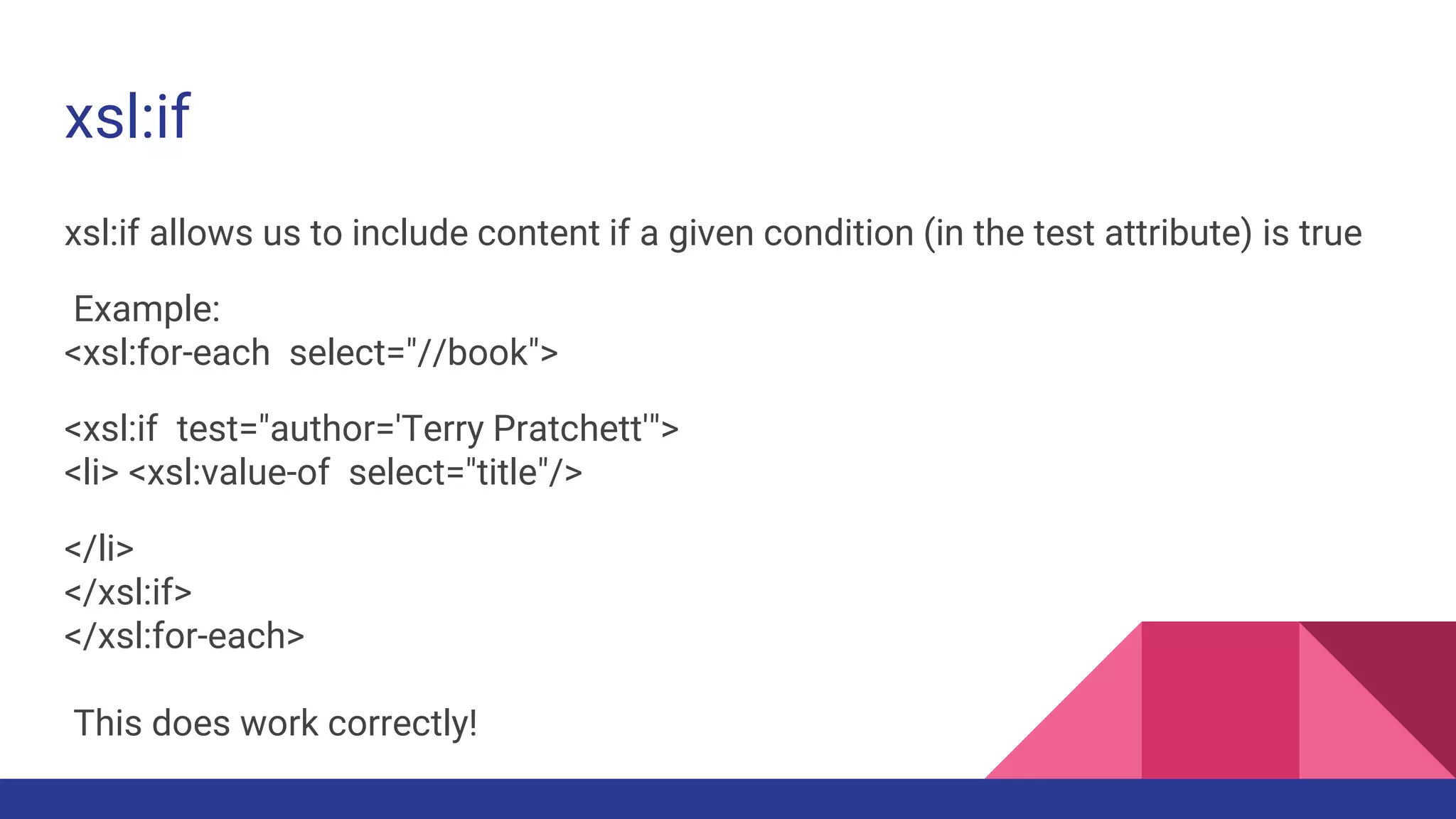
xsl:if
xsl:if allows us to include content if a given condition (in the test attribute) is true
Example:
<xsl:for-each select="//book">
<xsl:if test="author='Terry Pratchett'">
<li> <xsl:value-of select="title"/>
</li>
</xsl:if>
</xsl:for-each>
This does work correctly!
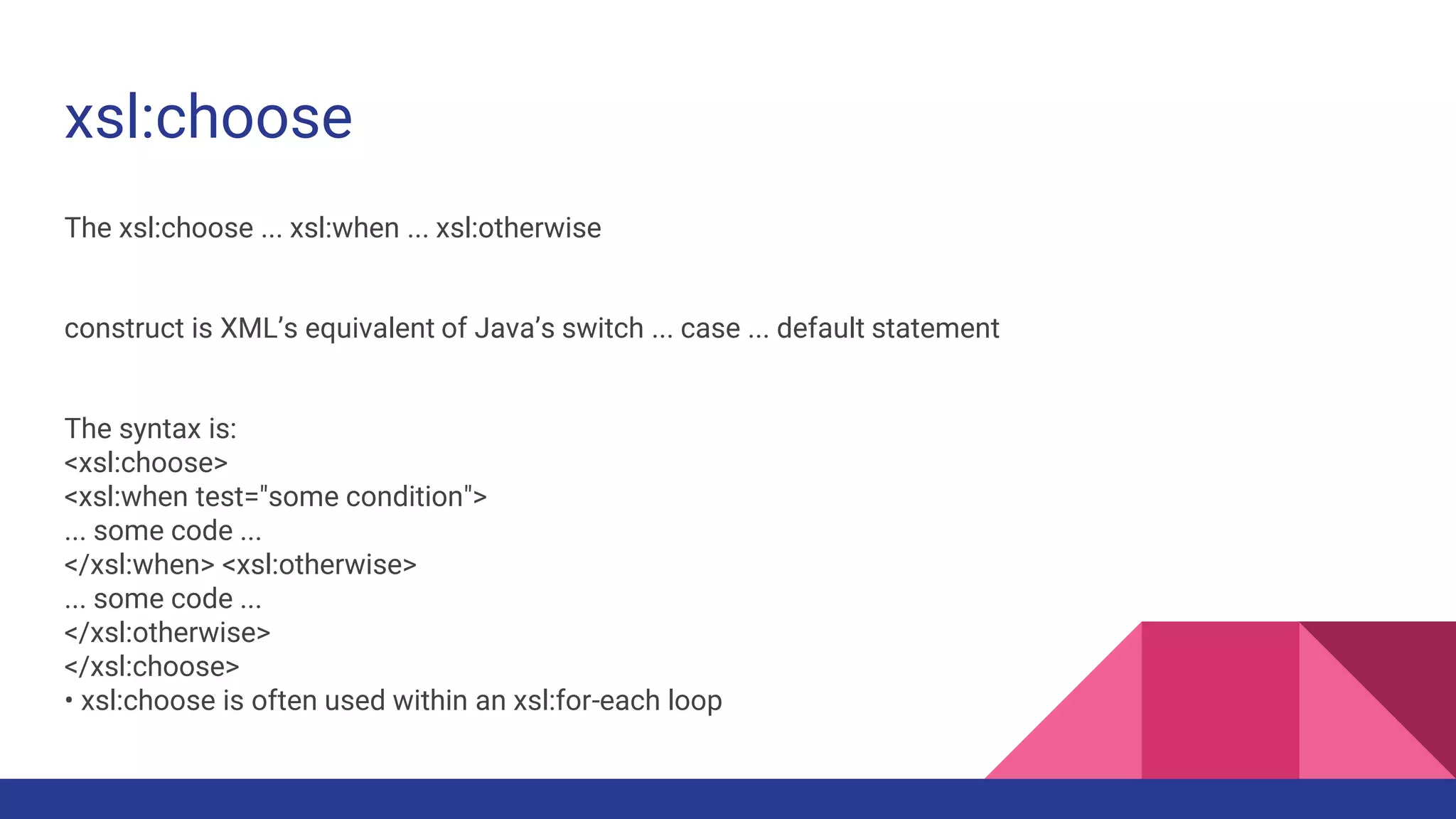
xsl:choose
The xsl:choose ... xsl:when ... xsl:otherwise
construct is XML’s equivalent of Java’s switch ... case ... default statement
The syntax is:
<xsl:choose>
<xsl:when test="some condition">
... some code ...
</xsl:when> <xsl:otherwise>
... some code ...
</xsl:otherwise>
</xsl:choose>
• xsl:choose is often used within an xsl:for-each loop
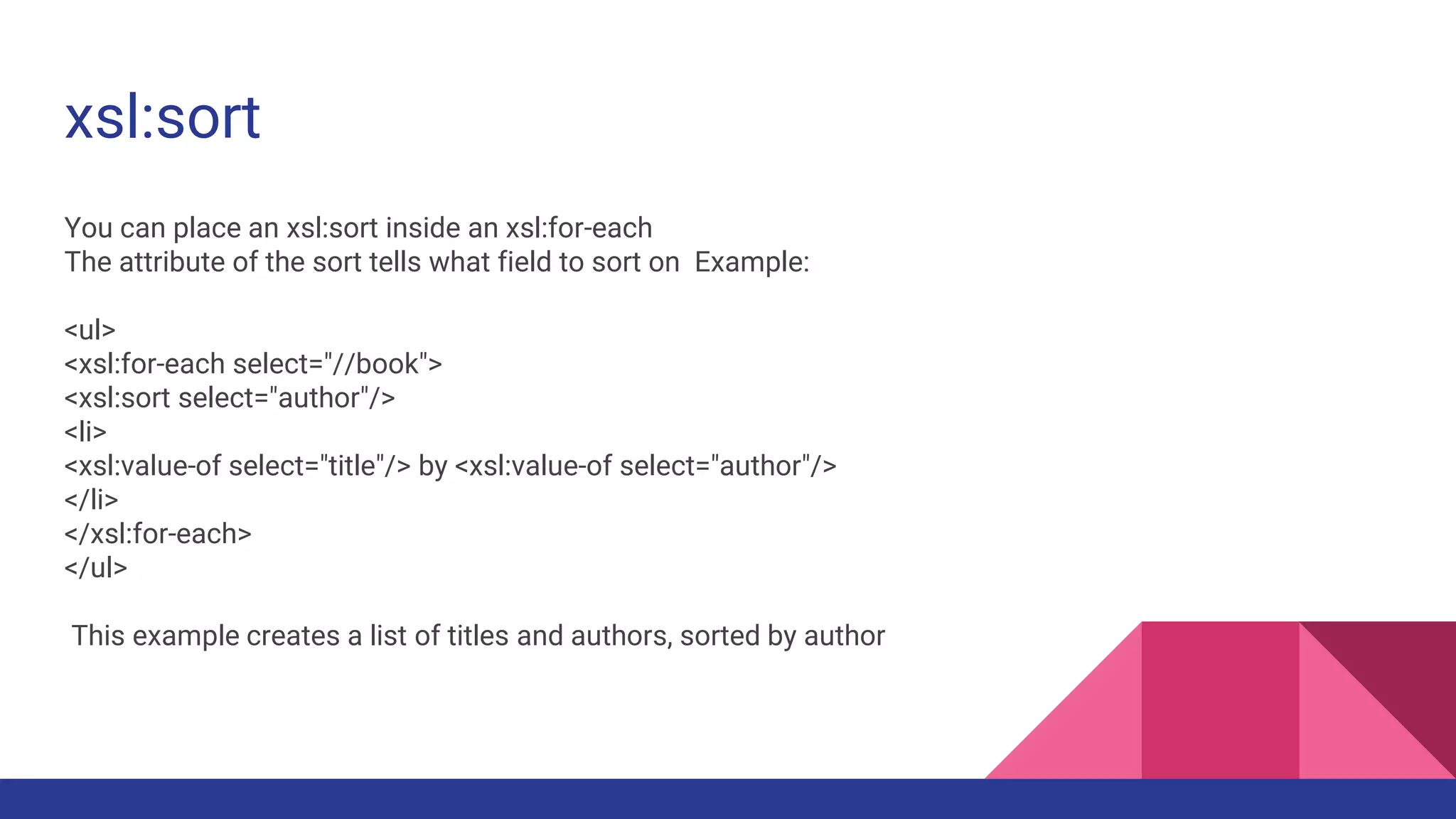
xsl:sort
You can place an xsl:sort inside an xsl:for-each
The attribute of the sort tells what field to sort on Example:
<ul>
<xsl:for-each select="//book">
<xsl:sort select="author"/>
<li>
<xsl:value-of select="title"/> by <xsl:value-of select="author"/>
</li>
</xsl:for-each>
</ul>
This example creates a list of titles and authors, sorted by author
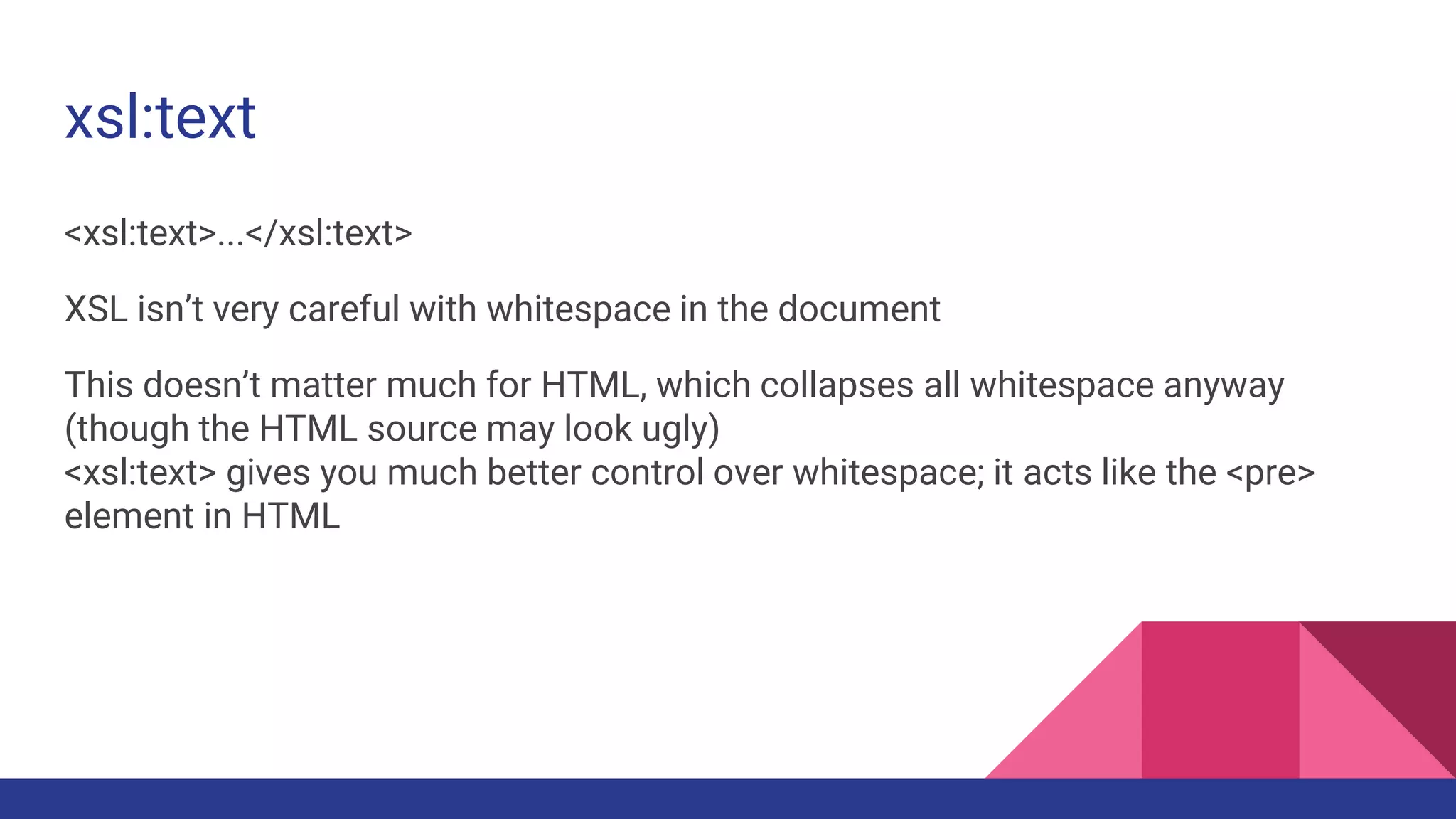
xsl:text
<xsl:text>...</xsl:text>
XSL isn’t very careful with whitespace in the document
This doesn’t matter much for HTML, which collapses all whitespace anyway
(though the HTML source may look ugly)
<xsl:text> gives you much better control over whitespace; it acts like the <pre>
element in HTML
Quick questions
- What are the input files in XSLT?
- Mentions 2 commands in XSL
- ¿What does the command choose?
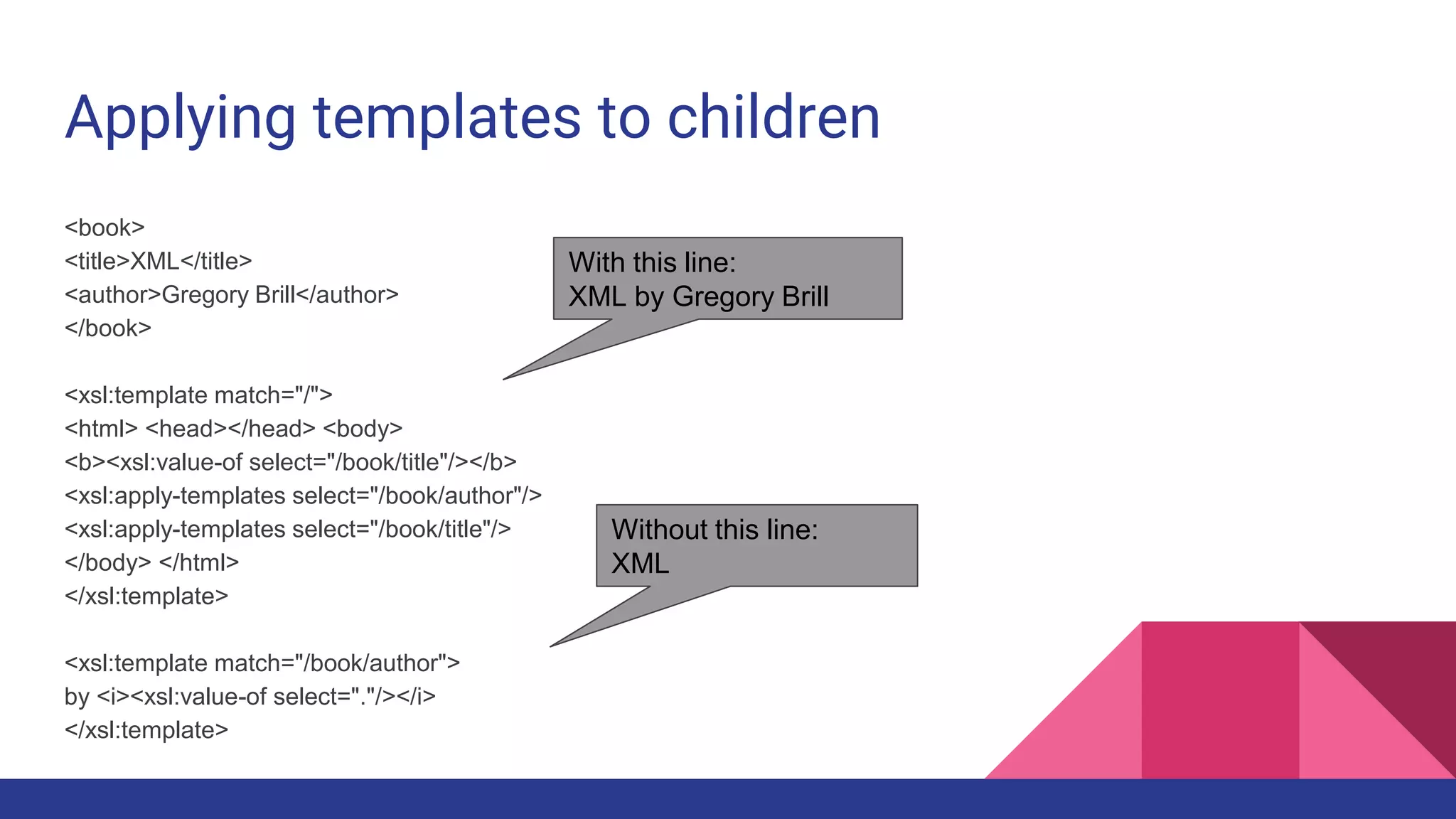
Applying templates to children
<book>
<title>XML</title>
<author>Gregory Brill</author>
</book>
<xsl:template match="/">
<html> <head></head> <body>
<b><xsl:value-of select="/book/title"/></b>
<xsl:apply-templates select="/book/author"/>
<xsl:apply-templates select="/book/title"/>
</body> </html>
</xsl:template>
<xsl:template match="/book/author">
by <i><xsl:value-of select="."/></i>
</xsl:template>
With this line:
XML by Gregory Brill
Without this line:
XML
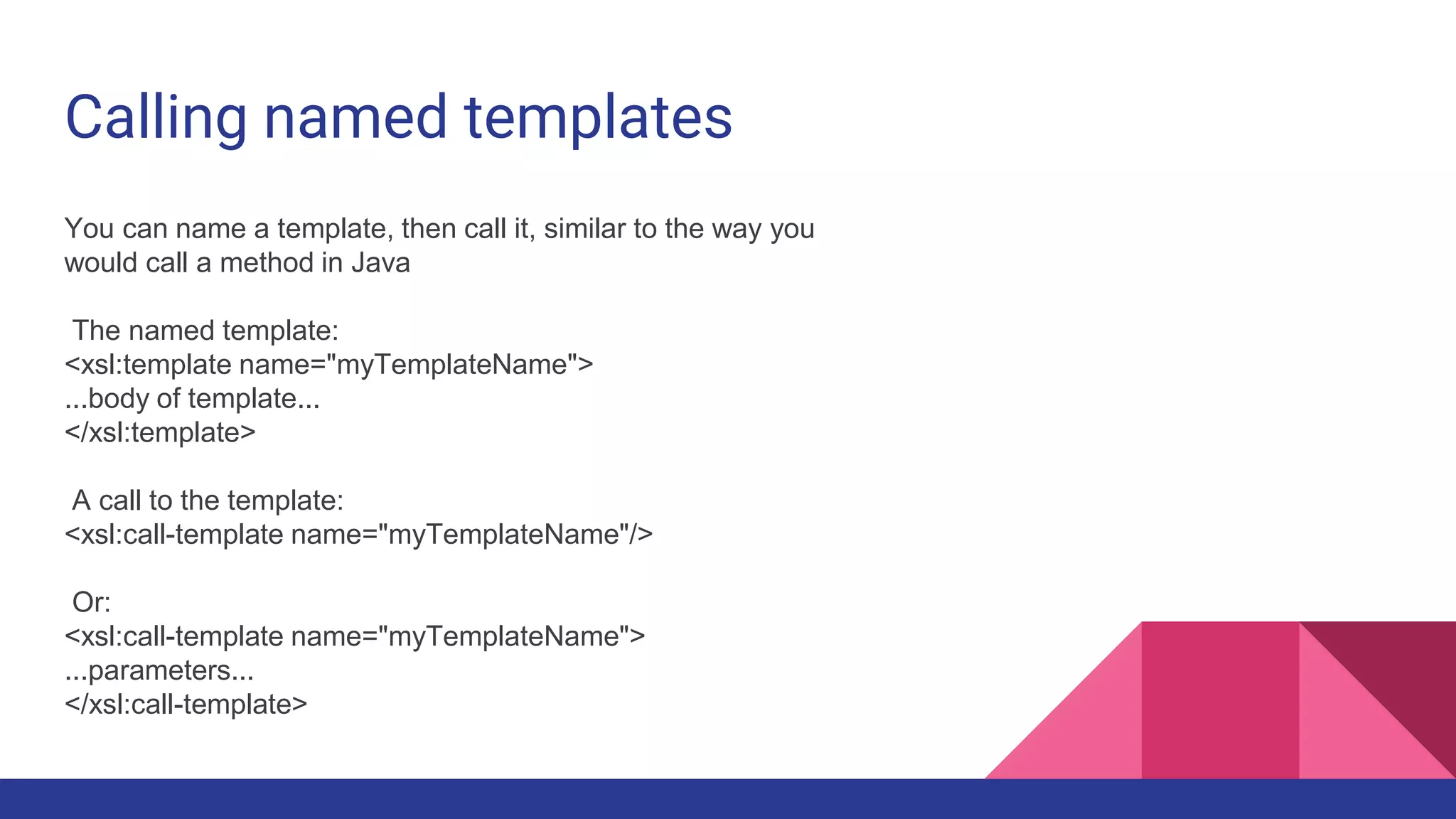
Calling named templates
You can name a template, then call it, similar to the way you
would call a method in Java
The named template:
<xsl:template name="myTemplateName">
...body of template...
</xsl:template>
A call to the template:
<xsl:call-template name="myTemplateName"/>
Or:
<xsl:call-template name="myTemplateName">
...parameters...
</xsl:call-template>
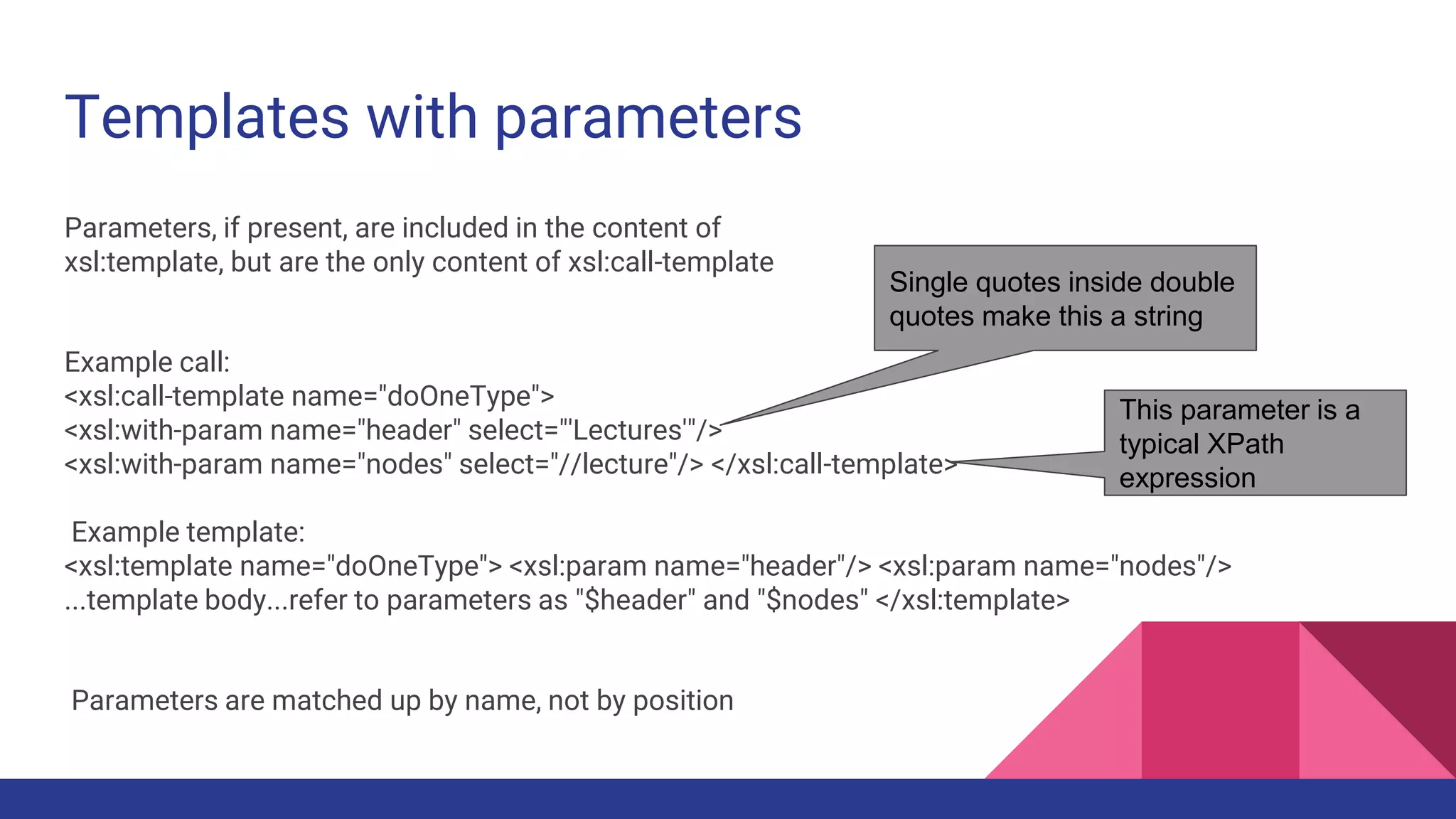
Templates with parameters
Parameters, if present, are included in the content of
xsl:template, but are the only content of xsl:call-template
Example call:
<xsl:call-template name="doOneType">
<xsl:with-param name="header" select="'Lectures'"/>
<xsl:with-param name="nodes" select="//lecture"/> </xsl:call-template>
Example template:
<xsl:template name="doOneType"> <xsl:param name="header"/> <xsl:param name="nodes"/>
...template body...refer to parameters as "$header" and "$nodes" </xsl:template>
Parameters are matched up by name, not by position
Single quotes inside double
quotes make this a string
This parameter is a
typical XPath
expression
Thoughts on XSL
XSL is a programming language--and not a particularly simple one
Expect to spend considerable time debugging your XSL
These slides have been an introduction to XSL and XSLT--there’s a lot more of it we haven’t covered
As with any programming, it’s a good idea to start simple and build it up incrementally: “Write a little, test
a little”
This is especially a good idea for XSLT, because you don’t get a lot of
feedback about what went wrong
I use jEdit with the XML plugin
I find it to be a big help, especially with XML syntax
My approach is: write (or change) a line or two, check for syntax errors,
then jump to IE and reload the XML file

XSLT presentation

  • 1.
    XSLT presentation By Alejandroherreño y Miguel Teheran
  • 2.
    XSLT ● XSLT standsfor Extensible Stylesheet Language Transformations ● XSLT is used to transform XML documents into other kinds of documents--usually, but not necessarily, XHTML ● XSLT uses two input files: The XML document containing the actual data The XSL document containing both the “framework” in which to insert the data, and XSLT commands to do so
  • 3.
    Simple example File data.xml: <?xmlversion="1.0"?> <?xml-stylesheet type="text/xsl" href="render.xsl"?> <message>Howdy!</message> File render.xsl: <?xml version="1.0"?> <xsl:stylesheet version="1.0” xmlns:xsl="http://www.w3.org/1999/XSL/Transform"> <!-- one rule, to transform the input root (/) → <xsl:template match="/"> <html><body> <h1><xsl:value-of select="message"/></h1> </body></html> </xsl:template> </xsl:stylesheet>
  • 4.
    The .xsl file AnXSLT document has the .xsl extension The XSLT document begins with: <?xml version="1.0"?> <xsl:stylesheet version="1.0" xmlns:xsl="http://www.w3.org/1999/XSL/Transform"> Contains one or more templates, such as: <xsl:template match="/"> ... </xsl:template> And ends with: </xsl:stylesheet>
  • 5.
    xsl:value-of <xsl:value-of select="XPath expression"/>selects the contents of an element and adds it to the output stream The select attribute is required Notice that xsl:value-of is not a container, hence it needs to end with a slash Example (from an earlier slide): <h1> <xsl:value-of select="message"/> </h1>
  • 6.
    xsl:for-each xsl:for-each is akind of loop statement The syntax is <xsl:for-each select="XPath expression"> Text to insert and rules to apply </xsl:for-each> Example: to select every book (//book) and make an unordered list (<ul>) of their titles (title), use: <ul> <xsl:for-each select="//book"> <li> <xsl:value-of select="title"/> </li> </xsl:for-each> </ul>
  • 7.
    Filtering output You canfilter (restrict) output by adding a criterion to the select attribute’s value: <ul> <xsl:for-each select="//book"> <li> <xsl:value-of select="title[../author='Terry Pratchett']"/> </li> </xsl:for-each> </ul> This will select book titles by Terry Pratchett
  • 8.
    Filter details Here isthe filter we just used: <xsl:value-of select="title[../author='Terry Pratchett']"/> author is a sibling of title, so from title we have to go up to its parent, book, then back down to author This filter requires a quote within a quote, so we need both single quotes and double quotes Legal filter operators are: = != &lt; &gt; Numbers should be quoted, but apparently don’t have to be
  • 9.
    xsl:if xsl:if allows usto include content if a given condition (in the test attribute) is true Example: <xsl:for-each select="//book"> <xsl:if test="author='Terry Pratchett'"> <li> <xsl:value-of select="title"/> </li> </xsl:if> </xsl:for-each> This does work correctly!
  • 10.
    xsl:choose The xsl:choose ...xsl:when ... xsl:otherwise construct is XML’s equivalent of Java’s switch ... case ... default statement The syntax is: <xsl:choose> <xsl:when test="some condition"> ... some code ... </xsl:when> <xsl:otherwise> ... some code ... </xsl:otherwise> </xsl:choose> • xsl:choose is often used within an xsl:for-each loop
  • 11.
    xsl:sort You can placean xsl:sort inside an xsl:for-each The attribute of the sort tells what field to sort on Example: <ul> <xsl:for-each select="//book"> <xsl:sort select="author"/> <li> <xsl:value-of select="title"/> by <xsl:value-of select="author"/> </li> </xsl:for-each> </ul> This example creates a list of titles and authors, sorted by author
  • 12.
    xsl:text <xsl:text>...</xsl:text> XSL isn’t verycareful with whitespace in the document This doesn’t matter much for HTML, which collapses all whitespace anyway (though the HTML source may look ugly) <xsl:text> gives you much better control over whitespace; it acts like the <pre> element in HTML
  • 13.
    Quick questions - Whatare the input files in XSLT? - Mentions 2 commands in XSL - ¿What does the command choose?
  • 14.
    Applying templates tochildren <book> <title>XML</title> <author>Gregory Brill</author> </book> <xsl:template match="/"> <html> <head></head> <body> <b><xsl:value-of select="/book/title"/></b> <xsl:apply-templates select="/book/author"/> <xsl:apply-templates select="/book/title"/> </body> </html> </xsl:template> <xsl:template match="/book/author"> by <i><xsl:value-of select="."/></i> </xsl:template> With this line: XML by Gregory Brill Without this line: XML
  • 15.
    Calling named templates Youcan name a template, then call it, similar to the way you would call a method in Java The named template: <xsl:template name="myTemplateName"> ...body of template... </xsl:template> A call to the template: <xsl:call-template name="myTemplateName"/> Or: <xsl:call-template name="myTemplateName"> ...parameters... </xsl:call-template>
  • 16.
    Templates with parameters Parameters,if present, are included in the content of xsl:template, but are the only content of xsl:call-template Example call: <xsl:call-template name="doOneType"> <xsl:with-param name="header" select="'Lectures'"/> <xsl:with-param name="nodes" select="//lecture"/> </xsl:call-template> Example template: <xsl:template name="doOneType"> <xsl:param name="header"/> <xsl:param name="nodes"/> ...template body...refer to parameters as "$header" and "$nodes" </xsl:template> Parameters are matched up by name, not by position Single quotes inside double quotes make this a string This parameter is a typical XPath expression
  • 17.
    Thoughts on XSL XSLis a programming language--and not a particularly simple one Expect to spend considerable time debugging your XSL These slides have been an introduction to XSL and XSLT--there’s a lot more of it we haven’t covered As with any programming, it’s a good idea to start simple and build it up incrementally: “Write a little, test a little” This is especially a good idea for XSLT, because you don’t get a lot of feedback about what went wrong I use jEdit with the XML plugin I find it to be a big help, especially with XML syntax My approach is: write (or change) a line or two, check for syntax errors, then jump to IE and reload the XML file