preencoded.png
Presented by : Mohd Faraz
BMRIT 6th Semester
Paramedical College, Faculty of Medicine
Aligarh Muslim University, Aligarh
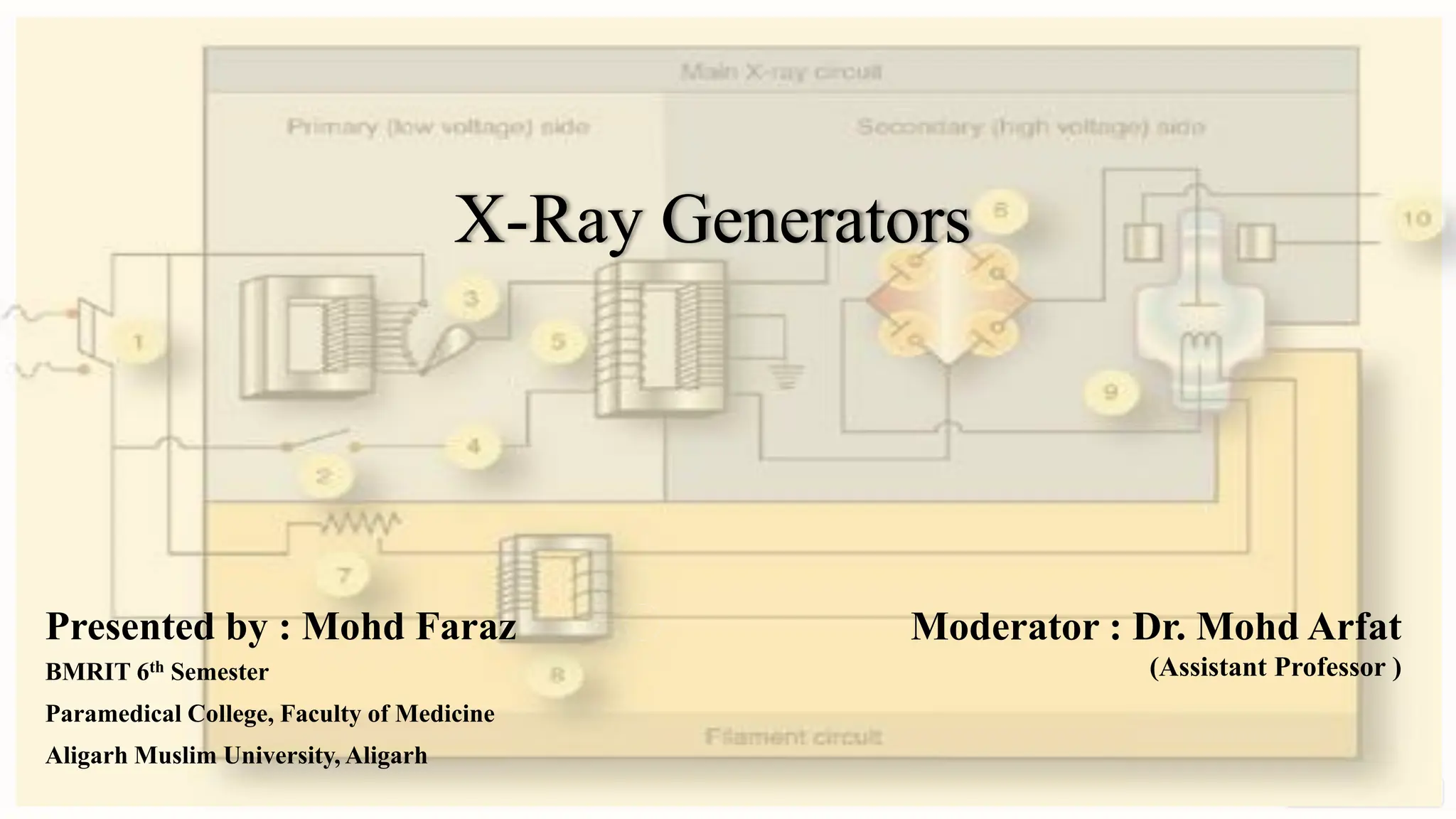
X-Ray Generators
Moderator : Dr. Mohd Arfat
(Assistant Professor )
preencoded.png
• X-rays are a form of electromagnetic radiation with high energy and short
wavelength, capable of penetrating most substances, including human
tissues.
• They are widely used in medical imaging, radiation therapy, and
industrial applications.
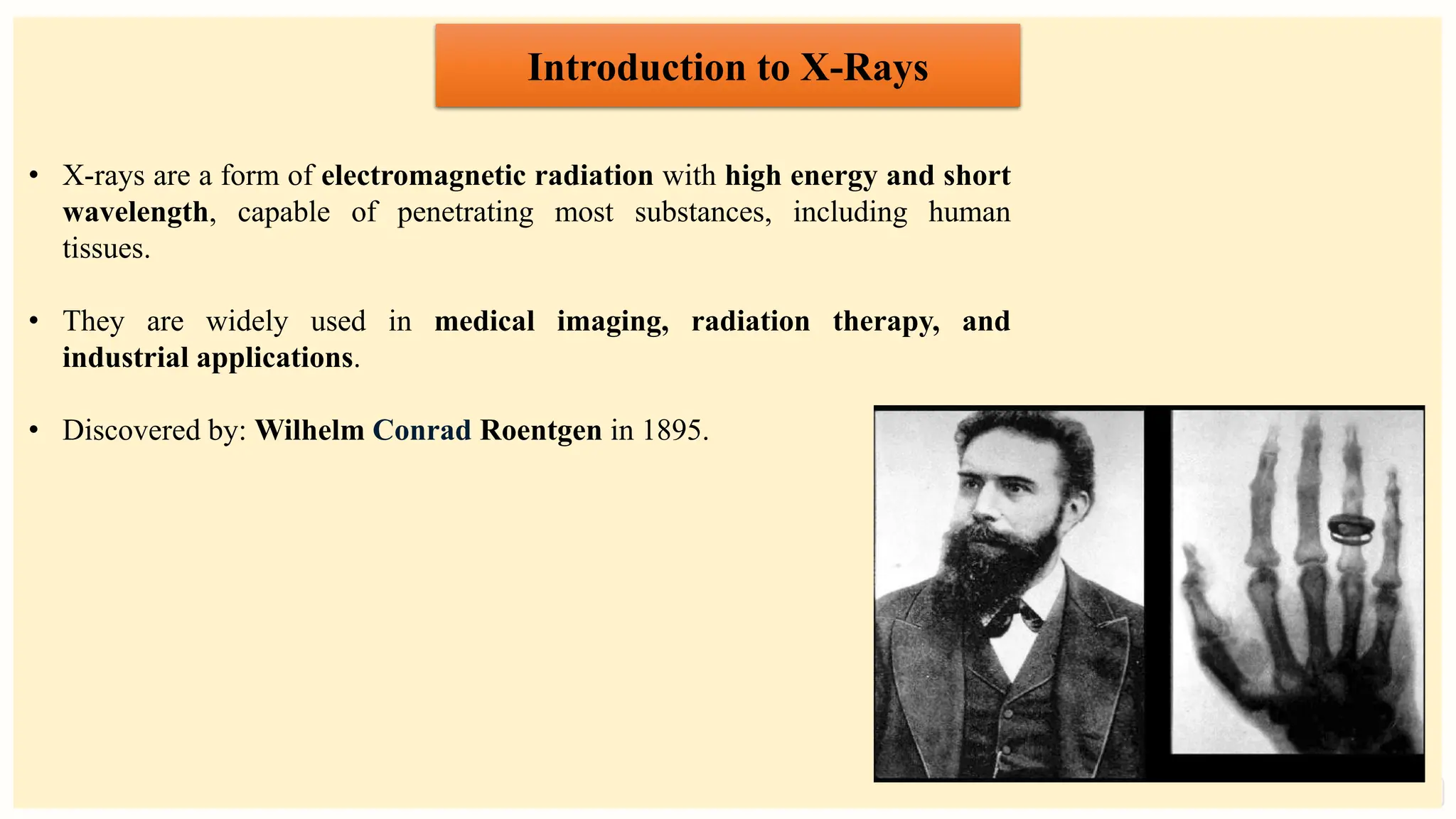
• Discovered by: Wilhelm Conrad Roentgen in 1895.
Introduction to X-Rays
preencoded.png
Properties of X-Rays
i. Invisible: Cannot be seen by the human eye.
ii. High Penetration Power: Can pass through soft tissues but are absorbed by dense structures like
bones.
iii. Ionizing Radiation: Can ionize atoms, causing potential damage to cells.
iv. Travel in Straight Lines: X-rays move in straight paths unless deflected.
v. No Electrical Charge: Unlike electrons, X-rays do not carry charge.
vi. Differential Absorption: Different tissues absorb X-rays differently, allowing contrast in imaging.
NOTE :
Denser objects absorb more X-rays, appearing white on an X-ray image, while less dense tissues appear
darker.
preencoded.png
Types of X-Rays Used in Medicine
âť‘ Soft X-Rays:
• Low Energy, 20-100 keV
• Used in diagnostic radiology (X-ray imaging, mammography, fluoroscopy).
âť‘ Hard X-Rays:
• High Energy, 100 keV - 10 MeV
• Used in radiotherapy, industrial imaging, and security scanning.
NOTE :
Soft X-rays are absorbed by tissues more easily, while hard X-rays penetrate deeper.
preencoded.png
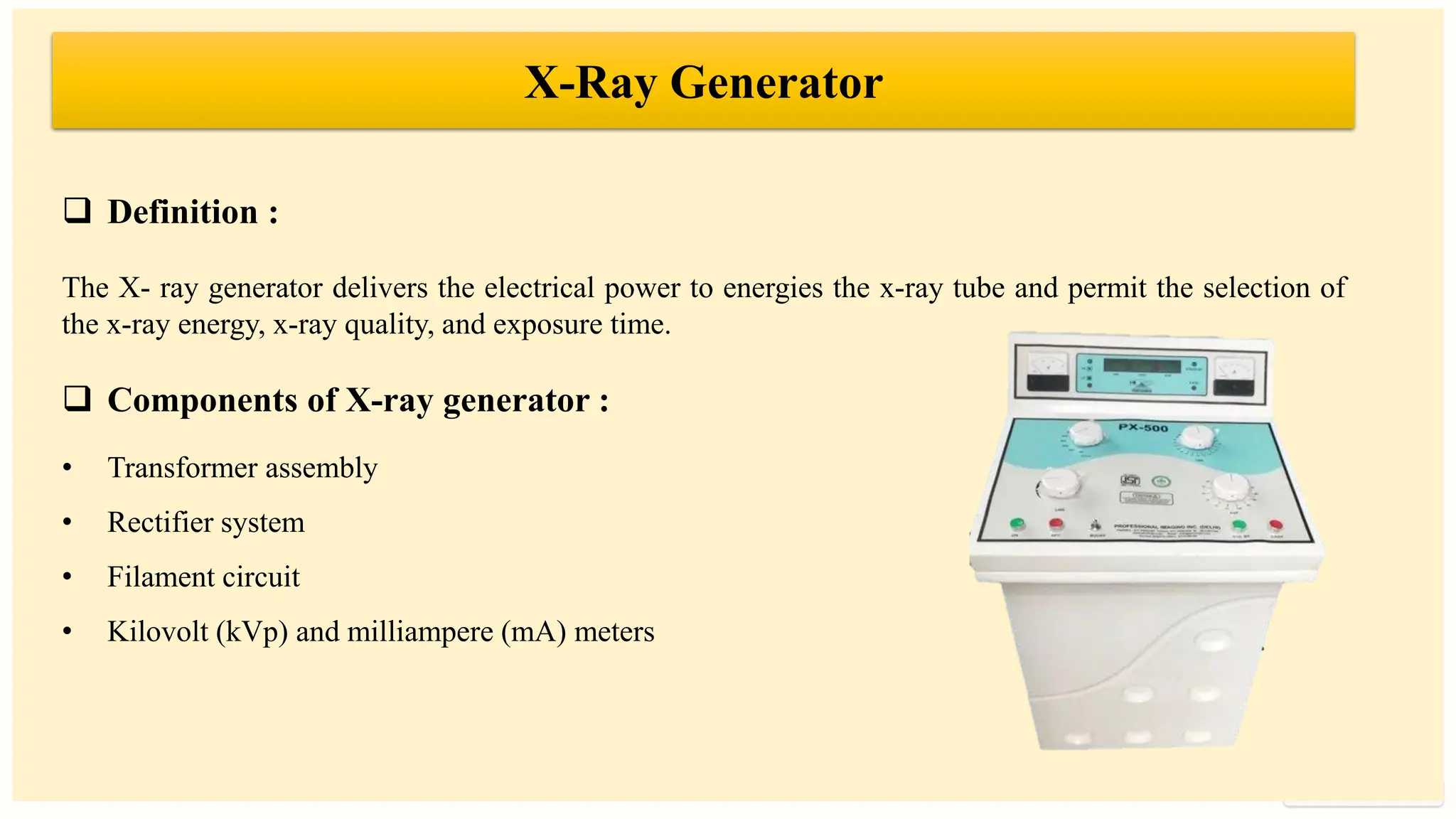
âť‘ Definition :
The X- ray generator delivers the electrical power to energies the x-ray tube and permit the selection of
the x-ray energy, x-ray quality, and exposure time.
âť‘ Components of X-ray generator :
• Transformer assembly
• Rectifier system
• Filament circuit
• Kilovolt (kVp) and milliampere (mA) meters
X-Ray Generator
preencoded.png
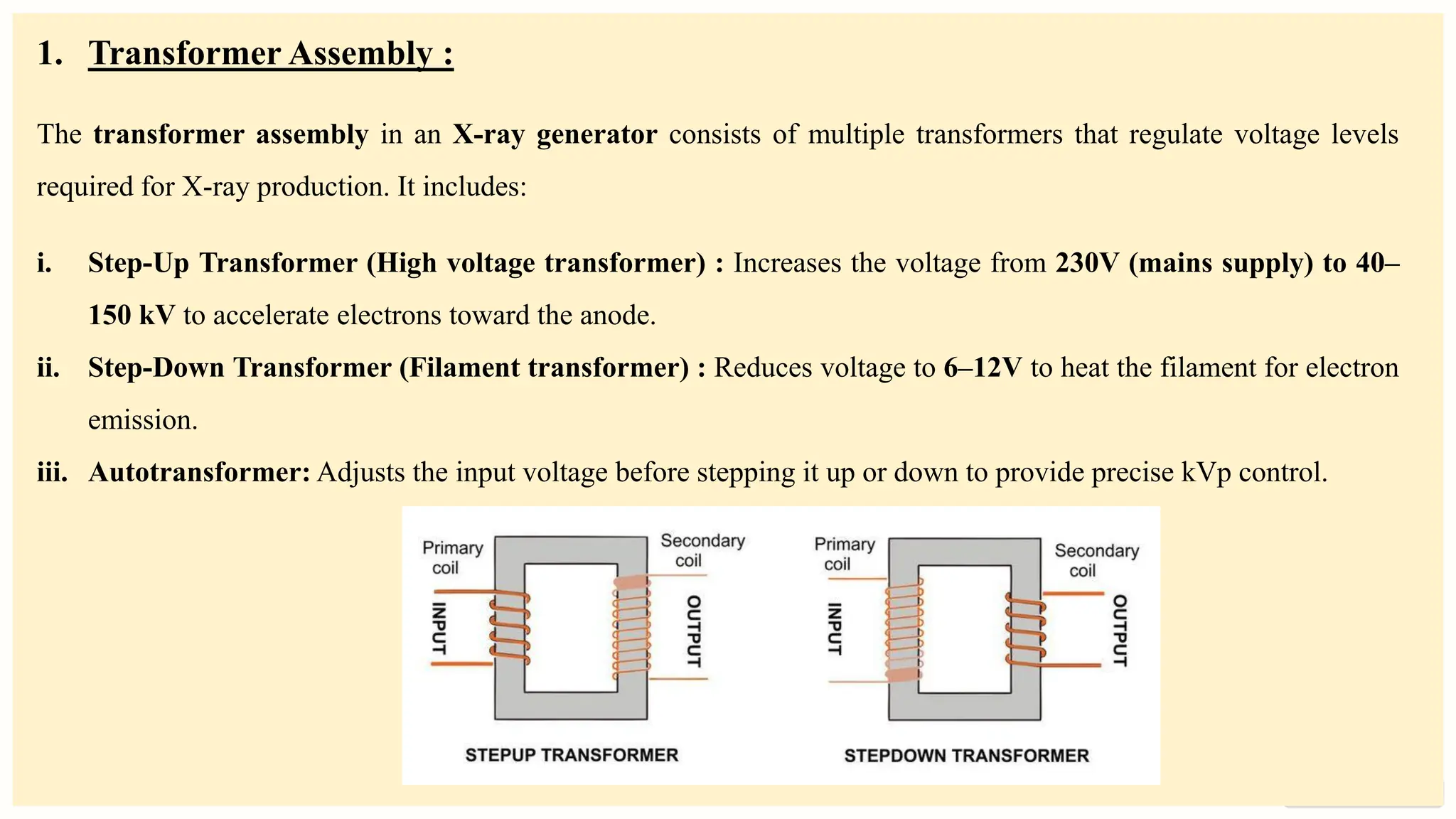
1. Transformer Assembly :
The transformer assembly in an X-ray generator consists of multiple transformers that regulate voltage levels
required for X-ray production. It includes:
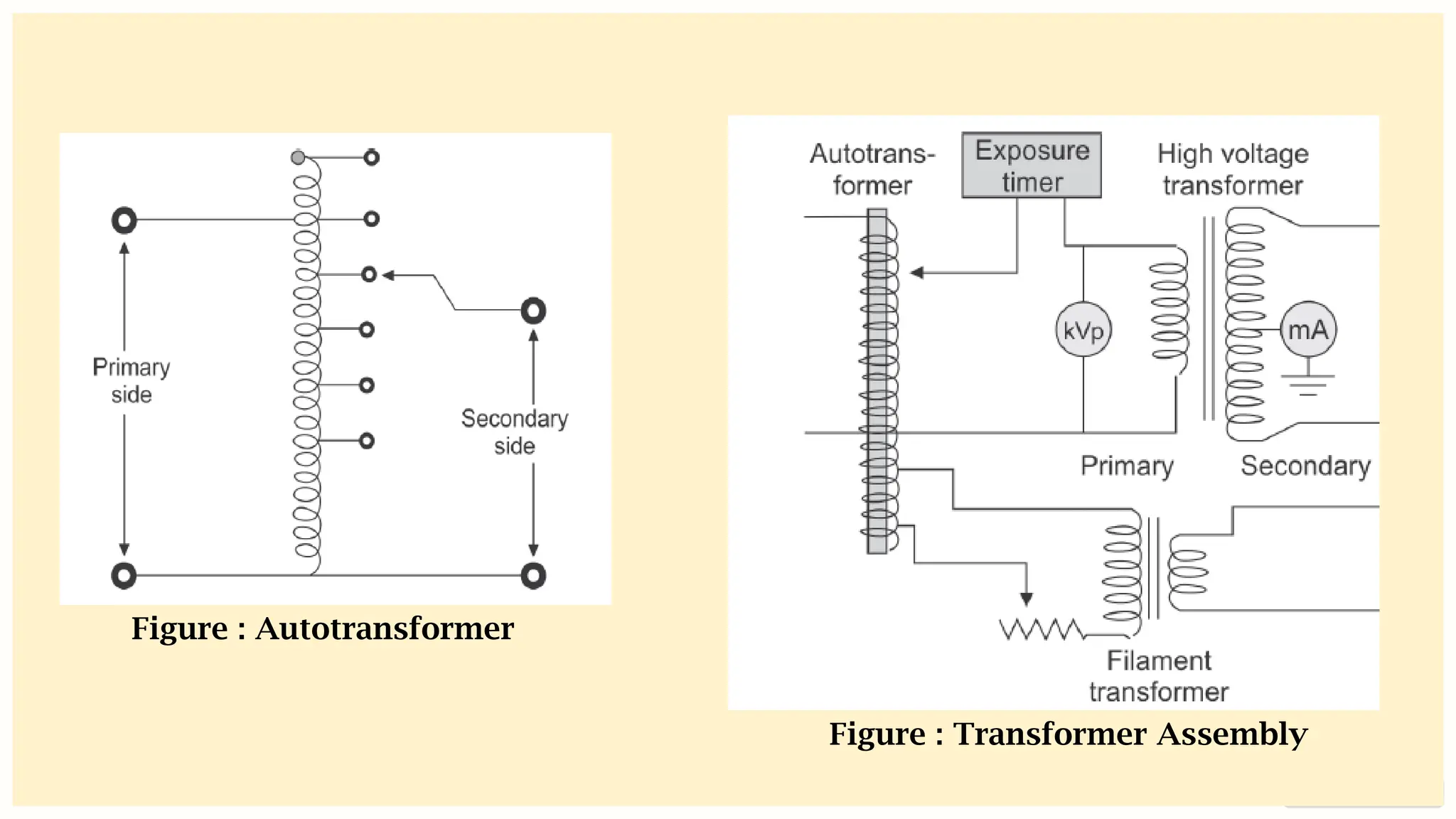
i. Step-Up Transformer (High voltage transformer) : Increases the voltage from 230V (mains supply) to 40–
150 kV to accelerate electrons toward the anode.
ii. Step-Down Transformer (Filament transformer) : Reduces voltage to 6–12V to heat the filament for electron
emission.
iii. Autotransformer: Adjusts the input voltage before stepping it up or down to provide precise kVp control.
preencoded.png
Figure : Transformer Assembly
Figure : Autotransformer
preencoded.png
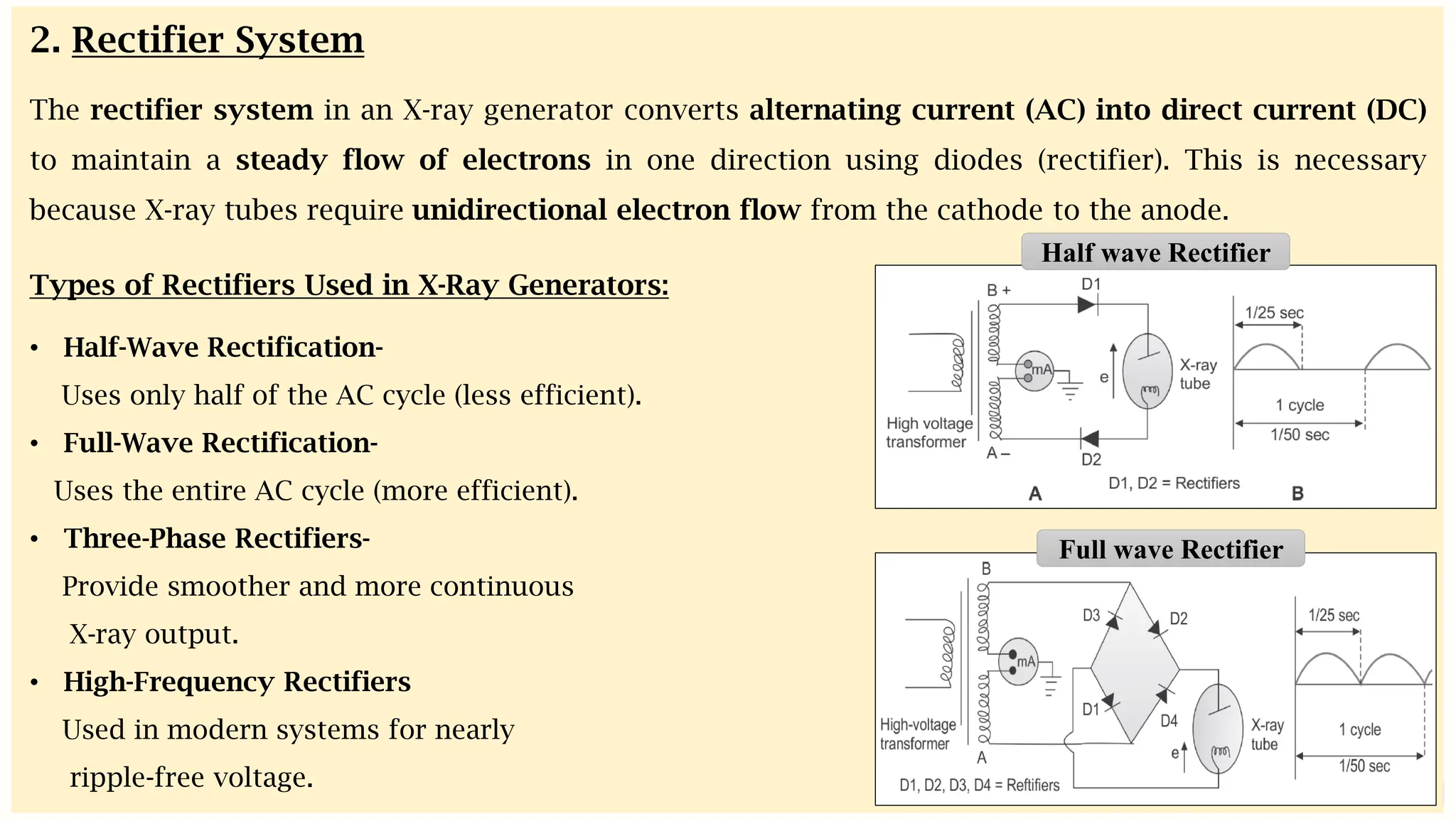
2. Rectifier System
The rectifier system in an X-ray generator converts alternating current (AC) into direct current (DC)
to maintain a steady flow of electrons in one direction using diodes (rectifier). This is necessary
because X-ray tubes require unidirectional electron flow from the cathode to the anode.
Types of Rectifiers Used in X-Ray Generators:
• Half-Wave Rectification-
Uses only half of the AC cycle (less efficient).
• Full-Wave Rectification-
Uses the entire AC cycle (more efficient).
• Three-Phase Rectifiers-
Provide smoother and more continuous
X-ray output.
• High-Frequency Rectifiers
Used in modern systems for nearly
ripple-free voltage.
Half wave Rectifier
Full wave Rectifier
preencoded.png
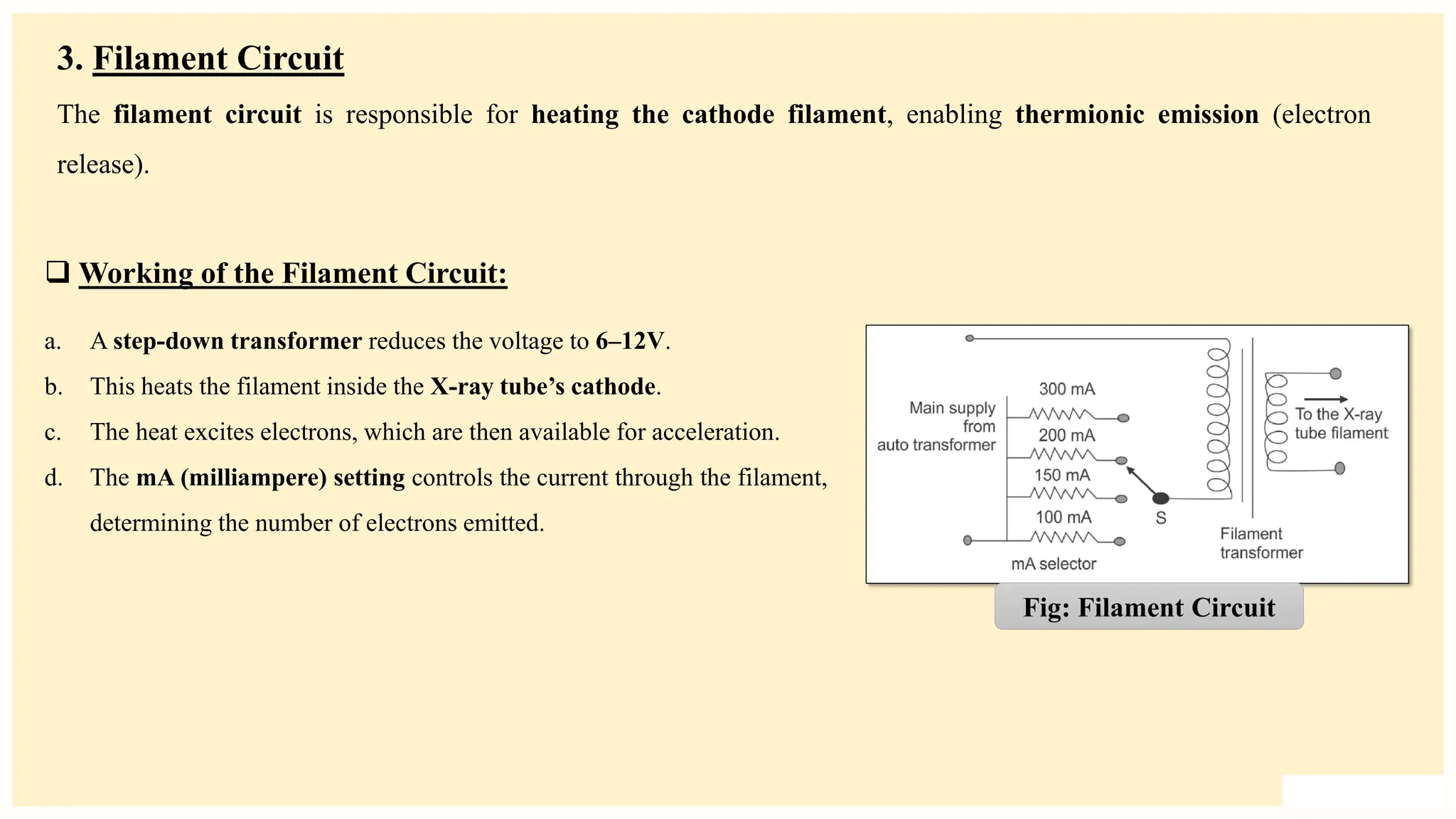
3. Filament Circuit
The filament circuit is responsible for heating the cathode filament, enabling thermionic emission (electron
release).
âť‘ Working of the Filament Circuit:
a. A step-down transformer reduces the voltage to 6–12V.
b. This heats the filament inside the X-ray tube’s cathode.
c. The heat excites electrons, which are then available for acceleration.
d. The mA (milliampere) setting controls the current through the filament,
determining the number of electrons emitted.
Fig: Filament Circuit
preencoded.png
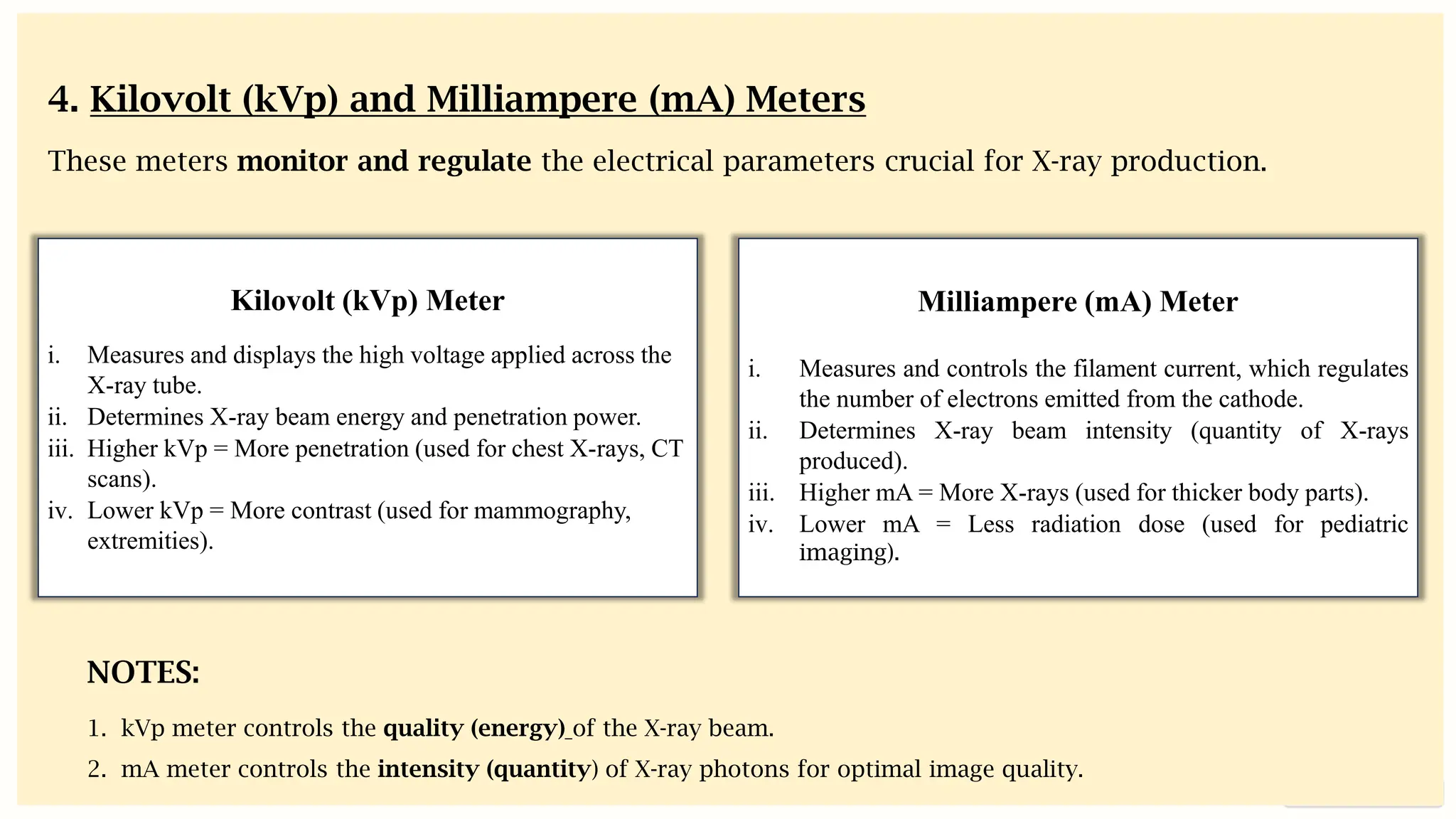
Kilovolt (kVp) Meter
i. Measures and displays the high voltage applied across the
X-ray tube.
ii. Determines X-ray beam energy and penetration power.
iii. Higher kVp = More penetration (used for chest X-rays, CT
scans).
iv. Lower kVp = More contrast (used for mammography,
extremities).
Milliampere (mA) Meter
i. Measures and controls the filament current, which regulates
the number of electrons emitted from the cathode.
ii. Determines X-ray beam intensity (quantity of X-rays
produced).
iii. Higher mA = More X-rays (used for thicker body parts).
iv. Lower mA = Less radiation dose (used for pediatric
imaging).
NOTES:
1. kVp meter controls the quality (energy) of the X-ray beam.
2. mA meter controls the intensity (quantity) of X-ray photons for optimal image quality.
4. Kilovolt (kVp) and Milliampere (mA) Meters
These meters monitor and regulate the electrical parameters crucial for X-ray production.
preencoded.png
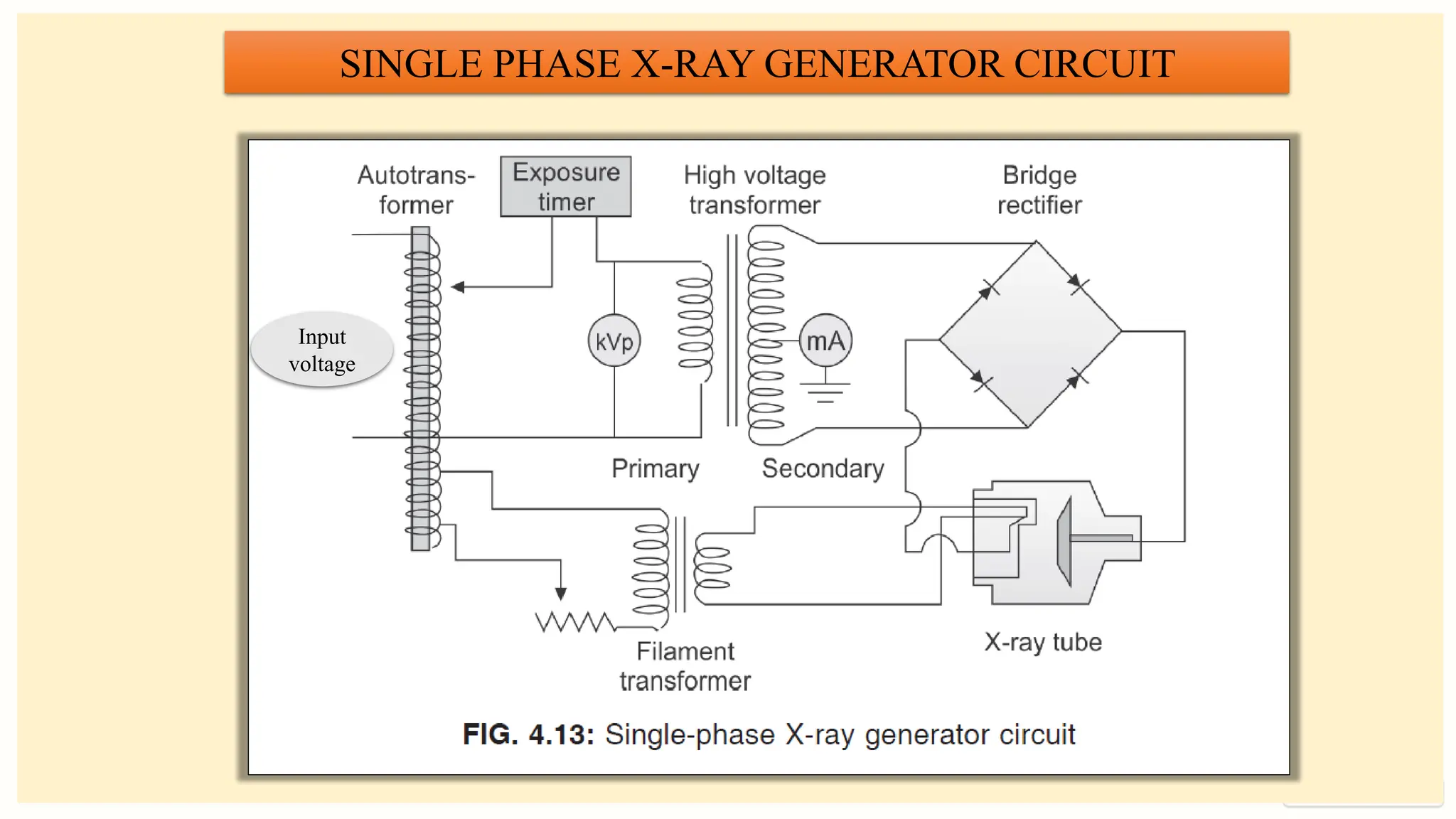
SINGLE PHASE X-RAY GENERATOR CIRCUIT
Input
voltage
preencoded.png
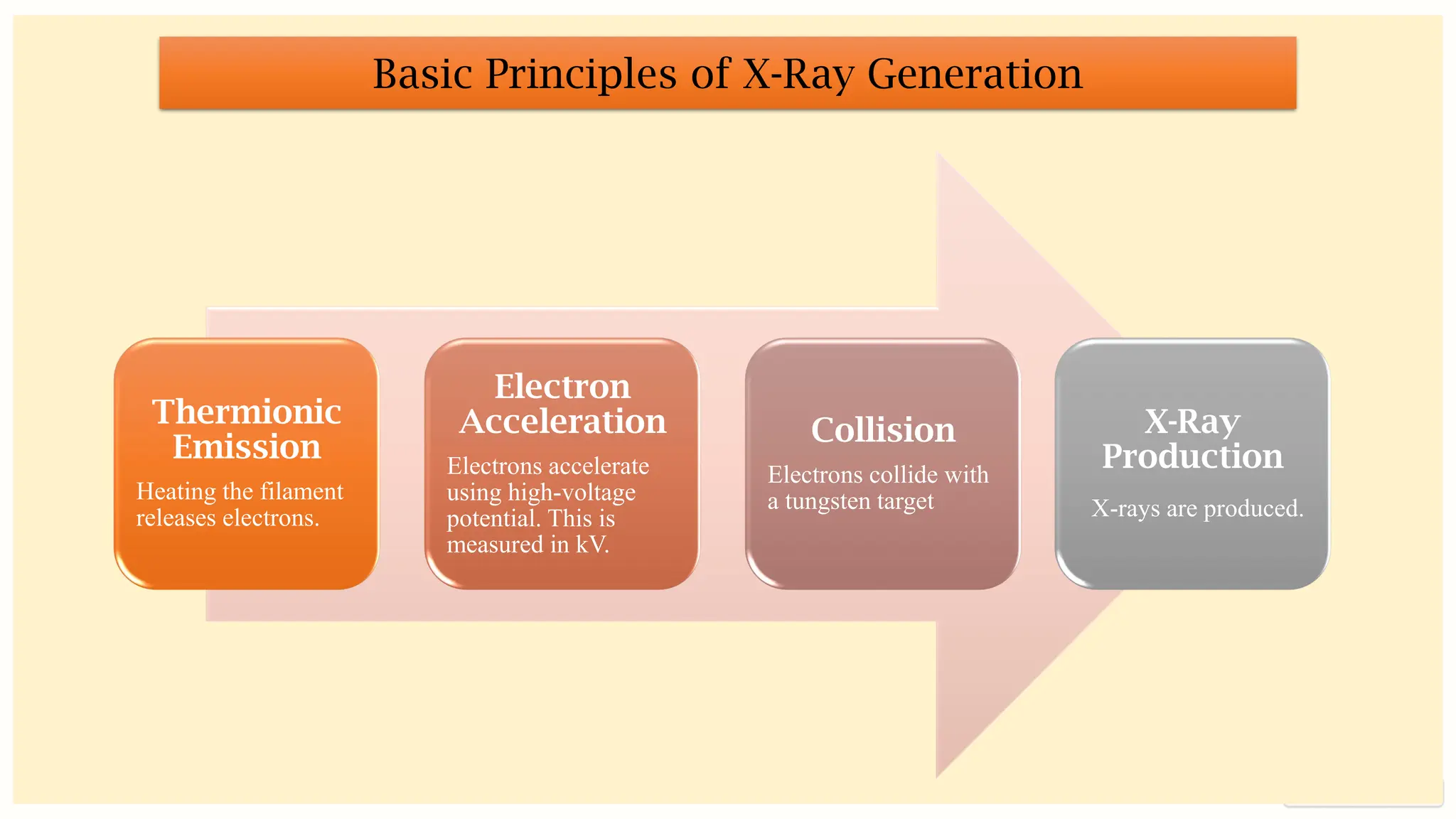
Thermionic
Emission
Heating the filament
releases electrons.
Electron
Acceleration
Electrons accelerate
using high-voltage
potential. This is
measured in kV.
Collision
Electrons collide with
a tungsten target
X-Ray
Production
X-rays are produced.
Basic Principles of X-Ray Generation
preencoded.png
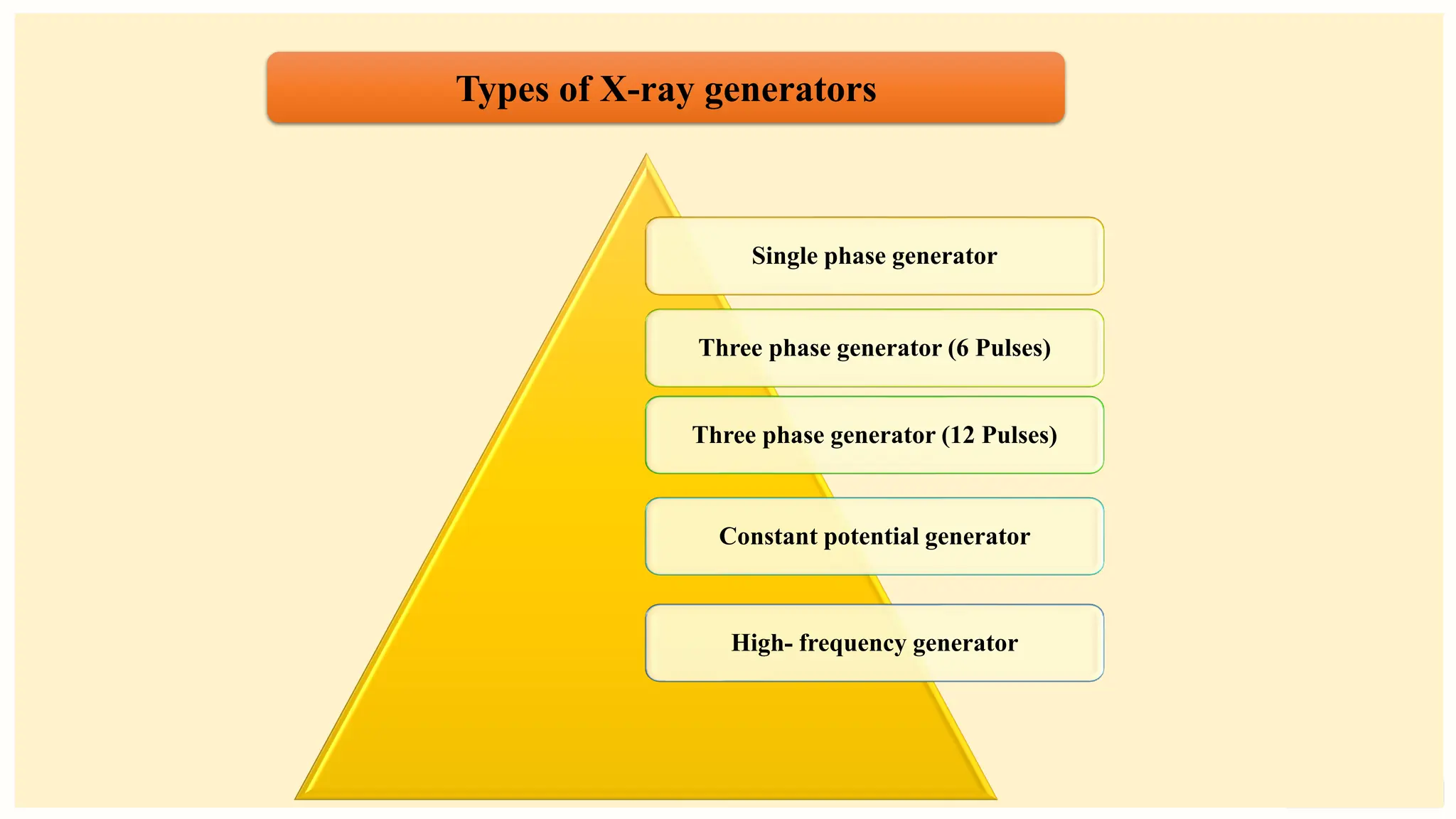
Types of X-ray generators
Single phase generator
Three phase generator (6 Pulses)
Three phase generator (12 Pulses)
Constant potential generator
High- frequency generator
preencoded.png
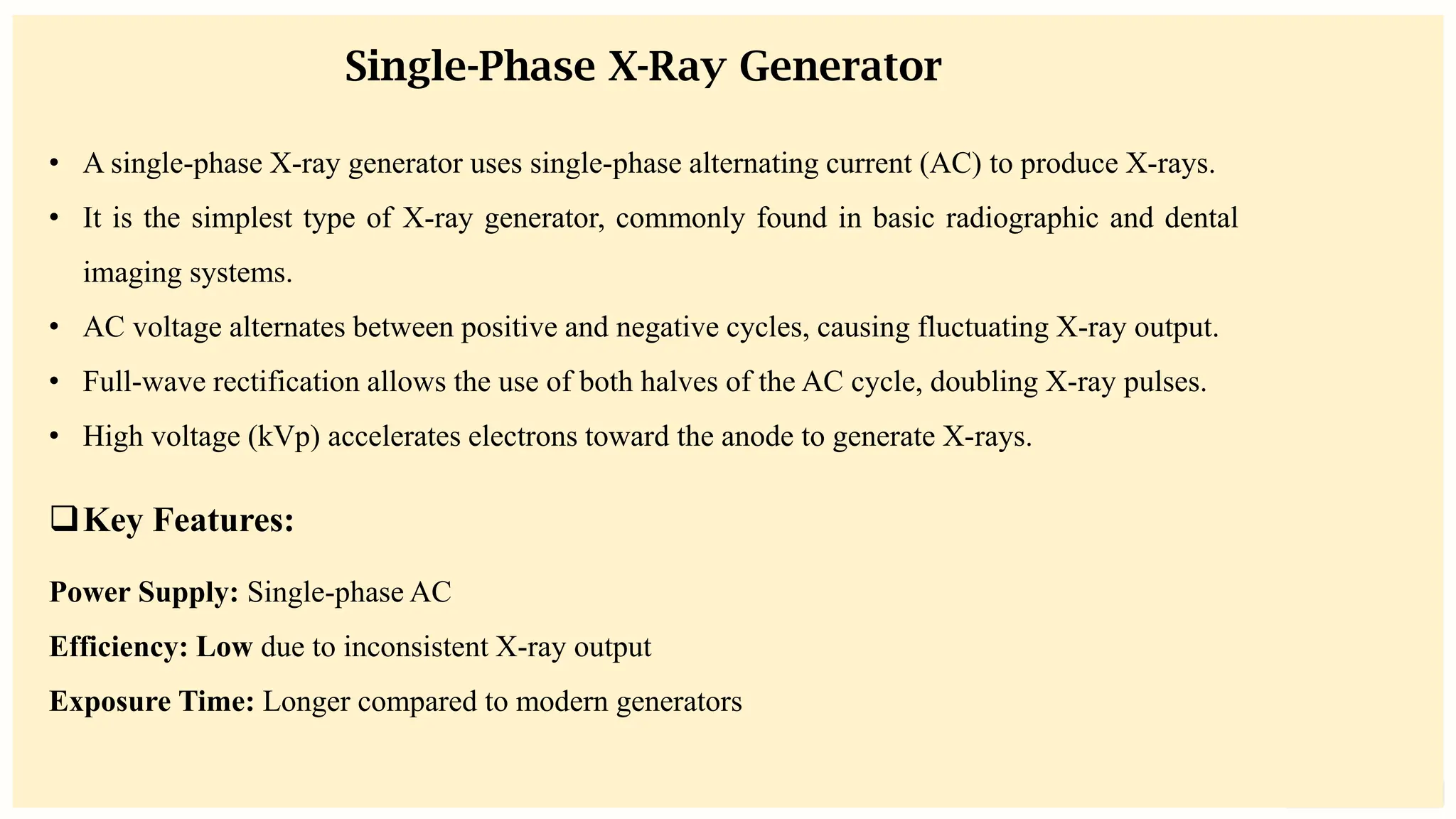
Single-Phase X-Ray Generator
• A single-phase X-ray generator uses single-phase alternating current (AC) to produce X-rays.
• It is the simplest type of X-ray generator, commonly found in basic radiographic and dental
imaging systems.
• AC voltage alternates between positive and negative cycles, causing fluctuating X-ray output.
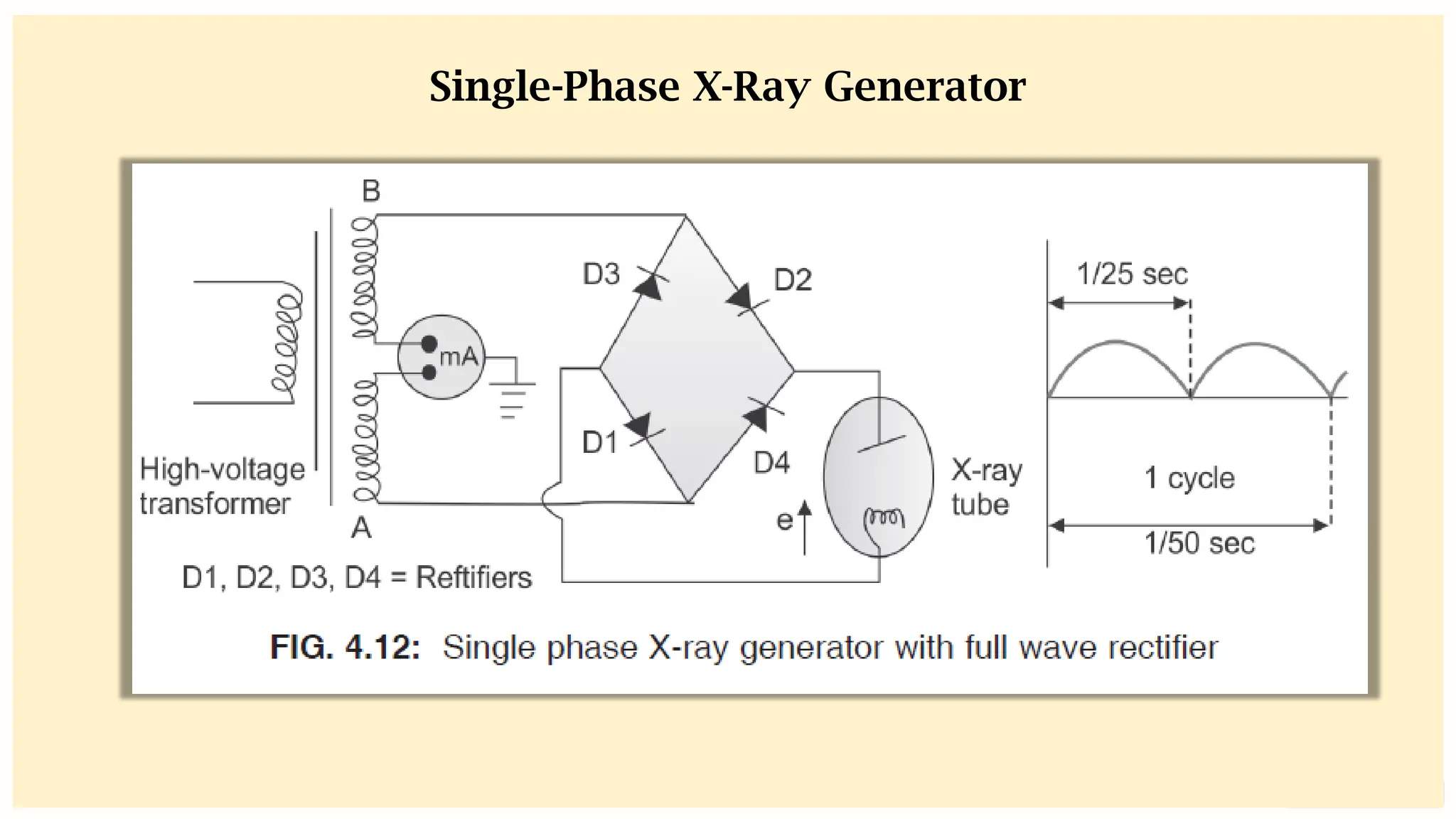
• Full-wave rectification allows the use of both halves of the AC cycle, doubling X-ray pulses.
• High voltage (kVp) accelerates electrons toward the anode to generate X-rays.
❑Key Features:
Power Supply: Single-phase AC
Efficiency: Low due to inconsistent X-ray output
Exposure Time: Longer compared to modern generators
preencoded.png
Single-Phase X-Ray Generator
preencoded.png
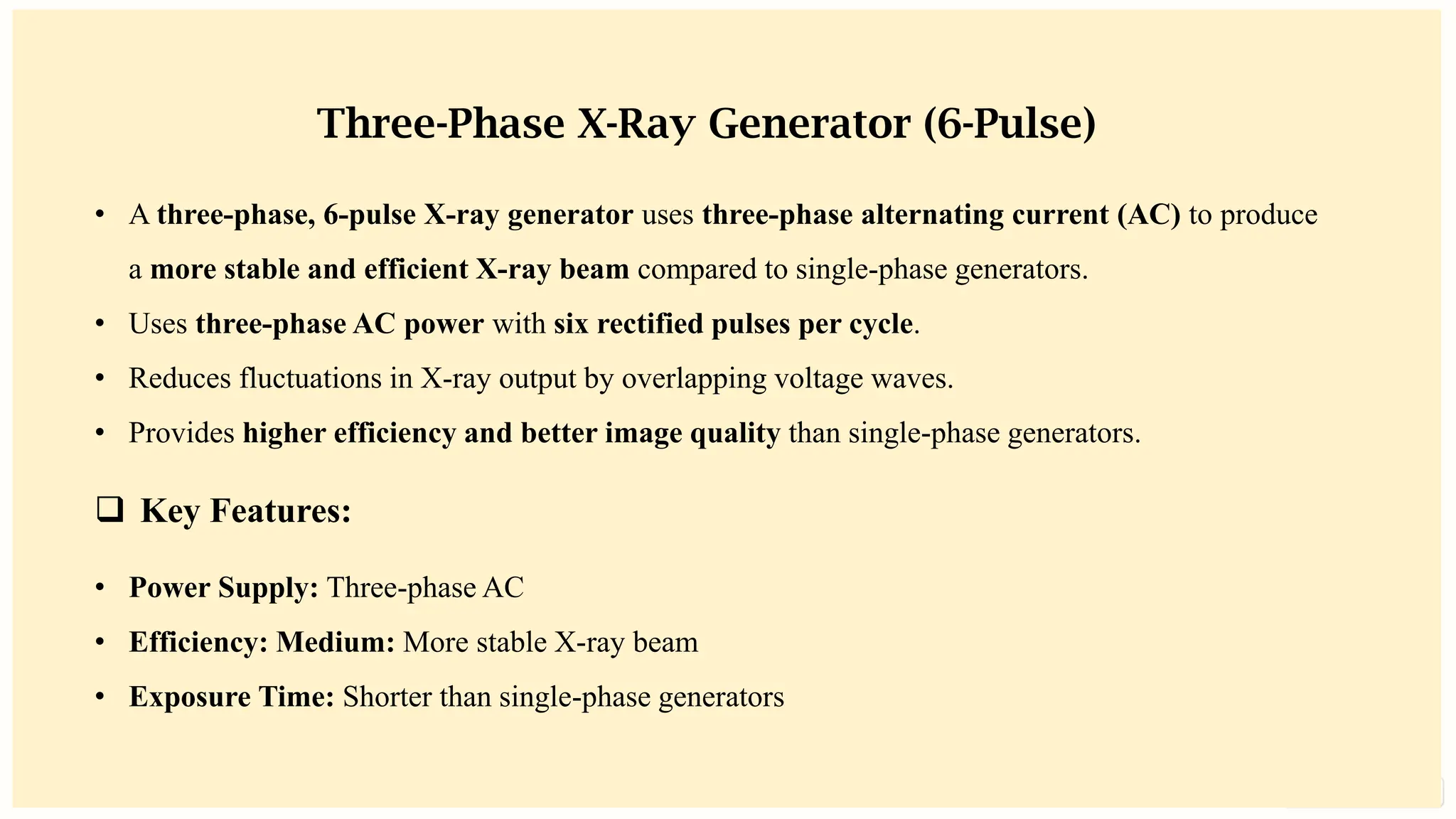
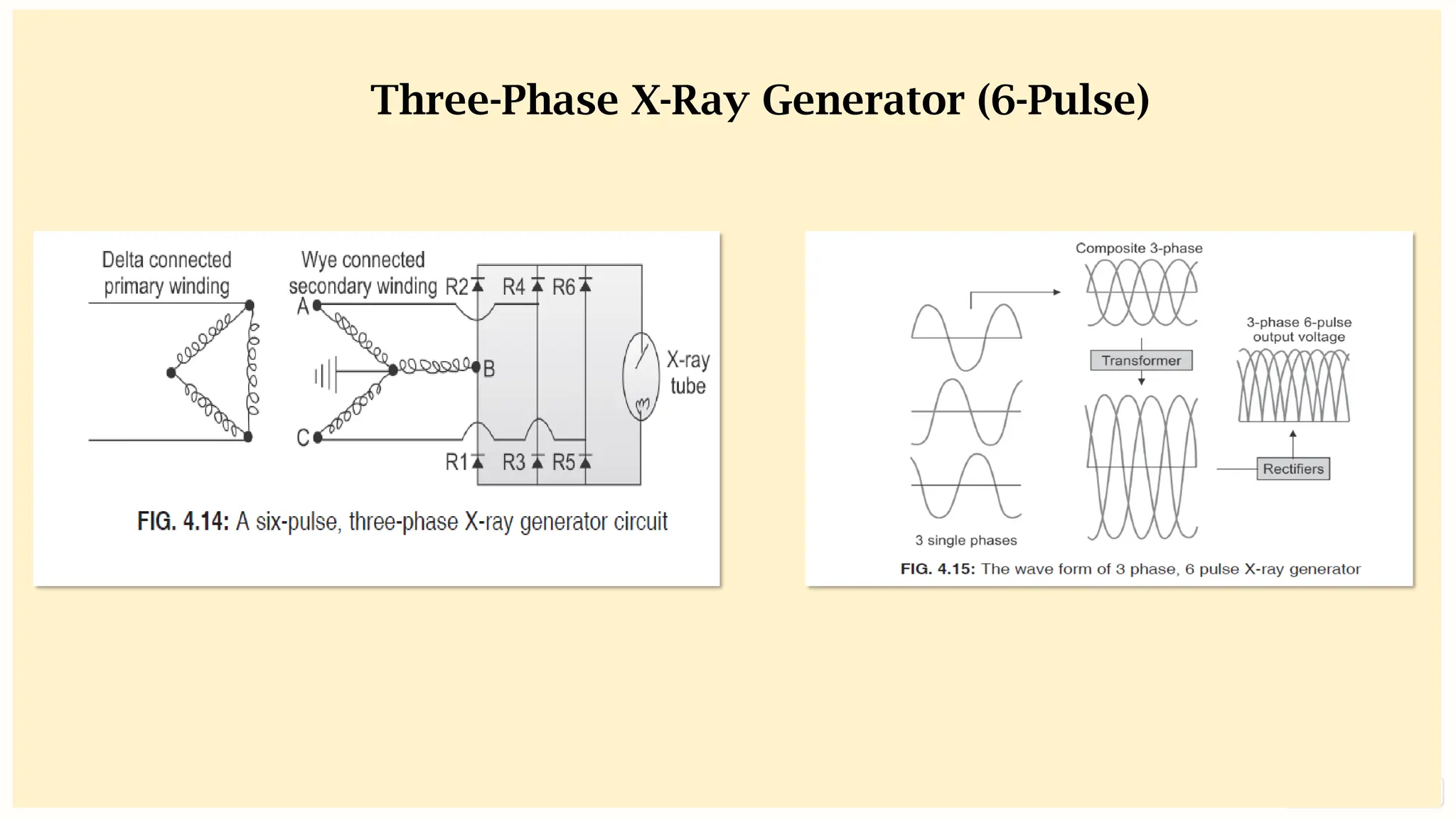
Three-Phase X-Ray Generator (6-Pulse)
• A three-phase, 6-pulse X-ray generator uses three-phase alternating current (AC) to produce
a more stable and efficient X-ray beam compared to single-phase generators.
• Uses three-phase AC power with six rectified pulses per cycle.
• Reduces fluctuations in X-ray output by overlapping voltage waves.
• Provides higher efficiency and better image quality than single-phase generators.
âť‘ Key Features:
• Power Supply: Three-phase AC
• Efficiency: Medium: More stable X-ray beam
• Exposure Time: Shorter than single-phase generators
preencoded.png
Three-Phase X-Ray Generator (6-Pulse)
preencoded.png
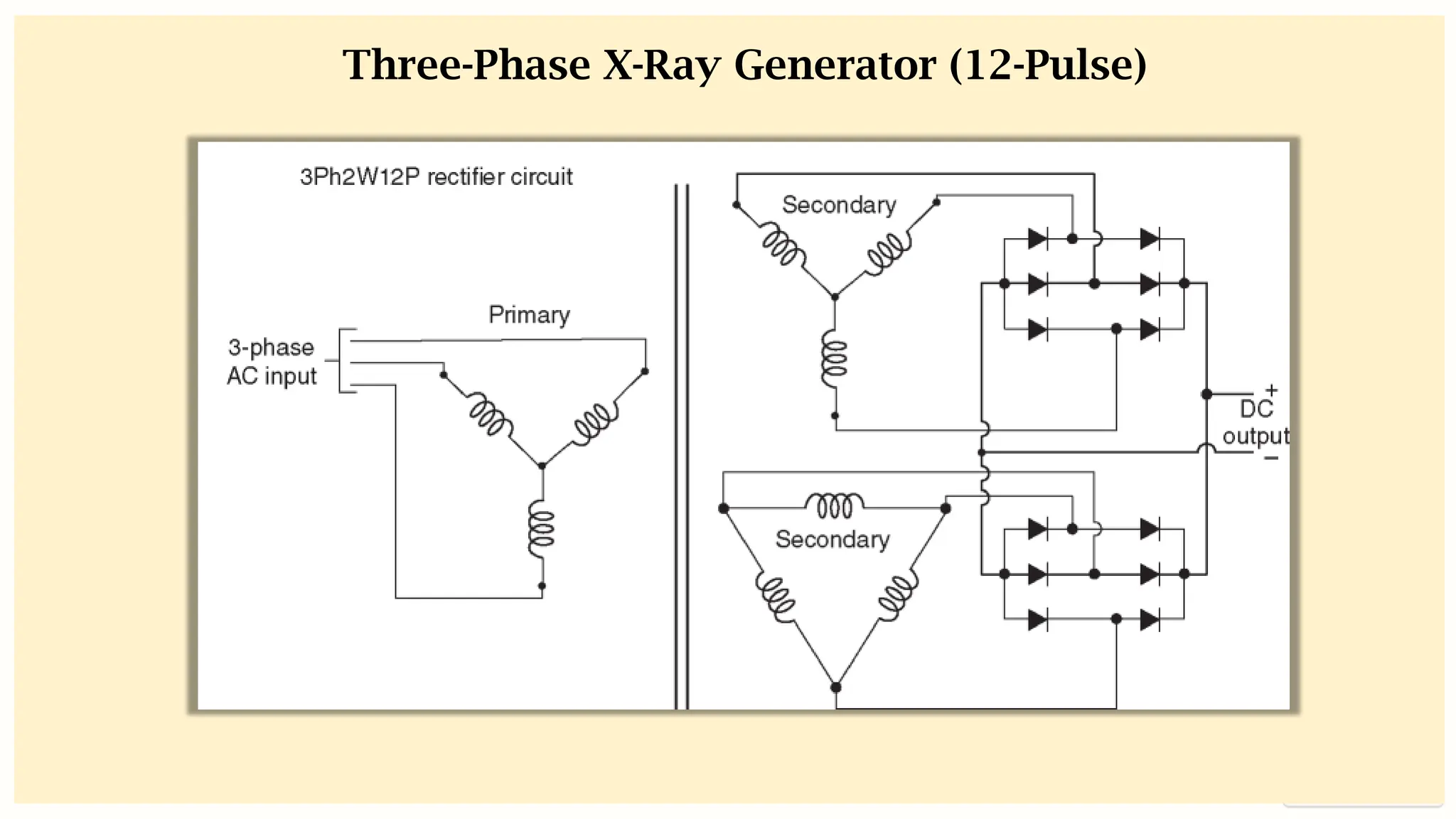
Three-Phase X-Ray Generator (12-Pulse)
• A three-phase, 12-pulse X-ray generator is an advanced generator that uses three-phase
alternating current (AC) with twelve rectified pulses per cycle, producing a highly stable and
efficient X-ray beam.
• Uses three-phase AC power with twelve rectifier diodes, reducing voltage fluctuations.
• Produces a nearly constant high-voltage output, ensuring smooth X-ray production.
• Provides better image quality with reduced patient radiation dose.
âť‘ Key Features:
• Power Supply: Three-phase AC
• Efficiency: High: Nearly continuous X-ray beam
• Exposure Time: Shorter, reducing motion artifacts
preencoded.png
Three-Phase X-Ray Generator (12-Pulse)
preencoded.png
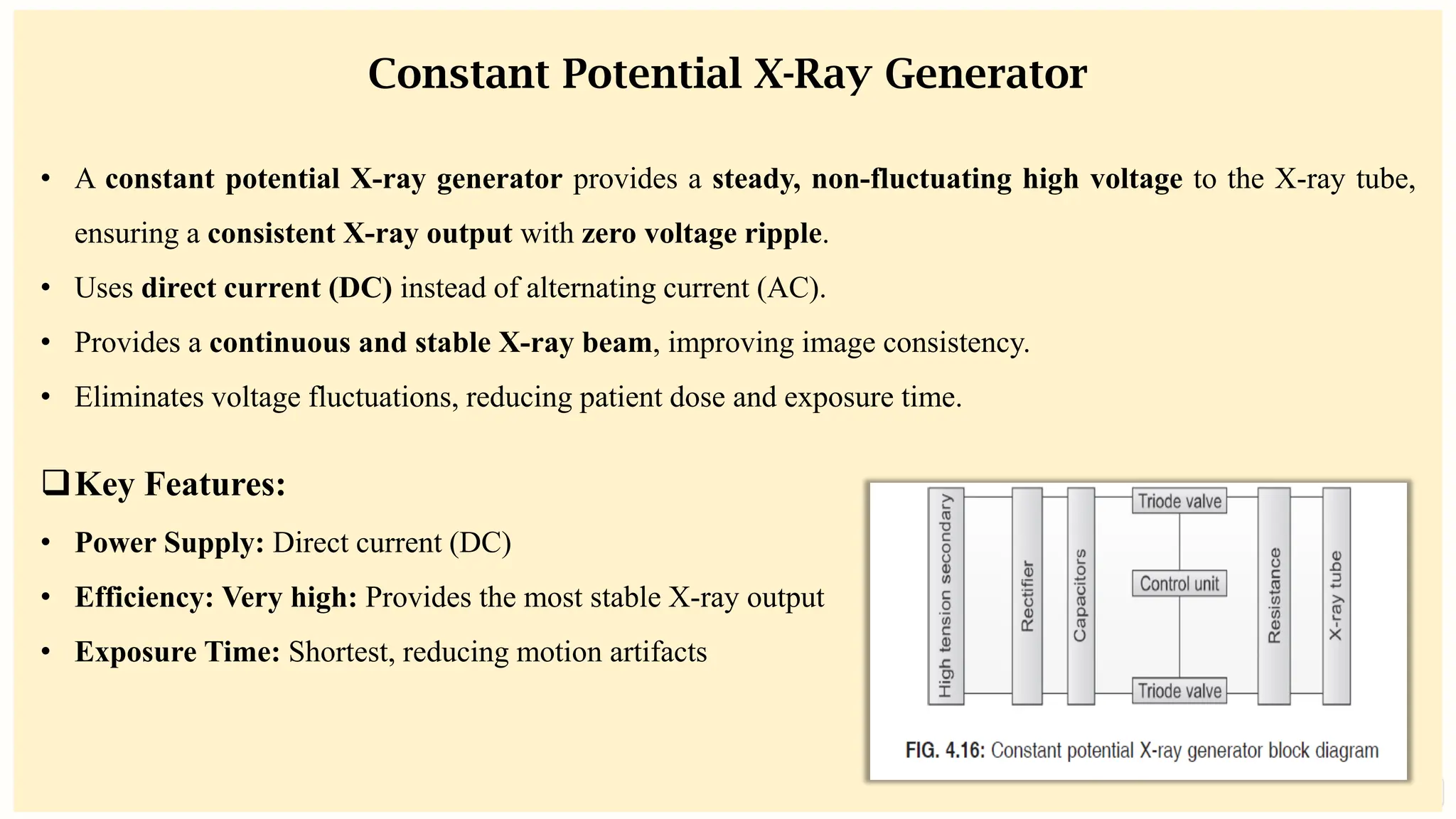
Constant Potential X-Ray Generator
• A constant potential X-ray generator provides a steady, non-fluctuating high voltage to the X-ray tube,
ensuring a consistent X-ray output with zero voltage ripple.
• Uses direct current (DC) instead of alternating current (AC).
• Provides a continuous and stable X-ray beam, improving image consistency.
• Eliminates voltage fluctuations, reducing patient dose and exposure time.
❑Key Features:
• Power Supply: Direct current (DC)
• Efficiency: Very high: Provides the most stable X-ray output
• Exposure Time: Shortest, reducing motion artifacts
preencoded.png
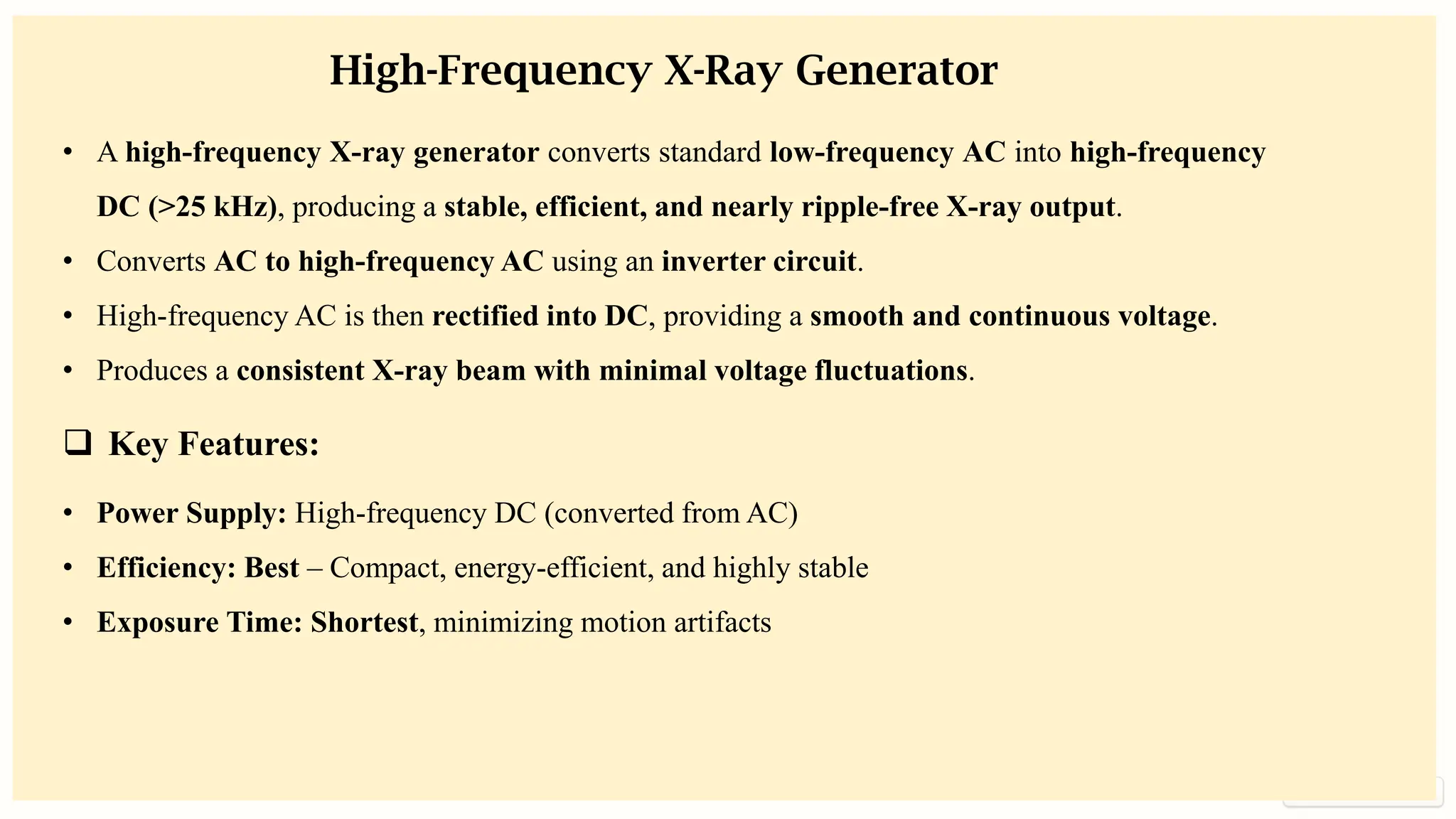
High-Frequency X-Ray Generator
• A high-frequency X-ray generator converts standard low-frequency AC into high-frequency
DC (>25 kHz), producing a stable, efficient, and nearly ripple-free X-ray output.
• Converts AC to high-frequency AC using an inverter circuit.
• High-frequency AC is then rectified into DC, providing a smooth and continuous voltage.
• Produces a consistent X-ray beam with minimal voltage fluctuations.
âť‘ Key Features:
• Power Supply: High-frequency DC (converted from AC)
• Efficiency: Best – Compact, energy-efficient, and highly stable
• Exposure Time: Shortest, minimizing motion artifacts
preencoded.png
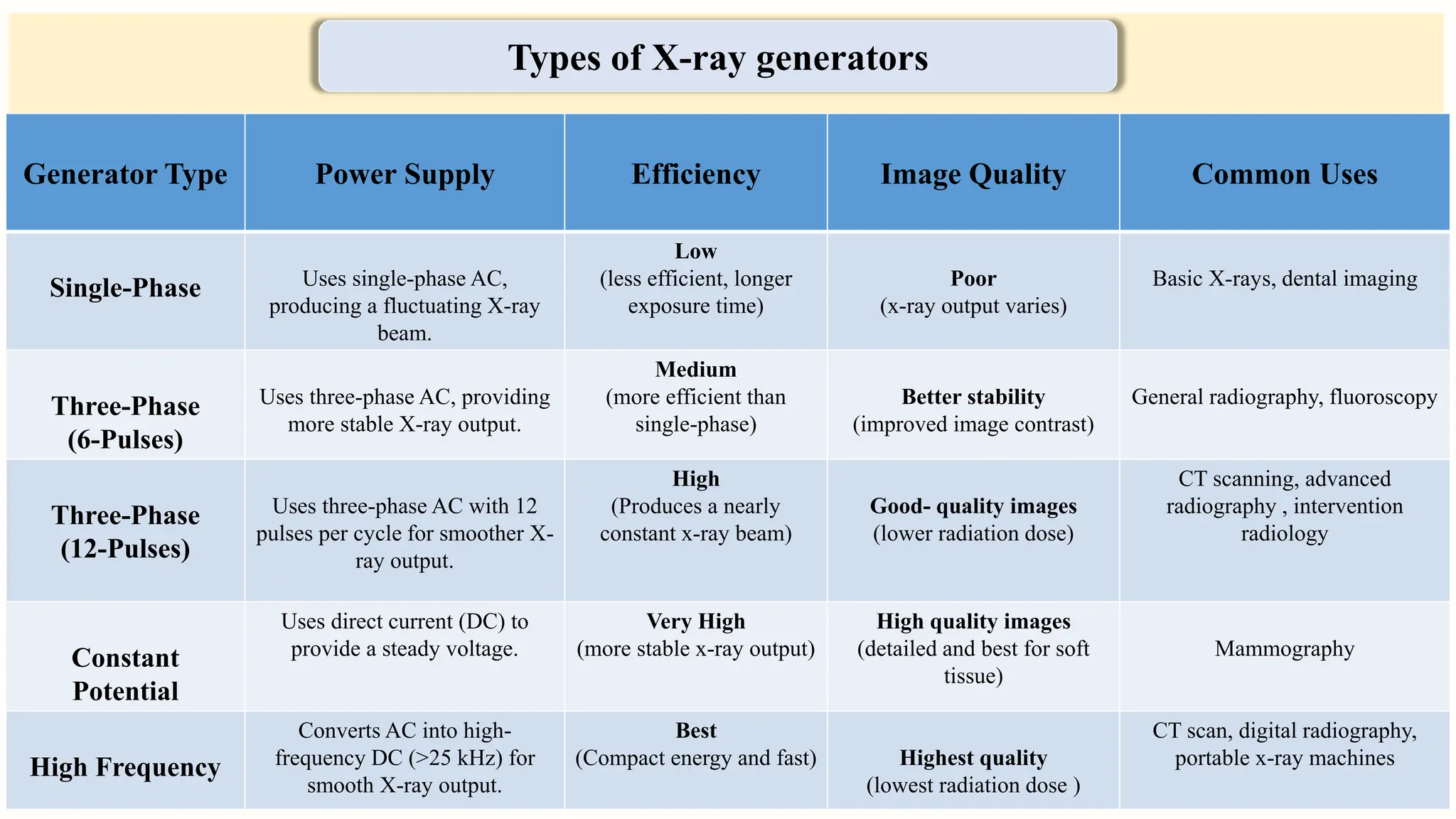
Generator Type Power Supply Efficiency Image Quality Common Uses
Single-Phase Uses single-phase AC,
producing a fluctuating X-ray
beam.
Low
(less efficient, longer
exposure time)
Poor
(x-ray output varies)
Basic X-rays, dental imaging
Three-Phase
(6-Pulses)
Uses three-phase AC, providing
more stable X-ray output.
Medium
(more efficient than
single-phase)
Better stability
(improved image contrast)
General radiography, fluoroscopy
Three-Phase
(12-Pulses)
Uses three-phase AC with 12
pulses per cycle for smoother X-
ray output.
High
(Produces a nearly
constant x-ray beam)
Good- quality images
(lower radiation dose)
CT scanning, advanced
radiography , intervention
radiology
Constant
Potential
Uses direct current (DC) to
provide a steady voltage.
Very High
(more stable x-ray output)
High quality images
(detailed and best for soft
tissue)
Mammography
High Frequency
Converts AC into high-
frequency DC (>25 kHz) for
smooth X-ray output.
Best
(Compact energy and fast) Highest quality
(lowest radiation dose )
CT scan, digital radiography,
portable x-ray machines
Types of X-ray generators
preencoded.png

X-Ray-Generators-and-Transformers final.pdf

  • 1.
    preencoded.png Presented by :Mohd Faraz BMRIT 6th Semester Paramedical College, Faculty of Medicine Aligarh Muslim University, Aligarh X-Ray Generators Moderator : Dr. Mohd Arfat (Assistant Professor )
  • 2.
    preencoded.png • X-rays area form of electromagnetic radiation with high energy and short wavelength, capable of penetrating most substances, including human tissues. • They are widely used in medical imaging, radiation therapy, and industrial applications. • Discovered by: Wilhelm Conrad Roentgen in 1895. Introduction to X-Rays
  • 3.
    preencoded.png Properties of X-Rays i.Invisible: Cannot be seen by the human eye. ii. High Penetration Power: Can pass through soft tissues but are absorbed by dense structures like bones. iii. Ionizing Radiation: Can ionize atoms, causing potential damage to cells. iv. Travel in Straight Lines: X-rays move in straight paths unless deflected. v. No Electrical Charge: Unlike electrons, X-rays do not carry charge. vi. Differential Absorption: Different tissues absorb X-rays differently, allowing contrast in imaging. NOTE : Denser objects absorb more X-rays, appearing white on an X-ray image, while less dense tissues appear darker.
  • 4.
    preencoded.png Types of X-RaysUsed in Medicine ❑ Soft X-Rays: • Low Energy, 20-100 keV • Used in diagnostic radiology (X-ray imaging, mammography, fluoroscopy). ❑ Hard X-Rays: • High Energy, 100 keV - 10 MeV • Used in radiotherapy, industrial imaging, and security scanning. NOTE : Soft X-rays are absorbed by tissues more easily, while hard X-rays penetrate deeper.
  • 5.
    preencoded.png ❑ Definition : TheX- ray generator delivers the electrical power to energies the x-ray tube and permit the selection of the x-ray energy, x-ray quality, and exposure time. ❑ Components of X-ray generator : • Transformer assembly • Rectifier system • Filament circuit • Kilovolt (kVp) and milliampere (mA) meters X-Ray Generator
  • 6.
    preencoded.png 1. Transformer Assembly: The transformer assembly in an X-ray generator consists of multiple transformers that regulate voltage levels required for X-ray production. It includes: i. Step-Up Transformer (High voltage transformer) : Increases the voltage from 230V (mains supply) to 40– 150 kV to accelerate electrons toward the anode. ii. Step-Down Transformer (Filament transformer) : Reduces voltage to 6–12V to heat the filament for electron emission. iii. Autotransformer: Adjusts the input voltage before stepping it up or down to provide precise kVp control.
  • 7.
    preencoded.png Figure : TransformerAssembly Figure : Autotransformer
  • 8.
    preencoded.png 2. Rectifier System Therectifier system in an X-ray generator converts alternating current (AC) into direct current (DC) to maintain a steady flow of electrons in one direction using diodes (rectifier). This is necessary because X-ray tubes require unidirectional electron flow from the cathode to the anode. Types of Rectifiers Used in X-Ray Generators: • Half-Wave Rectification- Uses only half of the AC cycle (less efficient). • Full-Wave Rectification- Uses the entire AC cycle (more efficient). • Three-Phase Rectifiers- Provide smoother and more continuous X-ray output. • High-Frequency Rectifiers Used in modern systems for nearly ripple-free voltage. Half wave Rectifier Full wave Rectifier
  • 9.
    preencoded.png 3. Filament Circuit Thefilament circuit is responsible for heating the cathode filament, enabling thermionic emission (electron release). ❑ Working of the Filament Circuit: a. A step-down transformer reduces the voltage to 6–12V. b. This heats the filament inside the X-ray tube’s cathode. c. The heat excites electrons, which are then available for acceleration. d. The mA (milliampere) setting controls the current through the filament, determining the number of electrons emitted. Fig: Filament Circuit
  • 10.
    preencoded.png Kilovolt (kVp) Meter i.Measures and displays the high voltage applied across the X-ray tube. ii. Determines X-ray beam energy and penetration power. iii. Higher kVp = More penetration (used for chest X-rays, CT scans). iv. Lower kVp = More contrast (used for mammography, extremities). Milliampere (mA) Meter i. Measures and controls the filament current, which regulates the number of electrons emitted from the cathode. ii. Determines X-ray beam intensity (quantity of X-rays produced). iii. Higher mA = More X-rays (used for thicker body parts). iv. Lower mA = Less radiation dose (used for pediatric imaging). NOTES: 1. kVp meter controls the quality (energy) of the X-ray beam. 2. mA meter controls the intensity (quantity) of X-ray photons for optimal image quality. 4. Kilovolt (kVp) and Milliampere (mA) Meters These meters monitor and regulate the electrical parameters crucial for X-ray production.
  • 11.
    preencoded.png SINGLE PHASE X-RAYGENERATOR CIRCUIT Input voltage
  • 12.
    preencoded.png Thermionic Emission Heating the filament releaseselectrons. Electron Acceleration Electrons accelerate using high-voltage potential. This is measured in kV. Collision Electrons collide with a tungsten target X-Ray Production X-rays are produced. Basic Principles of X-Ray Generation
  • 13.
    preencoded.png Types of X-raygenerators Single phase generator Three phase generator (6 Pulses) Three phase generator (12 Pulses) Constant potential generator High- frequency generator
  • 14.
    preencoded.png Single-Phase X-Ray Generator •A single-phase X-ray generator uses single-phase alternating current (AC) to produce X-rays. • It is the simplest type of X-ray generator, commonly found in basic radiographic and dental imaging systems. • AC voltage alternates between positive and negative cycles, causing fluctuating X-ray output. • Full-wave rectification allows the use of both halves of the AC cycle, doubling X-ray pulses. • High voltage (kVp) accelerates electrons toward the anode to generate X-rays. ❑Key Features: Power Supply: Single-phase AC Efficiency: Low due to inconsistent X-ray output Exposure Time: Longer compared to modern generators
  • 15.
  • 16.
    preencoded.png Three-Phase X-Ray Generator(6-Pulse) • A three-phase, 6-pulse X-ray generator uses three-phase alternating current (AC) to produce a more stable and efficient X-ray beam compared to single-phase generators. • Uses three-phase AC power with six rectified pulses per cycle. • Reduces fluctuations in X-ray output by overlapping voltage waves. • Provides higher efficiency and better image quality than single-phase generators. ❑ Key Features: • Power Supply: Three-phase AC • Efficiency: Medium: More stable X-ray beam • Exposure Time: Shorter than single-phase generators
  • 17.
  • 18.
    preencoded.png Three-Phase X-Ray Generator(12-Pulse) • A three-phase, 12-pulse X-ray generator is an advanced generator that uses three-phase alternating current (AC) with twelve rectified pulses per cycle, producing a highly stable and efficient X-ray beam. • Uses three-phase AC power with twelve rectifier diodes, reducing voltage fluctuations. • Produces a nearly constant high-voltage output, ensuring smooth X-ray production. • Provides better image quality with reduced patient radiation dose. ❑ Key Features: • Power Supply: Three-phase AC • Efficiency: High: Nearly continuous X-ray beam • Exposure Time: Shorter, reducing motion artifacts
  • 19.
  • 20.
    preencoded.png Constant Potential X-RayGenerator • A constant potential X-ray generator provides a steady, non-fluctuating high voltage to the X-ray tube, ensuring a consistent X-ray output with zero voltage ripple. • Uses direct current (DC) instead of alternating current (AC). • Provides a continuous and stable X-ray beam, improving image consistency. • Eliminates voltage fluctuations, reducing patient dose and exposure time. ❑Key Features: • Power Supply: Direct current (DC) • Efficiency: Very high: Provides the most stable X-ray output • Exposure Time: Shortest, reducing motion artifacts
  • 21.
    preencoded.png High-Frequency X-Ray Generator •A high-frequency X-ray generator converts standard low-frequency AC into high-frequency DC (>25 kHz), producing a stable, efficient, and nearly ripple-free X-ray output. • Converts AC to high-frequency AC using an inverter circuit. • High-frequency AC is then rectified into DC, providing a smooth and continuous voltage. • Produces a consistent X-ray beam with minimal voltage fluctuations. ❑ Key Features: • Power Supply: High-frequency DC (converted from AC) • Efficiency: Best – Compact, energy-efficient, and highly stable • Exposure Time: Shortest, minimizing motion artifacts
  • 22.
    preencoded.png Generator Type PowerSupply Efficiency Image Quality Common Uses Single-Phase Uses single-phase AC, producing a fluctuating X-ray beam. Low (less efficient, longer exposure time) Poor (x-ray output varies) Basic X-rays, dental imaging Three-Phase (6-Pulses) Uses three-phase AC, providing more stable X-ray output. Medium (more efficient than single-phase) Better stability (improved image contrast) General radiography, fluoroscopy Three-Phase (12-Pulses) Uses three-phase AC with 12 pulses per cycle for smoother X- ray output. High (Produces a nearly constant x-ray beam) Good- quality images (lower radiation dose) CT scanning, advanced radiography , intervention radiology Constant Potential Uses direct current (DC) to provide a steady voltage. Very High (more stable x-ray output) High quality images (detailed and best for soft tissue) Mammography High Frequency Converts AC into high- frequency DC (>25 kHz) for smooth X-ray output. Best (Compact energy and fast) Highest quality (lowest radiation dose ) CT scan, digital radiography, portable x-ray machines Types of X-ray generators
  • 23.