The XRD Technique
• Takes a sample of the material and places aTakes a sample of the material and places a
powdered sample which is then illuminatedpowdered sample which is then illuminated
with x-rays of a fixed wave-length.with x-rays of a fixed wave-length.
• The intensity of the reflected radiation isThe intensity of the reflected radiation is
recorded using a goniometer.recorded using a goniometer.
• The data is analyzed for the reflection angleThe data is analyzed for the reflection angle
to calculate the inter-atomic spacing.to calculate the inter-atomic spacing.
• The intensity is measured to discriminate theThe intensity is measured to discriminate the
various D spacing and the results arevarious D spacing and the results are
compared to known data to identify possiblecompared to known data to identify possible
matches.matches.
Powdering SamplesPowdering Samples
• The samples are powdered to give a randomThe samples are powdered to give a random
sampling of ALL atomic planes (crystal faces)sampling of ALL atomic planes (crystal faces)
• Statistically accurate given samples areStatistically accurate given samples are
powdered finely AND randomly oriented onpowdered finely AND randomly oriented on
sample holdersample holder
– Intensities are a reflection of d-spacing abundanceIntensities are a reflection of d-spacing abundance
• Problems arise with minerals that mayProblems arise with minerals that may
preferentially orient on sample holderpreferentially orient on sample holder
– Micas and clays have special preparation techniquesMicas and clays have special preparation techniques
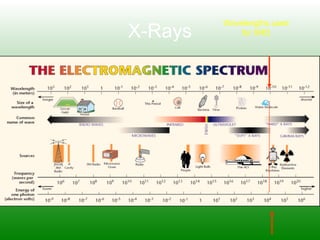
X-Rays
Wavelengths used
for XRD
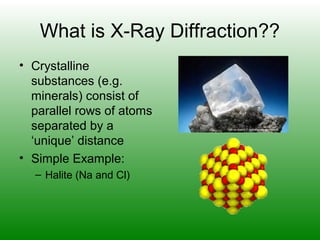
What is X-Ray Diffraction??
• Crystalline
substances (e.g.
minerals) consist of
parallel rows of atoms
separated by a
‘unique’ distance
• Simple Example:
– Halite (Na and Cl)
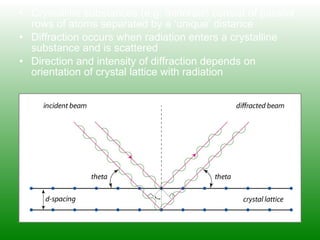
• Crystalline substances (e.g. minerals) consist of parallel
rows of atoms separated by a ‘unique’ distance
• Diffraction occurs when radiation enters a crystalline
substance and is scattered
• Direction and intensity of diffraction depends on
orientation of crystal lattice with radiation
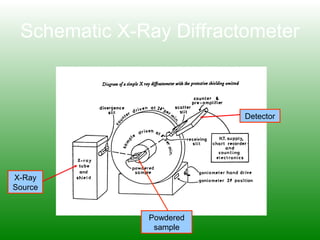
Schematic X-Ray Diffractometer
X-Ray
Source
Powdered
sample
Detector
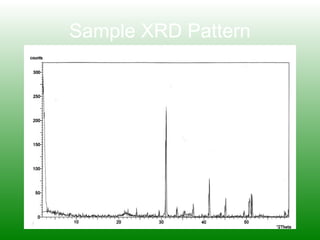
Sample XRD Pattern
background radiation
strong intensity = prominent crystal plane
weak intensity = subordinate crystal plane
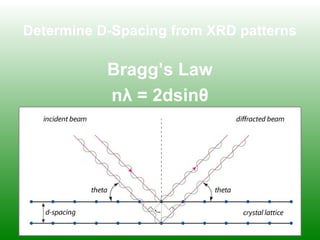
Determine D-Spacing from XRD patterns
Bragg’s Law
nλ = 2dsinθ
• n = reflection order (1,2,3,4,etc…)
• λ = radiation wavelength (1.54 angstroms)
• d = spacing between planes of atoms
(angstroms)
• θ = angle of incidence (degrees)
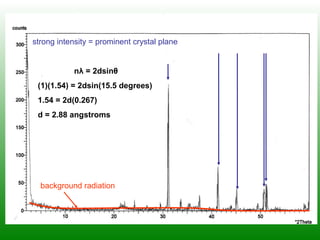
background radiation
strong intensity = prominent crystal plane
nλ = 2dsinθ
(1)(1.54) = 2dsin(15.5 degrees)
1.54 = 2d(0.267)
d = 2.88 angstroms
d-spacing Intensity
2.88 100
2.18 46
1.81 31
1.94 25
2.10 20
1.75 15
2.33 10
2.01 10
1.66 5
1.71 5
Factors that affect XRD data
• Sample not powdered fine enough
– May not give all d-spacing data (not random
enough)
• Analysis too fast (degrees/minute)
– May not give accurate peak data
• Mixture of minerals??
• Not crystalline – glass!!
Mixture of 2 Minerals
Applications of XRDApplications of XRD
• Unknown mineral IDUnknown mineral ID
• Solid solution ID (e.g. feldspars, olivine)Solid solution ID (e.g. feldspars, olivine)
• Mixtures of mineralsMixtures of minerals
• Clay analysesClay analyses
• ZeolitesZeolites
• Crystallographic applicationsCrystallographic applications
• Material ScienceMaterial Science
X ray  diffraction

X ray diffraction

  • 2.
    The XRD Technique •Takes a sample of the material and places aTakes a sample of the material and places a powdered sample which is then illuminatedpowdered sample which is then illuminated with x-rays of a fixed wave-length.with x-rays of a fixed wave-length. • The intensity of the reflected radiation isThe intensity of the reflected radiation is recorded using a goniometer.recorded using a goniometer. • The data is analyzed for the reflection angleThe data is analyzed for the reflection angle to calculate the inter-atomic spacing.to calculate the inter-atomic spacing. • The intensity is measured to discriminate theThe intensity is measured to discriminate the various D spacing and the results arevarious D spacing and the results are compared to known data to identify possiblecompared to known data to identify possible matches.matches.
  • 3.
    Powdering SamplesPowdering Samples •The samples are powdered to give a randomThe samples are powdered to give a random sampling of ALL atomic planes (crystal faces)sampling of ALL atomic planes (crystal faces) • Statistically accurate given samples areStatistically accurate given samples are powdered finely AND randomly oriented onpowdered finely AND randomly oriented on sample holdersample holder – Intensities are a reflection of d-spacing abundanceIntensities are a reflection of d-spacing abundance • Problems arise with minerals that mayProblems arise with minerals that may preferentially orient on sample holderpreferentially orient on sample holder – Micas and clays have special preparation techniquesMicas and clays have special preparation techniques
  • 4.
  • 6.
    What is X-RayDiffraction?? • Crystalline substances (e.g. minerals) consist of parallel rows of atoms separated by a ‘unique’ distance • Simple Example: – Halite (Na and Cl)
  • 8.
    • Crystalline substances(e.g. minerals) consist of parallel rows of atoms separated by a ‘unique’ distance • Diffraction occurs when radiation enters a crystalline substance and is scattered • Direction and intensity of diffraction depends on orientation of crystal lattice with radiation
  • 10.
  • 15.
  • 16.
    background radiation strong intensity= prominent crystal plane weak intensity = subordinate crystal plane
  • 17.
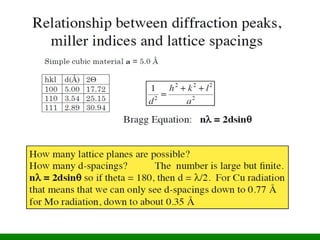
    Determine D-Spacing fromXRD patterns Bragg’s Law nλ = 2dsinθ • n = reflection order (1,2,3,4,etc…) • λ = radiation wavelength (1.54 angstroms) • d = spacing between planes of atoms (angstroms) • θ = angle of incidence (degrees)
  • 20.
    background radiation strong intensity= prominent crystal plane nλ = 2dsinθ (1)(1.54) = 2dsin(15.5 degrees) 1.54 = 2d(0.267) d = 2.88 angstroms
  • 21.
    d-spacing Intensity 2.88 100 2.1846 1.81 31 1.94 25 2.10 20 1.75 15 2.33 10 2.01 10 1.66 5 1.71 5
  • 22.
    Factors that affectXRD data • Sample not powdered fine enough – May not give all d-spacing data (not random enough) • Analysis too fast (degrees/minute) – May not give accurate peak data • Mixture of minerals?? • Not crystalline – glass!!
  • 23.
    Mixture of 2Minerals
  • 24.
    Applications of XRDApplicationsof XRD • Unknown mineral IDUnknown mineral ID • Solid solution ID (e.g. feldspars, olivine)Solid solution ID (e.g. feldspars, olivine) • Mixtures of mineralsMixtures of minerals • Clay analysesClay analyses • ZeolitesZeolites • Crystallographic applicationsCrystallographic applications • Material ScienceMaterial Science