PRESENT BY : Mansi
Tyagi
The World trade organisation is an organisation that intends to
supervise and liberalise international trade.
• The WTO is the only global international organization
dealing with the rules of trade between nations.
• The goal is to help producers of goods and services,
exporters and importers conduct their business.
WTO
 Established: 1st January 1995.
 Created By: Uruguay Round negotiations (1986-
1994)
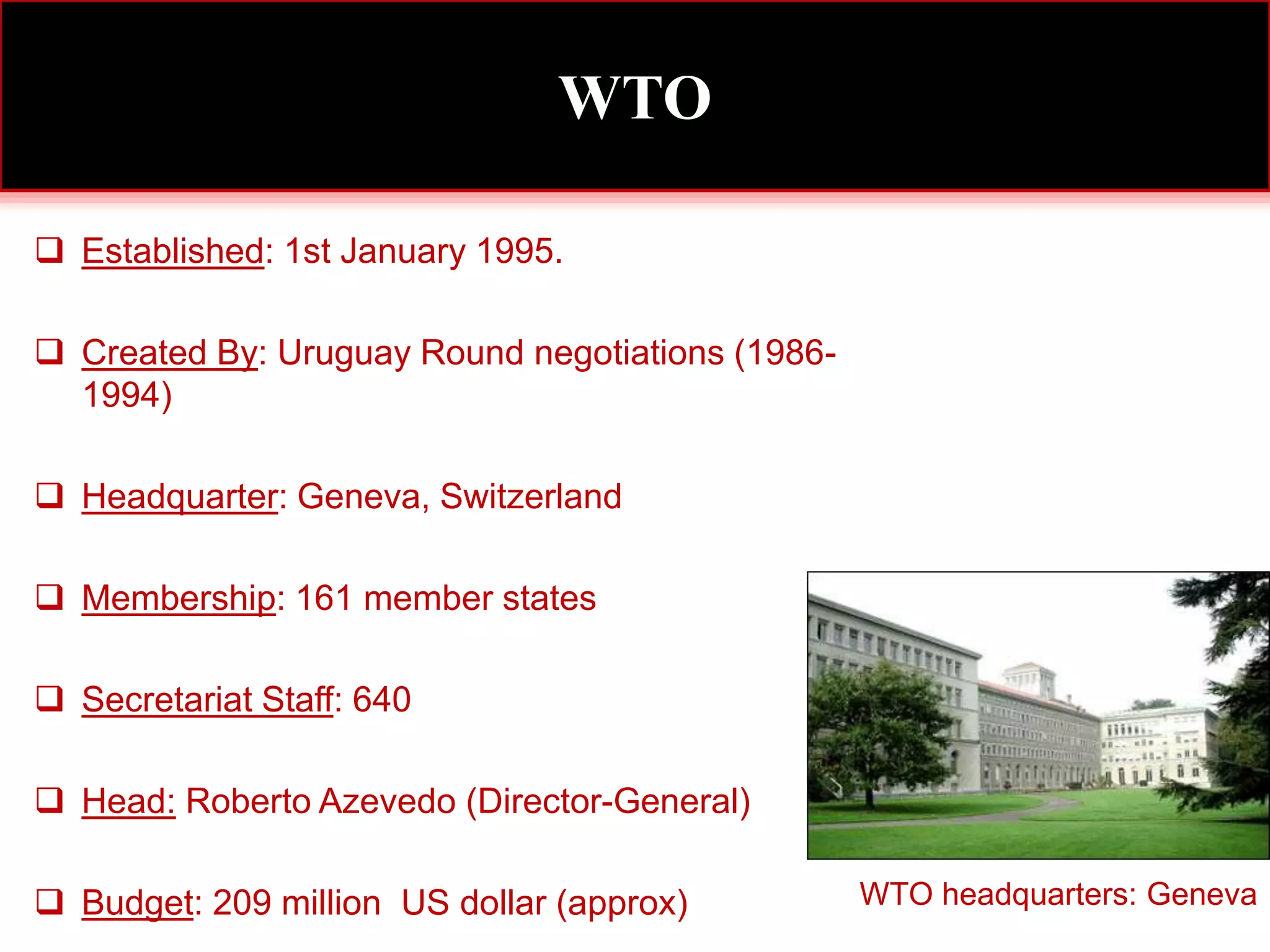
 Headquarter: Geneva, Switzerland
 Membership: 161 member states
 Secretariat Staff: 640
 Head: Roberto Azevedo (Director-General)
 Budget: 209 million US dollar (approx) WTO headquarters: Geneva
OBJECTIVE OF THE WTO
 To implement the new world trade system as visualized in the agreement.
 To promote world trade in a manner that benefits every country.
 To ensure developing countries secure a better balance in sharing of the
advantages resulting from the expansion of international trade
corresponding to their developmental needs.
 To enhance competitiveness among all trading nations as to benefit
customers.
 To increase the level of production and productivity with a view of ensuring
level of employment in the world.
THE WTO STRUCTURE
WTO: THE MEMBERS
 The WTO is composed of countries which represents 95% of world trade.
 Of these, 123 were signed during the Uruguay round
 Over 3/4th of WTO members are developing or least
developed countries.
 There are 30 countries that are not members known as
Observers. These countries are currently negotiating
membership.
 The biggest of these non-members is Russia, however
they are in the process of accession.
FUNCTIONS OF WTO
The main function is to ensure that trade flows as
smoothly, predictably and freely as possible.
Administering trade agreements- WTO agreements
cover goods, services, intellectual property.
Acting as a forum for trade negotiations
Settling trade disputes-Importantly WTO set
procedures to settle disputes
Reviewing national trade policies
Assisting developing countries in trade policy issues,
through technical assistance and training programmes.
FUNCTIONS OF WTO
Negotiating the reduction or elimination of obstacles to
trade (import tariffs, other barriers to trade) and
agreeing on rules governing the conduct of international
trade.
Assisting the process of accession of some 30 countries
who are not yet members of the organization.
Co-operating with other international organizations- IMF
and The World Bank.
World Trade Organization coordinates with its
secretariat, which employees 500 + staff including
Economists, Statisticians, Lawyers and other experts in
related area of concern.
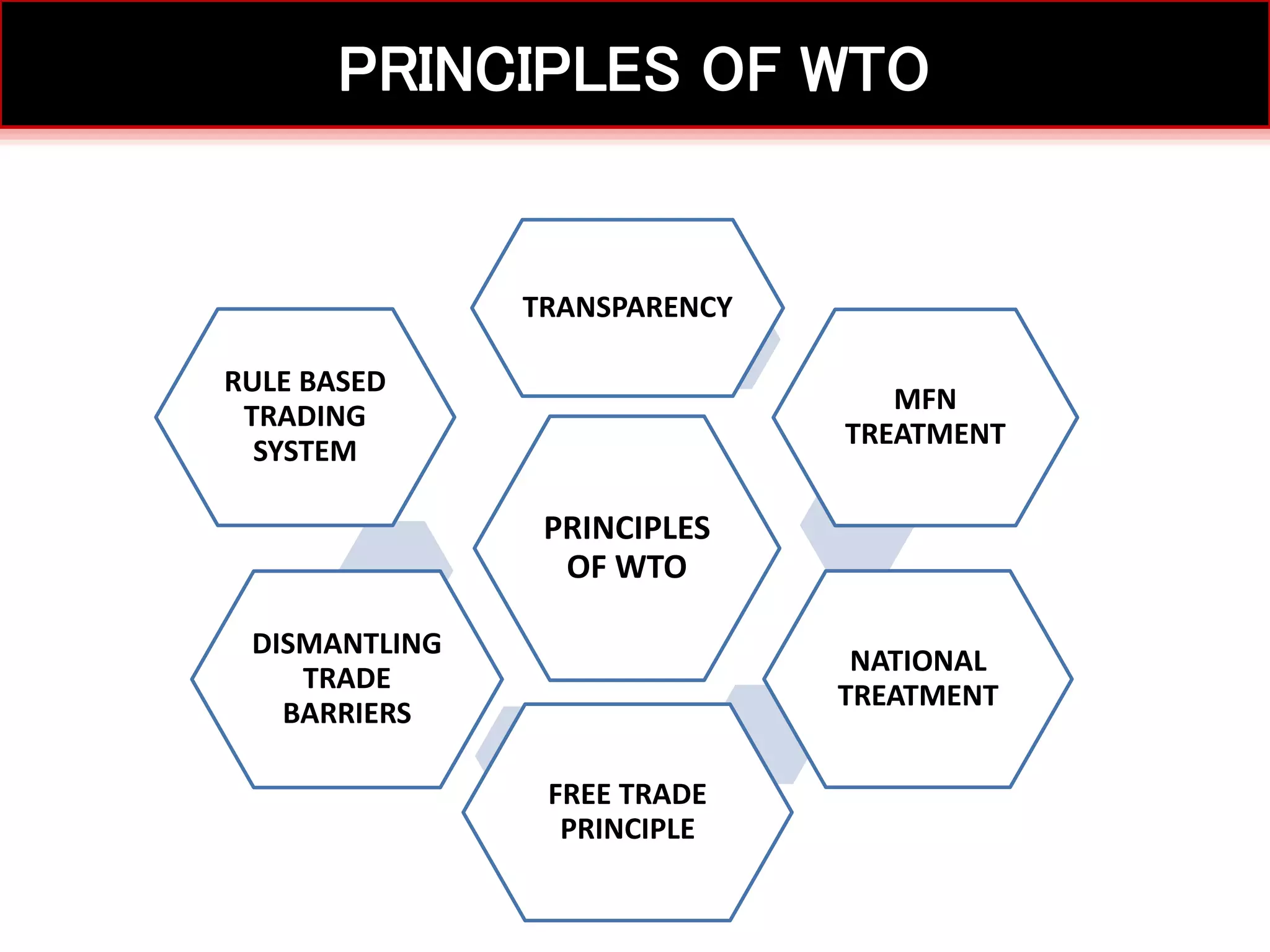
PRINCIPLES
OF WTO
TRANSPARENCY
MFN
TREATMENT
NATIONAL
TREATMENT
FREE TRADE
PRINCIPLE
DISMANTLING
TRADE
BARRIERS
RULE BASED
TRADING
SYSTEM
PRINCIPLES OF WTO
• After Marrakesh Agreement, India joined WTO since inception in
1995.
• Developing countries like India availed of greater trade
opportunities and also challenged a certain policies of developed
countries.
• For India, exposure to volatile international market would affect
not only domestic prices but also incomes of poor.
• Aim to participate in WTO rule based system with greater stability,
transparency and predictability in governance of international
trade.
THE WTO AND INDIA
ARTICLES IN INDIAN EXPRESS: IMPACT OF WTO
ON INDIA
Agricultural exports
Export of textile and clothing and Foreign
investment
Growth to service exports
Increase in export earnings
POSITIVE IMPACT ON INDIAN
ECONOMY
PROS
• Promotes free trade
• Raises world output levels via specialisation
• Establishes a standard rule by law and terms
of trade for greater efficiency
• Updates all participating countries and banks
to international standards and efficiency in
terms of trade and commerce.
CONCLUSION
• Although the stated aim of the WTO is to promote
free trade and stimulate economic growth, some
believe that globally free trade results in rich (both
people and countries) becoming richer awhile the
poor getting poorer.
• It will be able to help weak and poor
countries if it frames rules accordingly
WORLD TRADE ORGANIZATION

WORLD TRADE ORGANIZATION

  • 1.
    PRESENT BY :Mansi Tyagi
  • 2.
    The World tradeorganisation is an organisation that intends to supervise and liberalise international trade. • The WTO is the only global international organization dealing with the rules of trade between nations. • The goal is to help producers of goods and services, exporters and importers conduct their business.
  • 3.
    WTO  Established: 1stJanuary 1995.  Created By: Uruguay Round negotiations (1986- 1994)  Headquarter: Geneva, Switzerland  Membership: 161 member states  Secretariat Staff: 640  Head: Roberto Azevedo (Director-General)  Budget: 209 million US dollar (approx) WTO headquarters: Geneva
  • 4.
    OBJECTIVE OF THEWTO  To implement the new world trade system as visualized in the agreement.  To promote world trade in a manner that benefits every country.  To ensure developing countries secure a better balance in sharing of the advantages resulting from the expansion of international trade corresponding to their developmental needs.  To enhance competitiveness among all trading nations as to benefit customers.  To increase the level of production and productivity with a view of ensuring level of employment in the world.
  • 5.
  • 6.
    WTO: THE MEMBERS The WTO is composed of countries which represents 95% of world trade.  Of these, 123 were signed during the Uruguay round  Over 3/4th of WTO members are developing or least developed countries.  There are 30 countries that are not members known as Observers. These countries are currently negotiating membership.  The biggest of these non-members is Russia, however they are in the process of accession.
  • 7.
    FUNCTIONS OF WTO Themain function is to ensure that trade flows as smoothly, predictably and freely as possible. Administering trade agreements- WTO agreements cover goods, services, intellectual property. Acting as a forum for trade negotiations Settling trade disputes-Importantly WTO set procedures to settle disputes Reviewing national trade policies Assisting developing countries in trade policy issues, through technical assistance and training programmes.
  • 8.
    FUNCTIONS OF WTO Negotiatingthe reduction or elimination of obstacles to trade (import tariffs, other barriers to trade) and agreeing on rules governing the conduct of international trade. Assisting the process of accession of some 30 countries who are not yet members of the organization. Co-operating with other international organizations- IMF and The World Bank. World Trade Organization coordinates with its secretariat, which employees 500 + staff including Economists, Statisticians, Lawyers and other experts in related area of concern.
  • 9.
  • 10.
    • After MarrakeshAgreement, India joined WTO since inception in 1995. • Developing countries like India availed of greater trade opportunities and also challenged a certain policies of developed countries. • For India, exposure to volatile international market would affect not only domestic prices but also incomes of poor. • Aim to participate in WTO rule based system with greater stability, transparency and predictability in governance of international trade. THE WTO AND INDIA
  • 11.
    ARTICLES IN INDIANEXPRESS: IMPACT OF WTO ON INDIA
  • 12.
    Agricultural exports Export oftextile and clothing and Foreign investment Growth to service exports Increase in export earnings POSITIVE IMPACT ON INDIAN ECONOMY
  • 13.
    PROS • Promotes freetrade • Raises world output levels via specialisation • Establishes a standard rule by law and terms of trade for greater efficiency • Updates all participating countries and banks to international standards and efficiency in terms of trade and commerce.
  • 14.
    CONCLUSION • Although thestated aim of the WTO is to promote free trade and stimulate economic growth, some believe that globally free trade results in rich (both people and countries) becoming richer awhile the poor getting poorer. • It will be able to help weak and poor countries if it frames rules accordingly