SCR 6.1 –Community Based
Tourism Activities in Himachal
Ankit Sood
Ecotourism Planner –IDIPT (HP)
Community Based Ecotourism
• Environmentally Responsible Travel & visitation
to relatively undisturbed natural areas to enjoy
and appreciate nature ( and accompanying
cultural features- both past and present), that
promotes conservation, has low negative
visitor impact and provides for beneficially
active socio economic involvement of the local
population – IUCN
Ecotourism
Responsible Travel - Ecotourism
Basis of Community Based Tourism
BRINGING THE BALANCE RIGHT
SUSTAINABLE TOURISM FRAMEWORK
IN HIMACHAL PRADESH- IDIPT-HP
CBET Planning Process
Effective Community Involvement
Planning Process
Planning Process-Public Participation
What Factors influence choice of
Holiday Destination
Need for Holidaying
Service Chain in Mountains
SELECTION OF TOURISM CLUSTERS IN
IDIPT_HP
HIMACHAL PRADESH – COMMUNITY BASED EOURISM CLUSTERS
Village Clusters – Pong Dam
Cluster Village Tourism Social and cultural values:
Chintpurni
Nari
Rural and Religious
Religious importance,
archaeological sites
Moin
Shaproo
Nagrota Suriyan
Guler
Rural and Eco-tourism
Pong wetland is an ideal setting
for cultural and recreational
activities such as swimming
fishing, canoeing bird watching
etc. Additional importance -
Religious and Archaeological
sites
Masroor
Nagrota Suriyan
Haripur
Sugnara
Ransar
Pragpur
Pragpur
Rural and Eco-tourism
Cultural and recreational
activities. Additional importance
- Religious and Archaeological
sites
Garli
Sansarpur Terrace
Dada Shiba
Dharmeta
Dharmeta
Rural and Eco-tourism
Cultural Products
Soft Adventure Activities
Homestay
Khutera/Bari
Chata
Khatiyar
Criteria of Selection
• Existing Activities of
IDIPT-HP
Cluster I- Nagrota Suriyan
Cluster II- Dhameta
Cluster III- Paragpur
Cluster IV- Chintpurni
Cluster V- Kangra
Cluster VI- Naina Devi
Cluster VII- Shimla
NAGROTA SURIYAN CLUSTER MAP
Nagrota Suriyan
• Village - Nagrota Suriyan
• Cluster – Nagrota Suriyan
• Relevance – Transport Hub to main entry
points of Dharamsala and Pathankot .
• Linked by Narrow Gauge Train , Hub for
training and networking, Community
Information Center, Main market for entire
cluster for locals and tourists , Fishing
Auctions
Stage 1 Research and Value Chain
Analysis
Research & Value Chain Analysis
MARKET RESEARCH
Shimla
Dharamsala
Chintpurni
Naina Devi
Deliverable- Marketing
Strategy
Value Chain Analysis
Reports
Deliverables- Photographs
Manuals of
Birding, Culture and
Homestay
Pictorial
Human Resource and
Tourism Related Databases
PRODUCT RESEARCH VALUE CHAIN ANALYSIS
HANDICRAFTS
Weaving , Pottery, Bamboo
HOMESTAY
& BOATING INDUSTRY
Case Study- Value Chain Island
Value Chain Analysis
Research & Value Chain Analysis
Effective Participatory Planning
Process
Stage 1 – Research and Awareness through
Participatory Rural Assessment
Simple CBET Planning Framework
Integrated Approach – Planning
PLANNING
ACTIVITY

ORGANIZATIONAL
DEVELOPMENT
COMMUNITY
INVOLVEMENT
TOURISM PRODUCT
DEVELOPMENT
TOURISM PRODUCT
MARKETING
Where Are We Today?
Gather Information
1.
Evaluate existing group
composition. Identify
potential representatives
that could or should be
involved.
Identify both tourism and
non-tourism interests that
may be affected by the
proposed tourism
development. Determine
key issues and concerns of
the various stake-holders.
Conduct an inventory and
assessment of the area's
tourism resources,
services, and
infrastructure. Estimate
existing levels of use and
carrying capacity.
Profile the existing
markets in terms of
geographic origin,
demographics, family life-
cycle, spending patterns,
needs, and interests.
Where Do We Want To Go?
Identify Community
Values
2.
Tourism organization
members express
community values by
answering questions
related to quality of life
now and in the future.
Community
representatives express
their values by answering
questions related to quality
of life now and in the
future.
Values expressed by the
tourism organization and
community representatives
begin to form the
foundation upon which
future tourism
development and resource
allocation decisions will
be based.
Values expressed by the
tourism organization and
community representatives
begin to form the
foundation upon which
future tourism marketing
decisions will be based.
Create A Vision
3.
Tourism organization
members create an image
of how the community
should look, feel, and be,
now and in the future.
Community
representatives create an
image of how the
community should look,
feel, and be, now and in
the future.
The descriptive "story"
about future development
and quality of life in the
community further
strengthens the foundation
and guides tourism
development and resource
allocation decisions.
The descriptive "story"
about future development
and quality of life in the
community further
strengthens the foundation
and guides tourism
marketing decisions.
Where Do We Want To Go?
PLANNING
ACTIVITY

ORGANIZATIONAL
DEVELOPMENT
COMMUNITY
INVOLVEMENT
TOURISM PRODUCT
DEVELOPMENT
TOURISM PRODUCT
MARKETING
Identify Concerns and
Opportunities
4.
Tourism organization
members brainstorm a list of
concerns and opportunities
that the group or community
may be facing. Similar ideas
are combined and narrowed
down to reflect those: (1)
related to tourism and (2) the
tourism organization should
handle.
Community representatives
brainstorm a list of concerns
and opportunities the
community may be facing.
Similar ideas are combined
and narrowed down to
reflect: (1) those related to
tourism and (2) those that
can be addressed by the
tourism organization or
through tourism initiatives.
The major concerns and
opportunities will provide
direction for tourism
development initiatives.
Ideas expressed should be
revisited as more concrete
plans for developing or
enhancing tourism
attractions, services, and
infrastructure are being
considered.
The major concerns and
opportunities will provide
direction for tourism
development initiatives.
Ideas expressed should be
revisited as more concrete
plans for marketing tourism
resources and services are
being considered.
Develop A Mission
5.
Tourism organization
members articulate their
purpose for existing and
determine who they are
serving. It is important to
recognize not only the
visitor, but also community
needs during this activity.
The tourism organization's
mission serves as a vehicle to
inform the community about
the group's purpose for
existing.
The mission, along with the
values, vision, concerns, and
opportunities helps guide the
tourism development effort.
The mission, along with the
values, vision, concerns, and
opportunities helps guide the
tourism marketing effort.
Develop Goals
6.
Based on the tourism
organization's values, vision,
concerns, opportunities, and
mission, goals relative to the
structure and administration
of the organization are
developed.
Goals related to community
education and involvement in
the tourism development
effort are developed. Most
likely, goals will center on
ways to involve the public in
the planning process.
Based on the expressed
values, vision, concerns,
opportunities, and mission,
goals for the physical
development and/or
enhancement tourism
resources, traveler services,
and infrastructure are
developed.
Based on the plans for
tourism product development
and/or enhancement, goals
for tourism marketing are
developed.
How Are We Going To Get There?
PLANNING
ACTIVITY

ORGANIZATIONAL
DEVELOPMENT
COMMUNITY
INVOLVEMENT
TOURISM PRODUCT
DEVELOPMENT
TOURISM PRODUCT
MARKETING
Develop Objectives
7.
Tourism organization
members develop action-
oriented statements that
propose how to achieve
each organizational goal.
The number of objectives
for each goal will vary
depending on the group's
stage of development and
available human, physical,
and financial resources.
Tourism organization
members develop action-
oriented statements that
propose how to achieve
each community education
and involvement goal. The
number of objectives for
each goal will vary
depending on the
community's level of
interest and involvement in
the tourism initiatives, and
the available human,
physical, and financial
resources.
Tourism organization
members develop action-
oriented statements that
propose how to achieve
each tourism product
development goal. The
number of objectives for
each goal will vary
depending on the
community's stage of
development, the quantity
and quality of existing
tourism resources, services,
and infrastructure, and
available human, physical,
and financial resources.
Tourism organization
members develop action-
oriented statements that
propose how to achieve
each tourism product
marketing goal. The
number of objectives for
each goal will vary
depending on the quantity
and quality of existing
tourism marketing activities
and available human,
physical, and financial
resources.
Develop Actions
8.
Tourism organization
members define strategies
and tactics which outline
specifically how each
organizational development
objective will be achieved.
This includes exploring
funding and technical
assistance alternatives,
identifying timelines, and
assigning tasks.
Tourism organization
members define strategies
and tactics which outline
specifically how each
community education and
involvement objective will
be achieved. This includes
exploring funding and
technical assistance
alternatives, identifying
timelines, and assigning
tasks.
Tourism organization
members define strategies
and tactics which outline
specifically how each
tourism product
development objective will
be achieved. This includes
exploring funding and
technical assistance
alternatives, identifying
timelines, and assigning
tasks.
Tourism organization
members define strategies
and tactics which outline
specifically how each
tourism marketing objective
will be achieved. This
includes exploring funding
and technical assistance
alternatives, identifying
timelines, and assigning
tasks.
How Did We Do?
PLANNING
ACTIVITY

ORGANIZATIONAL
DEVELOPMENT
COMMUNITY
INVOLVEMENT
TOURISM PRODUCT
DEVELOPMENT
TOURISM PRODUCT
MARKETING
Evaluate Progress
9.
Organization members
conduct a periodic review
of the organization's
activities and progress. A
report is written and copies
submitted to appropriate
governing bodies, funding
agencies, and the general
public.
Organization members
conduct a periodic review
of key public involvement
activities. A report is
written and copies
submitted to appropriate
governing bodies, funding
agencies, and the general
public.
Organization members
conduct a periodic review
of tourism product
development and
implementation activities
and progress. A report is
written and copies
submitted to appropriate
governing bodies, funding
agencies, and the general
public.
Organization members
conduct a periodic review
of tourism product
marketing activities and
progress. A report is
written and copies
submitted to appropriate
governing bodies, funding
agencies, and the general
public.
Update and Modify Plan
10.
Based on new information
or changing circumstances,
revisions to the
organizational development
plan are made.
Based on new information
or changing circumstances,
revisions to the plan for
community involvement are
made.
Based on new information
or changing circumstances,
revisions to the plan for
tourism product
development are made.
Based on new information
or changing circumstances,
revisions to the plan for
tourism marketing are
made.
A thorough understanding of the interrelationship of the five main components of
the tourism industry: (1) tourism resources, (2) traveler services, (3) infrastructure,
(4) tourist markets, and (5) the host community or region, would lead long term
sustainable planning which brings us to institutionalizing tourism.
PROPOSED MODEL OF INSTITUTIONAL BUILDING IN HIMACHAL UNDER IDIPT
( Himachal Pradesh )
STAGE II – INSTITUTION BUILDING
STAGE II – Tourist Management
Models Mechanism
STAGE II – Tourist Management
Models Mechanism
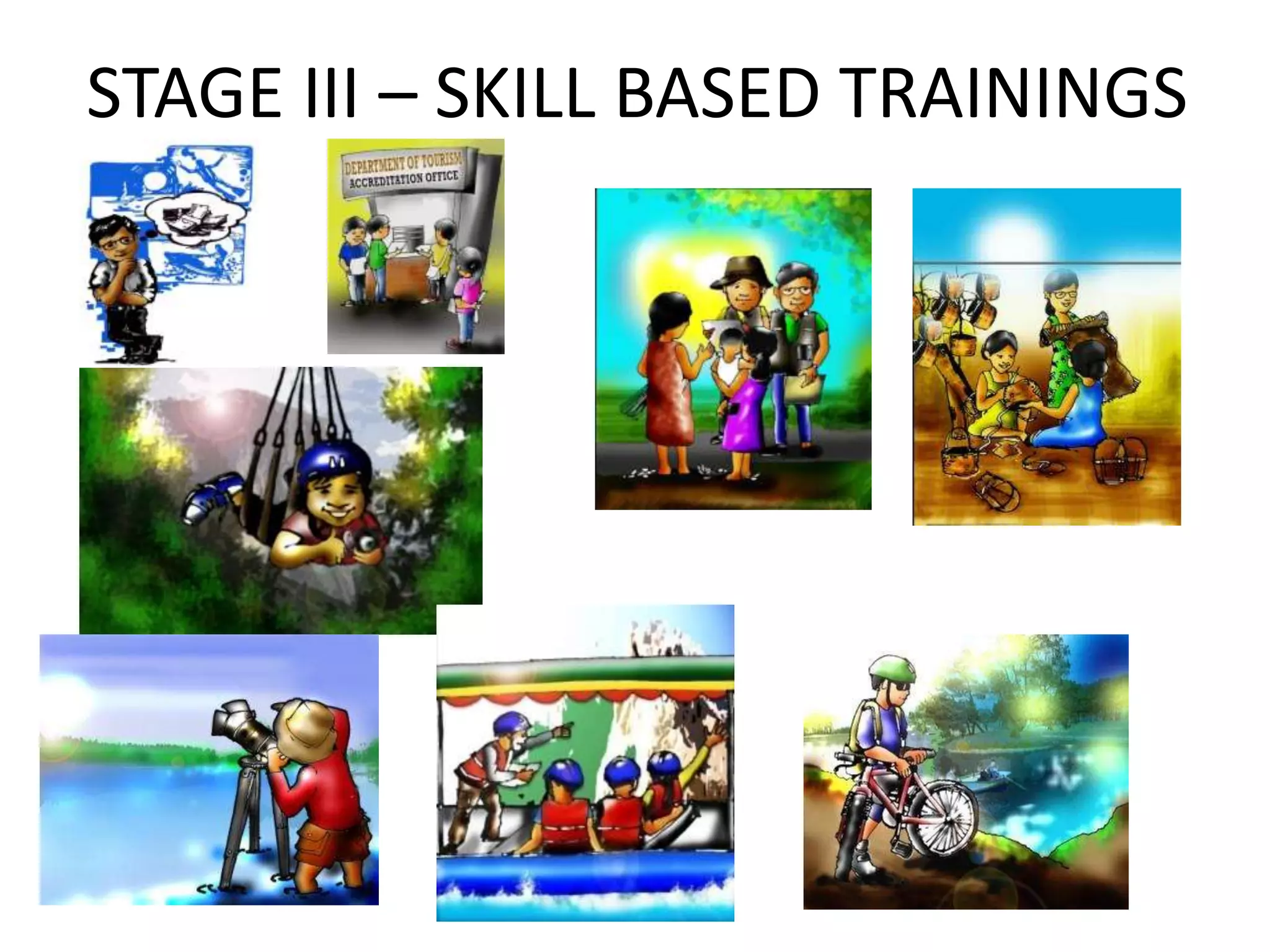
STAGE III – SKILL BASED TRAININGS
Technical Training Assistance Matrix
SKILL BASED
TRAININGS
IN IDIPT-HP
HIMACHAL
INSTITUTIONAL
TRAININGS
Cultural
Interpretation
Guides
Birding Guides
HOMESTAY
TRAININGS
SOFT
LANDADVENT
URE GUIDES
ANGLING GUIDES
HIKING AND LAND
BASED SOFT
ADVENTURE
FIRST AID AND
RESCUE
TRAININGS
HANDICRAFTS
TRAINING
SOFT WATER
BASED
ADVENTURE
SPORTS GUIDE
CROWD AND
DISASTER
MANAGEMENT
TRAININGS
FIRST AID AND
RESCUE TRAININGS
MARKETING &
INSTITUTIONAL
TRAININGS FOR ALL
CLUSTERS
SOLID WASTE
MANAGEMENT
TRAINING IN ALL
CLUSTERS
HOMESTAY
TRAINING IN
ALL CLUSTERS
HANDICRAFT AND
PACKAGING
TRAINING IN ALL
CLUSTERS
STAGE III – SKILL BASED TRAININGS
STAGE IV – MARKETING
Public
Relations
Publicity
Advertising
Online
Promtion
Personal
Selling
Branding
STAGE IV –CERTIFICATION AS A
MARKETING STRATEGY
Stage V Monitoring & Evaluation CBT
SHG SUPPORT SYSTEM
SHG
Ecotourism
Support
System in
IDIPT-HP
Tourism
Department
DTCA – HP
HPTDC
Marketing
Support
Major Banks like
ADB, GTZ and
other
international
ecotourism
Agencies support
Micro
Finance
Institution
e.g NABARD,
UNDP
National & state
level NGO’s
Eco-Tour
Operators and
Travel Agents
Internet –
Website and
Web 2 Tools
Forest Department &
Ecotourism Society of
Himachal Pradesh

Community Based Tourism - IDIPT ( HImachal Pradesh)

  • 1.
    SCR 6.1 –CommunityBased Tourism Activities in Himachal Ankit Sood Ecotourism Planner –IDIPT (HP)
  • 2.
    Community Based Ecotourism •Environmentally Responsible Travel & visitation to relatively undisturbed natural areas to enjoy and appreciate nature ( and accompanying cultural features- both past and present), that promotes conservation, has low negative visitor impact and provides for beneficially active socio economic involvement of the local population – IUCN
  • 3.
  • 4.
  • 5.
    Basis of CommunityBased Tourism BRINGING THE BALANCE RIGHT
  • 6.
    SUSTAINABLE TOURISM FRAMEWORK INHIMACHAL PRADESH- IDIPT-HP
  • 7.
  • 8.
  • 9.
  • 10.
  • 11.
    What Factors influencechoice of Holiday Destination
  • 12.
  • 13.
  • 14.
    SELECTION OF TOURISMCLUSTERS IN IDIPT_HP HIMACHAL PRADESH – COMMUNITY BASED EOURISM CLUSTERS
  • 15.
    Village Clusters –Pong Dam Cluster Village Tourism Social and cultural values: Chintpurni Nari Rural and Religious Religious importance, archaeological sites Moin Shaproo Nagrota Suriyan Guler Rural and Eco-tourism Pong wetland is an ideal setting for cultural and recreational activities such as swimming fishing, canoeing bird watching etc. Additional importance - Religious and Archaeological sites Masroor Nagrota Suriyan Haripur Sugnara Ransar Pragpur Pragpur Rural and Eco-tourism Cultural and recreational activities. Additional importance - Religious and Archaeological sites Garli Sansarpur Terrace Dada Shiba Dharmeta Dharmeta Rural and Eco-tourism Cultural Products Soft Adventure Activities Homestay Khutera/Bari Chata Khatiyar
  • 16.
    Criteria of Selection •Existing Activities of IDIPT-HP Cluster I- Nagrota Suriyan Cluster II- Dhameta Cluster III- Paragpur Cluster IV- Chintpurni Cluster V- Kangra Cluster VI- Naina Devi Cluster VII- Shimla
  • 18.
  • 20.
    Nagrota Suriyan • Village- Nagrota Suriyan • Cluster – Nagrota Suriyan • Relevance – Transport Hub to main entry points of Dharamsala and Pathankot . • Linked by Narrow Gauge Train , Hub for training and networking, Community Information Center, Main market for entire cluster for locals and tourists , Fishing Auctions
  • 21.
    Stage 1 Researchand Value Chain Analysis
  • 22.
    Research & ValueChain Analysis MARKET RESEARCH Shimla Dharamsala Chintpurni Naina Devi Deliverable- Marketing Strategy Value Chain Analysis Reports Deliverables- Photographs Manuals of Birding, Culture and Homestay Pictorial Human Resource and Tourism Related Databases PRODUCT RESEARCH VALUE CHAIN ANALYSIS HANDICRAFTS Weaving , Pottery, Bamboo HOMESTAY & BOATING INDUSTRY
  • 23.
    Case Study- ValueChain Island
  • 24.
  • 25.
    Research & ValueChain Analysis
  • 26.
  • 27.
    Stage 1 –Research and Awareness through Participatory Rural Assessment
  • 28.
  • 29.
    Integrated Approach –Planning PLANNING ACTIVITY  ORGANIZATIONAL DEVELOPMENT COMMUNITY INVOLVEMENT TOURISM PRODUCT DEVELOPMENT TOURISM PRODUCT MARKETING Where Are We Today? Gather Information 1. Evaluate existing group composition. Identify potential representatives that could or should be involved. Identify both tourism and non-tourism interests that may be affected by the proposed tourism development. Determine key issues and concerns of the various stake-holders. Conduct an inventory and assessment of the area's tourism resources, services, and infrastructure. Estimate existing levels of use and carrying capacity. Profile the existing markets in terms of geographic origin, demographics, family life- cycle, spending patterns, needs, and interests. Where Do We Want To Go? Identify Community Values 2. Tourism organization members express community values by answering questions related to quality of life now and in the future. Community representatives express their values by answering questions related to quality of life now and in the future. Values expressed by the tourism organization and community representatives begin to form the foundation upon which future tourism development and resource allocation decisions will be based. Values expressed by the tourism organization and community representatives begin to form the foundation upon which future tourism marketing decisions will be based. Create A Vision 3. Tourism organization members create an image of how the community should look, feel, and be, now and in the future. Community representatives create an image of how the community should look, feel, and be, now and in the future. The descriptive "story" about future development and quality of life in the community further strengthens the foundation and guides tourism development and resource allocation decisions. The descriptive "story" about future development and quality of life in the community further strengthens the foundation and guides tourism marketing decisions.
  • 30.
    Where Do WeWant To Go? PLANNING ACTIVITY  ORGANIZATIONAL DEVELOPMENT COMMUNITY INVOLVEMENT TOURISM PRODUCT DEVELOPMENT TOURISM PRODUCT MARKETING Identify Concerns and Opportunities 4. Tourism organization members brainstorm a list of concerns and opportunities that the group or community may be facing. Similar ideas are combined and narrowed down to reflect those: (1) related to tourism and (2) the tourism organization should handle. Community representatives brainstorm a list of concerns and opportunities the community may be facing. Similar ideas are combined and narrowed down to reflect: (1) those related to tourism and (2) those that can be addressed by the tourism organization or through tourism initiatives. The major concerns and opportunities will provide direction for tourism development initiatives. Ideas expressed should be revisited as more concrete plans for developing or enhancing tourism attractions, services, and infrastructure are being considered. The major concerns and opportunities will provide direction for tourism development initiatives. Ideas expressed should be revisited as more concrete plans for marketing tourism resources and services are being considered. Develop A Mission 5. Tourism organization members articulate their purpose for existing and determine who they are serving. It is important to recognize not only the visitor, but also community needs during this activity. The tourism organization's mission serves as a vehicle to inform the community about the group's purpose for existing. The mission, along with the values, vision, concerns, and opportunities helps guide the tourism development effort. The mission, along with the values, vision, concerns, and opportunities helps guide the tourism marketing effort. Develop Goals 6. Based on the tourism organization's values, vision, concerns, opportunities, and mission, goals relative to the structure and administration of the organization are developed. Goals related to community education and involvement in the tourism development effort are developed. Most likely, goals will center on ways to involve the public in the planning process. Based on the expressed values, vision, concerns, opportunities, and mission, goals for the physical development and/or enhancement tourism resources, traveler services, and infrastructure are developed. Based on the plans for tourism product development and/or enhancement, goals for tourism marketing are developed.
  • 31.
    How Are WeGoing To Get There? PLANNING ACTIVITY  ORGANIZATIONAL DEVELOPMENT COMMUNITY INVOLVEMENT TOURISM PRODUCT DEVELOPMENT TOURISM PRODUCT MARKETING Develop Objectives 7. Tourism organization members develop action- oriented statements that propose how to achieve each organizational goal. The number of objectives for each goal will vary depending on the group's stage of development and available human, physical, and financial resources. Tourism organization members develop action- oriented statements that propose how to achieve each community education and involvement goal. The number of objectives for each goal will vary depending on the community's level of interest and involvement in the tourism initiatives, and the available human, physical, and financial resources. Tourism organization members develop action- oriented statements that propose how to achieve each tourism product development goal. The number of objectives for each goal will vary depending on the community's stage of development, the quantity and quality of existing tourism resources, services, and infrastructure, and available human, physical, and financial resources. Tourism organization members develop action- oriented statements that propose how to achieve each tourism product marketing goal. The number of objectives for each goal will vary depending on the quantity and quality of existing tourism marketing activities and available human, physical, and financial resources. Develop Actions 8. Tourism organization members define strategies and tactics which outline specifically how each organizational development objective will be achieved. This includes exploring funding and technical assistance alternatives, identifying timelines, and assigning tasks. Tourism organization members define strategies and tactics which outline specifically how each community education and involvement objective will be achieved. This includes exploring funding and technical assistance alternatives, identifying timelines, and assigning tasks. Tourism organization members define strategies and tactics which outline specifically how each tourism product development objective will be achieved. This includes exploring funding and technical assistance alternatives, identifying timelines, and assigning tasks. Tourism organization members define strategies and tactics which outline specifically how each tourism marketing objective will be achieved. This includes exploring funding and technical assistance alternatives, identifying timelines, and assigning tasks.
  • 32.
    How Did WeDo? PLANNING ACTIVITY  ORGANIZATIONAL DEVELOPMENT COMMUNITY INVOLVEMENT TOURISM PRODUCT DEVELOPMENT TOURISM PRODUCT MARKETING Evaluate Progress 9. Organization members conduct a periodic review of the organization's activities and progress. A report is written and copies submitted to appropriate governing bodies, funding agencies, and the general public. Organization members conduct a periodic review of key public involvement activities. A report is written and copies submitted to appropriate governing bodies, funding agencies, and the general public. Organization members conduct a periodic review of tourism product development and implementation activities and progress. A report is written and copies submitted to appropriate governing bodies, funding agencies, and the general public. Organization members conduct a periodic review of tourism product marketing activities and progress. A report is written and copies submitted to appropriate governing bodies, funding agencies, and the general public. Update and Modify Plan 10. Based on new information or changing circumstances, revisions to the organizational development plan are made. Based on new information or changing circumstances, revisions to the plan for community involvement are made. Based on new information or changing circumstances, revisions to the plan for tourism product development are made. Based on new information or changing circumstances, revisions to the plan for tourism marketing are made. A thorough understanding of the interrelationship of the five main components of the tourism industry: (1) tourism resources, (2) traveler services, (3) infrastructure, (4) tourist markets, and (5) the host community or region, would lead long term sustainable planning which brings us to institutionalizing tourism.
  • 33.
    PROPOSED MODEL OFINSTITUTIONAL BUILDING IN HIMACHAL UNDER IDIPT ( Himachal Pradesh ) STAGE II – INSTITUTION BUILDING
  • 35.
    STAGE II –Tourist Management Models Mechanism
  • 36.
    STAGE II –Tourist Management Models Mechanism
  • 37.
    STAGE III –SKILL BASED TRAININGS
  • 38.
  • 39.
    SKILL BASED TRAININGS IN IDIPT-HP HIMACHAL INSTITUTIONAL TRAININGS Cultural Interpretation Guides BirdingGuides HOMESTAY TRAININGS SOFT LANDADVENT URE GUIDES ANGLING GUIDES HIKING AND LAND BASED SOFT ADVENTURE FIRST AID AND RESCUE TRAININGS HANDICRAFTS TRAINING SOFT WATER BASED ADVENTURE SPORTS GUIDE CROWD AND DISASTER MANAGEMENT TRAININGS FIRST AID AND RESCUE TRAININGS MARKETING & INSTITUTIONAL TRAININGS FOR ALL CLUSTERS SOLID WASTE MANAGEMENT TRAINING IN ALL CLUSTERS HOMESTAY TRAINING IN ALL CLUSTERS HANDICRAFT AND PACKAGING TRAINING IN ALL CLUSTERS
  • 40.
    STAGE III –SKILL BASED TRAININGS
  • 41.
    STAGE IV –MARKETING Public Relations Publicity Advertising Online Promtion Personal Selling Branding
  • 42.
    STAGE IV –CERTIFICATIONAS A MARKETING STRATEGY
  • 43.
    Stage V Monitoring& Evaluation CBT
  • 44.
    SHG SUPPORT SYSTEM SHG Ecotourism Support Systemin IDIPT-HP Tourism Department DTCA – HP HPTDC Marketing Support Major Banks like ADB, GTZ and other international ecotourism Agencies support Micro Finance Institution e.g NABARD, UNDP National & state level NGO’s Eco-Tour Operators and Travel Agents Internet – Website and Web 2 Tools Forest Department & Ecotourism Society of Himachal Pradesh