TOURISM PLANNINGTOURISM PLANNING
PlanningPlanning
A dynamic process of determining goals,
systematically selecting alternative courses
of actions to achieve those goals,
implementing the chosen alternatives, and
evaluating the choice to determine if it is
successful. The planning process regards the
environment which includes political,
physical, social and economic elements as
interrelated and interdependent
components which should be taken into
account in considering the future of
destination area.
Barriers to PlanningBarriers to Planning
1.) Many people are against planning in
principle, particularly within the free-
enterprise system. Many businessmen
view tourism planning as an
encroachment into their domain and are
skeptical of it’s real value.
free enterprise - an economic system
where few restrictions are placed on business
activities and ownership.
encroachment - something that intrudes
and has the power to influence whatever it
encounters. 
Barriers in PlanningBarriers in Planning
2.) It is expensive. Effective tourism
planning must be based upon detailed
resource analysis and market research.
3.) The tourism industry is complex and
diverse. A large number of government
departments have activities that impinge
on tourism. Unlike the automobile
manufacturing business, the tourism
industry cannot be readily identified.
Although the front-line recipients of tourists
expenditure such as hotels, airlines, resorts,
restaurants and commercial attractions are
obvious, others like retail stores and banks
are not normally seen as part of the tourism
industry. Another complication is that many
tourism businesses receive their income both
from visitors and local residents.
Barriers in PlanningBarriers in Planning
4.) Tourism is characterized by few large
businesses and various smaller
enterprises. There is also the tendency
for individual operators to consider
themselves as being in the hotel industry
or restaurant industry rather than
accepting their broader role in the
tourism industry.
The Tourism Planning ProcessThe Tourism Planning Process
Planning is an ongoing process that must
keep up with the changing character of
the world and of the destination area.
The planning procedure follows a step by
step pattern.
There are five essential steps inThere are five essential steps in
tourism planning process:tourism planning process:
1.) Background-analysis phase.
-Tourism policy goals are usually
classified into four, namely : economic,
consumer / social, resource / environmental,
and government operations.
2.) Detailed research and analysis phase.
 -a valid tourism plan cannot be
formulated without research.
Research should be concentrated in
four distinct areas namely: resources,
markets, activities, and competition.
3.) Synthesis phase.
◦ -tourism plans provide the “bridge”
between the present situation in a
destination area. They provide the
means to an end.
4.) Goal setting, strategy selection and
objective setting.
-the fourth step in the tourism
planning process is to define the planning
goals, strategies, and objectives. They
must becomplementary to policy and
goals.
5.) Plan development .
-the last step of the tourism planning
process is the development of the plan.
The plan includes the actions needed to
achieve the objectives, implement the
strategy, and satisfy the planning goals.
Classification of TravelersClassification of Travelers
According to PurposeAccording to Purpose
Travelers have a wide range of classifications
or categories based on the type of travel
they are engaged in. This is an important
detail during travel because it results in
getting the appropriate travel insurance or
the appropriate visa for international flights.
All international travel must have a passport.
Inappropriate insurance or the wrong visa
can create problems for the traveler, so
knowing the classification by purpose makes
a differences in travel.
Business TravelersBusiness Travelers
Business travelers are the men and women
who are traveling for business or job
purposes. This might result in international
travel, or it might remain in the United
States depending on the job and the type of
business. Business travelers going to an
international location need an appropriate
business or work visa for the country before
leaving based on the length of their stay.
Regardless of location, business travelers
should get appropriate travel insurance for
items like work computers.
Student TravelersStudent Travelers
Student travelers is the group that is either traveling
for educational purposes or the travelers who are
going for vacation between classes during school
breaks. Student travelers going abroad must have
appropriate visas, which will differ depending on
whether the trip is a pleasure trip or an educational
trip. For an education trip, student visas allowing the
student to study in a school are necessary, though
countries differ in exact requirements. For
vacationing purposes, students need a tourist visa for
international travel. Visas are not required for
traveling within the United States. Travel insurance
for students will usually cover items like laptops and
digital cameras.
Group TravelersGroup Travelers
The group traveler is the large tourist
group, often of friends and family, who have
at least 10 individuals within the group. In
most cases group travelers are going as
tourists to any given location. When
applying for a visa, group travelers usually
apply for a tourist visa to a country. For
insurance purposes, group travelers often
get special rates or deals because of the
large number of individuals.
Medical TravelersMedical Travelers
Medical travelers are those who are
traveling to see a specialized doctor for a
medical ailment. For example, traveling from
one side of the country to the other to see
a specific medical doctor. This type of
traveler will vary in needs for both insurance
or visas depending on the location of the
travel. If traveling to a location outside the
United States the appropriate visa will either
be a tourist or visitors visa or a medical visa
if the country has a separate category.
Family, Senior or SingleFamily, Senior or Single
VacationersVacationers
Vacationers who are not part of a large
group, but rather fall under a family, senior
or single's category, are often separated in
insurance. As far as visas for international
travel are concerned, the typical visa is a
tourist or visitor's visa. For short-term visits,
some countries might have a visa waiver,
such as travel to Japan, which allows
Americans with a valid passport to enter the
country up to 90 days without a visa. In
general, most countries will require a valid
visa.
Characteristics Of IndividualCharacteristics Of Individual
Tourism Development ProjectTourism Development Project
Individual tourism development projects
are generated either through the tourism
planning processor by the private sector.
In destinations without tourism plans, the
public sector may identify development
opportunities for private sector
investment. All individual tourism
development opportunities must be
carefully researched and analyzed before
their construction.
Steps in the Tourism ProjectSteps in the Tourism Project
Evaluation and Analysis SystemEvaluation and Analysis System
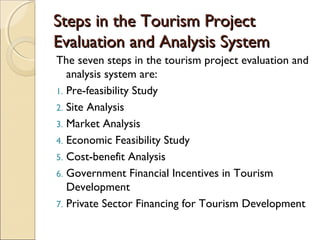
The seven steps in the tourism project evaluation and
analysis system are:
1. Pre-feasibility Study
2. Site Analysis
3. Market Analysis
4. Economic Feasibility Study
5. Cost-benefit Analysis
6. Government Financial Incentives in Tourism
Development
7. Private Sector Financing for Tourism Development
Definition of MarketingDefinition of Marketing
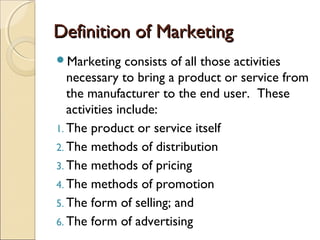
Marketing consists of all those activities
necessary to bring a product or service from
the manufacturer to the end user. These
activities include:
1. The product or service itself
2. The methods of distribution
3. The methods of pricing
4. The methods of promotion
5. The form of selling; and
6. The form of advertising
Uniqueness of Tourism MarketingUniqueness of Tourism Marketing
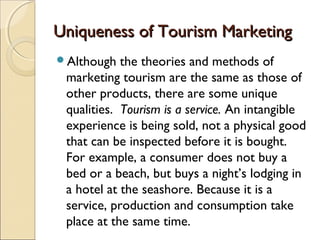
Although the theories and methods of
marketing tourism are the same as those of
other products, there are some unique
qualities. Tourism is a service. An intangible
experience is being sold, not a physical good
that can be inspected before it is bought.
For example, a consumer does not buy a
bed or a beach, but buys a night’s lodging in
a hotel at the seashore. Because it is a
service, production and consumption take
place at the same time.
Marketing OrientationMarketing Orientation
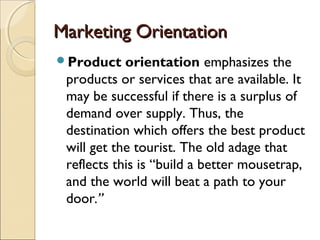
Product orientation emphasizes the
products or services that are available. It
may be successful if there is a surplus of
demand over supply. Thus, the
destination which offers the best product
will get the tourist. The old adage that
reflects this is “build a better mousetrap,
and the world will beat a path to your
door.”
Consumer Orientation places the
needs and wants of the tourist
foremost in the mind of the
marketer who seeks to provide a
product or service that will satisfy
those needs and wants.
Societal-marketing Approach or
Societal Orientation which
focuses on the satisfaction of tourist
needs and wants while respecting the
long-term interests of the
community.

Tourism planning

  • 1.
  • 2.
    PlanningPlanning A dynamic processof determining goals, systematically selecting alternative courses of actions to achieve those goals, implementing the chosen alternatives, and evaluating the choice to determine if it is successful. The planning process regards the environment which includes political, physical, social and economic elements as interrelated and interdependent components which should be taken into account in considering the future of destination area.
  • 3.
    Barriers to PlanningBarriersto Planning 1.) Many people are against planning in principle, particularly within the free- enterprise system. Many businessmen view tourism planning as an encroachment into their domain and are skeptical of it’s real value.
  • 4.
    free enterprise - aneconomic system where few restrictions are placed on business activities and ownership. encroachment - something that intrudes and has the power to influence whatever it encounters. 
  • 5.
    Barriers in PlanningBarriersin Planning 2.) It is expensive. Effective tourism planning must be based upon detailed resource analysis and market research. 3.) The tourism industry is complex and diverse. A large number of government departments have activities that impinge on tourism. Unlike the automobile manufacturing business, the tourism industry cannot be readily identified.
  • 6.
    Although the front-linerecipients of tourists expenditure such as hotels, airlines, resorts, restaurants and commercial attractions are obvious, others like retail stores and banks are not normally seen as part of the tourism industry. Another complication is that many tourism businesses receive their income both from visitors and local residents.
  • 7.
    Barriers in PlanningBarriersin Planning 4.) Tourism is characterized by few large businesses and various smaller enterprises. There is also the tendency for individual operators to consider themselves as being in the hotel industry or restaurant industry rather than accepting their broader role in the tourism industry.
  • 8.
    The Tourism PlanningProcessThe Tourism Planning Process Planning is an ongoing process that must keep up with the changing character of the world and of the destination area. The planning procedure follows a step by step pattern.
  • 9.
    There are fiveessential steps inThere are five essential steps in tourism planning process:tourism planning process: 1.) Background-analysis phase. -Tourism policy goals are usually classified into four, namely : economic, consumer / social, resource / environmental, and government operations.
  • 10.
    2.) Detailed researchand analysis phase.  -a valid tourism plan cannot be formulated without research. Research should be concentrated in four distinct areas namely: resources, markets, activities, and competition.
  • 11.
    3.) Synthesis phase. ◦-tourism plans provide the “bridge” between the present situation in a destination area. They provide the means to an end.
  • 12.
    4.) Goal setting,strategy selection and objective setting. -the fourth step in the tourism planning process is to define the planning goals, strategies, and objectives. They must becomplementary to policy and goals.
  • 13.
    5.) Plan development. -the last step of the tourism planning process is the development of the plan. The plan includes the actions needed to achieve the objectives, implement the strategy, and satisfy the planning goals.
  • 14.
    Classification of TravelersClassificationof Travelers According to PurposeAccording to Purpose Travelers have a wide range of classifications or categories based on the type of travel they are engaged in. This is an important detail during travel because it results in getting the appropriate travel insurance or the appropriate visa for international flights. All international travel must have a passport. Inappropriate insurance or the wrong visa can create problems for the traveler, so knowing the classification by purpose makes a differences in travel.
  • 15.
    Business TravelersBusiness Travelers Businesstravelers are the men and women who are traveling for business or job purposes. This might result in international travel, or it might remain in the United States depending on the job and the type of business. Business travelers going to an international location need an appropriate business or work visa for the country before leaving based on the length of their stay. Regardless of location, business travelers should get appropriate travel insurance for items like work computers.
  • 16.
    Student TravelersStudent Travelers Studenttravelers is the group that is either traveling for educational purposes or the travelers who are going for vacation between classes during school breaks. Student travelers going abroad must have appropriate visas, which will differ depending on whether the trip is a pleasure trip or an educational trip. For an education trip, student visas allowing the student to study in a school are necessary, though countries differ in exact requirements. For vacationing purposes, students need a tourist visa for international travel. Visas are not required for traveling within the United States. Travel insurance for students will usually cover items like laptops and digital cameras.
  • 17.
    Group TravelersGroup Travelers Thegroup traveler is the large tourist group, often of friends and family, who have at least 10 individuals within the group. In most cases group travelers are going as tourists to any given location. When applying for a visa, group travelers usually apply for a tourist visa to a country. For insurance purposes, group travelers often get special rates or deals because of the large number of individuals.
  • 18.
    Medical TravelersMedical Travelers Medicaltravelers are those who are traveling to see a specialized doctor for a medical ailment. For example, traveling from one side of the country to the other to see a specific medical doctor. This type of traveler will vary in needs for both insurance or visas depending on the location of the travel. If traveling to a location outside the United States the appropriate visa will either be a tourist or visitors visa or a medical visa if the country has a separate category.
  • 19.
    Family, Senior orSingleFamily, Senior or Single VacationersVacationers Vacationers who are not part of a large group, but rather fall under a family, senior or single's category, are often separated in insurance. As far as visas for international travel are concerned, the typical visa is a tourist or visitor's visa. For short-term visits, some countries might have a visa waiver, such as travel to Japan, which allows Americans with a valid passport to enter the country up to 90 days without a visa. In general, most countries will require a valid visa.
  • 20.
    Characteristics Of IndividualCharacteristicsOf Individual Tourism Development ProjectTourism Development Project Individual tourism development projects are generated either through the tourism planning processor by the private sector. In destinations without tourism plans, the public sector may identify development opportunities for private sector investment. All individual tourism development opportunities must be carefully researched and analyzed before their construction.
  • 21.
    Steps in theTourism ProjectSteps in the Tourism Project Evaluation and Analysis SystemEvaluation and Analysis System The seven steps in the tourism project evaluation and analysis system are: 1. Pre-feasibility Study 2. Site Analysis 3. Market Analysis 4. Economic Feasibility Study 5. Cost-benefit Analysis 6. Government Financial Incentives in Tourism Development 7. Private Sector Financing for Tourism Development
  • 22.
    Definition of MarketingDefinitionof Marketing Marketing consists of all those activities necessary to bring a product or service from the manufacturer to the end user. These activities include: 1. The product or service itself 2. The methods of distribution 3. The methods of pricing 4. The methods of promotion 5. The form of selling; and 6. The form of advertising
  • 23.
    Uniqueness of TourismMarketingUniqueness of Tourism Marketing Although the theories and methods of marketing tourism are the same as those of other products, there are some unique qualities. Tourism is a service. An intangible experience is being sold, not a physical good that can be inspected before it is bought. For example, a consumer does not buy a bed or a beach, but buys a night’s lodging in a hotel at the seashore. Because it is a service, production and consumption take place at the same time.
  • 24.
    Marketing OrientationMarketing Orientation Productorientation emphasizes the products or services that are available. It may be successful if there is a surplus of demand over supply. Thus, the destination which offers the best product will get the tourist. The old adage that reflects this is “build a better mousetrap, and the world will beat a path to your door.”
  • 25.
    Consumer Orientation placesthe needs and wants of the tourist foremost in the mind of the marketer who seeks to provide a product or service that will satisfy those needs and wants.
  • 26.
    Societal-marketing Approach or SocietalOrientation which focuses on the satisfaction of tourist needs and wants while respecting the long-term interests of the community.