Reflective Writing and the RevisionProcess: What Were You Thinking?Group II Marina Matos Patrícia SilvaRaíssa Almeida Wagner F. Guimarães Júnior
IntroductionWhat’s ReflectionandReflective Writing? “any activity that asks you to think about your own thinking.”You may think about: “writing processes in general or in relation to a particular essay.”Main reflection points    Rhetorical elements:audience and purpose;     Development strategies:comparison-contrast, exemplification, definition;Language features: word choice, sentence rhythm etc.
A Writer’s ExperienceThe author (Sandra L. Giles) was a doctoral student in Wendy Bishop’s Life Writing class at Florida State University;  What is a “Process Note”? “we explained our processes of working on the essay, as well as our thought processes in developing the ideas.”“We discussed each of our essays from the semester and recorded our learning and insights about writing and about the genre of nonfiction.”“I stopped worrying about how awkward the reflection was, stopped worrying about how to please the teacher, and started actually reflecting and thinking. New habits and ways of thinking formed.”
“Reflection helps you to develop your intentions (purpose), figure out your relation to your audience, uncover possible problems with your individual writing processes, set goals for revision, make decisions about language and style, and the list goes on.”“Reflection gives you a direction of what (or who) you want to reach when writing a text” – Wagner Junior’s reflection
My Letter to the Reader Assignment
InstructionsThis will be a sort of cover letter for your essayShould be on a separate sheet of paper, typed, stapled to the top of the final draft. Date the letter and address it to “Dear Reader.”Write nicely developed, fat paragraphsRemember to sign the letter
Tell the reader what you intend for the essay to do for its readerSay who you think the readers areDescribe your process of working on the essayThink about whether your letter and essay match up.Use the draft of your letter as a revising tool to make a few more adjustments to your essayHand the essay and letter in together
Examples and CommentsDear Reader,This essay is about how I feel about the changes in the financial aid rules. I talk about how they say you’re not eligible even if your parents aren’t supporting you anymore.Vague pronoun, define whether an applicant is dependent on or independent of parentsPart of taking on a topic is learning enough about it to be specific
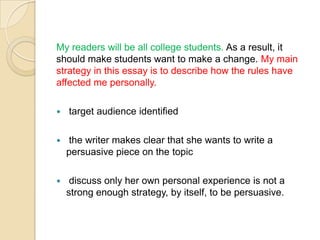
My readers will be all college students. As a result, it should make students want to make a change. My main strategy in this essay is to describe how the rules have affected me personally.  target audience identified the writer makes clear that she wants to write a persuasive piece on the topic discuss only her own personal experience is not a strong enough strategy, by itself, to be persuasive.
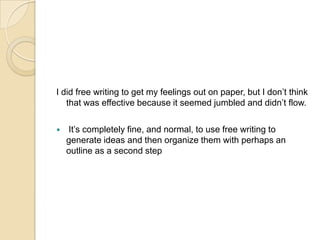
I did free writing to get my feelings out on paper, but I don’t think that was effective because it seemed jumbled and didn’t flow.It’s completely fine, and normal, to use free writing to generate ideas and then organize them with perhaps an outline as a second step
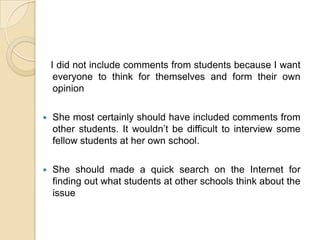
   I did not include comments from students because I want everyone to think for themselves and form their own opinionShe most certainly should have included comments from other students. It wouldn’t be difficult to interview some fellow students at her own school.She should made a quick search on the Internet for finding out what students at other schools think about the issue
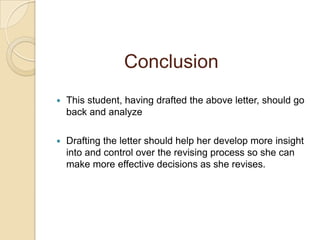
ConclusionThis student, having drafted the above letter, should go back and analyzeDrafting the letter should help her develop more insight into and control over the revising process so she can make more effective decisions as she revises.
How it worksIntentions, a sense of audience and purpose and of what thewriter want the essay to do, are essential to a good piece of communicative writing.
Examples from real studentsA Profile Essayby Joshua Dawson“This  essay  is  about my  grandmother  and  how she  overcame the hardships of life. [. . .] The purpose of this essay is to show how a  woman can be tough and can take anything life throws at her. I hope the  essay  reaches  students who  have  a single  parent  and  those who don’t know what a single parent goes through.”
A Cultural Differences Paper by Haley Moore“I  tried  to  show how, in America, we have everything from clean water to freedom of religion and other parts of the world do not. Also, I would like for my essay to inspire people to give donations or help in any way they can  for the countries that live in poverty.”
An Argumentative Essayby Chelsie Mathis“The main purpose of  this essay  is  to argue whether the [newspaper] editors used correct judgment when  deciding  to publish such  photos.  The  effect  that  I want my paper  to have on  the  readers  is  to  really make people think about others’ feelings and to make people realize that poor judgment can have a big effect. [ . . . ] I intend for my readers to possibly be high  school students going into the field of journalism or photojournalism.”
Writing about the Composing ProcessesJosh Autry and his essay on scuba diving:	“Mapping was my preferred method of outlining. It helped me organize my thoughts, go into detail, and pick the topics that I thought would be the most interesting to the readers.”   “I choose [sic] to write a paragraph about everything that can happen to a diver that is not prepared but after reviewing it I was afraid that it would scare an interested diver away. I chose to take that paragraph out and put a few warnings  in  the conclusion  so  the aspiring diver would not be clueless.”
	D’Amber Walker wrote:“At first my organization was off because I didn’t know  if I should start off with a personal experience which included telling a story or start with a statistic.”
Nigel Ellington titled his essay“If Everything Was Easy, Nothing Would Be Worth Anything” “I like this [title] because it’s catchy and doesn’t give too much away and it hooks you.”
How it Helps me (The instructor) Helps youIntroductionOne needs reflection to revise his or her text. To revise is to re-vision or re-see, to re-think some issues in the text.
The ReflectiveMemo It is a tool to help an instructor to avoid long discussions about an issue in one’s text. One writes this memo so that the instructor can help by a pointed advice, or possibly reassurance.Without a reflective memo, your instructor might pass right over the very issue you have been worried about.
The Habit of Self-Reflective WritingOne of the most important parts of reflective writing is the habit of self-reflective thinking.Establishing the habit of reflective thinking will have far-reaching benefits in your education, your career, and your life.
Guided Questions1). How can the rhetorical elements (audience, purpose) help a writer to improve his (or her) writing?2). How can the “Process note” help a writer to develop his (or her) next version of a text?3). What should the student write in his (or her) letter to the reader? And what should he do after writing it?4). What is the function to the letter to the reader?5). Why is it important for a student to verbalize his (or her) intentions?
6). Why is it important for a student to write about the composing processes?7).What is reflective writing and how reflection helps you write your text?8). What is the “process memo” and why it is important?9). Why is it so important to establish the habit of reflective thinking?10). How do you think reflective thinking can improve your writing skills?
ReferencesZEMLIANSKY, Pavel, LOWE, Charles (ed.). Writing Spaces: Readings on Writing. Volume 1.Indiana: Parlour Press, 2010.

Reflectivewritingandrevision group2morningb

  • 1.
    Reflective Writing andthe RevisionProcess: What Were You Thinking?Group II Marina Matos Patrícia SilvaRaíssa Almeida Wagner F. Guimarães Júnior
  • 2.
    IntroductionWhat’s ReflectionandReflective Writing?“any activity that asks you to think about your own thinking.”You may think about: “writing processes in general or in relation to a particular essay.”Main reflection points Rhetorical elements:audience and purpose;  Development strategies:comparison-contrast, exemplification, definition;Language features: word choice, sentence rhythm etc.
  • 3.
    A Writer’s ExperienceTheauthor (Sandra L. Giles) was a doctoral student in Wendy Bishop’s Life Writing class at Florida State University;  What is a “Process Note”? “we explained our processes of working on the essay, as well as our thought processes in developing the ideas.”“We discussed each of our essays from the semester and recorded our learning and insights about writing and about the genre of nonfiction.”“I stopped worrying about how awkward the reflection was, stopped worrying about how to please the teacher, and started actually reflecting and thinking. New habits and ways of thinking formed.”
  • 4.
    “Reflection helps youto develop your intentions (purpose), figure out your relation to your audience, uncover possible problems with your individual writing processes, set goals for revision, make decisions about language and style, and the list goes on.”“Reflection gives you a direction of what (or who) you want to reach when writing a text” – Wagner Junior’s reflection
  • 5.
    My Letter tothe Reader Assignment
  • 6.
    InstructionsThis will bea sort of cover letter for your essayShould be on a separate sheet of paper, typed, stapled to the top of the final draft. Date the letter and address it to “Dear Reader.”Write nicely developed, fat paragraphsRemember to sign the letter
  • 7.
    Tell the readerwhat you intend for the essay to do for its readerSay who you think the readers areDescribe your process of working on the essayThink about whether your letter and essay match up.Use the draft of your letter as a revising tool to make a few more adjustments to your essayHand the essay and letter in together
  • 8.
    Examples and CommentsDearReader,This essay is about how I feel about the changes in the financial aid rules. I talk about how they say you’re not eligible even if your parents aren’t supporting you anymore.Vague pronoun, define whether an applicant is dependent on or independent of parentsPart of taking on a topic is learning enough about it to be specific
  • 9.
    My readers willbe all college students. As a result, it should make students want to make a change. My main strategy in this essay is to describe how the rules have affected me personally. target audience identified the writer makes clear that she wants to write a persuasive piece on the topic discuss only her own personal experience is not a strong enough strategy, by itself, to be persuasive.
  • 10.
    I did freewriting to get my feelings out on paper, but I don’t think that was effective because it seemed jumbled and didn’t flow.It’s completely fine, and normal, to use free writing to generate ideas and then organize them with perhaps an outline as a second step
  • 11.
    I did not include comments from students because I want everyone to think for themselves and form their own opinionShe most certainly should have included comments from other students. It wouldn’t be difficult to interview some fellow students at her own school.She should made a quick search on the Internet for finding out what students at other schools think about the issue
  • 12.
    ConclusionThis student, havingdrafted the above letter, should go back and analyzeDrafting the letter should help her develop more insight into and control over the revising process so she can make more effective decisions as she revises.
  • 13.
    How it worksIntentions,a sense of audience and purpose and of what thewriter want the essay to do, are essential to a good piece of communicative writing.
  • 14.
    Examples from realstudentsA Profile Essayby Joshua Dawson“This essay is about my grandmother and how she overcame the hardships of life. [. . .] The purpose of this essay is to show how a woman can be tough and can take anything life throws at her. I hope the essay reaches students who have a single parent and those who don’t know what a single parent goes through.”
  • 15.
    A Cultural DifferencesPaper by Haley Moore“I tried to show how, in America, we have everything from clean water to freedom of religion and other parts of the world do not. Also, I would like for my essay to inspire people to give donations or help in any way they can for the countries that live in poverty.”
  • 16.
    An Argumentative EssaybyChelsie Mathis“The main purpose of this essay is to argue whether the [newspaper] editors used correct judgment when deciding to publish such photos. The effect that I want my paper to have on the readers is to really make people think about others’ feelings and to make people realize that poor judgment can have a big effect. [ . . . ] I intend for my readers to possibly be high school students going into the field of journalism or photojournalism.”
  • 17.
    Writing about theComposing ProcessesJosh Autry and his essay on scuba diving: “Mapping was my preferred method of outlining. It helped me organize my thoughts, go into detail, and pick the topics that I thought would be the most interesting to the readers.” “I choose [sic] to write a paragraph about everything that can happen to a diver that is not prepared but after reviewing it I was afraid that it would scare an interested diver away. I chose to take that paragraph out and put a few warnings in the conclusion so the aspiring diver would not be clueless.”
  • 18.
    D’Amber Walker wrote:“Atfirst my organization was off because I didn’t know if I should start off with a personal experience which included telling a story or start with a statistic.”
  • 19.
    Nigel Ellington titledhis essay“If Everything Was Easy, Nothing Would Be Worth Anything” “I like this [title] because it’s catchy and doesn’t give too much away and it hooks you.”
  • 20.
    How it Helpsme (The instructor) Helps youIntroductionOne needs reflection to revise his or her text. To revise is to re-vision or re-see, to re-think some issues in the text.
  • 21.
    The ReflectiveMemo Itis a tool to help an instructor to avoid long discussions about an issue in one’s text. One writes this memo so that the instructor can help by a pointed advice, or possibly reassurance.Without a reflective memo, your instructor might pass right over the very issue you have been worried about.
  • 22.
    The Habit ofSelf-Reflective WritingOne of the most important parts of reflective writing is the habit of self-reflective thinking.Establishing the habit of reflective thinking will have far-reaching benefits in your education, your career, and your life.
  • 23.
    Guided Questions1). Howcan the rhetorical elements (audience, purpose) help a writer to improve his (or her) writing?2). How can the “Process note” help a writer to develop his (or her) next version of a text?3). What should the student write in his (or her) letter to the reader? And what should he do after writing it?4). What is the function to the letter to the reader?5). Why is it important for a student to verbalize his (or her) intentions?
  • 24.
    6). Why isit important for a student to write about the composing processes?7).What is reflective writing and how reflection helps you write your text?8). What is the “process memo” and why it is important?9). Why is it so important to establish the habit of reflective thinking?10). How do you think reflective thinking can improve your writing skills?
  • 25.
    ReferencesZEMLIANSKY, Pavel, LOWE,Charles (ed.). Writing Spaces: Readings on Writing. Volume 1.Indiana: Parlour Press, 2010.