
Topic:  Reading and Writing  Skills Subject:  English Submitted to:  Miss Mudassar Jehan Submitted by:  Safa Murtaza -074 Aiman Murtaza-039 Ayesha Liaqat-042 Date:  27-01-2011
 
Communication is the art of transmitting  information,  ideas and attitudes from one person to another.
reading Writing  speaking listening
Reading is a process of retrieving the meaning of stored information or ideas.
To acquire knowledge  Reading helps in mental development Improvement of conversational skills Helps readers to decipher new words Developing vocabulary, language skills If the reader don't know anything about a subject, then it will be difficult for him to grab the information.
The way to understand reading: Two ways: 1. calling words – ability to recognize word structures 2. understand words – ability to understand the meaning within the context of the words One does not exist without the other.
READING Types Reading according to purpose. According to reading performance. According to Reading Instruction Program.
Skimming , Scanning, literature   Reading Intensive   Reading Reading   for   General Comprehension , Detailed   Reading ,  Reading according to purpose .
1. Skimming General understanding of the whole text. Fastest type of reading based on purpose. Also called  rapid-survey reading.
2. Scanning Look for specific information in the text. It makes you “skip more than you read”. Also called  search reading.
Comprehension Skills The ability to use context and prior knowledge to aid  reading and to make sense of what one reads and hears . Comprehension is based on:  Knowledge that reading makes sense  Readers' prior knowledge  Information presented in the text The use of context to assist recognition of words and meaning.
3-Five Basic Steps to Reading Comprehension 1. Previewing 2. Reading and Comprehending 3. Skimming 4. Scanning 5. Following Up
4. Intensive or functional reading Also called  word for word type of reading. Requires one to read materials related to his/her field of specialization. The object of intensive reading demands a great deal of content-area reading.
5. Extensive Also called  light-type of reading.  Reading for leisure. You love what you read.
6. Literature reading Not mainly for pleasure. Intends to familiarize readers with different genres of literature pieces: Novels, short stories, biography, etc.
B.  ACCORDING TO READING PERFORMANCE / RATE OF UNDERSTANDING
1. Speed reading Information tends to stay superficially in one’s mind. Not a good method if your objective is to gain a deeper understanding of the text.
2. Sub-vocalized reading One recognizes the form of the word and internally sounds it in the mind the way one pronounced it as a spoke word. Focuses primarily on the form, stress, intonation, phrasing of the language. This prevents one from quick reading and comprehension of the text.
3. Proofreading To see typographical errors Proofreading vs. editing
4. SPE (structure proposition evaluation) Three stages Recognizing language structures Making inferences Evaluation ideas, reasons, or conclusions Judgment is withheld until the text is fully understood.
C.  ACCORDING TO READING-INSTRUCTION PROGRAM
1. Read aloud Mostly teachers use this in instruction. Students will learn good expressions, proper pacing, and correct pronunciation.
2. Shared reading  It is also called as group reading. Enhance IQ level. It is necessary for students
3. Guided reading Reader is left alone to do silent reading. But the reader is motivated by the teacher by various strategies. Reader is not totally left alone.
4. Fluency reading Main objective:  To gain mastery of the Pronunciation, Phrasing,  Pausing,  Intonation,  Stress of the text. Progress: measured by the number of words one can read aloud and comprehensions Qs answered correctly.
Fluency Reading Text is read several times  e.g. comprehension reading. Importance: Taped reading,  Timed reading.
6. Developmental reading Aims to refine one’s reading: Reading readiness in the nursery. Beginning reading. Rapid growth. Refining and widening reading.
7. Selective or key-word reading Characterized by skimming and scanning
8. Remedial reading One submits himself/herself to a reading program that will give him/her special reading sessions under the guidance of a reading specialist.  This requires one to reflect on thoughts.
Memory and Concentration To really learn well, there are two things you need:  The ability to  and minimize distractions while you are studying. techniques to help you remember what you have learned. concentrate Memory
Writing Skills
Definition Writing skills are specific abilities which help writers put their thoughts into words in a meaningful form and to mentally interact with the message.
What is Writing? Writing may be: Persuasive writing. Author hopes to convince and  audience on his/her opinion. Objective writing. Presents facts and information  organized in an accessible way.
Objective of Writing To acquire generally useful techniques for effective writing. To utilized easy exercise that can help to improve your reading. To become familiar with common working mistakes.
Rules of Effective Writing Basic Rules Getting to the point Being Concise Paragraphing Framing Effective Questions Use of Nondiscriminatory Language Punctuation. Grammar  Spelling
Types of Writing Formal writing Informal writing
Formal Writing. It may be: Letter writing Paragraph writing Essay writing Story writing Dialogue writing … etc.
TYPES OF LETTER WRITING Formal Letters:  Tone is formal such as Business Letters. Semi-Formal Letters:  Tone and style is formal and meant for relatives. Invitation Letters. Informal Letters:  Tone and style is relaxed. It is written to relatives, friends, etc.  Form Letters:  Preprinted, Administration form, Application Form, etc.
What is Paragraph? A paragraph usually contains a general idea in one sentence, and 4 - 5 supporting sentences which expand this idea by giving explanation.
The Parts of a Paragraph Topic Sentence:  To introduce the main idea of the paragraph 2.  Details: Main body of the paragraph.  3.  Concluding Sentence:  To wrap-up your ideas.
Types of Paragraphs  For our purposes, here are the basic types of paragraphs: Narrative Exposition Descriptive Persuasive
Narrative Tells a story Uses specific details Is not a mere listing of events. It has characters, setting, conflict, and resolution. Time and place are usually established
Exposition Informative/explanatory Can be included incidentally with narrative or descriptive, but can also stand alone.
Description Series of detailed observations Usually not used by itself, but rather as a part of a whole The challenge is to make it interesting Imagery Sensory details; five senses Similes, metaphors
Persuasive Uses direct approach “ Believe me and do it!” Calls reader to action or to take a stand on an important issue More than just opinion is needed; information, analysis, and context must be given to the reader to let him/her make a decision
Writing a Story Helpful hints for story writing.
Dilemma Opening Build-up Resolution Ending Story Mountain
Humour Making the audience laugh as part of telling a story
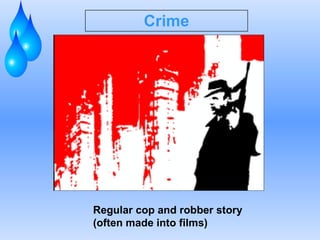
Crime Regular cop and robber story  (often made into films)
Real-life fiction Stories in a present day reality
Historical fiction Ancient traditional stories, myths and legends Eg: Lord of the Rings
Mystery Thrilling tales of the unknown phenomenon Eg: Alien stories, X-Files
Science fiction Use a setting involving science and technology Eg: Star Wars, The Matrix
Adventure Action-packed stories with dangerous obstacles  to overcome.
Fantasy Stories with magic and fairytale characters
What is Dialogue? When people speak in a piece of writing whether real or imaginary The direct speech is set off by quotation marks  Example:  “ Hi! ”
Why   Use   Dialogue? Makes writing more interesting. Reveals more information about the characters and situation.
Some common problems while writing ... Repetition repeating words or ideas Vagueness and verbosity using over-long sentences using imprecise terms Lack of analysis too much description no clear plan Lack of clarity assumption of knowledge
Objective : evidence driven. Accurate  : style,  referencing, data. Concise:  not wordy, balanced,  within word limit. Clear : point evident. Consistent:  expression, spelling, grammar. Convincing:  argument and language. Reader  friendly.


New eng assignment

  • 1.
  • 2.
    Topic: Readingand Writing Skills Subject: English Submitted to: Miss Mudassar Jehan Submitted by: Safa Murtaza -074 Aiman Murtaza-039 Ayesha Liaqat-042 Date: 27-01-2011
  • 3.
  • 4.
    Communication is theart of transmitting information, ideas and attitudes from one person to another.
  • 5.
    reading Writing speaking listening
  • 6.
    Reading is aprocess of retrieving the meaning of stored information or ideas.
  • 7.
    To acquire knowledge Reading helps in mental development Improvement of conversational skills Helps readers to decipher new words Developing vocabulary, language skills If the reader don't know anything about a subject, then it will be difficult for him to grab the information.
  • 8.
    The way tounderstand reading: Two ways: 1. calling words – ability to recognize word structures 2. understand words – ability to understand the meaning within the context of the words One does not exist without the other.
  • 9.
    READING Types Readingaccording to purpose. According to reading performance. According to Reading Instruction Program.
  • 10.
    Skimming , Scanning,literature Reading Intensive Reading Reading for General Comprehension , Detailed Reading , Reading according to purpose .
  • 11.
    1. Skimming Generalunderstanding of the whole text. Fastest type of reading based on purpose. Also called rapid-survey reading.
  • 12.
    2. Scanning Lookfor specific information in the text. It makes you “skip more than you read”. Also called search reading.
  • 13.
    Comprehension Skills Theability to use context and prior knowledge to aid reading and to make sense of what one reads and hears . Comprehension is based on: Knowledge that reading makes sense Readers' prior knowledge Information presented in the text The use of context to assist recognition of words and meaning.
  • 14.
    3-Five Basic Stepsto Reading Comprehension 1. Previewing 2. Reading and Comprehending 3. Skimming 4. Scanning 5. Following Up
  • 15.
    4. Intensive orfunctional reading Also called word for word type of reading. Requires one to read materials related to his/her field of specialization. The object of intensive reading demands a great deal of content-area reading.
  • 16.
    5. Extensive Alsocalled light-type of reading. Reading for leisure. You love what you read.
  • 17.
    6. Literature readingNot mainly for pleasure. Intends to familiarize readers with different genres of literature pieces: Novels, short stories, biography, etc.
  • 18.
    B. ACCORDINGTO READING PERFORMANCE / RATE OF UNDERSTANDING
  • 19.
    1. Speed readingInformation tends to stay superficially in one’s mind. Not a good method if your objective is to gain a deeper understanding of the text.
  • 20.
    2. Sub-vocalized readingOne recognizes the form of the word and internally sounds it in the mind the way one pronounced it as a spoke word. Focuses primarily on the form, stress, intonation, phrasing of the language. This prevents one from quick reading and comprehension of the text.
  • 21.
    3. Proofreading Tosee typographical errors Proofreading vs. editing
  • 22.
    4. SPE (structureproposition evaluation) Three stages Recognizing language structures Making inferences Evaluation ideas, reasons, or conclusions Judgment is withheld until the text is fully understood.
  • 23.
    C. ACCORDINGTO READING-INSTRUCTION PROGRAM
  • 24.
    1. Read aloudMostly teachers use this in instruction. Students will learn good expressions, proper pacing, and correct pronunciation.
  • 25.
    2. Shared reading It is also called as group reading. Enhance IQ level. It is necessary for students
  • 26.
    3. Guided readingReader is left alone to do silent reading. But the reader is motivated by the teacher by various strategies. Reader is not totally left alone.
  • 27.
    4. Fluency readingMain objective: To gain mastery of the Pronunciation, Phrasing, Pausing, Intonation, Stress of the text. Progress: measured by the number of words one can read aloud and comprehensions Qs answered correctly.
  • 28.
    Fluency Reading Textis read several times e.g. comprehension reading. Importance: Taped reading, Timed reading.
  • 29.
    6. Developmental readingAims to refine one’s reading: Reading readiness in the nursery. Beginning reading. Rapid growth. Refining and widening reading.
  • 30.
    7. Selective orkey-word reading Characterized by skimming and scanning
  • 31.
    8. Remedial readingOne submits himself/herself to a reading program that will give him/her special reading sessions under the guidance of a reading specialist. This requires one to reflect on thoughts.
  • 32.
    Memory and ConcentrationTo really learn well, there are two things you need: The ability to and minimize distractions while you are studying. techniques to help you remember what you have learned. concentrate Memory
  • 33.
  • 34.
    Definition Writing skillsare specific abilities which help writers put their thoughts into words in a meaningful form and to mentally interact with the message.
  • 35.
    What is Writing?Writing may be: Persuasive writing. Author hopes to convince and audience on his/her opinion. Objective writing. Presents facts and information organized in an accessible way.
  • 36.
    Objective of WritingTo acquire generally useful techniques for effective writing. To utilized easy exercise that can help to improve your reading. To become familiar with common working mistakes.
  • 37.
    Rules of EffectiveWriting Basic Rules Getting to the point Being Concise Paragraphing Framing Effective Questions Use of Nondiscriminatory Language Punctuation. Grammar Spelling
  • 38.
    Types of WritingFormal writing Informal writing
  • 39.
    Formal Writing. Itmay be: Letter writing Paragraph writing Essay writing Story writing Dialogue writing … etc.
  • 40.
    TYPES OF LETTERWRITING Formal Letters: Tone is formal such as Business Letters. Semi-Formal Letters: Tone and style is formal and meant for relatives. Invitation Letters. Informal Letters: Tone and style is relaxed. It is written to relatives, friends, etc. Form Letters: Preprinted, Administration form, Application Form, etc.
  • 41.
    What is Paragraph?A paragraph usually contains a general idea in one sentence, and 4 - 5 supporting sentences which expand this idea by giving explanation.
  • 42.
    The Parts ofa Paragraph Topic Sentence: To introduce the main idea of the paragraph 2. Details: Main body of the paragraph. 3. Concluding Sentence: To wrap-up your ideas.
  • 43.
    Types of Paragraphs For our purposes, here are the basic types of paragraphs: Narrative Exposition Descriptive Persuasive
  • 44.
    Narrative Tells astory Uses specific details Is not a mere listing of events. It has characters, setting, conflict, and resolution. Time and place are usually established
  • 45.
    Exposition Informative/explanatory Canbe included incidentally with narrative or descriptive, but can also stand alone.
  • 46.
    Description Series ofdetailed observations Usually not used by itself, but rather as a part of a whole The challenge is to make it interesting Imagery Sensory details; five senses Similes, metaphors
  • 47.
    Persuasive Uses directapproach “ Believe me and do it!” Calls reader to action or to take a stand on an important issue More than just opinion is needed; information, analysis, and context must be given to the reader to let him/her make a decision
  • 48.
    Writing a StoryHelpful hints for story writing.
  • 49.
    Dilemma Opening Build-upResolution Ending Story Mountain
  • 50.
    Humour Making theaudience laugh as part of telling a story
  • 51.
    Crime Regular copand robber story (often made into films)
  • 52.
    Real-life fiction Storiesin a present day reality
  • 53.
    Historical fiction Ancienttraditional stories, myths and legends Eg: Lord of the Rings
  • 54.
    Mystery Thrilling talesof the unknown phenomenon Eg: Alien stories, X-Files
  • 55.
    Science fiction Usea setting involving science and technology Eg: Star Wars, The Matrix
  • 56.
    Adventure Action-packed storieswith dangerous obstacles to overcome.
  • 57.
    Fantasy Stories withmagic and fairytale characters
  • 58.
    What is Dialogue?When people speak in a piece of writing whether real or imaginary The direct speech is set off by quotation marks Example: “ Hi! ”
  • 59.
    Why Use Dialogue? Makes writing more interesting. Reveals more information about the characters and situation.
  • 60.
    Some common problemswhile writing ... Repetition repeating words or ideas Vagueness and verbosity using over-long sentences using imprecise terms Lack of analysis too much description no clear plan Lack of clarity assumption of knowledge
  • 61.
    Objective : evidencedriven. Accurate : style, referencing, data. Concise: not wordy, balanced, within word limit. Clear : point evident. Consistent: expression, spelling, grammar. Convincing: argument and language. Reader friendly.
  • 62.
  • 63.