Leveraging Online Tools for Teacher LearningNSDC- St Louis, MO
ModeratorAnthony ReboraManaging editor of Education Week’s teachermagazine.org channel and the Teacher Professional Development Sourcebook.www.teachermagazine.orgwww.teachermagazine.org/tsb/
Elements of Effective PD: Consensus View  Gerald Herbert/APCollaborationTeacher inquiryFocus on student work/relevant subj. matterJob embeddedSustained activitiesConsistent follow-up
What Online PD (Optimally) Enables:  Gerald Herbert/APTraining extended over timeTransference to classroom practiceStrong focus on content through readings, multimedia, and online explorationCapacity building through teacher-led activitiesLearning community, rich online discussions(Barbara Treacy, EdTech Leaders Online, Education Week Webinar, Nov. 13, 2009: http://www.edweek.org/go/webinar/webpd)
Convergence of Trends  Gerald Herbert/APPressure on schools to improve/modernize PDMainstreaming of interactive (Web 2.0) toolsGrowing interest in teacher collaborationGrowing interest on new (i.e., Web- supported) models of teaching and learningBudgetary constraints and changes
Convergence of Trends  Gerald Herbert/AP“New resource constraints and continuing economic re-organization provides the opportunity to transform TPD activities and processes using newer and more meaningful models.”(Christopher Sessums, University of Florida, Education Week Webinar, Nov. 18, 2009: http://www.edweek.org/go/webinar/webpd )
  Gerald Herbert/APTypes of Tools and PlatformsCourse management platforms (Moodle, Blackboard, etc.)Voice and content tools (Voicethread, Gcast, etc.)Collaboration/networking tools (Wikispaces, Ning, etc.)Communication tools (Skype, Elluminate, etc.)
Types of Tools  Gerald Herbert/APResource sharing (delicious, diigo, etc.)Blogging and microblogging(Barbara Treacy, EdTech Leaders online)
Trend Lines: Teachers’ and the Web  Gerald Herbert/APThe Percentage of teachers who use the Internet at least once a week to get teaching ideas: 62(MetLife,“Survey of the American Teacher,” 2008)Percentage of teachers who have read or written a blog about teaching: 28(MetLife)Percentage of teachers who communicate online with an educator outside their district at least once a week: 11(MetLife)
Trend Lines: Online Course Enrollment   Gerald Herbert/APPercentage of teachers who have taken an online course for degree or professional credit: 39 (MetLife, 2008)Percent growth in teachers who have taken an online PD course between 2007 and 2008: 51(Project Tomorrow, “Learning in the 21st Century: 2009 Trends Update)
Trend Lines: Teachers and Social NetworkingPercentage of educators who have joined a social networking Web site: 61(edWeb.net, 2009)Percentage of educators who have participated in a professionally-oriented SNS: 15 (MetLife, 2008)Percentage of teachers who see the value of SNS for sharing information and resources with other educators: 58 (most commonly identified value) (edWeb.net, 2009)  Gerald Herbert/AP
TrendLines: Teachers and Social NetworkingNumber of members on the English Companion Ning (begun Dec. 2008): 9,830
Food for Thought  Gerald Herbert/AP“I think that online professional development does have the promise to [overcome teachers’ frustrations with PD], but that promised is only realized if people use the tools well. … But I do think some online tools, if the training takes advantage of them, can help with some of the classic issues of professional development.” (Chris Dede, Interview, Teacher Professional Development Sourcebook, Fall 2009: http://www.edweek.org/go/tsb/dede)
  Gerald Herbert/APFood For Thought“With online PD, I can work at home while my littlest one is napping. I love that. I love to tell my learners at the beginning of my course, ‘Hey, I’m teaching these courses in my pajamas.’ It’s great!”(Alethea Setser, PBS TeacherLine Course facilitator, Interview, Teacher Professional Development Sourcebook, Fall 2009: http://www.edweek.org/go/tsb/setser)
ResourcesTeacher Professional Development Sourcebook, Fall 2009: Leveraging Online Learning: http://www.teachersourcebook.orgChat Transcript: “Social Networking and Professional Development,” Nov. 12, 2009: http://www.edweek.org/ew/events/chats/2009/11/12/index.htmlWebinar: “Can Web 2.0 Save Professional Development,” Nov. 18, 2009: http://www.edweek.org/go/webinar/webpd
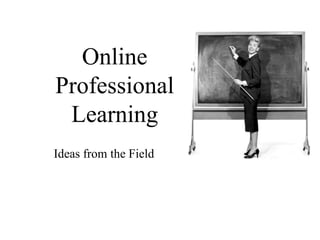
Online Professional LearningIdeas from the Field
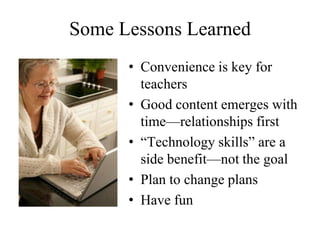
Some Lessons LearnedConvenience is key for teachers
Good content emerges with time—relationships first
“Technology skills” are a side benefit—not the goal
Plan to change plans
Have funModels & Strategies Real-time and lots of timePairs, trios, small & large groupsRequiring a responseNifty ideas: polling, recording, slides and videos, case studiesKEY PRINCIPLE: Nobody likes to feel dumb
Student Characteristics (pair-share review)LIST three things about your students that influence the way you set learning goals for them, and plan instruction that will meet their needs. What would another teacher need to know about this class to understand its “learning personality?”Share with a partner…
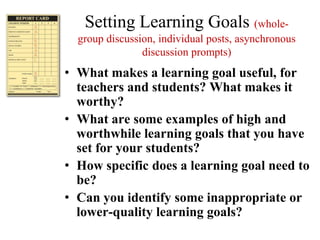
Setting Learning Goals (whole-group discussion, individual posts, asynchronous discussion prompts)What makes a learning goal useful, for teachers and students? What makes it worthy?
What are some examples of high and worthwhile learning goals that you have set for your students?
How specific does a learning goal need to be?
Can you identify some inappropriate or lower-quality learning goals?Sample Learning Goals (evaluation polling, deconstruction/reconstruction)My learning goals are:For all students to get 80% or above on the quiz
Exploring the concepts of density and mass
Manipulate three measurement tools; compare results, using two different graphic representations
Having students build a model volcano, in cooperating teams
For my students to understand what “democracy” is
Write three drafts of a persuasive essay; students will improve vocabulary and mechanics in each draftWhat are your learning goals? Why are they important?“In this lesson, I want my students to fully understand linear equations.  Linear equations are an integral and vital part of the 8th grade math curriculum. They represent the rigorous content that my students will need to know to become scientists and mathematicians. Linear equations are now part of the state curriculum benchmarks and are referenced in the National Council for Teachers of Mathematics standards.  My students will have to have this content mastered to meet the new state High School Merit Curriculum Standards, which require four years of formal mathematics coursework, so it’s very important that they understand them now.”
What are your learning goals?Why are they important?“This is the first lesson as we begin a unit on linear equations.  My goals for this lesson include having every student set up the problems correctly, and then explore the concept of scale. I want them to notice how changing the scale will give the graphs a different appearance without changing the function.  Students will experiment to find scales that fit common data points best. It will be messy work, a kind of trial and error. An abstract concept like linear function is really tough for 7th graders who have been working with arithmetic and more concrete problems; another goal is to make the students feel comfortable and competent in working with the tools of graphing.”
If the only tool you have is a hammer, you tend to see every problem as a nail —                     Abraham Maslow
HousekeepingPaperless handoutshttp://21stcenturylearning.wikispaces.comSheryl Nussbaum-BeachCo-Founder & CEO Powerful Learning Practice, LLChttp://plpnetwork.comsheryl@plpnetwork.comPresident21st Century Collaborative, LLChttp://21stcenturycollaborative.comsnbeach@cox.net
Welcome to the human network
Are you Ready for Leading/Learning in the 21st Century?It isn’t just “coming”… it has arrived! And schools who aren’t redefining themselves, risk becoming irrelevant in preparing students for the future.
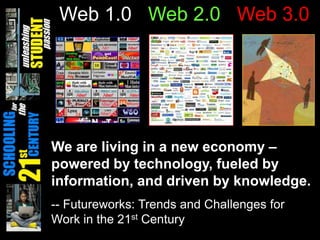
Web 1.0   Web 2.0   Web 3.0We are living in a new economy – powered by technology, fueled by information, and driven by knowledge.-- Futureworks: Trends and Challenges for Work in the 21st Century
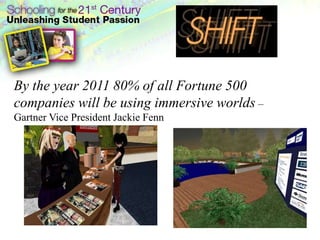
By the year 2011 80% of all Fortune 500 companies will be using immersive worlds – Gartner Vice President Jackie Fenn
New Media Literacies- What are they?http://newmedialiteracies.org/ *Will the future of education include broad-based, global reflection and inquiry?What role will Professional Learning Communities and Personal Learning Networks play?Will your current level of new media literacy skills allow you to take part in learning through these mediums?
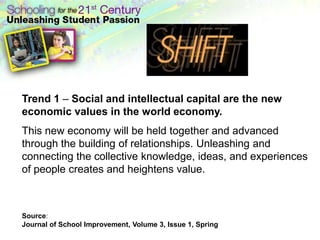
Trend 1 – Social and intellectual capital are the new economic values in the world economy.This new economy will be held together and advanced through the building of relationships. Unleashing and connecting the collective knowledge, ideas, and experiences of people creates and heightens value.Source:Journal of School Improvement, Volume 3, Issue 1, Spring 2002
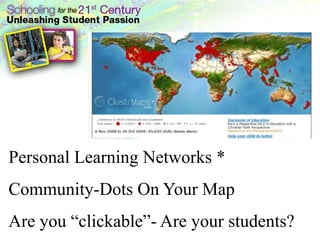
Personal Learning Networks *Community-Dots On Your MapAre you “clickable”- Are your students?
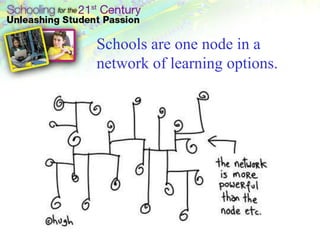
Schools are one node in a network of learning options.
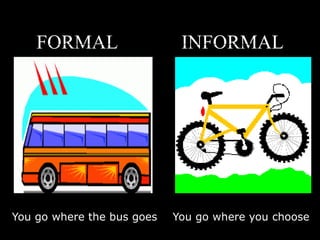
FORMAL             INFORMALYou go where the bus goesYou go where you chooseJay Cross – Internet Time
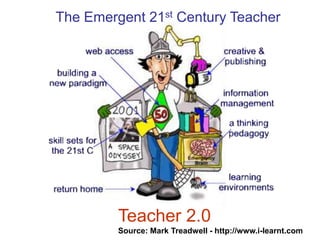
Teacher 2.0The Emergent 21st Century TeacherTeacher 2.0Source: Mark Treadwell- http://www.i-learnt.com
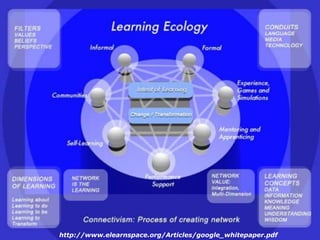
http://www.elearnspace.org/Articles/google_whitepaper.pdf
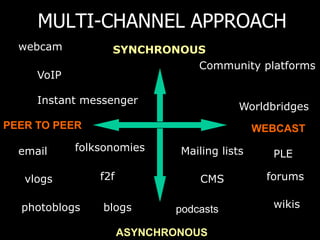
MULTI-CHANNEL APPROACHwebcamSYNCHRONOUSCommunity platformsVoIPConference roomsInstant messengerWorldbridgesPEER TO PEERWEBCASTfolksonomiesMailing listsemailPLEf2fforumsvlogsCMSwikisblogsphotoblogspodcastsASYNCHRONOUS
Mobile ComputingSmart PhonesThe mobile market has: 4 billion subscribers, three-fourths of whom live in developingcountries. Over a billion new phones are produced each year, and the fastest-growing sales segment belongs to smart phones —
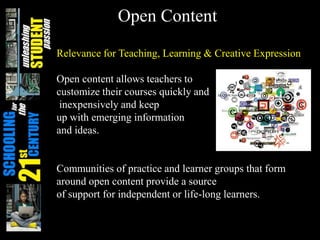
Open ContentRelevance for Teaching, Learning & Creative ExpressionOpen content allows teachers to customize their courses quickly and inexpensively and keepup with emerging information and ideas.Communities of practice and learner groups that form around open content provide a sourceof support for independent or life-long learners.
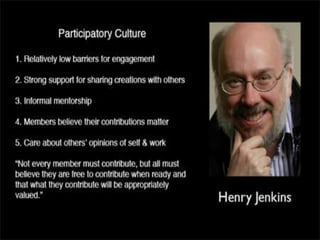
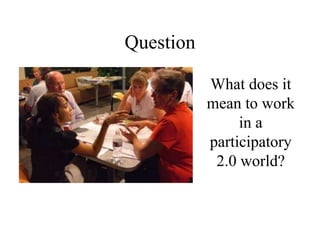
QuestionWhat does it mean to work in a participatory 2.0 world?
PD of the 21st Century will be—teacher directed through:Connections (PLN & CoP)
44LearningOne-on-one         Classroom             Informal

Nsdc This One

  • 1.
    Leveraging Online Toolsfor Teacher LearningNSDC- St Louis, MO
  • 2.
    ModeratorAnthony ReboraManaging editorof Education Week’s teachermagazine.org channel and the Teacher Professional Development Sourcebook.www.teachermagazine.orgwww.teachermagazine.org/tsb/
  • 3.
    Elements of EffectivePD: Consensus View Gerald Herbert/APCollaborationTeacher inquiryFocus on student work/relevant subj. matterJob embeddedSustained activitiesConsistent follow-up
  • 4.
    What Online PD(Optimally) Enables: Gerald Herbert/APTraining extended over timeTransference to classroom practiceStrong focus on content through readings, multimedia, and online explorationCapacity building through teacher-led activitiesLearning community, rich online discussions(Barbara Treacy, EdTech Leaders Online, Education Week Webinar, Nov. 13, 2009: http://www.edweek.org/go/webinar/webpd)
  • 5.
    Convergence of Trends Gerald Herbert/APPressure on schools to improve/modernize PDMainstreaming of interactive (Web 2.0) toolsGrowing interest in teacher collaborationGrowing interest on new (i.e., Web- supported) models of teaching and learningBudgetary constraints and changes
  • 6.
    Convergence of Trends Gerald Herbert/AP“New resource constraints and continuing economic re-organization provides the opportunity to transform TPD activities and processes using newer and more meaningful models.”(Christopher Sessums, University of Florida, Education Week Webinar, Nov. 18, 2009: http://www.edweek.org/go/webinar/webpd )
  • 7.
    GeraldHerbert/APTypes of Tools and PlatformsCourse management platforms (Moodle, Blackboard, etc.)Voice and content tools (Voicethread, Gcast, etc.)Collaboration/networking tools (Wikispaces, Ning, etc.)Communication tools (Skype, Elluminate, etc.)
  • 8.
    Types of Tools Gerald Herbert/APResource sharing (delicious, diigo, etc.)Blogging and microblogging(Barbara Treacy, EdTech Leaders online)
  • 9.
    Trend Lines: Teachers’and the Web Gerald Herbert/APThe Percentage of teachers who use the Internet at least once a week to get teaching ideas: 62(MetLife,“Survey of the American Teacher,” 2008)Percentage of teachers who have read or written a blog about teaching: 28(MetLife)Percentage of teachers who communicate online with an educator outside their district at least once a week: 11(MetLife)
  • 10.
    Trend Lines: OnlineCourse Enrollment Gerald Herbert/APPercentage of teachers who have taken an online course for degree or professional credit: 39 (MetLife, 2008)Percent growth in teachers who have taken an online PD course between 2007 and 2008: 51(Project Tomorrow, “Learning in the 21st Century: 2009 Trends Update)
  • 11.
    Trend Lines: Teachersand Social NetworkingPercentage of educators who have joined a social networking Web site: 61(edWeb.net, 2009)Percentage of educators who have participated in a professionally-oriented SNS: 15 (MetLife, 2008)Percentage of teachers who see the value of SNS for sharing information and resources with other educators: 58 (most commonly identified value) (edWeb.net, 2009) Gerald Herbert/AP
  • 12.
    TrendLines: Teachers andSocial NetworkingNumber of members on the English Companion Ning (begun Dec. 2008): 9,830
  • 13.
    Food for Thought Gerald Herbert/AP“I think that online professional development does have the promise to [overcome teachers’ frustrations with PD], but that promised is only realized if people use the tools well. … But I do think some online tools, if the training takes advantage of them, can help with some of the classic issues of professional development.” (Chris Dede, Interview, Teacher Professional Development Sourcebook, Fall 2009: http://www.edweek.org/go/tsb/dede)
  • 14.
    GeraldHerbert/APFood For Thought“With online PD, I can work at home while my littlest one is napping. I love that. I love to tell my learners at the beginning of my course, ‘Hey, I’m teaching these courses in my pajamas.’ It’s great!”(Alethea Setser, PBS TeacherLine Course facilitator, Interview, Teacher Professional Development Sourcebook, Fall 2009: http://www.edweek.org/go/tsb/setser)
  • 15.
    ResourcesTeacher Professional DevelopmentSourcebook, Fall 2009: Leveraging Online Learning: http://www.teachersourcebook.orgChat Transcript: “Social Networking and Professional Development,” Nov. 12, 2009: http://www.edweek.org/ew/events/chats/2009/11/12/index.htmlWebinar: “Can Web 2.0 Save Professional Development,” Nov. 18, 2009: http://www.edweek.org/go/webinar/webpd
  • 16.
  • 17.
  • 18.
    Good content emergeswith time—relationships first
  • 19.
    “Technology skills” area side benefit—not the goal
  • 20.
  • 21.
    Have funModels &Strategies Real-time and lots of timePairs, trios, small & large groupsRequiring a responseNifty ideas: polling, recording, slides and videos, case studiesKEY PRINCIPLE: Nobody likes to feel dumb
  • 22.
    Student Characteristics (pair-sharereview)LIST three things about your students that influence the way you set learning goals for them, and plan instruction that will meet their needs. What would another teacher need to know about this class to understand its “learning personality?”Share with a partner…
  • 23.
    Setting Learning Goals(whole-group discussion, individual posts, asynchronous discussion prompts)What makes a learning goal useful, for teachers and students? What makes it worthy?
  • 24.
    What are someexamples of high and worthwhile learning goals that you have set for your students?
  • 25.
    How specific doesa learning goal need to be?
  • 26.
    Can you identifysome inappropriate or lower-quality learning goals?Sample Learning Goals (evaluation polling, deconstruction/reconstruction)My learning goals are:For all students to get 80% or above on the quiz
  • 27.
    Exploring the conceptsof density and mass
  • 28.
    Manipulate three measurementtools; compare results, using two different graphic representations
  • 29.
    Having students builda model volcano, in cooperating teams
  • 30.
    For my studentsto understand what “democracy” is
  • 31.
    Write three draftsof a persuasive essay; students will improve vocabulary and mechanics in each draftWhat are your learning goals? Why are they important?“In this lesson, I want my students to fully understand linear equations. Linear equations are an integral and vital part of the 8th grade math curriculum. They represent the rigorous content that my students will need to know to become scientists and mathematicians. Linear equations are now part of the state curriculum benchmarks and are referenced in the National Council for Teachers of Mathematics standards. My students will have to have this content mastered to meet the new state High School Merit Curriculum Standards, which require four years of formal mathematics coursework, so it’s very important that they understand them now.”
  • 32.
    What are yourlearning goals?Why are they important?“This is the first lesson as we begin a unit on linear equations. My goals for this lesson include having every student set up the problems correctly, and then explore the concept of scale. I want them to notice how changing the scale will give the graphs a different appearance without changing the function. Students will experiment to find scales that fit common data points best. It will be messy work, a kind of trial and error. An abstract concept like linear function is really tough for 7th graders who have been working with arithmetic and more concrete problems; another goal is to make the students feel comfortable and competent in working with the tools of graphing.”
  • 33.
    If the onlytool you have is a hammer, you tend to see every problem as a nail — Abraham Maslow
  • 34.
    HousekeepingPaperless handoutshttp://21stcenturylearning.wikispaces.comSheryl Nussbaum-BeachCo-Founder& CEO Powerful Learning Practice, LLChttp://plpnetwork.comsheryl@plpnetwork.comPresident21st Century Collaborative, LLChttp://21stcenturycollaborative.comsnbeach@cox.net
  • 35.
    Welcome to thehuman network
  • 36.
    Are you Readyfor Leading/Learning in the 21st Century?It isn’t just “coming”… it has arrived! And schools who aren’t redefining themselves, risk becoming irrelevant in preparing students for the future.
  • 37.
    Web 1.0 Web 2.0 Web 3.0We are living in a new economy – powered by technology, fueled by information, and driven by knowledge.-- Futureworks: Trends and Challenges for Work in the 21st Century
  • 38.
    By the year2011 80% of all Fortune 500 companies will be using immersive worlds – Gartner Vice President Jackie Fenn
  • 40.
    New Media Literacies-What are they?http://newmedialiteracies.org/ *Will the future of education include broad-based, global reflection and inquiry?What role will Professional Learning Communities and Personal Learning Networks play?Will your current level of new media literacy skills allow you to take part in learning through these mediums?
  • 41.
    Trend 1 –Social and intellectual capital are the new economic values in the world economy.This new economy will be held together and advanced through the building of relationships. Unleashing and connecting the collective knowledge, ideas, and experiences of people creates and heightens value.Source:Journal of School Improvement, Volume 3, Issue 1, Spring 2002
  • 42.
    Personal Learning Networks*Community-Dots On Your MapAre you “clickable”- Are your students?
  • 43.
    Schools are onenode in a network of learning options.
  • 44.
    FORMAL INFORMALYou go where the bus goesYou go where you chooseJay Cross – Internet Time
  • 45.
    Teacher 2.0The Emergent21st Century TeacherTeacher 2.0Source: Mark Treadwell- http://www.i-learnt.com
  • 46.
  • 47.
    MULTI-CHANNEL APPROACHwebcamSYNCHRONOUSCommunity platformsVoIPConferenceroomsInstant messengerWorldbridgesPEER TO PEERWEBCASTfolksonomiesMailing listsemailPLEf2fforumsvlogsCMSwikisblogsphotoblogspodcastsASYNCHRONOUS
  • 48.
    Mobile ComputingSmart PhonesThemobile market has: 4 billion subscribers, three-fourths of whom live in developingcountries. Over a billion new phones are produced each year, and the fastest-growing sales segment belongs to smart phones —
  • 49.
    Open ContentRelevance forTeaching, Learning & Creative ExpressionOpen content allows teachers to customize their courses quickly and inexpensively and keepup with emerging information and ideas.Communities of practice and learner groups that form around open content provide a sourceof support for independent or life-long learners.
  • 51.
    QuestionWhat does itmean to work in a participatory 2.0 world?
  • 52.
    PD of the21st Century will be—teacher directed through:Connections (PLN & CoP)
  • 53.
    44LearningOne-on-one Classroom Informal
  • 54.
  • 55.
    46Free range learnersFree-rangelearners choose how and what they learn. Self-service is less expensive and more timely than the alternative. Informal learning has no need for the busywork, chrome, and bureaucracy that accompany typical classroom instruction.
  • 56.
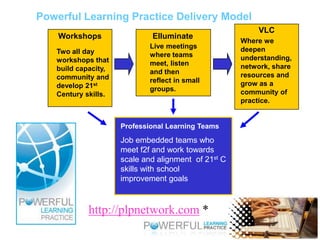
    Powerful Learning PracticeDelivery ModelVLCWorkshopsElluminateWhere we deepen understanding, network, share resources and grow as a community of practice.Live meetings where teams meet, listen and then reflect in small groups.Two all day workshops that build capacity, community and develop 21st Century skills.Professional Learning TeamsJob embedded teams who meet f2f and work towards scale and alignment of 21st C skills with school improvement goalshttp://plpnetwork.com *
  • 57.
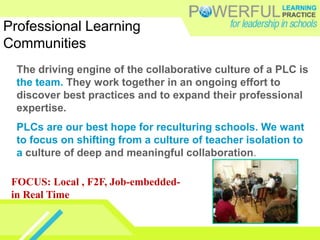
    Professional Learning CommunitiesThedriving engine of the collaborative culture of a PLC is the team. They work together in an ongoing effort to discover best practices and to expand their professional expertise. PLCs are our best hope for reculturing schools. We want to focus on shifting from a culture of teacher isolation to a culture of deep and meaningful collaboration.FOCUS: Local , F2F, Job-embedded- in Real Time
  • 58.
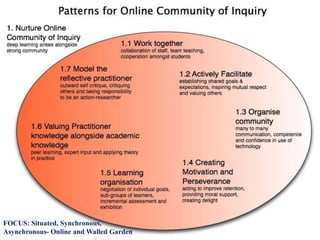
    Communities of PracticeFOCUS:Situated, Synchronous, Asynchronous- Online and Walled Garden
  • 60.
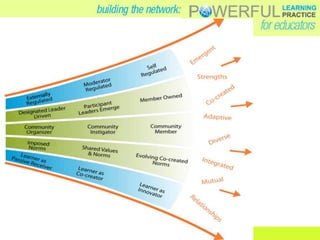
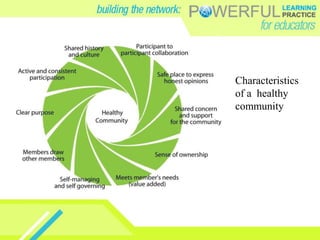
    Characteristics of a healthy community
  • 61.
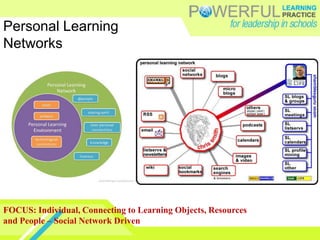
    Personal Learning NetworksFOCUS:Individual, Connecting to Learning Objects, Resources and People – Social Network Driven
  • 62.