Approaches to
Teaching
Writing
Colombia Teacher
Training Program
Approaches to Teaching Writing
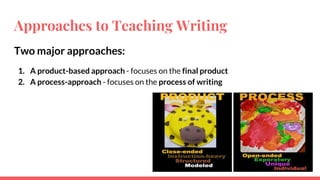
Two major approaches:
1. A product-based approach - focuses on the final product
2. A process-approach - focuses on the process of writing
The Product-Based Approach
The product-based approach:
● Focuses on the accuracy of the final product
● Grammar, spelling, punctuation and capitalization are accurate
● Learners are given a series of activities (controlled and guided) that are small
steps to complete before writing a whole text
● Bottom-up approach (accuracy of various language skills - letters, words,
sentences, paragraphs- is the focus)
● Both focus on activities that reinforce language learning (spelling, punctuation,
capitalization
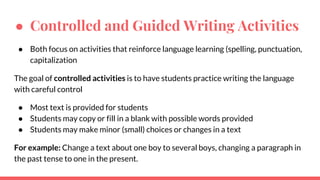
● Controlled and Guided Writing Activities
● Both focus on activities that reinforce language learning (spelling, punctuation,
capitalization
The goal of controlled activities is to have students practice writing the language
with careful control
● Most text is provided for students
● Students may copy or fill in a blank with possible words provided
● Students may make minor (small) choices or changes in a text
For example: Change a text about one boy to several boys, changing a paragraph in
the past tense to one in the present.
Controlled Writing Activities
● Forming letters by tracing, creating them physically (with arms, hands, bodies)
● Underlining stressed words as they are spoken
● Counting the words in a sentence or clapping with each word
● Copying words or sentences
● Completing words puzzles with the words provided
● Playing word games (Bingo, Concentration)
● Unscrambling words or sentences
● Filling in the gaps with the words or sentences provided
● Creating a poem with words provided
● Building a person word list
● Contributing words to a word wall
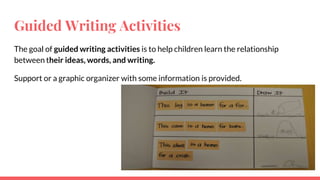
Guided Writing Activities
The goal of guided writing activities is to help children learn the relationship
between their ideas, words, and writing.
Support or a graphic organizer with some information is provided.
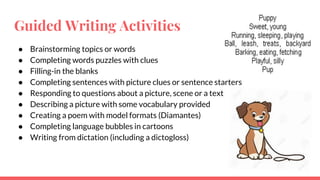
Guided Writing Activities
● Brainstorming topics or words
● Completing words puzzles with clues
● Filling-in the blanks
● Completing sentences with picture clues or sentence starters
● Responding to questions about a picture, scene or a text
● Describing a picture with some vocabulary provided
● Creating a poem with model formats (Diamantes)
● Completing language bubbles in cartoons
● Writing from dictation (including a dictogloss)
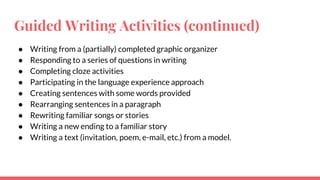
Guided Writing Activities (continued)
● Writing from a (partially) completed graphic organizer
● Responding to a series of questions in writing
● Completing cloze activities
● Participating in the language experience approach
● Creating sentences with some words provided
● Rearranging sentences in a paragraph
● Rewriting familiar songs or stories
● Writing a new ending to a familiar story
● Writing a text (invitation, poem, e-mail, etc.) from a model.
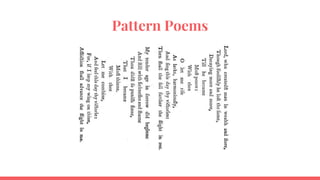
Pattern Poems
Music Videos/Music
● What do you hear?
● What sounds/instruments do you think are being played?
● Where do you think the instruments are being played?
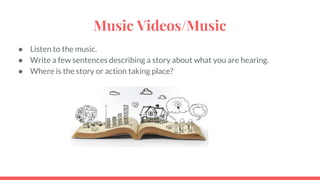
Music Videos/Music
● Listen to the music.
● Write a few sentences describing a story about what you are hearing.
● Where is the story or action taking place?
What are other ideas you have about guided
writing activities?
References
Shin, J. K., & Crandall, J. (. (2014). Teaching young learners English: From theory to practice.
Boston: National Geographic Learning.

Approaches to teaching writing product

  • 1.
  • 2.
    Approaches to TeachingWriting Two major approaches: 1. A product-based approach - focuses on the final product 2. A process-approach - focuses on the process of writing
  • 3.
    The Product-Based Approach Theproduct-based approach: ● Focuses on the accuracy of the final product ● Grammar, spelling, punctuation and capitalization are accurate ● Learners are given a series of activities (controlled and guided) that are small steps to complete before writing a whole text ● Bottom-up approach (accuracy of various language skills - letters, words, sentences, paragraphs- is the focus) ● Both focus on activities that reinforce language learning (spelling, punctuation, capitalization
  • 4.
    ● Controlled andGuided Writing Activities ● Both focus on activities that reinforce language learning (spelling, punctuation, capitalization The goal of controlled activities is to have students practice writing the language with careful control ● Most text is provided for students ● Students may copy or fill in a blank with possible words provided ● Students may make minor (small) choices or changes in a text For example: Change a text about one boy to several boys, changing a paragraph in the past tense to one in the present.
  • 5.
    Controlled Writing Activities ●Forming letters by tracing, creating them physically (with arms, hands, bodies) ● Underlining stressed words as they are spoken ● Counting the words in a sentence or clapping with each word ● Copying words or sentences ● Completing words puzzles with the words provided ● Playing word games (Bingo, Concentration) ● Unscrambling words or sentences ● Filling in the gaps with the words or sentences provided ● Creating a poem with words provided ● Building a person word list ● Contributing words to a word wall
  • 6.
    Guided Writing Activities Thegoal of guided writing activities is to help children learn the relationship between their ideas, words, and writing. Support or a graphic organizer with some information is provided.
  • 7.
    Guided Writing Activities ●Brainstorming topics or words ● Completing words puzzles with clues ● Filling-in the blanks ● Completing sentences with picture clues or sentence starters ● Responding to questions about a picture, scene or a text ● Describing a picture with some vocabulary provided ● Creating a poem with model formats (Diamantes) ● Completing language bubbles in cartoons ● Writing from dictation (including a dictogloss)
  • 8.
    Guided Writing Activities(continued) ● Writing from a (partially) completed graphic organizer ● Responding to a series of questions in writing ● Completing cloze activities ● Participating in the language experience approach ● Creating sentences with some words provided ● Rearranging sentences in a paragraph ● Rewriting familiar songs or stories ● Writing a new ending to a familiar story ● Writing a text (invitation, poem, e-mail, etc.) from a model.
  • 9.
  • 10.
    Music Videos/Music ● Whatdo you hear? ● What sounds/instruments do you think are being played? ● Where do you think the instruments are being played?
  • 11.
    Music Videos/Music ● Listento the music. ● Write a few sentences describing a story about what you are hearing. ● Where is the story or action taking place?
  • 12.
    What are otherideas you have about guided writing activities?
  • 13.
    References Shin, J. K.,& Crandall, J. (. (2014). Teaching young learners English: From theory to practice. Boston: National Geographic Learning.