WRITING TO ARGUE
At the end of this lesson, you will be able to say…I can identify when it is appropriate to use formal language
I can identify bias
I can use a balanced planning format to present an argument.
I can give an opinion that can be presented in the conclusion of a balanced argumentWhat is Argument?Arguments are normally cleverly structured by using linked paragraphs, careful choice of language and ideas that flow and lead to a powerful conclusion.As a writer you might be asked to develop an argument and you should carefully craft your ideas to make it as powerful as possible. Looking at arguments that other writers have written can help you develop the skills needed to achieve the best grade.
What is bias?Someone is only putting forward one side of an argument.
An advert, for example, will only tell you the good things about a product, and may exaggerate those!
Remember, a writer may only be telling you one side of a story, so always think about what a writer may not be telling you and don’t always believe what you read!Key skills in writing an argument Structuring ideas for the greatest impact.Making sure that your writing builds up to a powerful conclusion. No weaknesses in your argument. Always try to prove that you are right.
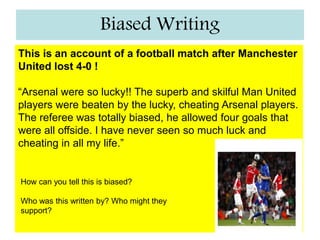
Biased WritingThis is an account of a football match after Manchester United lost 4-0 !“Arsenal were so lucky!! The superb and skilful Man United players were beaten by the lucky, cheating Arsenal players. The referee was totally biased, he allowed four goals that were all offside. I have never seen so much luck and cheating in all my life.”How can you tell this is biased?Who was this written by? Who might they support?
Unbiased WritingIn order to be fair and unbiased toward all members of the potential audience, it is important that the author uses language that does not stereotype or unfairly categorize any group of people or individuals. Besides offending potential readers, an author who uses sexist or racist language also damages ones credibility in the eyes of the audience. Even if the use of unbiased language is a mistake, that mistake which may seem small on paper, can have much larger implications and consequences.
Unbiased WritingOne of the more common forms of unbiased language is gender bias. For example, the sentence, “Any student interested in playing basketball should see his coach by this afternoon,”Where is the bias in the final statement?
How do you write a balanced argument?TitleA simple statement or question to draw attention to the issue.Introduction – Paragraph 1Short opening, explaining how the issue came about. That is the thesis statement. Do not put any views of your own in this section.
How do you write a balanced argument?Points ‘for’ – Paragraph 2Start this section with ‘Firstly’ or ‘The first reason is’. Write about your first point in favour of the argument but do not put your own point of view yet.Points ‘for’ – Paragraph 3Begin your next point with ‘Furthermore’ or ‘Indeed, it could be said that…’ but still do not give your own opinion.Points ‘for’ – Paragraph 4Use ‘Perhaps’ or ‘In addition’ to begin your final point in favour of the argument. Try to give evidence to support the point if you can.
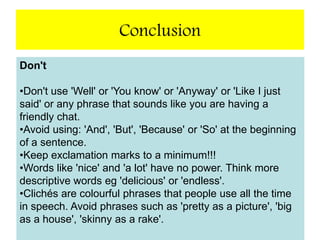
How do you write a balanced argument?Points ‘Against’ – Paragraph 5Begin with ‘However’ and put your first point against the argument without giving your own view.Points ‘Against’ – Paragraph 6Continue to put your points ‘against’, introducing them with formal words such as ‘Despite’, ‘On the other hand’ or ‘In contrast’. Points ‘Against’ – Paragraph 7Use ‘Finally’ to begin your last point. Still do not give your opinion.
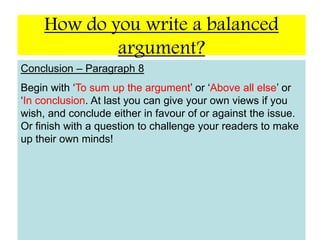
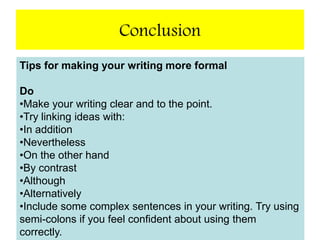
How do you write a balanced argument?Conclusion – Paragraph 8Begin with ‘To sum up the argument’ or ‘Above all else’ or ‘In conclusion. At last you can give your own views if you wish, and conclude either in favour of or against the issue. Or finish with a question to challenge your readers to make up their own minds!
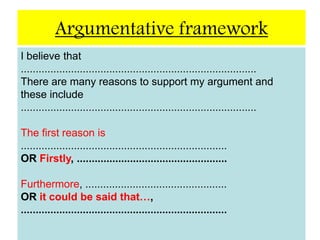
Argumentative frameworkI believe that ................................................................................ There are many reasons to support my argument and these include ................................................................................The first reason is ...................................................................... OR Firstly, ...................................................Furthermore, ................................................OR it could be said that…, ......................................................................
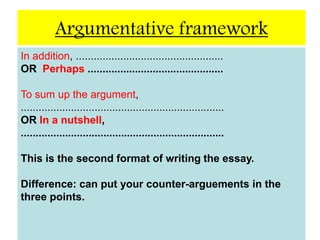
Argumentative frameworkIn addition, .................................................. OR  Perhaps ..............................................To sum up the argument, ..................................................................... OR In a nutshell, .....................................................................This is the second format of writing the essay.Difference: can put your counter-arguements in the three points.
ARGUMENTS FOR AND AGAINST WORK EXPERIENCE Sequence the arguments into a clear structure that builds up a powerful overall view. Think about the arguments that you do or don’t want to use and what order the points should be in to achieve the biggest impact on the reader.
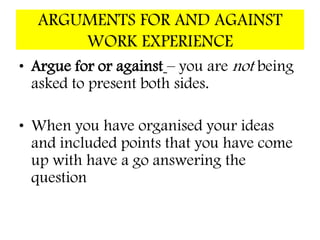
Argue for or against– you are not being asked to present both sides.When you have organised your ideas and included points that you have come up with have a go answering the question ARGUMENTS FOR AND AGAINST WORK EXPERIENCE
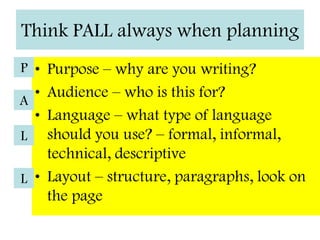
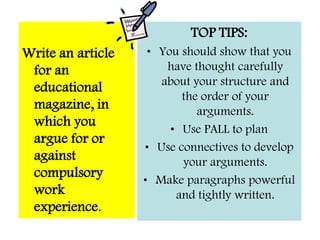
Think PALL always when planningPurpose – why are you writing?Audience – who is this for? Language – what type of language should you use? – formal, informal, technical, descriptiveLayout – structure, paragraphs, look on the page PALL
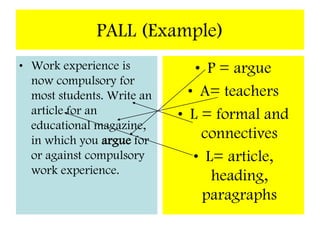
PALL (Example)Work experience is now compulsory for most students. Write an article for an educational magazine, in which you argue for or against compulsory work experience.P = argue  A= teachers L = formal and connectives L= article, heading,  paragraphs

How To Write Arguementative Writing

  • 1.
  • 2.
    At the endof this lesson, you will be able to say…I can identify when it is appropriate to use formal language
  • 3.
  • 4.
    I can usea balanced planning format to present an argument.
  • 5.
    I can givean opinion that can be presented in the conclusion of a balanced argumentWhat is Argument?Arguments are normally cleverly structured by using linked paragraphs, careful choice of language and ideas that flow and lead to a powerful conclusion.As a writer you might be asked to develop an argument and you should carefully craft your ideas to make it as powerful as possible. Looking at arguments that other writers have written can help you develop the skills needed to achieve the best grade.
  • 6.
    What is bias?Someoneis only putting forward one side of an argument.
  • 7.
    An advert, forexample, will only tell you the good things about a product, and may exaggerate those!
  • 8.
    Remember, a writermay only be telling you one side of a story, so always think about what a writer may not be telling you and don’t always believe what you read!Key skills in writing an argument Structuring ideas for the greatest impact.Making sure that your writing builds up to a powerful conclusion. No weaknesses in your argument. Always try to prove that you are right.
  • 9.
    Biased WritingThis isan account of a football match after Manchester United lost 4-0 !“Arsenal were so lucky!! The superb and skilful Man United players were beaten by the lucky, cheating Arsenal players. The referee was totally biased, he allowed four goals that were all offside. I have never seen so much luck and cheating in all my life.”How can you tell this is biased?Who was this written by? Who might they support?
  • 10.
    Unbiased WritingIn orderto be fair and unbiased toward all members of the potential audience, it is important that the author uses language that does not stereotype or unfairly categorize any group of people or individuals. Besides offending potential readers, an author who uses sexist or racist language also damages ones credibility in the eyes of the audience. Even if the use of unbiased language is a mistake, that mistake which may seem small on paper, can have much larger implications and consequences.
  • 11.
    Unbiased WritingOne ofthe more common forms of unbiased language is gender bias. For example, the sentence, “Any student interested in playing basketball should see his coach by this afternoon,”Where is the bias in the final statement?
  • 12.
    How do youwrite a balanced argument?TitleA simple statement or question to draw attention to the issue.Introduction – Paragraph 1Short opening, explaining how the issue came about. That is the thesis statement. Do not put any views of your own in this section.
  • 13.
    How do youwrite a balanced argument?Points ‘for’ – Paragraph 2Start this section with ‘Firstly’ or ‘The first reason is’. Write about your first point in favour of the argument but do not put your own point of view yet.Points ‘for’ – Paragraph 3Begin your next point with ‘Furthermore’ or ‘Indeed, it could be said that…’ but still do not give your own opinion.Points ‘for’ – Paragraph 4Use ‘Perhaps’ or ‘In addition’ to begin your final point in favour of the argument. Try to give evidence to support the point if you can.
  • 14.
    How do youwrite a balanced argument?Points ‘Against’ – Paragraph 5Begin with ‘However’ and put your first point against the argument without giving your own view.Points ‘Against’ – Paragraph 6Continue to put your points ‘against’, introducing them with formal words such as ‘Despite’, ‘On the other hand’ or ‘In contrast’. Points ‘Against’ – Paragraph 7Use ‘Finally’ to begin your last point. Still do not give your opinion.
  • 15.
    How do youwrite a balanced argument?Conclusion – Paragraph 8Begin with ‘To sum up the argument’ or ‘Above all else’ or ‘In conclusion. At last you can give your own views if you wish, and conclude either in favour of or against the issue. Or finish with a question to challenge your readers to make up their own minds!
  • 16.
    Argumentative frameworkI believethat ................................................................................ There are many reasons to support my argument and these include ................................................................................The first reason is ...................................................................... OR Firstly, ...................................................Furthermore, ................................................OR it could be said that…, ......................................................................
  • 17.
    Argumentative frameworkIn addition,.................................................. OR Perhaps ..............................................To sum up the argument, ..................................................................... OR In a nutshell, .....................................................................This is the second format of writing the essay.Difference: can put your counter-arguements in the three points.
  • 18.
    ARGUMENTS FOR ANDAGAINST WORK EXPERIENCE Sequence the arguments into a clear structure that builds up a powerful overall view. Think about the arguments that you do or don’t want to use and what order the points should be in to achieve the biggest impact on the reader.
  • 19.
    Argue for oragainst– you are not being asked to present both sides.When you have organised your ideas and included points that you have come up with have a go answering the question ARGUMENTS FOR AND AGAINST WORK EXPERIENCE
  • 20.
    Think PALL alwayswhen planningPurpose – why are you writing?Audience – who is this for? Language – what type of language should you use? – formal, informal, technical, descriptiveLayout – structure, paragraphs, look on the page PALL
  • 21.
    PALL (Example)Work experienceis now compulsory for most students. Write an article for an educational magazine, in which you argue for or against compulsory work experience.P = argue A= teachers L = formal and connectives L= article, heading, paragraphs