Writing a project/research proposal.
By
KHAEMBA STEPHEN
KYAMBOGO UNIVERSITY
B.SC. IN CHEMICAL AND PROCESS
ENGINEERING
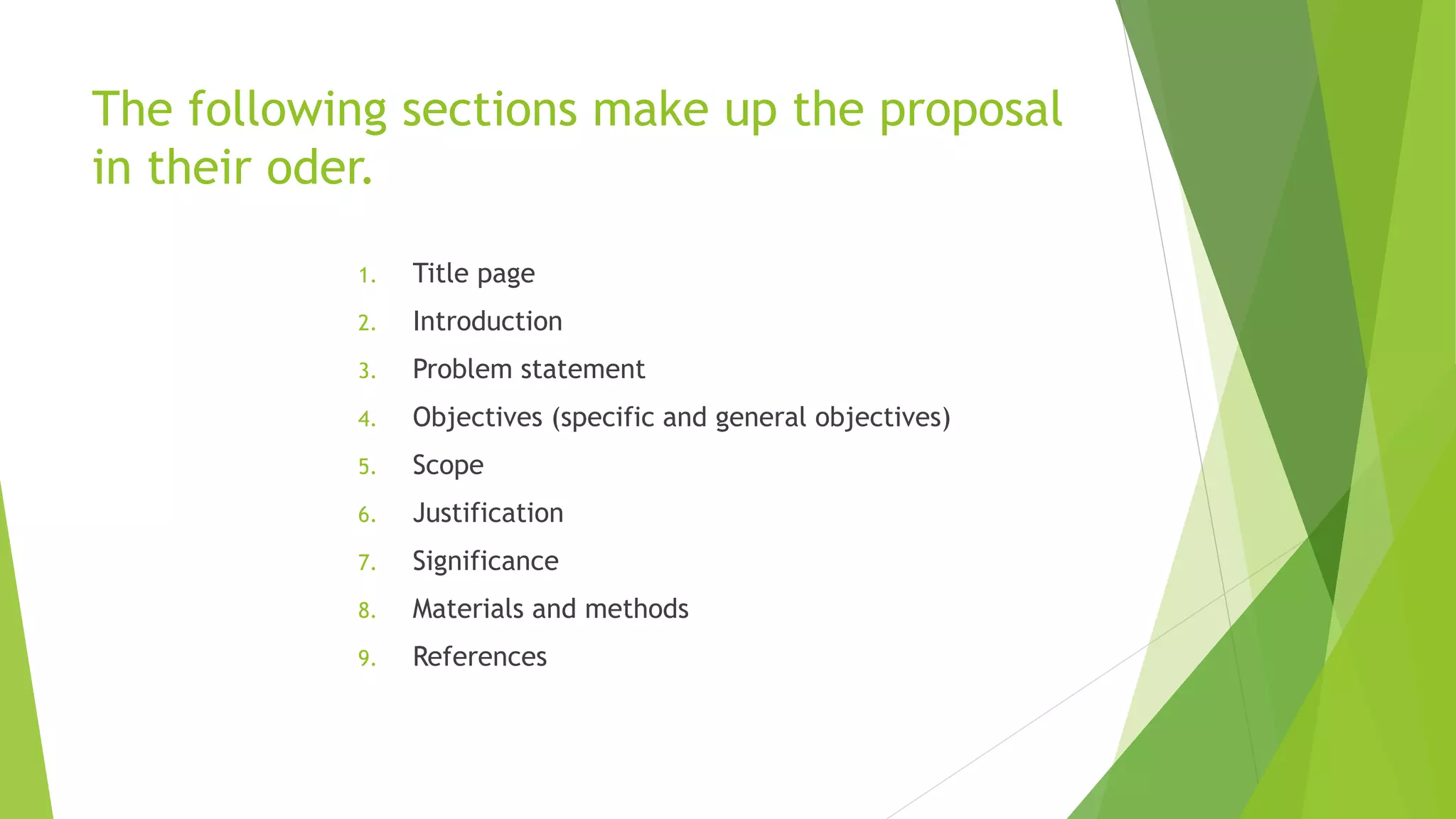
The following sections make up the proposal
in their oder.
1. Title page
2. Introduction
3. Problem statement
4. Objectives (specific and general objectives)
5. Scope
6. Justification
7. Significance
8. Materials and methods
9. References
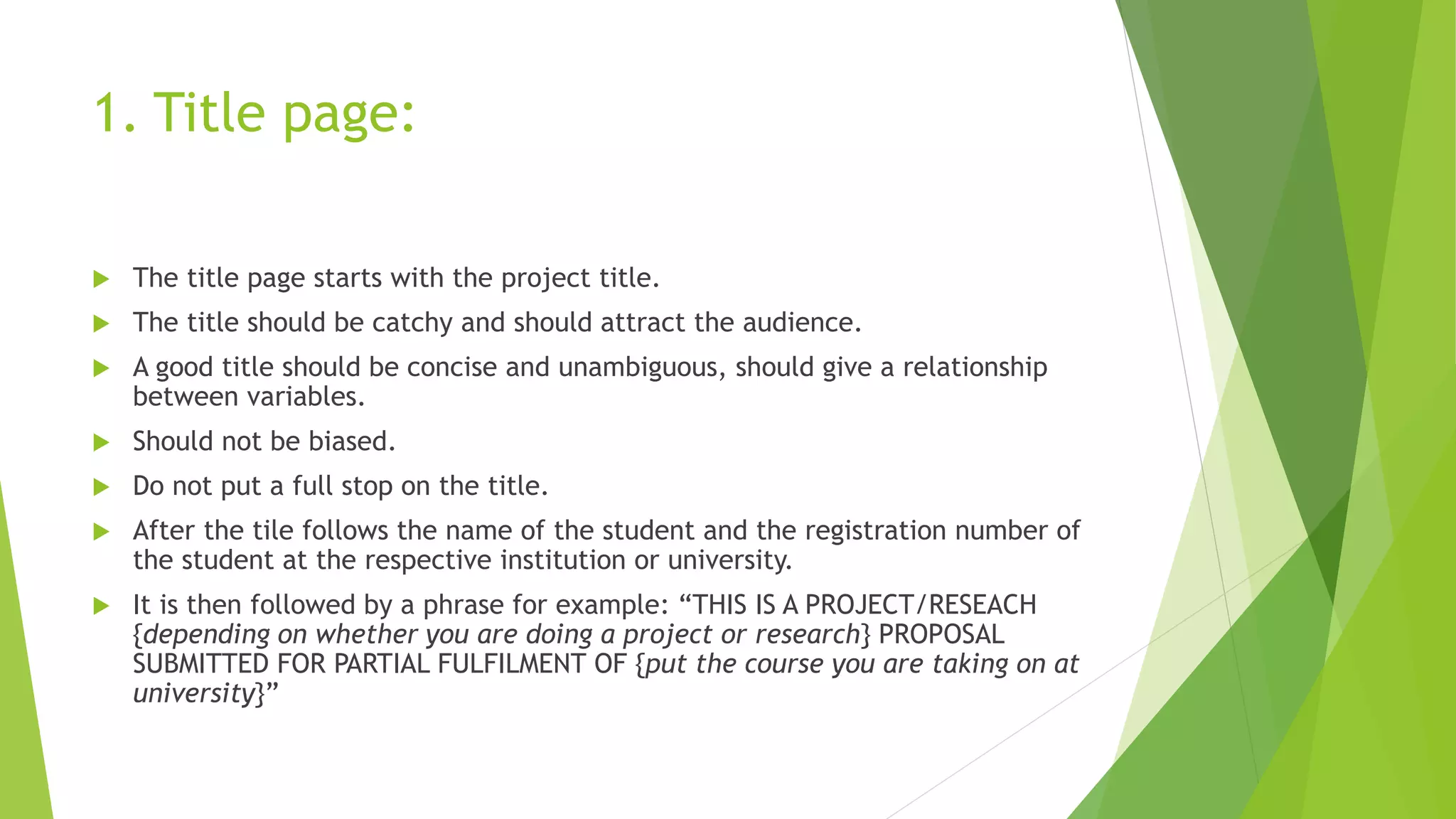
1. Title page:
 The title page starts with the project title.
 The title should be catchy and should attract the audience.
 A good title should be concise and unambiguous, should give a relationship
between variables.
 Should not be biased.
 Do not put a full stop on the title.
 After the tile follows the name of the student and the registration number of
the student at the respective institution or university.
 It is then followed by a phrase for example: “THIS IS A PROJECT/RESEACH
{depending on whether you are doing a project or research} PROPOSAL
SUBMITTED FOR PARTIAL FULFILMENT OF {put the course you are taking on at
university}”
2. Introduction:
 AN introduction is intended to provide a background to
build rapport with the reader.
3. Problem statement:
 Begin with what is there, then what is lacking and the
suggest that :
“This research proposal is intended to…” {do not bullet
your suggestion and should not put a reference here}
4. Objectives (general and specific
objectives):
 General objectives:
Include a Little phrase from the title.
All objectives must be activity oriented.
 Specific objectives:
Do not bullet specific objectives, instead number them.
There is no comparison among specific objectives.
Avoid words like Assess, evaluate, et al and instead use words like determine,
establish et al.
5. Scope:
 Scope provide the boundaries of the research. It is
important to limit the thinking of the academic
audience, for example :
 Time scope,
 Geographical scope, where the sampling and analysis
is done.
 Parameters to be used,
6. Justification:
It qualifies the approach to suit or solve
the problem. Justification focuses on the
methods and instruments and approaches
used to fulfil the objectives.
7.
SIGNIFICANCE: Social and community
oriented, the long term
and short term impacts
are checked on.
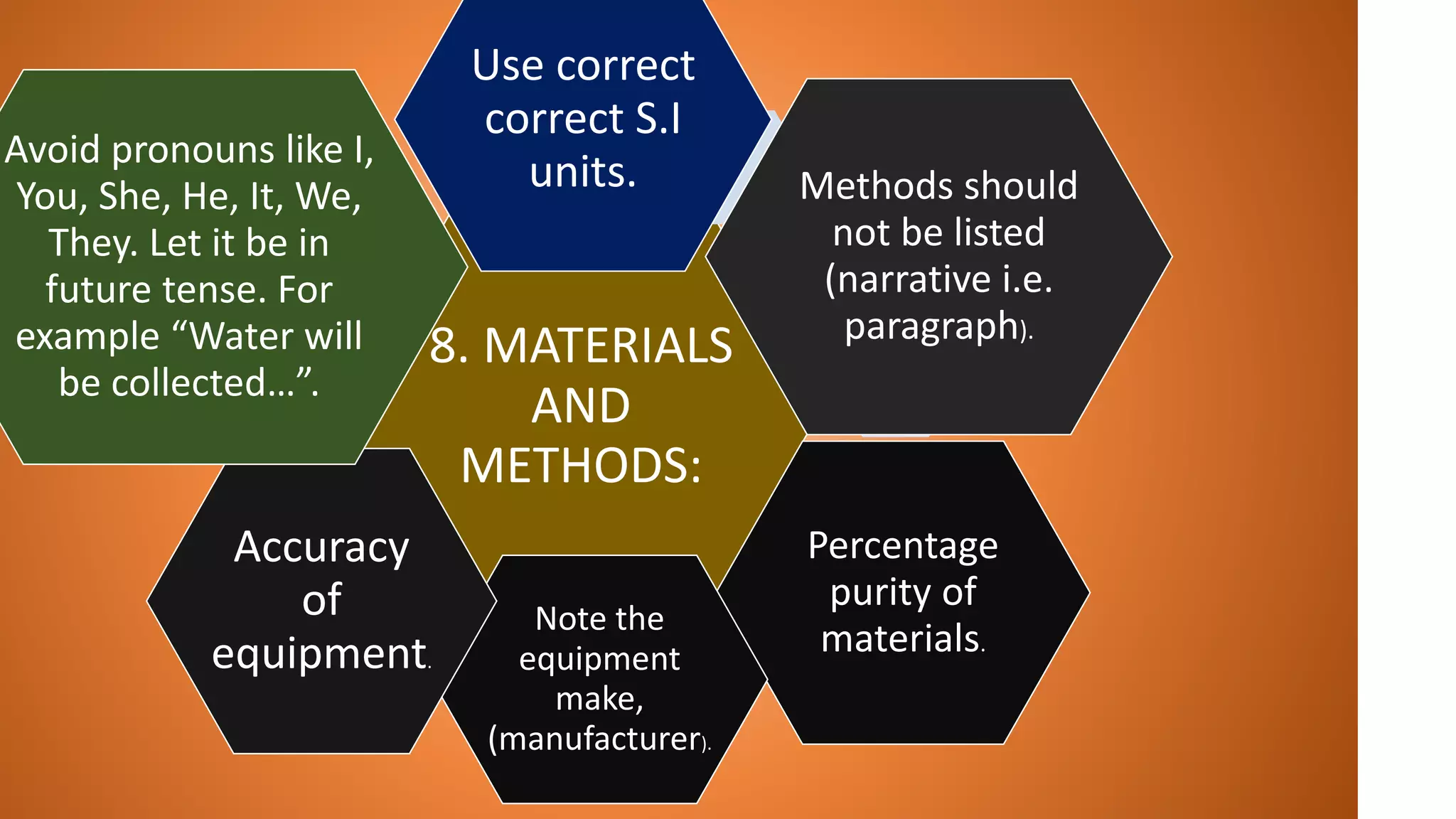
8. MATERIALS
AND
METHODS:
Use correct
correct S.I
units. Methods should
not be listed
(narrative i.e.
paragraph).
Percentage
purity of
materials.
Note the
equipment
make,
(manufacturer).
Accuracy
of
equipment.
Avoid pronouns like I,
You, She, He, It, We,
They. Let it be in
future tense. For
example “Water will
be collected…”.
Quote any books
or literature that is
helpful as far as
the project is
concerned.
9. REFERENCES:
I KNOW IT WAS A VERY HELPFUL RESOURCE.
PROJECTIN YOURSUCCESS
KHAEMBA STEPHEN
WISHES
YOU

Writing a project or research proposal

  • 1.
    Writing a project/researchproposal. By KHAEMBA STEPHEN KYAMBOGO UNIVERSITY B.SC. IN CHEMICAL AND PROCESS ENGINEERING
  • 2.
    The following sectionsmake up the proposal in their oder. 1. Title page 2. Introduction 3. Problem statement 4. Objectives (specific and general objectives) 5. Scope 6. Justification 7. Significance 8. Materials and methods 9. References
  • 3.
    1. Title page: The title page starts with the project title.  The title should be catchy and should attract the audience.  A good title should be concise and unambiguous, should give a relationship between variables.  Should not be biased.  Do not put a full stop on the title.  After the tile follows the name of the student and the registration number of the student at the respective institution or university.  It is then followed by a phrase for example: “THIS IS A PROJECT/RESEACH {depending on whether you are doing a project or research} PROPOSAL SUBMITTED FOR PARTIAL FULFILMENT OF {put the course you are taking on at university}”
  • 4.
    2. Introduction:  ANintroduction is intended to provide a background to build rapport with the reader.
  • 5.
    3. Problem statement: Begin with what is there, then what is lacking and the suggest that : “This research proposal is intended to…” {do not bullet your suggestion and should not put a reference here}
  • 6.
    4. Objectives (generaland specific objectives):  General objectives: Include a Little phrase from the title. All objectives must be activity oriented.  Specific objectives: Do not bullet specific objectives, instead number them. There is no comparison among specific objectives. Avoid words like Assess, evaluate, et al and instead use words like determine, establish et al.
  • 7.
    5. Scope:  Scopeprovide the boundaries of the research. It is important to limit the thinking of the academic audience, for example :  Time scope,  Geographical scope, where the sampling and analysis is done.  Parameters to be used,
  • 8.
    6. Justification: It qualifiesthe approach to suit or solve the problem. Justification focuses on the methods and instruments and approaches used to fulfil the objectives.
  • 9.
    7. SIGNIFICANCE: Social andcommunity oriented, the long term and short term impacts are checked on.
  • 10.
    8. MATERIALS AND METHODS: Use correct correctS.I units. Methods should not be listed (narrative i.e. paragraph). Percentage purity of materials. Note the equipment make, (manufacturer). Accuracy of equipment. Avoid pronouns like I, You, She, He, It, We, They. Let it be in future tense. For example “Water will be collected…”.
  • 11.
    Quote any books orliterature that is helpful as far as the project is concerned. 9. REFERENCES:
  • 12.
    I KNOW ITWAS A VERY HELPFUL RESOURCE. PROJECTIN YOURSUCCESS KHAEMBA STEPHEN WISHES YOU