CHAPTER –TWO
RESEARCH PROPOSAL WRITTING
aynalem21@gmail.com
1
AKSUM UNIVERSITY
MECHANICAL ENGINNNERING
DEPARTMENT
Proposal Writing
2
 Research proposal is the detailed plan of the future study.
 It is a document which sets out your ideas in an easily accessible way.
objective of writing a proposal is used to describe
 what will you do,
 why should it be done,
 how will you do it and
 what do you expect as a result.
ProposalWriting
3
 Being clear about these things from the beginning will help you
complete your research in a timely fashion.
 A weak or fuzzy proposal can lead to a long, painful and often
unsuccessful research writing exercise.
Therefore, a clean, well thought, proposal is the backbone for the
research itself.
ProposalWriting
4
 A well-thought and well-written proposal can be judged
according to three main criteria:
1. Is it full enough to answer the research question(s)?
2. Is it feasible in the particular set-up for the study?
3. Does it provide enough detail.
Components of a ResearchProposal
5
1. Title page
2. Executive Summary
3. Introduction/Background
4. Statement of the problem
5. Literature review
6. Objective/Aim of the study
7. Research methods, materials and
procedures:
8. Expected Result
9. Benefits and Beneficiaries
10. Work plan
11. Budget
12. References
1. Identifying a ResearchTopic/Title
6
Criteria for selecting a research
topic:
 Relevance/Significance
 Urgency of data needed
(timeliness)
 Feasibility of study
 Applicability of results
 Interest to the researcher
 Ethical acceptability
a good title does several things:
7
 It predicts content of the thesis.
 it catches the reader's interest.
 It Indicates content and main discoveries;
 use short and simple words
 avoid complex grammars
 make it attractive to readers!
 avoid redundancy of words
8
A good title is defined as
 the fewest possible words that describe the contents of the
study clearly.
 it is a label: it is not a sentence. should almost never contain
abbreviations.
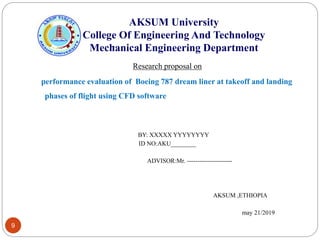
Title page
Page which contains:
Title, your name, the name of your department/institute/college
the name of your advisor(s) and date of delivery under the title.
.
9
Research proposal on
performance evaluation of Boeing 787 dream liner at takeoff and landing
phases of flight using CFD software
BY: XXXXX YYYYYYYY
ID NO:AKU________
ADVISOR:Mr. ----------------------
AKSUM ,ETHIOPIA
may 21/2019
AKSUM University
College Of Engineering And Technology
Mechanical Engineering Department
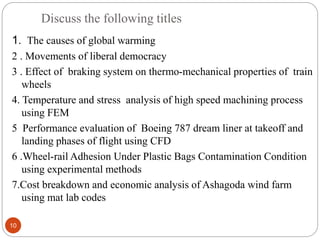
Discuss the following titles
10
1. The causes of global warming
2 . Movements of liberal democracy
3 . Effect of braking system on thermo-mechanical properties of train
wheels
4. Temperature and stress analysis of high speed machining process
using FEM
5 Performance evaluation of Boeing 787 dream liner at takeoff and
landing phases of flight using CFD
6 .Wheel-rail Adhesion Under Plastic Bags Contamination Condition
using experimental methods
7.Cost breakdown and economic analysis of Ashagoda wind farm
using mat lab codes
Executive Summary
11
 The executive summary is a one page brief summary of your
proposal.
 It needs to show a reasonably informed reader why a particular
topic is important to address and how you will do it.
 it needs to show how your work fits into a topic and what new
contribution your work will make for the society.
ExecutiveSummary
12
Generally it addresses the following points:
 Specify the question that your research will answer
 Establish why could it be a significant question;
 Show how are you going to answer the question.
 Do not put references, figures, or tables in the executive
Introduction/background
13
 The introduction provides readers with the background information for
the research proposal.
 Its purpose is to establish a framework for the research, so that readers
can understand how it is related to other research's.
 This is a statement to motivate your reader to read the rest of the
proposal, is it an important/interesting scientific problem that your
study either solves or addresses.
14
The introduction should cite
1. those who had the idea or ideas first, and
2. those who have done the most recent and relevant work.
You should then go on to explain why more work is necessary (your
work, of course.)
Introduction/background
15
 The introduction also should address the following points:
◦ Sufficient background information
◦ Proper acknowledgement of the previous works.
◦ Explain the scope of your work.
Introduction/background
Statement of the problem
16
 A problem might be defined as the issue that exists in the
literature, theory, or practice that leads to a need for the study.
 The researcher should think on what caused the need to do the
research (problem identification).
Statementof theproblem
17
 The question that he/she should ask him/herself is:
 Are there questions answers have not been found up to the
present?
 The statement of the problem describes the context for the study
and it also identifies the general analysis approach.
Statementof theproblem
18
 Effective problem statements answer the question
why does this research need to be conducted.
 If a researcher is unable to answer the question clearly, then the
statement of the problem will come off as ambiguous and diffuse.
Literature Review
19
 The literature review asks how similar and related questions have been
answered before.
 A literature review is a description of the literature relevant to your
particular field or topics.
LiteratureReview
20
In generally literature review gives an overview of
 what has been said,
 who the key writers are,
 what are the prevailing theories and hypotheses,
 what questions are being asked, and
 what methods and methodologies are appropriate and used.
Objective/Aimof the Study
21
 An objective may be thought of as either
 a solution to the problem or a step along the way toward achieving a
solution;
 an end state to be achieved in relation to the problem.
 The objectives of a research project summaries what is to be achieved by the
study.
Objective/Aimof theStudy
22
 Objective should be:
 simple (not complex)
 specific (not vague)
 stated in advance manner
Objective/Aimof the Study
23
Commonly, research objectives are classified into general objectives and
specific objectives.
The specific objectives are commonly considered as smaller portions of
the general objectives.
General objective
 What will be exactly studied?
 General statements specifying the desired outcomes of the
proposed project
Objective/Aimof the Study
24
 Specific objective
 It identifies in greater detail the specific aims of
research project,
It systematically address the various aspects of
problem to achieve the main objective.
Methods, Materialand Procedures
25
 The proposal should describe in detail the general research
plan. (may not necessarily be true for all types of research)
 Description of study area
 Description of study design
 Description of study participants
 Eligibility criteria ( if any)
 Determination of sample size (if any)
 Description of selection process (sampling method)
 Methods of data collection
Work plan/Activities
26
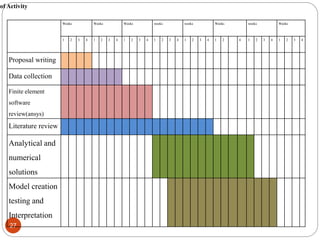
 Work plan is a schedule, chart or graph that summarizes the different
components of a research proposal and how they will be implemented in a
coherent way within a specific time-span.
 It may include:
 The tasks to be performed;
 When and where the tasks will be performed;
 Who will perform the tasks and the time each person will spend on
them;
 It describes the plan of assessing the ongoing progress toward achieving
the research objectives;
27
Weeks Weeks Weeks weeks weeks Weeks weeks Weeks
1 2 3 4 1 2 3 4 1 2 3 4 1 2 3 4 1 2 3 4 1 2 4 1 2 3 4 1 2 3 4
Proposal writing
Data collection
Finite element
software
review(ansys)
Literature review
Analytical and
numerical
solutions
Model creation
testing and
Interpretation
of Activity
Budget and Funding
28
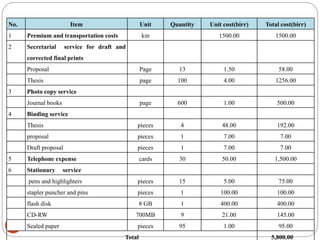
 It is the total cost required for accomplishing the project or
thesis.
 Cost for every budget item should be quantitatively shown.
 Their might be a need for budget justification of certain costs
whose requirement is not obvious
 15% contingency.
29
No. Item Unit Quantity Unit cost(birr) Total cost(birr)
1 Premium and transportation costs km 1500.00 1500.00
2 Secretarial service for draft and
corrected final prints
Proposal Page 13 1.50 58.00
Thesis page 100 4.00 1256.00
3 Photo copy service
Journal books page 600 1.00 500.00
4 Binding service
Thesis pieces 4 48.00 192.00
proposal pieces 1 7.00 7.00
Draft proposal pieces 1 7.00 7.00
5 Telephone expense cards 30 50.00 1,500.00
6 Stationary service
pens and highlighters pieces 15 5.00 75.00
stapler puncher and pins pieces 1 100.00 100.00
flash disk 8 GB 1 400.00 400.00
CD-RW 700MB 9 21.00 145.00
Sealed paper pieces 95 1.00 95.00
Total 5,800.00
References
30
 You must give references to all the information that you obtain
from books, papers in journals, and other sources.
 References may be made in the using index numbers in
brackets(Vancouver style) or authors name.
 The exact format applicable to your particular area of study will
be left for you to find out.
References
31
For a Journal paper give:
 the names of the authors,
 the year of publication,
 the title of the paper,
 the title of the journal,
 the volume number of the journal,
 the first and last page numbers of the paper.
References
32
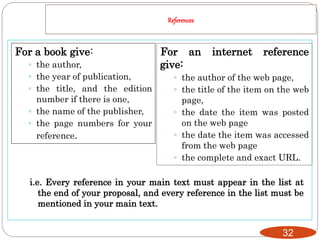
For a book give:
◦ the author,
◦ the year of publication,
◦ the title, and the edition
number if there is one,
◦ the name of the publisher,
◦ the page numbers for your
reference.
i.e. Every reference in your main text must appear in the list at
the end of your proposal, and every reference in the list must be
mentioned in your main text.
For an internet reference
give:
◦ the author of the web page,
◦ the title of the item on the web
page,
◦ the date the item was posted
on the web page
◦ the date the item was accessed
from the web page
◦ the complete and exact URL.
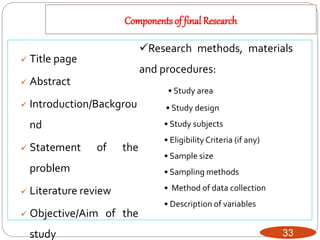
Components of final Research
33
 Title page
 Abstract
 Introduction/Backgrou
nd
 Statement of the
problem
 Literature review
 Objective/Aim of the
study
Research methods, materials
and procedures:
• Study area
• Study design
• Study subjects
• EligibilityCriteria (if any)
• Sample size
• Sampling methods
• Method of data collection
• Description of variables
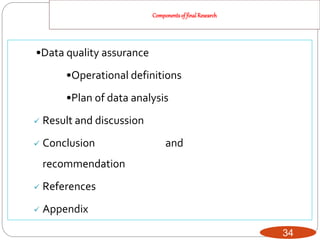
Componentsof finalResearch
34
•Data quality assurance
•Operational definitions
•Plan of data analysis
 Result and discussion
 Conclusion and
recommendation
 References
 Appendix

research proposal writting chapter 2

  • 1.
    CHAPTER –TWO RESEARCH PROPOSALWRITTING aynalem21@gmail.com 1 AKSUM UNIVERSITY MECHANICAL ENGINNNERING DEPARTMENT
  • 2.
    Proposal Writing 2  Researchproposal is the detailed plan of the future study.  It is a document which sets out your ideas in an easily accessible way. objective of writing a proposal is used to describe  what will you do,  why should it be done,  how will you do it and  what do you expect as a result.
  • 3.
    ProposalWriting 3  Being clearabout these things from the beginning will help you complete your research in a timely fashion.  A weak or fuzzy proposal can lead to a long, painful and often unsuccessful research writing exercise. Therefore, a clean, well thought, proposal is the backbone for the research itself.
  • 4.
    ProposalWriting 4  A well-thoughtand well-written proposal can be judged according to three main criteria: 1. Is it full enough to answer the research question(s)? 2. Is it feasible in the particular set-up for the study? 3. Does it provide enough detail.
  • 5.
    Components of aResearchProposal 5 1. Title page 2. Executive Summary 3. Introduction/Background 4. Statement of the problem 5. Literature review 6. Objective/Aim of the study 7. Research methods, materials and procedures: 8. Expected Result 9. Benefits and Beneficiaries 10. Work plan 11. Budget 12. References
  • 6.
    1. Identifying aResearchTopic/Title 6 Criteria for selecting a research topic:  Relevance/Significance  Urgency of data needed (timeliness)  Feasibility of study  Applicability of results  Interest to the researcher  Ethical acceptability
  • 7.
    a good titledoes several things: 7  It predicts content of the thesis.  it catches the reader's interest.  It Indicates content and main discoveries;  use short and simple words  avoid complex grammars  make it attractive to readers!  avoid redundancy of words
  • 8.
    8 A good titleis defined as  the fewest possible words that describe the contents of the study clearly.  it is a label: it is not a sentence. should almost never contain abbreviations. Title page Page which contains: Title, your name, the name of your department/institute/college the name of your advisor(s) and date of delivery under the title.
  • 9.
    . 9 Research proposal on performanceevaluation of Boeing 787 dream liner at takeoff and landing phases of flight using CFD software BY: XXXXX YYYYYYYY ID NO:AKU________ ADVISOR:Mr. ---------------------- AKSUM ,ETHIOPIA may 21/2019 AKSUM University College Of Engineering And Technology Mechanical Engineering Department
  • 10.
    Discuss the followingtitles 10 1. The causes of global warming 2 . Movements of liberal democracy 3 . Effect of braking system on thermo-mechanical properties of train wheels 4. Temperature and stress analysis of high speed machining process using FEM 5 Performance evaluation of Boeing 787 dream liner at takeoff and landing phases of flight using CFD 6 .Wheel-rail Adhesion Under Plastic Bags Contamination Condition using experimental methods 7.Cost breakdown and economic analysis of Ashagoda wind farm using mat lab codes
  • 11.
    Executive Summary 11  Theexecutive summary is a one page brief summary of your proposal.  It needs to show a reasonably informed reader why a particular topic is important to address and how you will do it.  it needs to show how your work fits into a topic and what new contribution your work will make for the society.
  • 12.
    ExecutiveSummary 12 Generally it addressesthe following points:  Specify the question that your research will answer  Establish why could it be a significant question;  Show how are you going to answer the question.  Do not put references, figures, or tables in the executive
  • 13.
    Introduction/background 13  The introductionprovides readers with the background information for the research proposal.  Its purpose is to establish a framework for the research, so that readers can understand how it is related to other research's.  This is a statement to motivate your reader to read the rest of the proposal, is it an important/interesting scientific problem that your study either solves or addresses.
  • 14.
    14 The introduction shouldcite 1. those who had the idea or ideas first, and 2. those who have done the most recent and relevant work. You should then go on to explain why more work is necessary (your work, of course.) Introduction/background
  • 15.
    15  The introductionalso should address the following points: ◦ Sufficient background information ◦ Proper acknowledgement of the previous works. ◦ Explain the scope of your work. Introduction/background
  • 16.
    Statement of theproblem 16  A problem might be defined as the issue that exists in the literature, theory, or practice that leads to a need for the study.  The researcher should think on what caused the need to do the research (problem identification).
  • 17.
    Statementof theproblem 17  Thequestion that he/she should ask him/herself is:  Are there questions answers have not been found up to the present?  The statement of the problem describes the context for the study and it also identifies the general analysis approach.
  • 18.
    Statementof theproblem 18  Effectiveproblem statements answer the question why does this research need to be conducted.  If a researcher is unable to answer the question clearly, then the statement of the problem will come off as ambiguous and diffuse.
  • 19.
    Literature Review 19  Theliterature review asks how similar and related questions have been answered before.  A literature review is a description of the literature relevant to your particular field or topics.
  • 20.
    LiteratureReview 20 In generally literaturereview gives an overview of  what has been said,  who the key writers are,  what are the prevailing theories and hypotheses,  what questions are being asked, and  what methods and methodologies are appropriate and used.
  • 21.
    Objective/Aimof the Study 21 An objective may be thought of as either  a solution to the problem or a step along the way toward achieving a solution;  an end state to be achieved in relation to the problem.  The objectives of a research project summaries what is to be achieved by the study.
  • 22.
    Objective/Aimof theStudy 22  Objectiveshould be:  simple (not complex)  specific (not vague)  stated in advance manner
  • 23.
    Objective/Aimof the Study 23 Commonly,research objectives are classified into general objectives and specific objectives. The specific objectives are commonly considered as smaller portions of the general objectives. General objective  What will be exactly studied?  General statements specifying the desired outcomes of the proposed project
  • 24.
    Objective/Aimof the Study 24 Specific objective  It identifies in greater detail the specific aims of research project, It systematically address the various aspects of problem to achieve the main objective.
  • 25.
    Methods, Materialand Procedures 25 The proposal should describe in detail the general research plan. (may not necessarily be true for all types of research)  Description of study area  Description of study design  Description of study participants  Eligibility criteria ( if any)  Determination of sample size (if any)  Description of selection process (sampling method)  Methods of data collection
  • 26.
    Work plan/Activities 26  Workplan is a schedule, chart or graph that summarizes the different components of a research proposal and how they will be implemented in a coherent way within a specific time-span.  It may include:  The tasks to be performed;  When and where the tasks will be performed;  Who will perform the tasks and the time each person will spend on them;  It describes the plan of assessing the ongoing progress toward achieving the research objectives;
  • 27.
    27 Weeks Weeks Weeksweeks weeks Weeks weeks Weeks 1 2 3 4 1 2 3 4 1 2 3 4 1 2 3 4 1 2 3 4 1 2 4 1 2 3 4 1 2 3 4 Proposal writing Data collection Finite element software review(ansys) Literature review Analytical and numerical solutions Model creation testing and Interpretation of Activity
  • 28.
    Budget and Funding 28 It is the total cost required for accomplishing the project or thesis.  Cost for every budget item should be quantitatively shown.  Their might be a need for budget justification of certain costs whose requirement is not obvious  15% contingency.
  • 29.
    29 No. Item UnitQuantity Unit cost(birr) Total cost(birr) 1 Premium and transportation costs km 1500.00 1500.00 2 Secretarial service for draft and corrected final prints Proposal Page 13 1.50 58.00 Thesis page 100 4.00 1256.00 3 Photo copy service Journal books page 600 1.00 500.00 4 Binding service Thesis pieces 4 48.00 192.00 proposal pieces 1 7.00 7.00 Draft proposal pieces 1 7.00 7.00 5 Telephone expense cards 30 50.00 1,500.00 6 Stationary service pens and highlighters pieces 15 5.00 75.00 stapler puncher and pins pieces 1 100.00 100.00 flash disk 8 GB 1 400.00 400.00 CD-RW 700MB 9 21.00 145.00 Sealed paper pieces 95 1.00 95.00 Total 5,800.00
  • 30.
    References 30  You mustgive references to all the information that you obtain from books, papers in journals, and other sources.  References may be made in the using index numbers in brackets(Vancouver style) or authors name.  The exact format applicable to your particular area of study will be left for you to find out.
  • 31.
    References 31 For a Journalpaper give:  the names of the authors,  the year of publication,  the title of the paper,  the title of the journal,  the volume number of the journal,  the first and last page numbers of the paper.
  • 32.
    References 32 For a bookgive: ◦ the author, ◦ the year of publication, ◦ the title, and the edition number if there is one, ◦ the name of the publisher, ◦ the page numbers for your reference. i.e. Every reference in your main text must appear in the list at the end of your proposal, and every reference in the list must be mentioned in your main text. For an internet reference give: ◦ the author of the web page, ◦ the title of the item on the web page, ◦ the date the item was posted on the web page ◦ the date the item was accessed from the web page ◦ the complete and exact URL.
  • 33.
    Components of finalResearch 33  Title page  Abstract  Introduction/Backgrou nd  Statement of the problem  Literature review  Objective/Aim of the study Research methods, materials and procedures: • Study area • Study design • Study subjects • EligibilityCriteria (if any) • Sample size • Sampling methods • Method of data collection • Description of variables
  • 34.
    Componentsof finalResearch 34 •Data qualityassurance •Operational definitions •Plan of data analysis  Result and discussion  Conclusion and recommendation  References  Appendix