Approaching your literature review 
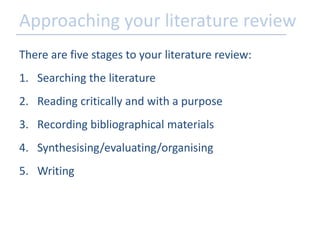
There are five stages to your literature review: 
1. Searching the literature 
2. Reading critically and with a purpose 
3. Recording bibliographical materials 
4. Synthesising/evaluating/organising 
5. Writing
1. Literature search 
The literature search will help you identify scope and key 
issues. Efficient searching will help you: 
 Identify which authors are interested in your specialism 
and those who take a generalist’s view. 
 Trace authors who are prominent in your subject and 
who can help you justify the importance of your research 
idea. 
 Include the authors would or could contradict your ideas. 
Read the easier articles first. Difficult or badly written 
articles will probably be easier to understand if you read 
them last when you have gained familiarity with your 
subject.
Scan the text first 
For the preliminary scan, don’t read the articles closely so 
as to avoid getting mired in detail. 
It may help to note down the key points for each article. 
When reading you should keep the following in mind: 
 What are the authors’ academic reputation? 
 Identify the research question and the specific 
hypotheses, the findings and how the findings were 
interpreted. 
 Are the authors objective or does their work appear to 
have a particular bias? 
Is contrary data considered and discussed or is it ignored?
2. Reading critically and with purpose 
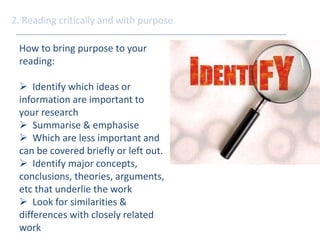
How to bring purpose to your 
reading: 
 Identify which ideas or 
information are important to 
your research 
 Summarise & emphasise 
 Which are less important and 
can be covered briefly or left out. 
 Identify major concepts, 
conclusions, theories, arguments, 
etc that underlie the work 
 Look for similarities & 
differences with closely related 
work
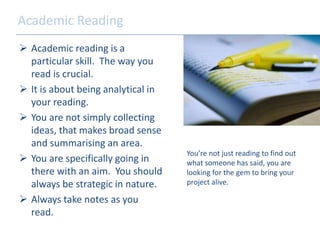
Academic Reading 
 Academic reading is a 
particular skill. The way you 
read is crucial. 
 It is about being analytical in 
your reading. 
 You are not simply collecting 
ideas, that makes broad sense 
and summarising an area. 
 You are specifically going in 
there with an aim. You should 
always be strategic in nature. 
 Always take notes as you 
read. 
You’re not just reading to find out 
what someone has said, you are 
looking for the gem to bring your 
project alive.
3. Recording bibliographical details 
This is very important! It is very annoying to look back 
over notes and want to reference something but not be 
able to remember where it came from… 
It can also help your reading to take note of: 
Contents pages 
Key points from an introduction 
Indexes
Identifying an argument 
Underlying an argument are points of view or ‘positions’ 
that people aim to convey to us, their audience. 
Contributing arguments 
The overall argument
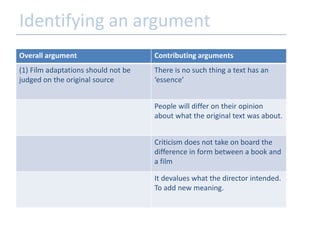
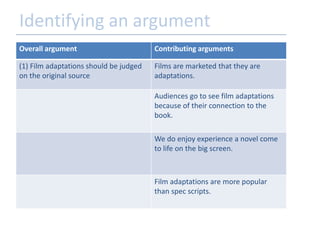
Identifying an argument 
Overall argument Contributing arguments 
(1) Film adaptations should not be 
judged on the original source 
There is no such thing a text has an 
‘essence’ 
People will differ on their opinion 
about what the original text was about. 
Criticism does not take on board the 
difference in form between a book and 
a film 
It devalues what the director intended. 
To add new meaning.
Identifying an argument 
Overall argument Contributing arguments 
(1) Film adaptations should be judged 
on the original source 
Films are marketed that they are 
adaptations. 
Audiences go to see film adaptations 
because of their connection to the 
book. 
We do enjoy experience a novel come 
to life on the big screen. 
Film adaptations are more popular 
than spec scripts.
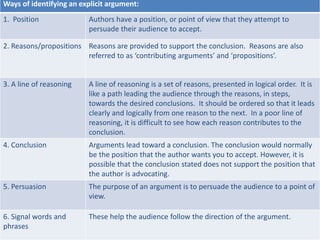
Ways of identifying an explicit argument: 
1. Position Authors have a position, or point of view that they attempt to 
Is it an argument? 
persuade their audience to accept. 
2. Reasons/propositions Reasons are provided to support the conclusion. Reasons are also 
referred to as ‘contributing arguments’ and ‘propositions’. 
3. A line of reasoning A line of reasoning is a set of reasons, presented in logical order. It is 
like a path leading the audience through the reasons, in steps, 
towards the desired conclusions. It should be ordered so that it leads 
clearly and logically from one reason to the next. In a poor line of 
reasoning, it is difficult to see how each reason contributes to the 
conclusion. 
4. Conclusion Arguments lead toward a conclusion. The conclusion would normally 
be the position that the author wants you to accept. However, it is 
possible that the conclusion stated does not support the position that 
the author is advocating. 
5. Persuasion The purpose of an argument is to persuade the audience to a point of 
view. 
6. Signal words and 
phrases 
These help the audience follow the direction of the argument.
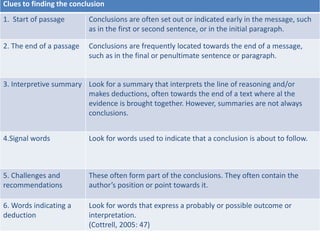
Clues to finding the conclusion 
1. Start of passage Conclusions are often set out or indicated early in the message, such 
Is it an argument? 
as in the first or second sentence, or in the initial paragraph. 
2. The end of a passage Conclusions are frequently located towards the end of a message, 
such as in the final or penultimate sentence or paragraph. 
3. Interpretive summary Look for a summary that interprets the line of reasoning and/or 
makes deductions, often towards the end of a text where al the 
evidence is brought together. However, summaries are not always 
conclusions. 
4.Signal words Look for words used to indicate that a conclusion is about to follow. 
5. Challenges and 
recommendations 
These often form part of the conclusions. They often contain the 
author’s position or point towards it. 
6. Words indicating a 
deduction 
Look for words that express a probably or possible outcome or 
interpretation. 
(Cottrell, 2005: 47)

Finding an argument

  • 1.
    Approaching your literaturereview There are five stages to your literature review: 1. Searching the literature 2. Reading critically and with a purpose 3. Recording bibliographical materials 4. Synthesising/evaluating/organising 5. Writing
  • 2.
    1. Literature search The literature search will help you identify scope and key issues. Efficient searching will help you:  Identify which authors are interested in your specialism and those who take a generalist’s view.  Trace authors who are prominent in your subject and who can help you justify the importance of your research idea.  Include the authors would or could contradict your ideas. Read the easier articles first. Difficult or badly written articles will probably be easier to understand if you read them last when you have gained familiarity with your subject.
  • 3.
    Scan the textfirst For the preliminary scan, don’t read the articles closely so as to avoid getting mired in detail. It may help to note down the key points for each article. When reading you should keep the following in mind:  What are the authors’ academic reputation?  Identify the research question and the specific hypotheses, the findings and how the findings were interpreted.  Are the authors objective or does their work appear to have a particular bias? Is contrary data considered and discussed or is it ignored?
  • 4.
    2. Reading criticallyand with purpose How to bring purpose to your reading:  Identify which ideas or information are important to your research  Summarise & emphasise  Which are less important and can be covered briefly or left out.  Identify major concepts, conclusions, theories, arguments, etc that underlie the work  Look for similarities & differences with closely related work
  • 5.
    Academic Reading Academic reading is a particular skill. The way you read is crucial.  It is about being analytical in your reading.  You are not simply collecting ideas, that makes broad sense and summarising an area.  You are specifically going in there with an aim. You should always be strategic in nature.  Always take notes as you read. You’re not just reading to find out what someone has said, you are looking for the gem to bring your project alive.
  • 6.
    3. Recording bibliographicaldetails This is very important! It is very annoying to look back over notes and want to reference something but not be able to remember where it came from… It can also help your reading to take note of: Contents pages Key points from an introduction Indexes
  • 7.
    Identifying an argument Underlying an argument are points of view or ‘positions’ that people aim to convey to us, their audience. Contributing arguments The overall argument
  • 8.
    Identifying an argument Overall argument Contributing arguments (1) Film adaptations should not be judged on the original source There is no such thing a text has an ‘essence’ People will differ on their opinion about what the original text was about. Criticism does not take on board the difference in form between a book and a film It devalues what the director intended. To add new meaning.
  • 9.
    Identifying an argument Overall argument Contributing arguments (1) Film adaptations should be judged on the original source Films are marketed that they are adaptations. Audiences go to see film adaptations because of their connection to the book. We do enjoy experience a novel come to life on the big screen. Film adaptations are more popular than spec scripts.
  • 10.
    Ways of identifyingan explicit argument: 1. Position Authors have a position, or point of view that they attempt to Is it an argument? persuade their audience to accept. 2. Reasons/propositions Reasons are provided to support the conclusion. Reasons are also referred to as ‘contributing arguments’ and ‘propositions’. 3. A line of reasoning A line of reasoning is a set of reasons, presented in logical order. It is like a path leading the audience through the reasons, in steps, towards the desired conclusions. It should be ordered so that it leads clearly and logically from one reason to the next. In a poor line of reasoning, it is difficult to see how each reason contributes to the conclusion. 4. Conclusion Arguments lead toward a conclusion. The conclusion would normally be the position that the author wants you to accept. However, it is possible that the conclusion stated does not support the position that the author is advocating. 5. Persuasion The purpose of an argument is to persuade the audience to a point of view. 6. Signal words and phrases These help the audience follow the direction of the argument.
  • 11.
    Clues to findingthe conclusion 1. Start of passage Conclusions are often set out or indicated early in the message, such Is it an argument? as in the first or second sentence, or in the initial paragraph. 2. The end of a passage Conclusions are frequently located towards the end of a message, such as in the final or penultimate sentence or paragraph. 3. Interpretive summary Look for a summary that interprets the line of reasoning and/or makes deductions, often towards the end of a text where al the evidence is brought together. However, summaries are not always conclusions. 4.Signal words Look for words used to indicate that a conclusion is about to follow. 5. Challenges and recommendations These often form part of the conclusions. They often contain the author’s position or point towards it. 6. Words indicating a deduction Look for words that express a probably or possible outcome or interpretation. (Cottrell, 2005: 47)

Editor's Notes

  • #5 Student example of student struggling to articulate what they were arguing – they were collecting stuff - they were doing loads of reading but weren’t stopping to note the jem’s of the reading.   What a good academic does is their antenna are always alert and excited and interested that creates a new angle on what it is you want to do.
  • #6 They are issues with mastering the art of reading as well as writing. Academic reading is a particular skill. The way you read is crucial. It is about being analytical in your reading. You are not simply collecting ideas, that makes broad sense and summarising an area. You are specifically going in there with an aim. You should always be strategic in nature. Student example of student struggling to articulate what they were arguing – they were collecting stuff - they were doing loads of reading but weren’t stopping to note the jem’s of the reading.   What a good academic does is their antenna are always alert and excited and interested that creates a new angle on what it is you want to do.
  • #8 When we read, watch, television, or listen to people talking, we are presented with other people’s arguments. The word ‘argument’ is used in two ways in critical thinking. Contributing arguments: Individual reasons are referred to as ‘arguments’ or ‘contributing arguments’ The overall argument is composed of arguments, or reasons. The overall argument presents the author’s position. The term ‘line of reasoning’ is used to refer to a set of reasons, or contributing arguments, structured to support the overall argument.
  • #9 When we read, watch, television, or listen to people talking, we are presented with other people’s arguments. The word ‘argument’ is used in two ways in critical thinking. Contributing arguments: Individual reasons are referred to as ‘arguments’ or ‘contributing arguments’ The overall argument is composed of arguments, or reasons. The overall argument presents the author’s position. The term ‘line of reasoning’ is used to refer to a set of reasons, or contributing arguments, structured to support the overall argument.
  • #10 When we read, watch, television, or listen to people talking, we are presented with other people’s arguments. The word ‘argument’ is used in two ways in critical thinking. Contributing arguments: Individual reasons are referred to as ‘arguments’ or ‘contributing arguments’ The overall argument is composed of arguments, or reasons. The overall argument presents the author’s position. The term ‘line of reasoning’ is used to refer to a set of reasons, or contributing arguments, structured to support the overall argument.
  • #11 Not all messages contain an argument. When we are reading or listening to a message critically, we can save time if we check for key features of an argument. Here are some items to look for in identifying an argument.
  • #12 These are short-cuts we can take to help us locate the main conclusion within a passage more quickly. These are only indicators of where to look as the author may not have chosen to use any of these methods to signal the conclusion.