How do I become a
Resident Assistant?
Carving out your Character
 Character
 Role Modeling
 Leadership and Followership
 Being a Team Player
Your values help define you as a leader
  Character                 and as a person. Character is who you
                            are and how you will act even when no
                            one is watching.
A Person of
Character Works
                           Consider the following:
Towards Being
                            ◦ Good intentions alone don’t cut it
Considerate                 ◦ You need to act
Humane                      ◦ Let your values be your guide
Aware
Reliable                    ◦ It’s the Big AND the Little things.
Active                     As an RA your character is probably under
Culturally sensitive       more scrutiny than the average student.
                           What is your character saying about you?
Team-focused
Effective
Respectful
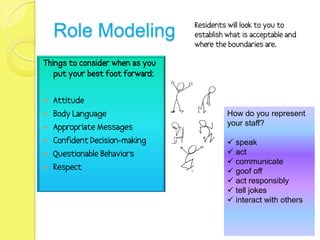
Residents will look to you to
    Role Modeling                establish what is acceptable and
                                 where the boundaries are.

Things to consider when as you
   put your best foot forward:

   Attitude
   Body Language                          How do you represent
                                           your staff?
   Appropriate Messages
   Confident Decision-making               speak
   Questionable Behaviors                  act
                                            communicate
   Respect                                 goof off
                                            act responsibly
                                            tell jokes
                                            interact with others
Leadership and Followership
  A true leader knows that it is important for others to share in leadership roles
  in order to build up new leaders for tomorrow.
                                         As RAs you don’t try to misuse or overextend your
                                         authority, your talents, or positions.
How to Diffuse Conflict
                                                               You should not be
 Set firm ground rules                                       the main attraction
 insist on civil language
                                                              Show people how
 Allow no personal attacks on                                to resolve their own
name calling                                                  conflicts rather
                                                              than doing it for
 Make your intentions &
expectation clear right from the                              them
start.
                                                              You’re there to
 Stop offending parties right
away – don’t let them drag the                                show them the way
group down
                                                          Your role involves
Praise positive behavior to send
                                                          facilitating
a clear message.
                                                          connections between
                                           “Good leaders were first great followers.” – Don
                                              Ward
                                                          people and
Being a Team Player

Develop a Team Supreme!
   Positive approach will gain respect
   Discuss strengths and weaknesses
   Create Team Traditions
   Avoid Cliques
   Open lines of Communication
   Support one Another
   Maintain a professional Attitude      Working with Supervisors!!!
                                          Get comfortable with this
   Be Polite
                                          person, even when it comes to
                                          sharing feedback. You will
                                          have a lot of personal time with
                                          your Community Coordinator.
                                          It’s okay to ask questions.
Being Yourself
 Positive Institutional Rep
 Wellness
 Priority, Organization, and Time
  Management
 Communication
Positive Institutional Rep
 Being an RA can be a 24/7 job. You serve as campus role models
 and an institutional representative. But can you still be you?


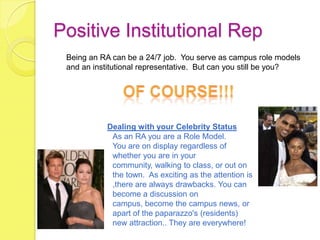
           Dealing with your Celebrity Status
            As an RA you are a Role Model.
            You are on display regardless of
            whether you are in your
            community, walking to class, or out on
            the town. As exciting as the attention is
            ,there are always drawbacks. You can
            become a discussion on
            campus, become the campus news, or
            apart of the paparazzo's (residents)
            new attraction.. They are everywhere!
Wellness
   Staying Well on and off the job
    ◦ Focus on the health of your mind, body, and spirit.
       Eating
       Sleeping
       Making time for important things
   Sleep Savvy
    ◦ What is the ideal amount of sleep you need?
       Overcompensate
       Routine
       Power Nap
   Nutritional Negligence
    ◦ What do you eat
    ◦ Skipping meals
    ◦ Water
   That Move around Magic
    ◦ Exercise
    ◦ Staying Active
   Let Your Spirit Soar
    ◦ Taking Quiet time for you
Priorities, Organization and Time
Management
                       Staying Organized
                        Separate your
Managing Priorities      Personal/Professio
                         nal Space
   Make Lists
                        Declutter
   Update Lists
   Identify Real
    Priorities
   Date List Items
   Know your Limits
Communication
    The Written Word
   Avoid the Passive
    Voice
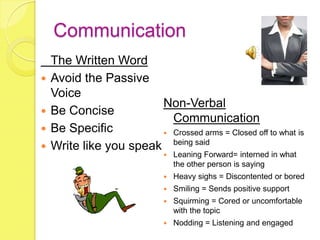
                        Non-Verbal
   Be Concise
                          Communication
   Be Specific          Crossed arms = Closed off to what is

   Write like you speak being said
                                Leaning Forward= interned in what
                                 the other person is saying
                                Heavy sighs = Discontented or bored
                                Smiling = Sends positive support
                                Squirming = Cored or uncomfortable
                                 with the topic
                                Nodding = Listening and engaged
Building Community
 Connecting with your residents
 Culture of Civility
 Programming and Event Management
Connecting with your
Residents
 Before you can plunge into the
 “deep stuff” you need to connect
 with residents on the most basic
 level.
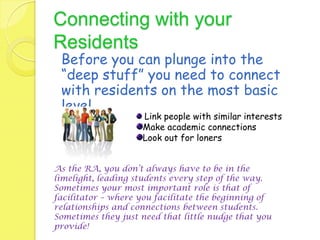
                    Link people with similar interests
                    Make academic connections
                    Look out for loners


As the RA, you don’t always have to be in the
limelight, leading students every step of the way.
Sometimes your most important role is that of
facilitator – where you facilitate the beginning of
relationships and connections between students.
Sometimes they just need that little nudge that you
provide!
Culture and Civility
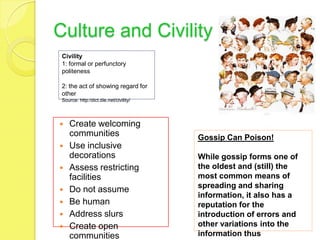
 Civility
 1: formal or perfunctory
 politeness

 2: the act of showing regard for
 other
 Source: http:/dict.die.net/civility/


   Create welcoming
    communities                         Gossip Can Poison!
   Use inclusive
    decorations                         While gossip forms one of
   Assess restricting                  the oldest and (still) the
    facilities                          most common means of
                                        spreading and sharing
   Do not assume
                                        information, it also has a
   Be human                            reputation for the
   Address slurs                       introduction of errors and
   Create open                         other variations into the
    communities                         information thus
Programming and Event
Management
                  Know your
                   Audience
                   ◦ Group Brainstorming
                   ◦ Surveys
                   ◦ Focus groups
How to get started Programming:
1. Know what your budget is
2. Format a timeline
3. Make your Publicity
4. The Small Stuff
5. Follow up
Being Inclusive
 Welcoming
 Diversity and Social Justice
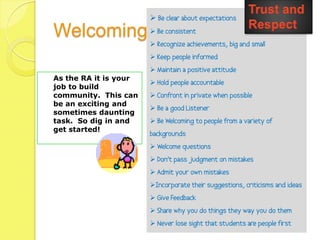
 Be clear about expectations

Welcoming               Be consistent
                        Recognize achievements, big and small
                        Keep people informed
                        Maintain a positive attitude
As the RA it is your
                        Hold people accountable
job to build
community. This can     Confront in private when possible
be an exciting and
                        Be a good Listener
sometimes daunting
task. So dig in and     Be Welcoming to people from a variety of
get started!
                       backgrounds
                        Welcome questions
                        Don’t pass judgment on mistakes
                        Admit your own mistakes
                       Incorporate their suggestions, criticisms and ideas
                        Give Feedback
                        Share why you do things they way you do them
                        Never lose sight that students are people first
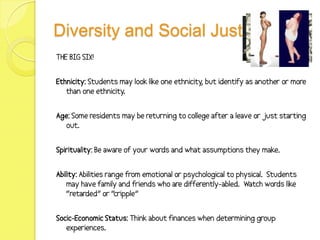
Diversity and Social Justice
THE BIG SIX!


Ethnicity: Students may look like one ethnicity but identify as another or more
                                               ,
   than one ethnicity.


Age: Some residents may be returning to college after a leave or just starting
  out.


Spirituality: Be aware of your words and what assumptions they make.


Ability: Abilities range from emotional or psychological to physical. Students
    may have family and friends who are differently-abled. Watch words like
    “retarded” or “cripple”


Socic-Economic Status: Think about finances when determining group
   experiences.
Learning from Mistakes
   It’s okay to be wrong
It’s okay to be wrong                                   “Character cannot be
                                                        developed in ease
                                                        and quiet. Only
                                                        through experience
Admitting when you’re wrong not only
                                                        of trial and suffering
  demonstrates human fallibility, it
                                                        can the soul be
  admits a willingness to hold yourself,                strengthened, ambiti
  as well as your fellow group                          on inspired, and
  members, to certain standards.                        success achieved”
                                                        - Helen Keller
 As an RA when you admit to being
  wrong it creates a more comfortable
  climate for residents and it reminds
                                           RES
  them it’s okay to take a risk.           LIFE


   “ You must never feel badly about making misstates, as long as you
   take the trouble to learn from them. For your often learn more by
   being wrong for the right reasons than you do by being right for the
   wrong reasons.”

            - Norton Juster, The Phantom Tollbooth
How do i become an ra

How do i become an ra

  • 1.
    How do Ibecome a Resident Assistant?
  • 2.
    Carving out yourCharacter  Character  Role Modeling  Leadership and Followership  Being a Team Player
  • 3.
    Your values helpdefine you as a leader Character and as a person. Character is who you are and how you will act even when no one is watching. A Person of Character Works  Consider the following: Towards Being ◦ Good intentions alone don’t cut it Considerate ◦ You need to act Humane ◦ Let your values be your guide Aware Reliable ◦ It’s the Big AND the Little things. Active As an RA your character is probably under Culturally sensitive more scrutiny than the average student. What is your character saying about you? Team-focused Effective Respectful
  • 4.
    Residents will lookto you to Role Modeling establish what is acceptable and where the boundaries are. Things to consider when as you put your best foot forward:  Attitude  Body Language How do you represent your staff?  Appropriate Messages  Confident Decision-making  speak  Questionable Behaviors  act  communicate  Respect  goof off  act responsibly  tell jokes  interact with others
  • 5.
    Leadership and Followership A true leader knows that it is important for others to share in leadership roles in order to build up new leaders for tomorrow. As RAs you don’t try to misuse or overextend your authority, your talents, or positions. How to Diffuse Conflict  You should not be  Set firm ground rules the main attraction  insist on civil language Show people how  Allow no personal attacks on to resolve their own name calling conflicts rather than doing it for  Make your intentions & expectation clear right from the them start. You’re there to  Stop offending parties right away – don’t let them drag the show them the way group down Your role involves Praise positive behavior to send facilitating a clear message. connections between “Good leaders were first great followers.” – Don Ward people and
  • 6.
    Being a TeamPlayer Develop a Team Supreme!  Positive approach will gain respect  Discuss strengths and weaknesses  Create Team Traditions  Avoid Cliques  Open lines of Communication  Support one Another  Maintain a professional Attitude Working with Supervisors!!! Get comfortable with this  Be Polite person, even when it comes to sharing feedback. You will have a lot of personal time with your Community Coordinator. It’s okay to ask questions.
  • 7.
    Being Yourself  PositiveInstitutional Rep  Wellness  Priority, Organization, and Time Management  Communication
  • 8.
    Positive Institutional Rep Being an RA can be a 24/7 job. You serve as campus role models and an institutional representative. But can you still be you? Dealing with your Celebrity Status As an RA you are a Role Model. You are on display regardless of whether you are in your community, walking to class, or out on the town. As exciting as the attention is ,there are always drawbacks. You can become a discussion on campus, become the campus news, or apart of the paparazzo's (residents) new attraction.. They are everywhere!
  • 9.
    Wellness  Staying Well on and off the job ◦ Focus on the health of your mind, body, and spirit.  Eating  Sleeping  Making time for important things  Sleep Savvy ◦ What is the ideal amount of sleep you need?  Overcompensate  Routine  Power Nap  Nutritional Negligence ◦ What do you eat ◦ Skipping meals ◦ Water  That Move around Magic ◦ Exercise ◦ Staying Active  Let Your Spirit Soar ◦ Taking Quiet time for you
  • 10.
    Priorities, Organization andTime Management Staying Organized  Separate your Managing Priorities Personal/Professio nal Space  Make Lists  Declutter  Update Lists  Identify Real Priorities  Date List Items  Know your Limits
  • 11.
    Communication The Written Word  Avoid the Passive Voice Non-Verbal  Be Concise Communication  Be Specific  Crossed arms = Closed off to what is  Write like you speak being said  Leaning Forward= interned in what the other person is saying  Heavy sighs = Discontented or bored  Smiling = Sends positive support  Squirming = Cored or uncomfortable with the topic  Nodding = Listening and engaged
  • 12.
    Building Community  Connectingwith your residents  Culture of Civility  Programming and Event Management
  • 13.
    Connecting with your Residents Before you can plunge into the “deep stuff” you need to connect with residents on the most basic level. Link people with similar interests Make academic connections Look out for loners As the RA, you don’t always have to be in the limelight, leading students every step of the way. Sometimes your most important role is that of facilitator – where you facilitate the beginning of relationships and connections between students. Sometimes they just need that little nudge that you provide!
  • 14.
    Culture and Civility Civility 1: formal or perfunctory politeness 2: the act of showing regard for other Source: http:/dict.die.net/civility/  Create welcoming communities Gossip Can Poison!  Use inclusive decorations While gossip forms one of  Assess restricting the oldest and (still) the facilities most common means of spreading and sharing  Do not assume information, it also has a  Be human reputation for the  Address slurs introduction of errors and  Create open other variations into the communities information thus
  • 15.
    Programming and Event Management  Know your Audience ◦ Group Brainstorming ◦ Surveys ◦ Focus groups How to get started Programming: 1. Know what your budget is 2. Format a timeline 3. Make your Publicity 4. The Small Stuff 5. Follow up
  • 16.
    Being Inclusive  Welcoming Diversity and Social Justice
  • 17.
     Be clearabout expectations Welcoming  Be consistent  Recognize achievements, big and small  Keep people informed  Maintain a positive attitude As the RA it is your  Hold people accountable job to build community. This can  Confront in private when possible be an exciting and  Be a good Listener sometimes daunting task. So dig in and  Be Welcoming to people from a variety of get started! backgrounds  Welcome questions  Don’t pass judgment on mistakes  Admit your own mistakes Incorporate their suggestions, criticisms and ideas  Give Feedback  Share why you do things they way you do them  Never lose sight that students are people first
  • 18.
    Diversity and SocialJustice THE BIG SIX! Ethnicity: Students may look like one ethnicity but identify as another or more , than one ethnicity. Age: Some residents may be returning to college after a leave or just starting out. Spirituality: Be aware of your words and what assumptions they make. Ability: Abilities range from emotional or psychological to physical. Students may have family and friends who are differently-abled. Watch words like “retarded” or “cripple” Socic-Economic Status: Think about finances when determining group experiences.
  • 19.
    Learning from Mistakes  It’s okay to be wrong
  • 20.
    It’s okay tobe wrong “Character cannot be developed in ease and quiet. Only through experience Admitting when you’re wrong not only of trial and suffering demonstrates human fallibility, it can the soul be admits a willingness to hold yourself, strengthened, ambiti as well as your fellow group on inspired, and members, to certain standards. success achieved” - Helen Keller As an RA when you admit to being wrong it creates a more comfortable climate for residents and it reminds RES them it’s okay to take a risk. LIFE “ You must never feel badly about making misstates, as long as you take the trouble to learn from them. For your often learn more by being wrong for the right reasons than you do by being right for the wrong reasons.” - Norton Juster, The Phantom Tollbooth