Writing 2.0: Technology-Rich
Approach to AZCCRS Writing
by Tracy Watanabe & Shauna Hamman
!
This work is licensed under a Creative Commons Attribution 4.0 International License.
Image: Web, Martin
Gommel, CC: BY, NC, SA
Today’sGoals:
TechnologyRichApproach
toAZCCRSWriting
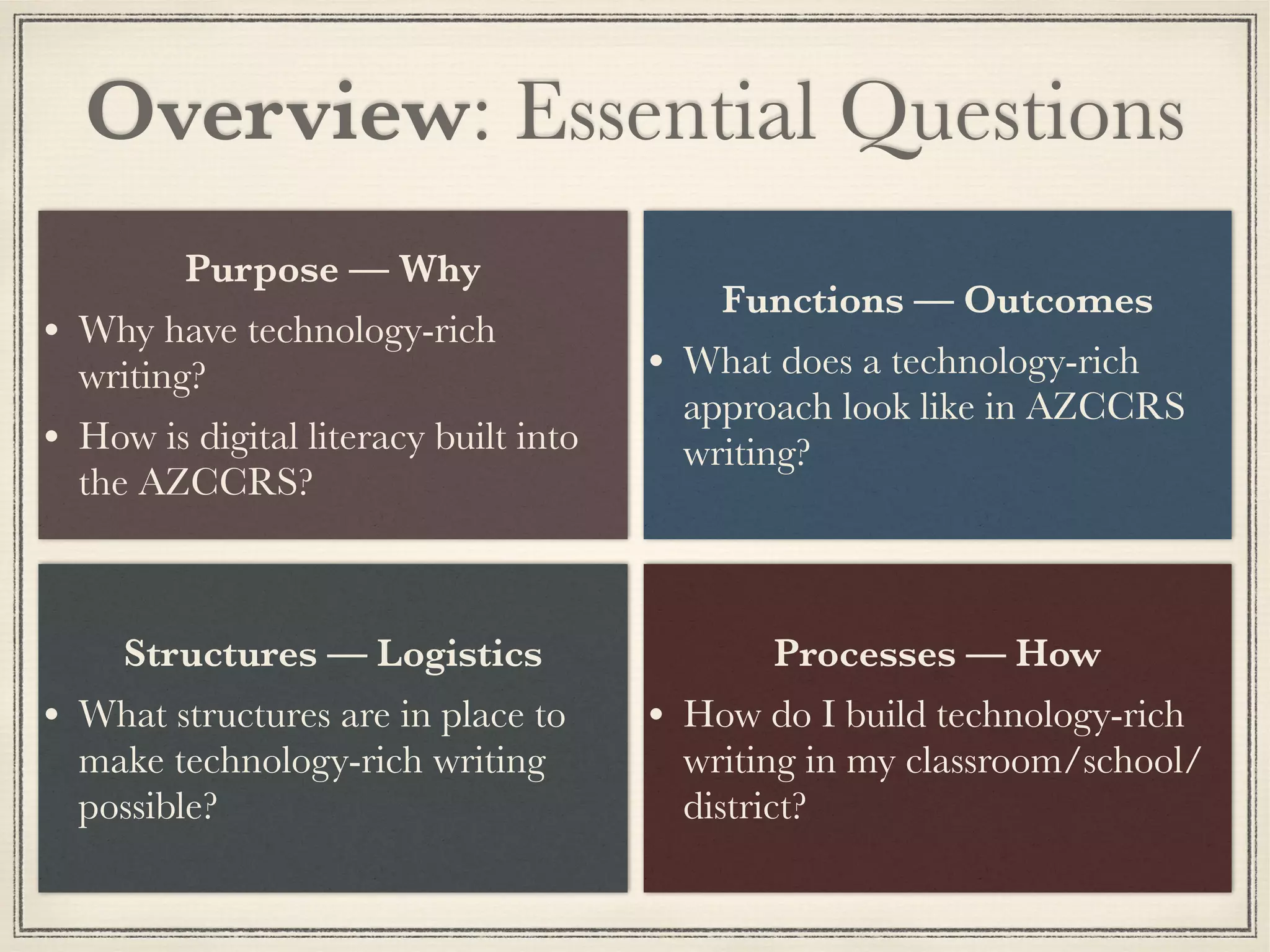
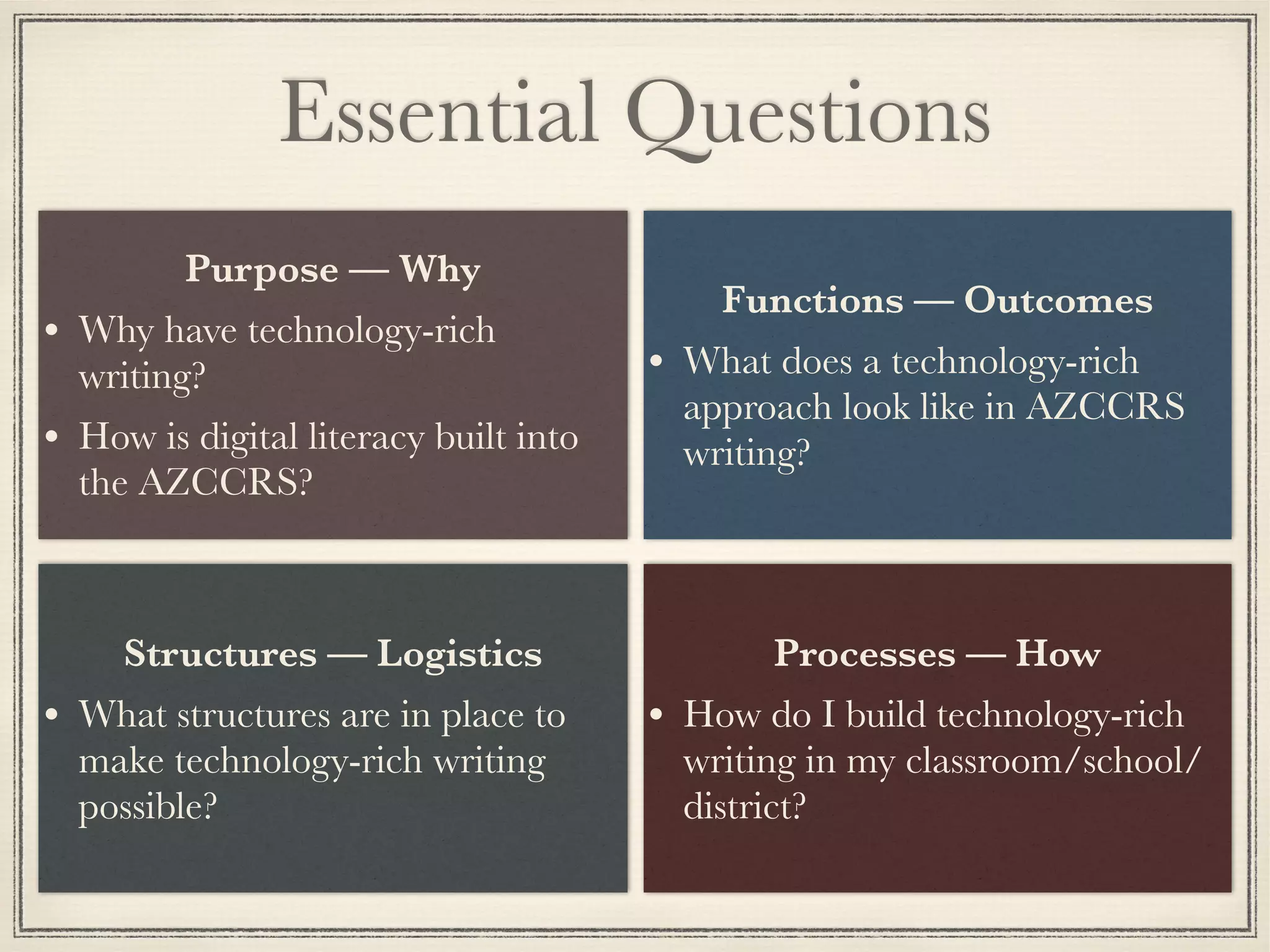
Overview: Essential Questions
Purpose — Why
• Why have technology-rich
writing?
• How is digital literacy built into
the AZCCRS?
Functions — Outcomes
• What does a technology-rich
approach look like in AZCCRS
writing?
Structures — Logistics
• What structures are in place to
make technology-rich writing
possible?
Processes — How
• How do I build technology-rich
writing in my classroom/school/
district?
What do you want to walk away with?
Image adapted from: Time To Walk Like A Rebel, Ian Sane, CC: BY
you
What skills are most desired by employers?
Image: Wikimedia Commons
What skills are most desired by employers?
Image: Wikimedia Commons
Communicate effectively
Ask insightful and critical questions.
Collaborate well with others.
Solve problems logically, systematically, and creatively.
Conduct logical, thorough research and critically
evaluate evidence.
Weigh the relevance and importance of ideas.
Recognize bias.
See multiple perspectives on an issue and empathize.
Use technologies and visual literacy to learn,
communicate, act, and produce.
Academic Conversations, p. 10. Adapted from Casner-Lotto and Barrington 2006; Hansen and Hansen 2009; National Association of Colleges and Employers 2007; Wagner 2008.
#1 skill on most lists
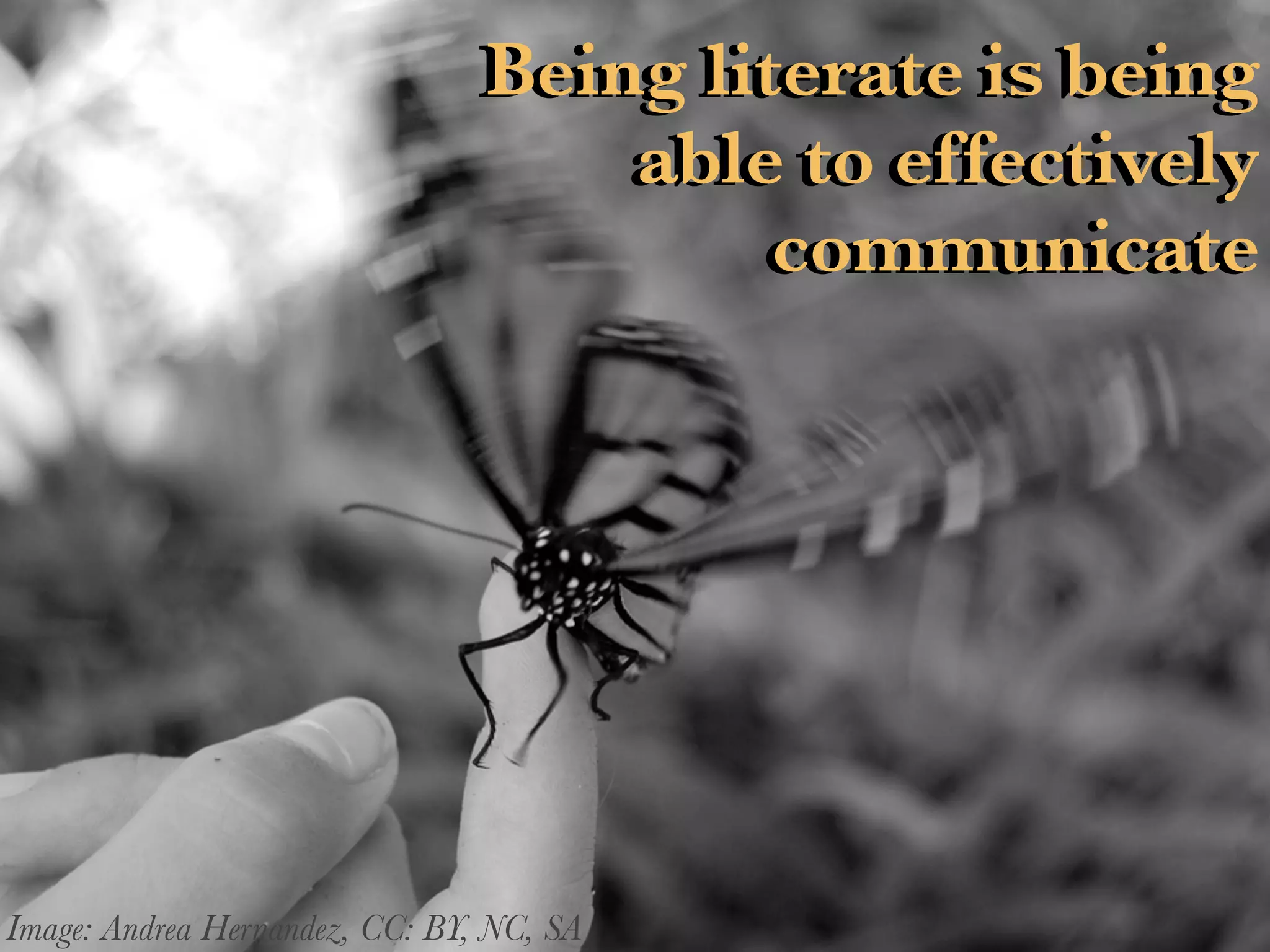
Being literate is being
able to effectively
communicate
Being literate is being
able to effectively
communicate
Image: Andrea Hernandez, CC: BY, NC, SA
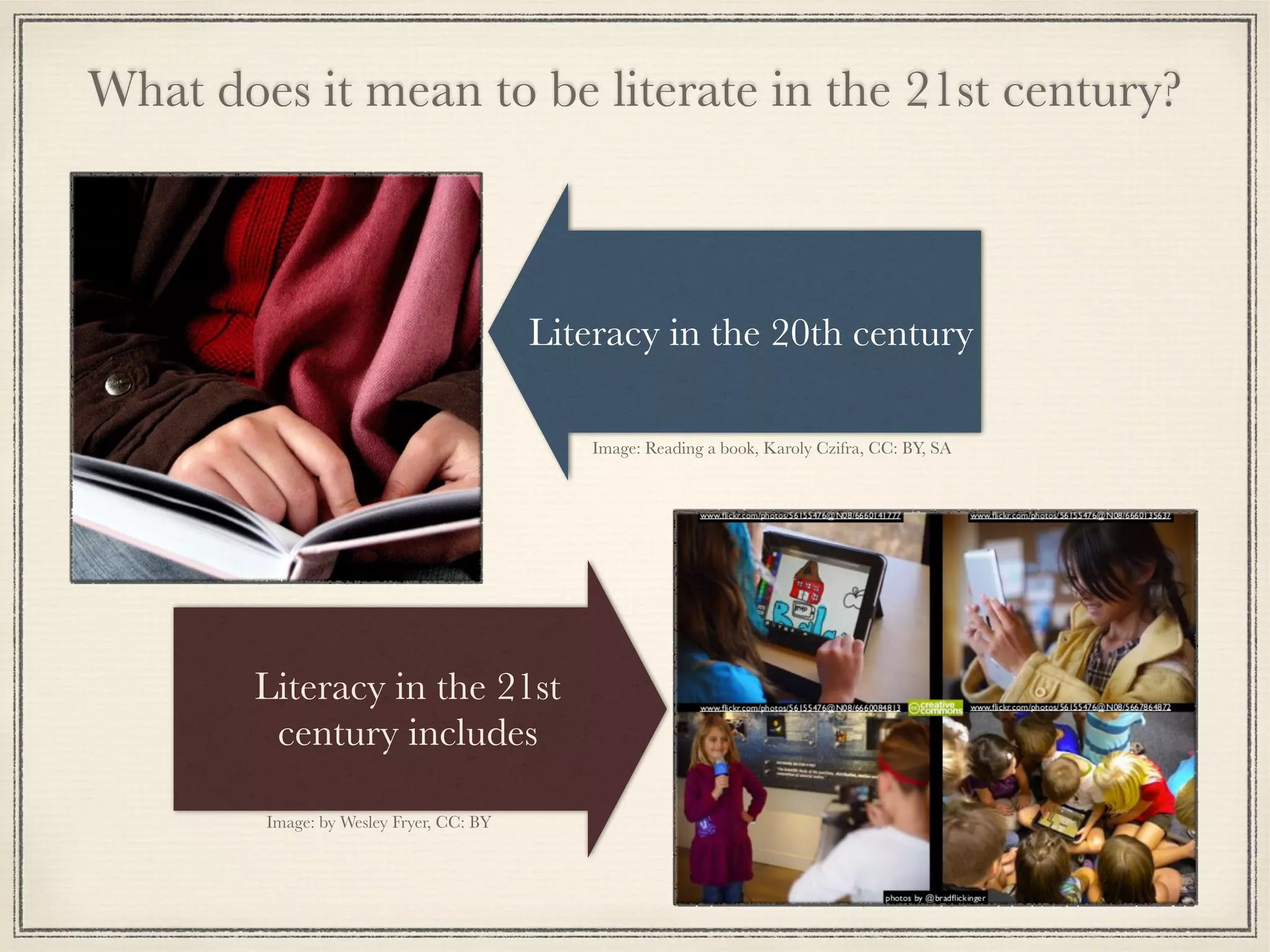
What does it mean to be literate in the 21st century?
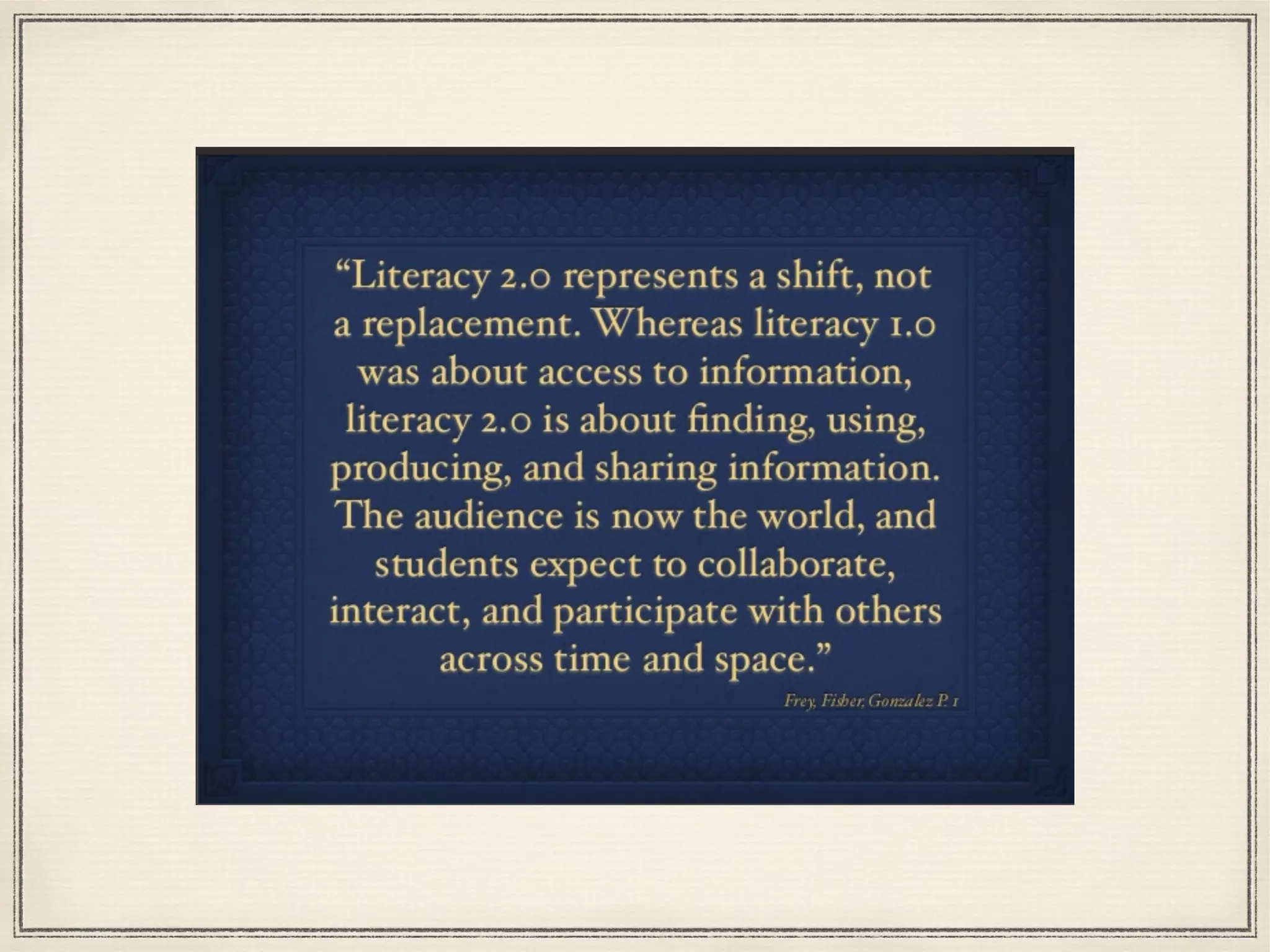
Literacy in the 21st
century includes
Literacy in the 20th century
Image: Reading a book, Karoly Czifra, CC: BY, SA
Image: by Wesley Fryer, CC: BY
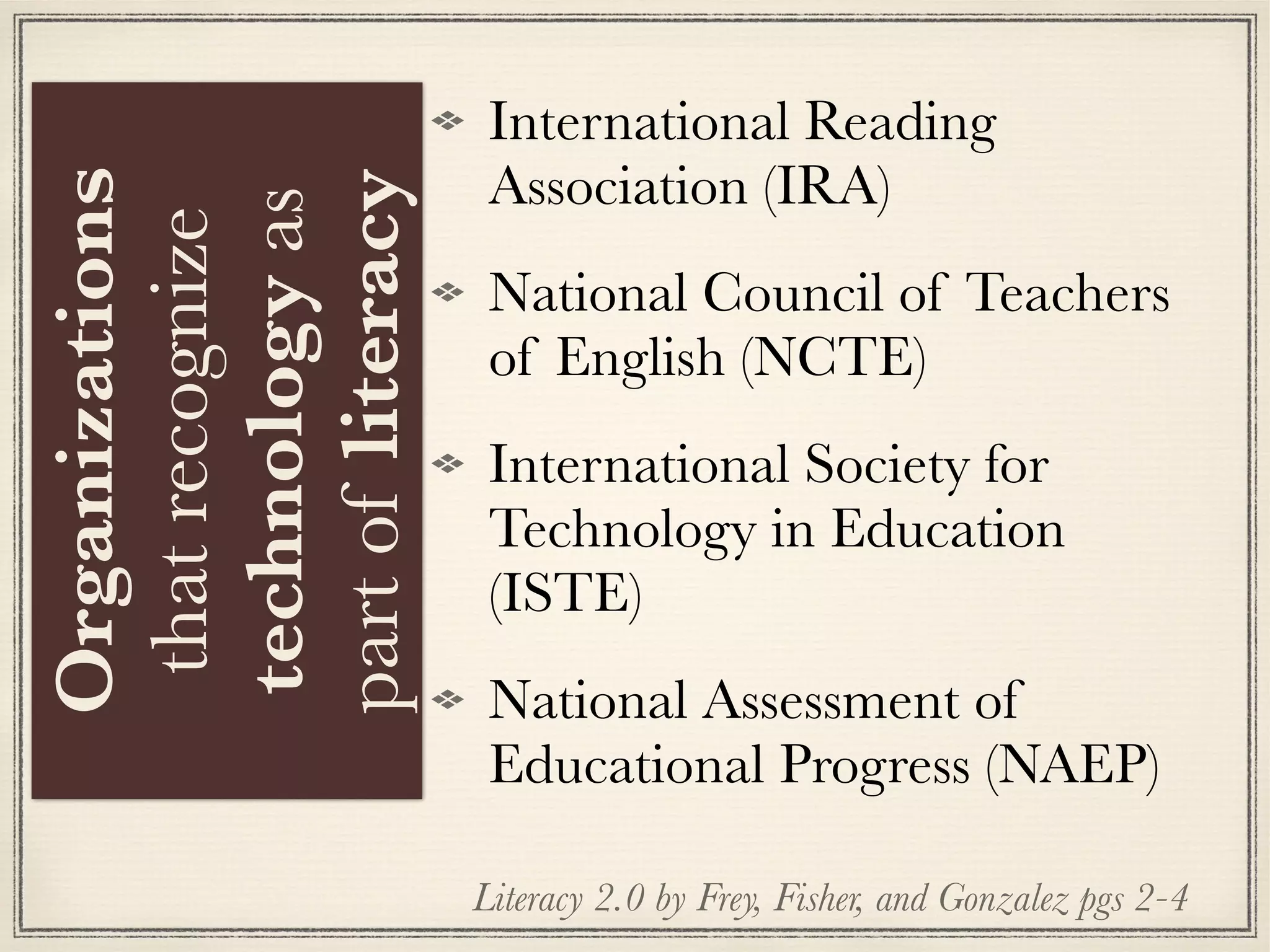
International Reading
Association (IRA)
National Council of Teachers
of English (NCTE)
International Society for
Technology in Education
(ISTE)
National Assessment of
Educational Progress (NAEP)
Literacy 2.0 by Frey, Fisher, and Gonzalez pgs 2-4
Organizations
thatrecognize
technologyas
partofliteracy
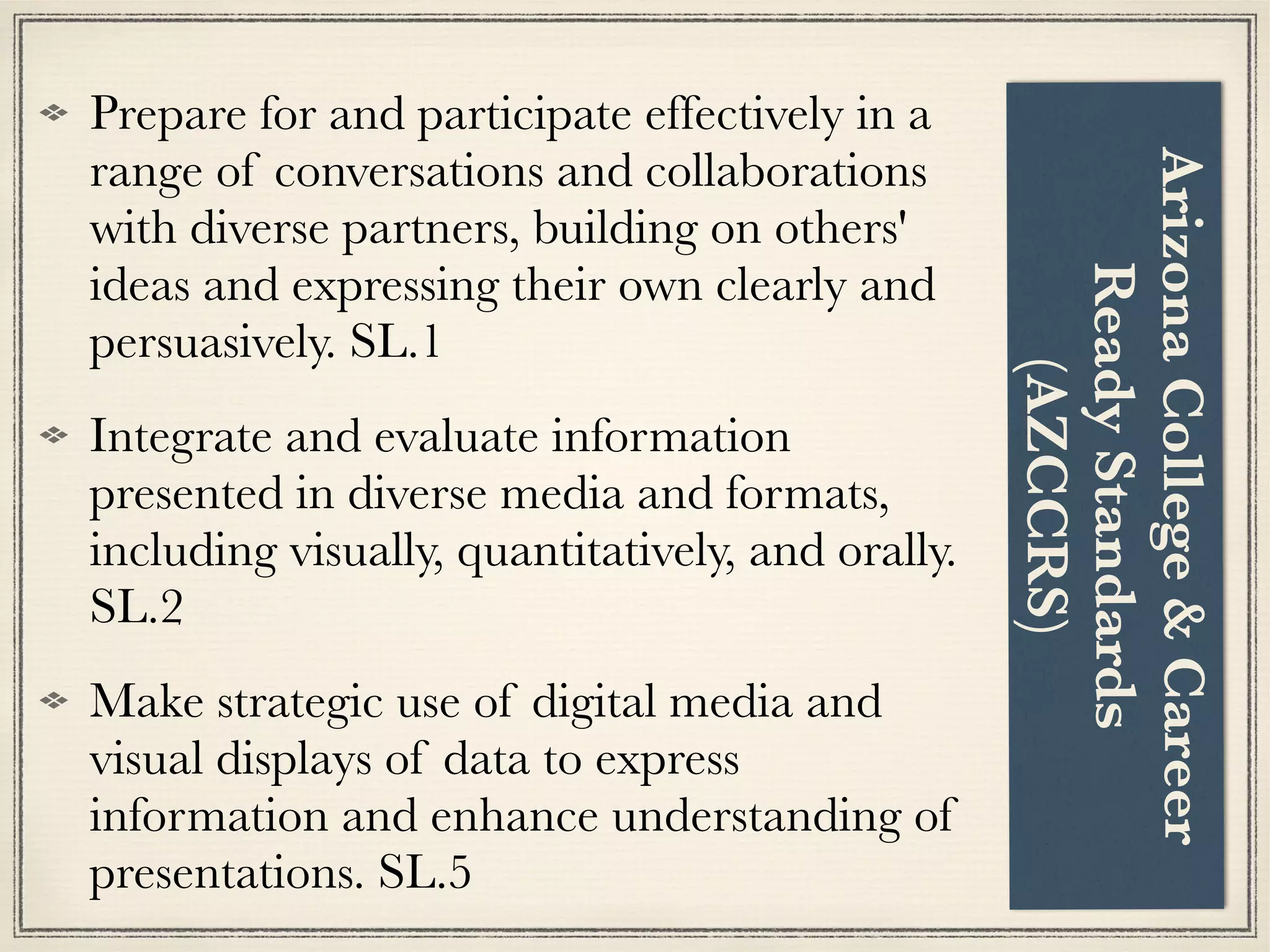
Prepare for and participate effectively in a
range of conversations and collaborations
with diverse partners, building on others'
ideas and expressing their own clearly and
persuasively. SL.1
Integrate and evaluate information
presented in diverse media and formats,
including visually, quantitatively, and orally.
SL.2
Make strategic use of digital media and
visual displays of data to express
information and enhance understanding of
presentations. SL.5
ArizonaCollege&Career
ReadyStandards
(AZCCRS)
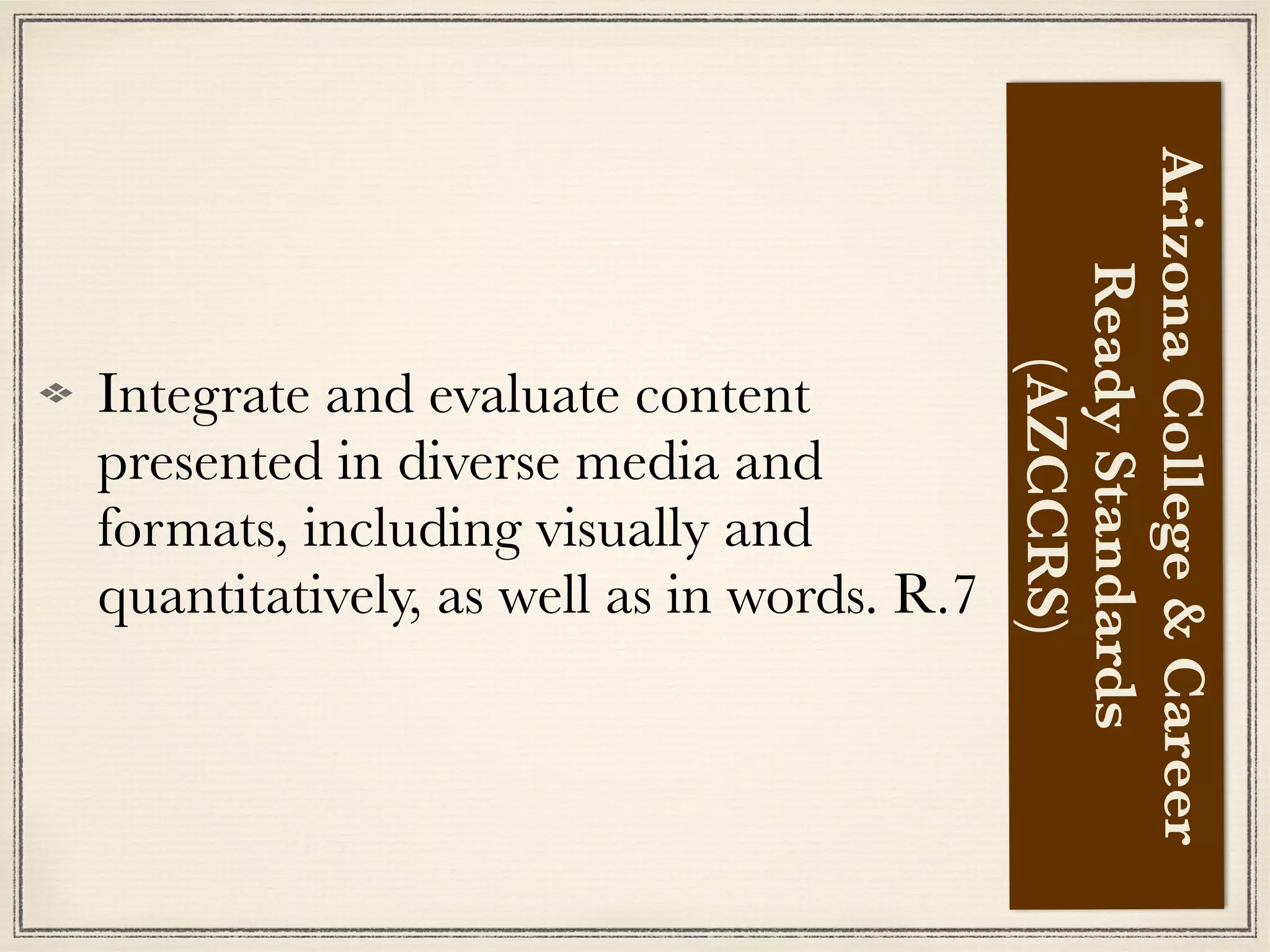
Integrate and evaluate content
presented in diverse media and
formats, including visually and
quantitatively, as well as in words. R.7
ArizonaCollege&Career
ReadyStandards
(AZCCRS)
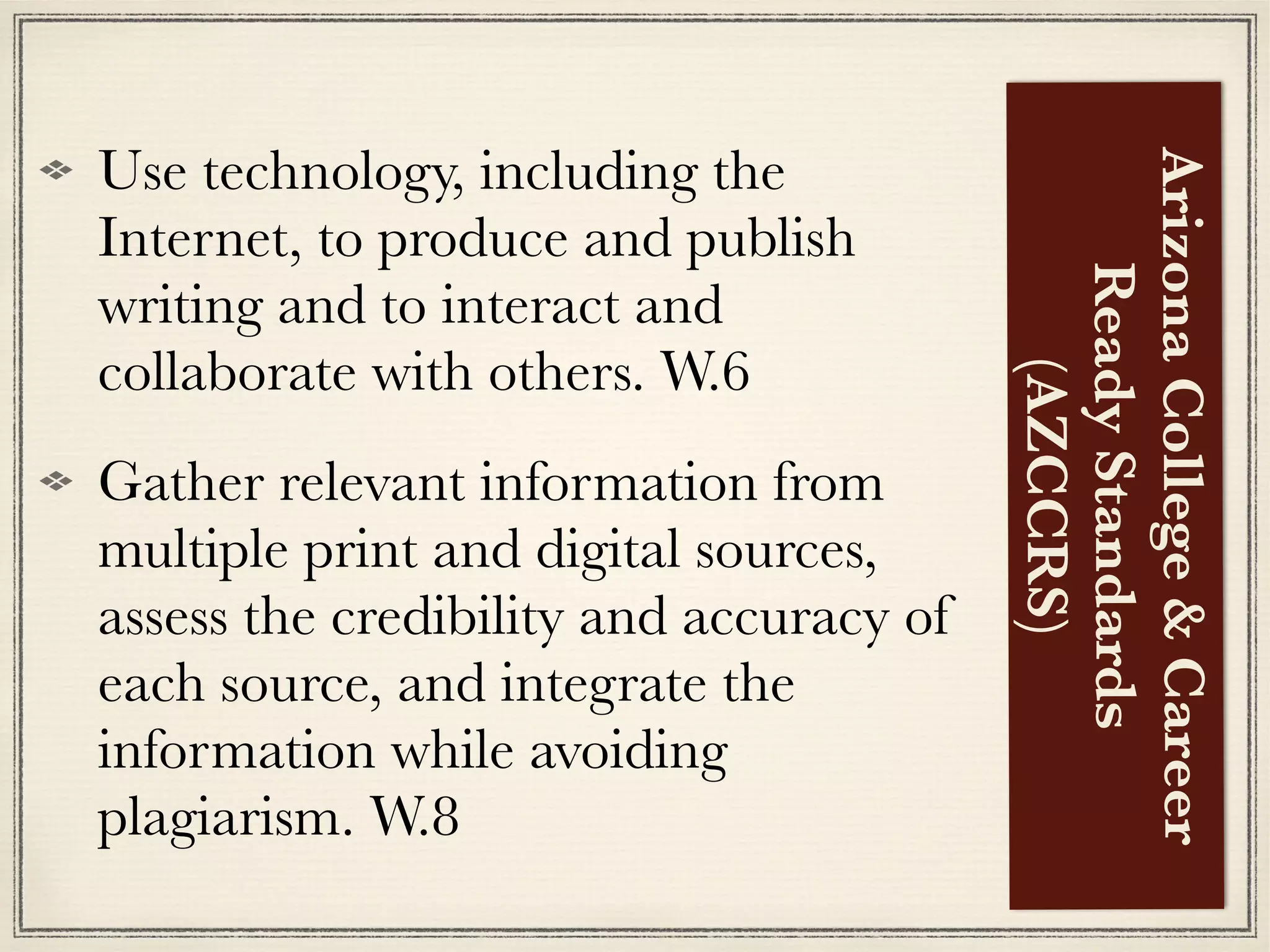
Use technology, including the
Internet, to produce and publish
writing and to interact and
collaborate with others. W.6
Gather relevant information from
multiple print and digital sources,
assess the credibility and accuracy of
each source, and integrate the
information while avoiding
plagiarism. W.8
ArizonaCollege&Career
ReadyStandards
(AZCCRS)
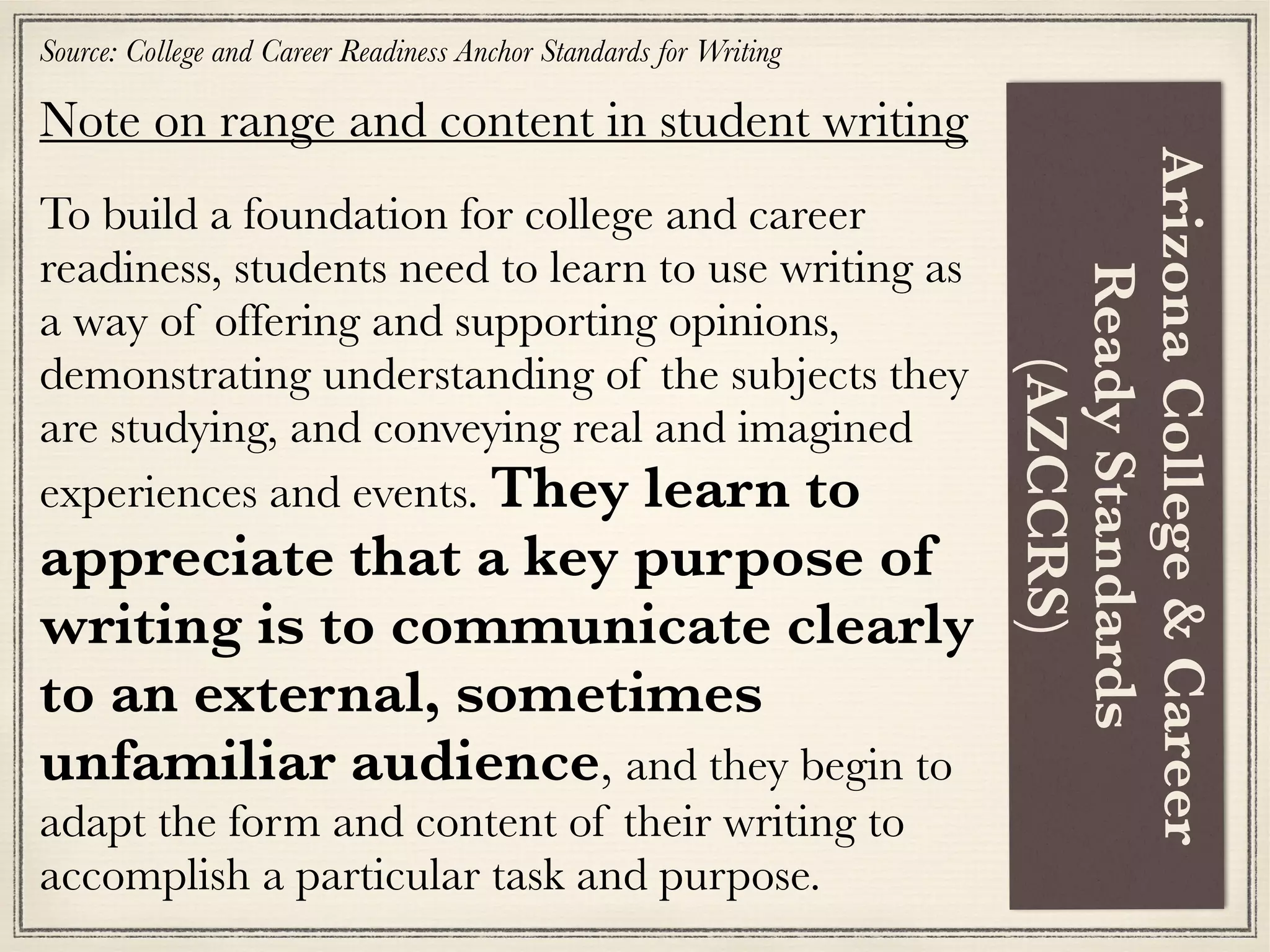
Note on range and content in student writing
To build a foundation for college and career
readiness, students need to learn to use writing as
a way of offering and supporting opinions,
demonstrating understanding of the subjects they
are studying, and conveying real and imagined
experiences and events. They learn to
appreciate that a key purpose of
writing is to communicate clearly
to an external, sometimes
unfamiliar audience, and they begin to
adapt the form and content of their writing to
accomplish a particular task and purpose.
ArizonaCollege&Career
ReadyStandards
(AZCCRS)
Source: College and Career Readiness Anchor Standards for Writing
!
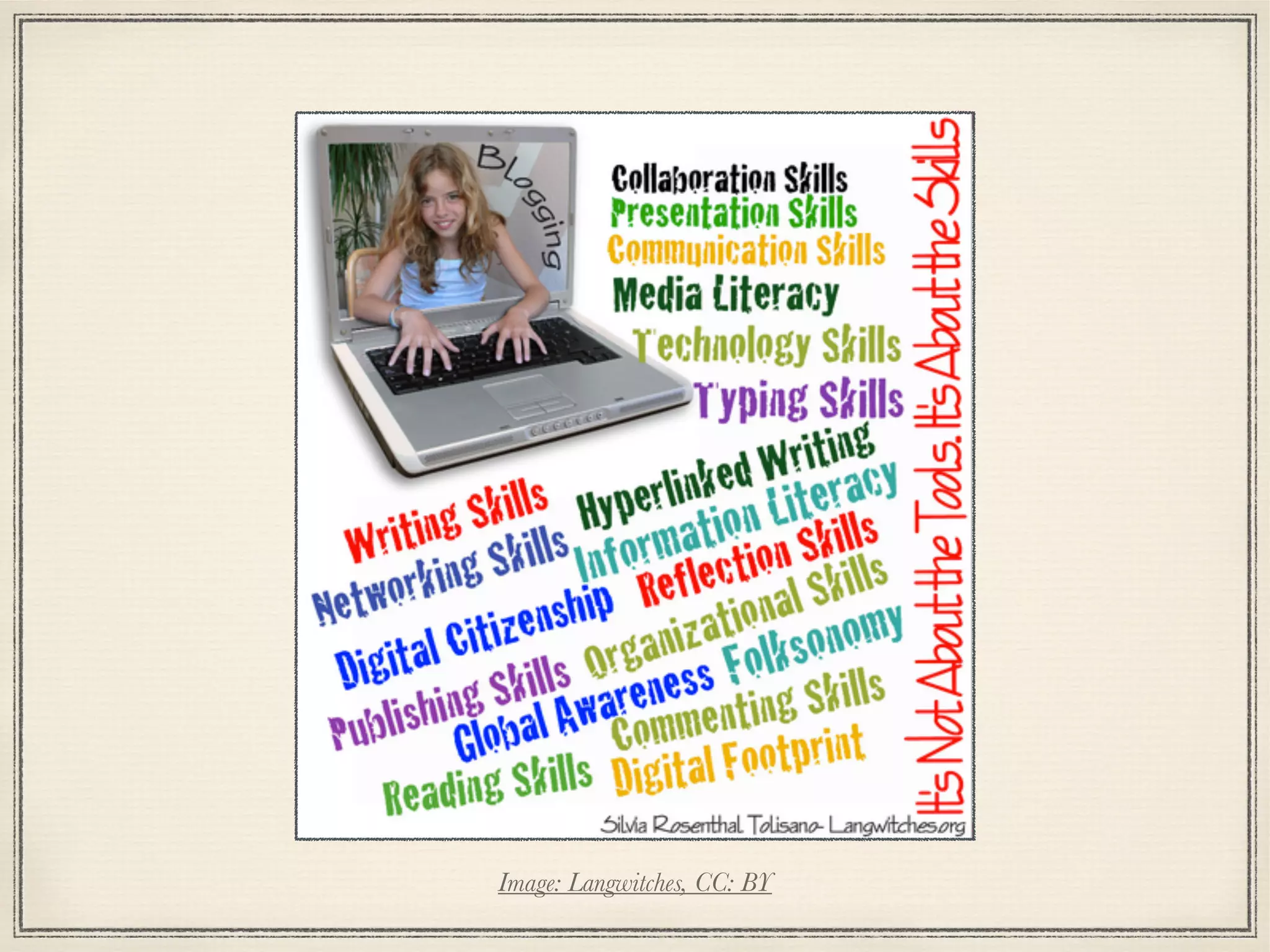
Image: Langwitches, CC: BY
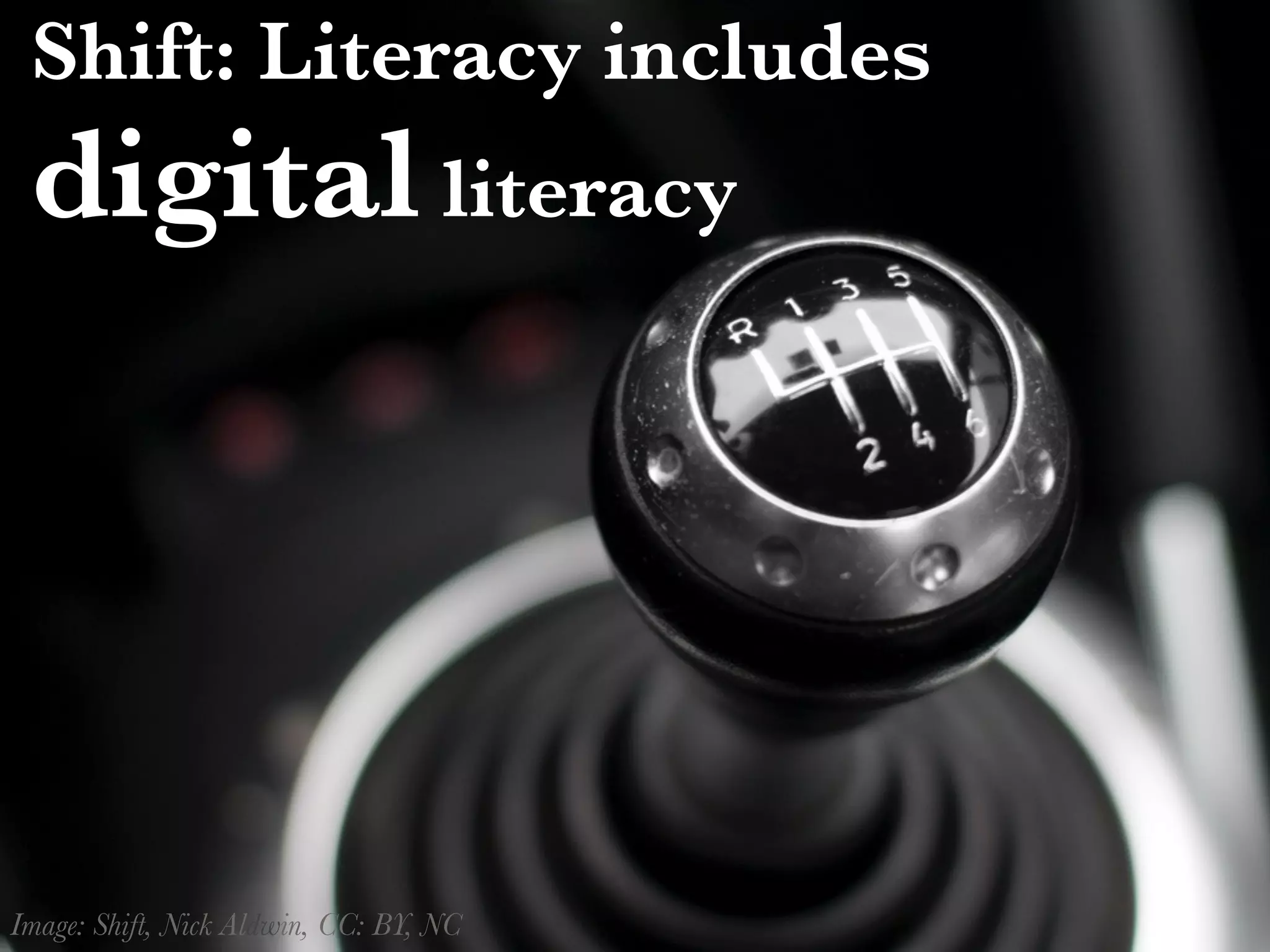
Shift: Literacy includes
digital literacy
Image: Shift, Nick Aldwin, CC: BY, NC
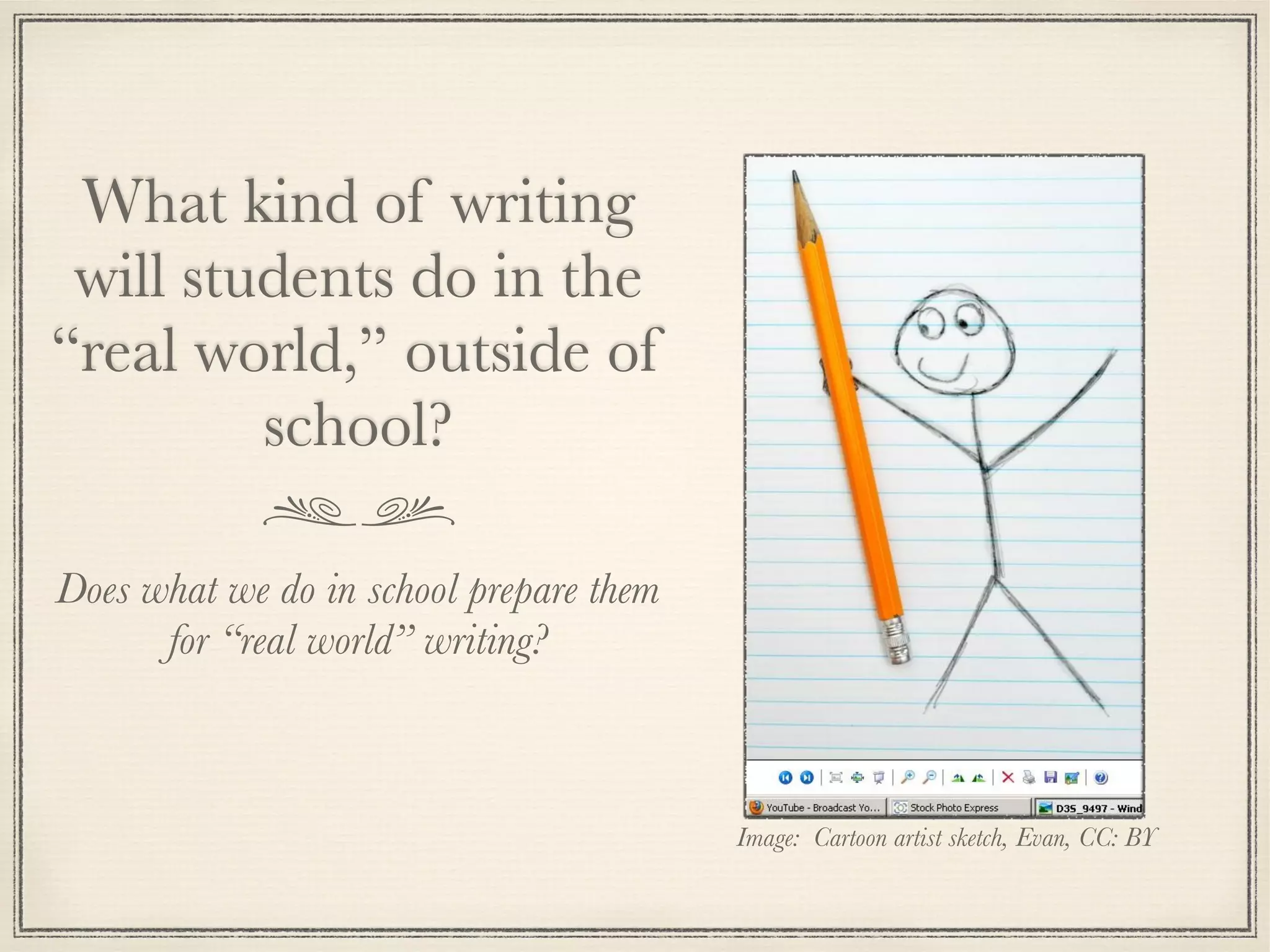
What kind of writing
will students do in the
“real world,” outside of
school?
Does what we do in school prepare them
for “real world” writing?
Image: Cartoon artist sketch, Evan, CC: BY
Essential Questions
Purpose — Why
• Why have technology-rich
writing?
• How is digital literacy built into
the AZCCRS?
Functions — Outcomes
• What does a technology-rich
approach look like in AZCCRS
writing?
Structures — Logistics
• What structures are in place to
make technology-rich writing
possible?
Processes — How
• How do I build technology-rich
writing in my classroom/school/
district?
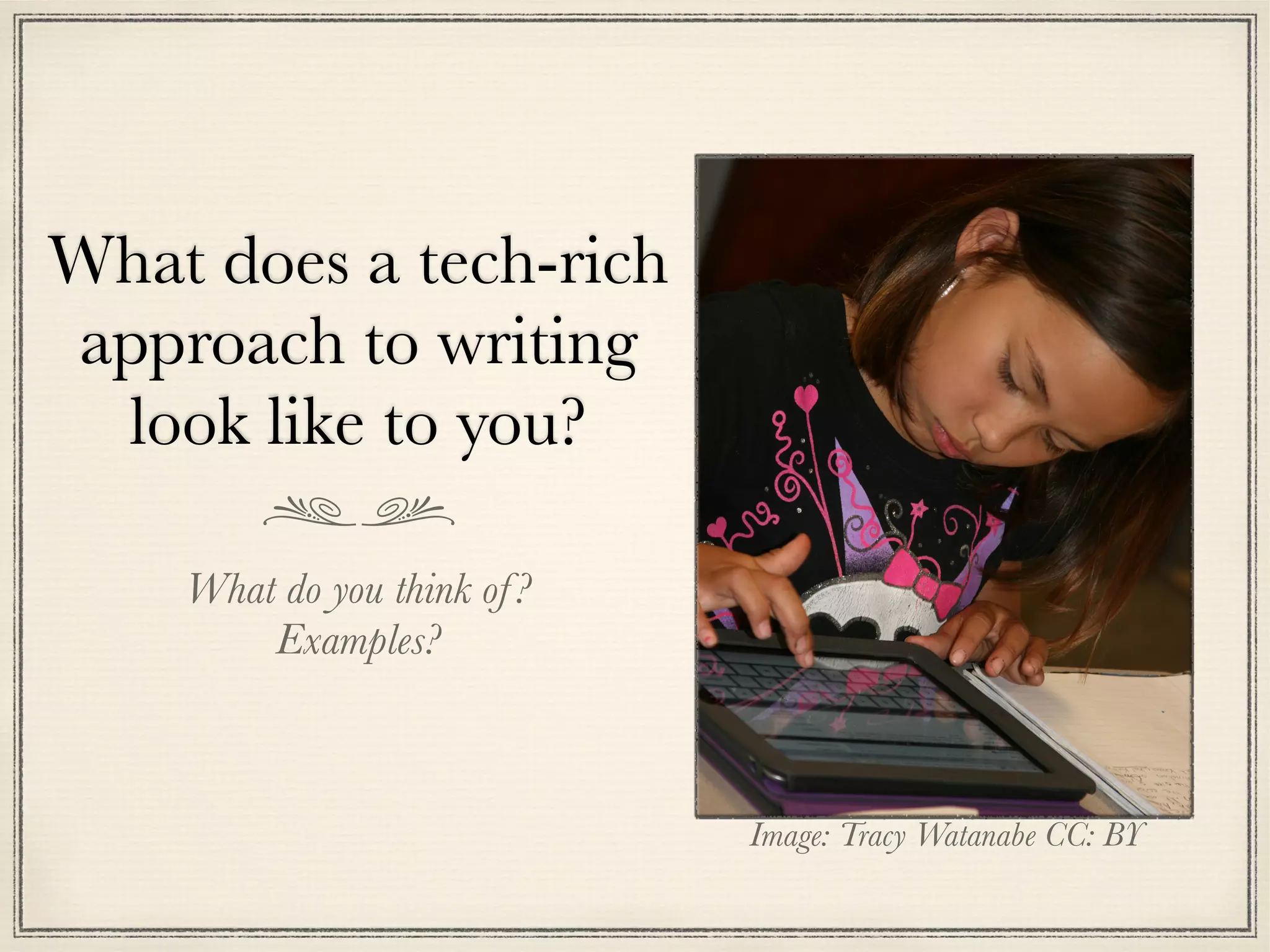
What does a tech-rich
approach to writing
look like to you?
What do you think of?
Examples?
Image: Tracy Watanabe CC: BY
Insert examples
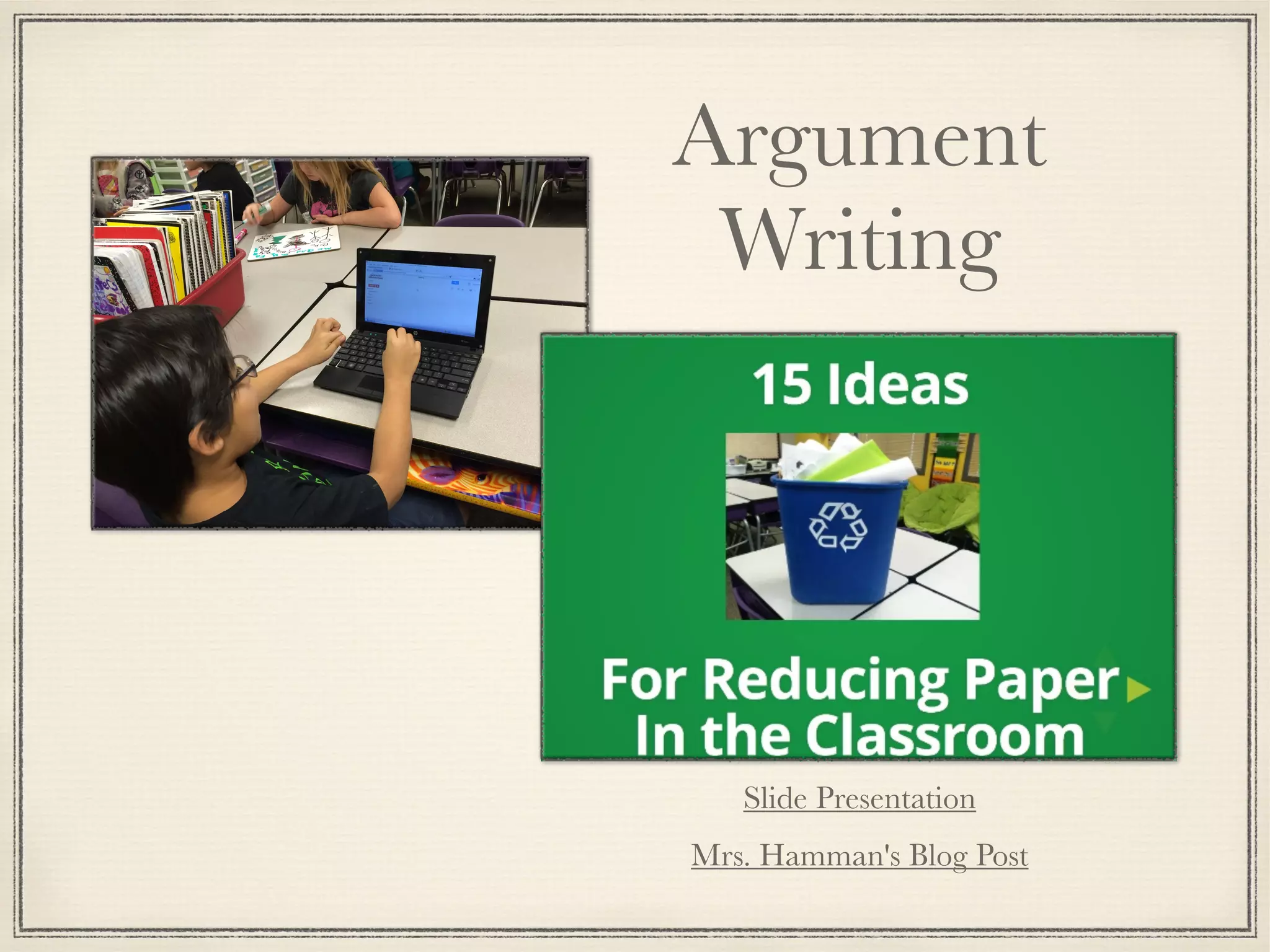
Argument
Writing
Slide Presentation
Mrs. Hamman's Blog Post
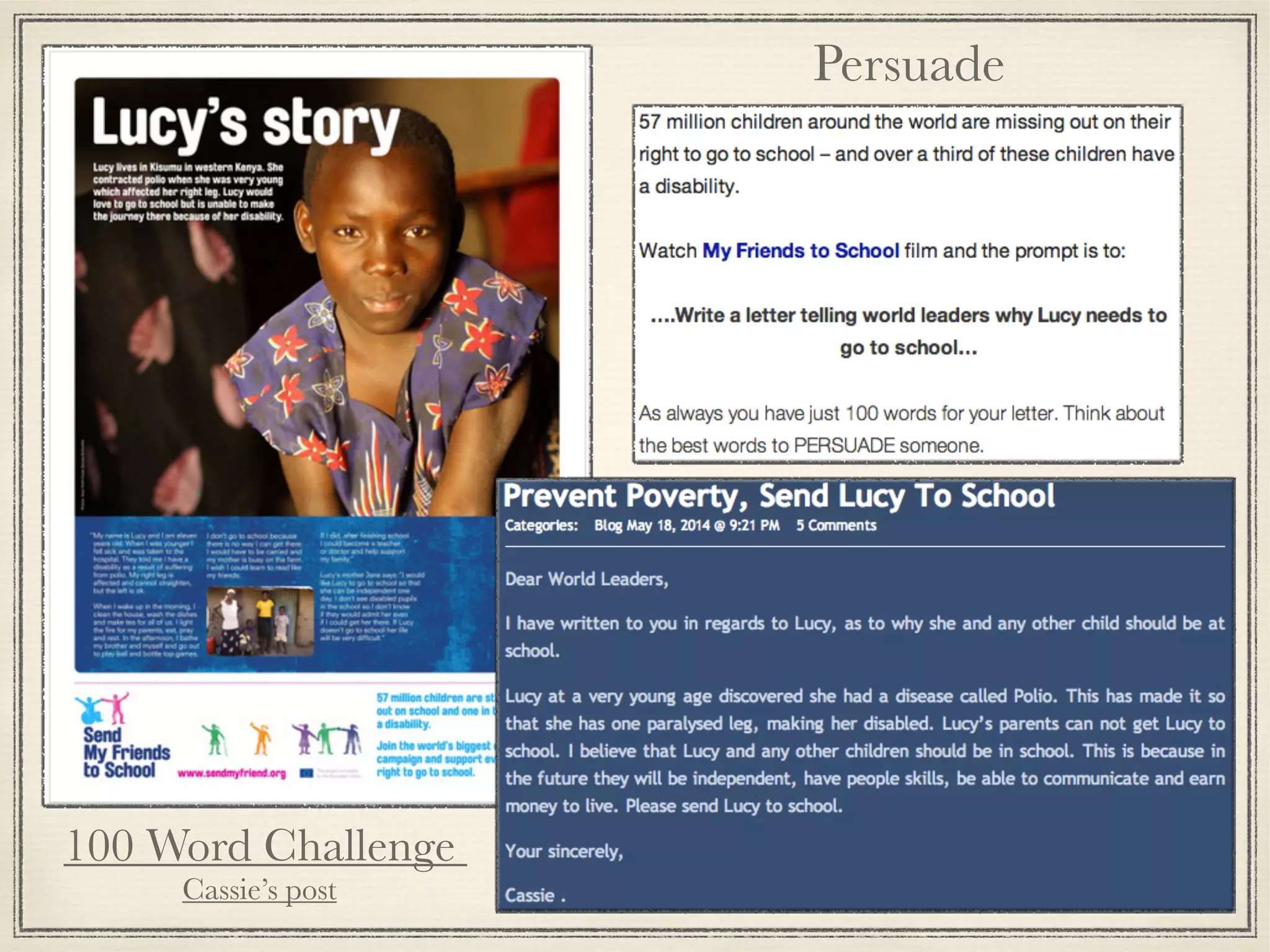
Persuade
100 Word Challenge
Cassie’s post
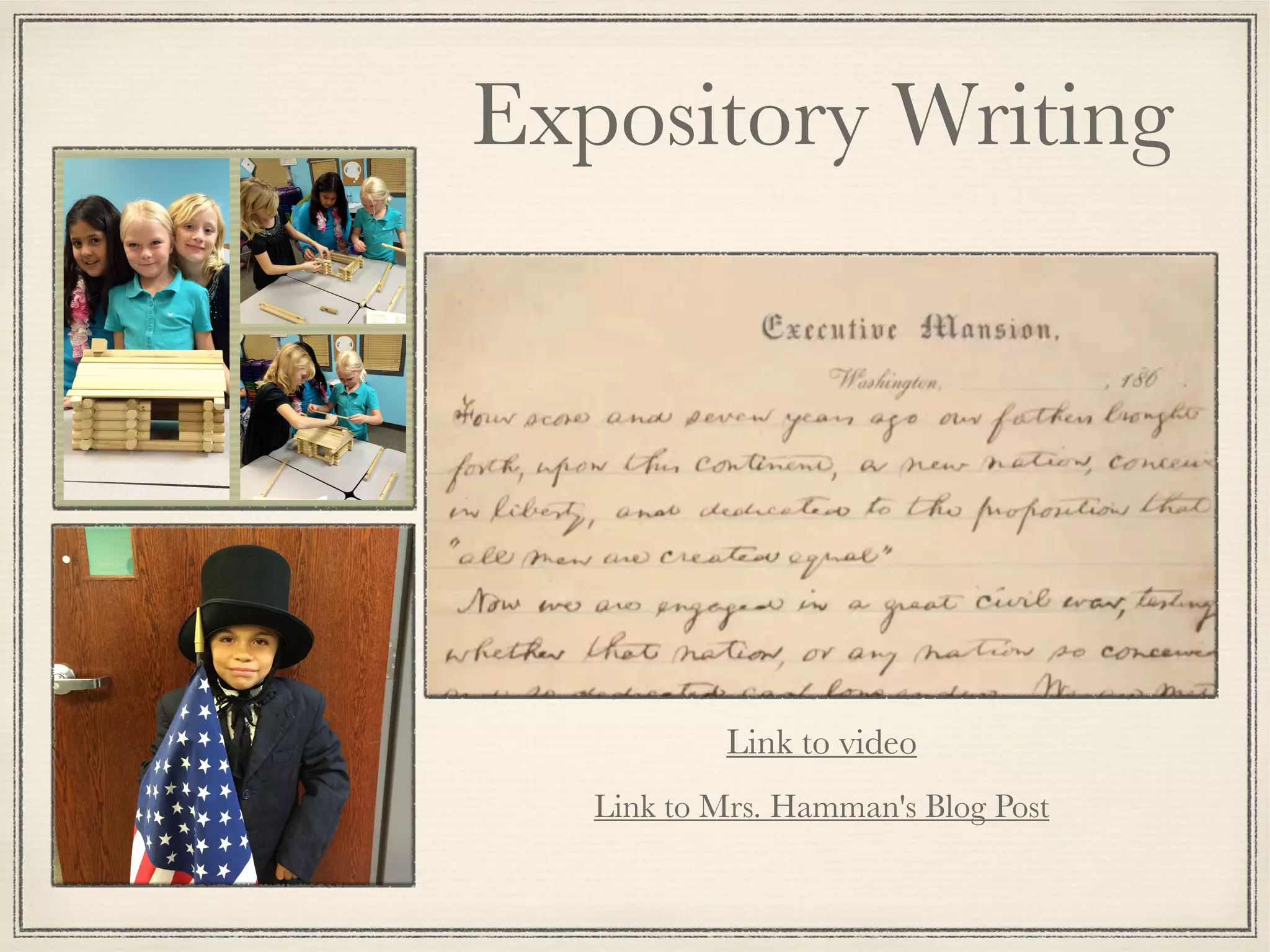
Expository Writing
Link to video
Link to Mrs. Hamman's Blog Post
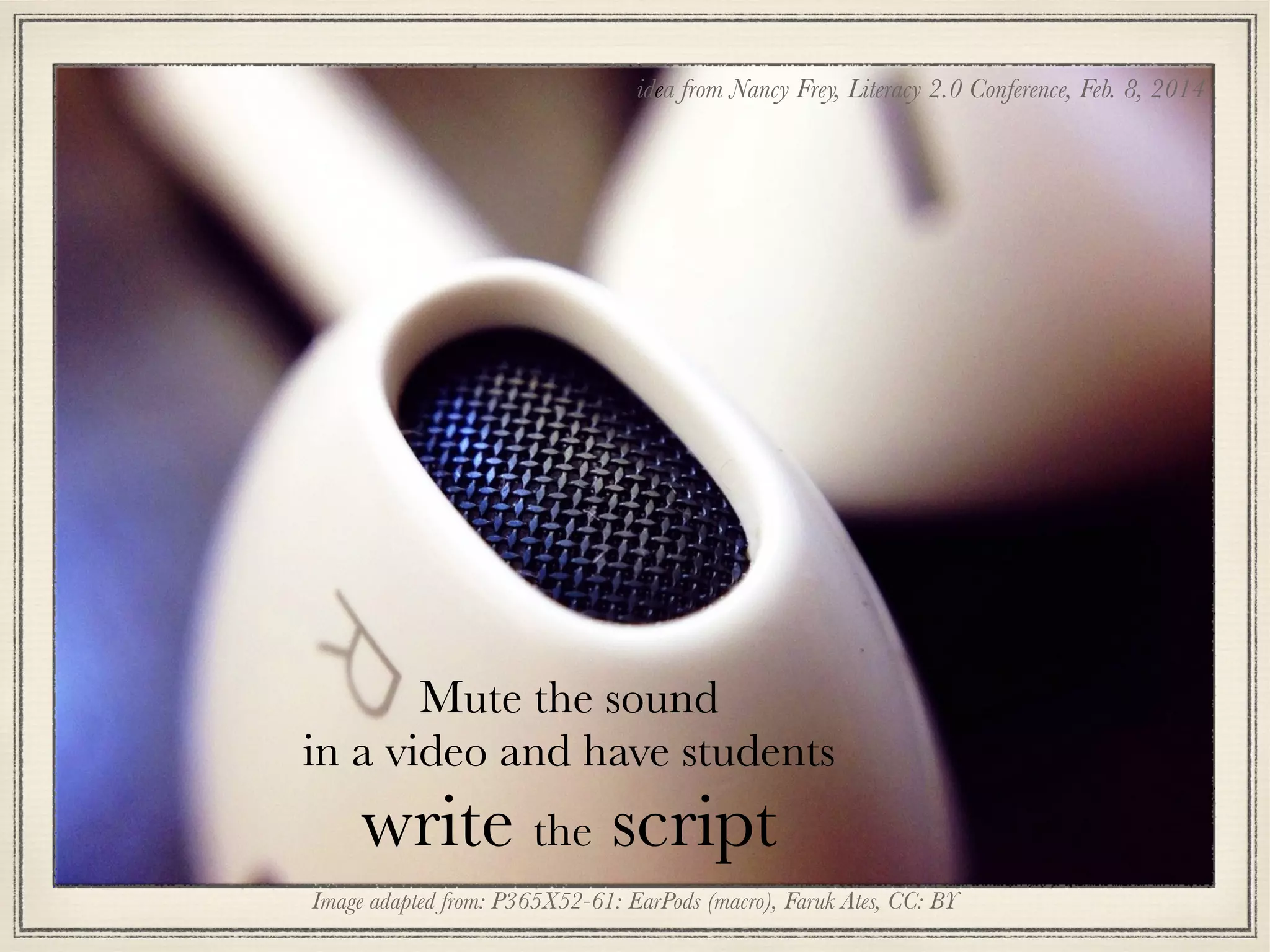
Image adapted from: P365X52-61: EarPods (macro), Faruk Ates, CC: BY
Mute the sound
in a video and have students
write the script
idea from Nancy Frey, Literacy 2.0 Conference, Feb. 8, 2014
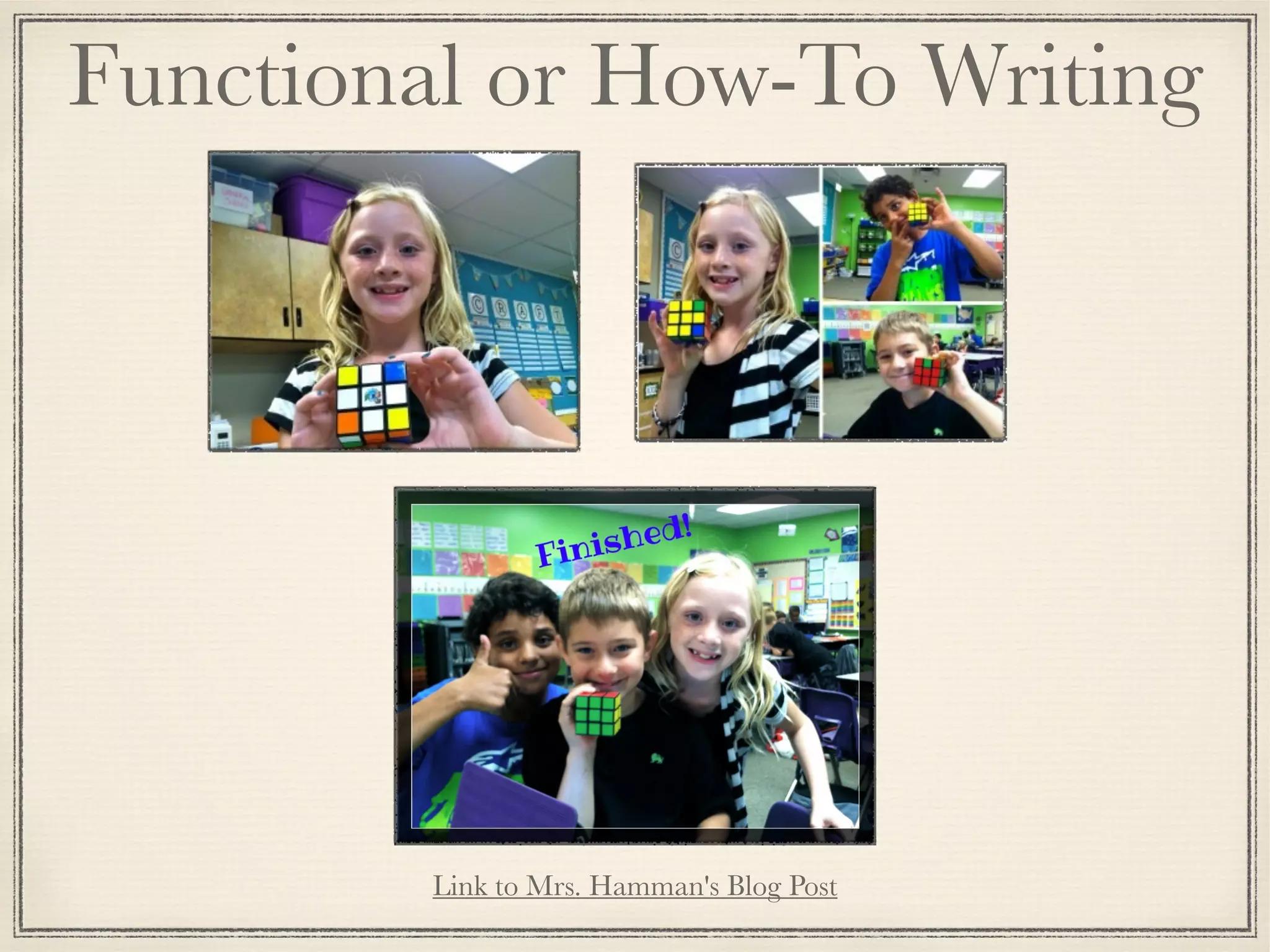
Functional or How-To Writing
Link to Mrs. Hamman's Blog Post
Poetry
Example of bio poem on Haiku Deck
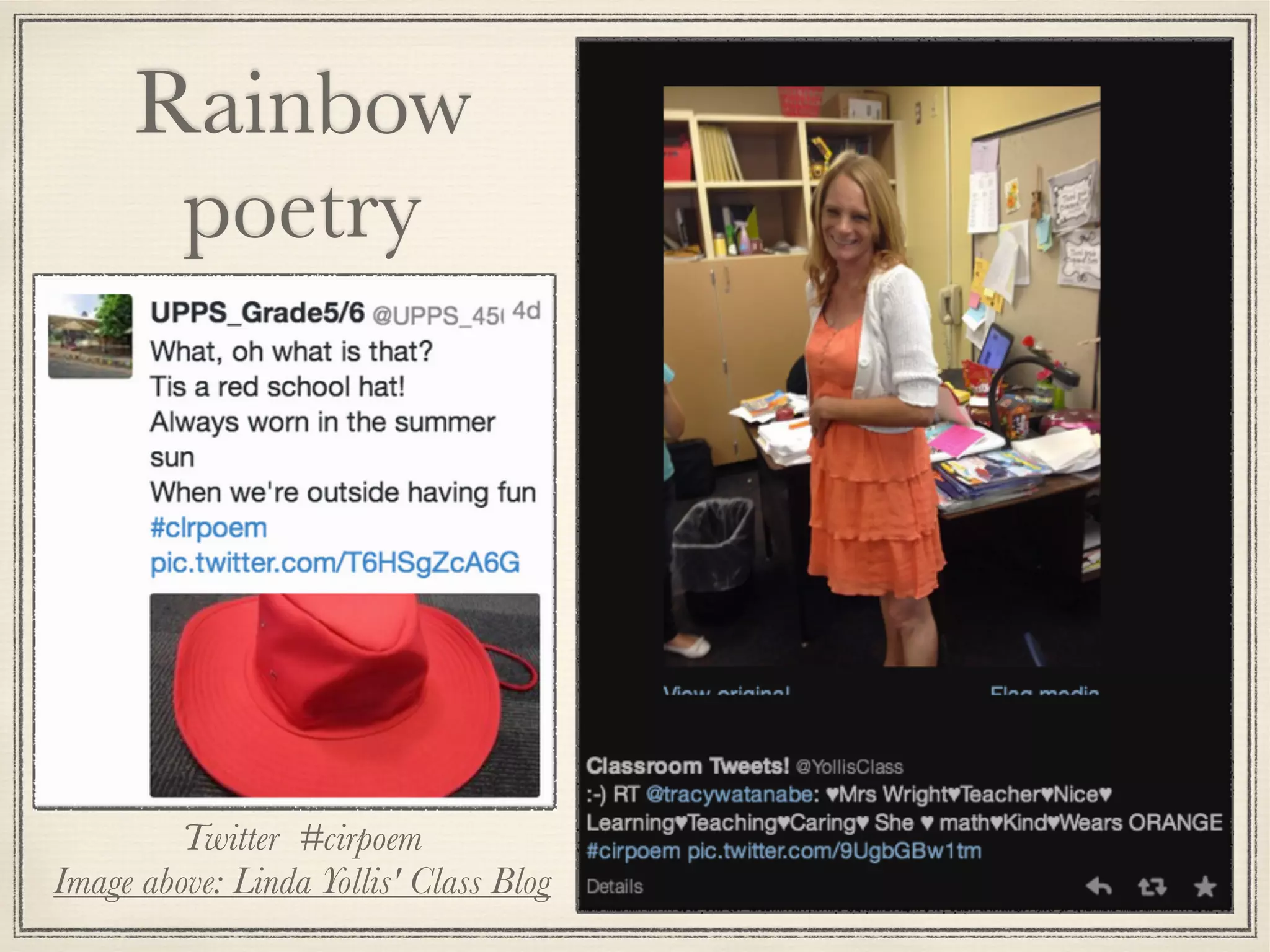
Rainbow
poetry
Twitter #cirpoem
Image above: Linda Yollis' Class Blog
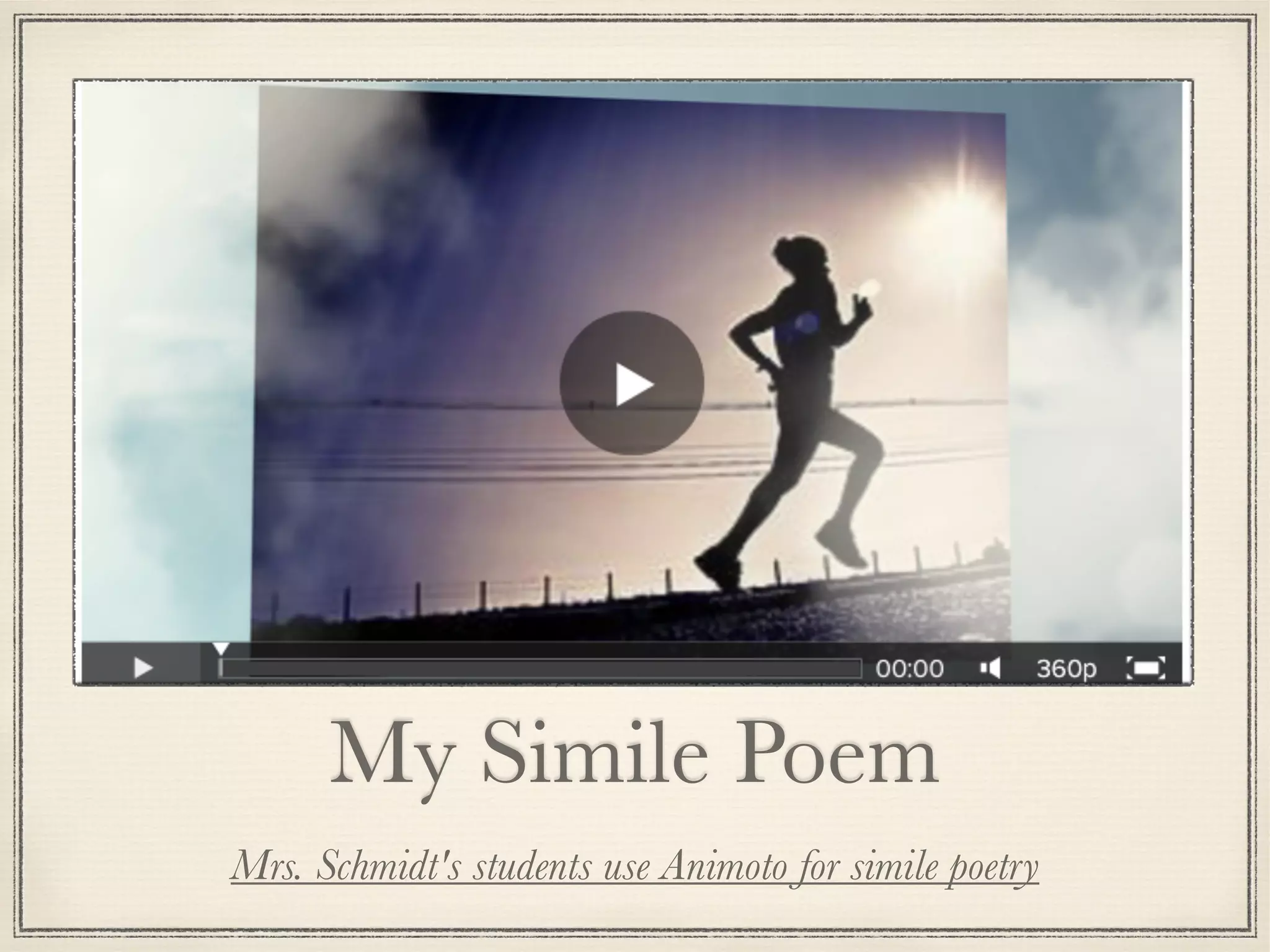
My Simile Poem
Mrs. Schmidt's students use Animoto for simile poetry
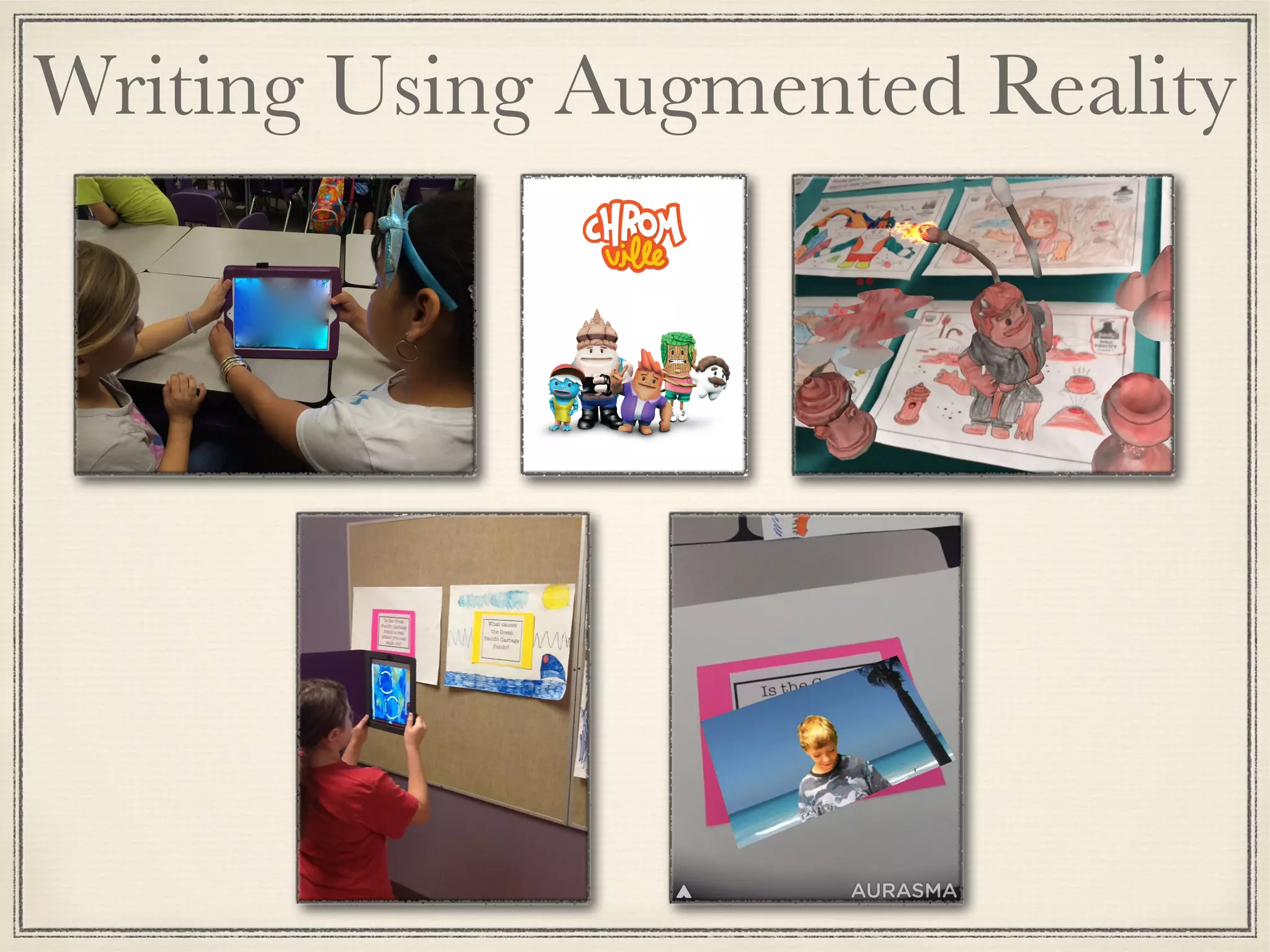
Writing Using Augmented Reality
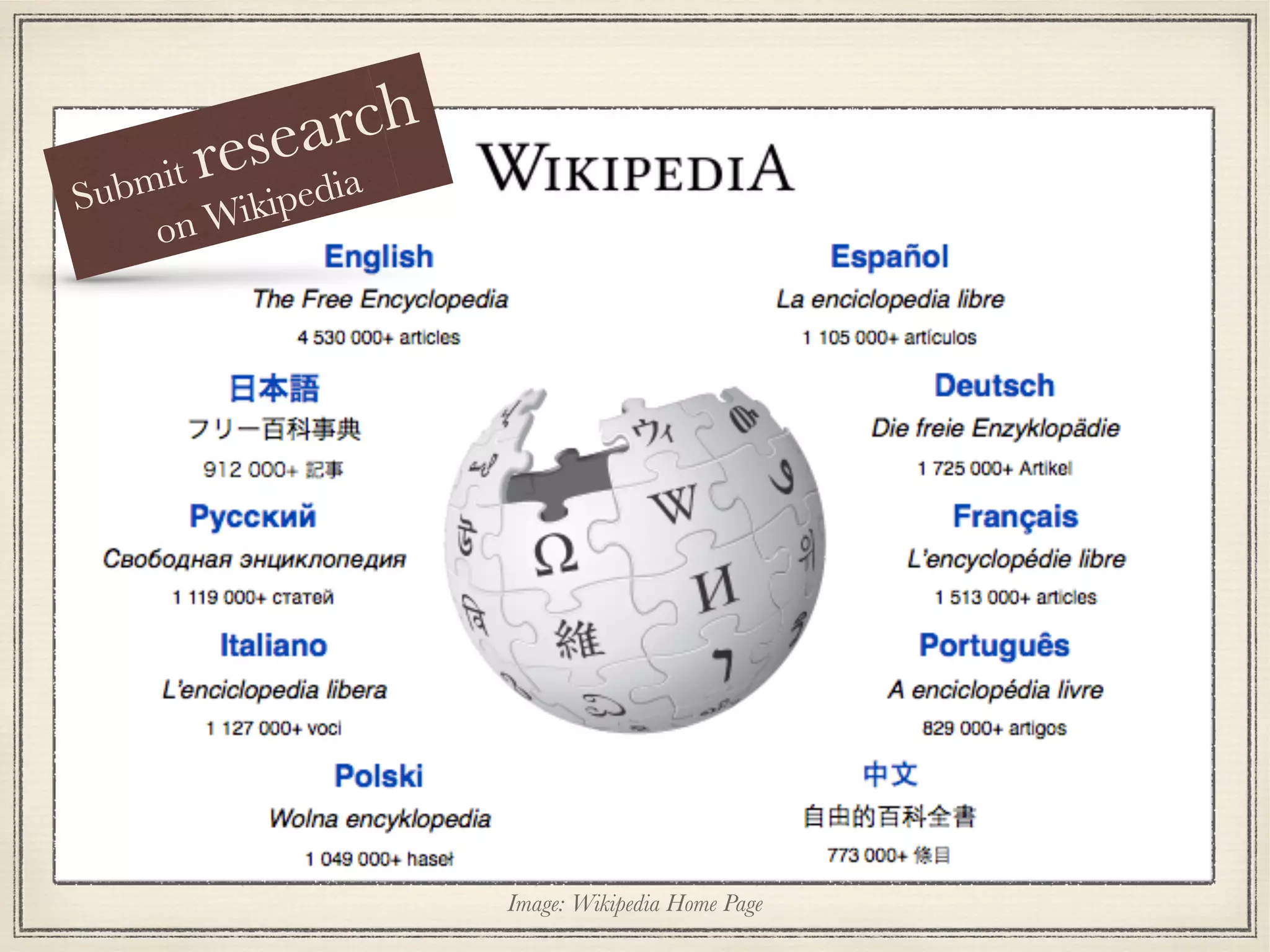
Image: Wikipedia Home Page
Submit research
on Wikipedia
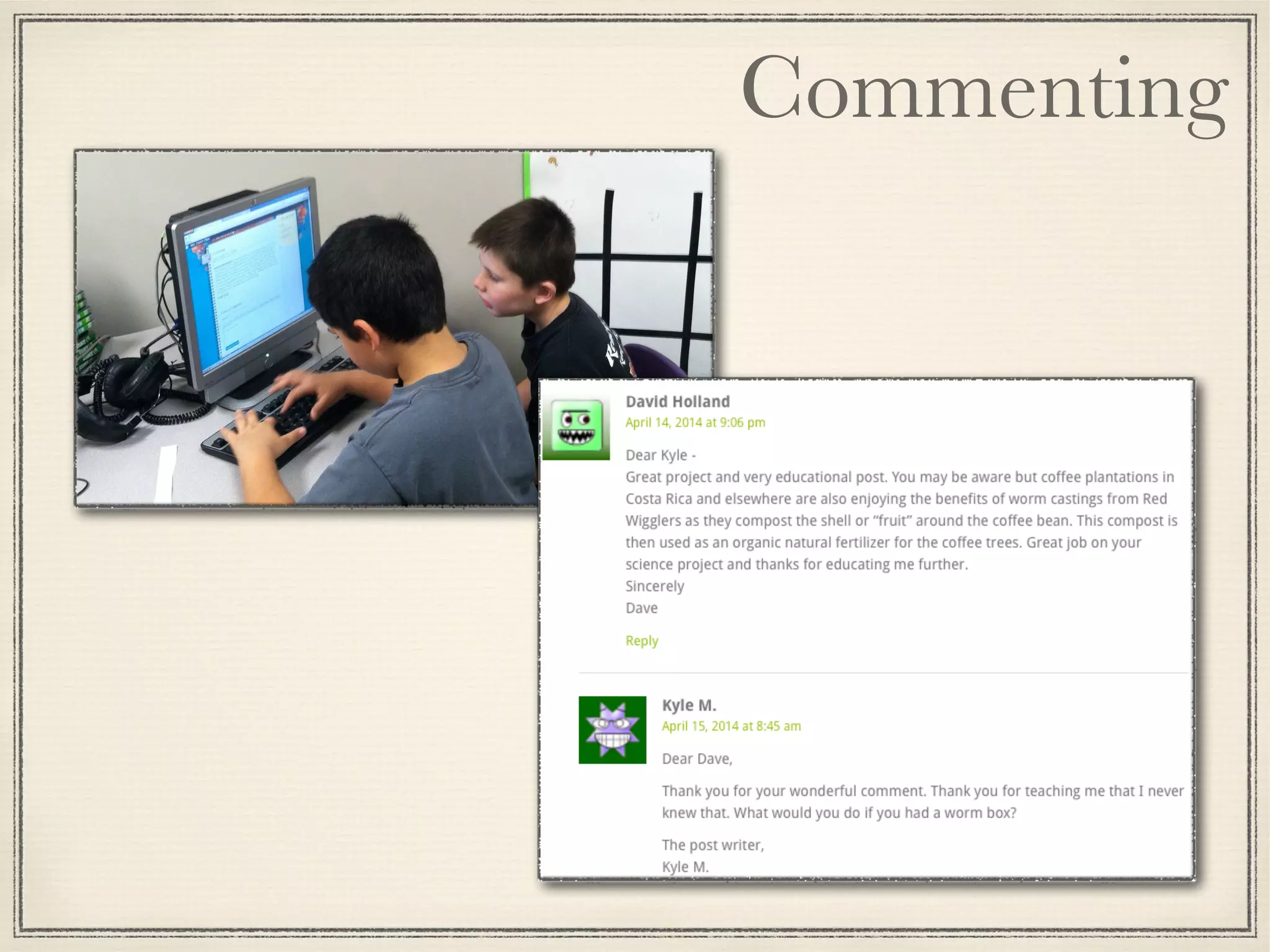
Commenting
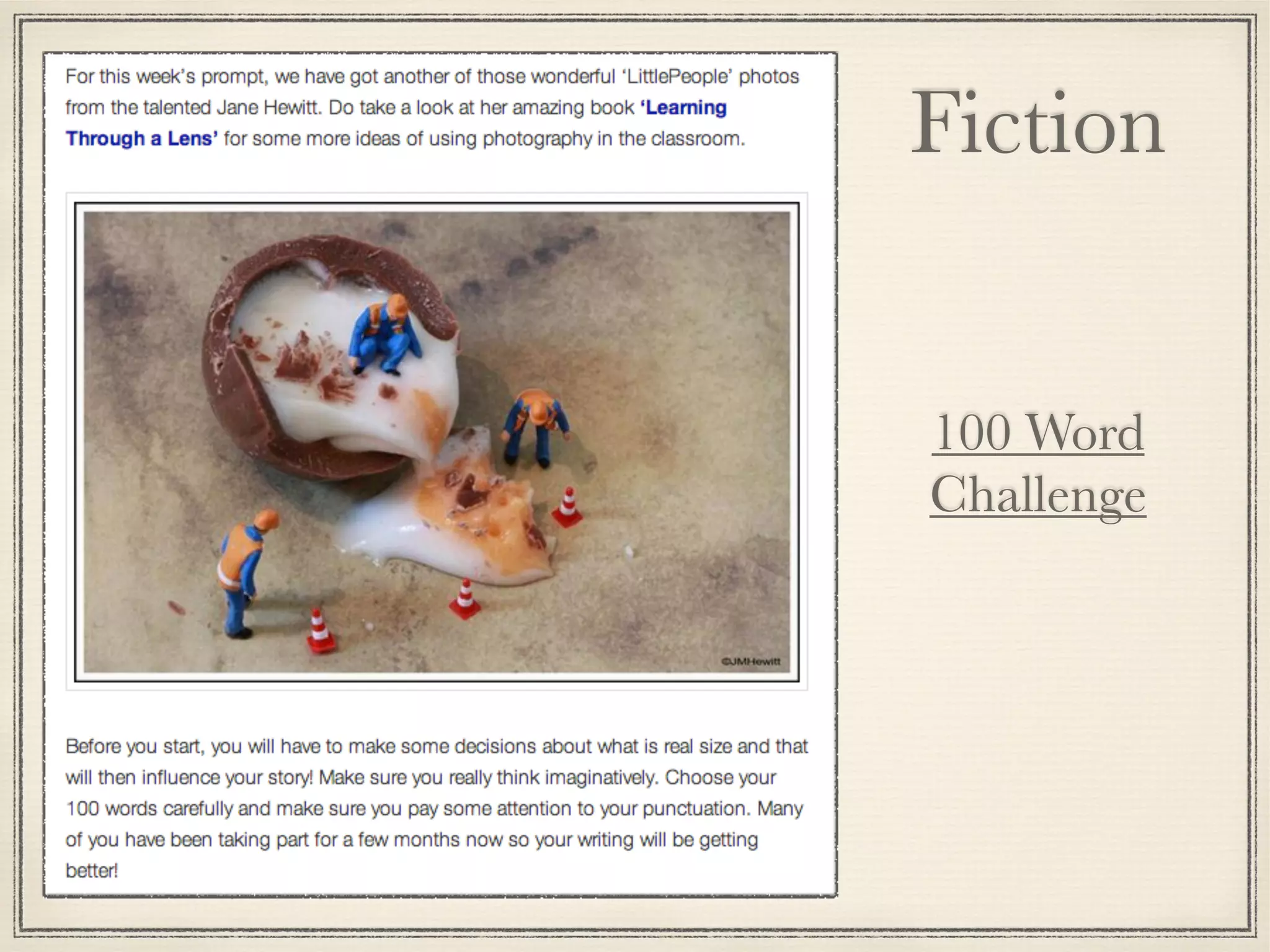
100 Word
Challenge
Fiction
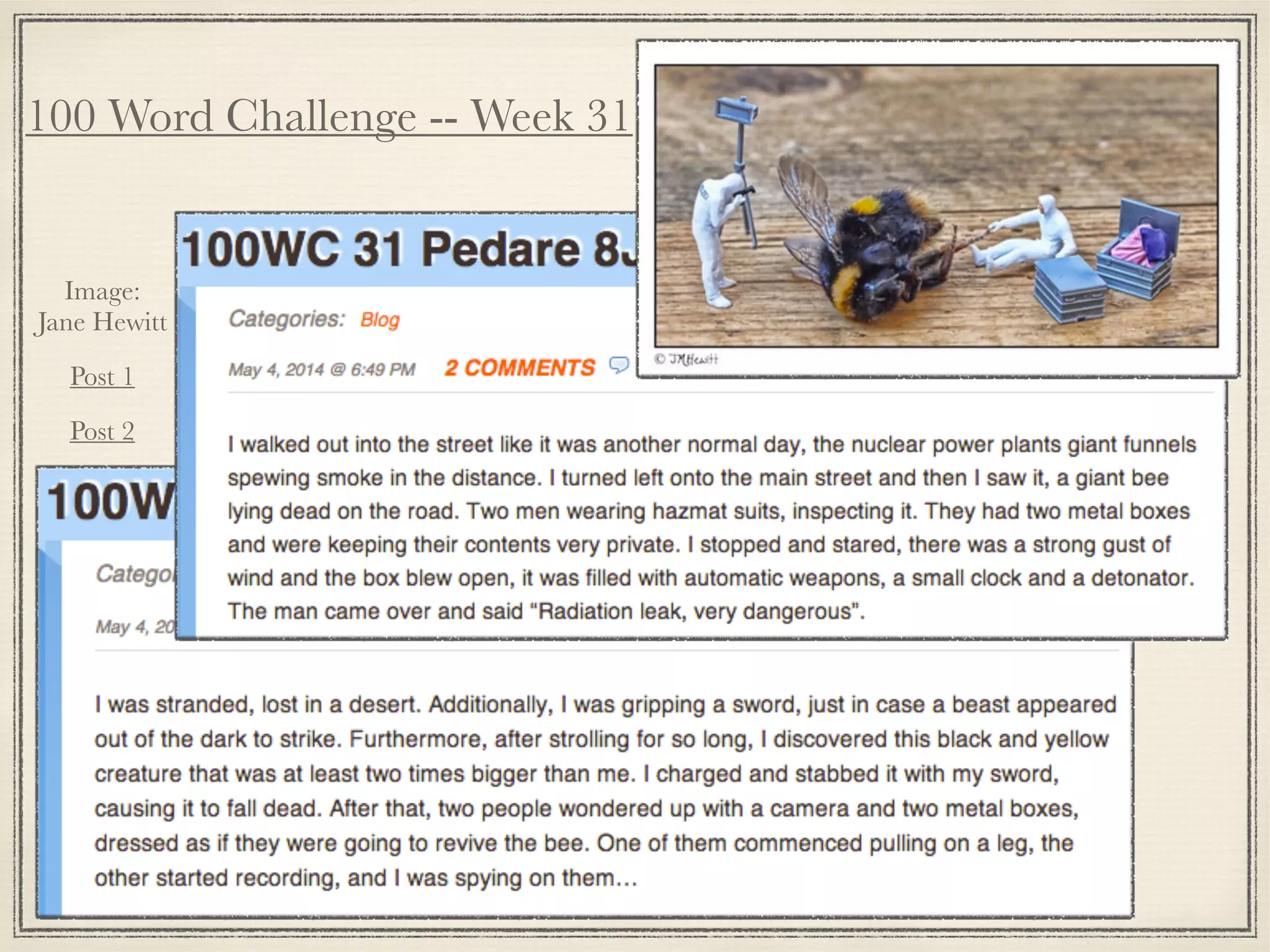
100 Word Challenge -- Week 31
Post 1
Image:
Jane Hewitt
Post 2
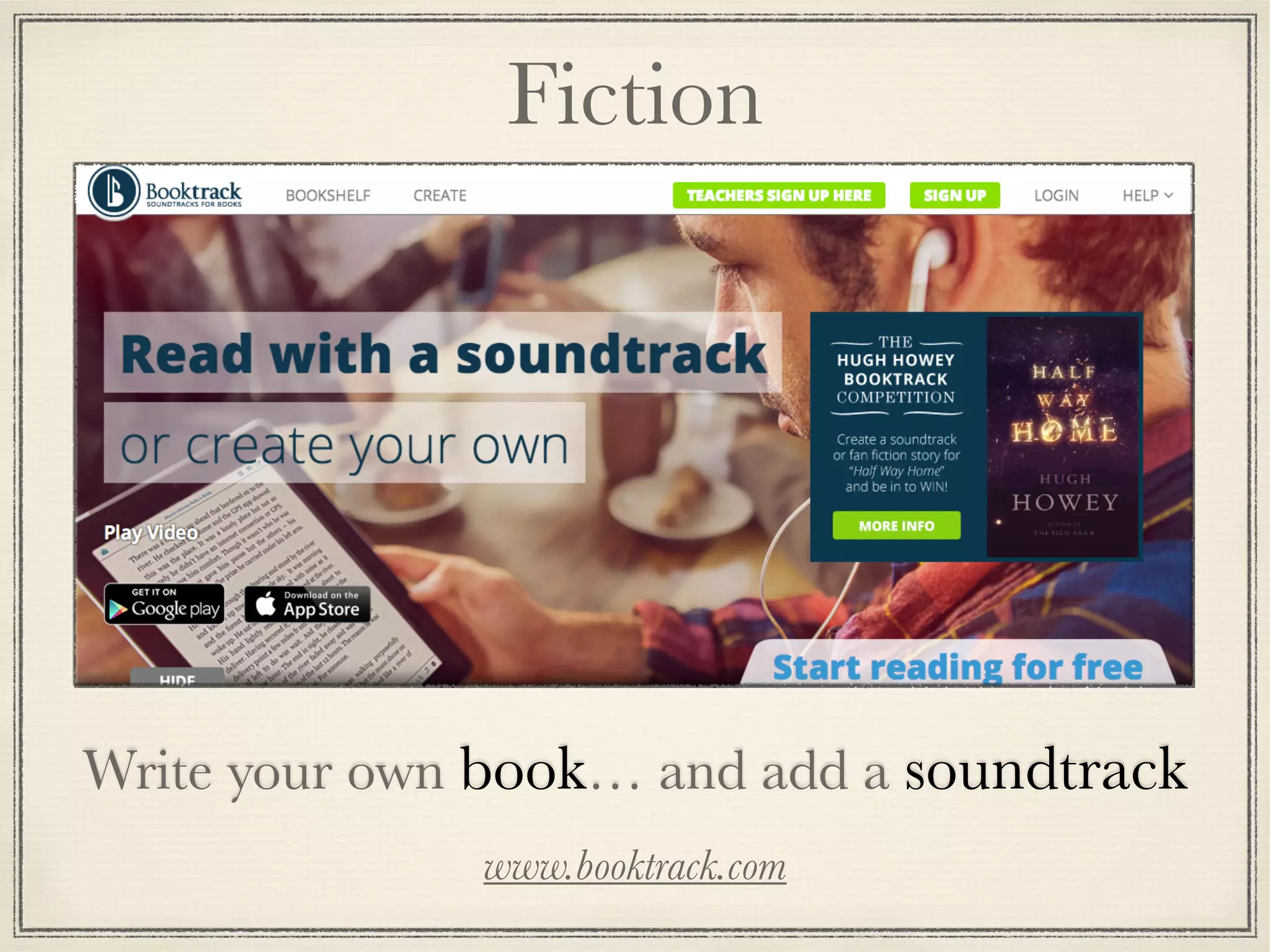
Write your own book… and add a soundtrack
www.booktrack.com
Fiction
Image adapted from: Brown paper packages tied with string Nomadic Lass, CC: BY, SA
Write a
book review
for Amazon
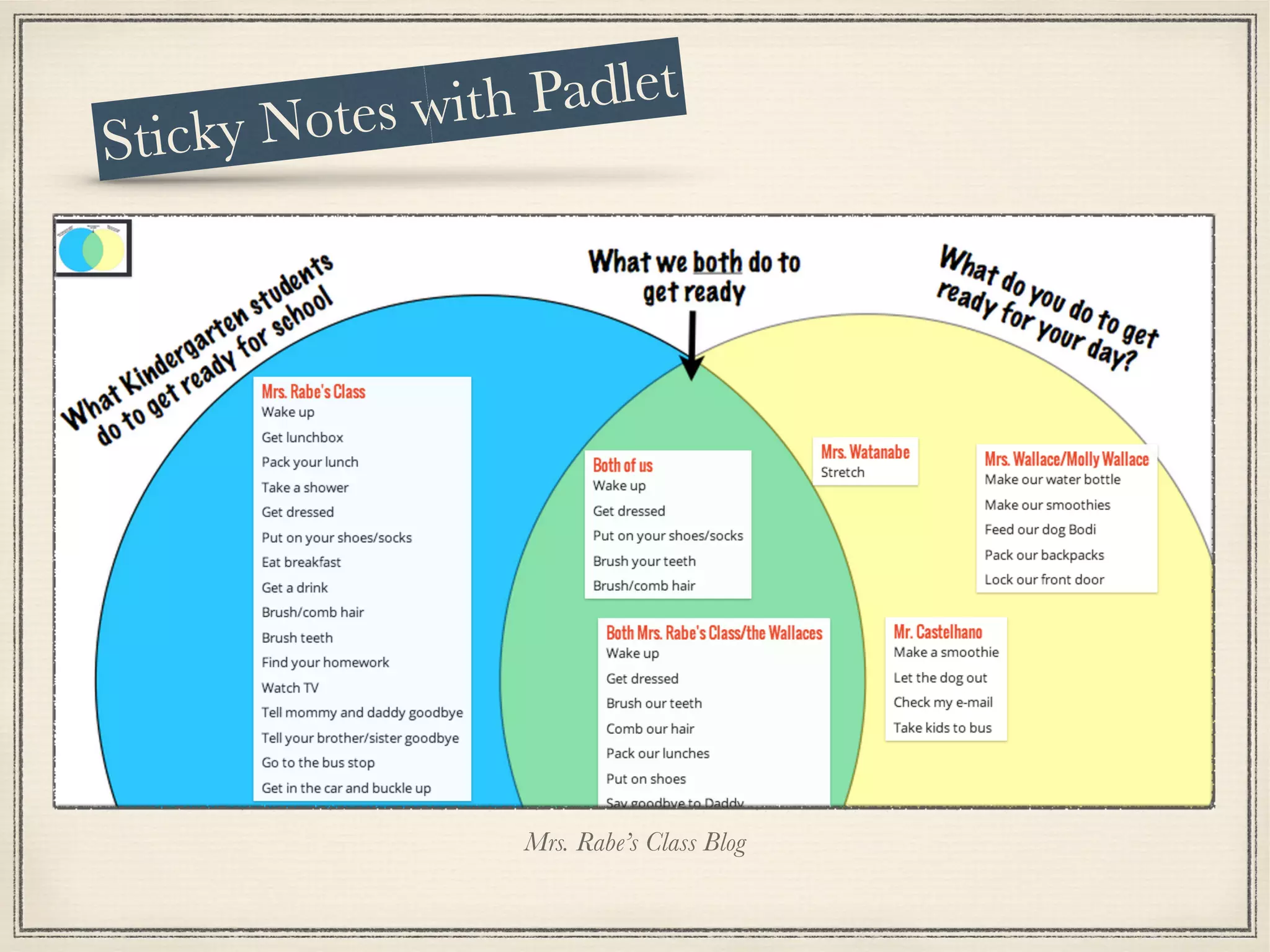
Sticky Notes with Padlet
Mrs. Rabe’s Class Blog
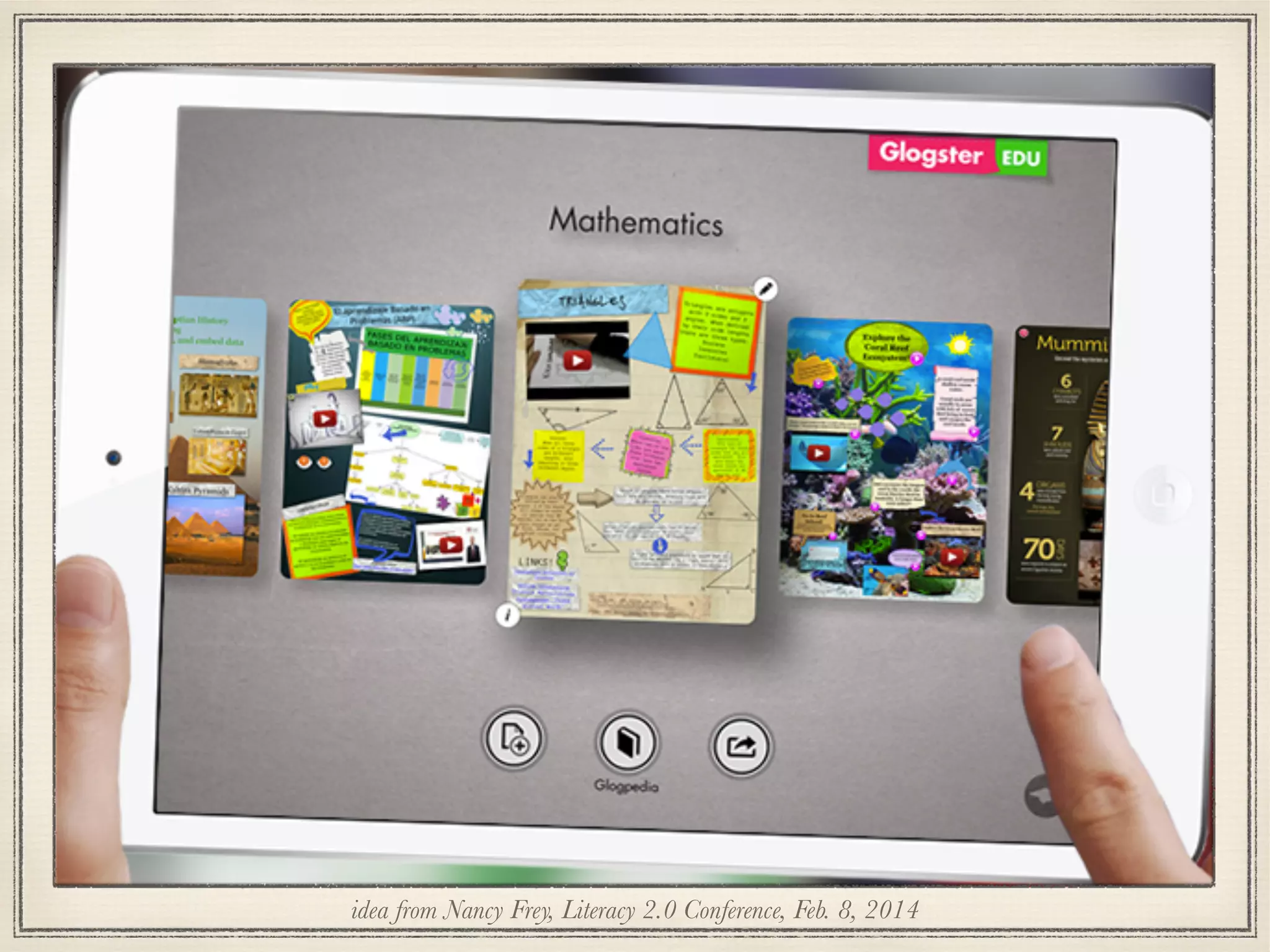
idea from Nancy Frey, Literacy 2.0 Conference, Feb. 8, 2014
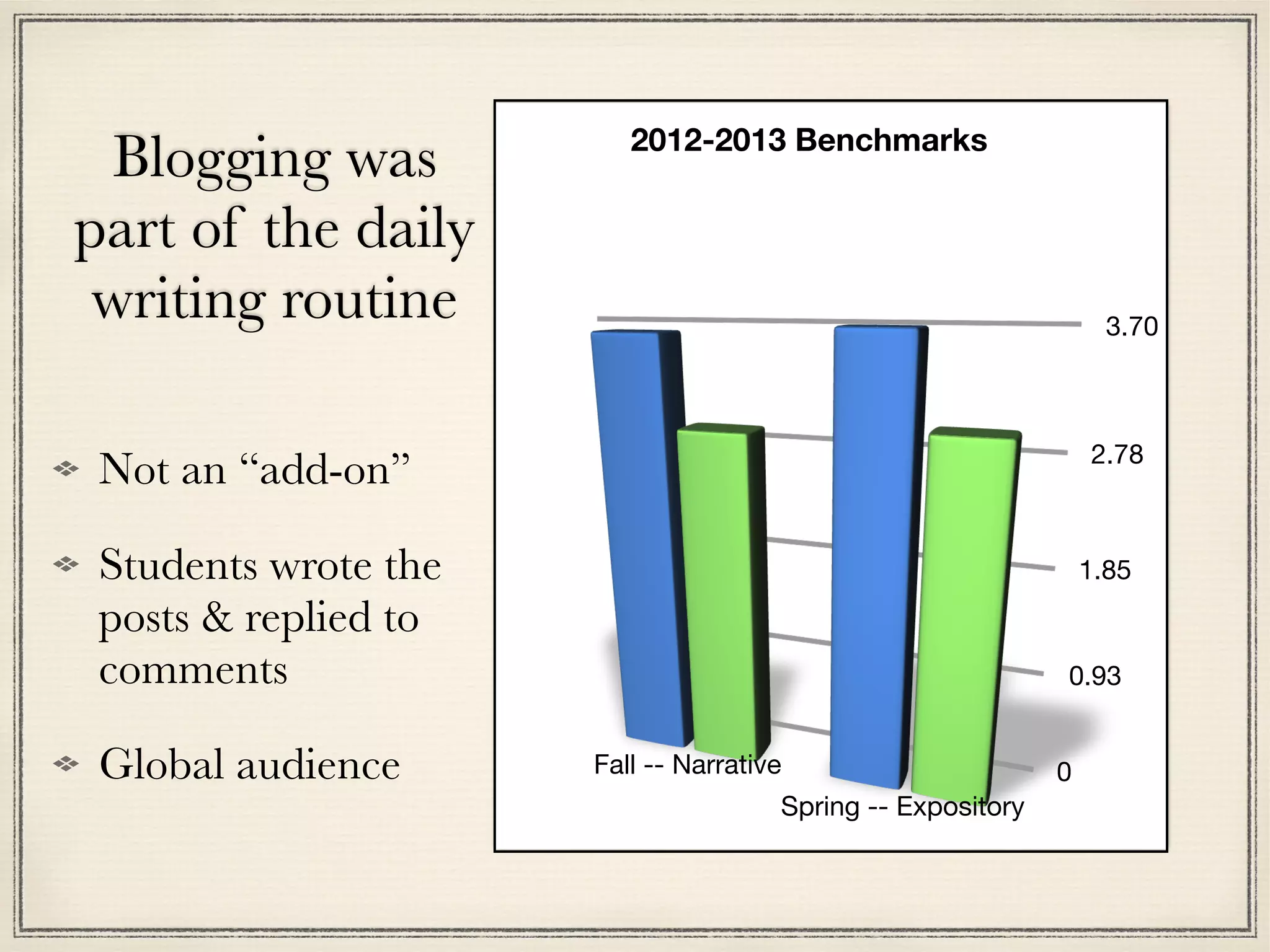
Blogging was
part of the daily
writing routine
0
0.93
1.85
2.78
3.70
Fall -- Narrative
Spring -- Expository
2012-2013 Benchmarks
Not an “add-on”
Students wrote the
posts & replied to
comments
Global audience
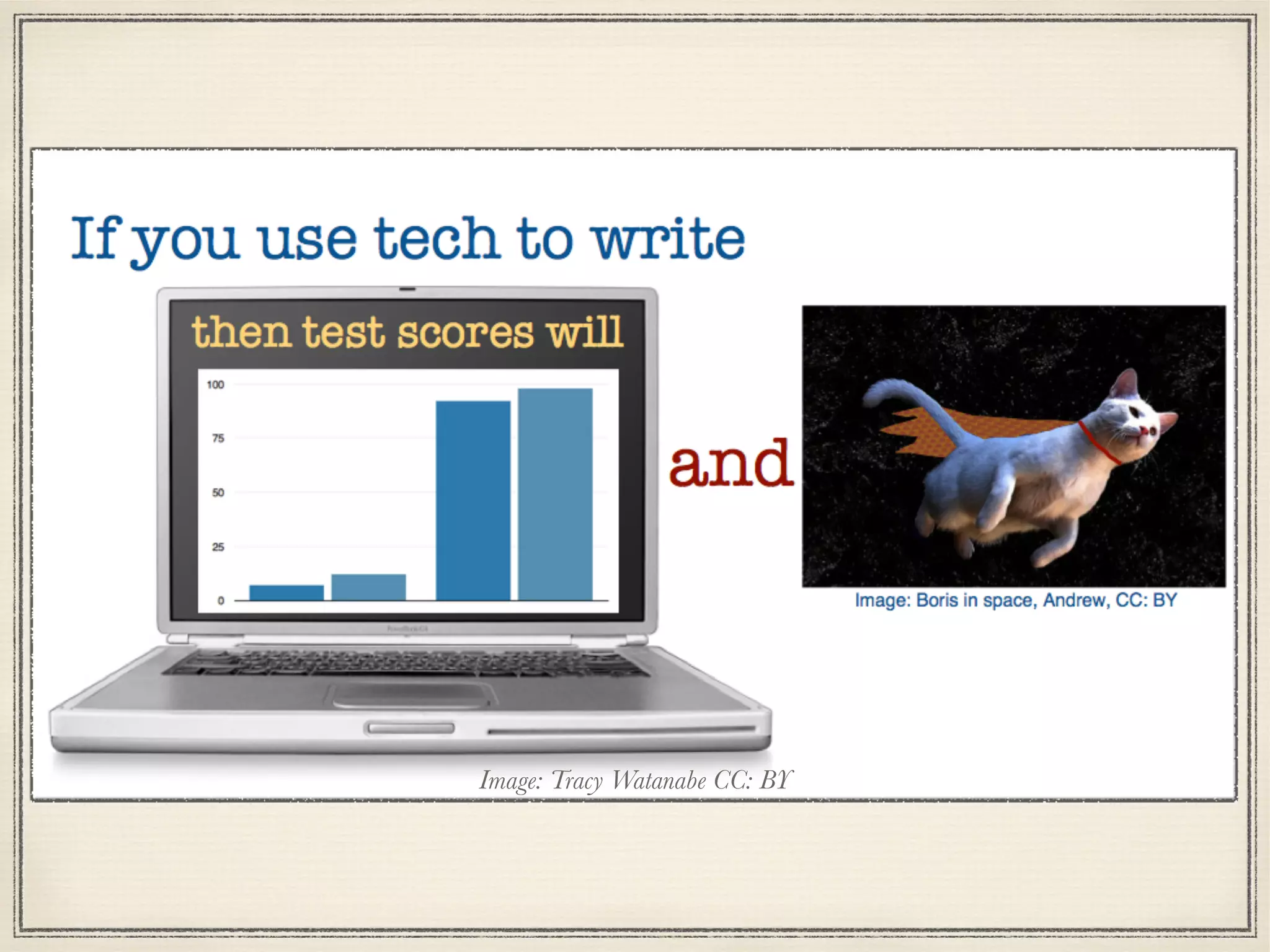
Image: Tracy Watanabe CC: BY
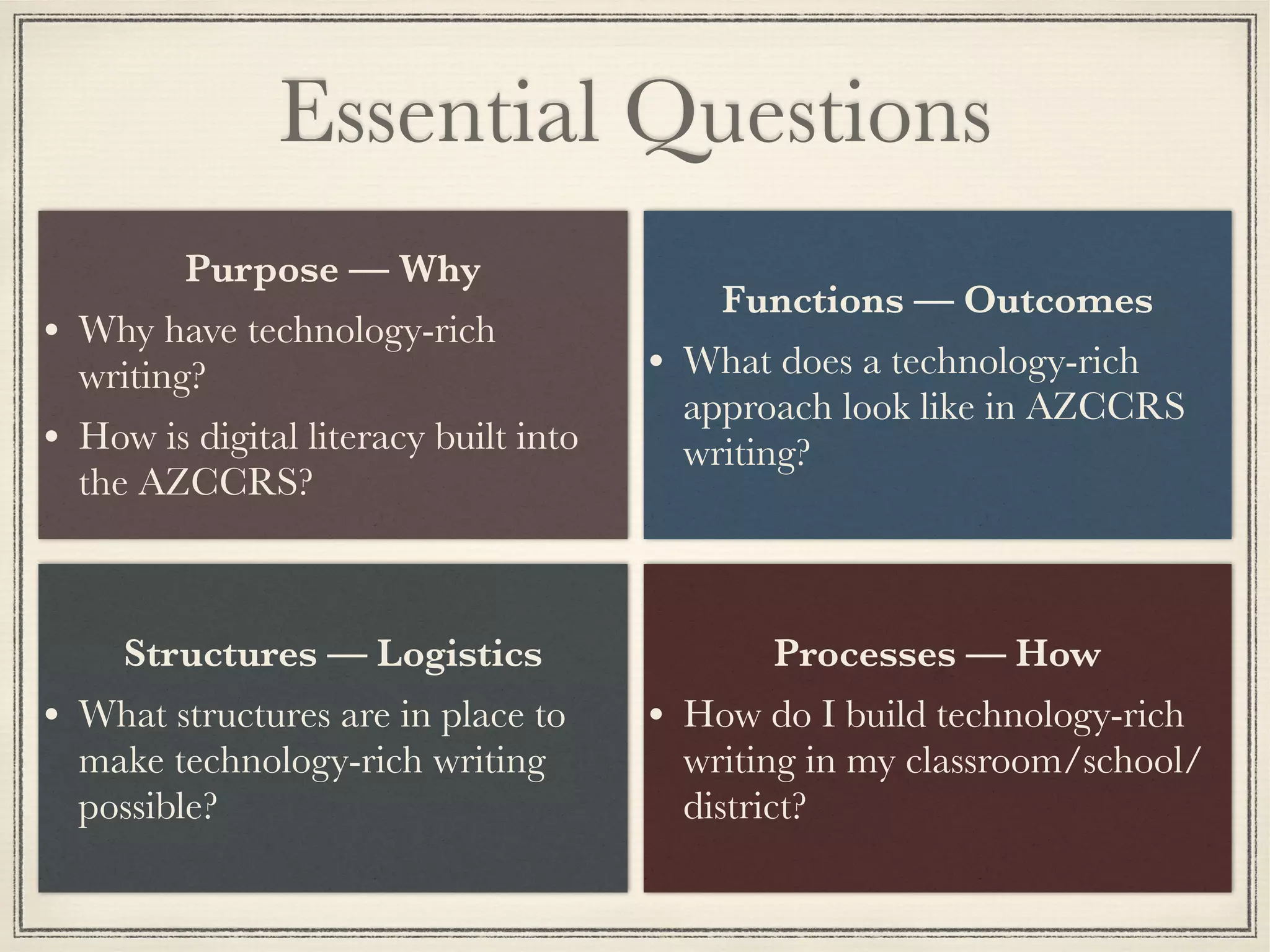
Essential Questions
Purpose — Why
• Why have technology-rich
writing?
• How is digital literacy built into
the AZCCRS?
Functions — Outcomes
• What does a technology-rich
approach look like in AZCCRS
writing?
Structures — Logistics
• What structures are in place to
make technology-rich writing
possible?
Processes — How
• How do I build technology-rich
writing in my classroom/school/
district?
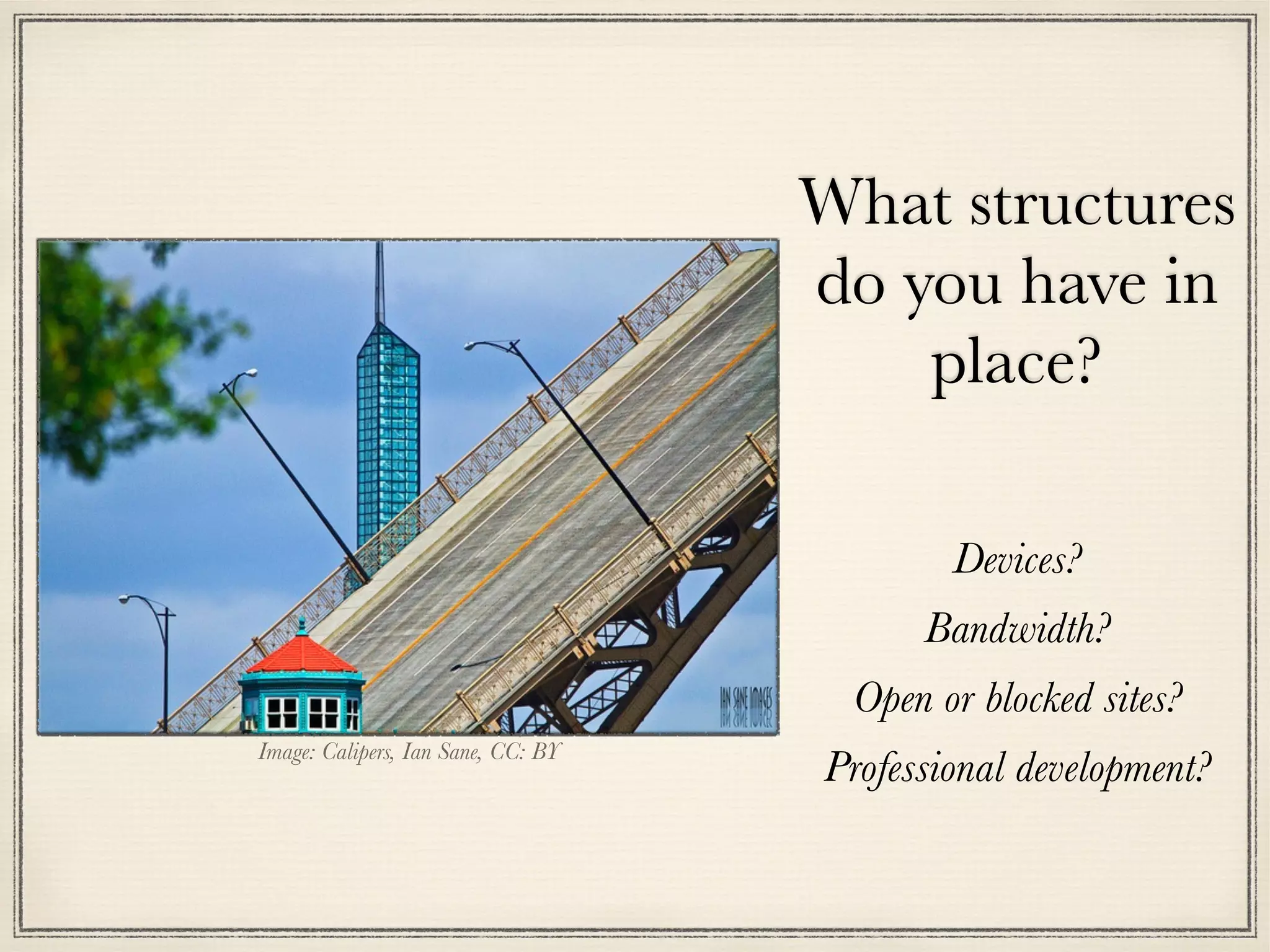
What structures
do you have in
place?
Devices?
Bandwidth?
Open or blocked sites?
Professional development?Image: Calipers, Ian Sane, CC: BY
What structures
do you have in
place?
Tech procedures?
Digital citizenship?
Class culture of risk?Image: The Colorful Bokeh Men, Ian Sane, CC: BY
How are the structures in place used?
1.Teacher only
2.Teacher & Students
as consumers
3.Teacher & Students
as consumers &
creators
4.Teachers & Students
as consumers,
creators, & shares to
global audience
Image: Plastered Against The Wall, Ian Sane, CC: BY
Structures for evidence-based writing
Image: A Burnside View, Ian Sane, CC: BY
Rubrics:
Hyperlinks
Cite sources for
ideas, images,
multi-media,
etc.
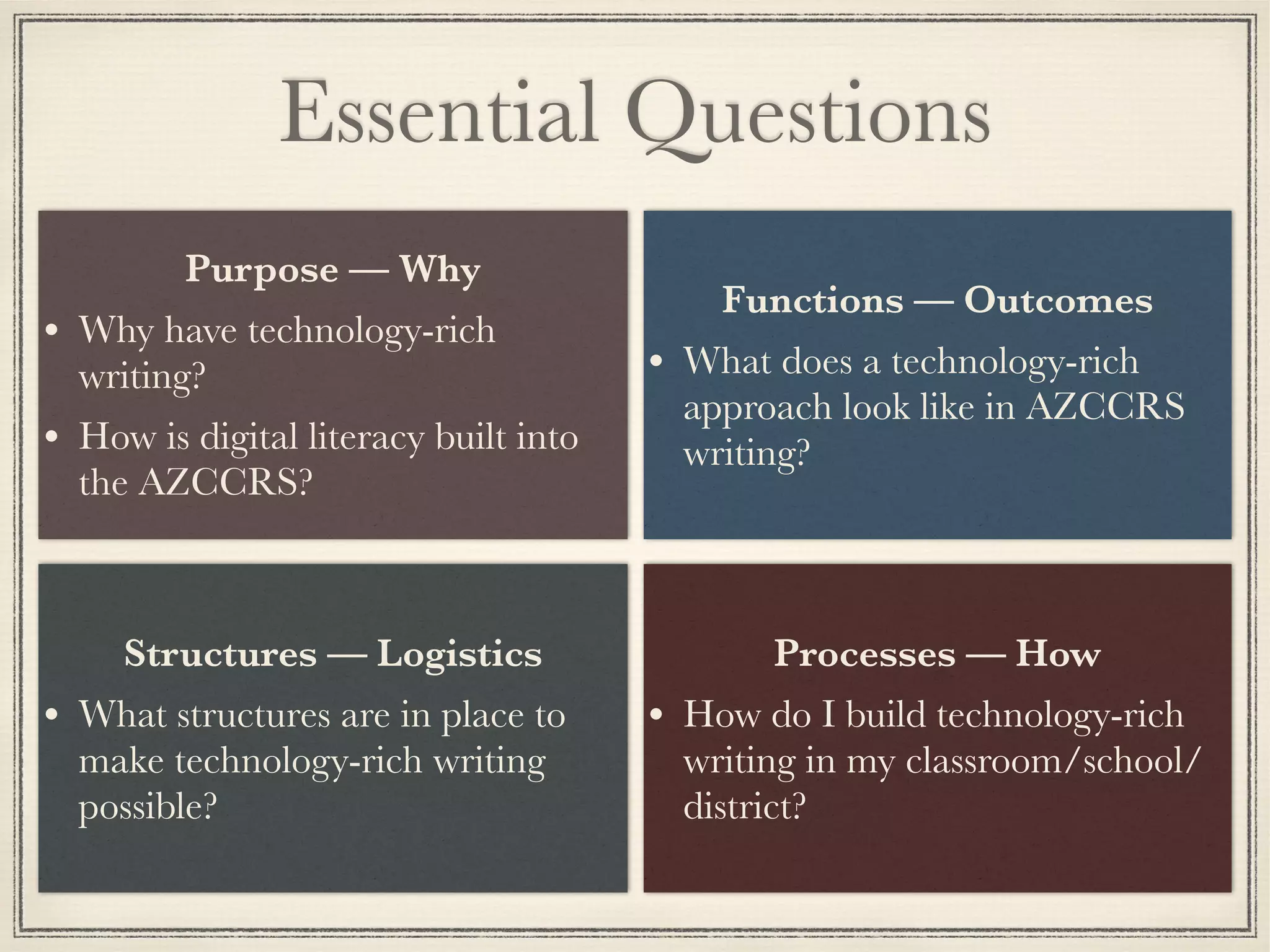
Essential Questions
Purpose — Why
• Why have technology-rich
writing?
• How is digital literacy built into
the AZCCRS?
Functions — Outcomes
• What does a technology-rich
approach look like in AZCCRS
writing?
Structures — Logistics
• What structures are in place to
make technology-rich writing
possible?
Processes — How
• How do I build technology-rich
writing in my classroom/school/
district?
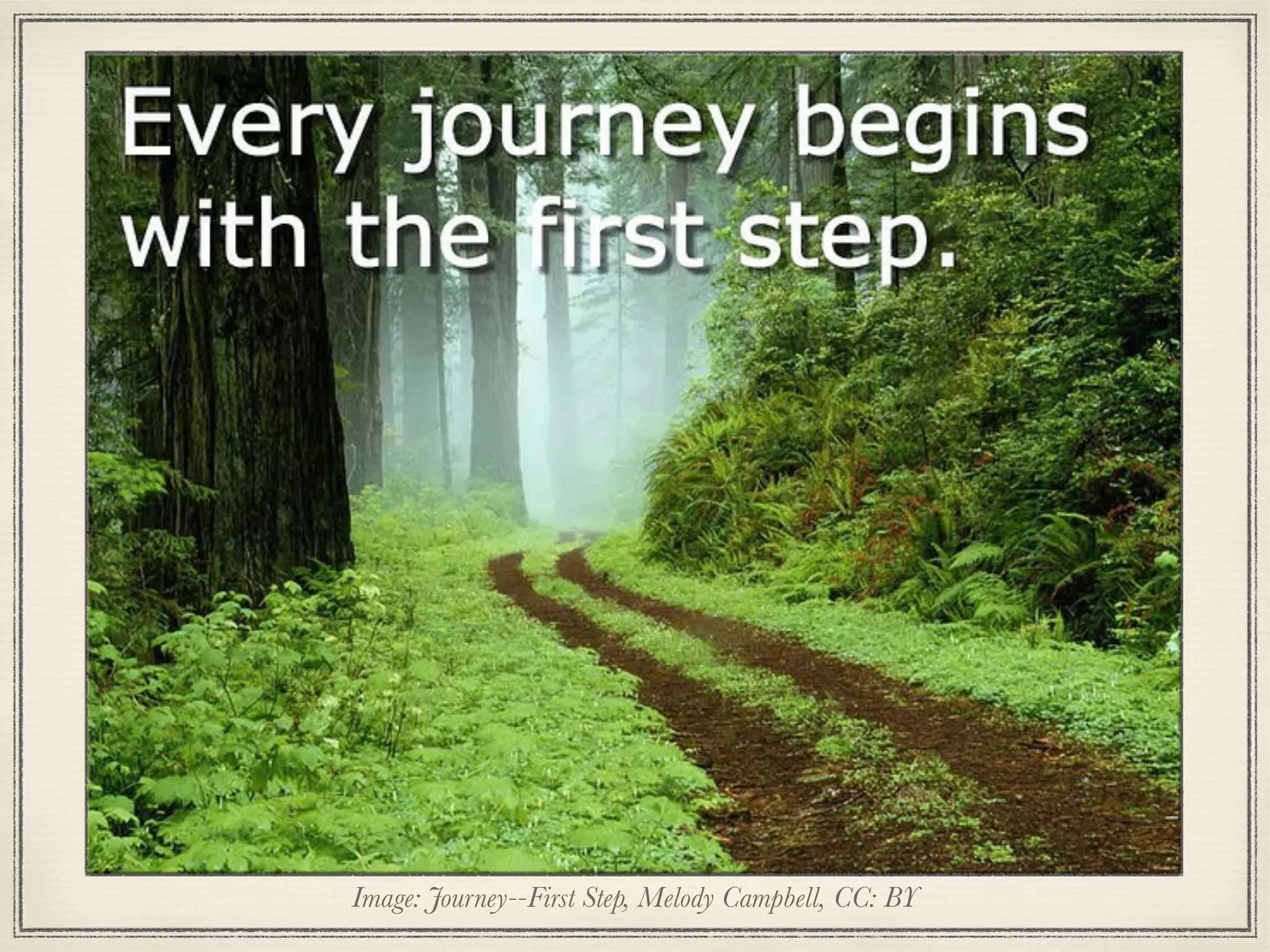
Image: Journey--First Step, Melody Campbell, CC: BY
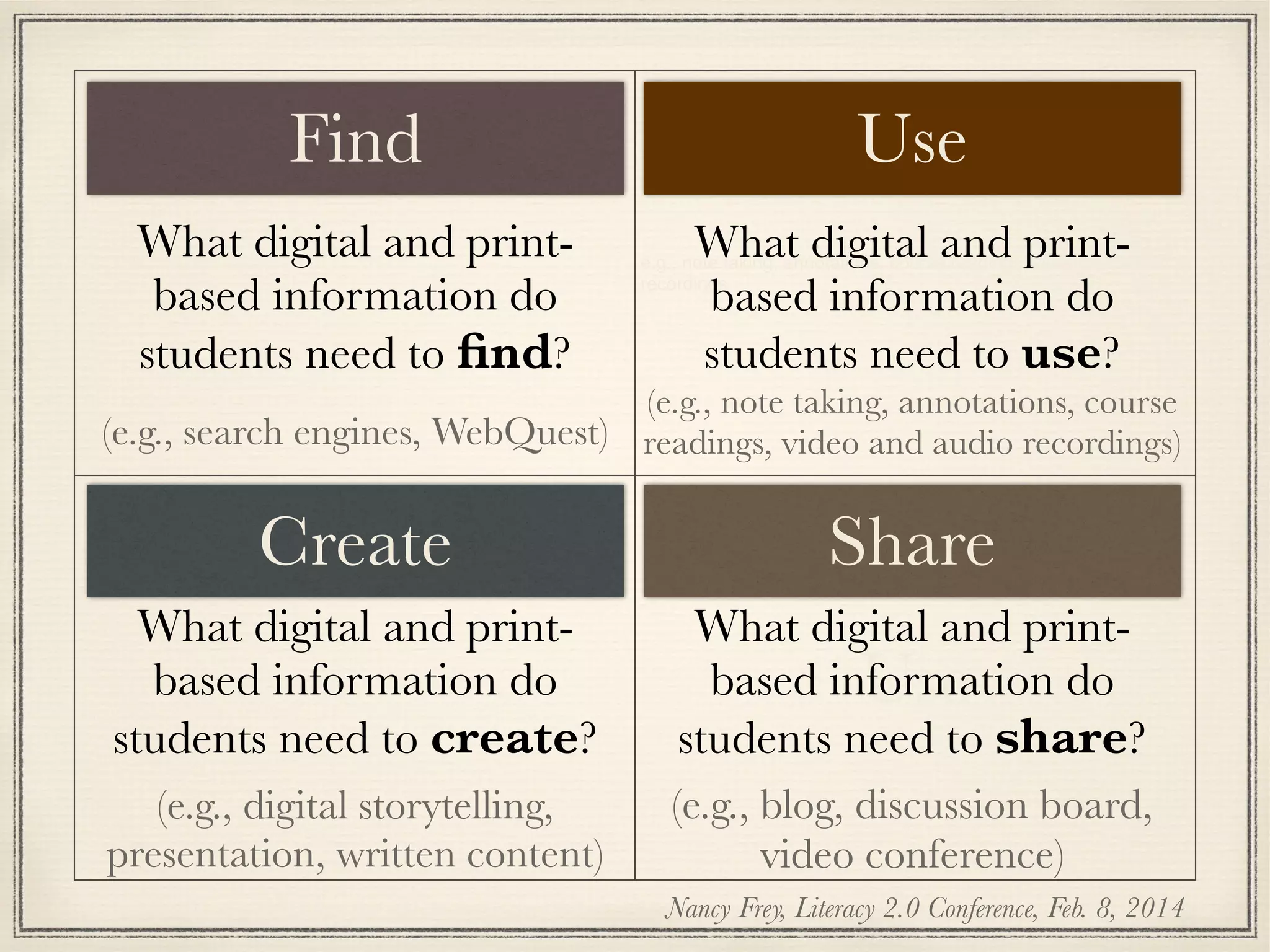
e.g., note taking, annotations, course readings, video and audio
recordings
Use
Find Use
Create Share
What digital and print-
based information do
students need to find?
(e.g., search engines, WebQuest)
What digital and print-
based information do
students need to use?
(e.g., note taking, annotations, course
readings, video and audio recordings)
(e.g., digital storytelling,
presentation, written content)
What digital and print-
based information do
students need to create?
What digital and print-
based information do
students need to share?
(e.g., blog, discussion board,
video conference)
Nancy Frey, Literacy 2.0 Conference, Feb. 8, 2014
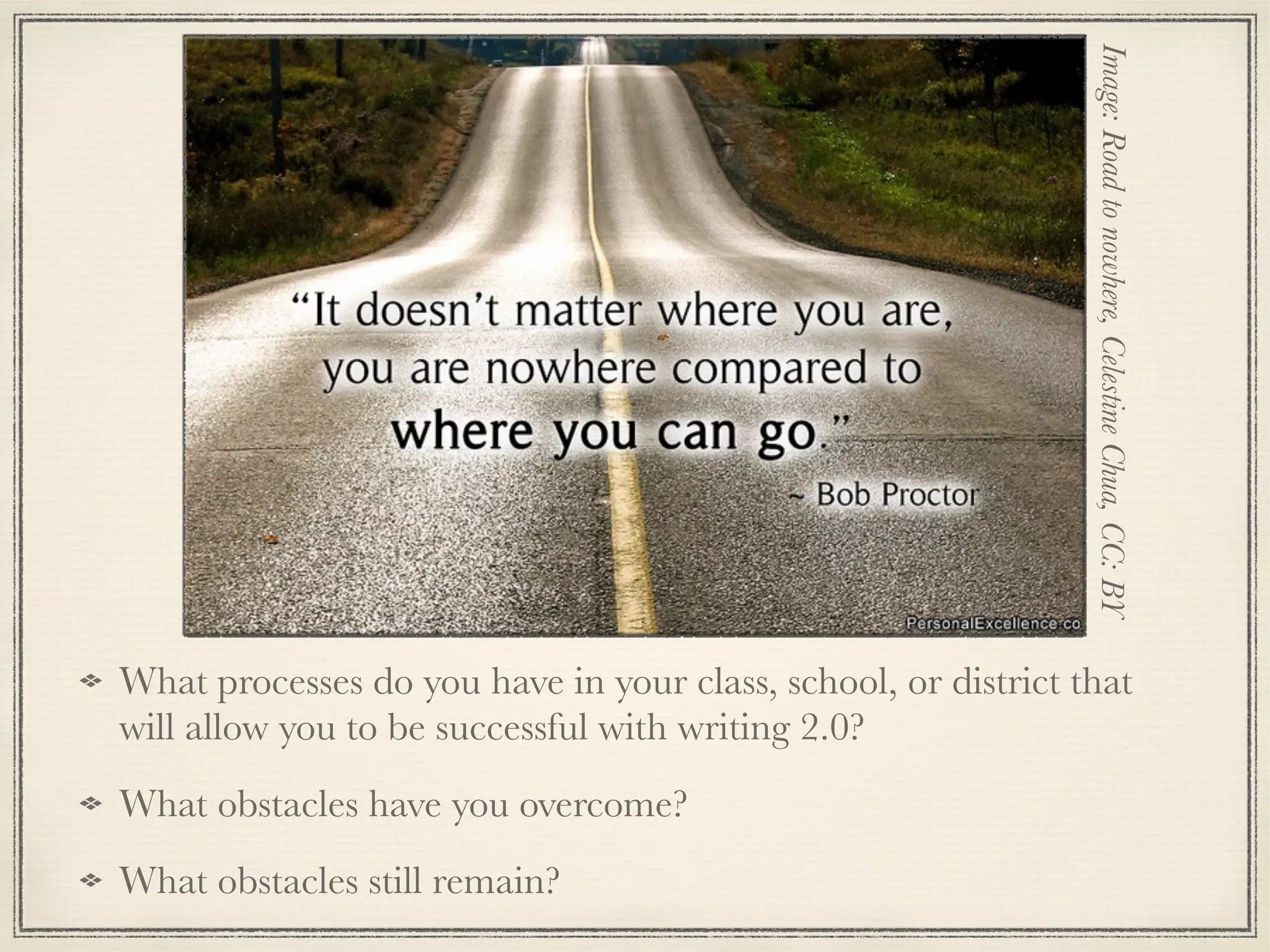
What processes do you have in your class, school, or district that
will allow you to be successful with writing 2.0?
What obstacles have you overcome?
What obstacles still remain?
Image:Roadtonowhere,CelestineChua,CC:BY
Essential Questions
Purpose — Why
• Why have technology-rich
writing?
• How is digital literacy built into
the AZCCRS?
Functions — Outcomes
• What does a technology-rich
approach look like in AZCCRS
writing?
Structures — Logistics
• What structures are in place to
make technology-rich writing
possible?
Processes — How
• How do I build technology-rich
writing in my classroom/school/
district?
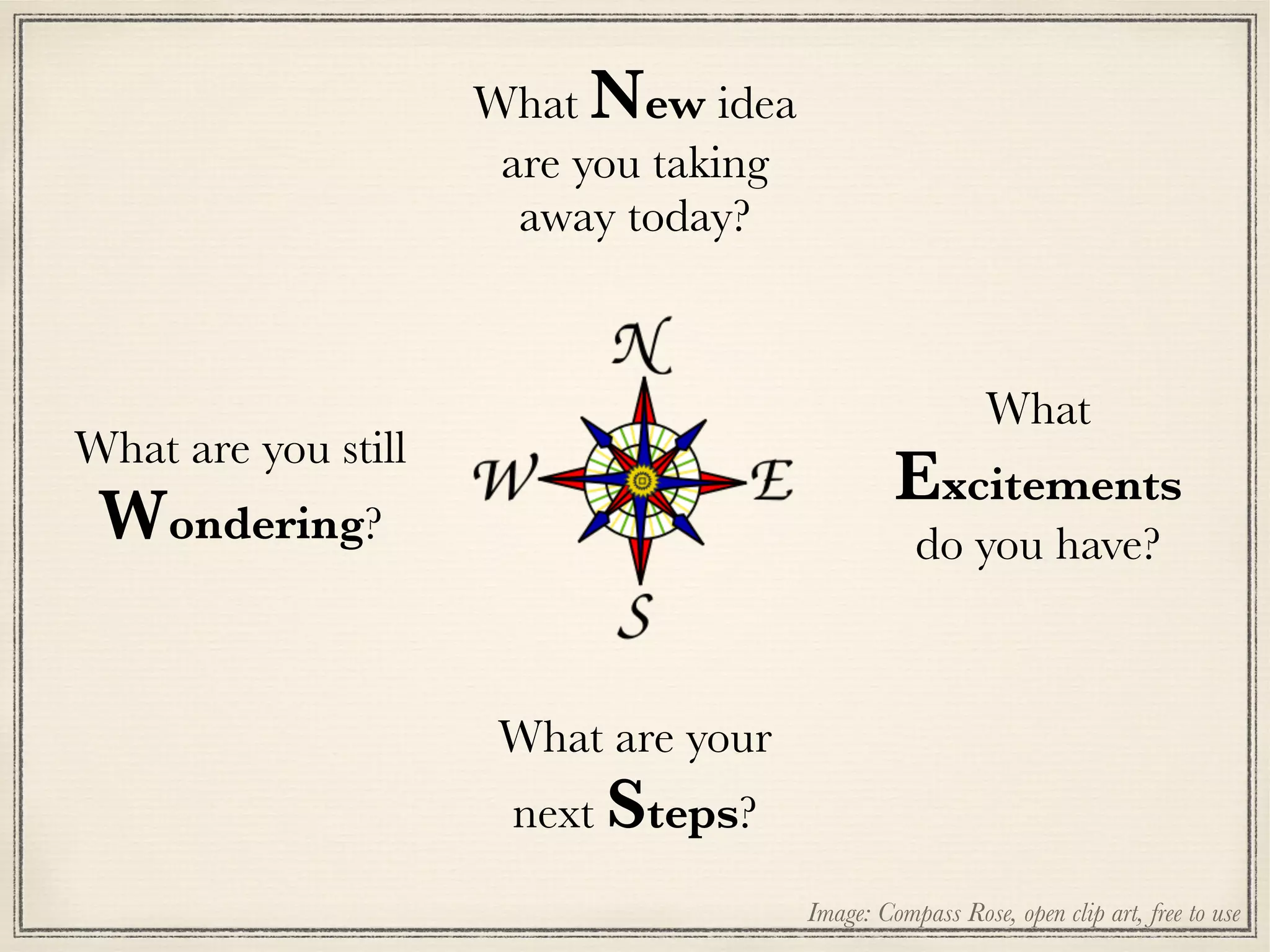
Image: Compass Rose, open clip art, free to use
What New idea
are you taking
away today?
What are your
next Steps?
What are you still
Wondering?
What
Excitements
do you have?
Special thanks to…
Resources from today:
http://bit.ly/LeadingChangeWriting

Writing 2.0: Technology-Rich Approach to Common Core Writing

  • 1.
    Writing 2.0: Technology-Rich Approachto AZCCRS Writing by Tracy Watanabe & Shauna Hamman ! This work is licensed under a Creative Commons Attribution 4.0 International License.
  • 2.
    Image: Web, Martin Gommel,CC: BY, NC, SA Today’sGoals: TechnologyRichApproach toAZCCRSWriting
  • 3.
    Overview: Essential Questions Purpose— Why • Why have technology-rich writing? • How is digital literacy built into the AZCCRS? Functions — Outcomes • What does a technology-rich approach look like in AZCCRS writing? Structures — Logistics • What structures are in place to make technology-rich writing possible? Processes — How • How do I build technology-rich writing in my classroom/school/ district?
  • 4.
    What do youwant to walk away with? Image adapted from: Time To Walk Like A Rebel, Ian Sane, CC: BY you
  • 5.
    What skills aremost desired by employers? Image: Wikimedia Commons
  • 6.
    What skills aremost desired by employers? Image: Wikimedia Commons Communicate effectively Ask insightful and critical questions. Collaborate well with others. Solve problems logically, systematically, and creatively. Conduct logical, thorough research and critically evaluate evidence. Weigh the relevance and importance of ideas. Recognize bias. See multiple perspectives on an issue and empathize. Use technologies and visual literacy to learn, communicate, act, and produce. Academic Conversations, p. 10. Adapted from Casner-Lotto and Barrington 2006; Hansen and Hansen 2009; National Association of Colleges and Employers 2007; Wagner 2008. #1 skill on most lists
  • 7.
    Being literate isbeing able to effectively communicate Being literate is being able to effectively communicate Image: Andrea Hernandez, CC: BY, NC, SA
  • 8.
    What does itmean to be literate in the 21st century? Literacy in the 21st century includes Literacy in the 20th century Image: Reading a book, Karoly Czifra, CC: BY, SA Image: by Wesley Fryer, CC: BY
  • 10.
    International Reading Association (IRA) NationalCouncil of Teachers of English (NCTE) International Society for Technology in Education (ISTE) National Assessment of Educational Progress (NAEP) Literacy 2.0 by Frey, Fisher, and Gonzalez pgs 2-4 Organizations thatrecognize technologyas partofliteracy
  • 11.
    Prepare for andparticipate effectively in a range of conversations and collaborations with diverse partners, building on others' ideas and expressing their own clearly and persuasively. SL.1 Integrate and evaluate information presented in diverse media and formats, including visually, quantitatively, and orally. SL.2 Make strategic use of digital media and visual displays of data to express information and enhance understanding of presentations. SL.5 ArizonaCollege&Career ReadyStandards (AZCCRS)
  • 12.
    Integrate and evaluatecontent presented in diverse media and formats, including visually and quantitatively, as well as in words. R.7 ArizonaCollege&Career ReadyStandards (AZCCRS)
  • 13.
    Use technology, includingthe Internet, to produce and publish writing and to interact and collaborate with others. W.6 Gather relevant information from multiple print and digital sources, assess the credibility and accuracy of each source, and integrate the information while avoiding plagiarism. W.8 ArizonaCollege&Career ReadyStandards (AZCCRS)
  • 14.
    Note on rangeand content in student writing To build a foundation for college and career readiness, students need to learn to use writing as a way of offering and supporting opinions, demonstrating understanding of the subjects they are studying, and conveying real and imagined experiences and events. They learn to appreciate that a key purpose of writing is to communicate clearly to an external, sometimes unfamiliar audience, and they begin to adapt the form and content of their writing to accomplish a particular task and purpose. ArizonaCollege&Career ReadyStandards (AZCCRS) Source: College and Career Readiness Anchor Standards for Writing
  • 15.
  • 16.
    Shift: Literacy includes digitalliteracy Image: Shift, Nick Aldwin, CC: BY, NC
  • 17.
    What kind ofwriting will students do in the “real world,” outside of school? Does what we do in school prepare them for “real world” writing? Image: Cartoon artist sketch, Evan, CC: BY
  • 18.
    Essential Questions Purpose —Why • Why have technology-rich writing? • How is digital literacy built into the AZCCRS? Functions — Outcomes • What does a technology-rich approach look like in AZCCRS writing? Structures — Logistics • What structures are in place to make technology-rich writing possible? Processes — How • How do I build technology-rich writing in my classroom/school/ district?
  • 19.
    What does atech-rich approach to writing look like to you? What do you think of? Examples? Image: Tracy Watanabe CC: BY
  • 20.
  • 21.
  • 22.
  • 23.
    Expository Writing Link tovideo Link to Mrs. Hamman's Blog Post
  • 24.
    Image adapted from:P365X52-61: EarPods (macro), Faruk Ates, CC: BY Mute the sound in a video and have students write the script idea from Nancy Frey, Literacy 2.0 Conference, Feb. 8, 2014
  • 25.
    Functional or How-ToWriting Link to Mrs. Hamman's Blog Post
  • 26.
    Poetry Example of biopoem on Haiku Deck
  • 27.
  • 28.
    My Simile Poem Mrs.Schmidt's students use Animoto for simile poetry
  • 29.
  • 30.
    Image: Wikipedia HomePage Submit research on Wikipedia
  • 31.
  • 32.
  • 33.
    100 Word Challenge-- Week 31 Post 1 Image: Jane Hewitt Post 2
  • 34.
    Write your ownbook… and add a soundtrack www.booktrack.com Fiction
  • 35.
    Image adapted from:Brown paper packages tied with string Nomadic Lass, CC: BY, SA Write a book review for Amazon
  • 36.
    Sticky Notes withPadlet Mrs. Rabe’s Class Blog
  • 37.
    idea from NancyFrey, Literacy 2.0 Conference, Feb. 8, 2014
  • 38.
    Blogging was part ofthe daily writing routine 0 0.93 1.85 2.78 3.70 Fall -- Narrative Spring -- Expository 2012-2013 Benchmarks Not an “add-on” Students wrote the posts & replied to comments Global audience
  • 39.
  • 42.
    Essential Questions Purpose —Why • Why have technology-rich writing? • How is digital literacy built into the AZCCRS? Functions — Outcomes • What does a technology-rich approach look like in AZCCRS writing? Structures — Logistics • What structures are in place to make technology-rich writing possible? Processes — How • How do I build technology-rich writing in my classroom/school/ district?
  • 43.
    What structures do youhave in place? Devices? Bandwidth? Open or blocked sites? Professional development?Image: Calipers, Ian Sane, CC: BY
  • 44.
    What structures do youhave in place? Tech procedures? Digital citizenship? Class culture of risk?Image: The Colorful Bokeh Men, Ian Sane, CC: BY
  • 45.
    How are thestructures in place used? 1.Teacher only 2.Teacher & Students as consumers 3.Teacher & Students as consumers & creators 4.Teachers & Students as consumers, creators, & shares to global audience Image: Plastered Against The Wall, Ian Sane, CC: BY
  • 46.
    Structures for evidence-basedwriting Image: A Burnside View, Ian Sane, CC: BY Rubrics: Hyperlinks Cite sources for ideas, images, multi-media, etc.
  • 47.
    Essential Questions Purpose —Why • Why have technology-rich writing? • How is digital literacy built into the AZCCRS? Functions — Outcomes • What does a technology-rich approach look like in AZCCRS writing? Structures — Logistics • What structures are in place to make technology-rich writing possible? Processes — How • How do I build technology-rich writing in my classroom/school/ district?
  • 48.
    Image: Journey--First Step,Melody Campbell, CC: BY
  • 49.
    e.g., note taking,annotations, course readings, video and audio recordings Use Find Use Create Share What digital and print- based information do students need to find? (e.g., search engines, WebQuest) What digital and print- based information do students need to use? (e.g., note taking, annotations, course readings, video and audio recordings) (e.g., digital storytelling, presentation, written content) What digital and print- based information do students need to create? What digital and print- based information do students need to share? (e.g., blog, discussion board, video conference) Nancy Frey, Literacy 2.0 Conference, Feb. 8, 2014
  • 50.
    What processes doyou have in your class, school, or district that will allow you to be successful with writing 2.0? What obstacles have you overcome? What obstacles still remain? Image:Roadtonowhere,CelestineChua,CC:BY
  • 51.
    Essential Questions Purpose —Why • Why have technology-rich writing? • How is digital literacy built into the AZCCRS? Functions — Outcomes • What does a technology-rich approach look like in AZCCRS writing? Structures — Logistics • What structures are in place to make technology-rich writing possible? Processes — How • How do I build technology-rich writing in my classroom/school/ district?
  • 52.
    Image: Compass Rose,open clip art, free to use What New idea are you taking away today? What are your next Steps? What are you still Wondering? What Excitements do you have?
  • 53.
    Special thanks to… Resourcesfrom today: http://bit.ly/LeadingChangeWriting