CMAT 447-001 T/TR 11:00AM—12:15PM DEVILBISS HALL 126
International Public Relations
COURSE WEBSITE: https://prva.wordpress.com/ | MY CLASSES CANVAS
Vinita Agarwal, PhD
Contact Info: FH 272 | Office Hours: T 1:30PM –2:30PM, W 1:00PM–3:00PM, &TR 1:30PM—3:30PM
Email: vxagarwal@salisbury.edu, via My Classes | Office Phone: 410-677-0083
COURSE POLICIES
Prerequisites
Junior standing and CMAT 101 and CMAT 102 with a grade of C or higher.
Course Description
International PR (CMAT 447) is one of the fastest growing sectors of public relations as corporations,
institutions, and nongovernmental organizations globalize. CMAT 447 provides the knowledge
frameworks and critical thinking and analytic skills necessary to prepare the advanced PR student in the
successful research, design, implementation, and evaluation of international PR projects. Substantial
academic and practical application and engagement is required.
Civic Engagement across the Curriculum
This course supports the University’s mission statement, which states in part, “Our highest purpose is to
empower our students with the knowledge, skills, and core values that contribute to active citizenship,
gainful employment, and life-long learning in a democratic society and interdependent world.” In
accordance with these goals, students in this course will participate in a civic engagement activity related
to a pressing social issue. Students will interact with community members outside of the classroom and
potentially share the outcomes of their efforts beyond the classroom setting.
Learning Objectives
CMAT 447 is an intense (but fun) learning experience requiring sustained and consistent engagement
through readings, reflection, research, critique, fieldwork, and practical application of your learning.
Through daily readings, engagement, and self-reflection, successful course participants will gain:
a) Knowledge of intercultural and international PR (IPR) theoretical frameworks to inform critical
understanding and insight into contemporary and future developments in IPR
b) Insight in intercultural dialogue via experiential engagement to navigate different meaning-systems and
gain competency as an effective international communicator through cultural contact
c) Insight into the influence of culture in PR practice within the context of a global marketplace and
international business
d) Knowledge of IPR practice in specific global regions through direct interpersonal engagement with global
IPR professionals
e) Experience in designing IPR artifacts that achieve strategic IPR communication goals
f) Intercultural and international collaboration skills through working with a community-based
cultural/minority group and conducting needs assessment through the application of strategic
communication planning principles
g) Experience in crafting effective messages utilizing a country-specific approach through application of
strategic IPR principles
h) Knowledge of challenges and opportunities in navigating global relationships
Course Readings
Course readings come from primary research sources as indicated on the syllabus and will be accessed via
a valid SU login to the Blackwell libraries online databases. The course uses my International PR course
Wordpress website (https://prva.wordpress.com/ ) for access to supplemental material and resources.
Selected Supplemental Resources (Accessible via course Wordpress website):
Institute of PR (http://www.instituteforpr.org/ )
PRSA Silver Anvil Awards (http://apps.prsa.org/awards/silveranvil/#.WS8AiBPyuu4 )
The Stevie Awards (http://blog.stevieawards.com/public-relations-awards/topic/the-international-public-
relations-association )
PRSA Global Affairs (http://apps.prsa.org/Network/GlobalAffairs/ )
PRSSA (http://prssa.prsa.org/about-prssa/learn-about-pr/international-pr/ )
Council of PR Firms (http://prcouncil.net/ )
Global Alliance of PR and Communication Management (http://www.globalalliancepr.org/ )
International Association of Business Communicators (https://www.iabc.com/ )
International PR Association (https://www.ipra.org/ )
Hispanic PR Association (http://www.hpra-usa.org/ )
International PR Network (http://iprn.com/ )
PROI Worldwide (http://www.proi.com/Public/ )
Arthur W. Page Center for Integrity in Public Communication (http://comm.psu.edu/page-
center/teaching-modules/ethics-in-public-relations )
PR Week (http://www.prweek.com/us )
International Association for the Measurement and Evaluation of Communication (https://amecorg.com/ )
Recommended
Ø Freitag, A.R., & Stokes, A.Q. (2009). Global Public Relations: Spanning Borders, Spanning
Cultures. New York: Routledge
Ø Parkinson, M.G., & Ekachai, D. (Eds.). (2006). International and intercultural public relations: A
campaign case approach. Boston, MA: Pearson Education/Allyn & Bacon
Ø Sriramesh, K., & Vercic, D. (Eds.). (2003). The global public relations handbook: Theory, research,
and practice. New Jersey: Lawrence Erlbaum Associates
Ø Newsom, D. (2007). Building the gaps in global communication. Malden, MA: Blackwell Publishing
Course Access
You will gain competency in and explore different online and mobile modalities essential to exploring
and conducting international public relations work. A proportion of our learning activities will take place
online and via online individual engagement with instructor and/or the learning material, practical
international contexts, and out-of-class field work.
Minimum Technology Requirements
For successful course completion, students should have access to and basic proficiency with utilizing:
a) A reliable Internet connection
b) A laptop or desktop computer with an updated operating system
c) Word precessing software, web browsers, online participation, and content management systems
d) Laptop/web camera
e) My Classes Canvas account
f) Off-campus access to SU’s Blackwell library’s online databases
Course Ethos
As responsible participants in your education and advanced PR students, I expect you will view the
course as a microcosm of your professional work ethic and our class as a community of peers engaged in
a shared learning experience. It also means that I will strive to provide each of you with the materials,
resources, and guidance necessary to achieve the course objectives.
Deadlines, Late Policy, and Make-Ups
The ability to deliver by deadline is critical for professional success in today’s competitive PR
environment. Please inform me via email in advance if you are unable to meet a deadline. Late
submissions are downgraded by a letter grade and not accepted after the second day. You are responsible
for obtaining timely permissions (when allowed) or making up any missed work.
Attendance and Participation
Attendance in class meetings is expected. Absences will negatively impact your performance and grade.
Out-of-class sessions will be discussed as semester progresses. Please discuss with me at your earliest if a
personal situation substantially affects your attendance. You are responsible for scheduling a meeting to
make up missed material within a week of your return to class. Students are expected to attend and to
actively participate in all in-class sessions and/or participate in online work on My Classes Canvas or via
Skype, online discussion forums, mobile apps as required. Participation during the semester is specifically
designed to encourage grasp of the material theoretically and pragmatically through reflection, discussion,
engagement, critique, and research. Participation will take many forms including fieldwork, interpersonal
interaction, in-class engagement, online discussion and critique, expert interviews, and web site analysis.
In order to participate effectively, students are expected to have read the assigned readings and completed
their reflections online before coming to class. Lectures and in-class reflections will build upon aspects
from the day’s assigned content. Student contribution through insightful questions, examples connecting
across previous lectures and readings, and sharing of external resources that enhances class discussion are
highly encouraged and will count substantively toward your class participation quality points.
IT Support Services
If you have any trouble with technology or access to the course learning website or the materials therein,
please contact IT at 410-677-5454 or at TETC 113 or at helpdesk@salisbury.edu.
The Office of Student Disability Support Services (OSDSS)
OSDSS provides guidance, access to resources, and accommodations for students with documented
disabilities. Such disabilities could include: medical, psychiatric, and/or learning disabilities, and/or
mobility, visual, and/or hearing impairments. They can be reached at 410-677-6536.
Emergency Clause
In the event of a major campus emergency, course requirements, deadlines, and grading percentages are
subject to changes. My Classes web page and my email address (vxagarwal@salisbury.edu) will be ways
to access the revised information, changes, and assignment deadlines you will be required to keep.
Academic Integrity
The CMAT department expects you have read and understand SU’s Student Policy on Academic Integrity
in your SU Student Handbook (www.salisbury.edu/Students/handbook/welcome.html) and thereby agree
to honor these standards. ALL incidences of academic dishonesty are subject to disciplinary action
including, but not limited to, separation from the university.
Email Policy and Communication
If you need to reach me, please contact me via My Classes email. In general, I will strive to respond to
your email within 48 hours of receipt (and by Monday, 5:00PM if sent over weekend). All course related
communication will be via email sent from my SU account or through My Classes. You are responsible
for monitoring your email regularly for updates, information regarding readings and assignments,
comments, and course-related work. With advance instructions, we may also engage in online
communication via Skype and other mobile and online modalities at specific points during the semester
(e.g., My Classes Adobe Connect).
Office Hours
I will hold office hours regularly during the semester per syllabus and by appointment.
Grading Policy
I strive to enter your grades within a week of their submission. You are responsible for monitoring your
grades. ALL grade assignments will be taken as final one week after grades have been posted on My
Classes Canvas. No grade change requests will be permitted after this period. It is your responsibility to
check My Classes to make sure grades have been recorded. You have up to one week from the day grades
are entered to bring any discrepancies to my notice. The review process assumes you accept the
possibility the grades can be revised upward/downward upon review. I do not keep records of in-class
assignments more than a week after grades are made available. Grading is based on the following rule-of-
thumb: “C” work meets the basic criteria, “B” work does a great job of meeting the criteria, and “A” work
not only does an excellent job of meeting the outlined criteria, but also surpasses expectations to go
beyond outlined criteria. “D” work does not meet one of the basic criteria at an acceptable level, and “F”
work is substandard and does not meet basic expectations on two or more criteria.
Course Requirements
ASSIGNMENT OVERVIEW
Course readings and assignments provide the student with theoretical and pragmatic insight into the
opportunities and challenges facing the practice of public relations globally by understanding the cultural
nuances of business practices guiding different regions and reflecting upon intercultural communication.
Assignments are designed to reinforce course learning objectives through in-depth, sustained
interpersonal dialogue and engagement, application in research, and design of PR artifacts toward needs
assessment of recent international immigrant community members in the city. Students are encouraged to
develop expertise in one global region. Independent research and fieldwork is expected and required.
Detailed assignment handouts will be provided at appropriate points in the semester.
1. Intercultural Contact and Interaction (100 points): Building upon Zaharna’s (2000) paper, a 2 hour
dialogue and engagement with an international student on a family value, social norm, business practice,
and cultural practice to enhance awareness of how differences in meaning-making, interpretation, and
practices in the U.S. and an international region influence ways of relating (e.g., building trust).
Insightfulness, inter-cultural sensitivity, and thoughtfulness in demonstrating understanding and
application of research frameworks in your interaction will be assessed.
2. Corporate Web Site Analysis (100 points): Compare and evaluate two corporate web sites for
application of cultural framework principles to product branding and building audience relationships in a
foreign market. Interview with an international public relations member of a U.S-based MNC based in the
U.S. or in the international market is preferred. Rigor, application of international PR principles, and
proficiency in application of culture-focused web site analysis will be assessed.
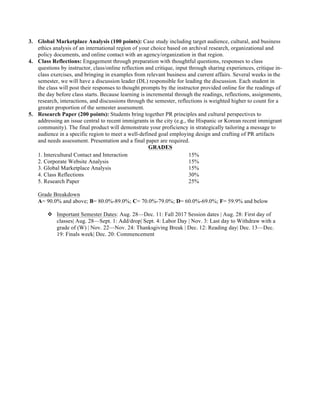
3. Global Marketplace Analysis (100 points): Case study including target audience, cultural, and business
ethics analysis of an international region of your choice based on archival research, organizational and
policy documents, and online contact with an agency/organization in that region.
4. Class Reflections: Engagement through preparation with thoughtful questions, responses to class
questions by instructor, class/online reflection and critique, input through sharing experiences, critique in-
class exercises, and bringing in examples from relevant business and current affairs. Several weeks in the
semester, we will have a discussion leader (DL) responsible for leading the discussion. Each student in
the class will post their responses to thought prompts by the instructor provided online for the readings of
the day before class starts. Because learning is incremental through the readings, reflections, assignments,
research, interactions, and discussions through the semester, reflections is weighted higher to count for a
greater proportion of the semester assessment.
5. Research Paper (200 points): Students bring together PR principles and cultural perspectives to
addressing an issue central to recent immigrants in the city (e.g., the Hispanic or Korean recent immigrant
community). The final product will demonstrate your proficiency in strategically tailoring a message to
audience in a specific region to meet a well-defined goal employing design and crafting of PR artifacts
and needs assessment. Presentation and a final paper are required.
GRADES
1. Intercultural Contact and Interaction 15%
2. Corporate Website Analysis 15%
3. Global Marketplace Analysis 15%
4. Class Reflections 30%
5. Research Paper 25%
Grade Breakdown
A= 90.0% and above; B= 80.0%-89.0%; C= 70.0%-79.0%; D= 60.0%-69.0%; F= 59.9% and below
v Important Semester Dates: Aug. 28—Dec. 11: Fall 2017 Session dates | Aug. 28: First day of
classes| Aug. 28—Sept. 1: Add/drop| Sept. 4: Labor Day | Nov. 3: Last day to Withdraw with a
grade of (W) | Nov. 22—Nov. 24: Thanksgiving Break | Dec. 12: Reading day| Dec. 13—Dec.
19: Finals week| Dec. 20: Commencement
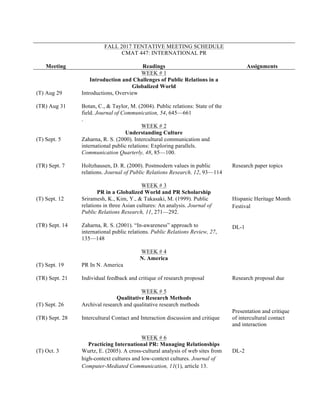
FALL 2017 TENTATIVE MEETING SCHEDULE
CMAT 447: INTERNATIONAL PR
Meeting Readings Assignments
(T) Aug 29
(TR) Aug 31
WEEK # 1
Introduction and Challenges of Public Relations in a
Globalized World
Introductions, Overview
Botan, C., & Taylor, M. (2004). Public relations: State of the
field. Journal of Communication, 54, 645—661
.
(T) Sept. 5
(TR) Sept. 7
WEEK # 2
Understanding Culture
Zaharna, R. S. (2000). Intercultural communication and
international public relations: Exploring parallels.
Communication Quarterly, 48, 85—100.
Holtzhausen, D. R. (2000). Postmodern values in public
relations. Journal of Public Relations Research, 12, 93—114
Research paper topics
(T) Sept. 12
(TR) Sept. 14
WEEK # 3
PR in a Globalized World and PR Scholarship
Sriramesh, K., Kim, Y., & Takasaki, M. (1999). Public
relations in three Asian cultures: An analysis. Journal of
Public Relations Research, 11, 271—292.
Zaharna, R. S. (2001). “In-awareness” approach to
international public relations. Public Relations Review, 27,
135—148
Hispanic Heritage Month
Festival
DL-1
(T) Sept. 19
(TR) Sept. 21
WEEK # 4
N. America
PR In N. America
Individual feedback and critique of research proposal Research proposal due
(T) Sept. 26
(TR) Sept. 28
WEEK # 5
Qualitative Research Methods
Archival research and qualitative research methods
Intercultural Contact and Interaction discussion and critique
Presentation and critique
of intercultural contact
and interaction
(T) Oct. 3
WEEK # 6
Practicing International PR: Managing Relationships
Wurtz, E. (2005). A cross-cultural analysis of web sites from
high-context cultures and low-context cultures. Journal of
Computer-Mediated Communication, 11(1), article 13.
DL-2
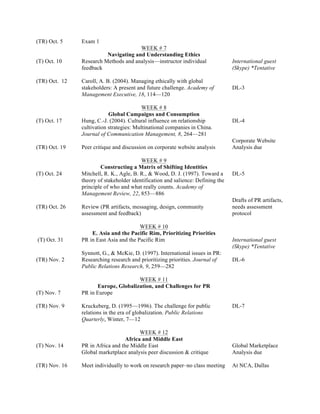
(TR) Oct. 5 Exam 1
(T) Oct. 10
(TR) Oct. 12
WEEK # 7
Navigating and Understanding Ethics
Research Methods and analysis—instructor individual
feedback
Caroll, A. B. (2004). Managing ethically with global
stakeholders: A present and future challenge. Academy of
Management Executive, 18, 114—120
International guest
(Skype) *Tentative
DL-3
(T) Oct. 17
(TR) Oct. 19
WEEK # 8
Global Campaigns and Consumption
Hung, C.-J. (2004). Cultural influence on relationship
cultivation strategies: Multinational companies in China.
Journal of Communication Management, 8, 264—281
Peer critique and discussion on corporate website analysis
DL-4
Corporate Website
Analysis due
(T) Oct. 24
(TR) Oct. 26
WEEK # 9
Constructing a Matrix of Shifting Identities
Mitchell, R. K., Agle, B. R., & Wood, D. J. (1997). Toward a
theory of stakeholder identification and salience: Defining the
principle of who and what really counts. Academy of
Management Review, 22, 853—886
Review (PR artifacts, messaging, design, community
assessment and feedback)
DL-5
Drafts of PR artifacts,
needs assessment
protocol
(T) Oct. 31
(TR) Nov. 2
WEEK # 10
E. Asia and the Pacific Rim, Prioritizing Priorities
PR in East Asia and the Pacific Rim
Synnott, G., & McKie, D. (1997). International issues in PR:
Researching research and prioritizing priorities. Journal of
Public Relations Research, 9, 259—282
International guest
(Skype) *Tentative
DL-6
(T) Nov. 7
(TR) Nov. 9
WEEK # 11
Europe, Globalization, and Challenges for PR
PR in Europe
Kruckeberg, D. (1995—1996). The challenge for public
relations in the era of globalization. Public Relations
Quarterly, Winter, 7—12
DL-7
(T) Nov. 14
(TR) Nov. 16
WEEK # 12
Africa and Middle East
PR in Africa and the Middle East
Global marketplace analysis peer discussion & critique
Meet individually to work on research paper–no class meeting
Global Marketplace
Analysis due
At NCA, Dallas
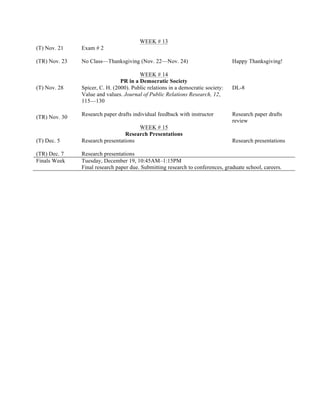
(T) Nov. 21
(TR) Nov. 23
WEEK # 13
Exam # 2
No Class—Thanksgiving (Nov. 22—Nov. 24) Happy Thanksgiving!
(T) Nov. 28
(TR) Nov. 30
WEEK # 14
PR in a Democratic Society
Spicer, C. H. (2000). Public relations in a democratic society:
Value and values. Journal of Public Relations Research, 12,
115—130
Research paper drafts individual feedback with instructor
DL-8
Research paper drafts
review
(T) Dec. 5
(TR) Dec. 7
WEEK # 15
Research Presentations
Research presentations
Finals Week Tuesday, December 19, 10:45AM–1:15PM
Final research paper due. Submitting research to conferences, graduate school, careers.

International Public Relations Syllabus

  • 1.
    CMAT 447-001 T/TR11:00AM—12:15PM DEVILBISS HALL 126 International Public Relations COURSE WEBSITE: https://prva.wordpress.com/ | MY CLASSES CANVAS Vinita Agarwal, PhD Contact Info: FH 272 | Office Hours: T 1:30PM –2:30PM, W 1:00PM–3:00PM, &TR 1:30PM—3:30PM Email: vxagarwal@salisbury.edu, via My Classes | Office Phone: 410-677-0083 COURSE POLICIES Prerequisites Junior standing and CMAT 101 and CMAT 102 with a grade of C or higher. Course Description International PR (CMAT 447) is one of the fastest growing sectors of public relations as corporations, institutions, and nongovernmental organizations globalize. CMAT 447 provides the knowledge frameworks and critical thinking and analytic skills necessary to prepare the advanced PR student in the successful research, design, implementation, and evaluation of international PR projects. Substantial academic and practical application and engagement is required. Civic Engagement across the Curriculum This course supports the University’s mission statement, which states in part, “Our highest purpose is to empower our students with the knowledge, skills, and core values that contribute to active citizenship, gainful employment, and life-long learning in a democratic society and interdependent world.” In accordance with these goals, students in this course will participate in a civic engagement activity related to a pressing social issue. Students will interact with community members outside of the classroom and potentially share the outcomes of their efforts beyond the classroom setting. Learning Objectives CMAT 447 is an intense (but fun) learning experience requiring sustained and consistent engagement through readings, reflection, research, critique, fieldwork, and practical application of your learning. Through daily readings, engagement, and self-reflection, successful course participants will gain: a) Knowledge of intercultural and international PR (IPR) theoretical frameworks to inform critical understanding and insight into contemporary and future developments in IPR b) Insight in intercultural dialogue via experiential engagement to navigate different meaning-systems and gain competency as an effective international communicator through cultural contact c) Insight into the influence of culture in PR practice within the context of a global marketplace and international business
  • 2.
    d) Knowledge ofIPR practice in specific global regions through direct interpersonal engagement with global IPR professionals e) Experience in designing IPR artifacts that achieve strategic IPR communication goals f) Intercultural and international collaboration skills through working with a community-based cultural/minority group and conducting needs assessment through the application of strategic communication planning principles g) Experience in crafting effective messages utilizing a country-specific approach through application of strategic IPR principles h) Knowledge of challenges and opportunities in navigating global relationships Course Readings Course readings come from primary research sources as indicated on the syllabus and will be accessed via a valid SU login to the Blackwell libraries online databases. The course uses my International PR course Wordpress website (https://prva.wordpress.com/ ) for access to supplemental material and resources. Selected Supplemental Resources (Accessible via course Wordpress website): Institute of PR (http://www.instituteforpr.org/ ) PRSA Silver Anvil Awards (http://apps.prsa.org/awards/silveranvil/#.WS8AiBPyuu4 ) The Stevie Awards (http://blog.stevieawards.com/public-relations-awards/topic/the-international-public- relations-association ) PRSA Global Affairs (http://apps.prsa.org/Network/GlobalAffairs/ ) PRSSA (http://prssa.prsa.org/about-prssa/learn-about-pr/international-pr/ ) Council of PR Firms (http://prcouncil.net/ ) Global Alliance of PR and Communication Management (http://www.globalalliancepr.org/ ) International Association of Business Communicators (https://www.iabc.com/ ) International PR Association (https://www.ipra.org/ ) Hispanic PR Association (http://www.hpra-usa.org/ ) International PR Network (http://iprn.com/ ) PROI Worldwide (http://www.proi.com/Public/ ) Arthur W. Page Center for Integrity in Public Communication (http://comm.psu.edu/page- center/teaching-modules/ethics-in-public-relations ) PR Week (http://www.prweek.com/us ) International Association for the Measurement and Evaluation of Communication (https://amecorg.com/ ) Recommended Ø Freitag, A.R., & Stokes, A.Q. (2009). Global Public Relations: Spanning Borders, Spanning Cultures. New York: Routledge Ø Parkinson, M.G., & Ekachai, D. (Eds.). (2006). International and intercultural public relations: A campaign case approach. Boston, MA: Pearson Education/Allyn & Bacon Ø Sriramesh, K., & Vercic, D. (Eds.). (2003). The global public relations handbook: Theory, research, and practice. New Jersey: Lawrence Erlbaum Associates Ø Newsom, D. (2007). Building the gaps in global communication. Malden, MA: Blackwell Publishing Course Access You will gain competency in and explore different online and mobile modalities essential to exploring and conducting international public relations work. A proportion of our learning activities will take place online and via online individual engagement with instructor and/or the learning material, practical international contexts, and out-of-class field work. Minimum Technology Requirements For successful course completion, students should have access to and basic proficiency with utilizing: a) A reliable Internet connection
  • 3.
    b) A laptopor desktop computer with an updated operating system c) Word precessing software, web browsers, online participation, and content management systems d) Laptop/web camera e) My Classes Canvas account f) Off-campus access to SU’s Blackwell library’s online databases Course Ethos As responsible participants in your education and advanced PR students, I expect you will view the course as a microcosm of your professional work ethic and our class as a community of peers engaged in a shared learning experience. It also means that I will strive to provide each of you with the materials, resources, and guidance necessary to achieve the course objectives. Deadlines, Late Policy, and Make-Ups The ability to deliver by deadline is critical for professional success in today’s competitive PR environment. Please inform me via email in advance if you are unable to meet a deadline. Late submissions are downgraded by a letter grade and not accepted after the second day. You are responsible for obtaining timely permissions (when allowed) or making up any missed work. Attendance and Participation Attendance in class meetings is expected. Absences will negatively impact your performance and grade. Out-of-class sessions will be discussed as semester progresses. Please discuss with me at your earliest if a personal situation substantially affects your attendance. You are responsible for scheduling a meeting to make up missed material within a week of your return to class. Students are expected to attend and to actively participate in all in-class sessions and/or participate in online work on My Classes Canvas or via Skype, online discussion forums, mobile apps as required. Participation during the semester is specifically designed to encourage grasp of the material theoretically and pragmatically through reflection, discussion, engagement, critique, and research. Participation will take many forms including fieldwork, interpersonal interaction, in-class engagement, online discussion and critique, expert interviews, and web site analysis. In order to participate effectively, students are expected to have read the assigned readings and completed their reflections online before coming to class. Lectures and in-class reflections will build upon aspects from the day’s assigned content. Student contribution through insightful questions, examples connecting across previous lectures and readings, and sharing of external resources that enhances class discussion are highly encouraged and will count substantively toward your class participation quality points. IT Support Services If you have any trouble with technology or access to the course learning website or the materials therein, please contact IT at 410-677-5454 or at TETC 113 or at helpdesk@salisbury.edu. The Office of Student Disability Support Services (OSDSS) OSDSS provides guidance, access to resources, and accommodations for students with documented disabilities. Such disabilities could include: medical, psychiatric, and/or learning disabilities, and/or mobility, visual, and/or hearing impairments. They can be reached at 410-677-6536. Emergency Clause In the event of a major campus emergency, course requirements, deadlines, and grading percentages are subject to changes. My Classes web page and my email address (vxagarwal@salisbury.edu) will be ways to access the revised information, changes, and assignment deadlines you will be required to keep. Academic Integrity The CMAT department expects you have read and understand SU’s Student Policy on Academic Integrity in your SU Student Handbook (www.salisbury.edu/Students/handbook/welcome.html) and thereby agree
  • 4.
    to honor thesestandards. ALL incidences of academic dishonesty are subject to disciplinary action including, but not limited to, separation from the university. Email Policy and Communication If you need to reach me, please contact me via My Classes email. In general, I will strive to respond to your email within 48 hours of receipt (and by Monday, 5:00PM if sent over weekend). All course related communication will be via email sent from my SU account or through My Classes. You are responsible for monitoring your email regularly for updates, information regarding readings and assignments, comments, and course-related work. With advance instructions, we may also engage in online communication via Skype and other mobile and online modalities at specific points during the semester (e.g., My Classes Adobe Connect). Office Hours I will hold office hours regularly during the semester per syllabus and by appointment. Grading Policy I strive to enter your grades within a week of their submission. You are responsible for monitoring your grades. ALL grade assignments will be taken as final one week after grades have been posted on My Classes Canvas. No grade change requests will be permitted after this period. It is your responsibility to check My Classes to make sure grades have been recorded. You have up to one week from the day grades are entered to bring any discrepancies to my notice. The review process assumes you accept the possibility the grades can be revised upward/downward upon review. I do not keep records of in-class assignments more than a week after grades are made available. Grading is based on the following rule-of- thumb: “C” work meets the basic criteria, “B” work does a great job of meeting the criteria, and “A” work not only does an excellent job of meeting the outlined criteria, but also surpasses expectations to go beyond outlined criteria. “D” work does not meet one of the basic criteria at an acceptable level, and “F” work is substandard and does not meet basic expectations on two or more criteria. Course Requirements ASSIGNMENT OVERVIEW Course readings and assignments provide the student with theoretical and pragmatic insight into the opportunities and challenges facing the practice of public relations globally by understanding the cultural nuances of business practices guiding different regions and reflecting upon intercultural communication. Assignments are designed to reinforce course learning objectives through in-depth, sustained interpersonal dialogue and engagement, application in research, and design of PR artifacts toward needs assessment of recent international immigrant community members in the city. Students are encouraged to develop expertise in one global region. Independent research and fieldwork is expected and required. Detailed assignment handouts will be provided at appropriate points in the semester. 1. Intercultural Contact and Interaction (100 points): Building upon Zaharna’s (2000) paper, a 2 hour dialogue and engagement with an international student on a family value, social norm, business practice, and cultural practice to enhance awareness of how differences in meaning-making, interpretation, and practices in the U.S. and an international region influence ways of relating (e.g., building trust). Insightfulness, inter-cultural sensitivity, and thoughtfulness in demonstrating understanding and application of research frameworks in your interaction will be assessed. 2. Corporate Web Site Analysis (100 points): Compare and evaluate two corporate web sites for application of cultural framework principles to product branding and building audience relationships in a foreign market. Interview with an international public relations member of a U.S-based MNC based in the U.S. or in the international market is preferred. Rigor, application of international PR principles, and proficiency in application of culture-focused web site analysis will be assessed.
  • 5.
    3. Global MarketplaceAnalysis (100 points): Case study including target audience, cultural, and business ethics analysis of an international region of your choice based on archival research, organizational and policy documents, and online contact with an agency/organization in that region. 4. Class Reflections: Engagement through preparation with thoughtful questions, responses to class questions by instructor, class/online reflection and critique, input through sharing experiences, critique in- class exercises, and bringing in examples from relevant business and current affairs. Several weeks in the semester, we will have a discussion leader (DL) responsible for leading the discussion. Each student in the class will post their responses to thought prompts by the instructor provided online for the readings of the day before class starts. Because learning is incremental through the readings, reflections, assignments, research, interactions, and discussions through the semester, reflections is weighted higher to count for a greater proportion of the semester assessment. 5. Research Paper (200 points): Students bring together PR principles and cultural perspectives to addressing an issue central to recent immigrants in the city (e.g., the Hispanic or Korean recent immigrant community). The final product will demonstrate your proficiency in strategically tailoring a message to audience in a specific region to meet a well-defined goal employing design and crafting of PR artifacts and needs assessment. Presentation and a final paper are required. GRADES 1. Intercultural Contact and Interaction 15% 2. Corporate Website Analysis 15% 3. Global Marketplace Analysis 15% 4. Class Reflections 30% 5. Research Paper 25% Grade Breakdown A= 90.0% and above; B= 80.0%-89.0%; C= 70.0%-79.0%; D= 60.0%-69.0%; F= 59.9% and below v Important Semester Dates: Aug. 28—Dec. 11: Fall 2017 Session dates | Aug. 28: First day of classes| Aug. 28—Sept. 1: Add/drop| Sept. 4: Labor Day | Nov. 3: Last day to Withdraw with a grade of (W) | Nov. 22—Nov. 24: Thanksgiving Break | Dec. 12: Reading day| Dec. 13—Dec. 19: Finals week| Dec. 20: Commencement
  • 6.
    FALL 2017 TENTATIVEMEETING SCHEDULE CMAT 447: INTERNATIONAL PR Meeting Readings Assignments (T) Aug 29 (TR) Aug 31 WEEK # 1 Introduction and Challenges of Public Relations in a Globalized World Introductions, Overview Botan, C., & Taylor, M. (2004). Public relations: State of the field. Journal of Communication, 54, 645—661 . (T) Sept. 5 (TR) Sept. 7 WEEK # 2 Understanding Culture Zaharna, R. S. (2000). Intercultural communication and international public relations: Exploring parallels. Communication Quarterly, 48, 85—100. Holtzhausen, D. R. (2000). Postmodern values in public relations. Journal of Public Relations Research, 12, 93—114 Research paper topics (T) Sept. 12 (TR) Sept. 14 WEEK # 3 PR in a Globalized World and PR Scholarship Sriramesh, K., Kim, Y., & Takasaki, M. (1999). Public relations in three Asian cultures: An analysis. Journal of Public Relations Research, 11, 271—292. Zaharna, R. S. (2001). “In-awareness” approach to international public relations. Public Relations Review, 27, 135—148 Hispanic Heritage Month Festival DL-1 (T) Sept. 19 (TR) Sept. 21 WEEK # 4 N. America PR In N. America Individual feedback and critique of research proposal Research proposal due (T) Sept. 26 (TR) Sept. 28 WEEK # 5 Qualitative Research Methods Archival research and qualitative research methods Intercultural Contact and Interaction discussion and critique Presentation and critique of intercultural contact and interaction (T) Oct. 3 WEEK # 6 Practicing International PR: Managing Relationships Wurtz, E. (2005). A cross-cultural analysis of web sites from high-context cultures and low-context cultures. Journal of Computer-Mediated Communication, 11(1), article 13. DL-2
  • 7.
    (TR) Oct. 5Exam 1 (T) Oct. 10 (TR) Oct. 12 WEEK # 7 Navigating and Understanding Ethics Research Methods and analysis—instructor individual feedback Caroll, A. B. (2004). Managing ethically with global stakeholders: A present and future challenge. Academy of Management Executive, 18, 114—120 International guest (Skype) *Tentative DL-3 (T) Oct. 17 (TR) Oct. 19 WEEK # 8 Global Campaigns and Consumption Hung, C.-J. (2004). Cultural influence on relationship cultivation strategies: Multinational companies in China. Journal of Communication Management, 8, 264—281 Peer critique and discussion on corporate website analysis DL-4 Corporate Website Analysis due (T) Oct. 24 (TR) Oct. 26 WEEK # 9 Constructing a Matrix of Shifting Identities Mitchell, R. K., Agle, B. R., & Wood, D. J. (1997). Toward a theory of stakeholder identification and salience: Defining the principle of who and what really counts. Academy of Management Review, 22, 853—886 Review (PR artifacts, messaging, design, community assessment and feedback) DL-5 Drafts of PR artifacts, needs assessment protocol (T) Oct. 31 (TR) Nov. 2 WEEK # 10 E. Asia and the Pacific Rim, Prioritizing Priorities PR in East Asia and the Pacific Rim Synnott, G., & McKie, D. (1997). International issues in PR: Researching research and prioritizing priorities. Journal of Public Relations Research, 9, 259—282 International guest (Skype) *Tentative DL-6 (T) Nov. 7 (TR) Nov. 9 WEEK # 11 Europe, Globalization, and Challenges for PR PR in Europe Kruckeberg, D. (1995—1996). The challenge for public relations in the era of globalization. Public Relations Quarterly, Winter, 7—12 DL-7 (T) Nov. 14 (TR) Nov. 16 WEEK # 12 Africa and Middle East PR in Africa and the Middle East Global marketplace analysis peer discussion & critique Meet individually to work on research paper–no class meeting Global Marketplace Analysis due At NCA, Dallas
  • 8.
    (T) Nov. 21 (TR)Nov. 23 WEEK # 13 Exam # 2 No Class—Thanksgiving (Nov. 22—Nov. 24) Happy Thanksgiving! (T) Nov. 28 (TR) Nov. 30 WEEK # 14 PR in a Democratic Society Spicer, C. H. (2000). Public relations in a democratic society: Value and values. Journal of Public Relations Research, 12, 115—130 Research paper drafts individual feedback with instructor DL-8 Research paper drafts review (T) Dec. 5 (TR) Dec. 7 WEEK # 15 Research Presentations Research presentations Research presentations Research presentations Finals Week Tuesday, December 19, 10:45AM–1:15PM Final research paper due. Submitting research to conferences, graduate school, careers.