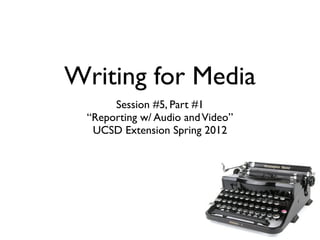
Writing for Media
       Session #5, Part #1
  “Reporting w/ Audio and Video”
   UCSD Extension Spring 2012
Radio Journalism
• BBC (generated globally in diff. languages)
• Voice of America (govt. run)
• NPR (National Public Radio)
• Satellite radio (SiriusXM)
• Local radio news: KFI, KSDO, KFMB, XTRA
• Web (podcasts freed us from radio, iTunes)
Advantages of Audio
• Easy to produce
• Take a story beyond text
• Give sources a “voice” (literally!)
• Allows listeners to see with their mind
• Allows audience to multitask (while listen)
• Mobile journalism (smartphones, tablets)
Writing to be Heard
• Titles before names
• No abbreviations, except FBI, UN, CIA
• Numbers and stats rounded off
• Personalize (second person -- “you”)
• Avoid symbols (“4-dollars”)
• Phonetic spelling for difficult words/names
Writing to Hear (cont.)
• Avoid third-person pronouns
• Avoid apposition (confusing)
• Avoid extended title descriptions
• Write in present tense (immediacy)
• Avoid dependent clauses at sentence
  beginning (use: subject, verb, object)
Recording Audio
• Sounds is everything!
• Find quiet place for recording
• Get used to the sound of your voice
• Listen before you record (any noise?)
• Practice your speaking voice (clarity)
• Add personality to your voice
Editing Audio
• Multiple tracks (mixing sounds)
• Beginnings and endings (intros)
• Standard constructions and techniques

• Audacity (PC)
• Garageband (Mac)
Ethics of Audio

• Get permission to record somebody
• Learn to be silent when interviewing
• Use music sparingly
• Don’t coach interviewee (no script)
• Don’t interrupt interviewee
Audio Slideshow

• Telling a story with pictures
• Create natural sequence
• Best quality photos
• Writing a script to match picture sequence
• Ambient sounds and/or music
Video Story Telling
• Story idea
• Keep it simple
• Who is involved?
• Central idea
• Location
• Timing
Shooting the Video
• Plan and think
• Framing
• Headroom
• Holding the camera (tripod)
• Camera angles
• Shoot a lot and carry a pen and notebook
Editing Video

• Create storyboards to outline
• Simplify transitions
• Use cutaways (variety)
• Establishing shots
• Pacing
• Sound! (high quality, good mic)
Questions...

Write for Media ucsd_ext_spring12_5 pt1

  • 1.
    Writing for Media Session #5, Part #1 “Reporting w/ Audio and Video” UCSD Extension Spring 2012
  • 2.
    Radio Journalism • BBC(generated globally in diff. languages) • Voice of America (govt. run) • NPR (National Public Radio) • Satellite radio (SiriusXM) • Local radio news: KFI, KSDO, KFMB, XTRA • Web (podcasts freed us from radio, iTunes)
  • 3.
    Advantages of Audio •Easy to produce • Take a story beyond text • Give sources a “voice” (literally!) • Allows listeners to see with their mind • Allows audience to multitask (while listen) • Mobile journalism (smartphones, tablets)
  • 4.
    Writing to beHeard • Titles before names • No abbreviations, except FBI, UN, CIA • Numbers and stats rounded off • Personalize (second person -- “you”) • Avoid symbols (“4-dollars”) • Phonetic spelling for difficult words/names
  • 5.
    Writing to Hear(cont.) • Avoid third-person pronouns • Avoid apposition (confusing) • Avoid extended title descriptions • Write in present tense (immediacy) • Avoid dependent clauses at sentence beginning (use: subject, verb, object)
  • 6.
    Recording Audio • Soundsis everything! • Find quiet place for recording • Get used to the sound of your voice • Listen before you record (any noise?) • Practice your speaking voice (clarity) • Add personality to your voice
  • 7.
    Editing Audio • Multipletracks (mixing sounds) • Beginnings and endings (intros) • Standard constructions and techniques • Audacity (PC) • Garageband (Mac)
  • 8.
    Ethics of Audio •Get permission to record somebody • Learn to be silent when interviewing • Use music sparingly • Don’t coach interviewee (no script) • Don’t interrupt interviewee
  • 9.
    Audio Slideshow • Tellinga story with pictures • Create natural sequence • Best quality photos • Writing a script to match picture sequence • Ambient sounds and/or music
  • 10.
    Video Story Telling •Story idea • Keep it simple • Who is involved? • Central idea • Location • Timing
  • 11.
    Shooting the Video •Plan and think • Framing • Headroom • Holding the camera (tripod) • Camera angles • Shoot a lot and carry a pen and notebook
  • 12.
    Editing Video • Createstoryboards to outline • Simplify transitions • Use cutaways (variety) • Establishing shots • Pacing • Sound! (high quality, good mic)
  • 13.

Editor's Notes